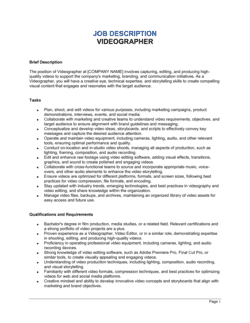
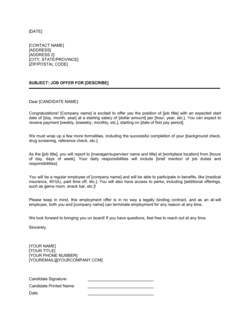
Project Coordinator Job Description Template

Free Word download β€’ Edit online β€’ Save & share with Drive β€’ Export to PDF

2 pagesβ€’20–30 min to fillβ€’Difficulty: Standardβ€’Signature requiredβ€’Legal review recommended
Learn more ↓
FreeProject Coordinator Job Description Template

At a glance

What it is
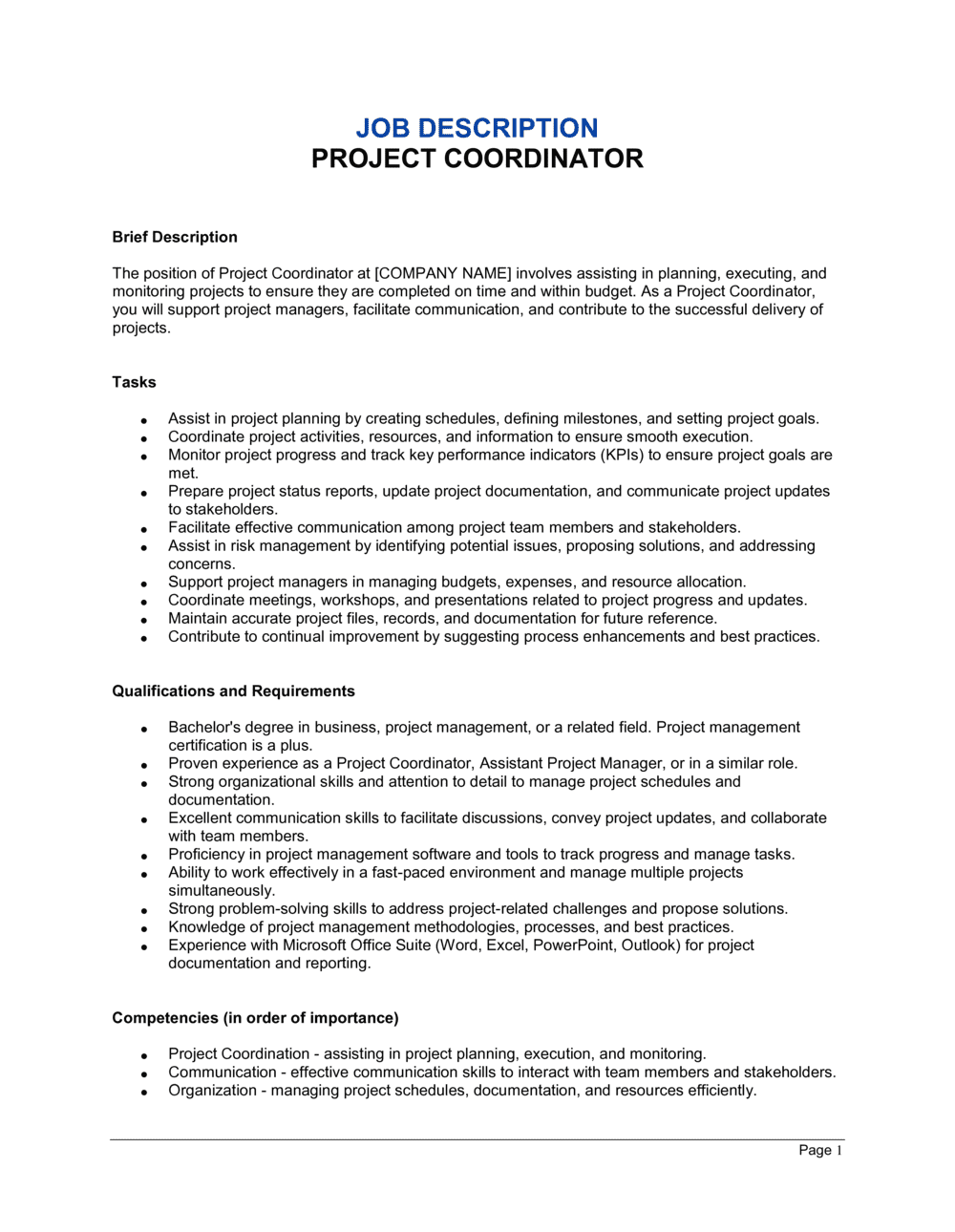
A Project Coordinator Job Description is a formal document that defines the scope of a project coordinator role β€” including duties, reporting lines, required qualifications, compensation range, and employment conditions. This free Word download gives you a structured, legally grounded starting point you can edit online and export as PDF for posting, onboarding, and HR records.
When you need it
Use it when creating a new project coordinator position, backfilling a vacancy, or standardizing role expectations across a growing project management function. It is also required when the job description is incorporated by reference into an employment contract or offer letter.
What's inside
Position title and department, reporting structure, core duties and responsibilities, performance expectations, required and preferred qualifications, compensation and benefits summary, working conditions, and an acknowledgment block for employer and employee signatures.

What is a Project Coordinator Job Description?

A Project Coordinator Job Description is a formal document that defines the full scope of a project coordinator position β€” including its essential duties, reporting relationships, required qualifications, performance standards, compensation range, and employment conditions. When signed by both employer and employee, it creates a documented record of role expectations that supports hiring decisions, performance management, accommodation assessments, and, when incorporated by reference into an employment contract, becomes part of the binding legal agreement governing the working relationship.

Why You Need This Document

Without a clearly written, signed job description, four operational and legal problems surface quickly. First, duty disputes become subjective β€” without a documented scope, coordinators and their managers disagree on what the role covers, and performance management loses its factual foundation. Second, pay transparency laws in an increasing number of US states, Canada, and the EU require salary ranges in job postings; publishing without one risks regulatory penalties. Third, accommodation requests under the ADA and equivalent legislation require employers to distinguish essential from marginal functions β€” an undifferentiated duty list makes that analysis indefensible. Fourth, when a coordinator role touches sensitive project data, client records, or proprietary systems, the confidentiality clause in this document establishes the employee's data handling obligations before access is granted. This template gives you a legally grounded, professionally structured starting point that closes all four gaps in under an hour.

Which variant fits your situation?

If your situation is…Use this template
Hiring a mid-level coordinator to support a single project managerProject Coordinator Job Description
Hiring a senior coordinator who independently manages multiple workstreamsProject Manager Job Description
Engaging a coordinator on a fixed-term or contract basisFixed-Term Employment Contract
Defining role expectations before drafting a formal employment offerJob Offer Letter
Creating a full PMO function with multiple coordinator levelsProject Management Office (PMO) Charter
Onboarding a coordinator who will also handle procurement tasksProcurement Coordinator Job Description
Hiring a coordinator in a heavily regulated industry such as healthcareHealthcare Project Coordinator Job Description

Common mistakes to avoid

❌ Omitting the 'not a contract' disclaimer

Why it matters: Without this disclaimer, a detailed job description can be interpreted as a binding promise of specific duties, making it difficult to adjust the role without risking a breach-of-contract claim.

Fix: Include a one-sentence disclaimer in the acknowledgment block stating the document is a general outline, not an employment contract, and that employment remains at-will or subject to the terms of the separate employment agreement.

❌ Setting legally unsupported minimum qualifications

Why it matters: Requiring credentials not demonstrably linked to essential job functions creates disparate impact exposure under Title VII in the US, the Equality Act in the UK, and equivalent legislation in Canada and the EU.

Fix: Audit every required qualification against the essential duties list. If the link is not direct and documentable, reclassify it as preferred or remove it.

❌ Publishing a salary range inconsistent with the internal pay band

Why it matters: When the actual offer falls below the posted range, candidates and current employees lose trust, and the employer may face pay transparency law violations in jurisdictions that mandate accurate range disclosure.

Fix: Confirm the compensation range with HR and payroll before publishing. Use the full approved pay band for the job grade, not a narrowed estimate.

❌ Failing to distinguish essential from marginal functions

Why it matters: Under the ADA and equivalent disability accommodation laws in Canada, the UK, and the EU, employers must accommodate employees who cannot perform marginal but not essential functions. An undifferentiated duty list makes this analysis impossible.

Fix: Review each duty statement and explicitly flag the five to seven functions that are core to the role's purpose. Document the time allocation and business necessity for each designation.

❌ Using the job description as a substitute for a performance management system

Why it matters: A job description that lists duties but sets no measurable KPIs provides no defensible basis for a performance improvement plan or termination for cause.

Fix: Add at least three quantifiable performance standards tied to essential functions, and reference them explicitly in the performance review process.

❌ Signing the acknowledgment after the employee's start date

Why it matters: In common-law jurisdictions, a document signed after employment has begun may require fresh consideration to be enforceable β€” particularly where it contains confidentiality or duty-scope restrictions.

Fix: Execute the signed job description before or on day one. If circumstances require a later signature, provide a documented additional benefit as fresh consideration.

The 10 key clauses, explained

Position Title and Department

In plain language: Establishes the exact job title, the department the role sits within, and the employment classification (full-time, part-time, contract).

Sample language
Position: Project Coordinator | Department: [DEPARTMENT NAME] | Classification: Full-Time, [EXEMPT / NON-EXEMPT] | Reports To: [TITLE OF DIRECT SUPERVISOR]

Common mistake: Using a generic title like 'Coordinator' without specifying level or department β€” this creates ambiguity during performance reviews and compensation benchmarking.

Position Summary

In plain language: A 3–5 sentence overview of the role's purpose, how it supports the broader team or organization, and the scope of projects involved.

Sample language
The Project Coordinator is responsible for supporting the planning, execution, and monitoring of [TYPE] projects within [DEPARTMENT/DIVISION]. Working under the direction of [TITLE], the Coordinator ensures that project documentation, timelines, and communications are maintained to [STANDARD] at all times.

Common mistake: Writing a position summary that duplicates the duties list verbatim β€” the summary should explain why the role exists, not itemize every task.

Essential Duties and Responsibilities

In plain language: The primary functions the employee is hired to perform, listed with enough specificity to support performance management and ADA accommodation assessments.

Sample language
1. Maintain project schedules, status logs, and milestone trackers in [TOOL/SYSTEM]. 2. Coordinate meetings, prepare agendas, and distribute minutes within [X] hours of conclusion. 3. Track action items and follow up with stakeholders to ensure on-time completion. 4. Prepare progress reports for [TITLE] on a [WEEKLY/BI-WEEKLY] basis.

Common mistake: Listing more than 10–12 duties without differentiating essential from marginal functions β€” courts and HR tribunals apply different standards to each when assessing accommodation or termination for cause.

Reporting Structure and Team Interaction

In plain language: Identifies the direct supervisor, any dotted-line relationships, and the cross-functional teams or stakeholders the coordinator routinely works with.

Sample language
This position reports directly to the [PROJECT MANAGER / DIRECTOR OF OPERATIONS]. The Coordinator will work cross-functionally with [TEAM A], [TEAM B], and external vendors, and may provide task direction to junior administrative staff.

Common mistake: Omitting dotted-line or matrix reporting relationships β€” coordinators often support multiple project managers, and undefined authority lines cause conflict and accountability gaps.

Required Qualifications

In plain language: The minimum education, experience, certifications, and skills necessary to perform the role β€” these are the threshold criteria used in hiring and, if needed, termination for cause.

Sample language
Education: Bachelor's degree in [FIELD] or equivalent work experience. Experience: Minimum [X] years in a project coordination or administrative role. Certifications: [PMP, CAPM, or equivalent] preferred. Skills: Proficiency in [MS Project / Asana / Jira / Monday.com], strong written and verbal communication.

Common mistake: Setting degree requirements that are not demonstrably linked to job performance β€” this creates disparate impact exposure under equal employment opportunity laws in the US, UK, and EU.

Performance Standards and KPIs

In plain language: The measurable outcomes and quality standards against which the coordinator's performance will be evaluated, typically reviewed at 30/60/90 days and annually.

Sample language
Performance will be evaluated against the following KPIs: (a) project documentation accuracy rate of [X]% or higher; (b) meeting minutes distributed within [X] hours of conclusion in [Y]% of instances; (c) action item close rate of [Z]% within agreed deadlines each reporting period.

Common mistake: Omitting performance standards entirely and relying on subjective manager assessment β€” without defined KPIs, disciplinary action or termination for performance reasons is harder to defend.

Compensation, Classification, and Benefits

In plain language: States the pay band or salary range, FLSA classification (exempt or non-exempt), payment frequency, and a reference to the applicable benefits program.

Sample language
Salary Range: $[MIN] – $[MAX] per year, paid [bi-weekly / semi-monthly]. Classification: [Non-Exempt β€” overtime eligible / Exempt]. Benefits: Eligible for the Company's standard benefits program, including health, dental, vision, and [X] days PTO per year, subject to plan terms.

Common mistake: Publishing a salary range that conflicts with the internal job grade β€” this creates pay equity exposure and undermines trust when the offer does not align with the posted range.

Working Conditions and Physical Requirements

In plain language: Describes the work environment (office, remote, hybrid, field), hours, travel expectations, and any physical demands required to perform essential functions.

Sample language
This position is [on-site / hybrid / fully remote] based in [CITY, STATE]. Standard hours are [X] per week. Occasional travel to [project sites / client offices] may be required, estimated at [X]% of working time. The role requires the ability to [sit for extended periods / lift up to X lbs / operate standard office equipment].

Common mistake: Omitting physical requirements for field or site-based coordinator roles β€” this creates ADA and duty-to-accommodate problems when a physical limitation arises post-hire.

Confidentiality and Data Handling

In plain language: Establishes the coordinator's obligation to protect project data, client information, and proprietary business information encountered during the course of the role.

Sample language
The Project Coordinator will have access to confidential project data, client records, and internal financial information. Employee agrees to handle all such information in accordance with the Company's Confidentiality Policy and applicable data protection laws, including [GDPR / CCPA / PIPEDA] where applicable.

Common mistake: Referencing a confidentiality policy that employees have never been given access to β€” courts have found that obligations tied to unattached, unseen documents are unenforceable.

Acknowledgment and Signature Block

In plain language: A signed declaration by both the employer and employee confirming the employee has received, read, and accepted the job description as a record of their role.

Sample language
I acknowledge that I have received and reviewed this Job Description and understand that it is not an employment contract but a general outline of duties. My employment remains [at-will / subject to the notice terms in my Employment Agreement]. Employee Signature: ___________ Date: ___________ Manager Signature: ___________ Date: ___________

Common mistake: Omitting the disclaimer that the job description is not a contract β€” without it, detailed duties and performance standards can be interpreted as contractual guarantees that limit the employer's ability to adjust the role.

How to fill it out

  1. 1

    Enter the position title, department, and classification

    Fill in the exact job title, the business unit or department, and select the correct FLSA classification β€” exempt or non-exempt. Confirm the classification with payroll or an HR advisor before publishing.

    πŸ’‘ A project coordinator earning under the current FLSA salary threshold ($684/week as of 2025) must be classified non-exempt and paid overtime for hours over 40 per week.

  2. 2

    Write the position summary

    Draft a 3–5 sentence overview explaining the role's purpose, who it supports, and the type or scale of projects involved. Focus on the outcome the role produces, not a list of tasks.

    πŸ’‘ Read the summary aloud β€” if it could describe any coordination role at any company, it is too generic. Add two specific details about your organization's projects or tools.

  3. 3

    List essential duties in order of time and priority

    Write 8–12 duty statements starting with an action verb. Order them by the percentage of time spent on each function, highest first. Flag the top five as 'essential functions' for ADA purposes.

    πŸ’‘ Use consistent verb tense β€” 'Coordinates,' 'Prepares,' 'Monitors' β€” rather than mixing present and gerund forms. Inconsistent grammar signals a hastily drafted document.

  4. 4

    Define the reporting structure and cross-functional relationships

    Name the direct supervisor's title, any dotted-line managers, and the teams or vendors the coordinator will regularly work with. Include whether the role has any supervisory authority over junior staff.

    πŸ’‘ In matrix organizations, name each project manager the coordinator supports by title β€” not name β€” to keep the document current after personnel changes.

  5. 5

    Set required and preferred qualifications separately

    Divide qualifications into 'required' (minimum threshold for hire) and 'preferred' (differentiating factors). Ensure each required qualification is demonstrably linked to an essential function.

    πŸ’‘ Requiring a four-year degree for a role whose essential functions can be performed with a two-year diploma or equivalent experience increases disparate impact risk without adding value.

  6. 6

    Add measurable performance standards

    Include at least three KPIs with specific targets β€” accuracy rates, response times, on-time delivery percentages. Tie each KPI directly to an essential duty in the duties section.

    πŸ’‘ KPIs that cannot be measured from existing systems (project management tools, timesheets) will not survive a disciplinary proceeding β€” only include what you can actually track.

  7. 7

    State compensation range and employment conditions

    Enter the salary band or hourly rate range, payment frequency, and a brief benefits summary. Reference the full benefits plan separately rather than specifying coverage levels in the job description itself.

    πŸ’‘ Several US states and cities now require salary ranges to be disclosed in job postings β€” check Colorado, New York, California, and Washington requirements before publishing externally.

  8. 8

    Obtain signatures before or on the first day of employment

    Both the hiring manager and the incoming employee must sign the acknowledgment block before or on the employee's first day. File the signed copy in the employee's personnel record.

    πŸ’‘ If the job description is incorporated by reference into the employment contract, ensure the language and dates are consistent across both documents β€” contradictions create enforceability gaps.

Frequently asked questions

What is a project coordinator job description?

A project coordinator job description is a formal document that defines the duties, qualifications, reporting structure, performance standards, and employment conditions of a project coordinator role. It serves as the authoritative record of what the position requires and is used in hiring, onboarding, performance management, and β€” when incorporated into an employment contract β€” as a legally referenced scope-of-work document.

What does a project coordinator do?

A project coordinator supports the planning, execution, and monitoring of projects by maintaining schedules and documentation, coordinating meetings and communications, tracking action items and deliverables, and preparing status reports for project managers or leadership. The role differs from a project manager in that it typically operates under supervision rather than independently owning project outcomes.

What qualifications should a project coordinator job description require?

Typical requirements include a bachelor's degree in business, communications, or a related field (or equivalent experience), one to three years of coordination or administrative experience, and proficiency in project management tools such as Asana, Jira, or MS Project. Certifications like CAPM or a PMP foundation credential are commonly listed as preferred. Only include qualifications demonstrably linked to essential functions to avoid disparate impact exposure.

Is a job description legally binding?

A job description is generally not a binding employment contract on its own, but it can create legal obligations when incorporated by reference into an employment agreement or offer letter. Courts in the US, Canada, and the UK have occasionally treated detailed duty lists and performance standards as implied contractual terms. Including a clear disclaimer that the document is not a contract and that employment terms are governed by a separate agreement is the standard way to prevent this.

Should a project coordinator job description include salary information?

Several US states β€” including Colorado, New York, California, and Washington β€” and the EU Pay Transparency Directive require employers to disclose a salary range in job postings. Even where disclosure is not mandated, publishing a range reduces negotiation friction and improves candidate quality. The range stated in the job description must match the approved internal pay band for the role to avoid pay equity and transparency law violations.

What is the difference between a project coordinator and a project manager job description?

A project manager job description defines a role that independently owns project outcomes β€” setting scope, budget, and stakeholder strategy. A project coordinator description defines a supporting role that maintains documentation, tracks tasks, and facilitates communication under a manager's direction. The coordinator description typically requires one to three years of experience versus five or more for a manager, and the compensation band is correspondingly lower.

How often should a project coordinator job description be updated?

Review the job description annually, whenever the role's scope changes materially, or before opening a new recruitment cycle. Outdated descriptions with obsolete tools, superseded reporting lines, or stale compensation ranges create legal exposure in pay transparency jurisdictions and erode trust with both candidates and incumbents. File every revised version with the date of update in the employee's personnel record.

What happens if the job description is incorporated into an employment contract?

When a job description is incorporated by reference into an employment contract, the duties, qualifications, and performance standards it contains become contractual obligations. Materially changing those duties without the employee's written consent can constitute a unilateral variation of contract β€” which in the UK and Canada may give rise to a constructive dismissal claim. Ensure the employment contract includes language permitting reasonable duty adjustments and have the employee acknowledge any significant updates in writing.

Do I need a lawyer to create a project coordinator job description?

For most standard domestic hires, a well-structured template is sufficient. Consider legal review when the description will be incorporated by reference into an employment contract, when the role involves access to sensitive data subject to GDPR or CCPA, when the employer operates in multiple jurisdictions with different pay transparency or accommodation requirements, or when the position involves supervisory authority that creates additional liability exposure.

How this compares to alternatives

vs Project Manager Job Description

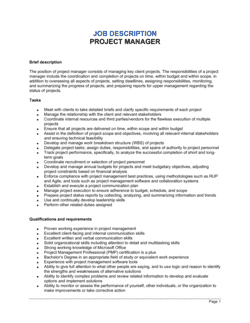
A project manager job description defines an autonomous role responsible for scope, budget, risk, and stakeholder strategy across the full project lifecycle. A project coordinator description defines a supporting role that operates under managerial direction, handling documentation, scheduling, and communications. Use the coordinator template for roles that assist rather than own project outcomes, and the manager template for roles with full accountability.

vs Employment Contract

An employment contract is the binding legal agreement governing the entire working relationship β€” compensation, IP, non-compete, termination, and severance. A job description defines the scope and expectations of a specific role. The two documents complement each other: the employment contract governs the relationship; the job description governs the work. When incorporated by reference, the job description becomes part of the contract.

vs Job Offer Letter

A job offer letter summarizes compensation and role to secure candidate acceptance; it is not a comprehensive role-definition document. A job description provides the full operational and legal specification of the position. The offer letter typically references the job description to avoid duplicating duty and qualification language, keeping the offer letter focused on acceptance terms.

vs Independent Contractor Agreement

An independent contractor agreement engages a self-employed individual for defined project-based deliverables with no employment entitlements. A job description is an employment document that creates employer obligations including benefits, overtime, and accommodation duties. Using a job description format for a contractor relationship signals an employment relationship and creates misclassification risk in the US, Canada, the UK, and the EU.

Industry-specific considerations

Construction and Engineering

Site coordination duties, safety compliance obligations, subcontractor communication logs, and permit tracking responsibilities are typically specified as essential functions.

Information Technology / SaaS

Agile and sprint coordination tasks, tool proficiency requirements (Jira, Confluence, Monday.com), and cross-functional stakeholder management with engineering and product teams.

Healthcare

HIPAA data handling obligations incorporated into the confidentiality clause, credentialing and compliance prerequisites, and coordination of multi-disciplinary clinical project teams.

Professional Services

Client-facing coordination tasks, billable-hour tracking responsibilities, and confidentiality obligations covering client engagement data and deliverables.

Jurisdictional notes

United States

FLSA classification (exempt vs. non-exempt) must be determined before publishing the description β€” misclassification triggers back pay and penalty liability. Colorado, New York, California, and Washington require salary ranges in job postings. ADA essential-function designations in the duty list carry legal weight when assessing accommodation requests. At-will language in the acknowledgment block is enforceable in 49 states but should be omitted for Montana hires.

Canada

At-will employment does not exist in Canada; job descriptions should not include at-will language. Each province's Employment Standards Act governs minimum notice and termination obligations, and a job description incorporated into a contract must not undercut statutory minimums. Quebec employers must provide the document in French for provincially regulated workplaces. Pay transparency requirements are active in British Columbia and Prince Edward Island, with additional provinces under consideration.

United Kingdom

A written statement of employment particulars β€” which typically incorporates or references the job description β€” must be provided on or before day one under the Employment Rights Act 1996. The Equality Act 2010 requires that minimum qualifications are objectively justified as linked to role requirements to avoid indirect discrimination claims. Where the description is incorporated into the employment contract, materially changing duties without consent may constitute a unilateral variation actionable by the employee.

European Union

The EU Pay Transparency Directive (effective by 2026) requires salary range disclosure in job postings across member states. The Transparent and Predictable Working Conditions Directive obliges employers to provide written role particulars within seven days of hire. GDPR applies to any personal data collected during the hiring process, and the confidentiality clause should reference applicable national data protection law. Member states vary significantly in their treatment of post-employment restrictions referenced in job descriptions.

Template vs lawyer β€” what fits your deal?

PathBest forCostTime
Use the templateStandard domestic coordinator hires in a single jurisdiction with no contract incorporationFree30–60 minutes
Template + legal reviewRoles with access to sensitive data, cross-border hires, or job descriptions incorporated into employment contracts$200–$5001–2 days
Custom draftedSenior coordinator roles with supervisory authority, regulated industries, or multi-jurisdiction compliance requirements$500–$2,0003–7 days

Glossary

Job Description
A formal document that outlines the duties, qualifications, reporting structure, and employment conditions of a specific role.
Reporting Structure
The chain of authority that identifies who the employee reports to and, where applicable, who reports to them.
Essential Functions
The core tasks a role exists to perform β€” distinct from marginal functions β€” which carry legal weight in ADA and similar accommodation assessments.
FLSA Classification
The designation of a US employee as exempt or non-exempt from federal overtime requirements under the Fair Labor Standards Act.
KPIs (Key Performance Indicators)
Quantifiable metrics used to evaluate whether a role is being performed to the required standard.
At-Will Employment
An employment arrangement β€” common in most US states β€” where either party may end the relationship at any time for any lawful reason.
Scope of Work
The defined boundaries of a role's responsibilities, used to prevent duty creep and to support performance management.
PMO (Project Management Office)
A centralized function or department that standardizes project governance, tools, and reporting across an organization.
Acknowledgment Clause
A signed declaration by the employee confirming they have read, understood, and agree to the terms set out in the job description.
Job Grade / Pay Band
An internal classification that groups roles of similar scope and value to ensure consistent and equitable compensation across the organization.

Part of your Business Operating System

This document is one of 3,000+ business & legal templates included in Business in a Box.

  • Fill-in-the-blanks β€” ready in minutes
  • 100% customizable Word document
  • Compatible with all office suites
  • Export to PDF and share electronically

Create your document in 3 simple steps.

From template to signed document β€” all inside one Business Operating System.
1
Download or open template

Access over 3,000+ business and legal templates for any business task, project or initiative.

2
Edit and fill in the blanks with AI

Customize your ready-made business document template and save it in the cloud.

3
Save, Share, Send, Sign

Share your files and folders with your team. Create a space of seamless collaboration.

Save time, save money, and create top-quality documents.

β˜…β˜…β˜…β˜…β˜…

"Fantastic value! I'm not sure how I'd do without it. It's worth its weight in gold and paid back for itself many times."

Managing Director Β· Mall Farm
Robert Whalley
Managing Director, Mall Farm Proprietary Limited
β˜…β˜…β˜…β˜…β˜…

"I have been using Business in a Box for years. It has been the most useful source of templates I have encountered. I recommend it to anyone."

Business Owner Β· 4+ years
Dr Michael John Freestone
Business Owner
β˜…β˜…β˜…β˜…β˜…

"It has been a life saver so many times I have lost count. Business in a Box has saved me so much time and as you know, time is money."

Owner Β· Upstate Web
David G. Moore Jr.
Owner, Upstate Web

Run your business with a system β€” not scattered tools

Stop downloading documents. Start operating with clarity. Business in a Box gives you the Business Operating System used by over 250,000 companies worldwide to structure, run, and grow their business.

Start freeΒ Β·Β No credit card required