HR Coordinator Job Description Template

Free Word download β€’ Edit online β€’ Save & share with Drive β€’ Export to PDF

2 pagesβ€’20–30 min to fillβ€’Difficulty: Standardβ€’Signature requiredβ€’Legal review recommended
Learn more ↓
FreeHR Coordinator Job Description Template

At a glance

What it is
An HR Coordinator Job Description is a formal document that defines the scope of the HR Coordinator role β€” including core responsibilities, required qualifications, reporting relationships, compensation range, and performance expectations. This free Word download gives you a structured, legally defensible starting point you can edit online and export as PDF for job postings, offer letters, or employee file documentation.
When you need it
Use it when opening a new HR Coordinator position, backfilling an existing role, or standardizing inconsistent role definitions across HR or administrative teams. It is also essential when preparing for audits, discrimination claims, or compensation benchmarking exercises that require documented role definitions.
What's inside
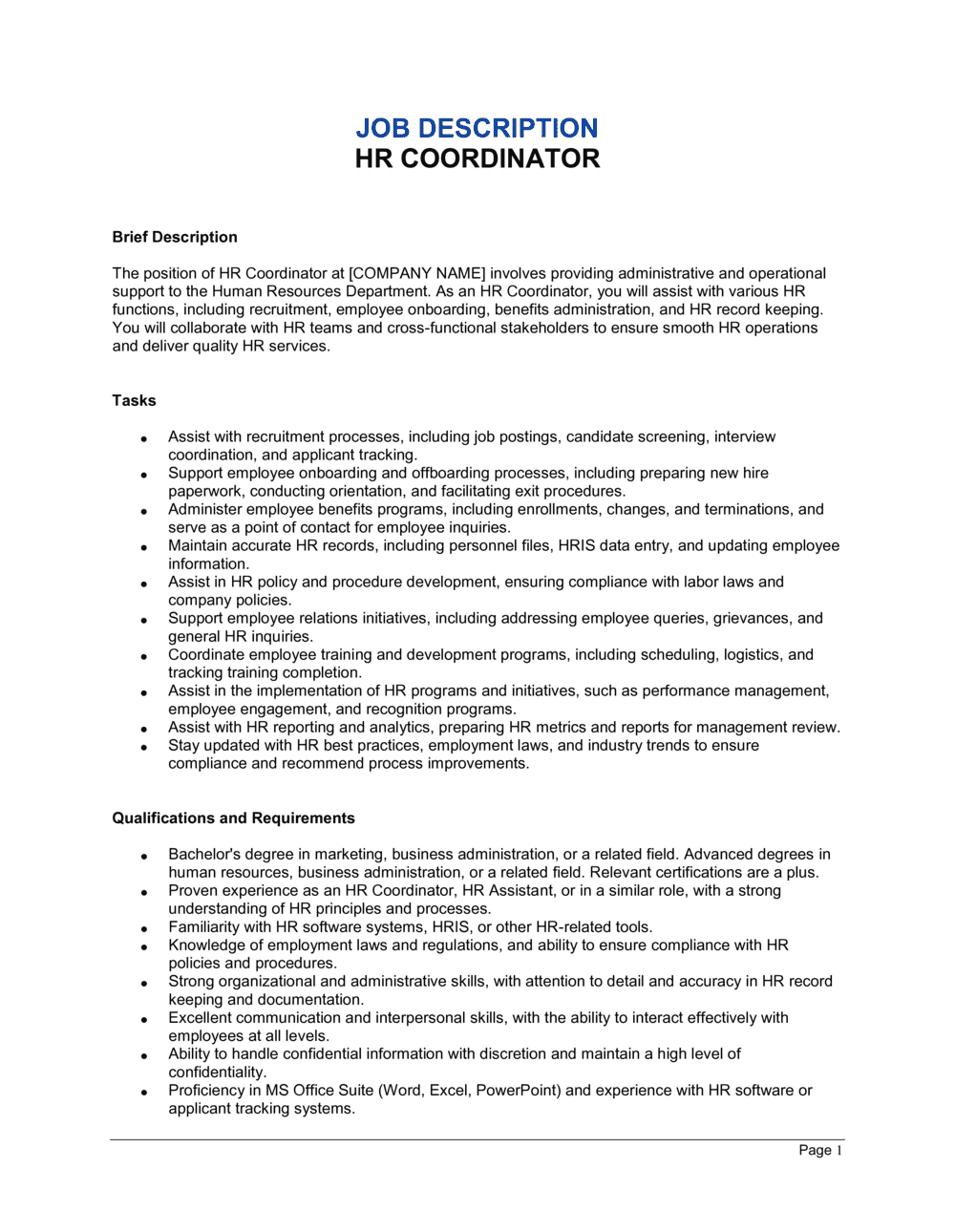
Job title and department, reporting structure, summary of purpose, detailed duties and responsibilities, required and preferred qualifications, compensation range and benefits overview, working conditions, and an acknowledgment section for employee signature.

What is an HR Coordinator Job Description?

An HR Coordinator Job Description is a formal document that defines the full scope of the HR Coordinator role within an organization β€” specifying essential duties, required and preferred qualifications, FLSA classification, reporting relationships, compensation range, and working conditions. It functions as both a recruiting instrument and a legally defensible employment record, providing the documented baseline used in performance management, accommodation requests, pay equity audits, and discrimination proceedings. When paired with a signed acknowledgment block, it establishes that the employee understood and accepted the role's expectations from day one.

Why You Need This Document

Without a documented job description, HR Coordinator roles become legally and operationally exposed on multiple fronts. An undefined role makes it nearly impossible to manage performance, justify a termination, or defend against a discrimination claim β€” courts and arbitrators consistently weigh whether the employer clearly communicated expectations. In jurisdictions with pay transparency laws (Colorado, New York, California, and others), posting an HR Coordinator role without a compensation range triggers regulatory complaints and civil penalties. Under the ADA, a missing or inaccurate list of essential functions undermines the employer's ability to deny accommodation requests that would otherwise fundamentally alter the position. Internally, an undocumented role creates compensation inconsistency that surfaces as pay equity liability during audits. This template gives you a structured, compliant starting point β€” covering classification, duties, qualifications, and acknowledgment β€” so you can fill the role and document it correctly the first time.

Which variant fits your situation?

If your situation is…Use this template
Hiring a generalist who handles all HR functions in a small companyHR Generalist Job Description
Recruiting a senior HR leader to set strategy and manage a teamHR Manager Job Description
Filling a specialist role focused exclusively on talent acquisitionRecruiter Job Description
Defining a payroll-focused HR support rolePayroll Administrator Job Description
Documenting an entry-level HR administrative assistant positionHR Assistant Job Description
Posting a role focused on employee training and development programsTraining and Development Coordinator Job Description
Hiring an HR Business Partner embedded in a specific business unitHR Business Partner Job Description

Common mistakes to avoid

❌ Misclassifying the role as FLSA-exempt

Why it matters: HR Coordinators performing routine administrative tasks often do not meet the administrative exemption's primary-duty test. Misclassification triggers back-pay liability for up to three years of unpaid overtime.

Fix: Apply both the salary-basis test ($684/week minimum) and the duties test β€” the employee's primary duty must involve the exercise of discretion and independent judgment on matters of significance. When in doubt, classify non-exempt.

❌ Omitting the compensation range in pay-transparency jurisdictions

Why it matters: Colorado, New York, California, Washington, and other jurisdictions require a pay range on all job postings. Publishing without one triggers agency complaints and civil penalties of up to $250,000 per violation in some states.

Fix: Before publishing, confirm which pay transparency laws apply to each location where the role will be posted and add the required range to the compensation clause.

❌ Mixing essential and marginal functions in the duties list

Why it matters: Under the ADA (and equivalent laws in Canada, UK, and EU), only essential functions can justify excluding a qualified applicant with a disability. A blended list creates accommodation liability.

Fix: Label the primary duties list as 'Essential Functions' and add a single catch-all sentence for marginal tasks: 'Other duties as assigned are considered marginal functions and are not listed above.'

❌ Using at-will language in international job descriptions

Why it matters: At-will employment is a US-specific doctrine. Inserting it into job descriptions for Canadian, UK, or EU employees creates legal ambiguity and may be read as an attempt to strip statutory notice entitlements.

Fix: Maintain separate job description templates for US and non-US locations. Replace the at-will clause with a statement referencing the applicable employment agreement or local statutory minimums.

❌ Requiring a four-year degree without business necessity

Why it matters: Degree requirements that are not tied to genuine job performance can constitute disparate-impact discrimination against protected classes β€” and are now restricted by statute for certain employers in Maryland, Colorado, and other jurisdictions.

Fix: Replace 'Bachelor's degree required' with 'Bachelor's degree or equivalent combination of education and relevant experience' unless a degree is demonstrably required to perform essential functions.

❌ Failing to obtain employee signature on the job description

Why it matters: An unsigned job description is not evidence that the employee knew what was expected. In performance management and termination proceedings, employers who cannot prove the employee reviewed the job description lose credibility with arbitrators and courts.

Fix: Include an acknowledgment block and collect a wet or electronic signature before or on the employee's first day. Store the signed copy in the personnel file.

The 9 key clauses, explained

Job Title, Department, and Classification

In plain language: States the official job title, the department the role belongs to, the FLSA classification (exempt or non-exempt), and the employment type (full-time, part-time, or contract).

Sample language
Job Title: HR Coordinator | Department: Human Resources | Reports To: [HR MANAGER / DIRECTOR OF HR] | FLSA Status: Non-Exempt | Employment Type: Full-Time

Common mistake: Misclassifying an HR Coordinator as FLSA-exempt without meeting the salary and duties tests. This exposes the employer to back-pay claims for overtime hours worked.

Position Summary

In plain language: A 3–5 sentence overview of the role's purpose, the team it supports, and the organizational outcome it drives.

Sample language
The HR Coordinator supports the day-to-day operations of the Human Resources department at [COMPANY NAME]. This role administers HR programs across the employee lifecycle β€” recruiting support, onboarding, benefits enrollment, HRIS maintenance, and compliance recordkeeping β€” serving approximately [NUMBER] employees across [NUMBER] locations.

Common mistake: Writing a position summary that reads like a marketing tagline ('dynamic self-starter in a fast-paced environment') rather than a factual description of organizational purpose β€” making it harder to defend in misclassification or discrimination proceedings.

Essential Duties and Responsibilities

In plain language: An itemized list of the core tasks the employee is primarily hired to perform, organized by function (recruiting, onboarding, benefits, compliance, reporting).

Sample language
Essential duties include: (a) coordinating job postings on [PLATFORMS]; (b) scheduling and administering pre-employment screening; (c) processing new-hire paperwork and I-9 documentation; (d) maintaining employee records in [HRIS NAME]; (e) administering benefits enrollment during open enrollment and qualifying life events; (f) generating monthly headcount and turnover reports.

Common mistake: Conflating essential and marginal functions in a single undifferentiated list. Under the ADA, only essential functions can be used to screen out applicants β€” mixing the two creates accommodation liability.

Required Qualifications

In plain language: The minimum education, experience, certifications, and skills a candidate must have to be considered for the role.

Sample language
Required: Associate's or Bachelor's degree in Human Resources, Business Administration, or a related field; minimum [1–2] years of HR administrative or coordination experience; proficiency in Microsoft Office Suite and at least one HRIS platform (e.g., Workday, BambooHR, ADP); working knowledge of federal and state employment law.

Common mistake: Requiring a four-year degree for an HR Coordinator role without a genuine business necessity. Several US states and cities now restrict degree requirements that screen out protected-class applicants disproportionately.

Preferred Qualifications

In plain language: Additional credentials or experiences that would make a candidate more competitive but are not disqualifying if absent.

Sample language
Preferred: PHR or SHRM-CP certification; experience with [SPECIFIC HRIS]; bilingual proficiency in [LANGUAGE]; prior experience supporting HR compliance in a [INDUSTRY] environment.

Common mistake: Listing preferred qualifications in a way that mirrors the required list β€” if virtually every preferred item is weighted equally with required items in screening, the distinction becomes legally meaningless.

Compensation and Benefits

In plain language: States the salary range or hourly rate, pay frequency, and a summary of available benefits β€” health, dental, vision, retirement, PTO.

Sample language
Compensation: $[MINIMUM] – $[MAXIMUM] annually, commensurate with experience. Benefits: medical, dental, and vision insurance; 401(k) with [X]% employer match; [X] days PTO per year; [X] paid holidays.

Common mistake: Omitting the compensation range in jurisdictions where pay transparency is now legally required (Colorado, New York, California, Washington, and others). Publishing without a range in those states creates regulatory exposure.

Working Conditions and Physical Requirements

In plain language: Describes the work environment (office, hybrid, remote), typical weekly hours, travel requirements, and any physical demands the role imposes.

Sample language
This position is primarily [on-site / hybrid / remote]. Standard hours are [X] per week, Monday through Friday. Occasional travel to [LOCATIONS] may be required, estimated at [X]% of time. The role requires the ability to sit for extended periods, operate standard office equipment, and occasionally lift materials weighing up to [X] lbs.

Common mistake: Listing physical requirements (lifting, standing) that are not genuinely required by the role. Phantom requirements can expose the employer to ADA failure-to-accommodate claims and unnecessarily narrow the applicant pool.

Reporting Relationships and Supervision

In plain language: Identifies the direct supervisor for the role and any direct reports or cross-functional teams the HR Coordinator regularly works with.

Sample language
This position reports directly to the [HR MANAGER / DIRECTOR OF HUMAN RESOURCES]. The HR Coordinator works cross-functionally with Finance, Legal, and all department heads and does not carry direct supervisory responsibility.

Common mistake: Leaving reporting structure blank or describing it vaguely ('works with leadership'). A missing reporting line creates org-chart ambiguity that complicates performance management and termination documentation.

Acknowledgment and At-Will Statement

In plain language: Confirms that the employee has received and reviewed the job description, and β€” for US employers β€” clarifies that the document is not an employment contract and does not alter at-will status.

Sample language
I acknowledge that I have received, read, and understood this job description. I understand that this document does not constitute a contract of employment and that my employment with [COMPANY NAME] remains at-will. | Employee Signature: _______________ | Date: _______________ | Manager Signature: _______________ | Date: _______________

Common mistake: Using at-will language in jurisdictions where at-will employment is not recognized (Canada, UK, EU). Including US-specific at-will disclaimers in international versions creates confusion and may undermine the notice-period obligations required by local law.

How to fill it out

  1. 1

    Enter the job title, department, and classification

    Confirm the official job title matches your HRIS and payroll records. Verify FLSA classification β€” most HR Coordinators are non-exempt unless they meet the administrative exemption's salary ($684/week minimum) and primary-duty tests.

    πŸ’‘ Run FLSA classification by your payroll provider or employment counsel before publishing β€” misclassification penalties run back three years under the FLSA.

  2. 2

    Write the position summary

    Describe the role's organizational purpose in three to five sentences: what the role does, who it supports, and what business outcome it drives. Avoid buzzwords; use numbers where possible (e.g., 'supporting 120 employees across two locations').

    πŸ’‘ Position summaries that quantify scope β€” employee count, locations, HRIS platforms β€” hold up better in compensation benchmarking and legal proceedings.

  3. 3

    List essential duties with function-based groupings

    Organize duties into four to six functional buckets (recruiting support, onboarding, benefits, compliance, reporting). Within each bucket, list the two to four most time-intensive tasks. Mark this section 'Essential Functions' explicitly.

    πŸ’‘ ADA guidance requires essential functions to be listed separately from marginal ones. A one-sentence note β€” 'Other duties as assigned are considered marginal functions' β€” protects the employer's flexibility without diluting the essential list.

  4. 4

    Define required qualifications precisely

    List the minimum education, years of experience, certifications, and technical skills that a candidate must have to perform the essential functions. Avoid requirements that are not directly tied to job performance.

    πŸ’‘ In states with degree-restriction laws (e.g., Maryland's Skills-Based Hiring Act for state employers), replace 'Bachelor's degree required' with 'Bachelor's degree or equivalent combination of education and experience' to stay compliant.

  5. 5

    Add the compensation range

    Enter the minimum and maximum of the pay band for this role. Verify that the range meets or exceeds minimum wage in every location where the position may be filled, and that it complies with pay transparency laws in applicable jurisdictions.

    πŸ’‘ Colorado, New York City, California, and Washington all require a compensation range on job postings β€” omitting it triggers agency complaints and civil penalties.

  6. 6

    Describe working conditions and physical requirements accurately

    State the work modality (on-site, hybrid, or remote), standard hours, and any travel requirement. List only physical demands that are genuinely required β€” if the role never requires lifting, do not include a lifting requirement.

    πŸ’‘ For hybrid roles, specify the minimum required on-site days per week rather than 'flexible' β€” vague hybrid language generates candidate disputes before day one.

  7. 7

    Complete the acknowledgment block and obtain signatures

    Have the hiring manager sign before posting to confirm organizational approval, and collect the employee's signature upon hire β€” before or on the first day. File the signed copy in the employee's personnel record.

    πŸ’‘ For Canadian, UK, or EU employees, replace the at-will disclaimer with a statement that the job description does not modify notice-period obligations under the applicable employment agreement or statute.

  8. 8

    Review for pay transparency and compliance before publishing

    Check the completed description against pay transparency requirements in every state or country where the role will be posted. Confirm that qualifications do not include education or background requirements that could constitute disparate impact discrimination.

    πŸ’‘ Run the final draft through your employment counsel or HR compliance software before publishing externally β€” a 30-minute review prevents regulatory complaints that can cost $10,000–$50,000 to resolve.

Frequently asked questions

What does an HR Coordinator do?

An HR Coordinator handles the day-to-day administrative and operational functions of a human resources department. Core duties typically include supporting recruitment by posting jobs and scheduling interviews, processing new-hire paperwork and onboarding logistics, maintaining employee records in an HRIS, administering benefits enrollment, and generating compliance reports. The role serves as the operational backbone of the HR function, freeing HR managers and business partners to focus on strategy and employee relations.

What qualifications should an HR Coordinator have?

Most HR Coordinator roles require an associate's or bachelor's degree in human resources, business administration, or a related field, plus one to two years of HR administrative experience. Proficiency with at least one HRIS platform (Workday, BambooHR, ADP) and Microsoft Office is standard. The SHRM-CP or PHR certification is a valuable differentiator but is typically listed as preferred rather than required for coordinator-level positions.

Is an HR Coordinator job description a legally binding contract?

In most US jurisdictions, a job description is not a contract of employment and does not alter at-will status when it includes the appropriate at-will disclaimer. However, a job description can be introduced as evidence in discrimination, accommodation, and wage claims to establish the scope of the role and expected duties. In Canada, the UK, and the EU, job descriptions form part of the employment record and interact with statutory notice obligations β€” making accuracy and completeness legally significant.

What is the difference between an HR Coordinator and an HR Generalist?

An HR Coordinator focuses primarily on administrative and operational tasks β€” scheduling, recordkeeping, onboarding logistics, and benefits administration. An HR Generalist handles a broader portfolio, typically including employee relations, performance management, and policy interpretation, and may have limited supervisory responsibilities. The two titles are sometimes used interchangeably in small organizations, but in larger companies the coordinator role is distinctly more transactional than the generalist role.

What pay transparency laws affect HR Coordinator job postings?

As of 2025, Colorado, New York, California, Washington, Hawaii, and Illinois require employers to include a compensation range on job postings, with several additional states and cities implementing similar rules. Federal contractors are also subject to pay transparency requirements under Executive Order 11246. Employers posting remotely to multiple states must check each state's threshold β€” some apply only to employers above a minimum employee count.

Should the HR Coordinator role be classified as FLSA-exempt or non-exempt?

Most HR Coordinator positions are classified as non-exempt under the FLSA because the role's primary duty is performing routine administrative tasks with limited discretion and independent judgment over matters of significance. The administrative exemption requires both a salary of at least $684 per week and a primary duty involving genuine discretionary authority β€” a standard most coordinators do not meet. Misclassification as exempt exposes the employer to back-pay liability for up to three years of overtime. When uncertain, consult employment counsel.

How often should an HR Coordinator job description be updated?

Review the job description annually during the performance cycle and whenever the role's duties, reporting structure, or compensation band changes materially. Outdated job descriptions create mismatches between documented responsibilities and actual work performed, which weakens the employer's position in performance disputes and complicates pay equity audits. A job description more than two years old without review is a compliance risk in jurisdictions with pay equity reporting requirements.

Do I need a lawyer to create an HR Coordinator job description?

For a single domestic hire in a straightforward US jurisdiction, a high-quality template typically suffices. Legal review is advisable when hiring across multiple states or countries with different pay transparency or degree-restriction laws, when the company is subject to OFCCP compliance as a federal contractor, or when a recent EEOC charge or pay-equity audit requires documented role definitions. A one-hour employment counsel review typically costs $200–$400 and is worthwhile for multi-state or international postings.

What is the typical salary range for an HR Coordinator?

In the United States, HR Coordinator salaries typically range from $42,000 to $65,000 annually, depending on location, industry, and years of experience, with major metro markets (New York, San Francisco, Seattle) trending toward the upper end. SHRM and BLS data from 2024 place the median around $52,000. Compensation bands should be benchmarked annually against at least two current market surveys to remain competitive and defensible in pay equity audits.

How this compares to alternatives

vs HR Manager Job Description

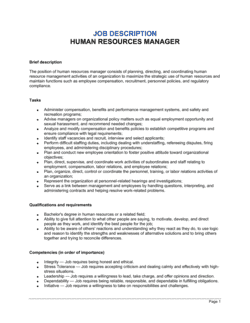
An HR Manager job description defines a leadership role responsible for setting policy, managing an HR team, and advising senior leadership on workforce strategy. An HR Coordinator description covers an operational support role focused on executing those policies day-to-day. Use the coordinator template for individual-contributor hires and the manager template when the role carries supervisory or strategic responsibilities.

vs HR Assistant Job Description

An HR Assistant job description covers an entry-level role with narrower scope β€” primarily clerical tasks such as filing, scheduling, and data entry under direct supervision. An HR Coordinator description defines a more autonomous role that owns specific HR processes end-to-end. Use the assistant template for first-time HR hires or part-time support roles.

vs Employment Contract

A job description defines the scope of a role and is used for recruiting, compliance, and performance management. An employment contract is the binding agreement that governs pay, IP assignment, confidentiality, non-compete, and termination terms. Both documents are needed β€” the job description does not substitute for a signed employment contract.

vs Job Offer Letter

A job offer letter confirms compensation, start date, and title to secure candidate acceptance. A job description defines the role's duties, qualifications, and expectations in full. The offer letter references the job description but is not a replacement for it β€” both should be signed and filed in the employee's personnel record.

Industry-specific considerations

Technology / SaaS

HR Coordinators in tech companies typically manage high-volume onboarding across distributed teams, HRIS integrations with equity management platforms, and I-9 compliance for remote hires across multiple states.

Healthcare

Coordination of credential verification, licensure tracking, and HIPAA-related confidentiality training are essential functions unique to healthcare HR Coordinator roles.

Manufacturing

Shift-schedule coordination, OSHA recordkeeping, union-agreement administration, and high-volume hourly recruiting distinguish the HR Coordinator role in manufacturing environments.

Professional Services

HR Coordinators in law firms, consulting firms, and accounting practices manage bar admission and professional licensure tracking, billable-hours data interfaces, and intensive lateral-hire onboarding.

Jurisdictional notes

United States

The FLSA governs exempt/non-exempt classification; most HR Coordinators are non-exempt. Pay transparency laws in Colorado, New York, California, Washington, Hawaii, and Illinois require a compensation range on all postings. ADA compliance requires separating essential from marginal functions. Several states now restrict mandatory degree requirements where not demonstrably job-related.

Canada

At-will language has no legal effect in Canada and should be removed from Canadian versions. Provincial pay equity legislation (Ontario Pay Equity Act, Quebec Act respecting pay equity) may require job descriptions to include job-class documentation for compensation analysis. Job descriptions in Quebec-regulated workplaces must be available in French.

United Kingdom

UK employers must provide a written statement of employment particulars β€” which references the job description β€” on or before day one of employment under the Employment Rights Act 1996. Equality Act 2010 compliance requires that qualifications and physical requirements be genuinely necessary to avoid indirect discrimination claims. Gender pay gap reporting for employers with 250+ employees makes accurate role classification essential.

European Union

The EU Pay Transparency Directive (effective 2026 in most member states) requires employers to disclose salary ranges in job postings and provide job evaluation criteria on request. Job descriptions must be free of gender-coded language under anti-discrimination directives. GDPR applies to any personal data collected during the application process referenced in the job posting.

Template vs lawyer β€” what fits your deal?

PathBest forCostTime
Use the templateSingle-state US hires at a company not subject to OFCCP or active pay equity auditsFree20–30 minutes
Template + legal reviewMulti-state postings, pay transparency compliance, or any international hire$200–$400 (one-hour employment counsel review)1–2 business days
Custom draftedFederal contractors, companies with active EEOC or OFCCP obligations, or organizations implementing a full job architecture redesign$800–$3,000+1–2 weeks

Glossary

Job Description
A formal written document specifying a role's title, duties, qualifications, reporting relationships, and compensation parameters.
Essential Functions
The core duties a position exists to perform β€” the tasks an employee must be able to carry out, with or without reasonable accommodation, under ADA and equivalent laws.
FLSA Classification
A US designation under the Fair Labor Standards Act indicating whether a role is exempt from overtime pay (salaried professional) or non-exempt (hourly, entitled to 1.5Γ— pay for hours over 40 per week).
Pay Equity
The principle that employees performing substantially similar work receive equal compensation regardless of gender, race, or other protected characteristics β€” enforced through laws like the US Equal Pay Act and Canada's Pay Equity Act.
ADA Reasonable Accommodation
A modification to a job, work environment, or the way a task is performed that enables a qualified person with a disability to fulfill the role's essential functions.
HRIS (Human Resources Information System)
Software used to manage employee data, payroll, benefits, recruiting, and HR workflows β€” commonly referenced as a required proficiency in HR Coordinator roles.
Onboarding
The structured process of integrating a new employee into the organization, covering documentation, orientation, system access, and early training.
Compa-Ratio
An employee's actual pay divided by the midpoint of their pay band β€” used to assess compensation positioning relative to market and internal equity.
Reporting Structure
The formal hierarchy identifying who a role reports to and, if applicable, who reports to that role β€” a required element in legally defensible job descriptions.
At-Will Statement
A clause, common in US job descriptions, clarifying that employment is at-will and the job description does not constitute a contract of employment.

Part of your Business Operating System

This document is one of 3,000+ business & legal templates included in Business in a Box.

  • Fill-in-the-blanks β€” ready in minutes
  • 100% customizable Word document
  • Compatible with all office suites
  • Export to PDF and share electronically

Create your document in 3 simple steps.

From template to signed document β€” all inside one Business Operating System.
1
Download or open template

Access over 3,000+ business and legal templates for any business task, project or initiative.

2
Edit and fill in the blanks with AI

Customize your ready-made business document template and save it in the cloud.

3
Save, Share, Send, Sign

Share your files and folders with your team. Create a space of seamless collaboration.

Save time, save money, and create top-quality documents.

β˜…β˜…β˜…β˜…β˜…

"Fantastic value! I'm not sure how I'd do without it. It's worth its weight in gold and paid back for itself many times."

Managing Director Β· Mall Farm
Robert Whalley
Managing Director, Mall Farm Proprietary Limited
β˜…β˜…β˜…β˜…β˜…

"I have been using Business in a Box for years. It has been the most useful source of templates I have encountered. I recommend it to anyone."

Business Owner Β· 4+ years
Dr Michael John Freestone
Business Owner
β˜…β˜…β˜…β˜…β˜…

"It has been a life saver so many times I have lost count. Business in a Box has saved me so much time and as you know, time is money."

Owner Β· Upstate Web
David G. Moore Jr.
Owner, Upstate Web

Run your business with a system β€” not scattered tools

Stop downloading documents. Start operating with clarity. Business in a Box gives you the Business Operating System used by over 250,000 companies worldwide to structure, run, and grow their business.

Start freeΒ Β·Β No credit card required