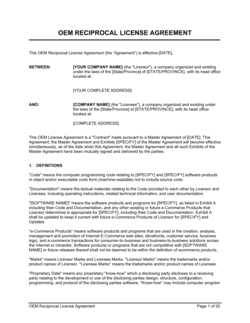
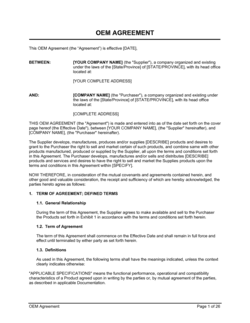
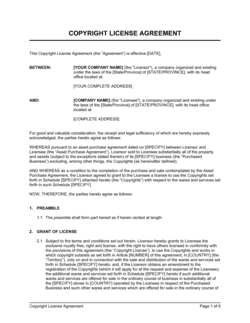
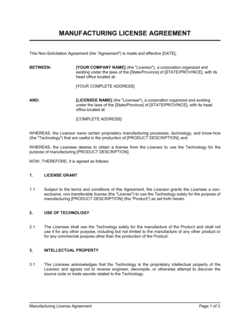
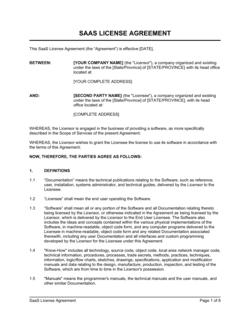
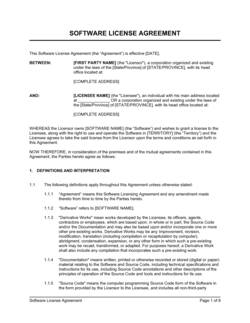
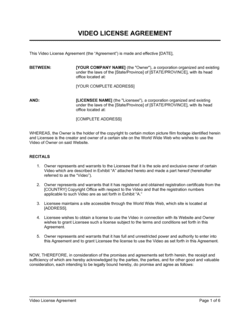
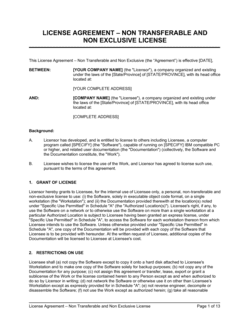
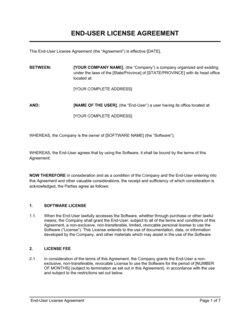
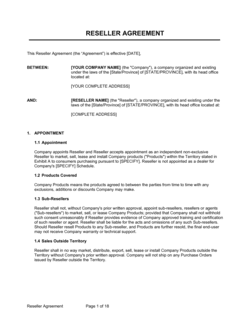
OEM Distribution and License Agreement Template

Free Word download • Edit online • Save & share with Drive • Export to PDF

18 pages35–45 min to fillDifficulty: ComplexSignature requiredLegal review recommended
Learn more ↓
FreeOEM Distribution and License Agreement Template

At a glance

What it is
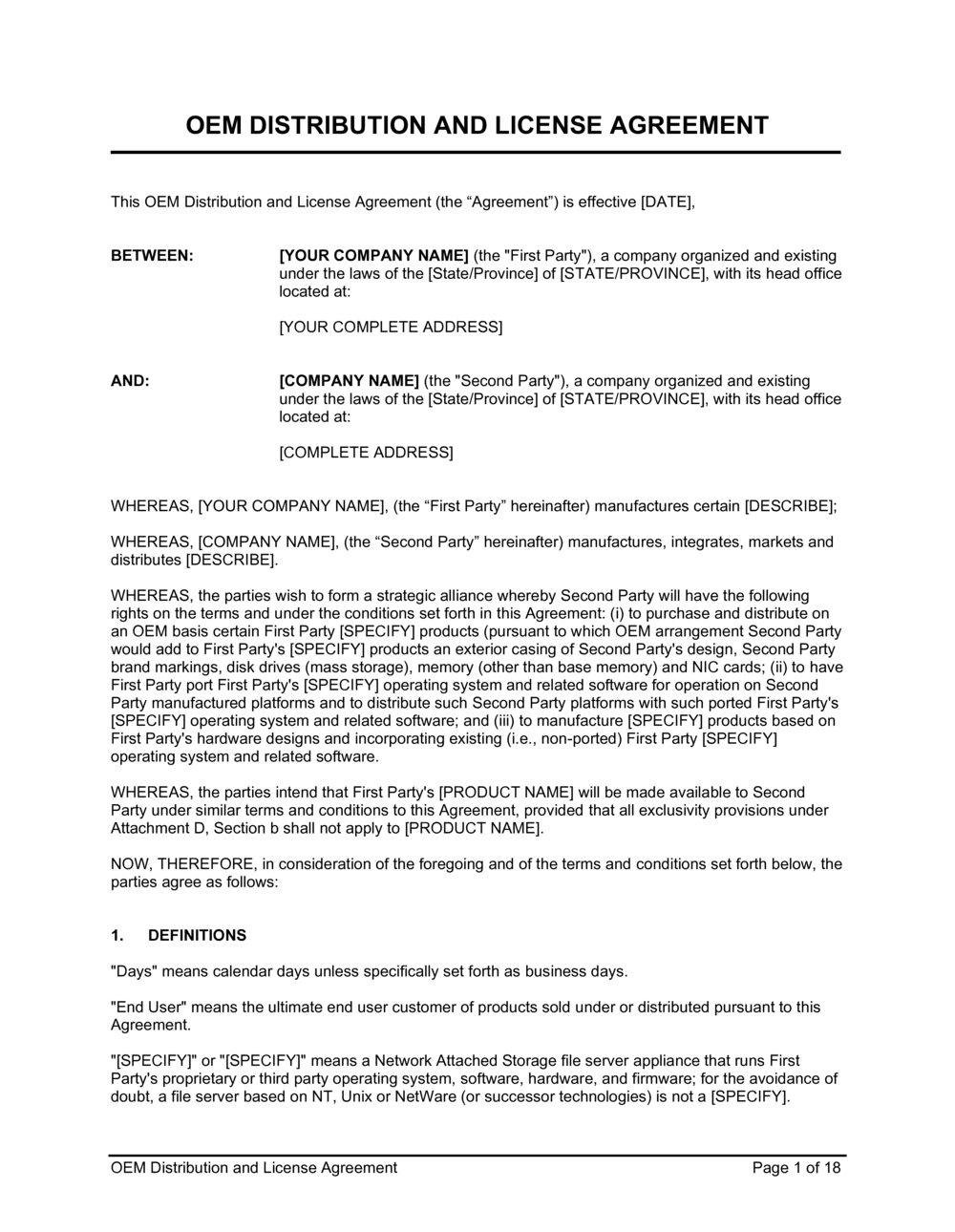
An OEM Distribution and License Agreement is a legally binding contract between an intellectual property owner (the licensor) and an original equipment manufacturer or reseller (the licensee) that grants the right to bundle, distribute, and sublicense the licensor's product or technology as part of the licensee's own offering. This free Word download covers the full scope of IP rights, territory, royalties, branding obligations, and termination in a single document you can edit online and export as PDF.
When you need it
Use it when a software vendor, hardware manufacturer, or technology company wants to allow a distribution partner to embed or resell their product under the partner's brand. It is also needed when the licensee requires a formal grant of rights before integrating third-party technology into their own commercial product.
What's inside
Grant of license and distribution rights, territory and exclusivity terms, royalty and payment structure, branding and white-label obligations, IP ownership and protection, confidentiality, warranties and indemnification, audit rights, and termination conditions with post-termination obligations.

What is an OEM Distribution and License Agreement?

An OEM Distribution and License Agreement is a legally binding contract between an intellectual property owner (the licensor) and a distribution partner (the licensee) that grants the partner the right to embed, bundle, rebrand, and distribute the licensor's technology or product as part of the partner's own commercial offering. Unlike a simple reseller arrangement, an OEM agreement transfers a structured set of IP rights — including the right to sublicense end users — and governs how those rights are scoped by territory, exclusivity terms, and royalty obligations. The agreement protects both parties: the licensor retains ownership of the underlying technology while controlling how it is used and monetized; the licensee receives the legal certainty needed to invest in integration, product development, and go-to-market execution.

Why You Need This Document

Distributing technology through an OEM channel without a formal agreement exposes both parties to serious and compounding risk. Without a written license, the licensee has no legally documented right to embed or redistribute the technology — making every product it ships a potential IP infringement. Without defined royalty terms, the licensor has no enforceable basis to collect payment or audit reported sales. Without IP ownership and improvement clauses, a licensee who builds enhancements on top of the licensed technology may claim independent rights in those enhancements — giving a distribution partner unexpected leverage over the licensor's own product roadmap. Post-termination obligations left unaddressed mean that when the relationship ends, thousands of existing end-user sublicenses may be left in legal limbo. This template provides the complete contractual structure to resolve all of these issues before they become disputes — covering rights, royalties, branding, audit, and wind-down in a single enforceable document.

Which variant fits your situation?

If your situation is…Use this template
Licensing software for embedding in a physical device with no resale rightsSoftware Embedded License Agreement
Granting a partner exclusive resale rights in a defined geographic territoryExclusive Distribution Agreement
Allowing a partner to sell under their own brand with no IP sublicensingWhite Label Agreement
Engaging a non-exclusive reseller with no bundling or branding rightsReseller Agreement
Licensing software to an end user directly with no distribution rightsSoftware License Agreement
Granting a manufacturer rights to produce and sell hardware under a licensed brandManufacturing License Agreement
Establishing a joint go-to-market with shared revenue and co-brandingJoint Venture Agreement

Common mistakes to avoid

❌ Granting exclusivity without a minimum volume commitment

Why it matters: An exclusive territory with no performance floor locks the licensor out of that market entirely, even if the licensee distributes zero units. The licensor loses revenue opportunity with no recourse.

Fix: Attach a Schedule of Annual Minimum Commitments and include a step-down clause converting exclusivity to non-exclusive status if minimums are not met in any given year.

❌ Leaving 'Net Revenue' undefined in the royalty clause

Why it matters: Ambiguous revenue definitions lead to royalty shortfalls that are almost impossible to litigate without expensive expert accounting testimony. The licensee will apply the interpretation most favorable to itself.

Fix: Define net revenue as gross sales less specifically enumerated deductions — returns actually credited, sales taxes collected, and shipping charged to customers — and nothing else.

❌ No ownership clause for improvements and derivative works

Why it matters: A licensee who builds enhancements may claim independent IP rights in those improvements, giving them leverage to withhold the enhancements or sublicense them to competitors.

Fix: Include an explicit clause assigning all improvements and derivative works related to the licensed technology back to the licensor, with a license-back to the licensee solely for use under this agreement.

❌ Automatic renewal without a calendar-flagged notice deadline

Why it matters: Parties routinely miss automatic renewal notice windows — often 60 or 90 days before expiry — and find themselves bound for another full term they did not intend to enter.

Fix: Add a practical reminder mechanism to the contract: a clause requiring each party to send a courtesy reminder to the other at least 120 days before the notice deadline, and calendar the deadline at signing.

❌ Uncapped indemnification for IP infringement

Why it matters: Unlimited indemnification exposes the licensor to catastrophic liability if the licensed technology is found to infringe a significant patent. Some jurisdictions will not enforce uncapped indemnities, leaving the clause void.

Fix: Cap indemnification at a multiple of total royalties paid in the 12 months preceding the claim — typically 1× to 3× — and carve out willful infringement for unlimited exposure only where fault is proven.

❌ Failing to address post-termination end-user sublicenses

Why it matters: If the licensee has distributed the OEM product to thousands of end customers, terminating all sublicenses simultaneously creates a customer service and legal liability crisis that the licensor may inherit.

Fix: Include a survival clause allowing existing end-user sublicenses to run to their natural expiry after agreement termination, with the licensor stepping into the licensee's obligations if necessary.

The 10 key clauses, explained

Grant of license and distribution rights

In plain language: Defines exactly what the licensee may do with the licensed technology — embed it, distribute it, sublicense it to end users, or modify it — and what is expressly prohibited.

Sample language
Licensor hereby grants to Licensee a [non-exclusive / exclusive], non-transferable license to [reproduce / distribute / sublicense] the Licensed Technology solely as integrated into Licensee's products ('OEM Products') within the Territory during the Term.

Common mistake: Omitting the word 'non-transferable' or failing to restrict sublicensing. Without explicit limits, the licensee may argue it can assign or further license the rights to third parties without consent.

Territory and exclusivity

In plain language: Specifies the geographic region in which the licensee may distribute the OEM product and whether the licensor may grant the same rights to competing partners in that region.

Sample language
The Territory shall be [COUNTRY / REGION]. This license is [exclusive / non-exclusive] within the Territory. Licensor shall not grant distribution rights for the Licensed Technology to any third party in the Territory during the exclusivity period of [X] months.

Common mistake: Granting exclusivity without a minimum volume commitment. An exclusive territory with no performance floor locks the licensor out of that market even if the licensee distributes zero units.

Royalties and payment terms

In plain language: States the royalty rate or per-unit fee, the reporting period, payment deadline, and the currency and method of payment.

Sample language
Licensee shall pay Licensor a royalty of [X]% of Net Revenue derived from OEM Products, or $[X] per unit distributed, whichever is greater. Royalties shall be reported and remitted within [30] days of the end of each calendar quarter.

Common mistake: Failing to define 'Net Revenue' precisely. Leaving the deduction basis vague — whether it includes shipping, returns, taxes, or partner discounts — leads to royalty disputes that are difficult to resolve without expensive litigation.

Branding and white-label obligations

In plain language: Sets out whether the licensed product may be sold under the licensee's brand, what attribution to the licensor (if any) is required, and the licensor's brand usage guidelines the licensee must follow.

Sample language
Licensee may market and distribute OEM Products under Licensee's brand. Licensee shall include the following attribution on all packaging and documentation: '[LICENSOR NAME] Technology Inside.' All use of Licensor's trademarks, if any, shall comply with Licensor's then-current Brand Guidelines.

Common mistake: Allowing full white-label distribution without requiring any attribution or quality approval. The licensor's technology may end up bundled with inferior products, damaging its reputation in ways the licensor has no contractual basis to address.

IP ownership and protection

In plain language: Confirms that the licensor retains all ownership of the licensed technology and any improvements made to it, and obligates the licensee to protect the licensor's IP from unauthorized use.

Sample language
All right, title, and interest in the Licensed Technology, including all improvements, modifications, and derivative works created by either party that relate to the Licensed Technology, shall vest exclusively in Licensor. Licensee shall promptly notify Licensor of any known or suspected infringement.

Common mistake: Failing to address ownership of improvements the licensee makes to the technology. Without a clear clause, a licensee who enhances the product may claim independent IP rights in those enhancements.

Confidentiality

In plain language: Prohibits each party from disclosing the other's confidential information — including source code, pricing, and technical specifications — to third parties during and after the agreement.

Sample language
Each party shall hold the other's Confidential Information in strict confidence, use it solely for purposes of this Agreement, and not disclose it to any third party without prior written consent. This obligation survives termination for a period of [3] years.

Common mistake: Using a one-way confidentiality clause that only protects the licensor. The licensee also discloses confidential information — customer data, sales projections, integration details — and requires reciprocal protection.

Warranties and indemnification

In plain language: The licensor warrants it owns the technology and has the right to license it; both parties indemnify each other for specific categories of loss, including third-party IP infringement claims.

Sample language
Licensor warrants that it has full right and authority to grant the licenses herein and that, to Licensor's knowledge, the Licensed Technology does not infringe any third-party IP right. Licensor shall indemnify Licensee against any third-party claim alleging that the Licensed Technology infringes a valid patent, copyright, or trade secret.

Common mistake: Omitting an indemnification cap or carve-out for willful infringement. An uncapped indemnity exposes the licensor to unlimited liability; courts in some jurisdictions will not enforce unlimited indemnities, leaving both parties without predictable risk exposure.

Audit rights and recordkeeping

In plain language: Grants the licensor the right to audit the licensee's records to verify royalty calculations, and requires the licensee to maintain accurate distribution and revenue records for a defined period.

Sample language
Licensor shall have the right, upon [30] days' written notice and no more than once per calendar year, to audit Licensee's books and records relating to OEM Product distribution. Licensee shall retain such records for a minimum of [3] years. If an audit reveals an underpayment exceeding [5]%, Licensee shall bear the cost of the audit.

Common mistake: No audit trigger for shortfall cost allocation. Without a percentage threshold, the licensee has little financial incentive to maintain accurate records, since the licensor bears audit costs regardless of the finding.

Term and termination

In plain language: Defines the initial contract period, renewal conditions, events that trigger immediate termination for cause, and the notice period required for termination without cause.

Sample language
This Agreement commences on [DATE] and continues for an initial term of [X] years, renewing automatically for successive one-year periods unless either party provides [90] days' written notice of non-renewal. Either party may terminate for cause upon [30] days' written notice if the other party materially breaches and fails to cure within the notice period.

Common mistake: Automatic renewal without a notice deadline. Licensors and licensees alike have missed the notice window and found themselves locked into an unwanted additional term — a common and costly oversight.

Post-termination obligations

In plain language: Specifies what the licensee must do after the agreement ends — stop distributing, destroy or return materials, wind down existing sublicenses, and pay any outstanding royalties.

Sample language
Upon termination, Licensee shall immediately cease distribution of OEM Products, destroy or return all copies of the Licensed Technology, and pay all outstanding royalties within [30] days. Existing sublicenses granted to end users prior to termination may continue under their original terms for the remainder of their licensed period.

Common mistake: Not addressing existing end-user sublicenses at termination. If the licensee has already distributed the product to thousands of customers, abrupt termination of those sublicenses creates downstream liability and customer service crises the licensor may inherit.

How to fill it out

  1. 1

    Identify both parties with full legal entity names

    Enter the licensor's and licensee's complete registered legal names, entity types, and principal place of business addresses. Do not use trade names or brand names in place of legal names.

    💡 Cross-reference each entity's registration in the applicable corporate registry before execution — a name discrepancy between the contract and the registry can complicate enforcement.

  2. 2

    Define the licensed technology precisely

    Attach a Schedule A or exhibit that describes the licensed technology, product, or software with version numbers, specification references, or patent numbers. Vague descriptions create scope disputes.

    💡 If the technology evolves during the contract term, include a process for updating the Schedule rather than amending the full agreement each time.

  3. 3

    Set the territory and exclusivity terms with performance minimums

    Choose the geographic territory carefully and decide whether exclusivity is warranted. If granting exclusivity, set a minimum annual distribution volume the licensee must meet to maintain exclusive status.

    💡 Tiered exclusivity — exclusive for Year 1 if 10,000 units are distributed, converting to non-exclusive if the threshold is missed — protects the licensor while incentivizing the licensee.

  4. 4

    Draft the royalty structure with defined revenue terms

    State whether royalties are per-unit, percentage-of-net-revenue, or a hybrid. Define every deduction from gross revenue that determines net revenue — taxes, shipping, returns, and channel discounts — so there is no room for interpretation.

    💡 A per-unit floor (the greater of X% or $Y per unit) protects the licensor if the licensee heavily discounts the OEM product to gain market share.

  5. 5

    Address IP ownership of improvements and derivative works

    Decide explicitly who owns improvements and enhancements: licensor only, licensee only, or jointly. Document this in the IP ownership clause and, if joint ownership applies, specify how jointly owned IP may be exploited.

    💡 Licensor ownership of all improvements is the most common and cleanest arrangement for software OEM deals — it avoids co-ownership disputes and keeps the technology roadmap under the licensor's control.

  6. 6

    Set audit frequency, trigger threshold, and cost allocation

    Limit audits to once per year, specify a minimum shortfall percentage (typically 5%) that triggers the licensee to bear audit costs, and require the licensee to retain records for at least three years.

    💡 Include a self-audit reporting obligation — requiring the licensee to certify royalty accuracy in writing each quarter — as a first line of verification before a full audit becomes necessary.

  7. 7

    Define termination notice periods and post-termination wind-down

    Set the notice period for non-renewal (90 days is standard for multi-year agreements) and the cure period for material breach (30 days is common). Address what happens to existing end-user sublicenses after termination.

    💡 A sell-off period of 60–90 days after termination — allowing the licensee to sell existing inventory — is often commercially reasonable and reduces termination disputes.

  8. 8

    Confirm governing law and dispute resolution before signing

    Choose a governing jurisdiction with clear, predictable commercial law for technology licensing — Delaware, New York, England and Wales, or Ontario are common choices. Specify whether disputes go to arbitration or court.

    💡 Arbitration confidentiality protects both parties' technology details from public court records — a significant advantage in competitive markets.

Frequently asked questions

What is an OEM distribution and license agreement?

An OEM distribution and license agreement is a contract between an IP owner and a distribution partner that grants the partner the right to bundle, rebrand, and resell the owner's product or technology as part of the partner's own offering. It defines the scope of rights granted, the territory, royalty structure, branding obligations, and how the relationship ends. It is commonly used in software, hardware, and technology industries where one company's technology is embedded or distributed inside another company's product.

What is the difference between an OEM agreement and a standard reseller agreement?

A reseller agreement authorizes a partner to sell the licensor's product as-is, under the licensor's brand, to end customers. An OEM agreement goes further — it allows the partner to integrate the technology into its own product, often under its own brand, and may include rights to sublicense to end users. OEM agreements require more detailed IP clauses, branding terms, and sublicense governance because the licensee's customers may not even know the underlying technology exists.

Does an OEM agreement need to be exclusive?

No — exclusivity is a negotiated term, not a requirement. Non-exclusive OEM agreements are common when the licensor wants to distribute through multiple partners simultaneously. If exclusivity is granted, it should always be conditioned on minimum annual distribution volumes. An exclusive agreement with no performance floor gives the licensee de facto control over the territory with no accountability to the licensor.

How are royalties typically calculated in an OEM license agreement?

Royalties in OEM agreements are typically calculated as a per-unit fee, a percentage of net revenue from products containing the licensed technology, or a hybrid of both. A hybrid structure — the greater of X% of net revenue or $Y per unit — protects the licensor if the licensee discounts heavily. Net revenue must be precisely defined to include only specified deductions, such as taxes collected and actual returns credited.

Who owns improvements and enhancements to the licensed technology?

Ownership of improvements is determined by the contract, not by default law. In most OEM agreements, the licensor retains ownership of all improvements to the core licensed technology. The licensee typically receives a license-back for any licensor-owned improvements. If the licensee creates independent enhancements that do not incorporate the core technology, those may be owned by the licensee — but this boundary must be explicitly drawn in the agreement.

Can the licensee sublicense the OEM product to end users?

Only if the agreement explicitly grants sublicensing rights. Without that right, the licensee cannot legally extend usage rights to third parties, including end customers. Most OEM agreements do grant a right to sublicense to end users for the purpose of using the bundled product, subject to an end-user license agreement (EULA) that must meet minimum standards set by the licensor.

What happens to end-user sublicenses when the OEM agreement terminates?

The agreement should address this explicitly. A common approach is to allow existing end-user sublicenses to run to their natural expiry after the OEM agreement terminates, preventing the licensor from inheriting an angry customer base. Some agreements require the licensor to step into the licensee's support obligations for those surviving sublicenses. Without a survival clause, terminating all sublicenses simultaneously is technically correct but commercially and legally risky.

Is an OEM distribution and license agreement enforceable internationally?

Generally yes, but enforceability depends on the governing law chosen in the agreement, the jurisdictions where the parties operate, and local IP and commercial law requirements. EU data protection laws may affect how user data embedded in OEM products is handled. Some countries restrict or require registration of technology license agreements for royalty payments to be repatriated. Legal review in each operational jurisdiction is advisable before the agreement is executed for international deployments.

Do I need a lawyer to draft or review an OEM distribution and license agreement?

For straightforward domestic OEM arrangements with modest royalty exposure, a high-quality template is a solid starting point. Legal review is strongly recommended when the technology is proprietary or patented, when exclusivity is granted over a significant territory, when annual royalties are expected to exceed $50,000, or when the agreement involves parties in multiple jurisdictions. An IP or technology licensing attorney typically charges $500–$1,500 to review and tailor a template for a standard OEM deal.

How this compares to alternatives

vs Software License Agreement

A software license agreement grants an end user the right to use software for internal purposes — it does not include distribution or sublicensing rights. An OEM distribution and license agreement is designed specifically for partners who will embed and redistribute the technology as part of their own product. If your counterparty is an end user rather than a distribution partner, use a software license agreement instead.

vs Reseller Agreement

A reseller agreement authorizes a partner to sell the licensor's product as-is, under the licensor's brand, without bundling or integration rights. An OEM agreement grants the right to integrate, rebrand, and sublicense the technology as part of the partner's own product. The OEM structure requires significantly more detailed IP, branding, and sublicense governance than a standard reseller arrangement.

vs Exclusive Distribution Agreement

An exclusive distribution agreement grants a partner sole rights to distribute a product in a territory, but does not include IP licensing, sublicensing, or integration rights. An OEM agreement combines distribution exclusivity with a technology license and is the appropriate document when the partner needs to embed or modify the product. Use the exclusive distribution agreement when the partner is reselling the product without modification or IP integration.

vs Joint Venture Agreement

A joint venture agreement establishes a shared business entity or commercial arrangement with mutual investment and shared profits. An OEM agreement is a vendor-customer relationship — the licensor retains full IP ownership and the licensee pays royalties. When the goal is shared development and co-ownership of new technology, a joint venture or co-development agreement is more appropriate than an OEM structure.

Industry-specific considerations

Software and SaaS

Licensing platform APIs or embedded software to hardware manufacturers or enterprise solution providers, with sublicense rights to end users and usage-based royalty reporting.

Hardware and Electronics

Embedding licensed firmware, operating systems, or chipset drivers in consumer or industrial devices, with per-unit royalties tied to manufacturing output rather than sales revenue.

Telecommunications

Bundling licensed software or codecs into network equipment or handsets, with regulatory compliance obligations and carrier-specific branding restrictions layered on top of standard OEM terms.

Healthcare and Medical Devices

Licensing diagnostic algorithms or software components for integration into FDA-regulated or CE-marked devices, requiring additional regulatory compliance representations and strict quality audit rights.

Automotive and Industrial

Embedding navigation, telematics, or control software into vehicles or machinery, with long contract terms (5–10 years), component-level version lock requirements, and product liability indemnification.

Consumer Electronics

Integrating licensed content, operating environments, or security technology into consumer devices, with retail channel sell-through reporting requirements and geographic territory management.

Jurisdictional notes

United States

US OEM agreements are primarily governed by contract law and the Uniform Commercial Code where goods are involved. IP licensing terms must comply with federal copyright and patent law. Non-compete and exclusivity clauses may be scrutinized under state antitrust law in California and other states. Royalty withholding tax obligations may apply to cross-border payments depending on applicable tax treaties.

Canada

Canadian OEM agreements are governed provincially — Ontario and British Columbia are common governing law choices for technology deals. PIPEDA and provincial privacy laws may affect how user data in bundled products is handled. Quebec civil law requirements apply if either party is provincially regulated in Quebec, and French-language documentation may be required. Cross-border royalty payments are subject to Part XIII withholding tax under the Income Tax Act, typically reduced by treaty.

United Kingdom

England and Wales is a common governing law choice for OEM agreements given predictable commercial contract law. Post-Brexit, EU IP registrations (EU trade marks, Community designs) no longer automatically cover the UK — separate UK IP rights should be confirmed. The UK GDPR applies to any OEM product processing personal data of UK residents. Competition law scrutiny of exclusive territorial grants is handled by the Competition and Markets Authority.

European Union

EU technology licensing agreements must comply with the EU Technology Transfer Block Exemption Regulation (TTBER), which sets safe-harbor rules for exclusivity, royalty obligations, and non-compete provisions. GDPR compliance is mandatory for any OEM product processing personal data of EU residents, and the licensor may need to contractually obligate the licensee to meet GDPR requirements. Exclusive territorial restrictions are subject to EU competition law review, and certain per-unit royalty structures may require notification under state aid rules in regulated sectors.

Template vs lawyer — what fits your deal?

PathBest forCostTime
Use the templateDomestic OEM arrangements with non-exclusive rights, modest royalty volumes, and a counterparty in the same jurisdictionFree1–3 hours to complete and review
Template + legal reviewAgreements involving exclusivity, annual royalties above $50,000, proprietary software, or parties in more than one country$500–$1,500 for an IP or technology licensing attorney review3–7 business days
Custom draftedComplex multi-territory OEM deals, patented technology, regulated industries (medical devices, automotive, telecoms), or material indemnification exposure$3,000–$10,000+ for full custom drafting by an IP attorney2–6 weeks

Glossary

OEM (Original Equipment Manufacturer)
A company that integrates another party's product or technology into its own offering and sells the combined product to end users, often under its own brand.
Licensor
The party that owns the intellectual property and grants the rights to use, distribute, or sublicense it under the terms of the agreement.
Licensee
The party that receives the grant of rights to use, distribute, or embed the licensor's technology as part of its own product or service.
Grant of License
The specific clause that defines the scope of rights transferred — whether to use, modify, sublicense, distribute, or create derivative works — and any limitations on those rights.
Royalty
A periodic payment from the licensee to the licensor, typically calculated as a fixed fee per unit distributed or a percentage of net revenue attributable to the licensed product.
Exclusivity
A term restricting the licensor from granting the same rights to other parties in a defined territory or market segment for the duration specified in the agreement.
White Label
A distribution arrangement in which the licensee sells the licensor's product under its own brand, with the original source obscured from end users.
Sublicense
The right, if granted, for the licensee to extend usage rights to a third party — such as an end customer — within the boundaries defined by the original license.
Audit Rights
A contractual provision allowing the licensor to inspect the licensee's sales records, usage logs, or royalty calculations to verify accurate reporting and payment.
Derivative Work
A product or work that incorporates or is based upon the licensed technology — ownership of derivative works must be explicitly addressed in the agreement.
Territory
The geographic scope — country, region, or worldwide — within which the licensee is authorized to distribute or sublicense the licensed product.
Indemnification
A clause requiring one party to compensate the other for losses, damages, or legal costs arising from a defined category of claim, such as IP infringement by the licensed product.

Part of your Business Operating System

This document is one of 3,000+ business & legal templates included in Business in a Box.

  • Fill-in-the-blanks — ready in minutes
  • 100% customizable Word document
  • Compatible with all office suites
  • Export to PDF and share electronically

Create your document in 3 simple steps.

From template to signed document — all inside one Business Operating System.
1
Download or open template

Access over 3,000+ business and legal templates for any business task, project or initiative.

2
Edit and fill in the blanks with AI

Customize your ready-made business document template and save it in the cloud.

3
Save, Share, Send, Sign

Share your files and folders with your team. Create a space of seamless collaboration.

Save time, save money, and create top-quality documents.

★★★★★

"Fantastic value! I'm not sure how I'd do without it. It's worth its weight in gold and paid back for itself many times."

Managing Director · Mall Farm
Robert Whalley
Managing Director, Mall Farm Proprietary Limited
★★★★★

"I have been using Business in a Box for years. It has been the most useful source of templates I have encountered. I recommend it to anyone."

Business Owner · 4+ years
Dr Michael John Freestone
Business Owner
★★★★★

"It has been a life saver so many times I have lost count. Business in a Box has saved me so much time and as you know, time is money."

Owner · Upstate Web
David G. Moore Jr.
Owner, Upstate Web

Run your business with a system — not scattered tools

Stop downloading documents. Start operating with clarity. Business in a Box gives you the Business Operating System used by over 250,000 companies worldwide to structure, run, and grow their business.

Start free · No credit card required