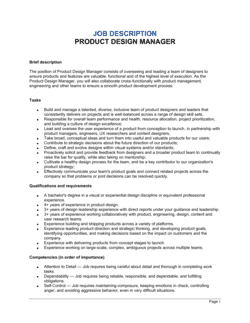
Product Design Director Job Description Template

Free Word download • Edit online • Save & share with Drive • Export to PDF

2 pages25–30 min to fillDifficulty: StandardSignature requiredLegal review recommended
Learn more ↓
FreeProduct Design Director Job Description Template

At a glance

What it is
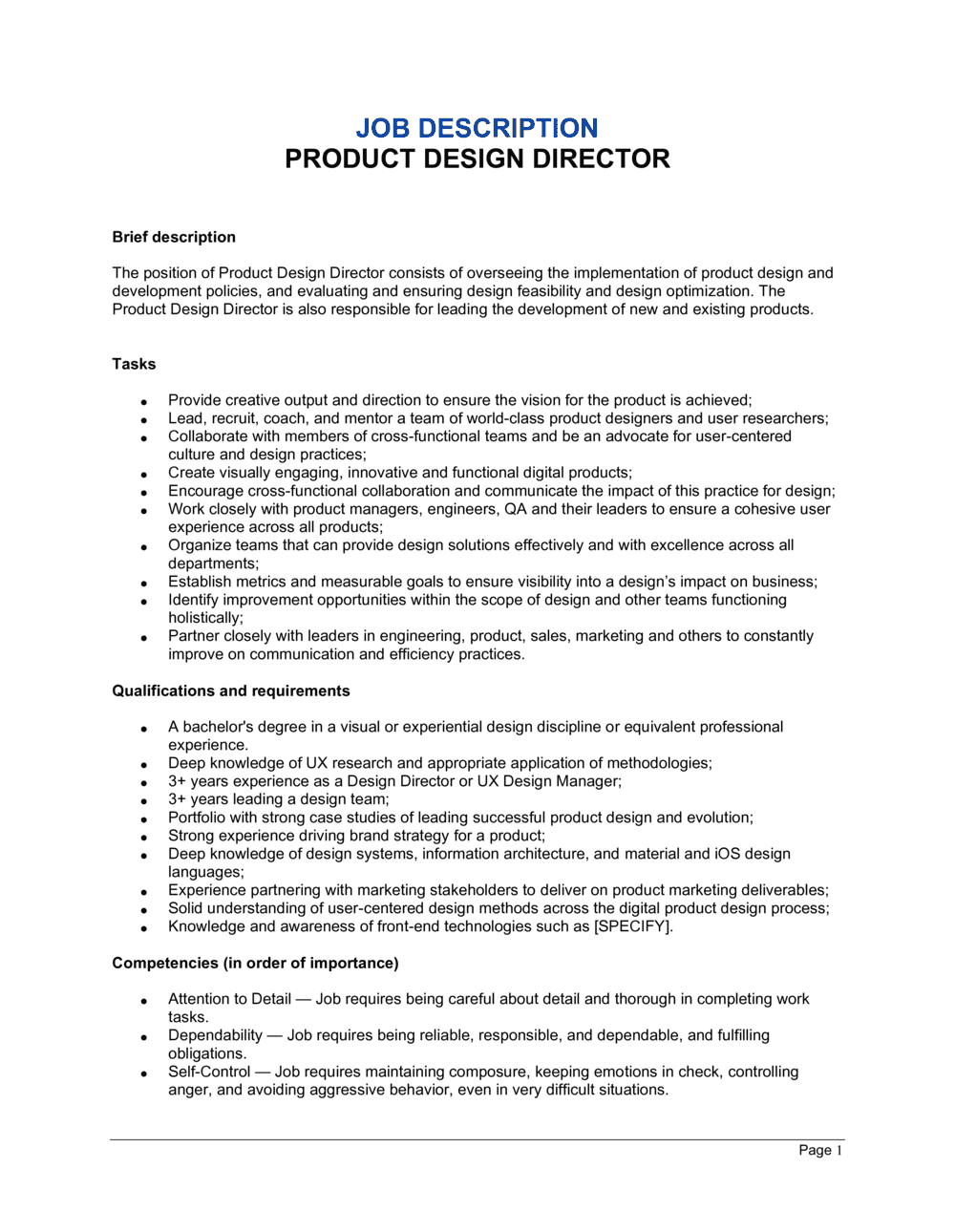
A Product Design Director Job Description is a formal document that defines the scope, responsibilities, qualifications, reporting structure, and compensation expectations for a senior design leadership role. This free Word download gives hiring teams a structured, legally sound starting point they can edit online and export as PDF for internal approval, job board posting, or inclusion in an offer package.
When you need it
Use it when creating a new Product Design Director role, backfilling a departing leader, or standardizing an existing position that has evolved informally. It is also required when the role triggers an employment contract, equity grant, or internal grade-leveling review.
What's inside
Role summary and organizational context, core responsibilities and design leadership scope, required and preferred qualifications, reporting structure and direct reports, compensation band and benefits overview, and equal-opportunity and legal compliance language.

What is a Product Design Director Job Description?

A Product Design Director Job Description is a formal document that defines the scope, responsibilities, qualifications, reporting structure, compensation, and legal employment terms for a senior design leadership role. It functions simultaneously as a candidate-facing job posting, an internal grade-leveling instrument, and a baseline document for performance management and employment law compliance. Unlike a casual role brief, a properly constructed job description creates a defensible record of what the employer intended the role to be — relevant in FLSA exemption classification, pay equity audits, and wrongful termination proceedings.

Why You Need This Document

Hiring a Product Design Director without a complete, legally reviewed job description creates exposure at every stage of the employment lifecycle. During recruiting, missing a salary range in a pay-transparency jurisdiction triggers regulatory fines. During onboarding, an ambiguous responsibilities section produces misaligned expectations that surface as performance disputes within the first year. During termination, a vague or outdated job description gives the employee's lawyer a viable argument that the stated grounds for dismissal were not established performance expectations. A signed, filed job description — incorporated by reference into the employment contract — closes these gaps before they open and gives HR teams a single authoritative source of truth for every decision made about the role from hire to exit.

Which variant fits your situation?

If your situation is…Use this template
Hiring a hands-on IC design leader who also manages a small teamSenior Product Designer Job Description
Filling a VP-level role overseeing multiple design directorsVP of Product Design Job Description
Defining a UX-focused role without broader product ownershipUX Design Director Job Description
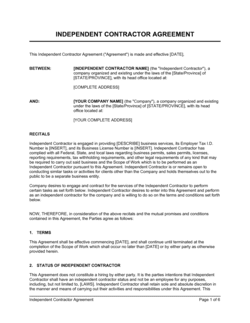
Posting a contract or freelance design leadership engagementIndependent Contractor Agreement
Creating a role that combines design and product managementHead of Product Job Description
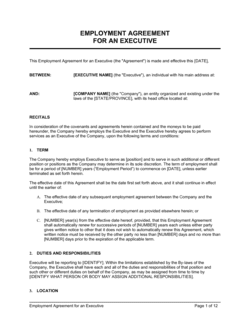
Documenting the role as part of an employment contract packageEmployment Contract (Executive)
Hiring a design director for a creative or brand-focused teamCreative Director Job Description

Common mistakes to avoid

❌ Omitting the salary range in jurisdictions that require it

Why it matters: Pay transparency laws in California, Colorado, New York, and Washington state require salary ranges in job postings. Non-compliance triggers fines of up to $250,000 per violation in some jurisdictions and opens the company to discrimination complaints.

Fix: Before publishing, check whether the role is open to candidates in any pay-transparency jurisdiction — including remote-eligible states. Post the genuine intended range, not a placeholder.

❌ Including a four-year degree requirement when it is not operationally necessary

Why it matters: Mandatory degree requirements for portfolio-based roles can constitute disparate impact discrimination under Title VII (US) and equivalent laws in the UK and EU, significantly narrowing the candidate pool without a valid business justification.

Fix: Replace 'Bachelor's degree required' with 'Bachelor's degree in Design or HCI, or equivalent practical experience' to remain compliant and attract qualified candidates from non-traditional backgrounds.

❌ Pasting at-will language into postings visible to non-US candidates

Why it matters: At-will employment is a US-only doctrine. Including it in a posting distributed to Canadian, UK, or EU candidates is legally meaningless at best and actively misleading at worst — it may create false expectations about termination rights.

Fix: Use jurisdiction-specific language for each posting location. For non-US roles, replace at-will language with notice-period and termination terms that meet local statutory minimums.

❌ Writing vague responsibilities that cannot support a performance review

Why it matters: A job description doubles as a performance management baseline. Vague accountabilities like 'drive design excellence' give managers no measurable standard to apply at review time and weaken the company's position in any wrongful termination dispute.

Fix: Write each responsibility with a measurable output or outcome. 'Define and ship a unified design system adopted by all product teams by Q3' is defensible; 'support design consistency' is not.

❌ Failing to update the job description after the role evolves

Why it matters: An outdated job description that no longer reflects actual duties creates misclassification risk (FLSA exemption may lapse), grade-leveling inconsistencies, and pay equity exposure when compensation is benchmarked against a role that no longer exists as described.

Fix: Schedule an annual review of all director-level job descriptions alongside the compensation cycle. Update the document, obtain re-signatures, and file the revised version in the employee's personnel record.

❌ Leaving the reporting structure ambiguous

Why it matters: For senior roles, an unclear reporting line affects FLSA exemption qualification, equity grant approval authority, and whether the employee is covered by director and officer insurance — all of which have legal and financial consequences.

Fix: Name the specific title the role reports to (e.g., 'Chief Product Officer') and list direct reports by function and count. If the org chart is in flux, note the interim reporting line and the expected permanent structure.

The 10 key clauses, explained

Role summary and organizational context

In plain language: A 3–5 sentence overview of the position's purpose, where it sits in the organization, and the business problem it solves.

Sample language
[COMPANY NAME] is seeking a Product Design Director to lead the [PRODUCT AREA] design team. Reporting to the [CPO / VP PRODUCT], you will own the end-to-end design process for [PRODUCT SUITE], partnering with Product and Engineering to deliver experiences used by [X] customers globally.

Common mistake: Writing the summary as a generic 'exciting opportunity' paragraph with no specifics. Candidates and legal reviewers both need enough organizational context to assess fit and scope — vague summaries attract unqualified applicants and weaken the role's grade-level justification.

Core responsibilities

In plain language: A bulleted list of 8–12 specific accountabilities — what the role owns, influences, and is measured on.

Sample language
Lead a team of [X] product designers and [X] design managers across [PRODUCT AREA]. Define and maintain the [COMPANY] design system. Partner with the Head of Product to set quarterly design OKRs aligned to [BUSINESS GOAL]. Present design strategy to the executive team quarterly.

Common mistake: Listing tasks instead of outcomes. 'Attend cross-functional meetings' is a task; 'drive alignment between product and engineering on design decisions' is an accountability. Task-based descriptions make performance management harder and reduce candidate quality.

Required qualifications

In plain language: Minimum education, years of experience, and non-negotiable skills the candidate must have on day one.

Sample language
8+ years of product design experience, including 3+ years in a people management role. Demonstrated portfolio of shipped consumer or enterprise products at scale. Proficiency in [FIGMA / SKETCH / RELEVANT TOOLS]. Bachelor's degree in Design, HCI, or a related field, or equivalent practical experience.

Common mistake: Including degree requirements that are not genuinely necessary. Mandating a four-year degree for a portfolio-based role can constitute disparate impact discrimination in some jurisdictions and excludes qualified candidates who are self-taught or bootcamp-trained.

Preferred qualifications

In plain language: Skills and experiences that differentiate strong candidates but are not disqualifying if absent — used to screen for stretch candidates without restricting the applicant pool unnecessarily.

Sample language
Experience building or scaling a design system from 0 to 1. Familiarity with [INDUSTRY DOMAIN — e.g., fintech, healthtech, SaaS]. Prior experience working in a [SERIES B / ENTERPRISE / HYPERGROWTH] environment. MBA or formal business training a plus.

Common mistake: Moving items between required and preferred without calibration. When the 'required' list is actually a wish list, you repel strong generalist candidates; when 'preferred' contains actual blockers, you waste interview cycles on unqualified applicants.

Reporting structure and direct reports

In plain language: States who the role reports to, how many direct reports they will manage, and which teams they will partner with cross-functionally.

Sample language
This role reports directly to the [CHIEF PRODUCT OFFICER / VP OF PRODUCT]. You will manage a team of [X] direct reports, including [X] Senior Product Designers and [X] Design Managers. Key cross-functional partners: Product Management, Engineering, Research, and Marketing.

Common mistake: Omitting the reporting line entirely. Candidates use this to assess decision-making authority and career trajectory; employment lawyers use it to establish whether a role qualifies for an executive or managerial FLSA exemption.

Compensation, equity, and benefits

In plain language: Discloses the salary range, bonus structure, equity eligibility, and key benefits — required by law in an increasing number of jurisdictions.

Sample language
Base salary: $[X]–$[X] USD, depending on experience and location. Eligible for annual performance bonus of up to [X]% of base salary. Equity: RSU grant of [$X] vesting over [4] years with a [1]-year cliff. Benefits include [HEALTH / DENTAL / VISION], [X] days PTO, and [401K / PENSION PLAN].

Common mistake: Omitting the salary range entirely in jurisdictions that require it. As of 2024, California, Colorado, New York City, and Washington state all mandate salary range disclosure in job postings — non-compliance triggers fines and applicant complaints.

Work location and schedule

In plain language: Specifies whether the role is remote, hybrid, or on-site, which office locations apply, and any travel or on-call expectations.

Sample language
This role is [REMOTE / HYBRID / ON-SITE] based in [CITY, STATE]. Hybrid employees are expected in the [CITY] office [X] days per week. Occasional travel to [OTHER LOCATIONS] for design sprints or all-hands meetings — estimated [X]% travel.

Common mistake: Using 'flexible work arrangement' without defining what that means. Ambiguous location language creates mismatched expectations, complicates tax and payroll compliance for cross-state hires, and can expose the company to constructive dismissal claims if terms change post-hire.

Employment type and at-will status

In plain language: States whether the position is full-time permanent, fixed-term, or contract, and includes at-will language where applicable.

Sample language
This is a full-time, permanent position. Employment with [COMPANY NAME] is at-will, meaning either party may terminate the relationship at any time, with or without cause, subject to applicable law.

Common mistake: Pasting at-will language into a job description posted to Canadian or UK candidates. At-will employment is a US doctrine; including it in postings visible to non-US applicants creates legal confusion and may be unenforceable or misleading under local employment law.

Equal opportunity and non-discrimination statement

In plain language: A legally required declaration that the employer does not discriminate on the basis of protected characteristics under applicable federal, state, and local law.

Sample language
[COMPANY NAME] is an equal opportunity employer. We do not discriminate on the basis of race, color, religion, sex, national origin, age, disability, veteran status, sexual orientation, gender identity, or any other characteristic protected by applicable law.

Common mistake: Using a generic boilerplate EEO statement that omits characteristics protected under local law. Several US cities and states, as well as UK and EU law, protect additional characteristics — including salary history, credit history, and family status — that a generic federal EEO statement does not cover.

Application instructions and process

In plain language: Tells candidates exactly how to apply, what to submit, and what to expect from the hiring process.

Sample language
To apply, submit your resume and a portfolio link via [APPLICATION URL]. Include [X] case studies showing end-to-end design process. Applications will be reviewed on a rolling basis. Shortlisted candidates will be contacted within [X] business days for an initial [PHONE / VIDEO] screen.

Common mistake: Omitting portfolio requirements entirely. For a design leadership role, a resume without a portfolio link is nearly always an automatic screen-out — failing to request it upfront wastes both sides' time in the first round.

How to fill it out

  1. 1

    Define the organizational context before writing

    Confirm where the role sits in the org chart — who it reports to, what team it leads, and what business unit it supports. This context shapes every other clause in the document.

    💡 If the reporting line is still being decided, delay posting until it is confirmed. A job description with an unclear reporting structure signals internal disorganization to senior candidates.

  2. 2

    Write responsibilities as outcomes, not tasks

    For each responsibility, ask 'what does success look like?' rather than 'what will they do all day?' Replace task language with accountability language — 'own,' 'drive,' 'define,' and 'deliver' rather than 'assist,' 'support,' and 'attend.'

    💡 Limit the responsibilities list to 10–12 bullets. More than 12 signals role bloat and causes candidates to self-select out when they cannot meet every item.

  3. 3

    Calibrate required versus preferred qualifications

    Treat 'required' as the absolute minimum to be considered on day one. Everything that can be learned in 6–12 months moves to 'preferred.' Audit the required list for degree requirements that are not genuinely necessary for the role.

    💡 Research shows that women apply to roles only when they meet nearly 100% of requirements, while men apply at around 60%. An inflated 'required' list disproportionately restricts your candidate pool.

  4. 4

    Add the compensation range

    Enter the base salary range, bonus target, and equity details. Check whether your target posting locations — including remote-eligible states — require salary range disclosure by law.

    💡 In states with pay transparency laws, the posted range must be the actual range you intend to pay — not an inflated range published to avoid commitment. Posting a range wider than $30–40K at this level invites regulatory scrutiny.

  5. 5

    Specify the work location and any travel requirements

    Choose one of: fully remote, hybrid with defined in-office days, or on-site. If hybrid or on-site, name the specific office location. Estimate travel as a percentage of time.

    💡 For roles open to candidates in multiple states, confirm with payroll whether you have nexus in each state before posting — hiring in a new state creates tax registration obligations.

  6. 6

    Insert the EEO statement and verify local protected classes

    Use the provided EEO statement as a base, then add any additional protected characteristics required by the state, city, or country where the role will be filled.

    💡 New York City, for example, adds protections for salary history, caregiver status, and criminal record. Run the final EEO statement past an employment lawyer if you are posting in more than two jurisdictions.

  7. 7

    Review for FLSA and local employment law compliance

    Confirm the role qualifies for the executive or professional FLSA exemption based on the salary threshold and duties test. For non-US postings, replace at-will language with jurisdiction-appropriate notice and termination terms.

    💡 The FLSA salary threshold for exempt employees was $684/week as of 2024 — a role below this threshold cannot be classified as exempt regardless of title.

  8. 8

    Have HR and legal sign off before publishing

    Route the final draft to HR for grade-level alignment and to legal for EEO compliance and pay transparency review. For executive hires, also obtain approval from the hiring manager's direct supervisor.

    💡 Keep a signed and dated copy of the approved job description on file. It becomes the baseline document for performance reviews and any future termination or reclassification decisions.

Frequently asked questions

What is a Product Design Director job description?

A Product Design Director job description is a formal document that defines the responsibilities, qualifications, reporting structure, compensation, and legal terms for a senior design leadership role. It serves three functions: it attracts qualified candidates, establishes the baseline for performance management, and provides legal documentation for employment classification and compliance purposes. For any director-level hire, a signed and dated job description should be retained in the employee's personnel file.

What should a Product Design Director job description include?

At minimum: a role summary with organizational context, 8–12 core responsibilities written as outcomes, required and preferred qualifications, reporting structure and direct report count, compensation range, work location and schedule, employment type, an EEO statement, and application instructions. For jurisdictions with pay transparency laws, the salary range is legally required. Missing the reporting structure or compensation range are the two most common gaps in director-level postings.

Is a job description a legally binding document?

A job description is generally not a standalone binding contract, but it carries significant legal weight. Courts and employment tribunals use it to determine FLSA exemption status, evaluate wrongful termination claims, assess pay equity compliance, and establish whether a role change constitutes constructive dismissal. When incorporated by reference into an employment contract or offer letter, the job description becomes contractually binding. Always have a lawyer review director-level job descriptions before finalizing.

What is the difference between a Product Design Director and a VP of Product Design?

The distinction is typically one of scope and organizational influence. A Product Design Director usually leads a specific product area or design team with direct reports. A VP of Product Design typically oversees multiple directors, sets company-wide design strategy, and participates in executive decision-making. At many companies, the VP title also carries board reporting responsibility and greater equity. The job description should reflect the actual scope, not just the title, to avoid grade-level inflation and compensation benchmarking errors.

Do I need to include a salary range in a job description?

Yes, if the role is open to candidates in any jurisdiction with a pay transparency law. As of 2024, California, Colorado, New York City, New York state, and Washington require salary ranges in job postings. Several additional states and cities are phasing in similar requirements. The posted range must reflect the genuine range the employer is willing to pay — not an artificially wide range used to avoid commitment. Posting without a range in a required jurisdiction carries fines of up to $250,000 per violation in some localities.

Can a job description be used as an employment contract?

A job description alone is not a substitute for a full employment contract. It lacks the enforceable clauses required for IP assignment, non-compete, confidentiality, and termination — all of which are essential for a director-level hire. The job description should be attached as a schedule or exhibit to a formal employment contract, with the contract governing in the event of any conflict between the two documents.

How specific should the qualifications section be?

Required qualifications should be specific enough to be defensible as bona fide occupational requirements. For a Product Design Director, that typically means 8+ years of experience, demonstrated people management, a shipped-product portfolio, and proficiency in current design tooling. Avoid specifying tools or platforms that are not actually used by the team — requiring Figma expertise when the team uses Sketch, for example, is a common error that filters out strong candidates unnecessarily.

What FLSA classification applies to a Product Design Director?

Most Product Design Director roles qualify as FLSA-exempt under either the executive exemption (if managing two or more employees and having hiring/firing authority) or the professional exemption (if the primary duty requires advanced knowledge in a field of science or learning). Exempt status requires a minimum salary of $684 per week as of 2024 — a threshold that all director-level design roles comfortably exceed. Confirm the specific duties test applies before classifying the role as exempt to avoid back-overtime liability.

Should the job description be updated after someone is hired?

Yes. Job descriptions should be reviewed annually as part of the performance cycle and updated whenever the role's responsibilities, reporting structure, or compensation band changes materially. An outdated description creates pay equity exposure, FLSA reclassification risk, and — if incorporated into the employment contract — a potential breach of contract claim if the employer assigns duties outside the documented scope. Store the original signed version and each revision in the employee's personnel file with dates.

How this compares to alternatives

vs VP of Product Design Job Description

A VP of Product Design oversees multiple directors, sets enterprise-wide design strategy, and typically reports directly to the C-suite with board visibility. A Product Design Director leads a specific team or product area and reports into the VP or CPO. The two documents differ in scope of authority, span of control, compensation band, and FLSA exemption basis — using the wrong template inflates or deflates the role and creates grade-leveling inconsistencies.

vs Senior Product Designer Job Description

A Senior Product Designer is an individual contributor who executes complex design work independently, typically without direct reports. The Product Design Director role adds people management, cross-functional leadership, and strategic planning accountabilities. Conflating the two leads to misclassification, incorrect FLSA exempt status, and compensation benchmarking errors.

vs Employment Contract (Executive)

A job description defines the role and its requirements for hiring and performance management purposes. An executive employment contract governs the legal terms of the relationship — IP assignment, non-compete, severance, and equity. For a director-level design hire, both documents are needed: the job description as Schedule A attached to the employment contract, with the contract terms prevailing in any conflict.

vs Independent Contractor Agreement

An independent contractor agreement is appropriate when engaging a design leader as a fractional or project-based consultant rather than a permanent employee. Misclassifying a director-level employee as a contractor exposes the company to back taxes, benefit liability, and penalties. The decision point is behavioral control — if the company controls how and when the work is done, the worker is an employee, not a contractor.

Industry-specific considerations

SaaS / Technology

Responsibilities typically include design system ownership, cross-functional product squad leadership, and defining design metrics tied to activation and retention OKRs.

Financial Services / Fintech

Accessibility compliance (WCAG 2.1 AA), regulatory UI disclosure requirements, and the need to balance conversion-optimized design with compliance constraints are distinctive accountability areas.

Healthcare / HealthTech

HIPAA-compliant UX patterns, clinical workflow research, and FDA software as a medical device (SaMD) design guidelines add domain-specific qualification requirements.

Retail / E-commerce

A/B testing culture, conversion rate optimization metrics, mobile-first design at scale, and seasonal campaign design coordination with marketing are defining accountability areas.

Jurisdictional notes

United States

Pay transparency laws in California, Colorado, New York, and Washington require salary ranges in all job postings, including remote roles open to residents of those states. The FLSA executive exemption requires the employee to manage at least two full-time employees and have genuine hiring and firing authority — confirm the role meets the duties test, not just the salary threshold. Non-compete enforceability varies by state; California bans them entirely for employees.

Canada

At-will employment language must be removed and replaced with notice-period and termination terms that meet provincial Employment Standards Act minimums. British Columbia and Prince Edward Island require pay range disclosure in job postings as of 2023–2024. Quebec postings must be available in French for provincially regulated employers. Non-solicitation and IP assignment clauses in offer packages must be supported by fresh consideration to be enforceable.

United Kingdom

UK employers must provide a written statement of employment particulars — which may incorporate the job description by reference — on or before day one of employment. The Equality Act 2010 prohibits discriminatory qualification requirements; audit the required qualifications list for any criteria that could constitute indirect discrimination on the basis of age, sex, or disability. Post-employment non-competes must be reasonable in scope and duration to be enforceable.

European Union

The EU Pay Transparency Directive (effective 2026) will require employers to disclose salary ranges in job postings across all member states. The EU Transparent and Predictable Working Conditions Directive requires written employment terms within 7 days of hire. General Data Protection Regulation (GDPR) applies to applicant data collected during the hiring process — include a brief candidate data processing notice or link to your privacy policy in the application instructions.

Template vs lawyer — what fits your deal?

PathBest forCostTime
Use the templateHR teams and founders hiring a Product Design Director in a single US state with a straightforward org structureFree30–60 minutes
Template + legal reviewRoles posted across multiple states with pay transparency requirements, or where the description will be incorporated into an employment contract$300–$600 for a 1–2 hour employment lawyer review2–4 business days
Custom draftedExecutive design hires with equity, cross-border postings, or companies in heavily regulated industries requiring domain-specific qualification language$1,000–$3,000+1–2 weeks

Glossary

Job Description
A formal written document that defines the duties, qualifications, reporting relationships, and compensation expectations for a specific role — used in hiring, performance management, and employment law compliance.
FLSA Exemption
A classification under the US Fair Labor Standards Act that determines whether a role is exempt from overtime pay requirements; most director-level roles qualify as exempt under the executive or professional exemption.
EEO Statement
An Equal Employment Opportunity disclosure that employers are legally required to include in job postings, affirming they do not discriminate on the basis of protected characteristics.
Pay Transparency Law
Legislation in jurisdictions such as California, Colorado, New York, and Washington requiring employers to disclose a salary range in job postings.
IC (Individual Contributor)
An employee who produces work directly rather than managing others — relevant when defining whether a design director role includes people management or is an IC leadership track.
OKRs (Objectives and Key Results)
A goal-setting framework used to align team output with company strategy; frequently referenced in design director job descriptions to define success metrics.
Design System
A centralized library of reusable components, patterns, and guidelines that governs visual and interaction consistency across a company's products.
Cross-Functional Leadership
The ability to drive outcomes by influencing and coordinating peers across product, engineering, and marketing without direct reporting authority.
At-Will Employment
Employment that either party may end at any time for any lawful reason without advance notice — common in US states; does not apply in Canada, the UK, or the EU.
Span of Control
The number of direct reports a manager oversees; for a Product Design Director, a typical span is 4–10 designers plus any design managers.
Grade Level / Job Band
An internal classification system that groups roles by seniority, scope, and pay range — used to ensure equitable compensation and consistent titling across the organization.

Part of your Business Operating System

This document is one of 3,000+ business & legal templates included in Business in a Box.

  • Fill-in-the-blanks — ready in minutes
  • 100% customizable Word document
  • Compatible with all office suites
  • Export to PDF and share electronically

Create your document in 3 simple steps.

From template to signed document — all inside one Business Operating System.
1
Download or open template

Access over 3,000+ business and legal templates for any business task, project or initiative.

2
Edit and fill in the blanks with AI

Customize your ready-made business document template and save it in the cloud.

3
Save, Share, Send, Sign

Share your files and folders with your team. Create a space of seamless collaboration.

Save time, save money, and create top-quality documents.

★★★★★

"Fantastic value! I'm not sure how I'd do without it. It's worth its weight in gold and paid back for itself many times."

Managing Director · Mall Farm
Robert Whalley
Managing Director, Mall Farm Proprietary Limited
★★★★★

"I have been using Business in a Box for years. It has been the most useful source of templates I have encountered. I recommend it to anyone."

Business Owner · 4+ years
Dr Michael John Freestone
Business Owner
★★★★★

"It has been a life saver so many times I have lost count. Business in a Box has saved me so much time and as you know, time is money."

Owner · Upstate Web
David G. Moore Jr.
Owner, Upstate Web

Run your business with a system — not scattered tools

Stop downloading documents. Start operating with clarity. Business in a Box gives you the Business Operating System used by over 250,000 companies worldwide to structure, run, and grow their business.

Free Forever Plan · No credit card required