Plumber Job Description Template

Free Word download • Edit online • Save & share with Drive • Export to PDF

3 pages20–30 min to fillDifficulty: StandardSignature requiredLegal review recommended
Learn more ↓
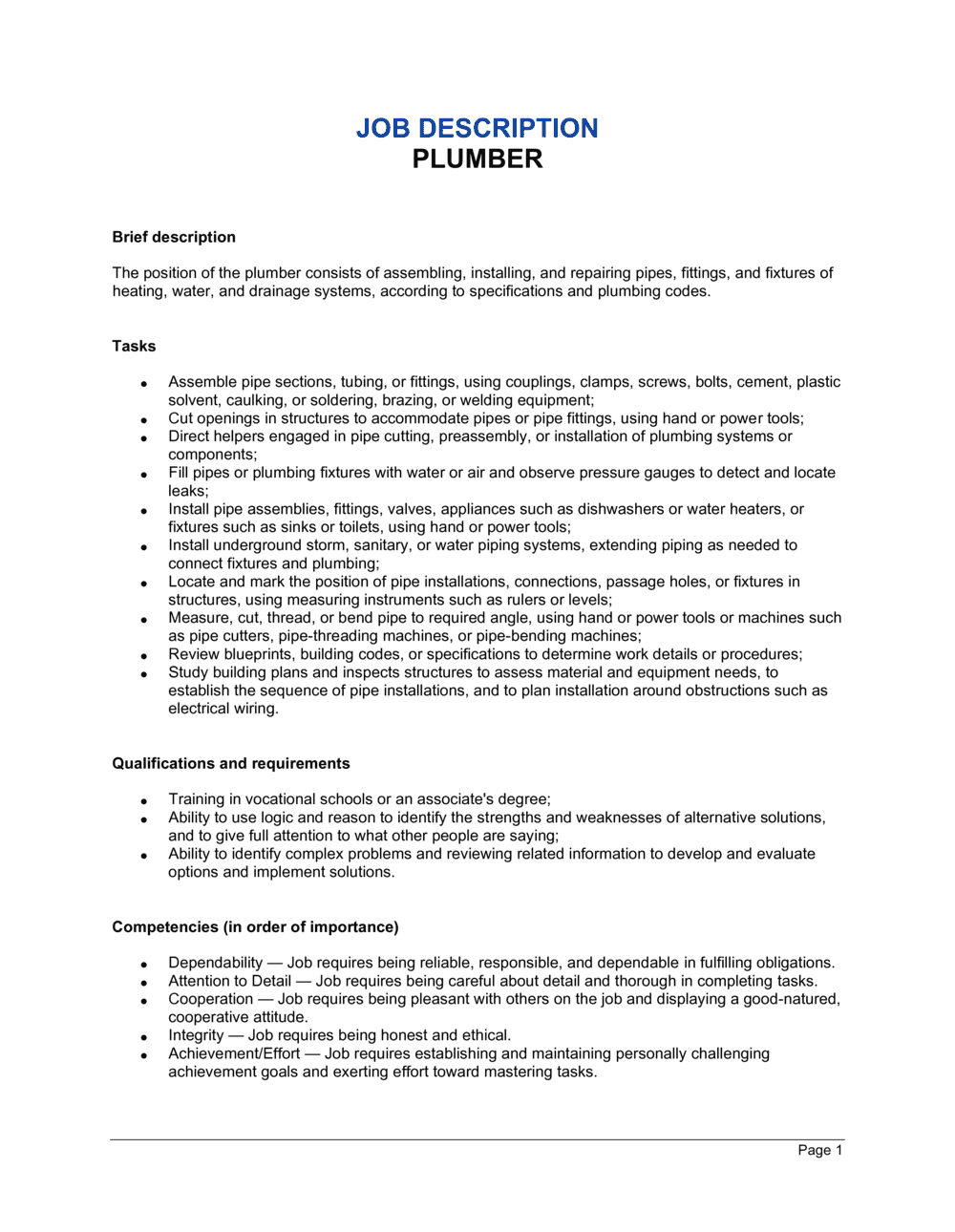
FreePlumber Job Description Template

At a glance

What it is
A Plumber Job Description is a formal employment document that defines the duties, qualifications, licensing requirements, physical demands, and compensation expectations for a plumbing role. This free Word download gives you a structured, legally grounded starting point you can edit online and export as PDF to use in job postings, offer letters, and signed employment files.
When you need it
Use it when hiring a new plumber — apprentice, journeyman, or master — or when formalizing duties for an existing employee whose role has evolved. It is also required whenever your jurisdiction mandates written job descriptions as part of the employment record.
What's inside
Position title and reporting structure, detailed duties and responsibilities, required and preferred qualifications, licensing and certification requirements, physical and environmental demands, compensation and benefits summary, and a signature block for employer and employee acknowledgment.

What is a Plumber Job Description?

A Plumber Job Description is a formal employment document that defines the title, license level, core duties, required qualifications, physical demands, safety obligations, and compensation expectations for a plumbing role. Unlike a casual job posting, a signed job description becomes part of the employee's permanent HR file and serves as the authoritative reference for performance evaluations, accommodation requests, and, when necessary, termination for cause. It also documents the employer's compliance with licensing, pay transparency, and occupational health and safety requirements that govern the skilled trades in most jurisdictions.

Why You Need This Document

Hiring a plumber without a written job description leaves four significant gaps simultaneously. First, without a documented license requirement, you may hire a worker whose credentials do not authorize the permit-pulling or supervisory work the role actually demands — creating code compliance and insurance liability on every job they touch. Second, without a physical demands statement, pre-employment screening decisions are legally indefensible under disability discrimination statutes in the US, Canada, and the UK. Third, in states and provinces with pay transparency laws, posting a role without a compensation range is a regulatory violation carrying civil penalties. Fourth, a job description without an employment-status disclaimer can be introduced as evidence of promised ongoing employment, undermining at-will status when you need to terminate. A completed, signed plumber job description closes all four gaps in 30 minutes — and gives you a legally grounded document that holds up when it matters.

Which variant fits your situation?

If your situation is…Use this template
Hiring an entry-level worker still completing their apprenticeshipApprentice Plumber Job Description
Hiring a licensed journeyman for residential service callsJourneyman Plumber Job Description
Hiring a master plumber to oversee a crew and sign off on permitsMaster Plumber Job Description
Engaging a plumber on a project basis rather than as an employeeIndependent Contractor Agreement
Hiring a plumber for large commercial or industrial installationsCommercial Plumber Job Description
Documenting duties for a plumbing foreman managing a field crewPlumbing Foreman Job Description
Creating a full employment contract to accompany the job descriptionEmployment Contract

Common mistakes to avoid

❌ Omitting the license level from the job title

Why it matters: Hiring a journeyman when the role requires a master plumber — or vice versa — creates permit-pulling liability, code compliance violations, and potential insurance gaps on completed work.

Fix: State the required license level in the title and in the required qualifications clause, and verify the candidate's license status with the issuing board before the offer letter is issued.

❌ Failing to distinguish essential from marginal functions

Why it matters: If every listed duty is treated as equally essential, accommodation requests become harder to manage and termination decisions based on inability to perform a minor task become legally vulnerable.

Fix: Review the duty list and mark the five to seven tasks that consume the most time or are most critical to the role's purpose as 'essential functions' in the document.

❌ Using a pay figure instead of a pay range

Why it matters: A single figure commits the employer to that exact rate and leaves no room for experience adjustments, while also violating pay transparency laws in an increasing number of jurisdictions.

Fix: State a range — e.g., '$32–$48/hr depending on license level and experience' — and note that final compensation is determined at offer based on qualifications.

❌ No acknowledgment disclaimer about employment status

Why it matters: A detailed job description without an at-will disclaimer can be introduced as evidence of promised ongoing employment, undermining the employer's ability to terminate without cause.

Fix: Add a one-sentence disclaimer above the signature block: 'This job description does not constitute a contract of employment or a guarantee of employment for any specific period.'

❌ Referencing a drug testing policy not yet provided to the employee

Why it matters: Disciplinary action or termination based on a drug testing policy the employee was never given has been ruled procedurally defective by courts and arbitrators.

Fix: Attach the current drug and alcohol policy as a signed exhibit and confirm receipt in writing on the same date the job description is signed.

❌ Setting physical requirements higher than the role actually demands

Why it matters: Inflated requirements — a 100-lb lift requirement for a role rarely exceeding 40 lbs — create disparate impact exposure and may screen out qualified candidates protected under disability law.

Fix: Conduct a brief task analysis or review prior workers' comp records to set physical demands at the actual levels encountered in the role, not aspirational maximums.

The 9 key clauses, explained

Position Title and Reporting Structure

In plain language: States the official job title, the department or division, and who the plumber reports to directly and indirectly.

Sample language
Position Title: [JOURNEYMAN / MASTER / APPRENTICE] Plumber | Department: [FIELD OPERATIONS / MAINTENANCE] | Reports To: [PLUMBING FOREMAN / OPERATIONS MANAGER] | Location: [CITY, STATE]

Common mistake: Using a generic title like 'Plumber' without specifying the license level. This creates misalignment between the posting, the hiring decision, and the payroll classification, and may expose the employer to misclassification claims.

Position Summary

In plain language: A 3–5 sentence overview of the role's purpose, the types of systems the plumber will work on, and the employment context — full-time, part-time, or seasonal.

Sample language
[COMPANY NAME] is seeking a full-time [TITLE] Plumber to install, maintain, and repair water supply, drainage, and gas piping systems at [RESIDENTIAL / COMMERCIAL / INDUSTRIAL] properties across [SERVICE AREA]. The role reports to [SUPERVISOR TITLE] and operates as part of a [X]-person field crew.

Common mistake: Writing a position summary that reads like a marketing tagline. A vague summary like 'join our dynamic team' provides no legally useful basis for performance management or termination for cause.

Essential Duties and Responsibilities

In plain language: A detailed, prioritized list of core tasks — installations, repairs, inspections, code compliance — that define the role's scope and form the basis for performance evaluations.

Sample language
Install, repair, and maintain water supply lines, drainage systems, gas lines, water heaters, fixtures, and backflow prevention devices in accordance with [STATE/LOCAL] plumbing codes. Diagnose and repair leaks, blockages, and pressure faults. Complete all work orders and service reports on the same business day.

Common mistake: Listing duties in no particular order without marking which are essential versus marginal. Under the ADA and equivalent statutes, only essential functions trigger accommodation analysis — failing to distinguish them creates legal exposure.

Required Qualifications and Education

In plain language: States the minimum credentials — license level, years of experience, and educational background — that a candidate must hold to be considered for the role.

Sample language
Required: Valid [STATE] [Journeyman / Master] Plumber license in good standing. Minimum [X] years of [residential / commercial] plumbing experience. High school diploma or GED. Valid driver's license with clean driving record.

Common mistake: Setting education requirements — such as 'associate's degree required' — that bear no relation to the actual job duties. Courts and the EEOC have found such requirements to have an unlawful disparate impact on protected groups when they are not demonstrably job-related.

Licenses, Certifications, and Continuing Education

In plain language: Lists every license and certification the plumber must hold on their first day and any continuing education obligations required to maintain employment.

Sample language
Must hold a valid [STATE] Plumber [Journeyman / Master] License at time of hire. Required certifications: OSHA 10 (OSHA 30 preferred), [STATE] backflow prevention tester certification (if applicable). Licenses must be renewed in compliance with [STATE LICENSING BOARD] renewal schedules at the employee's expense unless otherwise agreed in writing.

Common mistake: Omitting who bears the cost and time of license renewals. If the contract is silent, disputes arise over whether the employer owes paid leave for exam days or course fees — especially for master-level exams costing $500–$1,500.

Physical Demands and Working Conditions

In plain language: Quantifies lifting requirements, postures, environmental exposures, and travel expectations so the employer can conduct lawful pre-employment screening and manage accommodation requests.

Sample language
Must be able to lift and carry up to [50] lbs unassisted. Frequent kneeling, crouching, and working in confined spaces. Exposure to extreme temperatures, loud noise, and hazardous materials including sewage. Travel to job sites within [X]-mile radius required daily.

Common mistake: Inflating physical requirements beyond what the role actually demands to screen out applicants. Setting a 100-lb lift requirement for a residential service plumber who rarely lifts more than 40 lbs exposes the employer to disability discrimination claims.

Compensation, Pay Grade, and Benefits

In plain language: States the wage or salary range, pay frequency, overtime eligibility, and the benefits the plumber is entitled to — health insurance, tool allowance, vehicle use, and PTO.

Sample language
Hourly rate: $[MIN]–$[MAX] per hour depending on license level and experience. Pay frequency: bi-weekly. Overtime: eligible per [FLSA / applicable provincial law]. Benefits: [HEALTH / DENTAL / VISION], [X] days PTO, tool allowance of $[X]/year, company vehicle or mileage reimbursement at IRS standard rate.

Common mistake: Listing a single pay figure rather than a range. Stating only the minimum rate in writing and verbally promising more creates an unwritten obligation that is difficult to enforce or modify — and in several jurisdictions, pay transparency laws now require a range.

Safety Compliance and Drug Testing

In plain language: Documents the plumber's obligation to follow safety protocols, wear PPE, and comply with the employer's drug and alcohol policy — including pre-employment and random testing.

Sample language
Employee must comply with all OSHA standards, company safety policies, and site-specific safety requirements at all times. Employee consents to pre-employment drug screening and acknowledges the company's right to conduct random drug and alcohol testing in accordance with [COMPANY POLICY NAME], a copy of which is attached as Exhibit A.

Common mistake: Referencing a drug testing policy that does not yet exist or has not been distributed to the employee. Courts have rejected disciplinary action based on policies the employee was never given the opportunity to read and acknowledge.

Acknowledgment and Signature Block

In plain language: Confirms the employee has read, understood, and agreed to the job description — and that it does not constitute a contract of guaranteed employment unless a separate agreement says otherwise.

Sample language
By signing below, Employee acknowledges receipt of this job description and understands that it does not constitute a contract of employment or guarantee employment for any specific duration. This description may be modified by [COMPANY NAME] with reasonable notice. Employee: [SIGNATURE / DATE] | Employer Representative: [SIGNATURE / DATE / TITLE]

Common mistake: Omitting the disclaimer that the job description is not a guarantee of employment. Without it, a detailed job description can be used as evidence that the employer promised ongoing employment — undermining at-will status in US jurisdictions.

How to fill it out

  1. 1

    Enter the position title and license level

    Select the correct classification — Apprentice, Journeyman, or Master — and confirm it matches the license your jurisdiction requires for the work the employee will actually perform.

    💡 Check your state or provincial licensing board's exact title terminology. 'Journeyman' is used in most US states but some use 'Licensed Plumber' or 'Plumbing Technician' as the official classification.

  2. 2

    List essential duties in order of time allocation

    Rank duties from most to least time-intensive and mark the top five to seven as 'essential functions.' This ordering supports ADA accommodation analysis and performance review documentation.

    💡 Duties that take less than 5% of a plumber's weekly hours are unlikely to qualify as essential functions — keep them in the description but do not label them essential.

  3. 3

    Specify required versus preferred qualifications

    Separate hard requirements (valid journeyman license, clean driving record) from preferences (OSHA 30 certification, commercial experience). This widens your applicant pool without lowering the actual bar.

    💡 Every required qualification should have a direct, documented connection to a task in the duties section — this is your defense against disparate-impact claims.

  4. 4

    Fill in the physical demands with real numbers

    Enter actual weight limits based on the heaviest object the plumber regularly handles — copper pipe, water heater units, cast-iron sections — rather than a round number that sounds protective.

    💡 Review your workers' compensation claims history to identify the most common injury types. Match physical demand language to those risks to support pre-employment screening decisions.

  5. 5

    Set the compensation range and benefits

    Enter a wage range reflecting your local prevailing wage (if the role involves public work) or your internal pay bands. List every benefit with enough specificity that the employee knows what to expect on day one.

    💡 In states with pay transparency laws — including Colorado, California, New York, and Washington — posting a job without a salary range is a violation. Add the range to both the job description and the external posting.

  6. 6

    Attach and reference all policies by name

    If the job description references a safety manual, drug testing policy, or vehicle use agreement, attach each as a labeled exhibit and reference it in the relevant clause by exhibit letter.

    💡 Use the phrase 'as amended from time to time' when referencing policy documents that change periodically — this avoids creating a contractual obligation to the current version of a policy.

  7. 7

    Have both parties sign before the first shift

    Present the job description to the employee before or on their first day and obtain a dated signature. Store the original in the employee's HR file and give the employee a copy.

    💡 In Canada and the UK, post-hire signature on a document containing restrictions (drug testing consent, IP assignment) may be unenforceable without fresh consideration — execute before day one.

Frequently asked questions

What is a plumber job description?

A plumber job description is a formal employment document that defines a plumbing role's title, duties, qualifications, licensing requirements, physical demands, and compensation. It functions as both a hiring tool and a binding employment record — setting enforceable expectations for performance management, accommodation requests, and termination decisions. When signed by both parties, it becomes part of the employee's permanent HR file.

What should a plumber job description include?

At minimum: position title and license level, reporting structure, position summary, essential duties and responsibilities, required qualifications and certifications, physical demands and working conditions, compensation range and benefits, safety and drug testing obligations, and a signature block with an at-will or employment-status disclaimer. Omitting any of these creates legal gaps that can complicate hiring, accommodation, and termination decisions.

Does a plumber job description constitute an employment contract?

Not automatically — but it can be treated as one if it contains guarantee-of-employment language or is signed in a jurisdiction where courts look to the totality of written documents to determine employment terms. Including an explicit disclaimer — 'This document does not constitute a contract of guaranteed employment' — protects at-will status in US jurisdictions and limits implied-contract risk in common-law jurisdictions generally.

What licenses should a plumber job description require?

The required license depends on the role. An apprentice plumber needs enrollment in a state- or provincially-approved apprenticeship program. A journeyman plumber needs a valid journeyman license from the applicable licensing board. A master plumber needs a master license — required in most jurisdictions to pull permits and supervise others. Always verify the exact license designation with your state or provincial licensing board before finalizing the document.

Can I use the same job description for employees and independent contractors?

No. A detailed job description that specifies daily duties, required tools, work hours, and supervisor oversight is characteristic of an employment relationship. Attaching it to an independent contractor arrangement significantly strengthens a worker misclassification claim under the IRS, DOL, or provincial employment standards criteria. Use an Independent Contractor Agreement with a scope-of-work addendum instead for contractors.

What physical demands should I list for a plumber role?

Base physical demands on a documented task analysis of the actual role. Typical plumber demands include lifting 40–60 lbs regularly, frequent kneeling and crouching, working in confined spaces, exposure to temperature extremes and hazardous materials, and prolonged standing on uneven surfaces. These figures support pre-employment medical examinations and ADA or human rights code accommodation assessments.

Do pay transparency laws apply to plumber job descriptions?

Yes, in jurisdictions that have enacted pay transparency legislation — including California, Colorado, New York, Washington, and several Canadian provinces. These laws require that a wage or salary range be included in any external job posting and, in some cases, in the internal job description. The range should reflect the actual pay band for the role, not an aspirational ceiling or a floor set at minimum wage.

How often should a plumber job description be updated?

Review it whenever the role's duties materially change — new equipment, expanded service territory, added license requirements, or a shift from residential to commercial work. A description more than two years old may no longer reflect the essential functions courts would evaluate in a disability accommodation dispute or a wrongful termination claim. Annual review aligned to the performance cycle is standard practice.

What is the difference between a plumber job description and a job posting?

A job description is an internal employment document defining duties, qualifications, and terms — signed by the employee and kept in the HR file. A job posting is the external advertisement derived from the job description, edited for tone and brevity and published on job boards. The job description is the authoritative legal record; the posting is the marketing version. They should be consistent but need not be identical.

How this compares to alternatives

vs Employment Contract

An employment contract is the binding agreement governing the entire employment relationship — compensation, IP, non-compete, confidentiality, and termination terms. A job description defines the specific duties and qualifications for a role. The two documents work together: the job description specifies what the employee does; the employment contract specifies the legal terms under which they do it. Using a job description without an employment contract leaves confidentiality, non-compete, and severance obligations undefined.

vs Independent Contractor Agreement

An independent contractor agreement engages a self-employed plumber for project-based work without creating an employment relationship — no benefits, no tax withholding, no overtime. A job description signals employee status through its specification of hours, supervision, and daily duties. Using a job description for a worker you intend to treat as a contractor is a primary indicator of misclassification under IRS, DOL, and provincial labor authority tests.

vs Job Offer Letter

A job offer letter summarizes compensation, start date, and role title to secure the candidate's acceptance. It does not contain the detailed duty statements, physical demands, or safety compliance obligations that a job description captures. An offer letter and job description serve different purposes and should both be executed — the offer letter triggers acceptance; the signed job description becomes the permanent role record.

vs Scope of Work (Construction Contract)

A scope of work is a project-level document attached to a construction or service contract that defines deliverables, timelines, and materials for a specific engagement. A job description is a personnel document defining an ongoing employee role. A scope of work governs a transaction; a job description governs a person. General contractors sometimes confuse the two when onboarding trade workers — the correct document depends entirely on whether the worker is an employee or a contractor.

Industry-specific considerations

Residential Construction

New-build rough-in and finish plumbing duties, code inspection sign-off responsibilities, and warranty call-back obligations tied to builder liability periods.

Commercial and Industrial Facilities

Large-diameter piping, fire suppression system integration, prevailing wage compliance, and OSHA 30 certification requirements for multi-employer worksites.

Property Management

Emergency response availability requirements, multi-unit building maintenance scope, and documentation obligations for habitability compliance under local landlord-tenant codes.

Municipal and Public Works

Civil service classification alignment, union agreement interaction, Davis-Bacon or prevailing wage obligations, and background check requirements for work on public infrastructure.

Jurisdictional notes

United States

Plumber licensing is regulated at the state level — there is no federal plumber's license. Requirements range from no statewide license (some states defer to municipalities) to a tiered apprentice/journeyman/master system with separate exams. The ADA requires job descriptions to distinguish essential from marginal functions before a hiring decision is made. Pay transparency laws in California, Colorado, New York, and Washington require a compensation range in all job postings. Federal Davis-Bacon Act prevailing wages apply on federally funded construction projects.

Canada

Plumbers in Canada are regulated under the Red Seal Program (Interprovincial Standards), allowing journeyman certification to be recognized across most provinces. Employment standards vary by province — Ontario, Alberta, and BC each set different minimum notice, overtime, and pay requirements. Job descriptions referencing drug testing must align with human rights codes, which require individualized accommodation analysis before any adverse action. Quebec job descriptions for provincially regulated employers must be provided in French.

United Kingdom

Plumbers in the UK are not subject to a mandatory statutory licensing regime, though Gas Safe registration is legally required for any work on gas fittings and appliances. Employers must provide a written statement of employment particulars — which includes the job description — on or before the employee's first day under the Employment Rights Act 1996. Physical demand statements should reflect Equality Act 2010 reasonable adjustment obligations. The National Living Wage sets the floor for plumber compensation regardless of what the job description states.

European Union

Plumbing qualifications vary significantly across EU member states — some require nationally recognized vocational credentials while others operate through guild or trade association certification. The EU Transparent and Predictable Working Conditions Directive requires written employment terms, including a description of duties, within seven calendar days of hire. GDPR considerations apply when collecting health or disability information during the physical demands assessment process. Non-EU national workers may require a work permit specifying their trade classification, making an accurate job description essential for visa applications.

Template vs lawyer — what fits your deal?

PathBest forCostTime
Use the templateSmall plumbing companies and property managers hiring standard journeyman or apprentice roles in a single US state or Canadian provinceFree15–30 minutes
Template + legal reviewEmployers in pay-transparency jurisdictions, roles requiring drug testing consent, or positions on publicly funded projects subject to prevailing wage$200–$500 for an HR consultant or employment lawyer review1–3 days
Custom draftedMulti-state or cross-border plumbing operations, unionized workforces, or roles with complex licensing, safety, or accommodation requirements$500–$2,000+1–2 weeks

Glossary

Journeyman Plumber
A licensed plumber who has completed an apprenticeship and passed a state or provincial licensing exam, qualified to work independently under a master plumber's oversight.
Master Plumber
The highest trade license level, allowing the holder to pull permits, supervise apprentices and journeymen, and take full legal responsibility for plumbing installations.
Apprentice Plumber
A trainee who works under a licensed plumber while completing a formal apprenticeship program, typically 4–5 years, combining on-the-job hours with classroom instruction.
Essential Functions
The core duties an employee must be able to perform with or without reasonable accommodation — the term used in ADA compliance analysis in the United States.
Physical Demands Statement
A section of a job description that quantifies lifting requirements, postural demands, and environmental exposures to support pre-employment screening and accommodation assessments.
Prevailing Wage
A government-mandated minimum hourly rate for specific trades on publicly funded projects, determined by the US Department of Labor (Davis-Bacon Act) or equivalent provincial or national authority.
OSHA 10 / OSHA 30
US Occupational Safety and Health Administration training certifications — 10-hour for general site workers and 30-hour for supervisors — commonly required for plumbers on commercial and public construction projects.
At-Will Employment
An employment relationship that either party may end at any time for any lawful reason — the default in most US states but absent in Canada, the UK, and the EU.
Scope of Work
A defined list of tasks, systems, and site conditions the plumber is expected to address, used to distinguish the role from adjacent trades and limit liability disputes.
Reasonable Accommodation
A modification to a job's duties, schedule, tools, or environment that enables a qualified person with a disability to perform the essential functions without undue hardship to the employer.

Part of your Business Operating System

This document is one of 3,000+ business & legal templates included in Business in a Box.

  • Fill-in-the-blanks — ready in minutes
  • 100% customizable Word document
  • Compatible with all office suites
  • Export to PDF and share electronically

Create your document in 3 simple steps.

From template to signed document — all inside one Business Operating System.
1
Download or open template

Access over 3,000+ business and legal templates for any business task, project or initiative.

2
Edit and fill in the blanks with AI

Customize your ready-made business document template and save it in the cloud.

3
Save, Share, Send, Sign

Share your files and folders with your team. Create a space of seamless collaboration.

Save time, save money, and create top-quality documents.

★★★★★

"Fantastic value! I'm not sure how I'd do without it. It's worth its weight in gold and paid back for itself many times."

Managing Director · Mall Farm
Robert Whalley
Managing Director, Mall Farm Proprietary Limited
★★★★★

"I have been using Business in a Box for years. It has been the most useful source of templates I have encountered. I recommend it to anyone."

Business Owner · 4+ years
Dr Michael John Freestone
Business Owner
★★★★★

"It has been a life saver so many times I have lost count. Business in a Box has saved me so much time and as you know, time is money."

Owner · Upstate Web
David G. Moore Jr.
Owner, Upstate Web

Run your business with a system — not scattered tools

Stop downloading documents. Start operating with clarity. Business in a Box gives you the Business Operating System used by over 250,000 companies worldwide to structure, run, and grow their business.

Free Forever Plan · No credit card required