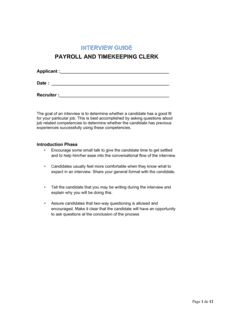
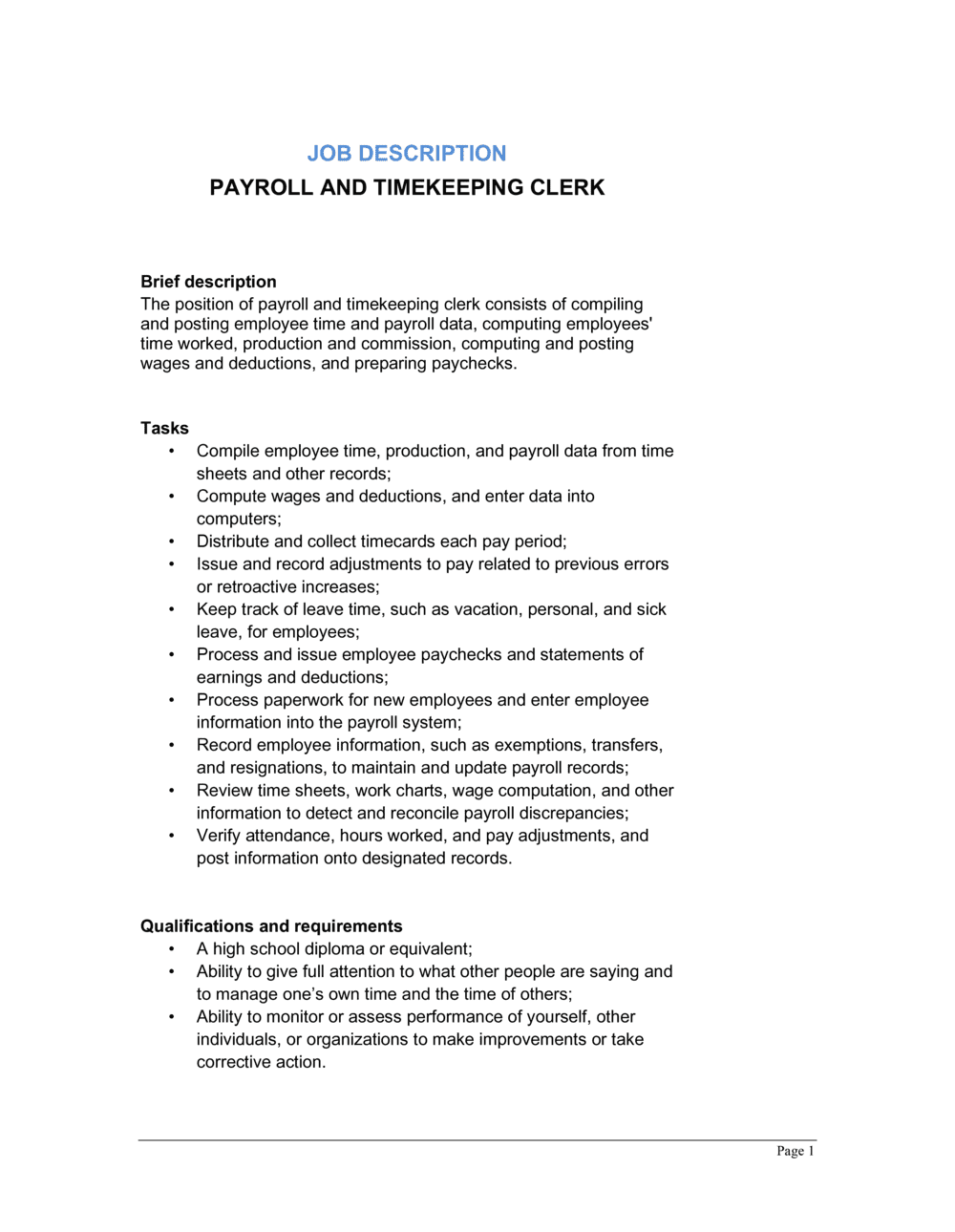
Payroll and Timekeeping Clerk Job Description Template

Free Word download • Edit online • Save & share with Drive • Export to PDF

3 pages20–30 min to fillDifficulty: StandardSignature requiredLegal review recommended
Learn more ↓
FreePayroll and Timekeeping Clerk Job Description Template

At a glance

What it is
A Payroll and Timekeeping Clerk Job Description is a formal binding document that defines the duties, reporting structure, qualifications, compliance obligations, and performance expectations for a payroll and timekeeping clerk role within an organization. This free Word download gives you a professionally structured starting point you can edit online and export as PDF for use in job postings, offer letters, and employee files.
When you need it
Use it when hiring or onboarding a payroll and timekeeping clerk, restructuring your payroll function, or updating role definitions to reflect new compliance requirements or system changes. It is also required when the position is referenced in an employment contract, used to support a wage-and-hour audit, or submitted to HR certification bodies.
What's inside
Role summary, core duties, timekeeping and recordkeeping responsibilities, reporting structure, required qualifications and certifications, tools and systems proficiency, performance expectations, confidentiality obligations, and compensation and classification disclosures.

What is a Payroll and Timekeeping Clerk Job Description?

A Payroll and Timekeeping Clerk Job Description is a formal document that defines the duties, reporting structure, required qualifications, compliance obligations, confidentiality requirements, and performance standards for an employee responsible for processing payroll and maintaining employee time records. It functions simultaneously as a hiring tool, an onboarding reference, and a binding operational document placed in the employee's personnel file. Because payroll clerks handle sensitive compensation data, tax identification numbers, and bank account details for every employee in an organization, the job description carries legal weight beyond a typical role summary — courts and regulators routinely rely on it in wage-and-hour audits, privacy investigations, and wrongful termination proceedings.

Why You Need This Document

Operating without a written, signed payroll and timekeeping clerk job description creates four concrete risks. First, an incorrect FLSA classification embedded in an informal role description — or no description at all — exposes the employer to retroactive overtime liability of up to three years plus liquidated damages. Second, vague duty definitions make it nearly impossible to substantiate a termination for cause when payroll errors occur, because ownership of specific tasks was never documented. Third, the absence of a role-specific confidentiality clause leaves the employer unable to demonstrate that an employee who accessed or disclosed compensation data had received explicit notice of their data-handling obligations — a requirement under GDPR, PIPEDA, and an expanding list of US state privacy laws. Fourth, without documented performance standards, disputes over payroll accuracy and timeliness become credibility contests rather than contract interpretation. This template gives you a professionally structured, jurisdiction-aware starting point that closes all four gaps in under an hour.

Which variant fits your situation?

If your situation is…Use this template
Hiring a senior payroll professional managing multi-jurisdiction payrollPayroll Manager Job Description
Defining a role focused exclusively on benefits and deductions administrationBenefits Administrator Job Description
Hiring a generalist HR clerk who will handle payroll as one of several dutiesHR Clerk Job Description
Engaging a freelance payroll specialist for a project-based engagementIndependent Contractor Agreement
Formalizing the hire with a binding employment agreementEmployment Contract
Creating a job description for a payroll system implementation roleFinancial Systems Analyst Job Description
Hiring an entry-level data entry clerk to support payroll processingData Entry Clerk Job Description

Common mistakes to avoid

❌ Incorrect FLSA exemption classification

Why it matters: Classifying a payroll clerk as exempt when they qualify as non-exempt triggers retroactive overtime liability under the FLSA — up to three years of back pay plus liquidated damages equal to the same amount.

Fix: Apply the FLSA duties test for administrative exemption before finalizing the classification. When the role is borderline, default to non-exempt or obtain a written opinion from an employment attorney.

❌ Vague duty descriptions that say 'assists with payroll'

Why it matters: When a payroll error occurs, ownership is disputed if the job description does not state which tasks the clerk owns end-to-end — complicating disciplinary action and audit responses.

Fix: Rewrite each duty as a specific, active-voice task: 'Enters all approved timesheets into ADP by 5:00 PM each Thursday prior to pay date.'

❌ Omitting a confidentiality clause specific to payroll data

Why it matters: Payroll clerks access compensation, bank account, and tax ID data for every employee. A generic confidentiality statement does not put the clerk on notice that payroll data carries heightened protection under privacy and labor laws.

Fix: Add a payroll-specific data handling clause that names the data categories, the authorized uses, and the applicable privacy policy — and have the employee acknowledge it in writing.

❌ No quantified performance standards in the document

Why it matters: Without measurable benchmarks, 'unsatisfactory performance' is subjective and difficult to substantiate in a termination proceeding — particularly in jurisdictions requiring documented cause.

Fix: Set specific, numeric targets: error rate per pay cycle, time-entry completion deadline, and response time for employee payroll inquiries.

❌ Single-jurisdiction retention period applied to multi-state or multi-province workforce

Why it matters: Applying only the federal three-year FLSA minimum when employees work in states with longer requirements — such as California's four-year statute of limitations on wage claims — creates compliance gaps that surface in litigation.

Fix: Audit the retention requirements for each state, province, or country where employees work, then apply the longest period as the company-wide standard.

❌ Signing the job description after the employee's start date

Why it matters: A job description signed after employment begins may be challenged as lacking fresh consideration in common-law jurisdictions, weakening confidentiality and performance standard clauses.

Fix: Execute the job description before or on the employee's first day and file a signed copy in the personnel record immediately.

The 10 key clauses, explained

Role Summary and Classification

In plain language: Defines the position's purpose in one to three sentences and states the FLSA exemption status, EEO job category, and full-time or part-time classification.

Sample language
The Payroll and Timekeeping Clerk is a non-exempt, full-time administrative support position responsible for processing payroll and maintaining accurate timekeeping records for all [COMPANY NAME] employees. EEO Category: Administrative Support.

Common mistake: Omitting the FLSA exemption status from the job description. If the classification is wrong and an audit occurs, the employer bears the burden of proof — and retroactive overtime liability can extend up to three years under the FLSA.

Reporting Structure

In plain language: Identifies who the clerk reports to, any dotted-line relationships, and whether the role has supervisory responsibilities over other staff.

Sample language
Reports directly to the [PAYROLL MANAGER / CONTROLLER / HR DIRECTOR]. Works in close coordination with the [ACCOUNTING DEPARTMENT] and [HUMAN RESOURCES TEAM]. No direct reports.

Common mistake: Listing dual reporting lines without clarifying which is primary. Ambiguous authority creates confusion about who approves timesheets, authorizes corrections, and conducts performance reviews.

Core Payroll Processing Duties

In plain language: Itemizes the clerk's primary responsibilities in running payroll — collecting timesheets, entering hours, processing adjustments, and distributing pay.

Sample language
Collect, verify, and enter employee timekeeping data for each pay period; process payroll adjustments including retroactive pay, bonuses, and termination checks; distribute pay stubs and direct deposit confirmations; resolve discrepancies with employees and managers within [X] business days.

Common mistake: Using vague language like 'assists with payroll' instead of specifying which steps the clerk owns end-to-end. Vague duties create accountability gaps and complicate performance management when errors occur.

Timekeeping System Administration

In plain language: Covers the clerk's responsibility for maintaining the time and attendance system — setting up new hires, correcting punches, running reports, and ensuring system accuracy.

Sample language
Maintain employee records in [TIME AND ATTENDANCE SYSTEM]; configure new-hire profiles within [X] business days of onboarding; audit and correct time entries flagged for exceptions; generate weekly attendance reports for department managers.

Common mistake: Failing to specify which system the clerk administers. When the role becomes vacant, the absence of system-specific duties makes it harder to assess candidates or train a replacement.

Recordkeeping and Compliance Obligations

In plain language: States the clerk's duty to retain payroll and timekeeping records in accordance with applicable laws — typically three to seven years depending on jurisdiction — and to support audits and wage claims.

Sample language
Maintain payroll records — including timesheets, pay stubs, and adjustment documentation — for a minimum of [X] years in accordance with [APPLICABLE LAW / COMPANY POLICY]; produce records upon request during government audits, wage claims, or internal investigations.

Common mistake: Setting a single retention period without checking jurisdiction-specific requirements. The US FLSA requires a minimum of three years, but IRS records must be kept four years, and several states require longer periods for state tax purposes.

Garnishment and Deduction Processing

In plain language: Assigns responsibility for calculating, applying, and remitting wage garnishments, child support orders, tax levies, and voluntary deductions such as benefits premiums and retirement contributions.

Sample language
Process all mandatory wage garnishments — including child support, tax levies, and creditor orders — and voluntary deductions — including health insurance premiums and [401(k) / RRSP] contributions — accurately within each pay period; remit amounts to the appropriate agencies or vendors by the required deadlines.

Common mistake: Omitting garnishment responsibilities from the job description entirely. When a garnishment is missed or late, the employer — not just the clerk — faces liability for the shortfall and potential contempt of court.

Confidentiality and Data Handling

In plain language: Establishes the clerk's obligation to protect employee compensation data, social security and tax identification numbers, bank account details, and benefit elections from unauthorized disclosure.

Sample language
Treat all employee payroll data as strictly confidential; access, use, and share compensation and personal tax information only as required to perform assigned duties; comply with [COMPANY NAME]'s data privacy policy and applicable laws including [APPLICABLE PRIVACY LAW].

Common mistake: Using a generic confidentiality statement that does not specify payroll data categories. Courts and regulators expect employers to demonstrate that employees who handle sensitive compensation data received explicit, role-specific privacy instructions.

General Ledger and Accounting Coordination

In plain language: Defines the clerk's role in coding payroll expenses to the correct GL accounts, preparing journal entries, and reconciling payroll registers to accounting records.

Sample language
Assign payroll expenses to the appropriate general ledger cost centers; prepare and submit payroll journal entries to the Accounting team by [DEADLINE]; assist with monthly payroll reconciliations and respond to queries from the Controller or external auditors.

Common mistake: Assigning GL coding responsibilities without specifying the deadline relative to payroll close. Without a deadline tied to accounting close, payroll entries are submitted late and delay month-end financial reporting.

Required Qualifications and Systems Proficiency

In plain language: Lists minimum education, experience, certifications, and software skills required to perform the role — including specific payroll systems, spreadsheet tools, and any preferred credentials.

Sample language
Minimum requirements: high school diploma or equivalent; [2] years of payroll processing experience; proficiency in [PAYROLL SOFTWARE — e.g., ADP, Paychex, Ceridian]; intermediate Excel skills; CPP or FPC certification preferred.

Common mistake: Setting qualifications so broadly (e.g., 'accounting degree required') that they screen out qualified candidates with equivalent payroll-specific experience, limiting the applicant pool and potentially triggering disparate-impact claims.

Performance Expectations and Review Cadence

In plain language: Sets measurable standards for accuracy, timeliness, and error rates, and states how and how often performance will be evaluated.

Sample language
Maintain a payroll processing error rate of no more than [X]% per pay period; complete all time-entry tasks by [DAY/TIME] each pay period; participate in quarterly performance reviews conducted by the [PAYROLL MANAGER / HR DIRECTOR].

Common mistake: Omitting quantified performance standards from the job description. Without them, 'unsatisfactory performance' is difficult to substantiate in a termination for cause — creating wrongful dismissal exposure.

How to fill it out

  1. 1

    Enter the company name and job classification details

    Fill in your legal entity name, the role's FLSA exemption status (non-exempt is typical for clerks), EEO category, and whether the position is full-time or part-time.

    💡 Confirm FLSA classification with your HR or legal team before publishing — misclassifying a non-exempt role as exempt is one of the most common and costly payroll compliance errors.

  2. 2

    Define the reporting structure clearly

    Identify the primary supervisor by title, any dotted-line relationships, and whether the role interacts regularly with Accounting, HR, or department managers.

    💡 Use titles, not names — job descriptions outlast the individuals filling each role, and names require frequent updates.

  3. 3

    List specific payroll and timekeeping duties

    Replace generic phrases like 'assists with payroll' with end-to-end task ownership: which steps the clerk initiates, which they approve, and which outputs they produce each pay period.

    💡 Draft this section by walking through your current pay cycle step by step — every task the clerk performs is a bullet point.

  4. 4

    Name the systems and tools used

    Specify the payroll software (e.g., ADP Workforce Now, Ceridian Dayforce, Paychex Flex), time and attendance system, and any ERP or accounting platform the clerk interfaces with.

    💡 System-specific requirements in the job posting filter for candidates who need less training and can be productive faster.

  5. 5

    Set recordkeeping retention periods

    Enter the minimum retention period for payroll and timekeeping records based on the jurisdictions where your employees work. Cross-reference federal, state or provincial, and tax authority requirements.

    💡 When requirements conflict, use the longest applicable retention period — it satisfies all jurisdictions simultaneously.

  6. 6

    Add confidentiality and data handling obligations

    Include a specific clause listing the categories of sensitive data the clerk will access — compensation figures, tax IDs, bank account numbers, benefit elections — and the policies that govern their handling.

    💡 Reference your data privacy policy by name and version so there is a clear audit trail linking the job description to the governing policy.

  7. 7

    Specify qualifications and certifications

    List minimum and preferred education, experience, software skills, and certifications. The FPC (Fundamental Payroll Certification) is appropriate for clerks; the CPP (Certified Payroll Professional) is more appropriate for managers.

    💡 Mark each requirement as 'required' or 'preferred' — combining them into one undifferentiated list causes qualified candidates to self-select out unnecessarily.

  8. 8

    Set measurable performance standards and have both parties sign

    Enter specific, numeric performance targets (error rate, on-time completion rate) and the review cadence. Obtain the employee's signature before or on the first day of employment.

    💡 A signed job description placed in the employee's personnel file gives you documented acknowledgment of duties — essential evidence if performance or compliance issues arise later.

Frequently asked questions

What is a payroll and timekeeping clerk job description?

A payroll and timekeeping clerk job description is a formal document that defines the duties, required qualifications, reporting structure, compliance obligations, and performance standards for a clerk who processes payroll and maintains employee time records. It functions as both a hiring tool and a binding reference document placed in the employee's personnel file. When signed by the employee, it creates documented acknowledgment of role expectations — relevant in audits, disputes, and performance proceedings.

Is a job description a legally binding document?

A job description is generally not a standalone employment contract, but it can carry legal weight in several contexts. Courts have used job descriptions as evidence of an employee's duties in wage-and-hour classification disputes, discrimination claims, and wrongful termination cases. When incorporated by reference into an employment contract or signed as a standalone acknowledgment, specific clauses — such as confidentiality obligations and performance standards — become enforceable. Treat it as a binding operational document regardless of jurisdiction.

What is the difference between a payroll clerk and a payroll manager?

A payroll clerk is typically a non-exempt administrative role responsible for data entry, timekeeping administration, deduction processing, and record maintenance within a defined pay cycle. A payroll manager oversees the function — setting policy, managing staff, ensuring compliance across jurisdictions, and liaising with external auditors and tax authorities. The manager role is typically exempt, compensated at a higher level, and requires certifications such as the CPP. Each role requires a separate job description.

What certifications are relevant for a payroll and timekeeping clerk?

The Fundamental Payroll Certification (FPC) issued by the American Payroll Association is the standard entry-level credential for payroll clerks in the US and is recognized by many Canadian employers. The Certified Payroll Professional (CPP) is more appropriate for senior or managerial roles. In Canada, the National Payroll Institute offers the Payroll Compliance Practitioner (PCP) designation. Listing FPC as 'preferred' rather than 'required' keeps the applicant pool broad for entry-level hires.

How long must payroll and timekeeping records be retained?

In the US, the FLSA requires payroll and timekeeping records to be kept for at least three years; IRS records for four years. Several states — including California and New York — require longer periods. In Canada, the CRA requires payroll records for six years from the end of the tax year. In the UK, HMRC requires payroll records for three years after the end of the tax year. For multi-jurisdiction employers, applying the longest applicable period as a single company-wide standard is the most efficient approach.

What payroll software should a clerk be proficient in?

The most widely used platforms in North America are ADP Workforce Now, Paychex Flex, Ceridian Dayforce, and Paylocity. QuickBooks Payroll is common in smaller businesses. The correct answer depends on what your organization uses — specify the actual system in the job description rather than a generic requirement. Intermediate Excel skills are universally expected for payroll reconciliation, journal entry preparation, and exception reporting.

Should the job description include a confidentiality clause?

Yes. Payroll clerks access compensation data, tax identification numbers, bank account details, and benefits elections for every employee in the organization. A role-specific confidentiality clause — naming the data categories, authorized uses, and applicable privacy policy — puts the clerk on explicit notice of their obligations. This is particularly important under GDPR in the EU and UK, PIPEDA in Canada, and state privacy laws such as California's CCPA, where employers must demonstrate that employees handling personal data received specific data-handling instructions.

How do I classify a payroll clerk under the FLSA?

Payroll and timekeeping clerks are typically classified as non-exempt under the FLSA because their primary duties are routine data entry and record maintenance rather than the exercise of discretion and independent judgment required for the administrative exemption. To qualify as exempt, an employee must earn at least $684 per week (as of 2024) and their primary duty must include office work directly related to management or general business operations, exercising discretion on matters of significance. Most clerks do not meet this standard. Consult an employment attorney if the role is borderline.

Can I use one job description for multiple payroll clerks?

Yes, provided all incumbents perform substantially the same duties, use the same systems, and operate under the same reporting structure. If one clerk handles multi-state payroll while another processes only a single-state workforce, or if their seniority levels differ materially, separate descriptions are cleaner for performance management and FLSA classification purposes. Each signed copy should be individualized with the employee's name and signature date before filing.

How this compares to alternatives

vs Payroll Manager Job Description

A payroll manager job description covers a supervisory, typically exempt role responsible for compliance strategy, staff oversight, and cross-jurisdiction payroll governance. The clerk description defines an individual contributor, non-exempt processing role. Using a manager template for a clerk hire risks misclassification under the FLSA and overstates the seniority of the position.

vs HR Clerk Job Description

An HR clerk job description covers a broader administrative role spanning recruitment coordination, benefits administration, and employee records — with payroll as one of many duties. The payroll and timekeeping clerk description is focused exclusively on compensation processing and time records. Use the payroll-specific template when the role is dedicated to payroll; use the HR clerk template when payroll is a secondary responsibility.

vs Employment Contract

An employment contract is the binding legal agreement that governs compensation, termination, confidentiality, and IP for a specific hire. A job description defines duties and performance standards but is not a complete employment agreement. Both documents are needed — the job description is typically incorporated by reference into or attached to the employment contract.

vs Independent Contractor Agreement

An independent contractor agreement is used when engaging a self-employed payroll specialist for project-based work — no employment relationship, no benefits, no tax withholding. A job description establishes an employment relationship with all associated legal obligations. Misclassifying a payroll clerk as a contractor triggers back taxes, penalties, and potential benefit liability.

Industry-specific considerations

Healthcare

Shift differentials, on-call pay, licensure pay premiums, and complex overtime rules under state health department regulations require specialized timekeeping configurations.

Manufacturing

Multiple shift schedules, piece-rate and incentive pay calculations, union collective bargaining agreement compliance, and OSHA recordkeeping integration make timekeeping accuracy especially critical.

Retail / Hospitality

High employee turnover, tipped wage tracking, split-shift premiums, and variable schedules create high transaction volume and frequent correction cycles for payroll clerks.

Professional Services

Project-based billing requires timekeeping records to be coded to client matters as well as payroll accounts, creating dual reporting obligations to both HR and client finance teams.

Construction

Prevailing wage and Davis-Bacon Act compliance, certified payroll report preparation, and multi-jobsite tracking add significant complexity to the timekeeping clerk role.

Financial Services

Strict data privacy requirements, variable compensation structures including commissions and discretionary bonuses, and FINRA record retention rules require elevated accuracy and confidentiality standards.

Jurisdictional notes

United States

The FLSA requires payroll records to be retained for at least three years and time records for two years. Payroll clerks are typically non-exempt and entitled to overtime. Several states — including California, New York, and Washington — impose additional wage statement, pay frequency, and record retention requirements that must be reflected in the job description and recordkeeping clause. The IRS requires payroll tax records to be kept for four years.

Canada

Federal and provincial employment standards legislation requires payroll records to be retained for six years from the end of the tax year under CRA rules. Each province has its own employment standards for minimum wage, overtime thresholds, and pay statement requirements — Ontario, British Columbia, and Alberta differ materially. Quebec employers must ensure that job descriptions and employment documents are provided in French for provincially regulated workplaces.

United Kingdom

HMRC requires payroll records to be kept for three years after the end of the relevant tax year. Employers must provide a written statement of employment particulars on or before the first day of work under the Employment Rights Act 1996 — the job description should be attached or incorporated. GDPR as retained in UK law requires that employees who handle personal payroll data receive specific data-processing instructions, making the confidentiality clause especially important.

European Union

GDPR requires organizations to document the lawful basis for processing employees' payroll data and to ensure that staff who handle personal data receive role-specific data protection training and instructions. The EU Transparent and Predictable Working Conditions Directive requires written employment terms on or before day one, with clear duty descriptions. Record retention periods for payroll data vary by member state — Germany requires ten years under the Commercial Code, while France requires five years under the Labor Code.

Template vs lawyer — what fits your deal?

PathBest forCostTime
Use the templateSmall and mid-size businesses hiring a single-jurisdiction payroll clerk in a standard non-exempt roleFree30–60 minutes
Template + legal reviewEmployers with multi-state or multi-province workforces, unionized environments, or regulated industries such as healthcare or financial services$200–$500 for an HR consultant or employment attorney review1–3 days
Custom draftedLarge employers with complex payroll structures, international operations, or a history of wage-and-hour claims requiring defensible role documentation$500–$2,000+1–2 weeks

Glossary

Timekeeping Record
A documented log of hours worked by each employee — by day, week, and pay period — used to calculate gross wages.
Pay Period
The recurring interval (weekly, bi-weekly, semi-monthly, or monthly) over which employee hours and earnings are measured and paid.
Gross Wages
An employee's total earnings before any deductions — taxes, benefits premiums, retirement contributions, or garnishments.
Net Pay
The amount an employee receives after all mandatory and voluntary deductions are subtracted from gross wages.
FLSA Exempt / Non-Exempt
A US classification determining whether an employee is entitled to overtime pay under the Fair Labor Standards Act — non-exempt employees must receive 1.5× their regular rate for hours over 40 per week.
Garnishment
A court-ordered or government-mandated deduction from an employee's wages, such as child support or a tax levy, which the employer must process and remit.
W-2 / T4 / P60
Annual tax forms issued to employees summarizing wages paid and taxes withheld — called a W-2 in the US, T4 in Canada, and P60 in the UK.
General Ledger Coding
The process of assigning payroll expenses to the correct accounts in the company's accounting system so that labor costs are accurately reported.
Payroll Reconciliation
The process of comparing payroll register totals to bank disbursements and GL entries to confirm that every figure balances at period end.
EEO Classification
Equal Employment Opportunity job category codes (e.g., professionals, administrative support) that employers use in government compliance reporting.
PTO Accrual
The incremental earning of paid time off — vacation, sick, or personal days — based on hours worked or tenure, tracked in the payroll system.

Part of your Business Operating System

This document is one of 3,000+ business & legal templates included in Business in a Box.

  • Fill-in-the-blanks — ready in minutes
  • 100% customizable Word document
  • Compatible with all office suites
  • Export to PDF and share electronically

Create your document in 3 simple steps.

From template to signed document — all inside one Business Operating System.
1
Download or open template

Access over 3,000+ business and legal templates for any business task, project or initiative.

2
Edit and fill in the blanks with AI

Customize your ready-made business document template and save it in the cloud.

3
Save, Share, Send, Sign

Share your files and folders with your team. Create a space of seamless collaboration.

Save time, save money, and create top-quality documents.

★★★★★

"Fantastic value! I'm not sure how I'd do without it. It's worth its weight in gold and paid back for itself many times."

Managing Director · Mall Farm
Robert Whalley
Managing Director, Mall Farm Proprietary Limited
★★★★★

"I have been using Business in a Box for years. It has been the most useful source of templates I have encountered. I recommend it to anyone."

Business Owner · 4+ years
Dr Michael John Freestone
Business Owner
★★★★★

"It has been a life saver so many times I have lost count. Business in a Box has saved me so much time and as you know, time is money."

Owner · Upstate Web
David G. Moore Jr.
Owner, Upstate Web

Run your business with a system — not scattered tools

Stop downloading documents. Start operating with clarity. Business in a Box gives you the Business Operating System used by over 250,000 companies worldwide to structure, run, and grow their business.

Free Forever Plan · No credit card required