Municipal Clerk Job Description Template

Free Word download • Edit online • Save & share with Drive • Export to PDF

2 pages20–30 min to fillDifficulty: StandardSignature requiredLegal review recommended
Learn more ↓
FreeMunicipal Clerk Job Description Template

At a glance

What it is
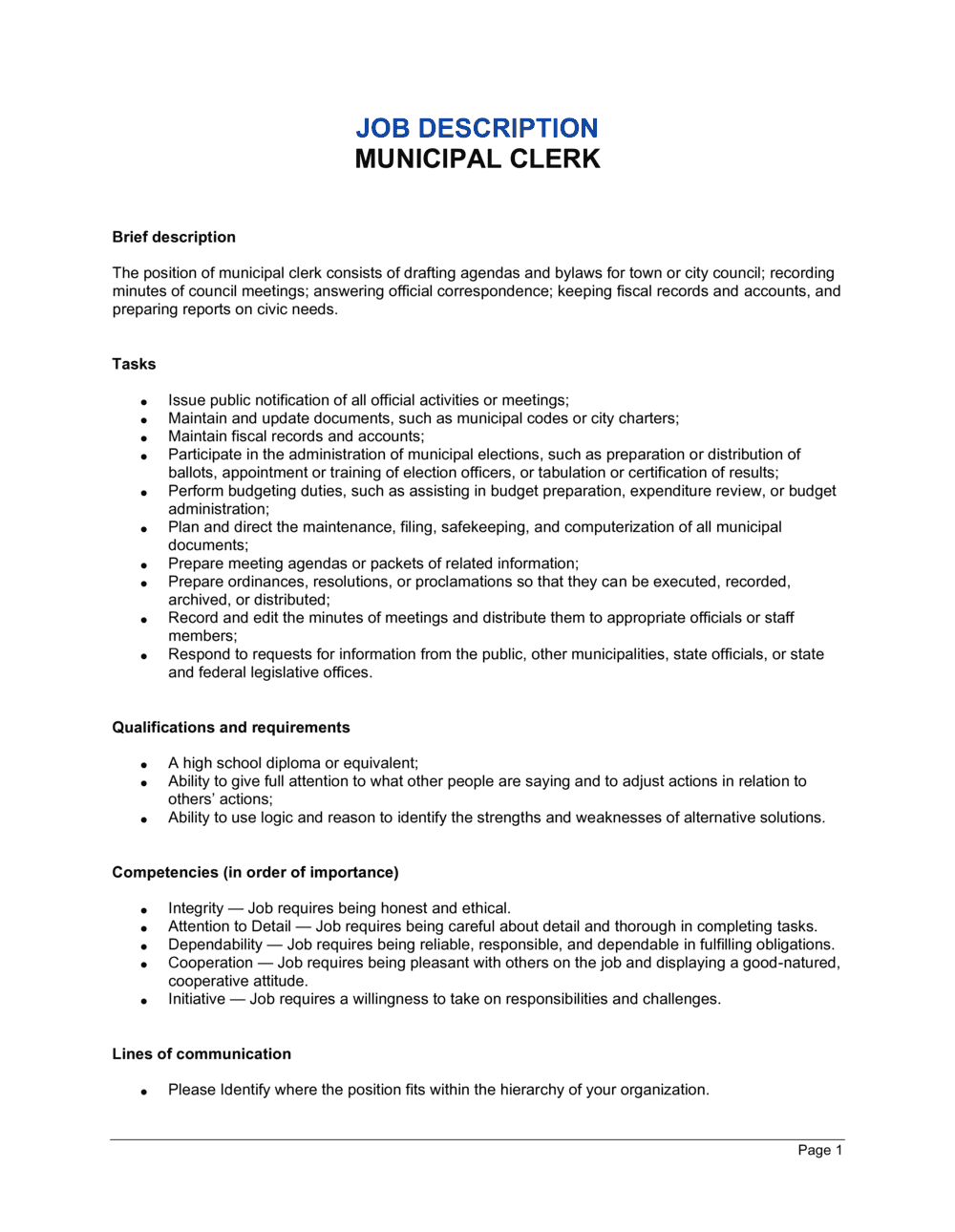
A Municipal Clerk Job Description is a formal binding document used by local governments, municipalities, townships, and councils to define the duties, qualifications, authority, and reporting structure of the municipal clerk position. This free Word download gives you a structured, legally compliant starting point you can edit online and export as PDF for HR files, job postings, council approval, and civil service classification purposes.
When you need it
Use it when creating or filling a municipal clerk vacancy, reclassifying the position under a civil service framework, or updating an existing description to reflect expanded statutory duties such as records management, election administration, or agenda coordination.
What's inside
Position summary and classification, essential duties and responsibilities, supervisory relationships and reporting structure, required and preferred qualifications, physical and working conditions, compensation band references, civil service compliance language, and signature and adoption blocks.

What is a Municipal Clerk Job Description?

A Municipal Clerk Job Description is a formally adopted governing document used by cities, towns, townships, villages, and special districts to define the duties, qualifications, authority, reporting structure, and working conditions of the municipal clerk position. Unlike a private-sector job description, this document carries legal weight: it serves as the classification basis for civil service pay grading, the ADA essential-functions record in accommodation disputes, and the operative definition of the role in collective bargaining and grievance proceedings. It must reflect the specific statutory duties assigned to the clerk by state or provincial municipal law — covering official records custody, council meeting administration, election management, and public records access — not just a generic summary of administrative work.

Why You Need This Document

Operating without a formally adopted municipal clerk job description creates compounding legal and operational exposure. Civil service systems require an approved description before a vacancy can be posted or filled — skipping this step can void a hire or trigger a classification grievance before the employee's first day. Without a clear essential-functions section, the municipality cannot legally defend an ADA accommodation decision or a termination based on inability to perform core duties. A description that omits statutory duties — election administration, FOIA processing, or ordinance codification — creates authority ambiguity that courts and arbitrators resolve against the employer. And without a formal adoption signature and resolution reference, the document has no standing in any grievance or reclassification proceeding. This template gives municipalities a compliant, jurisdiction-ready starting point that closes all four gaps while remaining editable for the specific statutory framework, charter provisions, and collective bargaining obligations that apply in your municipality.

Which variant fits your situation?

If your situation is…Use this template
Hiring a municipal clerk for a small township with limited staffMunicipal Clerk Job Description (Small Municipality)
Creating a description for a deputy or assistant clerk roleDeputy Municipal Clerk Job Description
Posting an elected clerk position defined by city charterElected Municipal Clerk Job Description
Defining duties for a clerk who also serves as treasurerMunicipal Clerk-Treasurer Job Description
Documenting a records management specialist within a clerk's officePublic Records Manager Job Description
Engaging a temporary or contract clerk for a specific projectIndependent Contractor Agreement
Creating a full employment agreement for the clerk once hiredEmployment Contract

Common mistakes to avoid

❌ Conflating essential and marginal functions

Why it matters: Courts and EEOC investigators apply strict scrutiny to whether a claimed essential function is truly essential. Mixing in marginal tasks weakens the employer's position in ADA accommodation disputes and can result in the municipality being required to restructure the role.

Fix: Use two clearly labeled sections — 'Essential Functions' and 'Other Duties as Assigned' — and confirm each essential function is supported by either time spent, business impact, or statutory mandate.

❌ Omitting the non-contract disclaimer

Why it matters: A detailed job description that lacks a disclaimer has been treated as an implied contract in several state courts, creating tenure or just-cause protections the municipality did not intend to confer.

Fix: Include a prominent statement such as: 'This job description does not constitute an employment contract and may be amended to reflect operational needs or statutory changes.'

❌ Setting qualifications higher than the role requires

Why it matters: Requiring a bachelor's degree for a position where a high school diploma and relevant experience are sufficient can constitute disparate-impact discrimination under Title VII if the requirement disproportionately screens out a protected class without business justification.

Fix: Benchmark qualifications against comparable municipal clerk positions in similar-sized municipalities and document the business rationale for every minimum requirement.

❌ Filing an unsigned or resolution-less description

Why it matters: An unsigned job description has no formal standing in a civil service grievance, reclassification appeal, or collective bargaining dispute. Without a dated adoption record, opposing parties can argue the description was never formally approved.

Fix: Always complete the signature and adoption block before the position is posted or filled, and attach the description to the relevant council resolution or HR classification record.

❌ Using a generic private-sector job description without statutory adaptation

Why it matters: Municipal clerks operate under state-specific statutory authority — election administration, open meetings law, and records retention schedules that are jurisdiction-specific. A generic template that ignores these creates a description that does not reflect the actual legal duties of the role.

Fix: Identify and cite the specific state statutes governing the municipal clerk position in your jurisdiction and ensure every statutory duty is reflected in the essential functions section.

❌ Listing a fixed salary instead of a pay range

Why it matters: A single salary figure in the official job description limits hiring flexibility, signals to all candidates that negotiation is not possible, and may conflict with civil service pay grade structures that mandate a minimum-to-maximum range.

Fix: Reference the applicable civil service salary grade and the full range (minimum to maximum) rather than a fixed figure, and add 'commensurate with qualifications and experience.'

The 10 key clauses, explained

Position identification and classification

In plain language: States the official job title, department, reporting relationship, FLSA status, civil service grade, and whether the position is appointed or elected.

Sample language
Position Title: Municipal Clerk | Department: [DEPARTMENT NAME] | Reports To: [CITY MANAGER / MAYOR / COUNCIL] | FLSA Status: Exempt | Civil Service Grade: [GRADE] | Classification: Appointed / Elected

Common mistake: Omitting the FLSA status designation. If the classification is later challenged, a missing or incorrect FLSA field can expose the municipality to back-pay liability for unclaimed overtime.

Position summary

In plain language: A two-to-four sentence overview of the role's primary purpose, scope of authority, and the general category of work performed.

Sample language
Under the direction of [SUPERVISOR TITLE], the Municipal Clerk serves as the official record keeper and legal custodian of all municipal documents for [MUNICIPALITY NAME]. The Clerk coordinates legislative processes, administers elections, and ensures compliance with state public records and open meetings laws.

Common mistake: Writing a position summary so broad that it provides no meaningful basis for performance evaluation or pay classification — vague summaries create civil service reclassification disputes.

Essential duties and responsibilities

In plain language: An itemized list of the core functions the clerk must perform, drafted to satisfy ADA essential-functions requirements and support reasonable accommodation analysis.

Sample language
Essential duties include: (1) preparing and certifying agendas and minutes for all Council meetings; (2) maintaining the official journal of ordinances and resolutions; (3) administering the municipal election process in accordance with [STATE] Election Code; (4) processing public records requests under [STATE] FOIA within [X] business days.

Common mistake: Mixing essential and marginal functions in a single undifferentiated list. Courts and HR tribunals require a clear distinction to adjudicate ADA accommodation claims.

Supervisory authority and reporting structure

In plain language: Defines who the clerk reports to, whether the clerk supervises other staff, and the scope of any supervisory responsibility — hiring, evaluating, or disciplining subordinates.

Sample language
The Municipal Clerk reports directly to [CITY MANAGER / MAYOR]. The Clerk directly supervises [NUMBER] Deputy Clerk(s) and [NUMBER] administrative support staff, including responsibility for performance evaluations, work scheduling, and disciplinary recommendations.

Common mistake: Stating supervisory responsibility without specifying its scope. A clerk listed as 'supervising' office staff with no authority to evaluate or discipline faces credibility problems when managing performance.

Required qualifications and education

In plain language: Minimum education credentials, years of experience, required certifications (such as Certified Municipal Clerk designation), and any statutory eligibility requirements.

Sample language
Minimum Qualifications: Associate's degree in public administration, business, or related field; [X] years of progressively responsible municipal government experience; or equivalent combination. Preferred: Certified Municipal Clerk (CMC) designation from the International Institute of Municipal Clerks.

Common mistake: Setting education minimums that are higher than the duties require, without a demonstrated business necessity. Overly restrictive requirements can create disparate-impact liability under Title VII.

Knowledge, skills, and abilities (KSAs)

In plain language: A specific list of technical competencies — records management systems, parliamentary procedure, election law, agenda software — and interpersonal skills the role demands.

Sample language
Required knowledge: municipal records retention law, Robert's Rules of Order, state election administration procedures, and [STATE] Open Meetings Act. Required skills: proficiency in [AGENDA MANAGEMENT SOFTWARE], Microsoft Office Suite, and document imaging systems.

Common mistake: Listing generic soft skills (e.g., 'excellent communication') without any measurable technical competencies. Job descriptions without specific KSAs cannot support defensible hiring decisions or performance improvement plans.

Physical requirements and working conditions

In plain language: Documents physical demands — lifting, extended sitting, evening meeting attendance — and working environment details, required to support ADA reasonable-accommodation analysis.

Sample language
The position requires the ability to sit for extended periods, operate standard office equipment, and attend evening Council meetings as required. Occasional lifting of up to [X] lbs. Work is performed primarily in an office setting; some local travel to election polling sites may be required.

Common mistake: Omitting evening or weekend meeting attendance as a working condition. If not disclosed in writing, employees can contest schedule requirements as a unilateral change to working conditions.

Compensation and benefits reference

In plain language: References the applicable pay range, salary band, or civil service grade without locking a specific salary into the job description — preserving flexibility while meeting transparency requirements.

Sample language
Compensation: [MUNICIPALITY NAME] Salary Grade [X], ranging from $[MINIMUM] to $[MAXIMUM] annually, commensurate with qualifications and experience. Full benefits package available per [MUNICIPALITY NAME] Personnel Policy.

Common mistake: Stating a single fixed salary rather than a range. A fixed figure in the description creates an expectation of that salary for all candidates and limits negotiation for exceptional hires.

Compliance and equal opportunity statement

In plain language: Confirms the position is subject to applicable civil rights, ADA, and equal opportunity employment laws, and that the description does not constitute an employment contract.

Sample language
[MUNICIPALITY NAME] is an Equal Opportunity Employer. This job description does not constitute an employment contract and may be amended by the municipality to reflect changes in duties. All employment is subject to [STATE] civil service regulations and applicable law.

Common mistake: Omitting the disclaimer that the job description is not a contract. Without it, a detailed description can be construed as an implied employment agreement in some jurisdictions, limiting the employer's flexibility to modify duties.

Adoption and signature block

In plain language: Records formal adoption of the description by the appropriate authority — department head, HR director, or council resolution — with date and signature lines for accountability.

Sample language
Approved by: [DEPARTMENT HEAD / HR DIRECTOR NAME], [TITLE] | Signature: ___________________________ | Date: [DATE] | Council Resolution No. (if applicable): [RESOLUTION NUMBER]

Common mistake: Filing an unsigned or undated job description. An unadopted description has no formal standing in a civil service grievance or reclassification proceeding.

How to fill it out

  1. 1

    Enter the municipality's legal name and position identification

    Insert the municipality's full registered legal name, the official position title, the department, and the FLSA exemption status. Confirm whether the position is appointed or elected under the relevant state statute or city charter.

    💡 Check your state's municipal code to confirm the statutory title — 'City Clerk,' 'Town Clerk,' and 'Clerk of Council' can carry different legal meanings and authority levels.

  2. 2

    Draft the position summary with scope of authority

    Write two to four sentences identifying the primary purpose of the role, who the clerk reports to, and the main categories of work — records, elections, legislative support, and public access.

    💡 Tie the summary directly to the municipal code section that creates the position. Statutory references add legal weight and help justify the classification grade.

  3. 3

    List essential duties separately from marginal functions

    Itemize the core duties the clerk must perform — certifying minutes, indexing ordinances, administering elections, processing FOIA requests — and separate them clearly from ancillary tasks like ordering supplies or covering reception.

    💡 Label the section 'Essential Functions' explicitly and add a parenthetical: '(The following are illustrative, not exhaustive)' to preserve flexibility for duty changes.

  4. 4

    Define supervisory authority with specific scope

    State whether the clerk supervises any staff, how many, and what supervisory authority is included — scheduling, evaluating, recommending discipline. Avoid vague language like 'oversees' without defining what that means.

    💡 If the clerk supervises a deputy clerk, include a cross-reference to the deputy clerk job description so the authority relationship is documented consistently across both files.

  5. 5

    Set minimum qualifications with business-necessity rationale

    Enter the minimum education, years of experience, and required certifications. For each requirement, confirm that it is genuinely necessary for job performance — overly restrictive requirements invite disparate-impact challenges under Title VII and equivalent state laws.

    💡 Include 'or equivalent combination of education and experience' to avoid disqualifying strong candidates who took non-traditional paths into municipal government.

  6. 6

    Populate the KSA block with specific technical competencies

    List the specific software, statutory knowledge areas, and procedural skills the position requires — agenda management platforms, records management systems, state election code, and Robert's Rules of Order.

    💡 Name the specific agenda or records management software your municipality uses. Generic 'computer proficiency' language does not support screening decisions or training plans.

  7. 7

    Document physical requirements and working conditions accurately

    Record all physical demands — lifting limits, extended sitting, and the requirement to attend evening or weekend meetings — and note any travel obligations such as election site supervision.

    💡 Consult your ADA coordinator before finalizing this section to ensure the physical requirements listed are genuinely essential and defensible in an accommodation request.

  8. 8

    Obtain formal adoption signatures before posting

    Route the completed description through department head, HR director, and, where required, full council resolution before posting the vacancy. Enter the adoption date and relevant resolution number in the signature block.

    💡 File the signed original in the official personnel classification file and attach a copy to the council meeting minutes where it was adopted — this creates a clean audit trail for future reclassification or grievance proceedings.

Frequently asked questions

What is a municipal clerk job description?

A municipal clerk job description is a formal document adopted by a local government body that defines the duties, qualifications, authority, reporting structure, and working conditions for the municipal clerk position. It serves as the legal basis for hiring, classifying, and evaluating the clerk, and is required in most civil service systems before a vacancy can be posted or filled. It differs from a private-sector job description in that it must reflect jurisdiction-specific statutory duties assigned to the clerk by state law.

What does a municipal clerk do?

A municipal clerk is the official record keeper for local government — responsible for preparing and certifying council meeting agendas and minutes, maintaining the official journal of ordinances and resolutions, codifying municipal law, administering local elections, processing Freedom of Information requests, and providing administrative support to the governing body. In many jurisdictions, the clerk also holds notarial authority and serves as the official custodian of the municipal seal. The exact duties vary by state statute and city or township charter.

Is a municipal clerk an elected or appointed position?

It depends on the jurisdiction and the type of municipality. In many US states, municipal clerks in villages, townships, and smaller cities are elected by voters. In larger cities and counties, the clerk is typically appointed by the city manager, mayor, or council. Some charters allow the position to be either, at the governing body's discretion. The job description must accurately reflect which type applies, as this affects statutory authority, removal procedures, and civil service coverage.

Why does a municipal clerk job description need a formal adoption process?

In most civil service and collective bargaining environments, a job description must be formally adopted — typically by council resolution or HR classification action — to have legal standing in grievance proceedings, reclassification appeals, and ADA accommodation analyses. An informally circulated or unsigned description can be challenged as never having been officially approved, weakening the municipality's position in any dispute about the scope of duties or compensation classification.

What qualifications are typically required for a municipal clerk?

Minimum qualifications typically include an associate's or bachelor's degree in public administration, business, or a related field combined with two to five years of progressively responsible municipal experience. Many municipalities prefer or require the Certified Municipal Clerk (CMC) designation from the International Institute of Municipal Clerks. Some states impose additional statutory eligibility requirements — such as residency or a specific licensing exam — that must be reflected in the job description.

How does ADA compliance affect how a municipal clerk job description is written?

The Americans with Disabilities Act requires employers to distinguish between essential functions — duties that must be performed with or without reasonable accommodation — and marginal functions that could be reassigned. A municipal clerk job description that fails to make this distinction clearly can expose the municipality to liability if it denies an accommodation request based on a function that is not truly essential. Physical requirements such as lifting limits and evening meeting attendance must also be specifically documented and genuinely justified.

Does a municipal clerk job description constitute an employment contract?

Not if it includes the standard disclaimer that the description does not constitute an employment contract and may be amended to reflect operational needs. Without that language, courts in some jurisdictions have found that a detailed, formally adopted job description creates implied contractual protections — particularly for employees in states that recognize implied contract exceptions to at-will employment. Including the disclaimer and ensuring the governing employment relationship is documented in a separate employment agreement or civil service classification record is best practice.

What state laws affect municipal clerk job descriptions in the US?

Every US state has statutes specifically governing the powers and duties of municipal clerks — covering records retention, open meetings, election administration, and public records access. States like Michigan, Wisconsin, and New York have detailed statutory frameworks that specify exactly which duties are legally assigned to the clerk by statute. A job description that conflicts with or omits statutory duties can create confusion about authority and liability. Always cross-reference the relevant state municipal code section when drafting or updating the description.

How often should a municipal clerk job description be updated?

At minimum, review the description whenever the position becomes vacant, whenever state legislation materially changes the clerk's statutory duties, or whenever the municipality adopts new technology or significantly restructures the clerk's office. Many HR professionals in local government recommend a full review every three to five years as a standard practice, with a formal re-adoption by council resolution to keep the classification record current. An outdated description creates mismatches between pay grade and actual duties that can trigger reclassification grievances.

How this compares to alternatives

vs Employment Contract

An employment contract governs the bilateral legal relationship between the employer and a specific employee — compensation, benefits, IP, confidentiality, and termination. A job description defines the position itself, not the individual hire. The job description must exist and be formally adopted before an employment contract is issued. Both documents are needed; they serve different legal purposes.

vs Offer Letter

An offer letter extends employment to a specific candidate and summarizes compensation and start date. A municipal clerk job description is a standing governance document adopted by the municipality that defines the role regardless of who holds it. The offer letter references the job description — it does not replace it. In civil service environments, the offer letter cannot contradict the adopted description.

vs Position Requisition Form

A position requisition is an internal HR document requesting authorization to fill a vacancy — budget approval, headcount, and timeline. A job description is the legal and operational definition of the role itself. The requisition triggers the hiring process; the job description governs it. Both are required for a compliant civil service hire, but they are separate documents with separate approval chains.

vs Performance Evaluation Form

A performance evaluation measures how well an individual employee is fulfilling the role over a review period. A job description defines what the role requires in the first place. The evaluation should be built directly from the essential functions and KSAs in the job description — a mismatch between the two is a common source of civil service grievances and wrongful termination claims.

Industry-specific considerations

Local government / municipalities

Statutory duty requirements vary sharply by state — descriptions must cite the applicable municipal code sections and reflect whether the position is elected, appointed, or classified under a civil service system.

County and regional government

County clerk positions often carry additional recorder, registrar, and court-filing duties that require a more complex essential-functions section and a higher civil service classification grade.

Township and village government

In smaller townships, the clerk frequently serves as treasurer or deputy assessor as well, making combined-duty job descriptions with clearly separated function categories essential for accurate classification.

Special districts and authorities

Utility districts, school boards, and transit authorities often use a clerk or secretary role with governance and records obligations that closely mirror municipal clerk duties but are governed by a separate enabling statute.

Jurisdictional notes

United States

Municipal clerk duties and authority are defined by state statute, city charter, or both — and vary significantly across all 50 states. States like Michigan (MCL 41.71), Wisconsin (Wis. Stat. §61.25), and New York (Town Law §30) have detailed statutory duty lists that must be reflected in the job description. FLSA exemption status, ADA essential-functions requirements, and Title VII disparate-impact rules apply to all municipal employers regardless of size.

Canada

In Canada, the position is typically titled 'Municipal Clerk' or 'Clerk-Administrator' and is governed by provincial municipal acts — for example, Ontario's Municipal Act (2001) and British Columbia's Community Charter. Job descriptions must comply with provincial human rights codes (which operate like ADA equivalents), and unionized municipal workplaces require descriptions to align with collective agreement classification provisions. Quebec descriptions must be available in French.

United Kingdom

In England and Wales, the equivalent role is the Town or Parish Clerk, governed by the Local Government Act 1972. The Equality Act 2010 requires that physical and medical requirements be justified as proportionate means to a legitimate aim — similar to ADA essential-functions analysis. The National Association of Local Councils (NALC) publishes model job descriptions and recommended salary scales (the NJC pay spine) that are widely adopted as the baseline for drafting.

European Union

EU member states govern local government clerk roles through national public administration law, with significant variation — German Gemeindeordnung frameworks differ substantially from French territorial civil service (fonction publique territoriale) rules. The EU Working Conditions Directive requires transparent written terms of employment including a clear description of duties within seven days of hire. GDPR compliance obligations are frequently assigned to the clerk's office and should be reflected in the KSA section where applicable.

Template vs lawyer — what fits your deal?

PathBest forCostTime
Use the templateSmall municipalities with straightforward appointed clerk roles and no active collective bargaining agreementFree1–2 hours
Template + legal reviewMunicipalities updating a description after statutory changes, reclassification, or a civil service grievance$300–$800 (municipal HR consultant or labor attorney review)3–5 business days
Custom draftedCities with collective bargaining agreements covering the clerk position, charter amendments redefining the clerk's authority, or multi-county shared-service arrangements$1,500–$4,000+2–4 weeks

Glossary

Municipal Clerk
An appointed or elected local government official responsible for maintaining official records, coordinating council meetings, administering oaths, and managing public access to government documents.
Civil Service Classification
A formal system that categorizes government positions by duties, responsibilities, and required qualifications to establish pay grades and eligibility criteria.
Essential Functions
The core duties of a position that must be performed with or without reasonable accommodation, as defined under the Americans with Disabilities Act and equivalent legislation.
FLSA Exemption
A determination under the Fair Labor Standards Act as to whether a position qualifies as exempt from overtime pay requirements based on salary level and job duties.
Minutes
The official written record of proceedings at a council or board meeting, prepared and certified by the municipal clerk as the legally binding account of decisions made.
Ordinance
A law enacted by a local government body; the municipal clerk is typically responsible for codifying, indexing, and maintaining the official record of all ordinances.
Records Retention Schedule
A legally mandated timetable specifying how long different categories of government records must be kept before they can be destroyed or archived.
ADA Compliance
Adherence to the Americans with Disabilities Act requirements, including ensuring job descriptions accurately distinguish essential from marginal functions to support accommodation decisions.
Notarial Authority
Statutory power held by some municipal clerks to administer oaths, certify documents, and perform other notarial acts on behalf of the municipality.
FOIA / Open Records
Freedom of Information Act obligations requiring the municipal clerk to process public records requests within legally defined response windows.
Codification
The systematic organization and publication of a municipality's ordinances and resolutions into an official, searchable legal code.

Part of your Business Operating System

This document is one of 3,000+ business & legal templates included in Business in a Box.

  • Fill-in-the-blanks — ready in minutes
  • 100% customizable Word document
  • Compatible with all office suites
  • Export to PDF and share electronically

Create your document in 3 simple steps.

From template to signed document — all inside one Business Operating System.
1
Download or open template

Access over 3,000+ business and legal templates for any business task, project or initiative.

2
Edit and fill in the blanks with AI

Customize your ready-made business document template and save it in the cloud.

3
Save, Share, Send, Sign

Share your files and folders with your team. Create a space of seamless collaboration.

Save time, save money, and create top-quality documents.

★★★★★

"Fantastic value! I'm not sure how I'd do without it. It's worth its weight in gold and paid back for itself many times."

Managing Director · Mall Farm
Robert Whalley
Managing Director, Mall Farm Proprietary Limited
★★★★★

"I have been using Business in a Box for years. It has been the most useful source of templates I have encountered. I recommend it to anyone."

Business Owner · 4+ years
Dr Michael John Freestone
Business Owner
★★★★★

"It has been a life saver so many times I have lost count. Business in a Box has saved me so much time and as you know, time is money."

Owner · Upstate Web
David G. Moore Jr.
Owner, Upstate Web

Run your business with a system — not scattered tools

Stop downloading documents. Start operating with clarity. Business in a Box gives you the Business Operating System used by over 250,000 companies worldwide to structure, run, and grow their business.

Free Forever Plan · No credit card required