Financial Analyst Job Description Template

Free Word download • Edit online • Save & share with Drive • Export to PDF

2 pages20–30 min to fillDifficulty: StandardSignature requiredLegal review recommended
Learn more ↓
FreeFinancial Analyst Job Description Template

At a glance

What it is
A Financial Analyst Job Description is a formal document that defines the scope, responsibilities, qualifications, reporting structure, and compensation parameters for a financial analyst role within an organization. This free Word download can be edited online and exported as PDF, giving HR teams and hiring managers a compliant, professionally structured starting point ready for posting or inclusion in an employment contract.
When you need it
Use it when creating a new financial analyst position, backfilling a vacancy, or formalizing an existing role that has grown beyond its original scope. It is also referenced during annual compensation reviews, performance evaluations, and any dispute over role boundaries or expectations.
What's inside
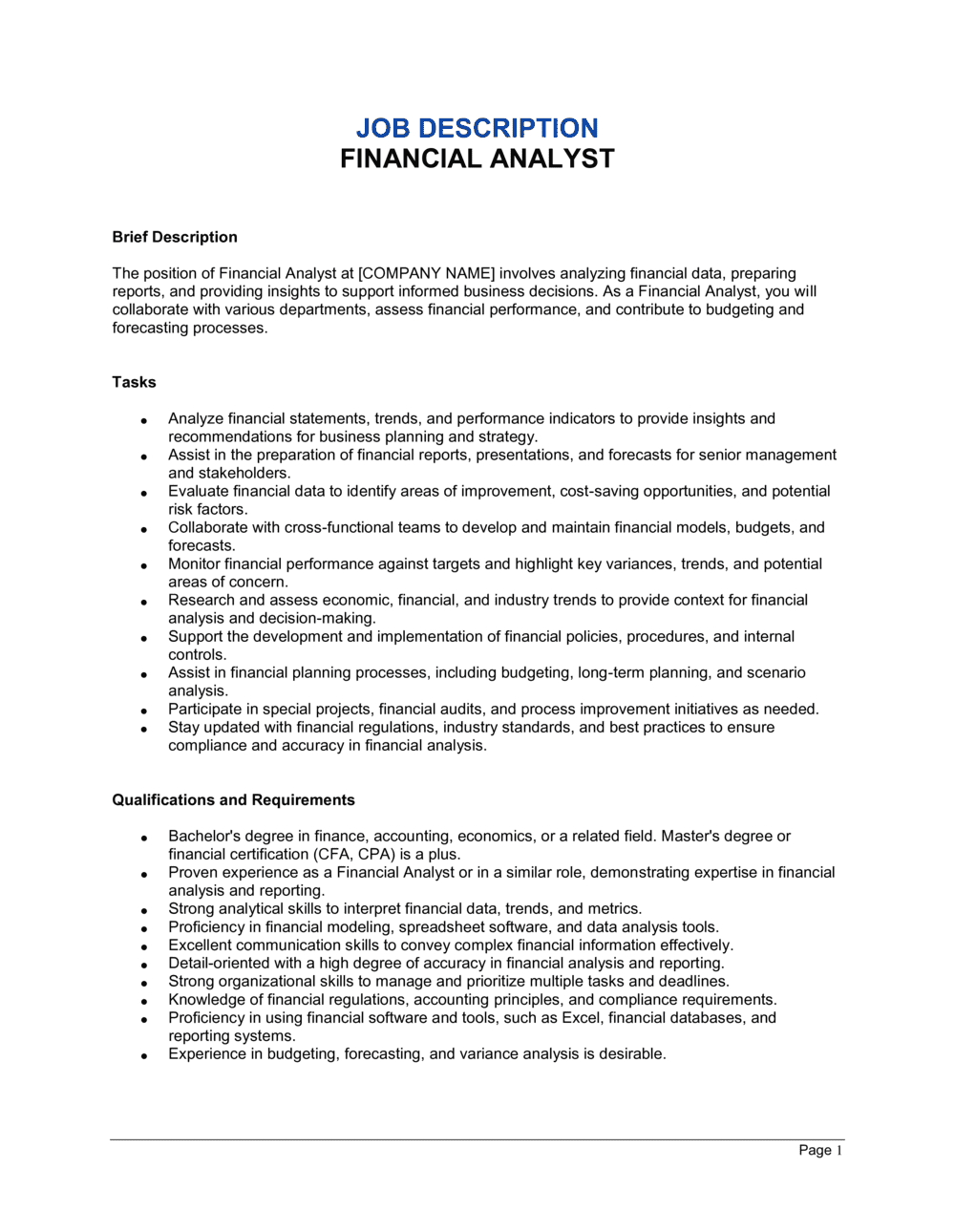
Position title and department, reporting structure, core duties and responsibilities, required and preferred qualifications, key performance indicators, compensation and benefits summary, employment type and location, and an acknowledgment block for employer and employee signatures.

What is a Financial Analyst Job Description?

A Financial Analyst Job Description is a formal document that defines the scope, duties, qualifications, reporting structure, key performance indicators, and compensation parameters for a financial analyst role. It serves simultaneously as a hiring tool, a performance management baseline, and a legal record of what the employer and employee agreed the role entails. Unlike an informal job posting, a properly drafted job description is signed by both parties, stored in the employee's personnel file, and referenced during compensation reviews, performance improvement plans, and — when disputes arise — in employment tribunal or court proceedings.

Why You Need This Document

Operating without a signed, current job description exposes your organization on three fronts at once. First, without documented essential functions and KPIs, you cannot support a performance improvement plan or a termination-for-cause decision in a legally defensible way — a significant liability when financial analyst salaries and potential wrongful termination claims are both material. Second, in pay-transparency jurisdictions including California, Colorado, New York, and Washington, posting a role without a salary range now carries civil penalties. Third, a signed acknowledgment that the employee understands their duties is your first line of defense against constructive dismissal claims when the role evolves. This template gives HR teams and finance leaders a professionally structured, compliance-aware starting point — ready to customize in under an hour and attach directly to an employment agreement.

Which variant fits your situation?

If your situation is…Use this template
Hiring an entry-level analyst for financial reporting and modeling supportJunior Financial Analyst Job Description
Filling a senior or lead analyst role with direct reports and strategic inputSenior Financial Analyst Job Description
Defining a data-focused finance role involving SQL, BI tools, and large datasetsFP&A Analyst Job Description
Hiring an analyst with a focus on investment research and portfolio evaluationInvestment Analyst Job Description
Creating a contract-based analyst role for a defined project or fiscal yearFixed-Term Financial Analyst Job Description
Documenting an existing role for a performance review or compensation benchmarkingPosition Description (Finance)
Posting a remote-only financial analyst position with distributed-team protocolsRemote Financial Analyst Job Description

Common mistakes to avoid

❌ Omitting the salary range in pay-transparency jurisdictions

Why it matters: California, Colorado, New York, and Washington all require employers to disclose pay ranges on job postings. Failure to comply carries civil penalties and reputational damage with candidates.

Fix: Confirm whether your posting locations trigger disclosure requirements and insert the approved salary band before publishing or sharing the description.

❌ Using the job description as the employment contract

Why it matters: A signed job description without a 'not a contract' disclaimer can be interpreted as a binding employment agreement, limiting the employer's ability to change duties, compensation, or terminate at will.

Fix: Include the standard acknowledgment disclaimer and execute a separate employment agreement that governs compensation, termination, and restrictive covenants.

❌ Conflating required and preferred qualifications

Why it matters: When all qualifications appear in a single undifferentiated list, recruiters screen out qualified candidates who lack preferred-only credentials, and hiring managers argue over the minimum bar mid-process.

Fix: Use two clearly labeled sections — 'Required Qualifications' and 'Preferred Qualifications' — and keep the required list to genuine must-haves only.

❌ Leaving KPIs blank or describing them in unmeasurable terms

Why it matters: A job description without measurable performance standards cannot support a performance improvement plan and makes termination-for-cause documentation legally vulnerable.

Fix: Define 3–5 specific, time-bound metrics tied directly to the duties listed — reporting deadlines, forecast accuracy tolerances, or ad hoc turnaround times.

❌ Skipping the physical demands section for office-based roles

Why it matters: Without documented essential physical functions, an employer cannot demonstrate that an accommodation request falls outside the scope of the role, increasing ADA liability.

Fix: Complete the physical demands section for every role, noting sedentary requirements, computer use, and any travel expectations even if minimal.

❌ Signing the job description after the employee's start date

Why it matters: Post-start-date signatures create the same fresh-consideration problem as late-signed employment contracts — particularly for any acknowledgment of duty scope or at-will status.

Fix: Execute the job description acknowledgment on or before the first day of work and file the signed copy immediately.

The 10 key clauses, explained

Position identification

In plain language: States the official job title, department, position control number if applicable, employment type, and work location or remote status.

Sample language
Position Title: Financial Analyst | Department: Finance & Accounting | Reports To: Director of Finance | Employment Type: Full-Time, Exempt | Location: [CITY, STATE] / [Remote / Hybrid]

Common mistake: Using an informal working title instead of the approved payroll title. Mismatches between the job description and the employment contract create classification and compensation disputes.

Position summary

In plain language: A 3–5 sentence overview of the role's purpose, primary focus, and how it supports the organization's financial objectives.

Sample language
The Financial Analyst is responsible for supporting [COMPANY NAME]'s financial planning, reporting, and analysis functions. This role provides data-driven insights to guide strategic decision-making across business units and reports directly to the [TITLE].

Common mistake: Copying the position summary verbatim from a generic job board post without tailoring it to the company's specific finance function, making it impossible to use as a performance benchmark.

Essential duties and responsibilities

In plain language: An itemized list of the primary tasks the employee must perform, written in active verb form and ordered by time or priority.

Sample language
Prepare monthly, quarterly, and annual financial reports; conduct variance analysis against budget and prior periods; build and maintain financial models for [BUSINESS UNIT]; support annual budgeting and quarterly forecasting cycles; and respond to ad hoc analysis requests from [TITLE].

Common mistake: Listing responsibilities at such a high level of generality — 'perform financial analysis' — that the description cannot support a performance improvement plan or define the scope of a dispute.

Required qualifications

In plain language: The minimum education, years of experience, certifications, and technical skills a candidate must have to be considered for the role.

Sample language
Bachelor's degree in Finance, Accounting, Economics, or a related field; [X]+ years of financial analysis experience; advanced proficiency in Microsoft Excel, including pivot tables and financial modeling; and working knowledge of [ERP SYSTEM NAME].

Common mistake: Setting qualifications that do not correspond to the actual duties — requiring a CPA for a role with no accounting responsibilities, for example — which narrows the candidate pool unnecessarily and may trigger adverse-impact scrutiny.

Preferred qualifications

In plain language: Additional credentials, experience, or skills that distinguish top candidates but are not eliminatory if absent.

Sample language
CFA designation or progress toward Level II; experience with [BI TOOL — Power BI / Tableau / Hyperion]; prior exposure to [INDUSTRY — manufacturing / SaaS / healthcare] financial models; and familiarity with SQL for data extraction.

Common mistake: Mixing required and preferred qualifications into a single list. Candidates cannot distinguish the minimum bar from the ideal profile, and recruiters cannot screen consistently.

Reporting structure and supervisory responsibilities

In plain language: Identifies who the analyst reports to and whether the role has any direct reports or team leadership responsibilities.

Sample language
This position reports directly to the [TITLE — Director of Finance / CFO / VP of FP&A]. The Financial Analyst [does not have / has] direct supervisory responsibility. [If applicable:] The analyst provides functional guidance to [NUMBER] junior analysts or finance associates.

Common mistake: Omitting supervisory responsibilities entirely for senior analyst roles that informally mentor or review junior staff — creating scope creep, compensation grievances, and FLSA classification issues.

Key performance indicators

In plain language: Measurable outcomes tied directly to the role's responsibilities, used to evaluate performance during reviews and set expectations at hire.

Sample language
On-time delivery of monthly close reporting within [X] business days of period end; forecast accuracy within [±X]% of actuals; completion of ad hoc analysis requests within [X] business days; and zero material errors in investor or board reporting packages.

Common mistake: Leaving this section blank or describing KPIs in vague terms like 'meet deadlines.' Without measurable standards, performance reviews become subjective and termination for performance becomes legally difficult to defend.

Compensation and benefits

In plain language: States the salary band or range, bonus eligibility, equity if applicable, and a reference to the company's standard benefits program.

Sample language
Base salary range: $[MINIMUM]–$[MAXIMUM] annually, commensurate with experience. Eligible for annual performance bonus of up to [X]% of base salary. Benefits include [HEALTH / DENTAL / VISION / 401(k)] as described in the Company's current benefits summary.

Common mistake: Omitting the salary range entirely in jurisdictions that now mandate pay transparency — including California, New York, Colorado, and Washington — exposing the company to regulatory penalties and candidate distrust.

Physical demands and work environment

In plain language: Describes the physical requirements of the role and any relevant environmental conditions, supporting ADA compliance documentation in the US.

Sample language
This role is primarily sedentary, requiring the ability to sit for extended periods, operate a computer, and communicate verbally and in writing. Occasional travel to [LOCATIONS] may be required, not to exceed [X]% of work time.

Common mistake: Skipping this section for office-based roles. Courts have held that even sedentary roles must document essential physical functions to support ADA reasonable-accommodation decisions.

Acknowledgment and signatures

In plain language: A block where both the employee and a company representative sign and date to confirm the employee has received, read, and understood the job description.

Sample language
I acknowledge that I have received and read this job description and understand that it is not an exhaustive list of duties and does not constitute a contract of employment. Employee Signature: _________________ Date: _____ | Manager Signature: _________________ Date: _____

Common mistake: Omitting the disclaimer that the job description is not an employment contract. Without this language, a signed job description can be introduced as a binding contract limiting the employer's ability to adjust duties.

How to fill it out

  1. 1

    Complete the position identification block

    Enter the official payroll job title, department, direct manager title, employment type (full-time / part-time), FLSA classification (exempt / non-exempt), and work location or remote status.

    💡 Confirm the job title against your payroll system before publishing — discrepancies between the job description and the offer letter create classification complications at hire.

  2. 2

    Write the position summary

    Draft a 3–5 sentence paragraph describing the role's primary purpose, the financial function it supports, and how it contributes to the organization's business objectives.

    💡 Anchor the summary to your company's specific financial structure — reference FP&A, treasury, or business unit finance as applicable rather than using generic language.

  3. 3

    List essential duties in active verb form

    Write each responsibility starting with an action verb — 'prepare,' 'analyze,' 'maintain,' 'present' — and include enough specificity to distinguish this role from adjacent analyst positions.

    💡 Aim for 8–12 bullet points. Fewer than 6 is too vague; more than 15 suggests the role is two jobs and will drive rapid turnover.

  4. 4

    Separate required from preferred qualifications

    List required qualifications (minimum degree, years of experience, required tools) in one section and preferred qualifications (advanced certifications, industry-specific experience, additional technical skills) in a clearly labeled separate section.

    💡 Run the required qualifications list past legal or HR before publishing to check for unintended adverse impact — for example, degree requirements for roles where experience is a genuine substitute.

  5. 5

    Define measurable KPIs

    Add 3–5 specific, measurable performance indicators tied directly to the duties listed. Include targets such as reporting deadlines, forecast accuracy thresholds, or turnaround times for ad hoc requests.

    💡 KPIs stated in the job description carry weight in performance reviews and termination-for-cause documentation — make them objective and achievable, not aspirational.

  6. 6

    Enter the compensation range and benefits reference

    Insert the approved salary band for the role, note bonus eligibility percentage, and reference the company's standard benefits program by name rather than detailing specific coverage levels.

    💡 Check whether your jurisdiction requires pay range disclosure on job postings — California, Colorado, New York, and Washington all mandate it as of 2025.

  7. 7

    Add the physical demands and acknowledgment block

    Complete the physical demands section even for sedentary roles, then ensure the acknowledgment block includes the disclaimer that the document is not an employment contract.

    💡 Have the signed acknowledgment block filed separately from the employment contract to avoid any argument that the job description's terms override the contract.

  8. 8

    Obtain signatures before or on the first day

    Both the employee and the hiring manager should sign and date the job description before or on the employee's first day of work, not after.

    💡 Store the executed copy in the employee's personnel file and in BIB Drive — you will need it if a performance dispute or ADA accommodation request arises.

Frequently asked questions

What does a financial analyst job description include?

A complete financial analyst job description includes the position title and department, a position summary, an itemized list of essential duties, required and preferred qualifications, reporting structure, key performance indicators, compensation range and benefits reference, physical demands, and a signed acknowledgment block. Each section serves a distinct HR, legal, or operational purpose — omitting any one of them creates a gap that either weakens performance management or increases legal exposure.

Is a financial analyst job description a legally binding document?

On its own, a job description is generally not a binding employment contract in most jurisdictions — provided it includes the standard disclaimer that it does not constitute a contract of employment. However, if signed without that disclaimer, or if it is expressly incorporated into an employment agreement, its terms may become enforceable. Always include the disclaimer in the acknowledgment block and keep the job description separate from the employment contract.

What qualifications should a financial analyst job description require?

Standard required qualifications include a bachelor's degree in finance, accounting, economics, or a related field; two to five years of relevant experience depending on seniority; advanced Excel proficiency including financial modeling; and working knowledge of the company's ERP or reporting tools. Preferred qualifications typically include a CFA designation or progress toward it, experience with BI tools such as Power BI or Tableau, and industry-specific financial modeling exposure.

Do I need to include a salary range in a financial analyst job description?

Whether a salary range is legally required depends on where the role is posted and where the employee works. As of 2025, California, Colorado, New York, Washington, and several other jurisdictions mandate pay range disclosure on job postings. Even where not legally required, publishing a salary band reduces time-to-hire and filters out misaligned candidates early in the process.

What is the difference between a financial analyst job description and an employment contract?

A job description defines the role — its duties, qualifications, reporting lines, and performance expectations. An employment contract governs the employment relationship — compensation, IP assignment, confidentiality, non-compete obligations, termination, and severance. The job description is often attached to or referenced in the employment contract but should not substitute for it. Relying on a job description as the sole employment document leaves the employer without enforceable restrictive covenants.

How often should a financial analyst job description be updated?

Review and update the job description annually, or whenever the role's duties or reporting structure change materially. A description that no longer reflects the actual role cannot support a performance improvement plan, a compensation re-grade, or a termination-for-cause defense. Have the employee re-acknowledge any material update with a dated signature.

What are the FLSA classification implications for a financial analyst role?

Most financial analyst roles qualify as exempt under the FLSA's administrative or professional exemptions, provided the employee earns above the current salary threshold ($684 per week as of 2024, subject to change) and primarily performs office work directly related to management or general business operations requiring independent judgment. Misclassifying a non-exempt analyst as exempt exposes the employer to back overtime pay, penalties, and class-action risk. Confirm the classification with HR or employment counsel before finalizing the description.

Can I use this template for a contract or freelance financial analyst?

This template is designed for an employee relationship. For a freelance or independent contractor financial analyst, use an Independent Contractor Agreement that defines deliverables, payment terms, and IP ownership instead. Attaching an employee-style job description to a contractor engagement strengthens any worker-misclassification argument that the worker should have been classified as an employee.

What KPIs should appear in a financial analyst job description?

Relevant KPIs for financial analyst roles include on-time delivery of monthly close reporting within a defined number of business days, forecast accuracy within a stated percentage variance of actuals, turnaround time on ad hoc analysis requests, zero material errors in board or investor reporting packages, and completion of the annual budget model by a defined date. Tie each KPI to a specific duty listed in the essential functions section so the connection between performance and expectation is explicit.

How this compares to alternatives

vs Employment Contract

An employment contract governs the legal relationship — compensation, IP ownership, non-compete, confidentiality, and termination terms. A job description defines the role's scope, duties, and performance expectations. The two documents complement each other: the job description is typically attached to or referenced in the employment contract but cannot substitute for it. Missing either one creates a gap the other cannot fill.

vs Offer Letter

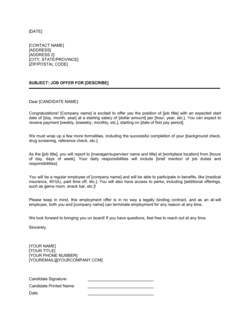
An offer letter communicates compensation, start date, and basic terms to trigger acceptance. A job description details the full scope of duties, qualifications, KPIs, and reporting structure. Offer letters reference the job description but do not replace it — relying on an offer letter alone leaves performance expectations undefined and weakens any future performance-management process.

vs Independent Contractor Agreement

An independent contractor agreement engages a self-employed individual for defined deliverables without creating an employment relationship. A job description establishes an employee role with full HR, benefits, and labor-law obligations. Using an employee-style job description for a contractor engagement is a worker-misclassification red flag and should be avoided.

vs Performance Review Template

A performance review evaluates an employee against standards that should have been set at hire. A job description is the source document for those standards — the KPIs, duties, and qualifications in the description become the benchmark for every subsequent review. Starting a performance review without a current job description means evaluating against unstated expectations.

Industry-specific considerations

Financial Services and Banking

Descriptions emphasize regulatory reporting requirements, Basel or IFRS9 model familiarity, and stress-testing or scenario analysis as core duties alongside standard FP&A work.

Technology / SaaS

Roles focus on SaaS metrics including MRR, ARR, churn, and CAC/LTV modeling, and typically require proficiency in BI tools such as Looker, Tableau, or Power BI alongside Excel.

Healthcare and Life Sciences

Descriptions include cost-center analysis for clinical operations, reimbursement modeling, and familiarity with healthcare-specific accounting standards and payer mix reporting.

Manufacturing and Supply Chain

Analyst roles center on cost accounting, standard costing variance analysis, inventory valuation, and capex modeling tied to production capacity planning.

Professional Services

Descriptions highlight utilization rate tracking, client profitability analysis, project-based revenue recognition, and billing rate benchmarking as core analytical responsibilities.

Retail and E-commerce

Roles emphasize margin analysis by category or SKU, promotional ROI measurement, inventory turnover modeling, and same-store or cohort revenue comparisons.

Jurisdictional notes

United States

FLSA exempt/non-exempt classification must be determined before the description is finalized — most financial analyst roles qualify as exempt under the administrative exemption, but the salary threshold ($684/week as of 2024) must be met. Pay transparency laws in California, Colorado, New York, and Washington require salary ranges on postings. ADA compliance requires documenting essential functions and physical demands in every description.

Canada

Job descriptions incorporated into employment agreements must reflect duties accurately, as Canadian courts use them to assess constructive dismissal claims when duties are unilaterally changed. Provincial employment standards vary — Ontario, British Columbia, and Alberta each set different notice and termination minimums. Quebec employers must ensure documents provided to francophone employees are available in French under the Charter of the French Language.

United Kingdom

UK employers must provide a written statement of employment particulars that includes a job title and a general description of duties on or before day one. The Equality Act 2010 requires that qualification requirements be justifiable and not indirectly discriminate against protected characteristics. Salary ranges are not yet legally mandated but are increasingly expected by candidates and are part of broader pay-gap reporting obligations for employers with 250 or more employees.

European Union

The EU Pay Transparency Directive (2023/970), which member states must transpose by June 2026, will require employers to disclose salary ranges in job postings and prohibit asking candidates about prior pay. Works council consultation may be required before creating or materially changing a job description in countries including Germany, France, and the Netherlands. Job descriptions that define essential functions support compliance with national disability-accommodation frameworks across member states.

Template vs lawyer — what fits your deal?

PathBest forCostTime
Use the templateStandard financial analyst hires at small to mid-size businesses in a single jurisdictionFree30–60 minutes
Template + legal reviewRoles in pay-transparency jurisdictions, senior analyst positions with supervisory responsibilities, or descriptions being incorporated into employment contracts$200–$500 for an HR consultant or employment attorney review1–3 days
Custom draftedExecutive-level financial roles, regulated industries (banking, healthcare), or multi-jurisdiction employers with differing classification rules$500–$2,000+1–2 weeks

Glossary

Job Description
A formal document that defines a role's duties, qualifications, reporting structure, and compensation — used in hiring, performance management, and compensation reviews.
Essential Functions
The core duties an employee must be able to perform, with or without reasonable accommodation, as required by the Americans with Disabilities Act (ADA) in the US.
FLSA Classification
The US Fair Labor Standards Act classification of a role as exempt or non-exempt, determining whether the employee is entitled to overtime pay.
KPI (Key Performance Indicator)
A measurable metric used to evaluate whether an employee is meeting the performance expectations of their role.
Reporting Structure
The formal hierarchy showing which manager or executive the financial analyst reports to and which roles, if any, report to them.
CFA (Chartered Financial Analyst)
A globally recognized investment analysis credential awarded by the CFA Institute, commonly listed as a preferred qualification for senior financial analyst roles.
FP&A (Financial Planning and Analysis)
A finance function responsible for budgeting, forecasting, variance analysis, and providing financial insights to support business decisions.
Variance Analysis
The process of comparing actual financial results against budget or forecast figures and explaining the differences.
At-Will Employment
A US employment doctrine under which either party can end the employment relationship at any time for any lawful reason — relevant when the job description is incorporated into an employment agreement.
Reasonable Accommodation
A modification to a job or work environment that allows a qualified individual with a disability to perform the essential functions of the role.
Position Control Number
An internal identifier assigned to a budgeted headcount slot, used in larger organizations to track approved positions against actual hires.

Part of your Business Operating System

This document is one of 3,000+ business & legal templates included in Business in a Box.

  • Fill-in-the-blanks — ready in minutes
  • 100% customizable Word document
  • Compatible with all office suites
  • Export to PDF and share electronically

Create your document in 3 simple steps.

From template to signed document — all inside one Business Operating System.
1
Download or open template

Access over 3,000+ business and legal templates for any business task, project or initiative.

2
Edit and fill in the blanks with AI

Customize your ready-made business document template and save it in the cloud.

3
Save, Share, Send, Sign

Share your files and folders with your team. Create a space of seamless collaboration.

Save time, save money, and create top-quality documents.

★★★★★

"Fantastic value! I'm not sure how I'd do without it. It's worth its weight in gold and paid back for itself many times."

Managing Director · Mall Farm
Robert Whalley
Managing Director, Mall Farm Proprietary Limited
★★★★★

"I have been using Business in a Box for years. It has been the most useful source of templates I have encountered. I recommend it to anyone."

Business Owner · 4+ years
Dr Michael John Freestone
Business Owner
★★★★★

"It has been a life saver so many times I have lost count. Business in a Box has saved me so much time and as you know, time is money."

Owner · Upstate Web
David G. Moore Jr.
Owner, Upstate Web

Run your business with a system — not scattered tools

Stop downloading documents. Start operating with clarity. Business in a Box gives you the Business Operating System used by over 250,000 companies worldwide to structure, run, and grow their business.

Free Forever Plan · No credit card required