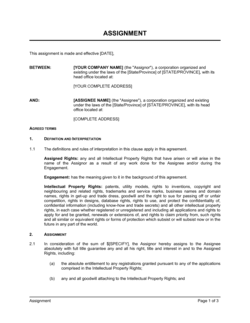
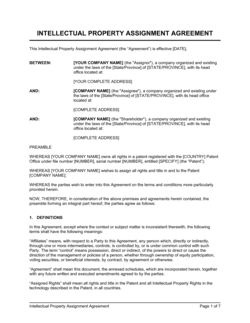
Patent Assignment Template

Free Word download • Edit online • Save & share with Drive • Export to PDF

4 pages25–30 min to fillDifficulty: ComplexSignature requiredLegal review recommended
Learn more ↓
FreePatent Assignment Template

At a glance

What it is
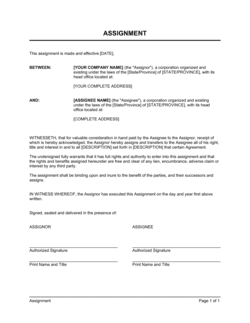
A Patent Assignment is a legally binding agreement that transfers ownership of a patent or patent application from one party (the assignor) to another (the assignee). This free Word download lets you document the transfer of full title to an invention, including all rights to enforce, license, and commercialize it, and export the completed document as PDF for filing with the relevant patent office.
When you need it
Use it when selling a patent outright, transferring IP from a founder or employee to a company, closing an acquisition that includes patent assets, or satisfying an investor's requirement that all IP be held by the corporate entity.
What's inside
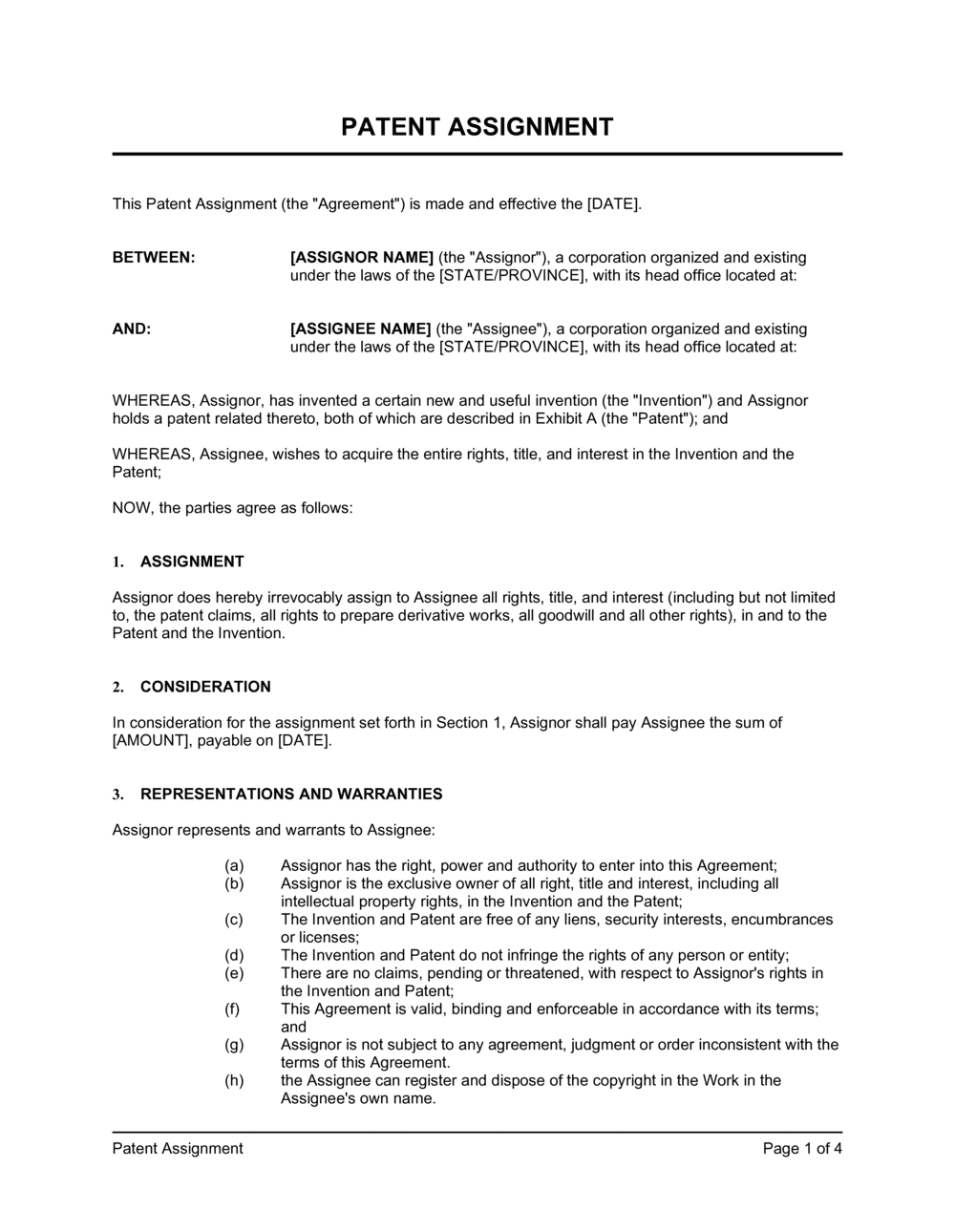
Identification of the assignor and assignee, a full description of the patent or application being transferred, the consideration paid, representations and warranties on title and enforceability, the scope of rights assigned, recording obligations, and governing law.

What is a Patent Assignment?

A Patent Assignment is a legally binding agreement that permanently transfers full ownership of a patent or patent application from the original owner (the assignor) to a new owner (the assignee). Unlike a patent license — which grants permission to use an invention while the licensor retains title — an assignment conveys the entire right, title, and interest in the patent, including the right to enforce it against infringers, grant licenses to third parties, and file related applications. Once executed and recorded with the relevant patent office, the assignee becomes the public owner of record, and the transfer is generally irrevocable.

Patent assignments are a routine part of the IP lifecycle in modern business: inventors assign patents to employers under the terms of their employment agreements; founders transfer personally held patents to their startup entity before a funding round; companies acquire patents in M&A transactions; and universities commercialize faculty research by assigning rights to spinouts or corporate partners. Because a patent represents a government-granted monopoly — typically lasting 20 years from the filing date — the document that transfers it must be drafted precisely, executed correctly, and recorded promptly to be fully effective.

Why You Need This Document

Without a written patent assignment, ownership of an invention can remain legally ambiguous long after the parties believe the transfer is complete. An investor conducting pre-closing due diligence who finds patents still titled in a founder's personal name — rather than the company — will require the gap to be closed before funding proceeds, often on a compressed timeline and at premium legal cost. A buyer who acquires a company without verifying that all relevant patents were properly assigned from their original inventors may discover post-acquisition that key assets were never validly transferred, reducing the portfolio's enforceability and commercial value.

Recording delays create additional risk: under US law, an unrecorded assignment can be defeated by a subsequent assignee who records first without knowledge of the earlier transfer. For international portfolios, each national patent office has its own recordation requirements — missing a single filing can leave the patent titled in the old owner's name in that country.

A properly drafted and promptly recorded patent assignment eliminates chain-of-title defects before they become disputes, satisfies investor and acquirer IP diligence checklists, and gives the new owner the standing they need to license and enforce the patent in their own name from day one.

Which variant fits your situation?

If your situation is…Use this template
Transferring all rights to a patent permanently for a cash paymentPatent Assignment Agreement (Full)
Granting rights to use a patent without transferring ownershipPatent License Agreement
Assigning all IP created by an employee during employmentEmployee IP Assignment Agreement
Transferring patents as part of a broader business asset saleAsset Purchase Agreement
Assigning rights from a co-inventor to a single corporate ownerCo-Inventor Patent Assignment
Pledging patent rights as collateral for a loanPatent Security Agreement
Transferring trademark and copyright alongside patent rightsIntellectual Property Assignment Agreement

Common mistakes to avoid

❌ Omitting continuation and divisional applications from Exhibit A

Why it matters: A patent family often includes filed or pending continuations that share the same priority date as the assigned patent. Omitting them leaves those applications owned by the assignor, splitting the portfolio and undermining the assignee's enforcement position.

Fix: Run a full patent family search on each listed patent before drafting Exhibit A and include every continuation, divisional, reissue, and foreign counterpart by application number.

❌ Failing to record with the USPTO promptly

Why it matters: Under 35 U.S.C. § 261, an unrecorded assignment is void against a subsequent assignee who records without notice of the prior transfer. Delaying recordation beyond three months creates a window during which a fraudulent or erroneous second assignment could take priority.

Fix: File the assignment electronically through the USPTO EPAS system within 30 days of execution and confirm the recorded reel and frame number before closing any related transaction.

❌ No warranty against prior licenses or encumbrances

Why it matters: Without this warranty, the assignee may discover post-closing that the patent is subject to a royalty-free license granted to a third party years earlier, materially reducing its commercial value.

Fix: Require the assignor to represent explicitly that no prior licenses, covenants not to sue, or security interests exist, and attach a schedule of any known exceptions for the assignee to accept or reject.

❌ Skipping the inventor cooperation clause

Why it matters: Patent prosecution, maintenance, and enforcement routinely require declarations and signatures from named inventors. A former employee or co-founder who is not contractually obligated to cooperate can block or delay critical filings indefinitely.

Fix: Include a cooperation covenant binding each named inventor personally, not just the assignor entity, and obtain signatures from all individual inventors as additional parties or witnesses at execution.

❌ Using an entity's trade name instead of its registered legal name

Why it matters: A trade name is not a legal entity and cannot hold title to a patent. An assignment to or from a trade name creates a chain-of-title defect that requires a corrective assignment — and may need to be re-recorded at additional cost before the patent can be licensed or sold.

Fix: Verify the exact registered legal name of every party against the relevant corporate registry before drafting, and include the jurisdiction of incorporation alongside the entity name.

❌ Assigning only 'rights to use' rather than full title

Why it matters: Language like 'grants and assigns the right to use' creates an exclusive license rather than a true assignment, leaving the original owner as the patent's record owner and undermining the assignee's standing to sue for infringement in their own name.

Fix: Use the phrase 'assigns, transfers, and conveys the entire right, title, and interest' to effect a complete transfer of ownership, consistent with USPTO recordation requirements.

The 10 key clauses, explained

Parties and recitals

In plain language: Identifies the assignor and assignee by their full legal names and states the purpose and background of the assignment.

Sample language
This Patent Assignment Agreement ('Agreement') is entered into as of [DATE] by and between [ASSIGNOR FULL LEGAL NAME], a [ENTITY TYPE] organized under the laws of [JURISDICTION] ('Assignor'), and [ASSIGNEE FULL LEGAL NAME], a [ENTITY TYPE] organized under the laws of [JURISDICTION] ('Assignee').

Common mistake: Using a trade name or individual nickname instead of the registered legal entity name, which creates chain-of-title defects that must be corrected by a subsequent corrective assignment.

Description and identification of assigned patents

In plain language: Lists every patent and application being transferred by patent number, application number, title, filing date, and country of registration.

Sample language
Assignor hereby assigns to Assignee all right, title, and interest in and to the patents and patent applications listed in Exhibit A, including U.S. Patent No. [PATENT NUMBER] entitled '[TITLE OF INVENTION],' filed [FILING DATE], and all continuations, divisionals, and foreign counterparts thereof.

Common mistake: Omitting continuation, divisional, and foreign counterpart applications from the list — creating gaps in the portfolio that require costly corrective filings later.

Assignment of title and scope of rights

In plain language: Transfers the full bundle of patent rights — including the right to sue for past infringement, license, and commercialize the invention — from assignor to assignee.

Sample language
Assignor hereby irrevocably assigns, transfers, and conveys to Assignee the entire right, title, and interest in and to the Assigned Patents, including all rights to (a) sue and recover damages for past and future infringement, (b) grant licenses or sublicenses, and (c) apply for related patents in any jurisdiction.

Common mistake: Assigning only the right to 'use' the patent rather than full title, which results in a license rather than an assignment and leaves the assignor as the record owner.

Consideration

In plain language: States the payment or other value exchanged for the assignment, which is required to make the contract binding.

Sample language
In consideration of the payment of [USD $AMOUNT] ('Purchase Price'), receipt of which Assignor hereby acknowledges, and other good and valuable consideration, Assignor agrees to the assignment set forth herein.

Common mistake: Reciting only 'one dollar and other valuable consideration' without specifying the actual agreed amount, which can undermine the document's credibility in subsequent litigation or due diligence.

Representations and warranties

In plain language: The assignor confirms they own the patent free of encumbrances, the patent is valid and not subject to any undisclosed challenges, and they have authority to execute the assignment.

Sample language
Assignor represents and warrants that: (a) Assignor is the sole and exclusive owner of the Assigned Patents; (b) the Assigned Patents are free and clear of all liens, licenses, and encumbrances; (c) Assignor has not previously assigned, transferred, or encumbered the Assigned Patents; and (d) Assignor has full authority to enter into this Agreement.

Common mistake: Omitting a warranty that no prior license grants exist, leaving the assignee exposed to undisclosed licensees who retain rights to practice the patent after the transfer.

Inventor cooperation covenant

In plain language: Requires the assignor and any named inventors to sign additional documents, make declarations, and assist the assignee in prosecuting or defending the patent after closing.

Sample language
Assignor shall, and shall cause each named inventor to, execute all documents, provide all declarations, and take all further actions reasonably requested by Assignee to record, perfect, or enforce the assignment, including executing any supplemental assignments required by any patent office.

Common mistake: No cooperation clause — once consideration is paid, an uncooperative former owner can stall USPTO maintenance filings, international prosecution, and enforcement actions, all of which require inventor signatures.

Recordation obligation

In plain language: Specifies who is responsible for recording the assignment with the USPTO (and foreign offices) and within what timeframe, which is critical to establishing priority over subsequent transferees.

Sample language
Assignee shall record this Agreement with the USPTO within [30] days of execution and shall bear all associated recordation fees. Assignor shall cooperate with any additional filings required by foreign patent offices within [60] days of Assignee's written request.

Common mistake: Leaving recordation responsibility unspecified — if neither party records the assignment, a subsequent assignee who records first may take priority over the original assignee under 35 U.S.C. § 261.

Indemnification

In plain language: Allocates responsibility between the parties if a third party challenges the patent's validity or ownership, or if the assignor's warranties prove to be false.

Sample language
Assignor shall indemnify, defend, and hold harmless Assignee from and against any claims, losses, or damages arising out of (a) any breach of Assignor's representations and warranties, or (b) any third-party claim that Assignor lacked authority to transfer the Assigned Patents.

Common mistake: One-sided indemnification that covers only patent validity challenges but not ownership challenges, leaving the assignee unprotected against a co-inventor who was not party to the assignment.

Governing law and dispute resolution

In plain language: Specifies which jurisdiction's law governs the agreement and how disputes are resolved — arbitration, mediation, or courts — and where.

Sample language
This Agreement shall be governed by the laws of the State of [STATE], without regard to its conflict-of-laws principles. Any dispute arising hereunder shall be resolved by binding arbitration administered by [AAA/JAMS] in [CITY, STATE], except that either party may seek injunctive relief in any court of competent jurisdiction.

Common mistake: Selecting a governing state that has no connection to either party's operations, which courts in some jurisdictions may treat as unenforceable forum-shopping and decline to apply.

Entire agreement and severability

In plain language: Confirms the written agreement is the complete record of the deal and that if any provision is found unenforceable, the rest of the agreement survives.

Sample language
This Agreement constitutes the entire agreement between the parties with respect to the subject matter hereof and supersedes all prior negotiations, representations, and agreements. If any provision is held invalid or unenforceable, the remaining provisions shall continue in full force and effect.

Common mistake: No integration clause — prior email negotiations and term sheets can then be introduced as evidence of additional obligations not in the signed agreement, complicating enforcement.

How to fill it out

  1. 1

    Identify all parties by their full legal names

    Enter the assignor's and assignee's complete registered legal names, entity types (individual, LLC, corporation), and states or countries of organization. If the assignor is an individual inventor, use their full legal name as it appears on the patent.

    💡 Cross-check the assignor's name against the USPTO assignment database before signing — any discrepancy requires a corrective assignment before recording.

  2. 2

    Build a complete patent schedule as Exhibit A

    List every patent and patent application being transferred with its patent number or application number, title, filing date, and country. Explicitly include all continuations, divisionals, reissues, and foreign counterparts of each listed patent.

    💡 Pull the full family from the USPTO Patent Center or Espacenet before drafting Exhibit A — a single omitted continuation can cost more to correct than the original legal fees.

  3. 3

    State the consideration clearly

    Enter the agreed purchase price in full. If the assignment is a gift or intra-company transfer with no cash payment, recite at minimum 'good and valuable consideration, the receipt and sufficiency of which are hereby acknowledged' to ensure the contract is supported by consideration.

    💡 For significant transactions, document the purchase price in a separate term sheet or letter of intent before executing the assignment — this protects both parties if the deal is later disputed.

  4. 4

    Review and complete the representations and warranties

    Confirm each warranty is accurate: the assignor owns the patent outright, no prior licenses or encumbrances exist, and no litigation or inter partes review is pending. If exceptions exist, disclose them in a schedule rather than deleting the warranty entirely.

    💡 Request a fresh USPTO assignment database search and a litigation history check on the patent number before signing — surprises here are far cheaper to address before closing.

  5. 5

    Include the inventor cooperation covenant

    Name every inventor listed on the patent in the cooperation clause and specify the types of assistance they must provide — USPTO declarations, foreign filing signatures, and affidavits for enforcement proceedings.

    💡 If any named inventor is no longer reachable or is a former employee, note it now and obtain a signed cooperation agreement from them separately before the assignment closes.

  6. 6

    Assign recordation responsibility and deadline

    Specify that the assignee will record the assignment with the USPTO within 3 months of execution to establish priority under 35 U.S.C. § 261. For international patents, identify which foreign offices require recordation and set separate deadlines.

    💡 File the assignment with the USPTO electronically through the Electronic Patent Assignment System (EPAS) — paper filings take significantly longer to process and create a gap in public notice.

  7. 7

    Execute before all required signatories

    Both the assignor and assignee must sign the agreement. If the assignor is an entity, obtain a signature from an authorized officer and attach evidence of authority (board resolution or incumbency certificate). Some jurisdictions and foreign patent offices also require notarization.

    💡 Obtain signatures from all named individual inventors separately if they are different from the assignor entity — some patent offices treat inventors as essential parties to the assignment.

  8. 8

    Record the assignment and retain originals

    File the executed assignment with the USPTO via EPAS and retain the recorded copy with the reel and frame number. File with any applicable foreign patent offices within the deadlines specified in the agreement.

    💡 Store the fully executed, recorded assignment in a central IP docket system and link it to the patent file — gaps in the docket are the first thing an acquirer's IP due diligence will flag.

Frequently asked questions

What is a patent assignment?

A patent assignment is a legal agreement that permanently transfers full ownership of a patent or patent application from one party (the assignor) to another (the assignee). Unlike a license, which grants permission to use a patent while the original owner retains title, an assignment conveys the entire right, title, and interest — including the right to sue for infringement, grant sublicenses, and apply for related patents. Once recorded with the patent office, the assignee becomes the public owner of record.

When is a patent assignment required?

A patent assignment is typically required when a founder needs to transfer personally held patents to their startup before a venture capital round, when an employee-inventor must assign rights to their employer under an employment agreement, when a company acquires a business whose patent portfolio is a key asset, or when an individual inventor sells their patent outright. Many investors and acquirers will not close a transaction unless all relevant patents are cleanly titled in the target company's name.

What is the difference between a patent assignment and a patent license?

A patent assignment transfers full, permanent ownership of the patent to a new party — the assignor no longer has any rights in the invention. A patent license grants the licensee permission to use, make, or sell the patented invention for a defined period, geography, or field of use, while the licensor retains ownership. Assignments are generally irreversible; licenses can be time-limited, exclusive or non-exclusive, and often revocable under defined conditions.

Does a patent assignment need to be recorded with the USPTO?

Recording is not legally required for the assignment to be valid between the parties, but it is strongly advisable. Under 35 U.S.C. § 261, an unrecorded assignment is void against a subsequent assignee or mortgagee who takes title without notice of the prior transfer and records first. Recording within three months of execution also establishes the assignee as the owner of record for all future prosecution, maintenance, and enforcement purposes. The USPTO charges a modest fee to record an assignment electronically through its EPAS system.

Can a patent be assigned without the inventor's involvement?

An entity that already holds title — such as a company that received an assignment from the inventor at the time of hiring — can assign the patent to a third party without the inventor's consent. However, the named inventors on the patent remain on record regardless of who owns it, and many patent office filings, prosecution steps, and declarations still require inventor signatures. Including a cooperation covenant binding the inventors to assist the new owner is therefore essential in any assignment.

What consideration is needed for a valid patent assignment?

For a patent assignment to be contractually binding, it must be supported by consideration — something of value exchanged between the parties. This is typically a stated cash payment, but it can also be equity, a promissory note, or a recital that the assignment is part of an employment agreement or broader transaction. Assignments that recite only nominal consideration (one dollar) are generally valid but can attract scrutiny in litigation or due diligence; stating the actual purchase price is better practice for significant transactions.

Are patent assignments public record?

Yes. Once recorded with the USPTO, a patent assignment is publicly accessible through the USPTO Assignment Center database. This means competitors, potential licensees, and acquirers can see the full chain of title for any US patent. Similar public registries exist at the EPO, the UK Intellectual Property Office, and the Canadian Intellectual Property Office. This public notice function is one of the primary reasons prompt recordation matters.

Do I need a lawyer to complete a patent assignment?

For straightforward intra-company transfers or simple sales between two parties with clearly defined patents, a high-quality template is often sufficient. However, legal review is strongly recommended when the portfolio includes pending applications, international filings, or security interests; when the assignment is part of an M&A transaction; when inventor cooperation issues are anticipated; or when the patent's commercial value is material. A patent attorney's review typically costs $500–$1,500 and can prevent chain-of-title defects that are far more expensive to correct after the fact.

What happens to existing licenses when a patent is assigned?

Generally, an assignment does not automatically terminate existing licenses unless the license agreement says otherwise. The new owner (assignee) typically takes the patent subject to any licenses granted by the prior owner. This is why the warranty against prior encumbrances is so important — the assignee should require the assignor to disclose all existing licenses before closing so the assignee can evaluate their impact on the patent's value.

How this compares to alternatives

vs Patent License Agreement

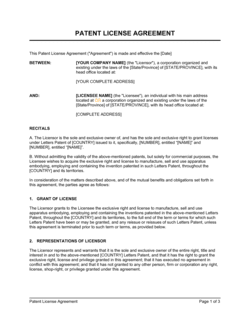
A patent license grants permission to use, make, or sell the patented invention without transferring ownership. A patent assignment permanently conveys full title. Use a license when the patent owner wants to monetize the patent while retaining it; use an assignment when the goal is a complete, irreversible sale or transfer of the patent itself.

vs Intellectual Property Assignment Agreement

An IP assignment agreement covers a broader bundle of rights — patents, trademarks, copyrights, and trade secrets — in a single document. A patent assignment transfers only patent rights. Use the broader IP assignment when an acquisition or employment separation involves multiple IP categories; use the patent-specific form when only defined patent assets are changing hands.

vs Technology Transfer Agreement

A technology transfer agreement conveys the right to use, develop, or commercialize a technology — often including know-how, trade secrets, and technical documentation alongside patent rights. A patent assignment transfers only the legal title to the patent instrument itself. Technology transfers are more common in university-to-industry or cross-border research contexts.

vs Asset Purchase Agreement

An asset purchase agreement covers all assets being acquired in a transaction — equipment, contracts, inventory, customer lists, and IP — while a patent assignment specifically handles the IP title transfer that is typically scheduled as an exhibit to the APA. In an M&A context, both documents are needed: the APA governs the deal, and the patent assignment effects the actual transfer of title.

Industry-specific considerations

Technology / SaaS

Software and algorithm patents are routinely assigned from founders to the corporate entity as a condition of seed or Series A funding, with investor IP reps requiring clean title in the company's name.

Pharmaceutical and Biotech

Drug formulation and method-of-treatment patents are among the most commercially valuable assets in pharma M&A, requiring exhaustive chain-of-title diligence and inventor cooperation covenants that may span decades.

Manufacturing and Hardware

Device and process patents are assigned as part of asset purchase agreements when production lines or product lines are sold, often requiring simultaneous recordation in multiple countries where the patent is registered.

Universities and Research Institutions

Technology transfer offices assign faculty-developed patents to spinout companies or corporate licensees under Bayh-Dole Act obligations, requiring inventor cooperation agreements and government license reservations to be explicitly addressed.

Financial Services / Fintech

Fintech patents covering payment processing methods and fraud-detection algorithms are transferred in portfolio acquisitions, with particular attention to prior art challenges and inter partes review proceedings that must be disclosed in the assignment warranties.

Consumer Products

Product design and utility patents are assigned alongside trademark rights in brand acquisitions, requiring coordinated IP assignment schedules that cross-reference related trademark and trade dress registrations.

Jurisdictional notes

United States

Under 35 U.S.C. § 261, a patent assignment must be in writing to be valid. Recordation with the USPTO within three months of execution establishes priority over subsequent assignees. The USPTO's Electronic Patent Assignment System (EPAS) handles electronic filings. State law governs contract formation and enforcement, but federal patent law governs the underlying rights being transferred.

Canada

Under the Canadian Patent Act, assignments must be in writing and recorded with the Canadian Intellectual Property Office (CIPO) to be effective against third parties. Quebec's Civil Code applies to the contractual mechanics for parties in that province, introducing distinct rules on warranties and remedies. International assignments involving Canadian patents should explicitly address CIPO recordation alongside any USPTO filing.

United Kingdom

Under the UK Patents Act 1977, a patent assignment must be in writing and signed by the assignor. Registration with the UK Intellectual Property Office (UKIPO) is required for the assignment to be effective against third parties. Post-Brexit, European Patent Office (EPO) validation patents and national UK patents must be assigned and recorded separately with the UKIPO.

European Union

European patents granted by the EPO are assigned through the EPO's online filing system and must then be recorded individually with each national patent office in the designated countries. GDPR considerations apply if the assignment documentation references inventor personal data. The EU Unitary Patent system (operational since 2023) allows a single assignment to cover participating member states, simplifying multi-jurisdiction transfers.

Template vs lawyer — what fits your deal?

PathBest forCostTime
Use the templateStraightforward intra-company transfers, founder-to-company assignments, or simple patent sales between two domestic partiesFree30–60 minutes
Template + legal reviewAssignments involving multiple patents or pending applications, employment-related IP transfers, or moderate-value transactions$500–$1,500 for a patent attorney review2–5 business days
Custom draftedM&A transactions, international patent portfolios, assignments with complex warranty carve-outs, or patents subject to government license obligations$2,000–$10,000+1–3 weeks

Glossary

Assignor
The current owner of a patent or patent application who is transferring their rights to another party.
Assignee
The party receiving full ownership of the patent or patent application under the assignment.
Patent Application
A formal request filed with a patent office to obtain patent protection for an invention, before a patent is granted.
Consideration
The payment or other benefit exchanged for the transfer of patent rights — typically a stated dollar amount or a recital of other valuable consideration.
Chain of Title
The documented sequence of ownership transfers for a patent from the original inventor to the current owner, establishing clear title.
Recordation
The formal filing of a patent assignment with the relevant patent office (e.g., the USPTO) to put the public on notice of the change in ownership.
Warranty of Title
A representation by the assignor that they have full, unencumbered ownership of the patent and the legal authority to transfer it.
Continuation Application
A subsequent patent application claiming the same invention as an earlier application, which should be explicitly included in the assignment to avoid ownership gaps.
Priority Date
The earliest filing date associated with a patent application, which determines its position in time relative to prior art and competing applications.
Encumbrance
Any lien, license, or third-party claim on a patent that limits or restricts the assignor's ability to transfer full, clean title.
Inventor
The individual who conceived the invention — distinct from the owner; inventors must be named on the patent regardless of who owns it.
USPTO
The United States Patent and Trademark Office, the federal agency that grants US patents and records patent assignments.

Part of your Business Operating System

This document is one of 3,000+ business & legal templates included in Business in a Box.

  • Fill-in-the-blanks — ready in minutes
  • 100% customizable Word document
  • Compatible with all office suites
  • Export to PDF and share electronically

Create your document in 3 simple steps.

From template to signed document — all inside one Business Operating System.
1
Download or open template

Access over 3,000+ business and legal templates for any business task, project or initiative.

2
Edit and fill in the blanks with AI

Customize your ready-made business document template and save it in the cloud.

3
Save, Share, Send, Sign

Share your files and folders with your team. Create a space of seamless collaboration.

Save time, save money, and create top-quality documents.

★★★★★

"Fantastic value! I'm not sure how I'd do without it. It's worth its weight in gold and paid back for itself many times."

Managing Director · Mall Farm
Robert Whalley
Managing Director, Mall Farm Proprietary Limited
★★★★★

"I have been using Business in a Box for years. It has been the most useful source of templates I have encountered. I recommend it to anyone."

Business Owner · 4+ years
Dr Michael John Freestone
Business Owner
★★★★★

"It has been a life saver so many times I have lost count. Business in a Box has saved me so much time and as you know, time is money."

Owner · Upstate Web
David G. Moore Jr.
Owner, Upstate Web

Run your business with a system — not scattered tools

Stop downloading documents. Start operating with clarity. Business in a Box gives you the Business Operating System used by over 250,000 companies worldwide to structure, run, and grow their business.

Free Forever Plan · No credit card required