1
Identify the parties and the patent portfolio
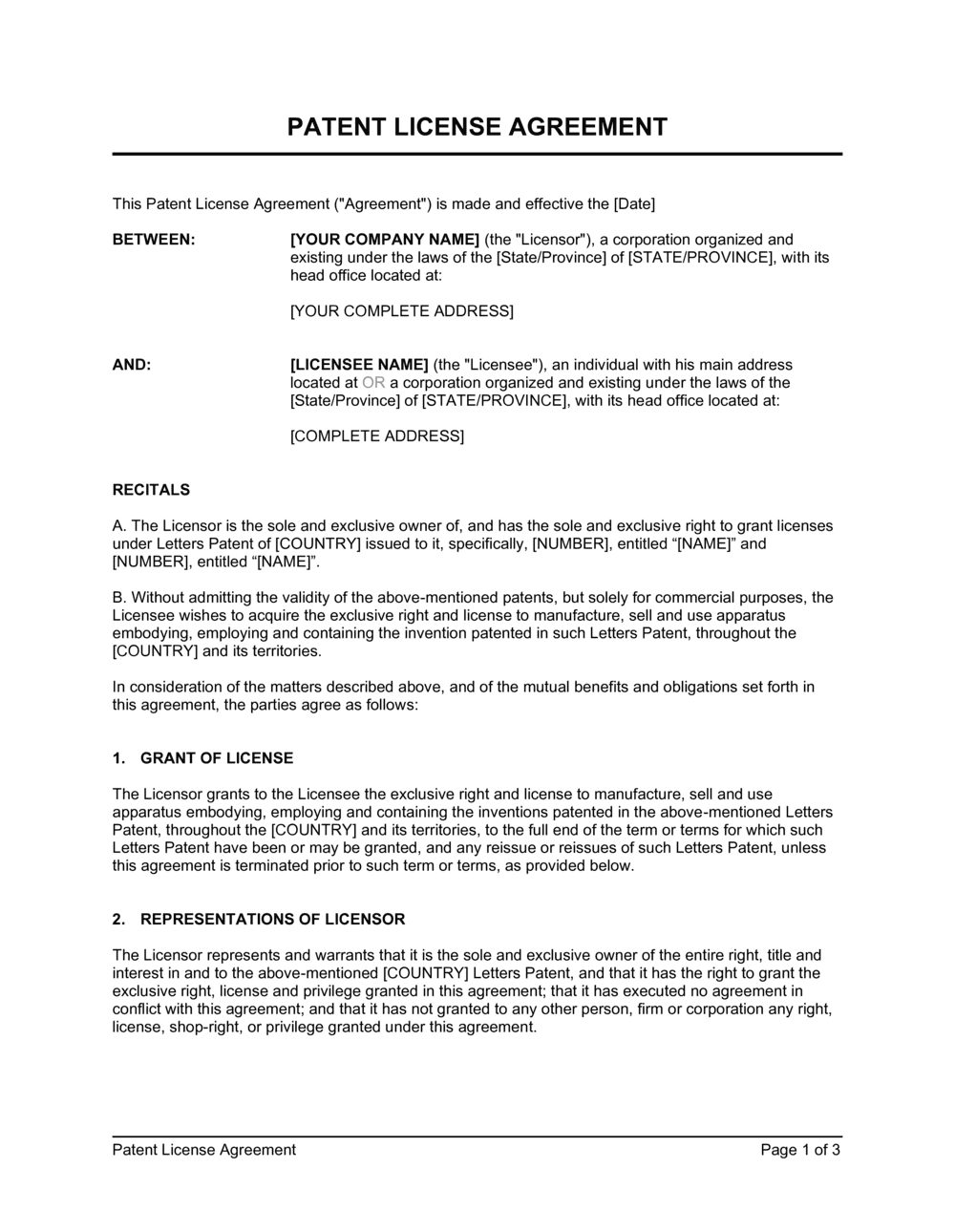
Enter the licensor's and licensee's full legal entity names, registered addresses, and jurisdiction of incorporation. List every patent number, application number, and country of registration covered by the agreement in a Schedule.
💡 Pull patent numbers from the patent office register on the day of signing to confirm current ownership status and that maintenance fees are paid up.
2
Define exclusivity, territory, and field of use
Choose exclusive, non-exclusive, or sole license. Specify the territory (e.g., worldwide, United States only, EU member states). Define the field of use narrowly enough to preserve the licensor's ability to license other markets.
💡 If granting worldwide exclusivity in a broad field, add a reversion clause tied to minimum royalties — otherwise the licensor is locked out of all commercialization indefinitely.
3
Set the royalty structure and payment mechanics
Enter the upfront fee, running royalty percentage, and royalty base. Define 'Net Sales' with a complete list of permitted deductions. Set the royalty reporting period (quarterly is standard) and the due date for reports and payments.
💡 Industry royalty benchmarks vary widely: pharmaceutical patents typically range from 2–10% of net sales; mechanical and electronics patents from 1–5%. Research comparable licenses before agreeing to a rate.
4
Address sublicensing and have-made rights
Decide whether the licensee may sublicense and whether it may have products manufactured by contract manufacturers ('have-made' rights). If sublicensing is permitted, set the revenue-sharing percentage and require that sublicense agreements flow down all material obligations.
💡 Require the licensee to provide a copy of every sublicense agreement within 30 days of execution — this lets you verify that your IP obligations are being passed through correctly.
5
Allocate patent prosecution and maintenance responsibility
State which party is responsible for paying renewal fees and filing continuation applications. Include a step-in right allowing the licensee to take over prosecution if the licensor elects to abandon any covered patent.
💡 For licenses covering pending applications, define what happens if the application does not issue — does the royalty obligation survive, reduce, or terminate?
6
Draft the infringement enforcement provisions
For exclusive licenses, give the licensee a right to enforce the patent against infringers independently if the licensor does not act within a defined window (typically 90–180 days). Specify how litigation costs and recoveries are shared.
💡 Licensees in regulated markets (pharma, medical devices) often need stand-alone enforcement rights to protect market exclusivity — do not leave this section as licensor-only.
7
Set term, termination triggers, and post-termination obligations
Define the agreement's duration (typically life of the last patent). List termination triggers: uncured material breach, insolvency, patent challenge by licensee, or failure to meet minimum commercialization milestones. Specify what happens to existing inventory and sublicenses upon termination.
💡 Include a sell-off period of 90–180 days post-termination for the licensee to deplete finished-goods inventory — without it, termination can leave the licensee with unmarketable stock.
8
Execute before any licensed activity begins
Both parties must sign the agreement before the licensee manufactures, sells, or imports any product under the license. Backdating or executing after commercial activity has begun creates ambiguity about royalty accrual and may void representations made at signing.
💡 Use a countersignature page that records execution date separately from the agreement date to avoid any question about when binding obligations arose.