Overtime Policy Guidance Template

Free Word download β€’ Edit online β€’ Save & share with Drive β€’ Export to PDF

8 pagesβ€’20–30 min to fillβ€’Difficulty: Standard
Learn more ↓
FreeOvertime Policy Guidance Template

At a glance

What it is
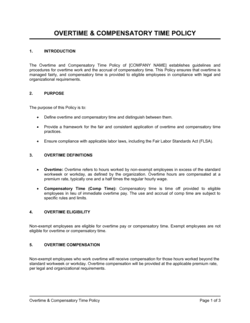
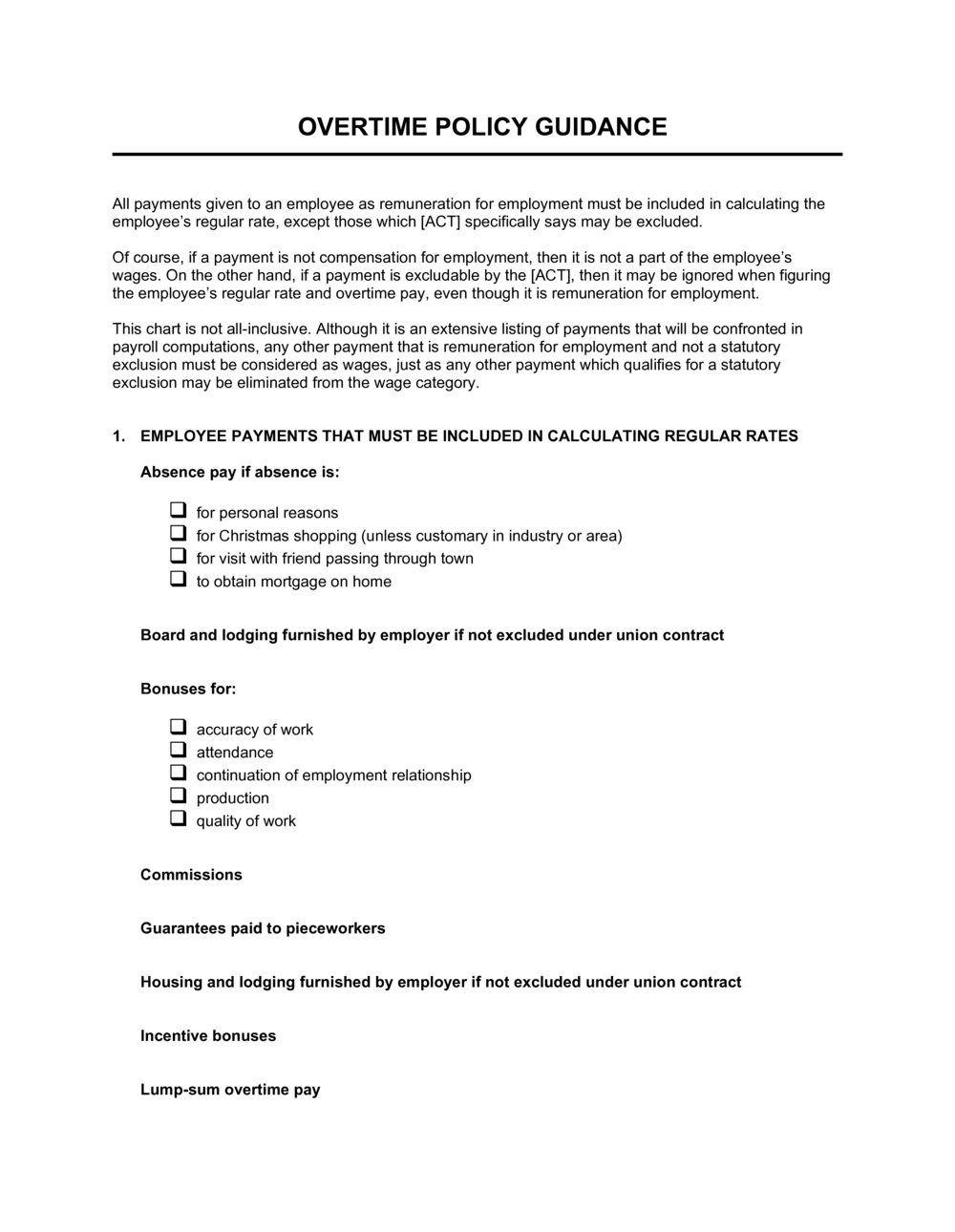
An Overtime Policy Guidance document is a written internal policy that defines the rules governing when employees may work overtime, who must authorize it, how it is calculated and compensated, and how records are maintained. This free Word download gives HR managers and business owners a structured, editable template they can tailor to their workforce and export as PDF for distribution to employees.
When you need it
Use it when onboarding your first hourly or non-exempt employees, when overtime disputes or payroll discrepancies arise, or when a workforce audit, employee handbook update, or regulatory review requires documented overtime procedures.
What's inside
Purpose and scope, employee eligibility classifications, authorization procedures, overtime calculation and pay rates, timekeeping requirements, disciplinary consequences for unauthorized overtime, and manager responsibilities β€” organized in a clear, section-by-section format ready for immediate use.

What is an Overtime Policy Guidance document?

An Overtime Policy Guidance document is an internal HR policy that establishes the rules governing when non-exempt employees may work hours beyond their standard schedule, how those hours must be authorized and recorded, and the rate at which they are compensated. It translates federal and state wage-and-hour law requirements β€” primarily the Fair Labor Standards Act and applicable state equivalents β€” into concrete, enforceable procedures that managers and employees can follow without needing to interpret the underlying statutes themselves. A well-drafted overtime policy covers employee classification, workweek definition, authorization workflows, timekeeping obligations, pay rate calculations, and the disciplinary consequences of non-compliance.

Why You Need This Document

Operating without a written overtime policy creates wage-and-hour exposure on multiple fronts simultaneously. Without documented authorization procedures, managers routinely approve β€” or tacitly allow β€” overtime hours that blow payroll budgets, and there is no paper trail to demonstrate the company acted in good faith when a dispute arises. Without a clear statement that all hours worked will be compensated regardless of authorization status, a single poorly worded manager email denying overtime pay can become the centerpiece of a Department of Labor complaint. Without explicit recordkeeping requirements, missing time records are treated as evidence of wage theft rather than administrative oversight. The FLSA allows employees to pursue back wages for up to two years β€” three years for willful violations β€” meaning that informal overtime practices accumulate liability quickly. This template gives HR teams and business owners a structured, customizable starting point that closes these gaps in an afternoon rather than discovering them during an audit.

Which variant fits your situation?

If your situation is…Use this template
Creating a standalone overtime policy for hourly non-exempt workersOvertime Policy Guidance
Building a complete employee handbook that includes overtime rulesEmployee Handbook
Documenting shift schedules alongside overtime thresholdsWork Schedule Policy
Tracking and approving overtime requests on a per-request basisOvertime Request Form
Managing labor costs across a construction or trades crewTime and Materials Policy
Setting broader compensation rules that include overtime pay gradesCompensation and Benefits Policy
Addressing remote-worker overtime for distributed teamsRemote Work Agreement

Common mistakes to avoid

❌ Stating that unauthorized overtime will not be paid

Why it matters: The FLSA requires employers to compensate all hours worked regardless of whether they were authorized. A policy that implies non-payment exposes the company to back-wage claims, liquidated damages, and DOL penalties.

Fix: State explicitly that all hours worked will be compensated and that the consequence for unauthorized overtime is disciplinary action β€” not docked pay.

❌ Classifying employees as exempt by job title alone

Why it matters: The FLSA exemption requires meeting both a salary-level test and a duties test. Employees with managerial titles who primarily perform non-exempt work are still entitled to overtime β€” and the back-pay liability compounds quickly.

Fix: Document the duties test analysis for every exempt role and review classifications annually when the DOL updates salary thresholds.

❌ Defining the workweek differently across departments

Why it matters: Inconsistent workweek definitions create arithmetic errors in overtime calculations and can result in some employees never crossing the 40-hour threshold even when they work equivalent total hours.

Fix: Set a single, company-wide workweek definition and embed it in both this policy and your timekeeping system configuration.

❌ Excluding non-discretionary bonuses from the regular rate

Why it matters: Non-discretionary bonuses β€” production bonuses, attendance bonuses, and shift differentials β€” must be included in the regular rate before calculating overtime. Omitting them understates the overtime premium owed.

Fix: List all forms of compensation that qualify as non-discretionary in the policy and confirm your payroll system recalculates the blended regular rate each period they are paid.

❌ No documented manager training on the policy

Why it matters: Supervisors who are unaware of the pre-authorization requirement or the prohibition on off-the-clock work are the most common source of wage claims β€” and their actions bind the company.

Fix: Include a mandatory manager training requirement in the policy and log completion dates in your HR system.

❌ Setting no review cadence for the policy

Why it matters: FLSA salary thresholds, state overtime rules, and daily overtime trigger points change through legislation and rulemaking. A policy that was compliant two years ago may expose the company today.

Fix: Schedule an annual policy review tied to a specific calendar date, assign ownership to a named HR role, and document that the review occurred.

The 9 key sections, explained

Purpose and scope

Employee classification

Overtime definition and thresholds

Authorization and approval process

Overtime calculation and pay rates

Timekeeping and recordkeeping requirements

Manager responsibilities

Disciplinary consequences

Policy review and amendment

How to fill it out

  1. 1

    Identify all non-exempt employee roles

    Before filling in any fields, audit your workforce and confirm which roles are non-exempt under the FLSA salary-level test ($684/week as of 2024) and the duties test. List them explicitly in the classification section.

    πŸ’‘ Check state law as well β€” some states set higher salary thresholds than the federal minimum, which affects who is covered by your policy.

  2. 2

    Define your workweek start and end day

    Enter the specific day and time your workweek begins and ends (e.g., Monday 12:00 a.m. through Sunday 11:59 p.m.). This definition is fixed once established and must be consistent across all departments.

    πŸ’‘ Choose a workweek that aligns with your payroll processing cycle β€” misalignment forces manual overtime calculations every period.

  3. 3

    Set the overtime threshold and applicable rates

    Enter the overtime threshold (40 hours/week federally; lower daily thresholds if you operate in California, Alaska, or Nevada). Specify the 1.5Γ— rate and any 2Γ— rate triggered by state law.

    πŸ’‘ If you employ staff in multiple states, create a state-specific addendum rather than trying to address all variations in the main policy body.

  4. 4

    Document the authorization workflow

    Name the approval chain: which form or system employees use to request overtime, who approves it, and by what deadline. Attach or link the overtime request form if you have one.

    πŸ’‘ A two-step approval (direct supervisor + department head) for overtime requests over [X] hours per week significantly reduces unplanned labor cost overruns.

  5. 5

    Specify timekeeping requirements

    Name the timekeeping system employees must use, submission deadlines, and how corrections are handled. State clearly that off-the-clock work is prohibited.

    πŸ’‘ Include a sentence explicitly prohibiting supervisors from asking employees to work off-the-clock β€” this one sentence is your first line of defense in a wage dispute.

  6. 6

    Draft the disciplinary section carefully

    List consequences for unauthorized overtime and for managers who circumvent the policy. Confirm that all hours worked will be compensated regardless of authorization status β€” this is legally required under the FLSA.

    πŸ’‘ Have your payroll manager or HR counsel review this section specifically β€” it is where the most common wage-claim language errors appear.

  7. 7

    Set a policy review date and owner

    Enter the HR role responsible for annual review, the review cadence, and the process for notifying employees of changes. Add a signature or acknowledgment line for employees to confirm receipt.

    πŸ’‘ Tie the review date to your annual compensation review cycle β€” both often need to be updated together when salary thresholds or benefit structures change.

  8. 8

    Distribute and collect acknowledgments

    Share the finalized policy with all non-exempt employees and collect signed acknowledgment forms. Store these in each employee's personnel file.

    πŸ’‘ For remote teams, use a digital acknowledgment tool and export the timestamped confirmation records β€” email acknowledgments are harder to locate during an audit.

Frequently asked questions

What is an overtime policy?

An overtime policy is a written internal document that defines when employees are eligible to work overtime, how they must request and receive authorization, the rate at which overtime hours are compensated, and how time records are maintained. It ensures the company meets wage and hour law requirements consistently and gives managers and employees clear rules to follow.

Who is covered by an overtime policy?

Overtime policies primarily govern non-exempt employees β€” those covered by the FLSA or equivalent state law β€” who are entitled to 1.5Γ— their regular rate for hours exceeding 40 per workweek. Exempt employees (salaried professionals, managers, and administrative roles meeting the FLSA duties and salary tests) are generally not entitled to overtime pay but should still be addressed in the policy scope to avoid ambiguity.

Can I refuse to pay overtime if an employee worked it without authorization?

No. Under the FLSA, employers must pay all hours that a non-exempt employee actually works, including unauthorized overtime. The appropriate remedy is disciplinary action, up to and including termination β€” not withholding wages. A policy that states unauthorized overtime will not be paid creates direct wage-claim exposure and is unenforceable.

What is the difference between daily and weekly overtime?

Federal law (FLSA) requires overtime only for hours exceeding 40 in a workweek β€” there is no federal daily overtime threshold. Several states, including California, Alaska, and Nevada, require overtime for hours exceeding 8 in a single workday. If you operate in those states, your policy must address daily overtime thresholds in addition to the weekly standard, and the higher of the two rates applies.

Are salaried employees entitled to overtime?

Salaried employees may or may not be entitled to overtime depending on their classification. Salaried employees who earn less than $684 per week (the current FLSA threshold as of 2024) are generally non-exempt and entitled to overtime regardless of their job title. Salaried employees above that threshold must also pass the FLSA duties test to be classified as exempt. Misclassifying a salaried employee as exempt is one of the most frequently cited wage-and-hour violations.

What should an overtime authorization form include?

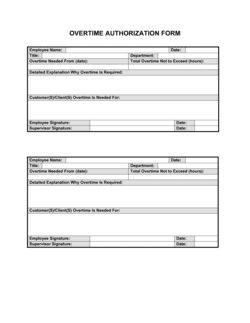
An effective overtime request form should capture the employee's name and role, the dates and estimated hours of overtime requested, the business reason for the overtime, supervisor approval with signature and date, and a field for actual hours worked after the fact. Keeping the request and the actuals on a single form makes payroll reconciliation straightforward and creates a clean audit trail.

How long must overtime records be kept?

The FLSA requires employers to retain payroll records β€” including time and attendance records β€” for at least three years. Records supporting wage computations, such as timesheets and pay rate tables, must be kept for at least two years. Many employment attorneys recommend a five-year retention period to cover state law variations and the statute of limitations for wage claims, which runs up to three years for willful violations under the FLSA.

Can employees waive their right to overtime pay?

No. The right to overtime pay under the FLSA cannot be waived by agreement between the employee and employer. Any agreement, written or oral, in which an employee waives overtime entitlement is void and unenforceable. The same rule applies in most state jurisdictions. Compensatory time off in lieu of overtime pay is permissible only for state and local government employers under federal law.

Do I need a lawyer to create an overtime policy?

For most small and mid-sized businesses with straightforward domestic operations, a well-structured template β€” reviewed by an HR professional familiar with your state's overtime rules β€” is sufficient. Engage an employment attorney when you operate across multiple states with varying daily overtime thresholds, when you have a significant number of borderline exempt classifications to defend, or when a wage complaint or DOL audit is already underway.

How this compares to alternatives

vs Employee Handbook

An employee handbook is a comprehensive document covering all HR policies β€” onboarding, code of conduct, benefits, leave, and overtime rules among many others. An overtime policy is a standalone document providing greater detail on a single subject. Use the standalone policy for operations teams that need the full rule set; embed a summary in the handbook for general employee reference.

vs Overtime Request Form

An overtime request form is a transactional document employees complete to seek approval for specific overtime hours. The policy sets the rules that govern when and how the form is used. The two documents work together β€” the policy without the form leaves authorization undocumented, and the form without the policy provides no framework for consistent decision-making.

vs Work Schedule Policy

A work schedule policy governs how shifts are assigned, modified, and communicated β€” including regular hours, shift swaps, and on-call arrangements. An overtime policy governs what happens when those scheduled hours are exceeded. Both are needed; schedule policy drives planned hours, and overtime policy governs what happens when actuals exceed them.

vs Compensation and Benefits Policy

A compensation and benefits policy covers the full pay structure β€” base pay grades, bonus plans, benefits enrollment, and pay equity practices. An overtime policy focuses specifically on the rules, rates, and authorization workflow for hours beyond the standard workweek. For most businesses, the overtime policy is referenced within the broader compensation policy rather than duplicating it.

Industry-specific considerations

Retail and Hospitality

High proportion of hourly non-exempt staff, fluctuating seasonal demand, and shift-based scheduling make pre-authorization workflows and daily overtime tracking critical in states like California.

Construction and Trades

Project-based overtime is common and often contractually required; the policy must address prevailing wage requirements on public contracts and daily overtime in applicable states.

Manufacturing

Shift premiums, production bonuses, and piece-rate pay must all be factored into the regular rate calculation, making the compensation section of the policy more complex than in service industries.

Healthcare

8-and-80 overtime rules under the FLSA allow healthcare employers to calculate overtime over a 14-day period rather than a 7-day workweek, creating a specialized policy variant that must be documented explicitly.

Template vs pro β€” what fits your needs?

PathBest forCostTime
Use the templateSmall businesses and HR teams managing non-exempt employees in a single stateFree1–2 hours to customize and distribute
Template + professional reviewBusinesses operating in states with daily overtime rules (California, Alaska, Nevada) or with a mix of exempt and non-exempt classifications to document$200–$600 for an HR consultant or employment attorney review2–5 business days
Custom draftedMulti-state employers, unionized workforces, or companies responding to a DOL audit or wage complaint$800–$3,000+ for custom employment counsel drafting1–3 weeks

Glossary

Non-Exempt Employee
An employee covered by FLSA (or equivalent) overtime rules, entitled to 1.5Γ— their regular rate for hours worked beyond 40 per week.
Exempt Employee
An employee who meets salary-level and duties tests that exclude them from statutory overtime entitlements β€” typically salaried managers, professionals, and administrative roles.
Regular Rate of Pay
The base hourly rate used to calculate overtime β€” includes hourly wages and certain bonuses but excludes gifts, expense reimbursements, and discretionary bonuses.
Overtime Premium
The additional 0.5Γ— rate paid on top of the regular rate for each hour worked beyond the statutory overtime threshold.
FLSA (Fair Labor Standards Act)
The US federal law setting minimum wage, overtime pay, recordkeeping, and child labor standards for most private and public employers.
Workweek
A fixed, regularly recurring period of 168 consecutive hours β€” seven consecutive 24-hour periods β€” that the employer defines as the basis for calculating overtime.
Compensatory Time (Comp Time)
Paid time off granted in lieu of overtime pay β€” permissible for state and local government employers under FLSA but generally prohibited for private-sector employees.
Pre-Authorization
The employer's requirement that an employee obtain written approval from a supervisor before working any hours beyond their scheduled shift.
Time and Attendance System
Software or physical timekeeping infrastructure used to record employees' start times, stop times, and total hours worked each workweek.
Payroll Period
The recurring cycle β€” weekly, biweekly, or semi-monthly β€” over which earned wages including overtime are calculated and paid out.
Doubling Time (Double Time)
Pay at 2Γ— the regular rate, required in some states (notably California) for hours exceeding 12 in a single workday or all hours on the seventh consecutive day of a workweek.

Part of your Business Operating System

This document is one of 3,000+ business & legal templates included in Business in a Box.

  • Fill-in-the-blanks β€” ready in minutes
  • 100% customizable Word document
  • Compatible with all office suites
  • Export to PDF and share electronically

Create your document in 3 simple steps.

From template to signed document β€” all inside one Business Operating System.
1
Download or open template

Access over 3,000+ business and legal templates for any business task, project or initiative.

2
Edit and fill in the blanks with AI

Customize your ready-made business document template and save it in the cloud.

3
Save, Share, Send, Sign

Share your files and folders with your team. Create a space of seamless collaboration.

Save time, save money, and create top-quality documents.

β˜…β˜…β˜…β˜…β˜…

"Fantastic value! I'm not sure how I'd do without it. It's worth its weight in gold and paid back for itself many times."

Managing Director Β· Mall Farm
Robert Whalley
Managing Director, Mall Farm Proprietary Limited
β˜…β˜…β˜…β˜…β˜…

"I have been using Business in a Box for years. It has been the most useful source of templates I have encountered. I recommend it to anyone."

Business Owner Β· 4+ years
Dr Michael John Freestone
Business Owner
β˜…β˜…β˜…β˜…β˜…

"It has been a life saver so many times I have lost count. Business in a Box has saved me so much time and as you know, time is money."

Owner Β· Upstate Web
David G. Moore Jr.
Owner, Upstate Web

Run your business with a system β€” not scattered tools

Stop downloading documents. Start operating with clarity. Business in a Box gives you the Business Operating System used by over 250,000 companies worldwide to structure, run, and grow their business.

Free Forever PlanΒ Β·Β No credit card required