Negative Response_No Opening Template

Free Word download β€’ Edit online β€’ Save & share with Drive β€’ Export to PDF

1 pageβ€’20–30 min to fillβ€’Difficulty: Standardβ€’Signature requiredβ€’Legal review recommended
Learn more ↓
FreeNegative Response_No Opening Template

At a glance

What it is
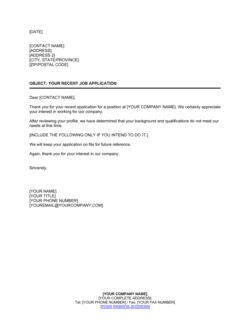
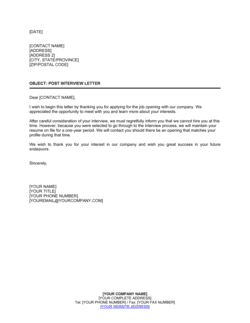
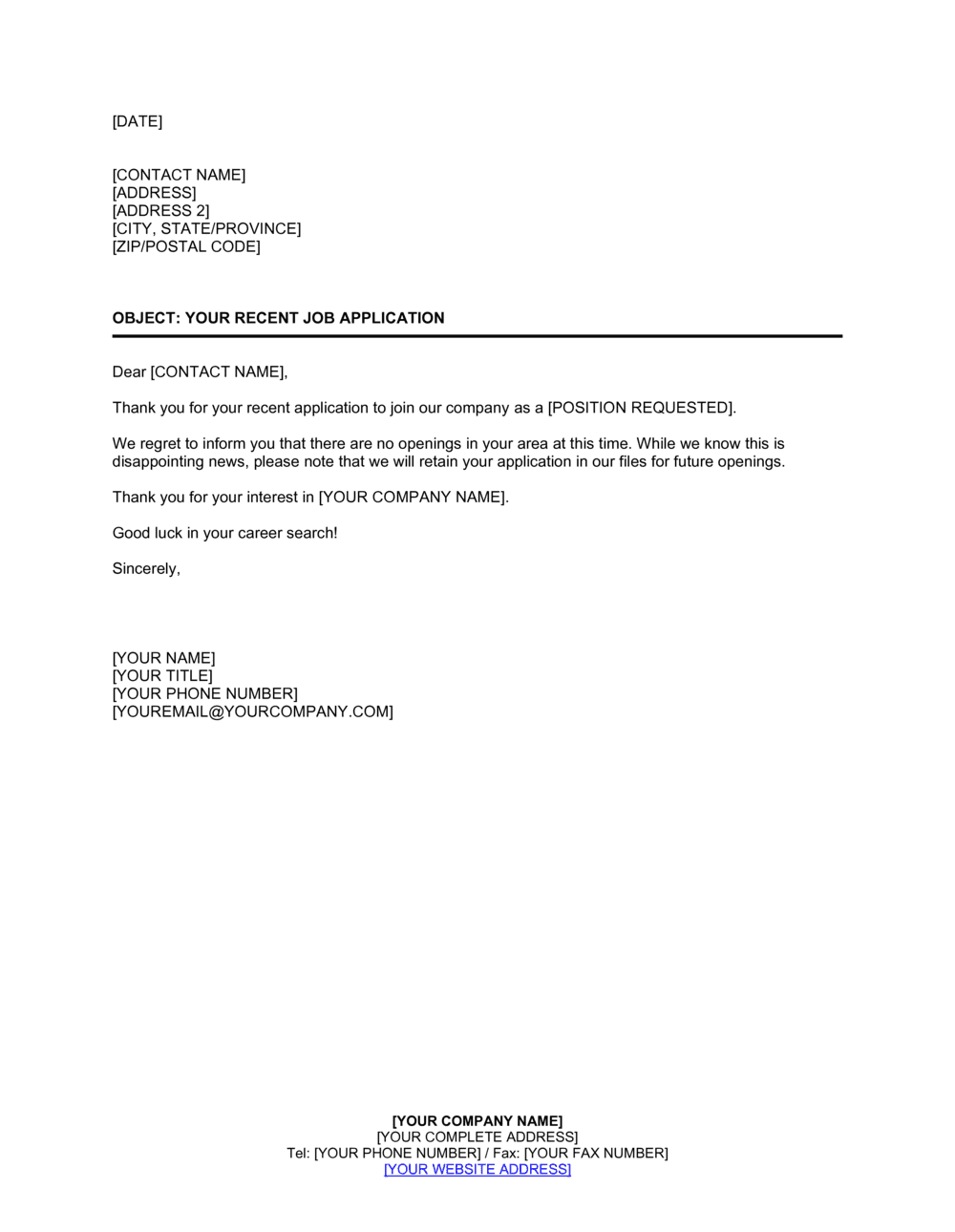
A Negative Response No Opening is a formal written communication an employer sends to a job applicant to confirm that no suitable vacancy currently exists for their application. This free Word download gives you a professionally drafted, legally defensible template you can edit online and export as PDF β€” ensuring every unsolicited or speculative application receives a clear, consistent, and respectful written response.
When you need it
Use it whenever a candidate submits a speculative application, a CV on file, or a referral inquiry and no matching role is open. It is equally appropriate when a position has been filled before the candidate could be considered, or when a hiring freeze prevents any new engagement.
What's inside
Employer and applicant identification, a clear statement that no current opening matches the applicant's profile, a professionally worded expression of appreciation for the candidate's interest, optional future-consideration language, and a closing statement that limits any implied employment commitment.

What is a Negative Response No Opening?

A Negative Response No Opening is a formal written communication an employer sends to a job applicant to confirm that no suitable vacancy currently exists for their profile. Unlike a standard rejection letter β€” which is issued after a candidate has been considered against a specific advertised role and not selected β€” this document is used when the employer has made no selection decision at all: the applicant submitted speculatively, the role does not exist, or a hiring freeze prevents engagement. Drafted correctly, it closes the applicant's inquiry in a professionally worded, legally defensible way that protects the employer from implied employment commitments, data protection violations, and discrimination claims arising from inconsistent or careless communication.

Why You Need This Document

Without a formal written response, speculative applicants follow up repeatedly, assume implied consideration, and in some cases pursue discrimination claims on the basis that silence constituted disparate treatment. The consequences of an informal or poorly worded response are equally serious: enthusiastic language promising future employment has been used in promissory estoppel claims, and retaining applicant data without a stated period violates GDPR, UK GDPR, and PIPEDA β€” all of which apply from the moment a CV lands in your inbox. A standardized, signed template with a clear no-opening statement, a conditional future-consideration clause, a data retention notice, and an explicit no-employment-relationship disclaimer closes all four risk vectors in under ten minutes per letter. This template gives you that standard β€” professionally formatted, jurisdiction-aware, and ready to deploy across every unsolicited application your organization receives.

Which variant fits your situation?

If your situation is…Use this template
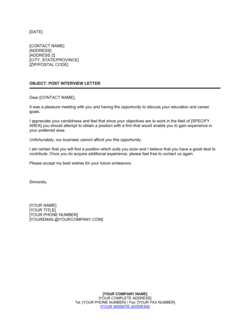
Declining a candidate after a completed interview when no role is availableNegative Response After Interview
Rejecting a candidate who was considered but a different applicant was selectedJob Application Rejection Letter
Notifying an internal transfer applicant that no vacancy exists in their target departmentInternal Transfer Rejection Letter
Declining a candidate after a resume review when the role itself has been cancelledPosition Cancelled Notification Letter
Inviting the candidate to re-apply when a future opening is expected within 90 daysFuture Consideration Letter
Responding to a referral from an existing employee when no role is openReferred Applicant No Opening Response
Confirming receipt of a CV submitted through a job board with no active listingCV Acknowledgement No Vacancy Letter

Common mistakes to avoid

❌ Using vague language that implies future opportunity

Why it matters: Phrases like 'we will definitely keep you in mind' or 'we expect roles to open soon' can create a legitimate expectation of employment, which has been used as the basis for promissory estoppel claims in several common-law jurisdictions.

Fix: Replace with conditional, time-bounded language: 'Should a suitable vacancy arise, we encourage you to apply through our careers page.' Remove any language that suggests inevitability.

❌ Omitting the data retention period when retaining the applicant's CV

Why it matters: Under GDPR and UK GDPR, retaining personal data without a stated purpose and defined retention period is unlawful processing β€” regulators have issued enforcement notices to employers specifically for this failure in the recruitment context.

Fix: State the exact retention period in the letter (12 months is the common standard) and include a deletion contact. Log the retention period against the applicant's record and act on it.

❌ Sending an unsigned, generic form letter

Why it matters: An unsigned mass-produced rejection with no named contact is more likely to be perceived as discriminatory because it provides no evidence of individual consideration β€” a key element in defending a disparate-treatment claim.

Fix: Include a named HR contact or hiring manager in the closing, and ensure the letter is signed or carries a named signatory block even when sent in bulk.

❌ Over-praising the candidate's qualifications in the rejection

Why it matters: Writing that a candidate is 'exactly the type of person we want' or 'exceptionally qualified' in a no-opening letter creates a contradiction that candidates and their lawyers use to argue the real reason for non-engagement was discriminatory.

Fix: Acknowledge effort and experience briefly and neutrally β€” 'we appreciate the time you invested in your application' β€” without characterizing the quality of the candidate's profile.

❌ Failing to include an equal opportunity statement

Why it matters: Without this clause, a rejection letter to a member of a protected group lacks any affirmative evidence that protected characteristics were irrelevant to the outcome, making the employer's position harder to defend in an investigation or tribunal.

Fix: Include a standard equal opportunity paragraph in every rejection letter, not selectively β€” inconsistent inclusion itself can become evidence of disparate treatment.

❌ Not retaining a copy of the sent letter

Why it matters: Employment discrimination claims are typically filed months after the rejection β€” in the US, an EEOC charge may arrive up to 300 days later. Without a retained copy, the employer cannot prove what was actually communicated.

Fix: File a timestamped copy of every sent rejection letter in your applicant tracking system or HR records immediately upon sending, linked to the applicant's file.

The 9 key clauses, explained

Employer and applicant identification

In plain language: Identifies the sending organization by full legal name and the applicant by name and application reference, establishing the parties to the communication.

Sample language
[EMPLOYER LEGAL NAME] ('Company') refers to the application submitted by [APPLICANT FULL NAME] on [DATE] for [POSITION TITLE / general employment inquiry] (Reference: [APPLICATION REF]).

Common mistake: Using only the brand name instead of the registered legal entity name β€” this creates ambiguity if the applicant later claims a misrepresentation and the trading name differs from the incorporated entity.

Clear statement of no current opening

In plain language: Unambiguously informs the applicant that no suitable vacancy currently exists, giving a factual basis for the response without speculating about future needs.

Sample language
After careful review of your application, we regret to inform you that there is no current opening at [EMPLOYER LEGAL NAME] that matches your qualifications and experience at this time.

Common mistake: Using hedging language like 'we don't think we have a role' β€” vague phrasing can be read as an invitation to follow up repeatedly or as a promise to reconsider, creating unnecessary correspondence and potential implied obligation.

Acknowledgement of the applicant's qualifications

In plain language: Briefly recognizes the applicant's credentials or interest without over-praising in a way that could imply they were a strong contender for a role that does not exist.

Sample language
We appreciate the time you invested in your application and recognize the experience you have developed in [FIELD / INDUSTRY].

Common mistake: Writing enthusiastic compliments about the candidate's qualifications β€” language like 'you are exactly the kind of person we are looking for' creates a reasonable expectation of future employment that can be difficult to defend if the person is never hired.

Reason for non-engagement (optional but recommended)

In plain language: States briefly and factually why the employer cannot proceed β€” typically a hiring freeze, no current vacancy, or a restructuring β€” without providing legally sensitive detail.

Sample language
At this time, [EMPLOYER LEGAL NAME] does not have an active recruitment program for [DEPARTMENT / ROLE TYPE] due to [current hiring freeze / no vacancy in the relevant area].

Common mistake: Omitting any reason entirely, then using inconsistent language across rejections β€” candidates who compare letters from the same employer and see contradictory explanations have pursued discrimination claims on the basis of disparate treatment.

Future consideration language (optional)

In plain language: Invites the applicant to re-apply at a later date or confirms their details will be retained on file, but uses conditional language that does not promise future contact.

Sample language
Should a suitable vacancy arise in the future, we would encourage you to monitor our careers page at [WEBSITE URL] and submit a new application at that time. We will retain your details on file for [X months / 12 months] unless you request deletion.

Common mistake: Promising to 'keep your CV on file and be in touch' without specifying the retention period β€” in GDPR and PIPEDA jurisdictions this creates a data-processing obligation the employer may not be equipped to honour.

Data retention and privacy notice

In plain language: Informs the applicant of the lawful basis for retaining their personal data, the retention period, and their right to request deletion β€” required in the EU, UK, and Canada.

Sample language
Your personal data will be retained for a period of [12 months] from the date of this letter, after which it will be securely deleted. You may request deletion at any time by contacting [DATA CONTACT / EMAIL]. Our privacy policy is available at [URL].

Common mistake: Retaining applicant data indefinitely without a stated period β€” regulators in the EU, UK, and Canada have issued fines and enforcement notices specifically for unlawful retention of rejected applicant data.

Equal opportunity and non-discrimination statement

In plain language: Affirms that the decision was not influenced by any protected characteristic and that the employer is an equal-opportunity employer.

Sample language
[EMPLOYER LEGAL NAME] is an equal opportunity employer. Our recruitment decisions are made without regard to race, color, religion, sex, national origin, age, disability, or any other characteristic protected by applicable law.

Common mistake: Omitting this clause in letters to applicants from identifiable protected groups β€” while not legally mandatory in all jurisdictions, its absence strengthens a discrimination claimant's narrative that protected status influenced the outcome.

No employment relationship disclaimer

In plain language: Explicitly states that this letter does not create or imply an employment relationship, an obligation to hire, or any contractual commitment.

Sample language
This letter does not constitute an offer of employment, a contract of employment, or any commitment to engage [APPLICANT FULL NAME] in the future. Any future employment relationship would be subject to a separate written agreement.

Common mistake: Leaving out this disclaimer on letters that include enthusiastic future-consideration language β€” courts in several jurisdictions have found that repeated positive correspondence, even without a formal offer, created a legitimate expectation of employment.

Closing and signatory

In plain language: Closes professionally with the name, title, and signature of the responsible HR representative or hiring manager, giving the applicant a named point of contact.

Sample language
We wish you every success in your job search. Yours sincerely, [SIGNATORY NAME] | [TITLE] | [EMPLOYER LEGAL NAME] | [DATE]

Common mistake: Sending an unsigned form letter β€” in jurisdictions where applicants have a statutory right to request reasons for rejection, an unsigned letter with no named contact delays the employer's response and signals poor process to regulators.

How to fill it out

  1. 1

    Insert the employer's full legal name and contact details

    Enter the registered corporate or trading name, mailing address, and HR contact email at the top of the letter. Use the legal entity name, not the brand name alone.

    πŸ’‘ Pre-save a master version of the letterhead block so every rejection letter goes out on consistent, correctly formatted company stationery.

  2. 2

    Address the applicant by full name and reference their application

    Use the applicant's full name in the salutation and include the date they applied and any application reference number. Avoid 'Dear Applicant' β€” named letters are less likely to trigger formal complaints.

    πŸ’‘ If no reference number exists, use the date of their application as the reference to create a traceable record in your HR filing system.

  3. 3

    State clearly that no current opening exists

    Write a single, unambiguous sentence confirming there is no suitable vacancy at this time. Do not soften with language that implies a role might appear imminently unless that is factually accurate.

    πŸ’‘ Keep this sentence factual and brief β€” one to two sentences is sufficient and reduces the risk of contradictory language appearing elsewhere in the letter.

  4. 4

    Decide whether to include future-consideration language

    If you genuinely intend to retain the applicant's details and may recruit in the relevant area within 12 months, include the optional future-consideration clause with a specific retention period. If not, omit it entirely.

    πŸ’‘ Only promise future consideration if you have a process to action it β€” empty promises damage employer brand and, in some jurisdictions, trigger data-processing obligations you may not meet.

  5. 5

    Complete the data retention and privacy notice

    Enter the retention period (typically 6–12 months), the deletion contact, and the URL of your privacy policy. This clause is mandatory for employers subject to GDPR, UK GDPR, or PIPEDA.

    πŸ’‘ Set a calendar reminder at the end of the retention period to delete the applicant's file β€” regulators check actual deletion, not just stated policy.

  6. 6

    Confirm the equal opportunity and no-commitment disclaimers are present

    Review that both the equal opportunity statement and the no-employment-relationship disclaimer are in the letter before sending. Do not delete these clauses to save space.

    πŸ’‘ If your jurisdiction has specific protected characteristics beyond the standard list β€” for example, genetic information under US federal law β€” add them to the equal opportunity clause.

  7. 7

    Sign and date the letter before sending

    Have the responsible HR manager or hiring authority sign the letter and date it. For high-volume responses, a printed signature block with a named individual is acceptable, but ensure one named person takes ownership of the communication.

    πŸ’‘ Send by email with a PDF attachment rather than plain text β€” a formatted PDF with a signature block is harder to alter and easier to retain as an auditable record.

  8. 8

    File a copy in your applicant tracking system

    Retain a timestamped copy of every sent letter in your HR records or applicant tracking system, linked to the applicant's profile, for at least as long as the stated data retention period.

    πŸ’‘ Document the date sent and the recipient email address alongside the copy β€” this creates the evidence trail needed to defend a discrimination claim if one is filed months later.

Frequently asked questions

What is a negative response no opening letter?

A negative response no opening letter is a formal written communication an employer sends to a job applicant to confirm that no suitable vacancy currently exists for their profile. It is used to respond to speculative applications, unsolicited CVs, and referral inquiries in a professional, legally defensible way. The letter closes the applicant's inquiry clearly while preserving the employer's brand and limiting any implied employment commitment.

Is an employer legally required to send a rejection letter?

In most jurisdictions, there is no statutory obligation to respond to speculative or unsolicited applications. However, for applications submitted in response to an advertised role, several jurisdictions β€” including the UK and many EU member states β€” require employers to notify applicants of the outcome. Even where not legally required, sending a written rejection is best practice: it closes the application formally, reduces follow-up contact, and creates an auditable record for discrimination defence purposes.

Can a rejection letter create an unintended employment obligation?

Yes, in limited circumstances. In common-law jurisdictions, enthusiastic language promising future employment or stating that a role will shortly become available has been used as the basis for promissory estoppel or misrepresentation claims. The risk is low when the letter is factually neutral, uses conditional future-consideration language, and includes an explicit no-employment-relationship disclaimer. The template includes all three safeguards by default.

How long should an employer retain a rejected applicant's personal data?

The standard practice in most jurisdictions is 6–12 months from the date of the rejection letter. In the EU and UK, GDPR and UK GDPR require a documented lawful basis and a defined retention period β€” typically the statute of limitations for discrimination claims (3 months in the UK Employment Tribunal, 1 year under the Equality Act 2010 in some contexts). In Canada under PIPEDA, retention should not exceed what is necessary for the purpose. The letter should state the period and provide a deletion contact.

Should the letter explain why the applicant was not considered?

A brief factual reason β€” hiring freeze, no vacancy, no matching role β€” is recommended because it reduces repeat applications and supports the employer's non-discriminatory intent. Detailed feedback on the applicant's qualifications is not advisable in a no-opening response, as it implies the employer conducted a substantive assessment that it may not be prepared to defend. Keep the explanation factual and structural: 'no current vacancy' rather than 'your skills do not meet our requirements.'

What is the difference between a negative response no opening and a standard job rejection letter?

A standard rejection letter is sent after an active recruitment process β€” the employer has reviewed and compared candidates against a specific vacancy and chosen someone else. A negative response no opening is sent when no vacancy exists at all β€” the employer is not comparing applicants and no selection decision has been made. The legal and communication risks differ: the no-opening letter must avoid implying a selection was made, while the standard rejection must avoid implying discrimination in an actual selection.

Can the same template be used for both speculative applicants and referrals from employees?

The template can be adapted for both, but referral situations warrant an additional sentence acknowledging the referral source positively β€” omitting this can damage the referring employee's experience. Avoid naming the referring employee in the letter sent to the applicant, as this can create awkwardness if the applicant and referrer have a personal relationship and the outcome is unexpected. A separate brief acknowledgement to the referring employee is best practice.

Does the letter need to be signed to be legally effective?

A signature is not required for the letter to communicate the rejection effectively, but a named signatory block is strongly recommended for legal defensibility. An unsigned, generic form letter provides no evidence of individual consideration β€” a gap that discrimination claimants and their representatives typically exploit. In practice, a printed name and title under a scanned signature is sufficient for email delivery. Using Business in a Box eSign timestamps execution and creates an auditable record.

What should an employer do if the applicant disputes the rejection?

If an applicant requests further information or alleges discrimination, the employer's response should rely on the retained copy of the letter and any application records held in the HR system. Do not amend or supplement the letter after sending. In the UK, employers have 40 days to respond to a Subject Access Request under UK GDPR β€” the applicant may use this route to obtain all correspondence. Having a clean, consistent, professionally worded letter on file is the employer's strongest defence.

How this compares to alternatives

vs Job Application Rejection Letter

A job application rejection letter is issued after an active recruitment process in which the applicant was considered against a specific vacancy and not selected. A negative response no opening is used when no vacancy exists β€” no selection was made and the applicant was not compared to others. The legal risks differ: the no-opening letter must avoid implying a selection occurred, while the rejection letter must demonstrate the selection was non-discriminatory.

vs Negative Response After Interview

A negative response after interview is sent following a face-to-face or video interview in which the employer evaluated the candidate substantively. It typically includes brief feedback and must address the candidate's reasonable expectation formed during the interview. A no-opening letter is sent before any substantive evaluation occurs and should not offer feedback on the candidate's qualifications.

vs Offer Letter

An offer letter is the positive counterpart β€” it formally extends an employment offer with terms. Both documents are part of the same recruitment communication lifecycle. The no-opening letter must be drafted carefully so that its language is clearly distinct from any offer-adjacent language, particularly when the employer genuinely intends to contact the applicant in the future.

vs Employment Contract

An employment contract governs the terms of an active employment relationship. A negative response no opening explicitly prevents any such relationship from forming and must include a no-employment-relationship disclaimer for that reason. If a no-opening letter accidentally uses contract-like language β€” compensation references, start-date suggestions β€” it can blur the line between a rejection and a conditional offer.

Industry-specific considerations

Technology / SaaS

High volumes of speculative engineering and product applications during hiring freezes require templated, GDPR-compliant responses that close the loop without creating data-retention backlogs.

Professional Services

Law firms, accounting practices, and consulting firms receive frequent graduate and lateral speculative applications; a professionally worded no-opening response protects firm reputation and limits implied commitment.

Healthcare

Regulated employers in healthcare must ensure rejection letters do not inadvertently reference protected health information or licensing status, and must comply with stricter data retention rules in several jurisdictions.

Retail / Hospitality

Seasonal employers receive large volumes of walk-in and email applications year-round; a templated no-opening response ensures consistent, documented communication even when no HR team is on site.

Jurisdictional notes

United States

No federal law requires employers to respond to unsolicited applications, but Title VII, the ADEA, and the ADA prohibit discrimination in all employment decisions, including rejections. EEOC charges must typically be filed within 180–300 days of the alleged discriminatory act. Several states β€” including California and New York β€” impose additional protected categories. Retain all rejection correspondence for at least one year; longer if the employer is a federal contractor subject to OFCCP record-keeping rules.

Canada

Each province has a Human Rights Code prohibiting discrimination in employment decisions. PIPEDA (and provincial equivalents in Alberta, BC, and Quebec) governs the collection, use, and retention of applicant personal data β€” employers must obtain implicit or explicit consent and limit retention to the period necessary for the purpose. Quebec's Law 25 (effective 2023) imposes stricter privacy obligations including a mandatory privacy policy and breach notification. Rejection letters must not reference any protected ground under the applicable provincial Code.

United Kingdom

The Equality Act 2010 prohibits discrimination across nine protected characteristics in all stages of recruitment. UK GDPR and the Data Protection Act 2018 require employers to state the lawful basis for retaining applicant data and to delete it after a defined period β€” the ICO recommends 6 months for unsuccessful applicants. Applicants may submit a Subject Access Request within 40 days requiring disclosure of all held data including rejection correspondence. From day one of a speculative inquiry, the employer is a data controller with full UK GDPR obligations.

European Union

GDPR (Regulation 2016/679) applies to all applicant data collected during recruitment, including speculative applications. Employers must have a documented lawful basis (typically legitimate interest or pre-contractual necessity), provide a privacy notice at the point of data collection, and delete data after the stated retention period. Member states vary in anti-discrimination protections β€” France, Germany, and the Netherlands have particularly active enforcement agencies. The retention standard for rejected applicants is typically 2–6 months depending on applicable national statute of limitations for discrimination claims.

Template vs lawyer β€” what fits your deal?

PathBest forCostTime
Use the templateHR managers and small business owners sending standard no-opening responses to unsolicited domestic applicantsFree5–10 minutes per letter
Template + legal reviewEmployers operating in GDPR, UK GDPR, or PIPEDA jurisdictions, or those with high-volume rejection workflows$150–$400 for an employment lawyer or HR consultant review of the template1–2 days for template setup; 5 minutes per letter thereafter
Custom draftedRegulated industries, employers with recent discrimination claims history, or multi-jurisdiction operations requiring jurisdiction-specific variants$500–$1,500 per custom template set1–2 weeks

Glossary

Speculative Application
An unsolicited job inquiry submitted by a candidate without a specific advertised vacancy to apply to.
Hiring Freeze
A temporary employer policy suspending all new hires, typically due to budget constraints, restructuring, or economic conditions.
Implied Employment Commitment
An unintentional contractual obligation created when an employer's written or verbal communication suggests a promise of future employment.
Applicant Pool
The group of individuals who have formally expressed interest in employment with an organization, whether or not a specific vacancy exists.
Future Consideration Clause
Optional language in a rejection letter that invites the candidate to re-apply or signals that their details will be retained for future openings.
Data Retention Notice
A statement informing the applicant how long the employer will retain their personal data and under what legal basis, required in many jurisdictions.
Equal Opportunity Statement
A declaration affirming the employer does not discriminate on the basis of protected characteristics such as race, gender, age, or disability.
Adverse Action
Any employment decision β€” including a rejection β€” that negatively affects an applicant, which may trigger disclosure obligations under certain employment laws.
At-Will Employment Disclaimer
Language clarifying that nothing in the letter creates an employment relationship or obligation to hire in the future.
Protected Characteristic
An attribute such as age, race, sex, disability, or religion that employment law prohibits employers from using as a basis for any hiring decision.

Part of your Business Operating System

This document is one of 3,000+ business & legal templates included in Business in a Box.

  • Fill-in-the-blanks β€” ready in minutes
  • 100% customizable Word document
  • Compatible with all office suites
  • Export to PDF and share electronically

Create your document in 3 simple steps.

From template to signed document β€” all inside one Business Operating System.
1
Download or open template

Access over 3,000+ business and legal templates for any business task, project or initiative.

2
Edit and fill in the blanks with AI

Customize your ready-made business document template and save it in the cloud.

3
Save, Share, Send, Sign

Share your files and folders with your team. Create a space of seamless collaboration.

Save time, save money, and create top-quality documents.

β˜…β˜…β˜…β˜…β˜…

"Fantastic value! I'm not sure how I'd do without it. It's worth its weight in gold and paid back for itself many times."

Managing Director Β· Mall Farm
Robert Whalley
Managing Director, Mall Farm Proprietary Limited
β˜…β˜…β˜…β˜…β˜…

"I have been using Business in a Box for years. It has been the most useful source of templates I have encountered. I recommend it to anyone."

Business Owner Β· 4+ years
Dr Michael John Freestone
Business Owner
β˜…β˜…β˜…β˜…β˜…

"It has been a life saver so many times I have lost count. Business in a Box has saved me so much time and as you know, time is money."

Owner Β· Upstate Web
David G. Moore Jr.
Owner, Upstate Web

Run your business with a system β€” not scattered tools

Stop downloading documents. Start operating with clarity. Business in a Box gives you the Business Operating System used by over 250,000 companies worldwide to structure, run, and grow their business.

Start freeΒ Β·Β No credit card required