Onboarding and Orientation Policy Template

Free Word download β€’ Edit online β€’ Save & share with Drive β€’ Export to PDF

2 pagesβ€’20–25 min to fillβ€’Difficulty: Standard
Learn more ↓
FreeOnboarding and Orientation Policy Template

At a glance

What it is
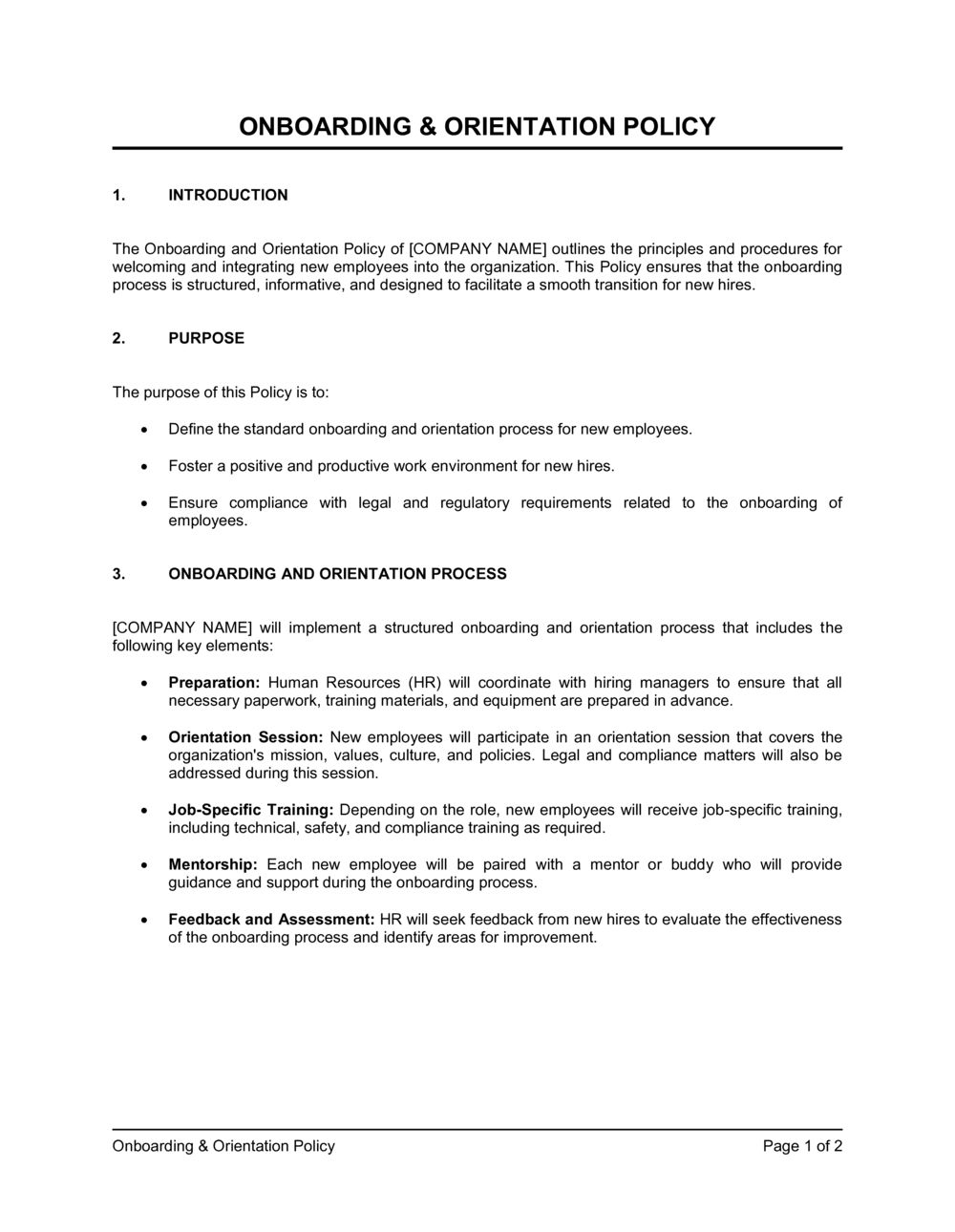
An Onboarding and Orientation Policy is an HR operational document that defines the structured process for integrating new employees into the organization β€” from offer acceptance through the end of a probationary period. This free Word download gives you a ready-to-edit policy covering roles, timelines, training milestones, and compliance requirements that you can tailor to your company and export as PDF.
When you need it
Use it when formalizing your new-hire process, standardizing the experience across departments, or preparing for HR audits that require documented people-management procedures.
What's inside
Policy purpose and scope, pre-boarding requirements, orientation schedule, role-specific training plan, manager and HR responsibilities, compliance and documentation checklist, probationary-period expectations, and policy review cadence.

What is an Onboarding and Orientation Policy?

An Onboarding and Orientation Policy is a formal HR operational document that defines the structured process for integrating new employees into the organization β€” from offer acceptance through the end of a probationary period. It assigns specific responsibilities to HR, hiring managers, and IT; establishes timelines for pre-boarding tasks, day-one orientation, and role-specific training milestones; and lists the compliance documentation that must be completed and retained. Unlike an ad-hoc checklist, a written policy ensures every new hire β€” regardless of department, location, or hiring manager β€” receives a consistent, well-organized introduction to the company.

Why You Need This Document

Without a documented onboarding policy, the new-hire experience is entirely dependent on which manager is doing the hiring β€” and the gaps show. Employees who arrive to find their laptop unprovisioned, their first week unscheduled, and their manager unprepared are measurably more likely to disengage within 90 days. Research from the Society for Human Resource Management consistently links structured onboarding programs with 25–30% improvements in first-year retention. Beyond retention, a written policy creates an auditable record that HR is executing onboarding consistently β€” a requirement for ISO 9001 certification, certain government contracting standards, and any HR due diligence process tied to a merger or acquisition. This template gives you the complete policy framework in a format you can customize in hours, not weeks.

Which variant fits your situation?

If your situation is…Use this template
Onboarding a remote employee with no in-person orientationRemote Work Policy
Documenting a 30-60-90 day performance plan for a new hire30-60-90 Day Plan
Formalizing probationary-period expectations and evaluation criteriaProbationary Period Policy
Capturing the full scope of HR policies in one documentEmployee Handbook
Outlining training requirements for a specific role or departmentTraining Plan Template
Communicating the onboarding schedule to the new hire before day oneWelcome Letter to New Employee
Assigning a buddy or mentor as part of a structured onboarding programMentorship Agreement

Common mistakes to avoid

❌ Starting onboarding tasks on day one instead of during pre-boarding

Why it matters: A new employee who arrives without a laptop, email access, or a workspace spends their first day waiting β€” signaling operational disorganization and damaging their first impression of the company.

Fix: Build a pre-boarding checklist with deadlines relative to the start date and assign accountability to IT, HR, and the hiring manager separately.

❌ Assigning all onboarding responsibility to HR

Why it matters: HR cannot complete role-specific training, introductions to teammates, or job-function coaching β€” the tasks that most directly affect time-to-productivity and 90-day retention.

Fix: Explicitly assign the hiring manager to own the first-week training plan, day-30 check-in, and role-specific milestone evaluations.

❌ Setting vague probationary milestones

Why it matters: Milestones like 'demonstrate proficiency' or 'meet expectations' are unenforceable and create conflict when the manager and employee have different interpretations at the 90-day mark.

Fix: Write milestones as observable, measurable outcomes β€” for example, 'independently manage three client accounts with no escalations' β€” so the evaluation is factual, not subjective.

❌ Never updating the policy after initial creation

Why it matters: Onboarding tools, team structures, compliance requirements, and remote-work norms change regularly β€” a policy that reflects a two-year-old process creates confusion and gaps.

Fix: Assign a named HR role as policy owner and set a calendar reminder for an annual review, with a change-log section at the front of the document.

❌ Overloading day one with policy readings and form-signing

Why it matters: Information overload on the first day reduces retention of critical content, increases new-hire anxiety, and delays the social connection that most directly predicts early engagement.

Fix: Spread compliance documentation across the first week, distribute pre-reading materials before day one, and reserve day one for introductions, setup, and a brief culture overview.

❌ Omitting remote or hybrid-specific onboarding procedures

Why it matters: Applying an in-office orientation script to a remote hire β€” or providing no equivalent β€” leaves distributed employees without the context, access, and social connection their in-office peers receive on day one.

Fix: Add a remote-hire addendum to the policy covering virtual tour alternatives, communication-tool setup, and structured virtual introductions in the first week.

The 9 key sections, explained

Purpose and scope

Roles and responsibilities

Pre-boarding requirements

Day-one orientation schedule

First-week training plan

Role-specific training milestones

Compliance and documentation requirements

Manager check-in schedule

Policy review and update cadence

How to fill it out

  1. 1

    Define the policy scope and effective date

    Specify which employee categories the policy covers β€” full-time, part-time, temporary, contract β€” and enter the effective date. Add a version number so HR can track revisions over time.

    πŸ’‘ If your organization uses contractors extensively, include them in scope but note any process differences that apply to non-employee workers.

  2. 2

    Assign owners to each onboarding responsibility

    Map every task in the policy to a specific role β€” not a person's name β€” so the policy remains valid through personnel changes. Common owners are HR, the hiring manager, IT, and the new employee.

    πŸ’‘ Use a RACI matrix (Responsible, Accountable, Consulted, Informed) in the roles section if you have more than three functions involved.

  3. 3

    Build the pre-boarding task list with deadlines

    List every action required before the start date and assign a deadline relative to the start date β€” for example, 'IT provisions access T-2 business days.' Include the new hire packet, system access, equipment, and welcome communication.

    πŸ’‘ Automate pre-boarding task triggers in your HRIS if possible β€” manual reminders fail when multiple hires start in the same week.

  4. 4

    Design the day-one orientation agenda

    Build a realistic hour-by-hour schedule for the first day that balances administrative setup with meaningful human connection. Limit mandatory policy readings to no more than 90 minutes total.

    πŸ’‘ For remote hires, replace the physical tour with a virtual all-hands or recorded company overview video to avoid an isolating first day.

  5. 5

    Set measurable 30-60-90 day milestones

    Write specific, observable milestones for each checkpoint β€” tool certifications, completed projects, independently managed tasks β€” rather than vague competency statements.

    πŸ’‘ Align Day 90 milestones directly with the job description's core performance indicators so the end-of-probation evaluation is consistent and objective.

  6. 6

    List all compliance documentation requirements with deadlines

    Enumerate every form, acknowledgment, and mandatory training module with the deadline for completion. Separate Day 1 requirements from Day 5 and Day 30 requirements.

    πŸ’‘ Check your jurisdiction's employment law annually β€” some states and provinces have added specific onboarding disclosure requirements in recent years.

  7. 7

    Enter manager check-in dates and attach the feedback form

    Specify the exact timing of each structured check-in and reference the feedback form or template to be used. Submit instructions for HR documentation retention.

    πŸ’‘ Pre-populate check-in dates in the hiring manager's calendar as a calendar invite template to remove the friction of scheduling each one manually.

  8. 8

    Set the review owner and annual review date

    Name the HR role responsible for annual policy review, enter the review month, and add a distribution requirement so updated versions reach all hiring managers promptly.

    πŸ’‘ Tie the annual review to your fiscal year start or your largest seasonal hiring window so the policy is always current when hiring volume peaks.

Frequently asked questions

What is an onboarding and orientation policy?

An onboarding and orientation policy is a formal HR document that defines the structured process for integrating new employees into the organization. It covers everything from pre-boarding tasks before the start date through day-one orientation, role-specific training milestones, compliance documentation requirements, and manager check-in schedules. Its purpose is to create a consistent, repeatable experience regardless of which department or manager is hiring.

What is the difference between onboarding and orientation?

Orientation is a specific event β€” typically the first day or first week β€” that introduces the new employee to the company's culture, facilities, policies, and administrative setup. Onboarding is the broader process spanning weeks or months that integrates the employee into their role, team, and working rhythms. A good policy covers both: the structured first-day event and the longer integration arc through the probationary period.

How long should onboarding last?

Most organizations structure onboarding around a 30-60-90 day framework, with formal milestones and manager check-ins at each interval. Research consistently shows that extending structured onboarding beyond the first week β€” with role-specific training and regular feedback β€” improves 12-month retention by 25–30% compared to orientation-only programs. Complex or senior roles may warrant a 6-month onboarding arc.

Who is responsible for employee onboarding?

Effective onboarding requires shared ownership. HR typically owns the administrative setup, compliance documentation, and policy distribution. The hiring manager owns the role-specific training plan, team introductions, and performance check-ins. IT owns equipment provisioning and system access. A written policy assigns each task to a specific role so accountability is clear regardless of personnel changes.

What compliance requirements should an onboarding policy address?

At minimum, US employers should address I-9 work-authorization verification (required on or before day one), federal and state tax withholding forms, direct deposit authorization, and any mandatory training β€” such as harassment prevention or workplace safety β€” required by applicable state law. Requirements vary by jurisdiction, so the policy should be reviewed annually against current employment law.

Should the onboarding policy be included in the employee handbook?

You can include a summary of onboarding expectations in the employee handbook, but the detailed operational policy β€” with task checklists, timelines, and role assignments β€” is typically maintained as a separate HR operations document. This separation makes the policy easier to update without triggering a full handbook revision every time a tool, process, or compliance requirement changes.

How do I adapt the onboarding policy for remote employees?

Add a remote-hire addendum that replaces in-person elements with virtual equivalents: a recorded company overview video instead of a facility tour, a virtual team lunch or video introduction session, and a communication-tool setup guide sent before day one. Equipment and system access deadlines become even more critical for remote hires, since there is no IT desk to walk up to on day one.

How often should the onboarding policy be reviewed and updated?

An annual review is the minimum standard. Trigger an off-cycle review whenever your HRIS or onboarding tooling changes, when employment law in your jurisdiction adds new onboarding disclosure requirements, or when employee feedback or exit interviews consistently identify gaps in the first-90-day experience. Assign a named HR role as policy owner to ensure the review actually happens.

Can a small business use a formal onboarding policy?

Yes β€” and it matters more at small businesses precisely because there is no dedicated HR team to fill in the gaps informally. A documented policy ensures that the second and tenth hires get the same structured experience as the first, reduces manager guesswork, and demonstrates organizational maturity to candidates comparing multiple offers. Start with the core sections and expand as your headcount and process complexity grow.

How this compares to alternatives

vs Employee Handbook

An employee handbook is the comprehensive reference document covering all company policies β€” conduct, benefits, leave, and more. An onboarding policy is an operational HR procedure focused specifically on the integration process for new hires. The handbook is given to employees; the onboarding policy is used by HR and managers to run the process. Both are needed, but they serve different audiences.

vs Training Plan

A training plan outlines the specific learning activities, content, and assessments for a role or skill area. An onboarding policy sets the broader framework β€” timelines, responsibilities, compliance requirements, and check-ins β€” within which role-specific training plans operate. The onboarding policy references training plans; it does not replace them.

vs Welcome Letter to New Employee

A welcome letter is a short communication sent to the new hire before day one to confirm logistics and set a positive tone. An onboarding policy is an internal HR governance document that defines the process those logistics follow. The welcome letter is written for the employee; the onboarding policy is written for the organization.

vs Probationary Period Policy

A probationary period policy focuses specifically on the evaluation criteria, manager obligations, and termination conditions that apply during an initial employment period. An onboarding policy is broader β€” it covers the full integration process, of which the probationary period is one component. Organizations typically need both documents to fully govern the new-hire experience.

Industry-specific considerations

Technology / SaaS

System-access provisioning, security training, and tool-stack walkthroughs are critical pre-boarding tasks given the volume of platforms engineers and sales teams use from day one.

Healthcare

Credentialing verification, HIPAA training completion, and clinical orientation are compliance-critical onboarding steps that must be documented before a new hire can interact with patients or patient data.

Retail / Hospitality

High turnover makes a streamlined, repeatable onboarding process β€” with a short orientation and fast role-specific training β€” essential for getting new staff productive within 1–3 days.

Professional Services

Client confidentiality policies, billing and time-tracking tool training, and introduction to key client accounts are the highest-priority onboarding tasks for client-facing roles.

Template vs pro β€” what fits your needs?

PathBest forCostTime
Use the templateSmall and mid-sized businesses building or formalizing their onboarding process for the first timeFree2–4 hours to customize and finalize
Template + professional reviewOrganizations in regulated industries or those scaling headcount rapidly across multiple jurisdictions$300–$800 for an HR consultant review1–3 days
Custom draftedEnterprise employers with union agreements, multi-country operations, or complex compliance onboarding requirements$1,500–$5,000+ for a custom HR policy project2–4 weeks

Glossary

Pre-boarding
The period between a candidate accepting an offer and their official start date, during which administrative and access setup tasks are completed.
Orientation
The formal introduction to the organization on or near the first day, covering culture, policies, facilities, and administrative setup.
Onboarding
The broader process β€” spanning days to months β€” of integrating a new employee into their role, team, and company culture.
Probationary Period
A defined initial employment period β€” typically 30 to 90 days β€” during which performance is evaluated before full confirmation of the role.
Role-Specific Training
Job-function training that equips the employee with the technical skills, tools, and processes needed to perform their specific duties.
Onboarding Buddy
A peer assigned to a new hire to answer informal questions, make introductions, and ease the social integration into the team.
Compliance Training
Mandatory training covering legal and regulatory obligations β€” such as workplace safety, harassment prevention, and data privacy β€” that all employees must complete.
I-9 Verification
The US federal process of verifying a new employee's identity and legal authorization to work, completed on or before the first day of employment.
Onboarding Checklist
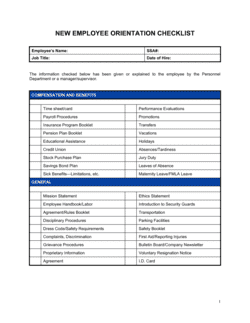
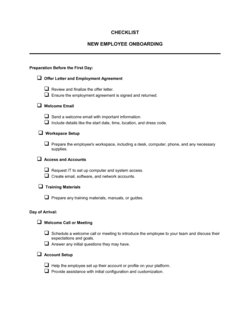
A structured list of tasks β€” equipment setup, system access, policy acknowledgments, and introductions β€” that must be completed by defined dates.
Time-to-Productivity
The elapsed time from a new hire's start date to the point at which they are performing their role at the expected standard.

Part of your Business Operating System

This document is one of 3,000+ business & legal templates included in Business in a Box.

  • Fill-in-the-blanks β€” ready in minutes
  • 100% customizable Word document
  • Compatible with all office suites
  • Export to PDF and share electronically

Create your document in 3 simple steps.

From template to signed document β€” all inside one Business Operating System.
1
Download or open template

Access over 3,000+ business and legal templates for any business task, project or initiative.

2
Edit and fill in the blanks with AI

Customize your ready-made business document template and save it in the cloud.

3
Save, Share, Send, Sign

Share your files and folders with your team. Create a space of seamless collaboration.

Save time, save money, and create top-quality documents.

β˜…β˜…β˜…β˜…β˜…

"Fantastic value! I'm not sure how I'd do without it. It's worth its weight in gold and paid back for itself many times."

Managing Director Β· Mall Farm
Robert Whalley
Managing Director, Mall Farm Proprietary Limited
β˜…β˜…β˜…β˜…β˜…

"I have been using Business in a Box for years. It has been the most useful source of templates I have encountered. I recommend it to anyone."

Business Owner Β· 4+ years
Dr Michael John Freestone
Business Owner
β˜…β˜…β˜…β˜…β˜…

"It has been a life saver so many times I have lost count. Business in a Box has saved me so much time and as you know, time is money."

Owner Β· Upstate Web
David G. Moore Jr.
Owner, Upstate Web

Run your business with a system β€” not scattered tools

Stop downloading documents. Start operating with clarity. Business in a Box gives you the Business Operating System used by over 250,000 companies worldwide to structure, run, and grow their business.

Start freeΒ Β·Β No credit card required