Notice of Check NSF Template

Free Word download β€’ Edit online β€’ Save & share with Drive β€’ Export to PDF

1 pageβ€’15–20 min to fillβ€’Difficulty: Standard
Learn more ↓
FreeNotice of Check NSF Template

At a glance

What it is
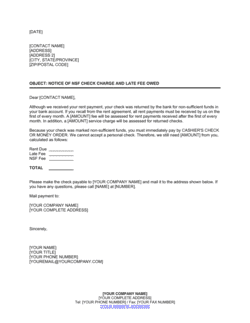
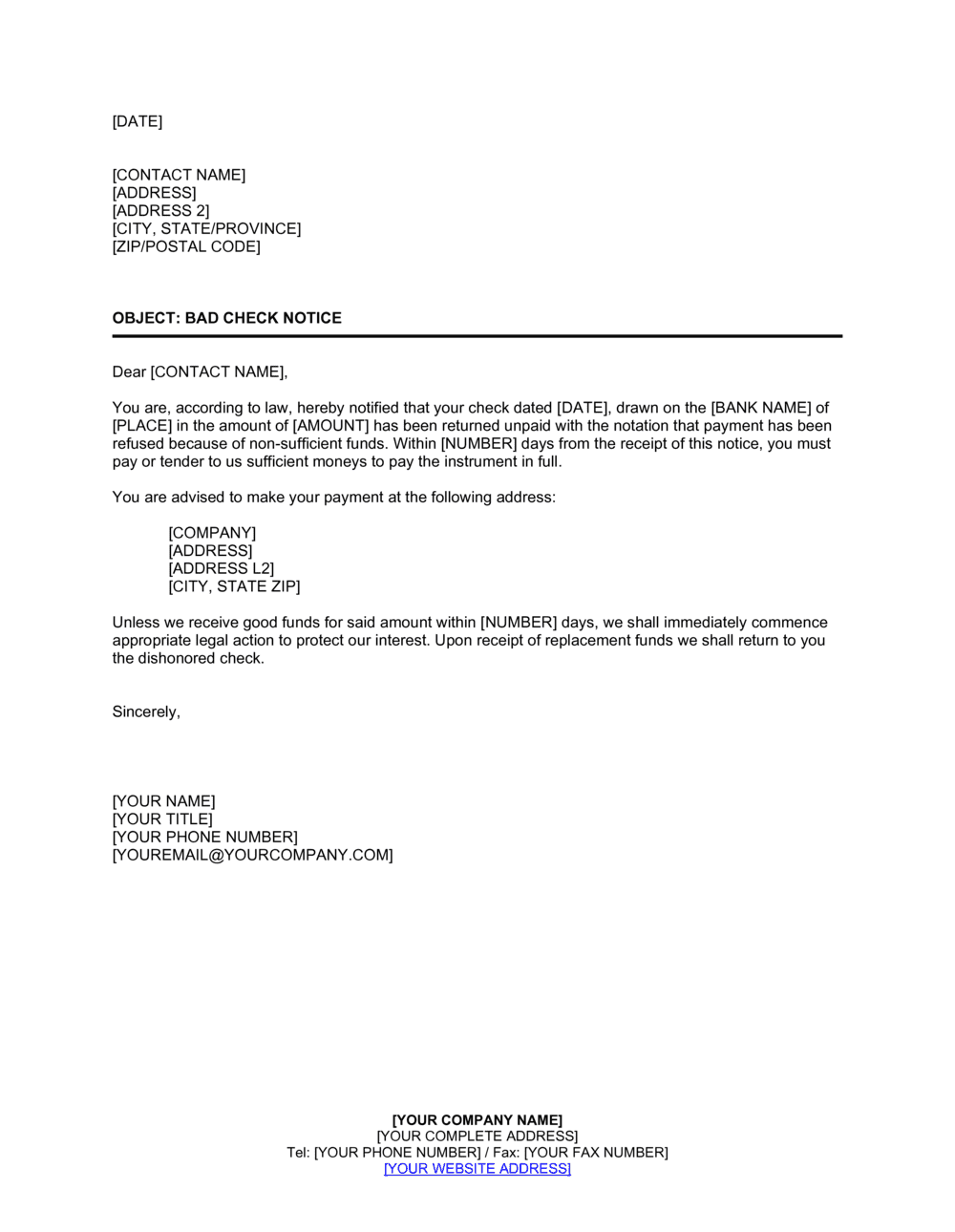
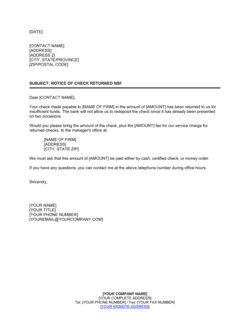
A Notice of Check NSF is a formal business letter sent by a payee to the check writer notifying them that their check was returned by the bank due to insufficient funds. This free Word download lets you fill in the check details, state the total amount owed including any returned-check fee, and set a clear deadline for repayment β€” ready to send in under 10 minutes.
When you need it
Send it as soon as your bank notifies you that a customer's or tenant's check has been returned unpaid. Prompt written notice is required in most US states before you can pursue civil or criminal remedies for a bad check.
What's inside
Sender and recipient identification, the original check details (number, date, and amount), the reason for return, the total amount now owed including NSF fees, a firm repayment deadline, accepted payment methods, and a warning of the consequences of non-payment.

What is a Notice of Check NSF?

A Notice of Check NSF is a formal written letter sent by a payee to the maker of a check that was returned unpaid by the bank due to non-sufficient funds. It documents the dishonor event, states the total amount now owed including any applicable returned-check fee, sets a firm repayment deadline, and warns of the civil or legal consequences of non-payment. Beyond recovering the debt, the letter serves a critical procedural function: most US states require documented written notice β€” with a defined demand period β€” before a payee can pursue statutory damages under civil bad-check laws or refer the matter to law enforcement.

Why You Need This Document

Failing to send a written NSF notice is not just an oversight β€” it is a procedural bar to recovery. Without it, you cannot claim statutory damages (which can run two to three times the check amount in many states), and a court may limit your recovery to face value only. An undocumented verbal request to repay gives the maker grounds to deny they were ever notified. Every day without a formal notice is a day the demand period has not started, delaying your ability to escalate to collections or file in small claims court. This template gives you the correctly structured, plain-language notice that satisfies statutory requirements, creates a paper trail, and puts the maker on clear notice β€” so that if they do not pay, you can act immediately when the deadline passes.

Which variant fits your situation?

If your situation is…Use this template
First returned check with no prior payment issuesNotice of Check NSF (Standard)
Second or repeat bounced check from the same payerFinal Demand Letter for Returned Check
Tenant rent check returned β€” lease clause invokedNSF Notice with Lease Violation Warning
Large-dollar check requiring formal legal escalationDemand Letter for Payment
Check returned and account sent to collectionsCollections Referral Notice

Common mistakes to avoid

❌ Using an indefinite repayment deadline

Why it matters: Phrases like 'promptly' or 'at your earliest convenience' have no legal meaning. State bad-check statutes require a specific demand period to have elapsed before you can file a civil claim.

Fix: Always state a specific calendar date β€” e.g., 'no later than June 15, 2026' β€” calculated to meet your state's minimum statutory notice period.
❌ Charging an NSF fee above the state cap

Why it matters: Most states cap returned-check fees at $25 to $50 per instrument. Demanding more than the cap can expose the payee to a counter-claim and undermine the entire demand.

Fix: Look up your state's returned-check fee limit before completing the letter and enter an amount at or below that cap.

❌ Sending by regular first-class mail only

Why it matters: Without a delivery record, the maker can claim they never received the notice β€” defeating the statutory notice requirement and delaying any civil or criminal referral.

Fix: Send by certified mail with return receipt requested, and retain the tracking confirmation and signed receipt in your files.

❌ Accepting a personal check as replacement payment

Why it matters: A second personal check can bounce just as easily as the first, resetting the entire process and signaling that you are not serious about the demand.

Fix: Specify in the letter that only certified funds β€” cashier's check, money order, or wire transfer β€” will be accepted as replacement payment.

The 9 key clauses, explained

Sender and recipient identification

In plain language: Opens the letter by stating the sender's business name and contact information and the recipient's full name and address.

Sample language
[SENDER BUSINESS NAME] | [STREET ADDRESS, CITY, STATE ZIP] | [DATE] | [RECIPIENT FULL NAME] | [RECIPIENT ADDRESS]

Common mistake: Using a nickname or trade name instead of the legal business name β€” if the matter escalates to court, the plaintiff must be identified by its registered legal name.

Subject line with check reference

In plain language: A bolded or capitalized subject line that immediately identifies this as an NSF notice and references the specific check.

Sample language
RE: RETURNED CHECK β€” CHECK NO. [XXXX] DATED [DATE] IN THE AMOUNT OF $[AMOUNT]

Common mistake: Omitting the check number and date from the subject line. Without these identifiers, the recipient may claim they received no notice about a specific instrument.

Notice of return

In plain language: States plainly that the check was presented to the bank and returned unpaid, naming the reason given by the bank.

Sample language
Please be advised that your check number [XXXX], dated [DATE], in the amount of $[AMOUNT], made payable to [PAYEE NAME], was presented for payment and returned by your bank marked '[NSF / ACCOUNT CLOSED / REFER TO MAKER]'.

Common mistake: Paraphrasing the bank's return reason rather than using the exact language on the bank's notice. The precise reason matters if the matter proceeds to a bad-check prosecution.

Total amount owed

In plain language: Itemizes the original check amount plus any applicable returned-check fee to state the exact total now owed.

Sample language
Original check amount: $[AMOUNT] | Returned check fee: $[FEE] | TOTAL NOW DUE: $[TOTAL]

Common mistake: Charging an NSF fee higher than the amount permitted by state law. Many states cap returned-check fees between $25 and $50; exceeding the cap can expose the payee to a counter-claim.

Repayment deadline

In plain language: Sets a specific calendar date by which full payment must be received β€” typically 10 to 30 days from the notice date.

Sample language
You are required to remit the full amount of $[TOTAL] in certified funds no later than [DATE β€” X DAYS FROM NOTICE DATE].

Common mistake: Writing 'as soon as possible' instead of a specific date. An indefinite deadline undermines your ability to show the demand period expired before filing a civil or criminal complaint.

Accepted payment methods

In plain language: Specifies that only certified funds β€” cashier's check, money order, or wire transfer β€” are acceptable for replacement payment.

Sample language
Payment must be made in certified funds only: cashier's check or money order payable to [PAYEE NAME], or wire transfer to [ACCOUNT DETAILS]. Personal checks will not be accepted.

Common mistake: Accepting another personal check as replacement payment. A second bounced check resets the process and signals the payee did not take the matter seriously.

Consequences of non-payment

In plain language: Warns the recipient of the civil and potentially criminal remedies available if they fail to pay within the demand period.

Sample language
Failure to remit payment in full by [DATE] may result in (a) referral to a collection agency, (b) a civil claim for the check amount plus statutory damages and court costs, and/or (c) referral to the appropriate authorities under applicable bad-check laws.

Common mistake: Threatening criminal prosecution as the only consequence listed. Overstating the criminal element without mentioning civil options can read as coercive and backfire in court.

Contact information and response instructions

In plain language: Tells the recipient who to contact to arrange payment or discuss the matter, and how to confirm receipt of certified funds.

Sample language
To arrange payment or discuss this matter, contact [NAME] at [PHONE] or [EMAIL] between [HOURS]. Please reference check number [XXXX] in all correspondence.

Common mistake: Providing only an email address with no phone number. Time-sensitive payment demands should offer the fastest available contact channel.

Sender's signature block

In plain language: Closes the letter with the sender's name, title, and business name β€” lending authority and giving the recipient a named party to respond to.

Sample language
Sincerely, | [SENDER NAME] | [TITLE] | [BUSINESS NAME] | [PHONE] | [EMAIL]

Common mistake: Leaving the signature block blank or using only a printed name without a title. A titled signatory signals the letter carries organizational authority.

How to fill it out

  1. 1

    Enter your business contact information

    Fill in your registered business name, mailing address, phone number, and email in the sender block at the top of the letter.

    πŸ’‘ Use the same name that appears on your bank account so the recipient can verify it matches the payee on the returned check.

  2. 2

    Add the recipient's name and address

    Enter the check writer's full legal name and current mailing address. If the check was from a business, use the registered business name and its principal address.

    πŸ’‘ Send via certified mail with return receipt requested β€” this creates a delivery record that is essential if the matter goes to court.

  3. 3

    Fill in the check details

    Enter the check number, the date written on the check, and the exact dollar amount. Copy these directly from the returned check or your bank's return notice.

    πŸ’‘ Attach a photocopy of the returned check to the letter. Having the physical evidence on file speeds up any follow-on legal action.

  4. 4

    State the bank's exact return reason

    Enter the reason code or language from your bank's notification β€” typically 'Non-Sufficient Funds,' 'Account Closed,' or 'Refer to Maker.'

    πŸ’‘ Keep the bank's original return notice on file; it is the primary evidence that the check was presented and dishonored.

  5. 5

    Calculate the total amount owed

    Add your permitted returned-check fee to the original check amount. Verify your state's statutory cap on NSF fees before entering the fee amount.

    πŸ’‘ Most states set the cap between $25 and $50. Charging above the cap can expose you to a counter-claim that offsets your recovery.

  6. 6

    Set a specific repayment deadline

    Count forward 10 to 30 calendar days from today's date and enter that date as the payment deadline. Many state bad-check statutes require a minimum of 10 days notice before civil action.

    πŸ’‘ Check your state's civil bad-check statute for the required notice period β€” using the statutory minimum puts you in the strongest position to file immediately after the deadline.

  7. 7

    Sign and send by certified mail

    Sign the letter with your name and title, make a copy for your files, and send the original by certified mail. Follow up with an email copy the same day to create a second delivery record.

    πŸ’‘ Log the certified mail tracking number in your accounts-receivable notes alongside the check details so everything is in one place if you need to escalate.

Frequently asked questions

What is a Notice of Check NSF?

A Notice of Check NSF is a formal letter sent by the payee to the person who wrote a check that was returned by the bank for insufficient funds. It documents the return, states the total amount owed including any returned-check fee, sets a deadline for repayment, and warns of the consequences β€” civil claim, collections referral, or bad-check complaint β€” if payment is not made. The letter also satisfies the written-notice requirement imposed by most state civil bad-check statutes.

Do I have to send a written notice before pursuing a bad check?

In most US states, yes. Civil bad-check statutes require the payee to send a written demand giving the maker a defined period β€” typically 10 to 30 days β€” to repay before the payee can sue for statutory damages. Without documented written notice, a court may dismiss a bad-check claim or reduce your recovery to the face value only. Check your state's specific statute for the required notice period and format.

How much can I charge as an NSF fee?

State law governs the maximum returned-check fee a payee can charge. The cap is commonly $25 to $50 per instrument, though some states allow higher amounts or permit a percentage of the check value. Charging above the statutory cap can expose you to a counter-claim. Review your state's returned-check or bad-check statute before entering a fee amount in the notice.

How should I send a Notice of Check NSF?

Send the letter by certified mail with return receipt requested so you have proof of delivery. Follow up the same day with an email copy if you have the recipient's address. Keep the certified mail tracking number, the signed return receipt, and a copy of the letter in your files. This delivery record is essential if you later need to prove the demand period expired before filing a civil claim.

What payment methods should I require for replacement?

Require certified funds only β€” a cashier's check, money order, or bank wire transfer. Do not accept another personal check from the same maker. A second personal check carries the same risk of dishonor and sends a signal that you are willing to extend repeated goodwill without consequence. State this explicitly in the letter.

What happens if the maker ignores the notice?

Once the demand period expires without payment, you typically have three options: file a civil claim in small claims or civil court for the check amount plus statutory damages and court costs; refer the account to a collections agency; or file a bad-check complaint with local law enforcement or the district attorney's office. The viability of criminal referral depends on the dollar amount and whether the maker can show the bad check was unintentional.

Can I use this notice for a rent check that bounced?

Yes. The same NSF notice structure applies to returned rent checks. Some landlords also serve a concurrent notice to pay rent or quit under their state's landlord-tenant statute, which triggers a separate remedy independent of the bad-check process. Check whether your lease includes a returned-check fee clause β€” if it does, reference the clause and the fee amount in the letter.

Is this the same as a demand letter?

A Notice of Check NSF is a specific type of demand letter focused on a returned instrument. A general demand letter for payment covers any unpaid debt and does not reference a specific check return event. The NSF notice is the appropriate starting document when the underlying payment method was a dishonored check; for invoices unpaid by any other means, a standard demand letter is more appropriate.

How this compares to alternatives

vs Demand for payment letter

A demand for payment letter addresses any overdue amount β€” unpaid invoices, contract balances, or loans β€” regardless of how the original payment was made or attempted. A Notice of Check NSF is specific to a returned check instrument, documents the bank return event, and satisfies the statutory written-notice requirement for bad-check civil remedies. Use the NSF notice when the payment vehicle was a dishonored check; use the demand letter for all other unpaid debts.

vs Collections referral notice

A collections referral notice informs a debtor that their account is being transferred to a third-party collections agency. It is typically the escalation step after an NSF notice goes unanswered past the demand period. The NSF notice comes first and is the formal demand; the collections referral follows if that demand fails.

vs Late payment reminder

A late payment reminder is a soft follow-up for an invoice that has passed its due date but has not yet been formally disputed or dishonored. It does not reference a bank return event and carries no statutory weight. Use it for overdue invoices paid by any method; use the NSF notice specifically when a check was returned by the bank.

vs Stop payment notice

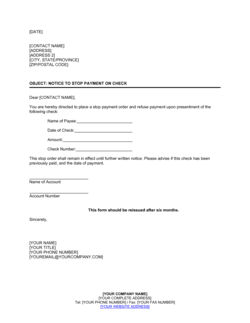
A stop payment notice is issued by the check writer β€” not the payee β€” to instruct their bank not to honor a specific check. An NSF notice is issued by the payee to the check writer after the bank has already refused payment due to insufficient funds. They address different events from opposite sides of the same transaction.

Industry-specific considerations

Retail

Retailers accepting checks at point of sale use NSF notices to recover face value and the bank's returned-item fee from customers whose checks bounce post-purchase.

Property Management

Landlords and property managers issue NSF notices for returned rent checks, often alongside a lease-violation warning, and require certified funds for all future rent payments.

Healthcare

Medical and dental practices use NSF notices to recover patient co-pays or balances paid by check, pairing the letter with a hold on future appointment scheduling until the balance is cleared.

Professional Services

Law firms, accounting practices, and consultants send NSF notices to clients who paid invoices by check, and typically update their billing policy to require ACH or card for subsequent payments.

Template vs pro β€” what fits your needs?

PathBest forCostTime
Use the templateAny business recovering a single returned check from a customer, tenant, or clientFreeUnder 10 minutes
Template + professional reviewHigh-value checks over $1,000 or repeat offenders where civil litigation is likely$75–$200 for a paralegal or attorney review1–2 business days
Custom draftedBusinesses with recurring NSF volume that need a firm-branded policy letter and integrated collections workflow$200–$600 for a custom attorney-drafted notice and policy3–5 business days

Glossary

NSF (Non-Sufficient Funds)
A bank status indicating a check could not be processed because the account on which it was drawn had less money than the check amount.
Returned Check Fee
A charge imposed by the payee's bank and/or the payee itself to recover the cost of processing a check that was returned unpaid.
Payee
The individual or business to whom a check is made out β€” the party receiving this notice notifies the check writer.
Maker / Drawer
The person or entity that wrote and signed the check β€” the party who receives the NSF notice and owes the replacement payment.
Check Number
The sequential number printed on the check used to identify the specific instrument that was returned.
Demand Period
The number of days β€” typically 10 to 30 β€” given in the notice for the maker to remit full payment before further action is taken.
Civil Bad Check Statute
A state law allowing the payee to sue the maker for the face value of the check plus statutory damages and fees if the check is not made good after proper written notice.
Certified Funds
Payment instruments β€” cashier's checks, money orders, or wire transfers β€” that guarantee the funds exist, often required as replacement payment after an NSF event.

Part of your Business Operating System

This document is one of 3,000+ business & legal templates included in Business in a Box.

  • Fill-in-the-blanks β€” ready in minutes
  • 100% customizable Word document
  • Compatible with all office suites
  • Export to PDF and share electronically

Create your document in 3 simple steps.

From template to signed document β€” all inside one Business Operating System.
1
Download or open template

Access over 3,000+ business and legal templates for any business task, project or initiative.

2
Edit and fill in the blanks with AI

Customize your ready-made business document template and save it in the cloud.

3
Save, Share, Send, Sign

Share your files and folders with your team. Create a space of seamless collaboration.

Save time, save money, and create top-quality documents.

β˜…β˜…β˜…β˜…β˜…

"Fantastic value! I'm not sure how I'd do without it. It's worth its weight in gold and paid back for itself many times."

Managing Director Β· Mall Farm
Robert Whalley
Managing Director, Mall Farm Proprietary Limited
β˜…β˜…β˜…β˜…β˜…

"I have been using Business in a Box for years. It has been the most useful source of templates I have encountered. I recommend it to anyone."

Business Owner Β· 4+ years
Dr Michael John Freestone
Business Owner
β˜…β˜…β˜…β˜…β˜…

"It has been a life saver so many times I have lost count. Business in a Box has saved me so much time and as you know, time is money."

Owner Β· Upstate Web
David G. Moore Jr.
Owner, Upstate Web

Run your business with a system β€” not scattered tools

Stop downloading documents. Start operating with clarity. Business in a Box gives you the Business Operating System used by over 250,000 companies worldwide to structure, run, and grow their business.

Free Forever PlanΒ Β·Β No credit card required