Notice of Revocation of Authority Template

Free Word download • Edit online • Save & share with Drive • Export to PDF

1 page15–25 min to fillDifficulty: Standard
Learn more ↓
FreeNotice of Revocation of Authority Template

At a glance

What it is
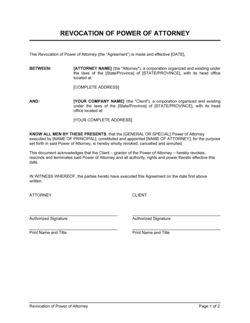
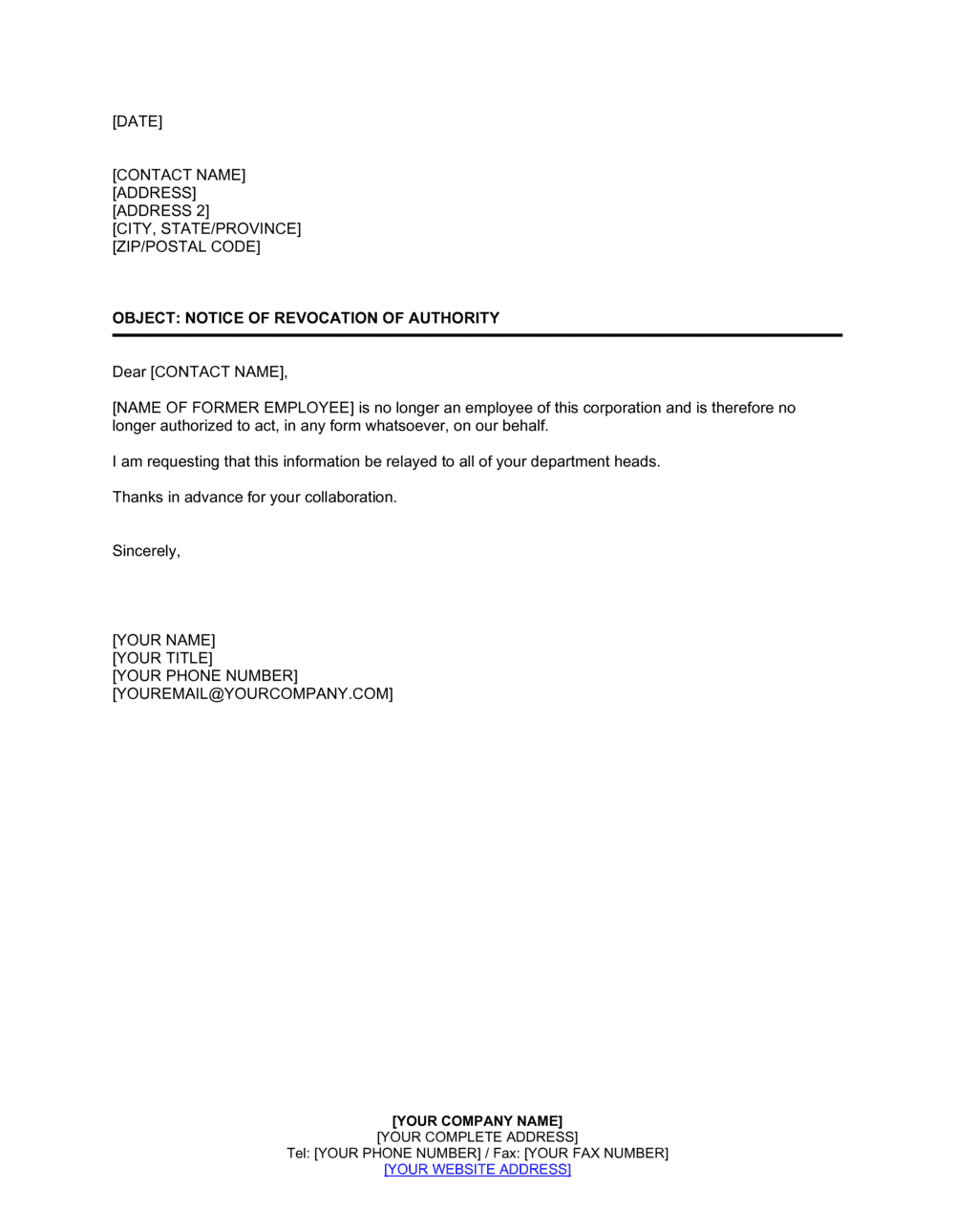
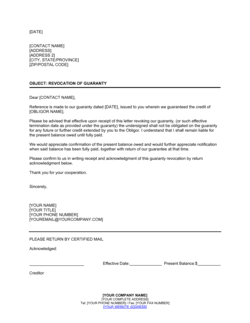
A Notice of Revocation of Authority is a formal written notice that officially cancels any previously granted permission for an agent, representative, or third party to act on behalf of an individual or organization. This free Word download lets you fill in the relevant party details, specify what authority is being revoked, and set an effective date — then export as PDF and deliver immediately.
When you need it
Use it when you need to terminate a relationship with an agent, broker, employee, or authorized representative whose permission to act on your behalf must be formally ended. Common triggers include ending a business partnership, dismissing an agent, or revoking a previously issued power of attorney.
What's inside
Sender and recipient identification, a clear statement of the authority being revoked, the effective date of revocation, a demand to cease all actions under the prior authorization, instructions for returning any credentials or documents, and a confirmation of delivery mechanism.

What is a Notice of Revocation of Authority?

A Notice of Revocation of Authority is a formal written notice that cancels any permission previously granted to an agent, representative, or third party to act on behalf of an individual or organization. It officially ends the agency relationship from the stated effective date, ensuring that the former agent can no longer legally bind the principal to contracts, commitments, or representations. Whether the original authority was granted through a power of attorney, an employment arrangement, a written authorization letter, or a verbal business agreement, this notice creates a clear, dated record that the permission has been withdrawn.

Why You Need This Document

Without a formal written revocation, an agent whose authority has ended informally may continue to take actions that legally bind you — entering contracts, making purchases, or representing your organization to third parties who have no reason to believe the authorization has changed. The concept of apparent authority means that if a third party reasonably believes the agent is still authorized, you may be held liable for their actions even after you have privately terminated the relationship. A clearly dated, properly delivered Notice of Revocation eliminates that exposure by putting both the agent and any affected third parties on formal notice that the authority no longer exists. This template gives you a ready-to-send document in minutes, protecting your organization from unauthorized commitments the moment a business relationship or employee role comes to an end.

Which variant fits your situation?

If your situation is…Use this template
Revoking authority granted under a formal power of attorneyRevocation of Power of Attorney
Terminating an agent's authority to buy or sell on your behalfNotice of Termination of Agency Agreement
Withdrawing an employee's signing authority for company accountsRevocation of Signing Authority Letter
Canceling a third party's authorization to access financial accountsBank Account Authorization Revocation Letter
Ending a representative's authority to negotiate contractsNotice of Revocation of Authority
Formally closing out an independent contractor's authorized scopeContract Termination Letter
Revoking an employee's authority upon company dissolution or saleNotice of Business Closure Letter

Common mistakes to avoid

❌ Using vague language instead of an explicit revocation

Why it matters: Phrases like 'we no longer require your services' do not constitute formal revocation of authority. The agent may continue acting and bind the principal to new obligations.

Fix: Use the word 'revoke' explicitly and state that all authority — or the specific authority — is cancelled effective a named date.
❌ Failing to notify third parties

Why it matters: Third parties who were unaware of the revocation can still hold the principal liable for actions the former agent takes under apparent authority.

Fix: Send a separate notice to all known counterparties, clients, and suppliers who previously dealt with the agent under the revoked authorization.

❌ Backdating the effective date

Why it matters: Setting an effective date before the notice is delivered does not retroactively cancel actions the agent took in the interim, and can create inconsistencies that undermine the notice's credibility.

Fix: Use the date of actual delivery as the effective date, or a future date for planned transitions. Address any unauthorized interim actions through a separate communication.

❌ Not specifying which authority is being revoked

Why it matters: A notice that lacks specificity leaves room for the agent to argue that only one narrow authorization was revoked while others remain intact.

Fix: Either revoke all authority in broad terms or list every specific role, scope, and document being cancelled to eliminate ambiguity.

The 9 key clauses, explained

Date and heading

In plain language: States the date the notice is issued and identifies the document clearly as a revocation of authority.

Sample language
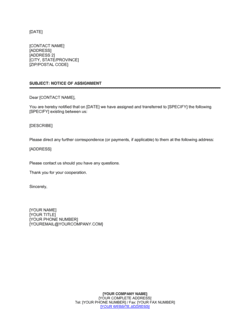
[DATE] NOTICE OF REVOCATION OF AUTHORITY

Common mistake: Omitting the issue date entirely, which creates ambiguity about when the revocation was sent versus when it takes effect.

Parties identification

In plain language: Names the principal issuing the revocation and the agent or representative whose authority is being revoked, with full legal names and addresses.

Sample language
FROM: [PRINCIPAL FULL NAME / COMPANY NAME], [ADDRESS] TO: [AGENT FULL NAME], [ADDRESS]

Common mistake: Using a nickname or trade name instead of the agent's full legal name, making it harder to enforce the revocation if the agent disputes it.

Reference to original authorization

In plain language: Identifies the original document, agreement, or date on which the authority was granted, giving context for what is being revoked.

Sample language
This notice refers to the authority granted to [AGENT NAME] under [DOCUMENT NAME / AGREEMENT DATE] dated [ORIGINAL DATE], whereby [AGENT NAME] was authorized to [DESCRIPTION OF AUTHORITY].

Common mistake: Failing to reference the original authorization. Without it, the agent may claim the revocation does not apply to a specific role or permission.

Clear statement of revocation

In plain language: Explicitly states that all authority previously granted is now revoked, leaving no ambiguity about the principal's intent.

Sample language
Effective [EFFECTIVE DATE], [PRINCIPAL NAME] hereby revokes, cancels, and withdraws any and all authority previously granted to [AGENT NAME] to act on behalf of [PRINCIPAL NAME / COMPANY NAME] in any capacity.

Common mistake: Using vague language such as 'we are no longer working together' instead of an explicit revocation statement — courts may not treat this as a formal legal notice.

Effective date

In plain language: States the specific date and, if needed, time at which the revocation takes effect and the agent must immediately cease acting.

Sample language
This revocation is effective immediately as of [DATE] at [TIME], or upon receipt of this notice, whichever is earlier.

Common mistake: Setting an effective date in the past, which can create liability for actions the agent took between the stated date and actual delivery of the notice.

Instruction to cease actions

In plain language: Directs the agent to immediately stop taking any actions, making representations, or entering into agreements on the principal's behalf.

Sample language
As of the effective date above, [AGENT NAME] is directed to immediately cease and desist from taking any actions, making any representations, or entering into any agreements on behalf of [PRINCIPAL NAME / COMPANY NAME].

Common mistake: Omitting this instruction, which can leave the agent believing they may complete in-progress transactions before winding down.

Return of documents and credentials

In plain language: Requests the return of any company property, access credentials, seals, authorization letters, or identification held by the agent.

Sample language
Please return all documents, identification cards, company seals, access credentials, and any other materials related to your authorization to [PRINCIPAL NAME] at [ADDRESS] no later than [RETURN DATE].

Common mistake: Not specifying a deadline or return address for materials, resulting in delays recovering sensitive company documents or access tokens.

Third-party notification instruction

In plain language: Notifies the agent that third parties who previously dealt with them under the authorization will also be informed of the revocation.

Sample language
Please be advised that [PRINCIPAL NAME / COMPANY NAME] will be notifying all relevant third parties, clients, suppliers, and counterparties of this revocation effective [EFFECTIVE DATE].

Common mistake: Skipping third-party notification entirely, which leaves the principal exposed to apparent authority claims from outside parties who continue dealing with the former agent.

Closing and authorized signature block

In plain language: Closes the letter professionally, identifies the authorized person issuing the notice, and provides contact details for any follow-up.

Sample language
This notice is issued by the undersigned on behalf of [PRINCIPAL NAME / COMPANY NAME]. [AUTHORIZED SIGNATORY NAME] [TITLE] [COMPANY NAME] [CONTACT INFORMATION]

Common mistake: Signing the notice with an illegible or stamped signature and no printed name or title, making it unclear who authorized the revocation.

How to fill it out

  1. 1

    Enter the issue date and parties

    Add today's date at the top of the letter and fill in the principal's full legal name and address in the FROM block, and the agent's full legal name and address in the TO block.

    💡 Use the same legal entity name that appears on the original authorization document to ensure the revocation is unambiguous.

  2. 2

    Reference the original authorization

    Identify the document, agreement, or correspondence that originally granted the agent's authority — include its title and date. If authority was granted verbally, describe the arrangement and approximate date.

    💡 Attach a copy of the original authorization to the notice when sending, so the agent cannot later claim confusion about what is being revoked.

  3. 3

    State the revocation clearly and completely

    Fill in the revocation paragraph using the agent's full name and specify whether all authority is revoked or only a defined subset. Broad revocation language covering 'any and all authority' is safer than a narrow list.

    💡 If you only want to revoke one specific type of authority while preserving others, list the retained authorities explicitly to avoid unintended over-revocation.

  4. 4

    Set a specific effective date

    Enter the date on which the revocation takes effect. For most situations, 'effective immediately upon receipt' is appropriate. For planned transitions, set a future date that gives the agent time to wrap up authorized activities.

    💡 Never backdate the effective date. If the agent has taken actions before receiving the notice, those actions may still bind the principal — address them separately.

  5. 5

    List items to be returned

    Identify any company property the agent holds — authorization letters, access badges, company seals, or login credentials — and specify a return deadline and address.

    💡 For digital credentials, revoke system access on the same day you send the notice rather than waiting for the agent to comply voluntarily.

  6. 6

    Sign and deliver by a documented method

    Have the authorized signatory print their name, title, and contact information below the signature. Send the notice by a method that creates a delivery record — certified mail, courier with receipt, or email with read-receipt.

    💡 Keep a copy of the sent notice and the delivery confirmation in the same file as the original authorization document.

Frequently asked questions

What is a Notice of Revocation of Authority?

A Notice of Revocation of Authority is a formal written communication that cancels any previously granted permission for an agent or representative to act on behalf of a principal. It ends the agency relationship from the effective date stated in the notice and protects the principal from being bound by future actions of the former agent. It is commonly used in business, property management, and legal administration contexts.

When should I use a Notice of Revocation of Authority?

Use this notice whenever an agent, broker, employee, or authorized representative's permission to act on your behalf must be formally terminated. Common situations include ending a business agency arrangement, revoking a power of attorney, removing a departing employee's signing authority, or withdrawing a property agent's authority to lease your premises.

Does a Notice of Revocation of Authority need to be signed?

While a physical signature is not strictly required for the notice to be effective in most business contexts, including a signed authorization block with the signatory's printed name and title significantly strengthens the document. It confirms who issued the revocation and on whose authority, reducing the risk of the agent disputing its validity.

Does the revocation need to be delivered in a specific way?

The revocation should be delivered by a method that creates a documented record of receipt — certified mail with return receipt, courier with signed delivery confirmation, or email with a read-receipt or acknowledgment reply. The delivery record is critical because the effective date is generally tied to receipt, and you may need to prove when the agent was formally notified.

What happens to actions the agent took before receiving the notice?

Actions taken by the agent before the notice was received and while the original authority was still in effect generally remain binding on the principal. The revocation only cancels authority going forward from the effective date. If the agent acted improperly or outside the scope of their authority, that is a separate matter addressed through contract or tort law rather than through the revocation notice itself.

Do I need to notify third parties as well?

Yes — notifying only the agent is typically insufficient. Third parties who were unaware of the revocation may continue to rely on the agent's apparent authority, and the principal can still be held liable for those transactions. Send a separate notice to all known clients, suppliers, counterparties, and institutions who previously dealt with the agent under the revoked authorization.

Is this the same as revoking a power of attorney?

A Notice of Revocation of Authority covers the broader category of any delegated business authority, while a revocation of power of attorney specifically cancels a formal legal instrument. If the original authorization was granted by a deed of power of attorney, a more formal deed of revocation witnessed by a notary or solicitor may be required in some jurisdictions. For standard business agency arrangements, this notice template is generally sufficient.

What should I do if the agent refuses to acknowledge the notice?

If the agent refuses to acknowledge receipt or continues acting after the effective date, retain your delivery confirmation as evidence, notify all relevant third parties immediately, revoke any system or account access you control directly, and seek legal advice if the agent enters into transactions purportedly on your behalf after the revocation date.

Can I revoke only part of an agent's authority?

Yes — a partial revocation is valid. In the revocation statement, specify exactly which authority is being revoked and explicitly confirm that other authorities remain in effect. Clear language is essential: list the revoked scope precisely and separately state what the agent may still do, to avoid the agent or third parties misreading the notice as a full termination.

How this compares to alternatives

vs Contract Termination Letter

A Contract Termination Letter ends an entire contractual relationship — services, deliverables, and all obligations. A Notice of Revocation of Authority focuses specifically on canceling the agent's permission to act, without necessarily ending any underlying service contract. Use revocation when you need to remove someone's authority to bind you while other aspects of the relationship may continue.

vs Termination of Employment Letter

A Termination of Employment Letter ends the employment relationship and covers notice periods, final pay, and benefits. A Notice of Revocation of Authority is narrower — it cancels the authority to act on the principal's behalf and is commonly issued alongside, but separately from, a dismissal letter when an employee had signing or agent authority.

vs Power of Attorney

A Power of Attorney grants broad legal authority for one party to act on another's behalf, often requiring notarization. A Notice of Revocation of Authority cancels any previously granted permission — whether under a power of attorney or a simpler business authorization. If the original authority was created by deed, a formal deed of revocation may also be needed.

vs Cease and Desist Letter

A Cease and Desist Letter demands that a party stop an action that infringes rights or causes harm — it is adversarial and often precedes legal action. A Notice of Revocation of Authority is an administrative notice that proactively cancels delegated permission; it is not a demand letter and does not allege wrongdoing.

Industry-specific considerations

Real Estate

Property owners revoke listing agents' authority to lease or sell when switching agencies or taking a property off the market mid-engagement.

Financial Services

Firms revoke trading or account-management authority from brokers or advisors when a client relationship ends or a regulatory issue arises.

Professional Services

Law firms and accountancies revoke staff or partner authority to represent clients upon departure, protecting client relationships and confidential matters.

Corporate / Enterprise

HR and legal teams routinely issue revocation notices to departing employees or officers whose signing, procurement, or banking authority must be terminated immediately.

Template vs pro — what fits your needs?

PathBest forCostTime
Use the templateBusiness owners, HR managers, and administrators revoking standard business or employment authorityFree10–15 minutes
Template + professional reviewSituations involving a power of attorney, financial account authority, or a dispute-prone agent relationship$100–$300 for a lawyer or notary review1–2 business days
Custom draftedComplex multi-party agency arrangements, regulated industries, or cross-border authority revocations requiring local law compliance$300–$800+3–7 business days

Glossary

Principal
The person or organization that originally granted authority to an agent to act on their behalf.
Agent
A person authorized by a principal to perform actions or make decisions on the principal's behalf.
Revocation
The formal act of canceling or withdrawing a previously granted right, power, or authority.
Authority
The legally or contractually granted permission for one party to act on behalf of another.
Effective Date
The specific calendar date on which the revocation takes effect and the agent's authority ceases.
Agency Relationship
A legal arrangement in which one party (the agent) is authorized to create obligations for another party (the principal).
Power of Attorney
A formal legal document granting one person the authority to act on behalf of another in legal, financial, or business matters.
Third-Party Notice
A copy of the revocation sent to any outside parties who previously relied on or interacted with the authorized agent.
Apparent Authority
The perception by third parties that an agent still has authority to act, even after the principal has internally revoked it — eliminated only by formal written notice.
Deed of Revocation
A more formal, witnessed document used to revoke authority that was originally granted by deed, such as a deed of power of attorney.

Part of your Business Operating System

This document is one of 3,000+ business & legal templates included in Business in a Box.

  • Fill-in-the-blanks — ready in minutes
  • 100% customizable Word document
  • Compatible with all office suites
  • Export to PDF and share electronically

Create your document in 3 simple steps.

From template to signed document — all inside one Business Operating System.
1
Download or open template

Access over 3,000+ business and legal templates for any business task, project or initiative.

2
Edit and fill in the blanks with AI

Customize your ready-made business document template and save it in the cloud.

3
Save, Share, Send, Sign

Share your files and folders with your team. Create a space of seamless collaboration.

Save time, save money, and create top-quality documents.

★★★★★

"Fantastic value! I'm not sure how I'd do without it. It's worth its weight in gold and paid back for itself many times."

Managing Director · Mall Farm
Robert Whalley
Managing Director, Mall Farm Proprietary Limited
★★★★★

"I have been using Business in a Box for years. It has been the most useful source of templates I have encountered. I recommend it to anyone."

Business Owner · 4+ years
Dr Michael John Freestone
Business Owner
★★★★★

"It has been a life saver so many times I have lost count. Business in a Box has saved me so much time and as you know, time is money."

Owner · Upstate Web
David G. Moore Jr.
Owner, Upstate Web

Run your business with a system — not scattered tools

Stop downloading documents. Start operating with clarity. Business in a Box gives you the Business Operating System used by over 250,000 companies worldwide to structure, run, and grow their business.

Start free · No credit card required