Proxy Revocation Template

Free Word download • Edit online • Save & share with Drive • Export to PDF

1 page20–30 min to fillDifficulty: StandardSignature requiredLegal review recommended
Learn more ↓
FreeProxy Revocation Template

At a glance

What it is
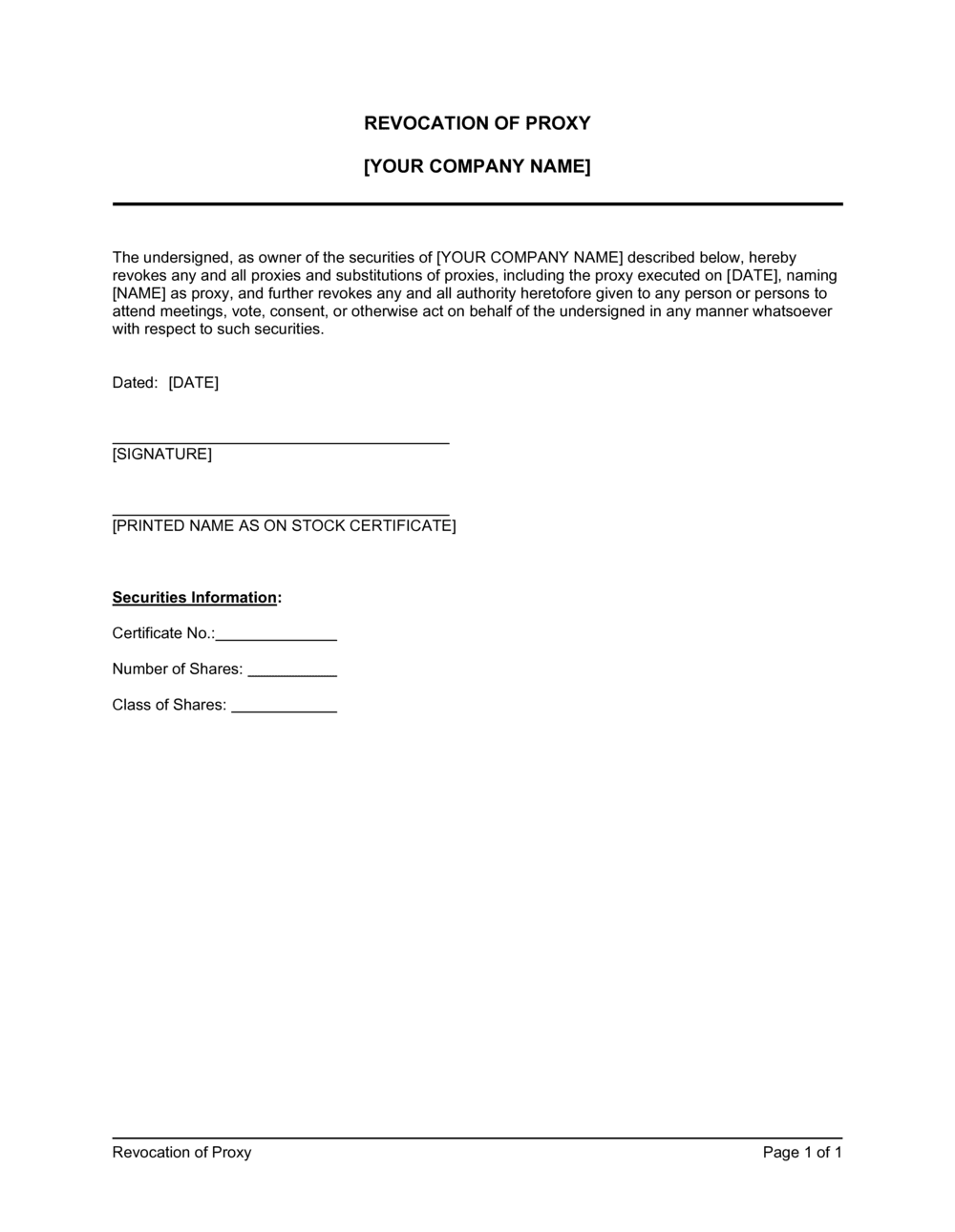
A Proxy Revocation is a formal legal document used to cancel a previously granted proxy — an authorization that allowed another person or entity to vote or act on behalf of the grantor at a shareholder meeting or other legal proceeding. This free Word download lets you edit, execute, and deliver a clear written revocation that protects your voting rights and creates a documented record of the cancellation.
When you need it
Use it whenever you have granted a proxy and need to take back that authority before it is exercised — for example, if you change your voting intention before a shareholder meeting, if the proxy holder is no longer a trusted representative, or if circumstances have changed since the original proxy was granted.
What's inside
Identification of the original proxy and its date, a clear declaration of revocation, effective date and method of delivery, confirmation that the proxy holder is notified, and the grantor's signature block. The document is designed to satisfy notice requirements under most corporate governance frameworks and securities regulations.

What is a Proxy Revocation?

A Proxy Revocation is a formal legal document through which a shareholder or other principal formally cancels an authorization — known as a proxy — that was previously granted to another person or entity to vote or act on their behalf. When a shareholder grants a proxy, they transfer their voting authority for a specific meeting or resolution; a proxy revocation withdraws that transfer of authority, restoring exclusive control to the grantor before the proxy is exercised. The document must be executed in writing, delivered to the proxy holder and to the corporation or its transfer agent, and received within the deadline set by applicable corporate law or the company's own governing documents to be effective for the relevant meeting.

Why You Need This Document

Without a written proxy revocation, a proxy holder retains legal authority to cast your vote even if your intentions have completely changed. In a contested shareholder vote — a merger, a board election, or a major asset sale — a single proxy cast incorrectly can affect the outcome of a resolution that cannot be undone. Verbal instructions to a proxy holder to "disregard" a proxy carry no legal weight; only a signed, delivered revocation cuts off their authority. Companies and transfer agents are legally required to honor outstanding proxies until a proper revocation is on file, regardless of what you may have communicated informally. This template gives you a clean, legally sound revocation document that creates a clear paper trail, satisfies typical notice requirements across major corporate jurisdictions, and protects your right to vote your own shares — free, ready to edit in Word, and exportable as PDF in minutes.

Which variant fits your situation?

If your situation is…Use this template
Revoking a proxy before a publicly listed company's annual general meetingProxy Revocation (Public Company)
Canceling a proxy granted for a private corporation's shareholder voteProxy Revocation (Private Company)
Withdrawing authority granted in a general power of attorneyRevocation of Power of Attorney
Granting a new proxy to a different representative to replace the old oneProxy Statement / Proxy Form
Revoking a proxy for a nonprofit board meetingProxy Revocation (Nonprofit)
Canceling a limited proxy granted for a specific transaction or resolution onlyRevocation of Limited Proxy
Documenting revocation as part of a broader shareholder agreement amendmentShareholders Agreement Amendment

Common mistakes to avoid

❌ Missing the company's revocation deadline

Why it matters: Most corporations set a cut-off — typically 24 to 48 hours before the meeting — after which revocations are not processed for that meeting. Missing it means the proxy holder votes your shares regardless of your revocation.

Fix: Check the meeting notice or the company's bylaws for the revocation deadline before drafting the document, and build in at least 24 hours of buffer for delivery and processing.

❌ Notifying only the proxy holder, not the company

Why it matters: A proxy holder who receives notice but whose authority is not canceled in the company's records can still cast a vote that the registrar accepts as valid, leaving you with no immediate remedy.

Fix: Deliver the signed revocation simultaneously to the proxy holder and to the company's transfer agent or corporate secretary, and retain proof of delivery for both.

❌ Attempting to revoke an irrevocable proxy without legal advice

Why it matters: Revoking a proxy that was explicitly granted as irrevocable — for example, as security for a financing arrangement — can constitute a breach of contract and expose the grantor to damages or injunctive proceedings.

Fix: Identify any irrevocability language in the original proxy before drafting the revocation. If such language exists, obtain legal advice on whether grounds exist to challenge irrevocability before issuing the document.

❌ Using ambiguous or conditional revocation language

Why it matters: Phrases such as 'I intend to revoke' or 'please consider this proxy canceled' are not operative revocations and may be challenged as insufficient by the proxy holder or the company.

Fix: Use present-tense declarative language in the operative clause: 'The Grantor hereby revokes and cancels the Original Proxy in its entirety, effective [DATE].'

❌ Backdating the revocation to the original proxy date

Why it matters: Dating the revocation document as of the original proxy's date implies you revoked it before it was ever acted upon — which may constitute fraud if the proxy holder has already taken steps in reliance on it.

Fix: Always date the revocation with the actual date of signature. If urgency is the concern, execute and deliver on the same day rather than backdating.

❌ Failing to reserve voting rights in the revocation

Why it matters: Without a reservation clause, the company may treat the revoked shares as non-voting for quorum or majority calculations, potentially affecting the outcome of a close vote.

Fix: Include an explicit clause stating that the grantor intends to vote in person or by newly appointed proxy, and follow up by attending the meeting or submitting a replacement proxy immediately.

The 10 key clauses, explained

Identification of Parties

In plain language: Names the grantor (the person revoking the proxy) and the proxy holder whose authority is being canceled, using their full legal names and roles.

Sample language
This Proxy Revocation is made by [GRANTOR FULL NAME] ('Grantor'), a shareholder of [COMPANY NAME] ('Company'), revoking any and all proxy authority previously granted to [PROXY HOLDER FULL NAME] ('Proxy Holder').

Common mistake: Using a nickname or trade name instead of the grantor's full legal name as it appears on the share register — causing the registrar or transfer agent to reject the revocation as unverifiable.

Reference to Original Proxy

In plain language: Identifies the specific proxy being revoked by its date of execution and, where available, its reference number, to avoid any ambiguity about which authorization is being canceled.

Sample language
This revocation applies to the proxy dated [ORIGINAL PROXY DATE], granted by the Grantor to the Proxy Holder in connection with the shareholder meeting of [COMPANY NAME] scheduled for [MEETING DATE] (the 'Original Proxy').

Common mistake: Failing to cite the original proxy's date or meeting reference. A blanket revocation with no identifying details may be contested by the proxy holder or rejected by the company's registrar.

Declaration of Revocation

In plain language: The operative clause stating clearly and unambiguously that the proxy is canceled in its entirety as of the effective date.

Sample language
The Grantor hereby revokes, cancels, and withdraws the Original Proxy in its entirety, effective as of [EFFECTIVE DATE AND TIME]. The Proxy Holder shall have no authority to vote or act on behalf of the Grantor from and after the effective time stated herein.

Common mistake: Using equivocal language such as 'the Grantor wishes to revoke' instead of a present-tense declarative statement. Conditional or aspirational language can create disputes about whether revocation actually occurred.

Effective Date and Time

In plain language: States the precise date — and, where the meeting is imminent, the time — at which the revocation takes effect. This is critical when a meeting is scheduled for the same day.

Sample language
This Proxy Revocation shall take effect at [TIME] on [DATE], which is no later than [X] hours before the commencement of the [MEETING NAME] scheduled for [MEETING DATE AND TIME] at [LOCATION].

Common mistake: Omitting the time of day when the meeting is the same day as the revocation. Without a stated time, a proxy holder may claim authority was still valid at the moment they cast a vote.

Scope of Revocation

In plain language: Specifies whether the revocation covers only the named proxy or all proxies previously granted by the grantor to any person in connection with the company or meeting.

Sample language
This revocation applies to the Original Proxy and, to the extent any other proxy authority was granted by the Grantor to the Proxy Holder or any other person in connection with [COMPANY NAME] or the [MEETING NAME], such authority is also hereby revoked in its entirety.

Common mistake: Narrowing the revocation to a single proxy when multiple proxies may have been issued — leaving the proxy holder with residual authority under a second or earlier grant.

Notice and Delivery Requirements

In plain language: Records how and when the revocation is being delivered to the proxy holder, and to the company or its transfer agent, to satisfy any notice requirements under applicable law or the company's governing documents.

Sample language
A copy of this Proxy Revocation has been delivered to the Proxy Holder by [METHOD OF DELIVERY] on [DATE]. A further copy has been delivered to [COMPANY NAME / TRANSFER AGENT NAME] at [ADDRESS / EMAIL] on [DATE] in accordance with [APPLICABLE BYLAW / STATUTORY REFERENCE].

Common mistake: Failing to deliver the revocation to both the proxy holder and the company or transfer agent. Notifying only the proxy holder without filing with the company may leave the vote still recorded in the proxy holder's name.

Reservation of Voting Rights

In plain language: Confirms that the grantor intends to vote in person or through a new proxy at the relevant meeting, so there is no gap in voting representation.

Sample language
The Grantor expressly reserves the right to attend the [MEETING NAME] and to vote the Grantor's [NUMBER] shares in person, or to appoint a new proxy holder of the Grantor's choosing, following the effective date of this revocation.

Common mistake: Omitting this clause, which can create confusion at the meeting as to whether the grantor intends to vote at all — allowing a company to argue the shares are non-voting for quorum purposes.

Representations and Warranties

In plain language: The grantor confirms that they have full authority to revoke the proxy, that the shares referenced are owned by the grantor, and that no irrevocability clause prevents the revocation.

Sample language
The Grantor represents and warrants that: (a) the Grantor is the registered owner of [NUMBER] shares of [COMPANY NAME]; (b) the Original Proxy was not granted as an irrevocable proxy coupled with an interest; and (c) the Grantor has full legal capacity and authority to execute this revocation.

Common mistake: Attempting to revoke an irrevocable proxy without legal analysis first. If the original proxy was coupled with an interest — for example, pledged to a lender — the revocation may be void and could expose the grantor to breach-of-contract liability.

Governing Law

In plain language: Identifies the jurisdiction whose corporate and securities laws govern the validity and interpretation of the revocation.

Sample language
This Proxy Revocation shall be governed by and construed in accordance with the laws of [STATE / PROVINCE / COUNTRY], without regard to its conflict-of-laws principles.

Common mistake: Omitting a governing law clause entirely. In cross-border share ownership situations, the absence of this clause creates uncertainty about which jurisdiction's rules on proxy revocation apply.

Signature and Dating

In plain language: The grantor's wet or electronic signature, printed name, date of execution, and — where required — a witness or notary attestation.

Sample language
Signed by the Grantor on [DATE]. _______________________________ [GRANTOR FULL NAME] Date: [DATE] Witness (if required): [WITNESS NAME AND SIGNATURE]

Common mistake: Dating the document with the meeting date rather than the actual date of signature. A backdated revocation can be challenged as fraudulent and renders the document unenforceable.

How to fill it out

  1. 1

    Locate and review the original proxy document

    Retrieve the original proxy you granted — note the exact date it was signed, the meeting it referenced, and the full legal name of the proxy holder. You will need these details to complete the identification and reference clauses.

    💡 If you cannot locate the original proxy, contact the company's corporate secretary or transfer agent — they will have a copy on file.

  2. 2

    Enter the grantor and proxy holder details

    Fill in your full legal name as it appears on the company's share register. Enter the proxy holder's full legal name exactly as it appears on the original proxy document.

    💡 Discrepancies between the name in the revocation and the name in the share register are the single most common cause of rejected revocations.

  3. 3

    Reference the original proxy precisely

    Enter the date the original proxy was executed and the name or date of the meeting it related to. If the proxy carried a reference number, include it.

    💡 If you have granted multiple proxies to the same person over time, use the scope-of-revocation clause to revoke all of them rather than naming each individually.

  4. 4

    Set the effective date and time

    Enter the date and, if the meeting is imminent, the specific time the revocation takes effect. Confirm that this is before any deadline set by the company for receiving revocations — typically 48 hours before the meeting.

    💡 Check the company's bylaws or the meeting notice for the cut-off time. Missing it by even an hour can mean your revocation is not honored for that meeting.

  5. 5

    Confirm irrevocability status

    Review the original proxy to determine whether it was granted as irrevocable or coupled with any financial interest. If there is any indication of irrevocability, pause and consult a lawyer before completing the document.

    💡 The words 'irrevocable' or 'coupled with an interest' in the original proxy are a hard stop — do not proceed without legal advice.

  6. 6

    Prepare delivery to both the proxy holder and the company

    Print or export the completed revocation as PDF. Deliver one copy to the proxy holder by email or courier and a second copy to the company's transfer agent or corporate secretary by the method specified in the meeting notice.

    💡 Send by a method that generates a delivery receipt — email with read receipt, courier with tracking, or registered mail — so you can prove timely delivery if challenged.

  7. 7

    Sign and date the document

    Sign and date the revocation on the actual day you execute it. If your jurisdiction or the company's bylaws require a witness signature, arrange for a witness to sign at the same time.

    💡 Use Business in a Box eSign to timestamp the execution and retain a certified copy in BIB Drive alongside the original proxy.

  8. 8

    Retain confirmation and monitor the meeting record

    Keep copies of the signed revocation, delivery receipts, and any acknowledgment from the company or transfer agent. After the meeting, verify that your vote was recorded correctly in the meeting minutes.

    💡 If you discover your proxy holder voted before the revocation was processed, raise an objection immediately with the corporate secretary and preserve all delivery evidence.

Frequently asked questions

What is a proxy revocation?

A proxy revocation is a formal written document that cancels a previously granted proxy — the authorization that allowed another person to vote or act on behalf of the grantor at a shareholder meeting or similar proceeding. Once delivered to the proxy holder and the relevant company or registrar, a properly executed revocation strips the proxy holder of all authority to vote the grantor's shares from the stated effective date onward.

Can I revoke a proxy after I have already signed it?

Yes. In most jurisdictions, a proxy is revocable at any time before it is exercised, as long as it was not granted as an irrevocable proxy coupled with a financial interest. The revocation must generally be delivered to both the proxy holder and the company before any applicable deadline set by the corporation's bylaws or meeting notice. Simply deciding to revoke without delivering the written notice is not sufficient.

What is an irrevocable proxy and can it be revoked?

An irrevocable proxy is one that explicitly states it cannot be revoked, typically because it is granted in connection with a financial interest held by the proxy holder — for example, as part of a loan security arrangement or a shareholders agreement. Attempting to revoke an irrevocable proxy without legal grounds can constitute breach of contract. If your proxy contains irrevocability language, consult a lawyer before issuing a revocation — there may be limited circumstances under which a court will permit revocation, but they are narrow.

How do I revoke a proxy before a shareholder meeting?

Complete a signed proxy revocation document identifying the original proxy by date and the meeting it relates to, state the effective date, and deliver copies to the proxy holder and to the company's corporate secretary or transfer agent before the cut-off time stated in the meeting notice — typically 24 to 48 hours before the meeting. Retain proof of delivery for both recipients. You may also attend the meeting in person, as physically appearing and voting generally supersedes a prior proxy under most corporate statutes.

Does attending a meeting automatically revoke a proxy?

In many jurisdictions, attending a shareholder meeting in person and voting directly does effectively revoke any outstanding proxy for that meeting, as the grantor's personal vote takes precedence. However, this is not universal — some corporate statutes and bylaws require written notice of revocation regardless of personal attendance. To be certain, deliver a signed revocation in advance rather than relying solely on your physical presence.

Is a proxy revocation the same as revoking a power of attorney?

They are similar in function — both cancel a previously granted authority to act on someone's behalf — but they operate under different legal frameworks. A proxy is typically granted for a specific shareholder vote and is governed by corporate law and securities regulations. A power of attorney is broader in scope, often covering financial, legal, or personal decisions, and is governed by agency law and specific POA statutes. Each requires its own revocation document; a proxy revocation does not cancel a power of attorney, and vice versa.

Does a proxy revocation need to be notarized?

In most jurisdictions, a proxy revocation does not require notarization to be valid. A signed, dated document delivered to the correct parties within the required timeframe is generally sufficient. Some companies or transfer agents may request a notarized signature for verification purposes on high-value share blocks, so check the specific requirements in the meeting notice or contact the corporate secretary in advance.

What happens if the proxy holder votes before my revocation is received?

If a proxy holder casts a vote before your revocation is processed — either because it arrived after the cut-off or was not properly filed — the vote may stand. Your remedy in that situation depends on the jurisdiction and whether the outcome materially affected a resolution. In some cases, you can challenge the vote at the meeting or file a formal objection with the corporate secretary immediately. Preserving your delivery receipts and timestamped evidence is critical to any subsequent challenge.

Can a proxy be revoked by granting a new proxy?

Yes. In most jurisdictions, granting a new proxy to a different (or the same) proxy holder automatically revokes all prior proxies for the same meeting, provided the new proxy is dated later than the original. The safest practice, however, is to issue an explicit written revocation alongside the new proxy to eliminate any ambiguity about which instrument controls and to create a clear paper trail for the company's records.

How this compares to alternatives

vs Revocation of Power of Attorney

A revocation of power of attorney cancels a broad grant of authority covering financial, legal, or personal decisions under agency law. A proxy revocation is narrower in scope, canceling only the authority to vote shares at a specific meeting under corporate law. If you need to cancel both, you require two separate documents — one does not substitute for the other.

vs Proxy Statement / Proxy Form

A proxy form grants authority to another person to vote your shares; a proxy revocation cancels that authority. They are mirror-image documents. If you want to change your representative rather than simply cancel, you should issue both a revocation of the old proxy and a new proxy form appointing your chosen replacement.

vs Shareholders Agreement

A shareholders agreement governs the ongoing relationship between shareholders, including voting arrangements that may include proxy commitments. A proxy revocation is a transactional document addressing a single instance of canceled voting authority. Where a shareholders agreement contains irrevocable proxy obligations, the revocation document must be reviewed alongside the agreement before execution.

vs Written Consent of Shareholders in Lieu of Meeting

A written consent allows shareholders to approve resolutions without a meeting, eliminating the need for proxies entirely. A proxy revocation applies specifically to in-meeting voting authority. If your company is shifting from a proxy-based meeting vote to a written consent process, the proxy revocation ensures no outstanding proxy holder appears at a meeting that will no longer take place.

Industry-specific considerations

Financial Services and Banking

Shareholder-heavy ownership structures and institutional investors frequently revoke proxies when merger or acquisition terms change between the proxy grant date and the vote.

Technology and SaaS

Founder-heavy cap tables with complex voting agreements mean proxy revocations often intersect with shareholder agreements and drag-along provisions requiring careful legal review.

Real Estate

Property investment vehicles and REITs use proxies extensively for investor votes on asset disposals; revocations are common when deal terms are renegotiated before closing.

Nonprofit and Association Governance

Nonprofit boards and membership associations grant proxies for governance votes; revocations arise when a member changes position on a bylaw amendment or leadership election.

Jurisdictional notes

United States

Under the Model Business Corporation Act and most state corporate statutes, a proxy is revocable unless it expressly states otherwise and is coupled with an interest. Delaware General Corporation Law §212 governs proxy validity and revocation for the majority of US-incorporated entities. SEC Rule 14a-4 imposes additional requirements for proxies solicited in connection with public company meetings, including specific revocation notice procedures. State-level variations in notice deadlines and delivery methods mean shareholders should confirm requirements with the company's transfer agent.

Canada

The Canada Business Corporations Act (CBCA) and provincial equivalents — including Ontario's Business Corporations Act and the British Columbia Business Corporations Act — permit revocation of a proxy at any time before it is exercised. Under the CBCA, a shareholder may revoke a proxy by depositing a written statement with the corporation's registered office no later than the day before the meeting or the last business day before an adjourned meeting. Quebec shareholders operating under French civil law should confirm that the revocation meets notarial or formality requirements applicable in that province.

United Kingdom

The Companies Act 2006 governs proxy rights in the UK. Section 324 grants members of a company the right to appoint a proxy, and revocation is generally permitted before the proxy is exercised. For quoted companies, the FCA's Listing Rules and the Shareholder Rights Directive II impose additional transparency requirements around proxy voting. Revocations for public company votes must typically be received by the company's registrar no later than 48 hours before the meeting. Electronic revocation is increasingly accepted under the Electronic Communications Act 2000.

European Union

The EU Shareholder Rights Directive II (2017/828) requires member states to facilitate shareholder participation including proxy voting and revocation for listed companies. Implementation varies by member state — Germany, France, the Netherlands, and Spain each have their own corporate statute provisions governing proxy revocation deadlines and delivery methods. GDPR considerations apply when personal data about shareholders is processed in connection with proxy revocation filings. Shareholders in cross-border EU holding structures should confirm which national law governs the company's share register and applicable revocation rules.

Template vs lawyer — what fits your deal?

PathBest forCostTime
Use the templateShareholders revoking a standard revocable proxy for a routine AGM or general shareholder vote in a private companyFree15–30 minutes
Template + legal reviewShareholders with large share blocks, complex cap tables, or any uncertainty about whether the original proxy contained irrevocability language$200–$5001–2 days
Custom draftedPublicly listed companies, contested shareholder votes, proxy revocations tied to M&A transactions, or situations where the proxy holder disputes the revocation$1,000–$3,500+3–7 days

Glossary

Proxy
A written authorization allowing one person (the proxy holder) to act or vote on behalf of another (the grantor) at a meeting or in a legal proceeding.
Proxy Holder
The person or entity authorized by the grantor to vote or act on their behalf under the terms of the original proxy.
Grantor
The person who originally granted the proxy authority and who executes the revocation to cancel it.
Revocation
The formal cancellation of a previously granted authority, making it legally void from the effective date stated in the revocation document.
Effective Date
The specific date and time on which the proxy revocation takes legal effect, after which the proxy holder has no authority to act.
Irrevocable Proxy
A proxy that cannot be revoked by the grantor, typically because it is coupled with an interest — for example, pledged as security for a loan. Such proxies require special legal analysis before any revocation attempt.
Coupled with an Interest
A proxy granted in connection with a financial interest held by the proxy holder — such as a creditor relationship — which typically makes the proxy irrevocable until the underlying interest is resolved.
Record Date
The date set by a corporation to determine which shareholders are entitled to vote at a meeting. A revocation must generally be delivered before the record date cut-off to be effective for that meeting.
Notice of Revocation
The formal written communication delivered to the proxy holder and, where required, to the corporation's registrar or transfer agent, confirming that the proxy has been canceled.
Transfer Agent
A company appointed by a corporation to maintain shareholder records, process proxy submissions, and receive revocation notices on behalf of the issuer.
Annual General Meeting (AGM)
The yearly meeting at which shareholders vote on key corporate matters such as director elections, auditor approval, and executive compensation — one of the most common occasions for proxies and their revocations.

Part of your Business Operating System

This document is one of 3,000+ business & legal templates included in Business in a Box.

  • Fill-in-the-blanks — ready in minutes
  • 100% customizable Word document
  • Compatible with all office suites
  • Export to PDF and share electronically

Create your document in 3 simple steps.

From template to signed document — all inside one Business Operating System.
1
Download or open template

Access over 3,000+ business and legal templates for any business task, project or initiative.

2
Edit and fill in the blanks with AI

Customize your ready-made business document template and save it in the cloud.

3
Save, Share, Send, Sign

Share your files and folders with your team. Create a space of seamless collaboration.

Save time, save money, and create top-quality documents.

★★★★★

"Fantastic value! I'm not sure how I'd do without it. It's worth its weight in gold and paid back for itself many times."

Managing Director · Mall Farm
Robert Whalley
Managing Director, Mall Farm Proprietary Limited
★★★★★

"I have been using Business in a Box for years. It has been the most useful source of templates I have encountered. I recommend it to anyone."

Business Owner · 4+ years
Dr Michael John Freestone
Business Owner
★★★★★

"It has been a life saver so many times I have lost count. Business in a Box has saved me so much time and as you know, time is money."

Owner · Upstate Web
David G. Moore Jr.
Owner, Upstate Web

Run your business with a system — not scattered tools

Stop downloading documents. Start operating with clarity. Business in a Box gives you the Business Operating System used by over 250,000 companies worldwide to structure, run, and grow their business.

Start free · No credit card required