Revocation of Power of Attorney Template

Free Word download β€’ Edit online β€’ Save & share with Drive β€’ Export to PDF

2 pagesβ€’25–30 min to fillβ€’Difficulty: Standardβ€’Signature requiredβ€’Legal review recommended
Learn more ↓
FreeRevocation of Power of Attorney Template

At a glance

What it is
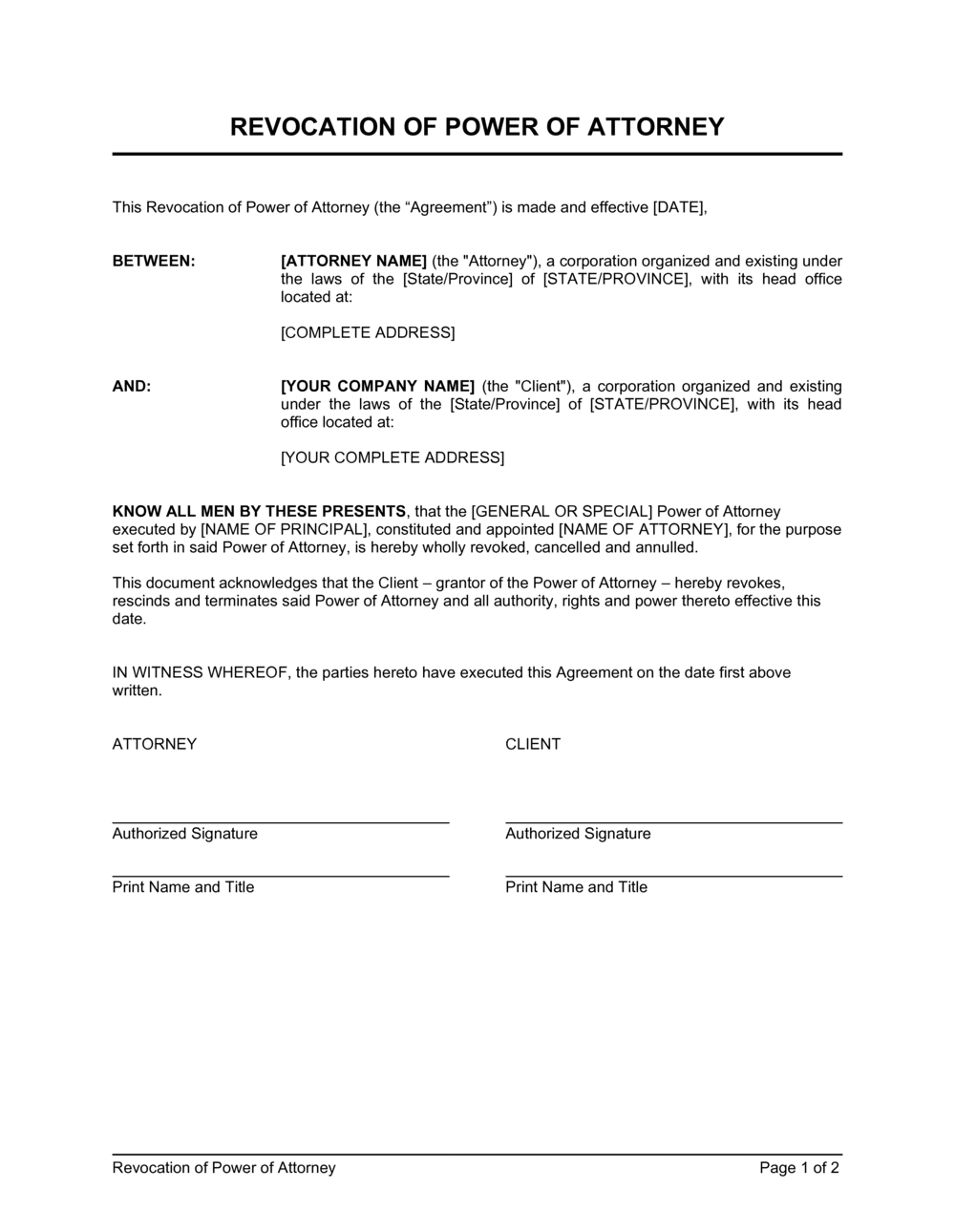
A Revocation of Power of Attorney is a legally binding document that formally cancels an existing power of attorney and strips the named agent of all authority to act on the principal's behalf. This free Word download lets you draft, edit, and export the notice as PDF, then serve it on your former agent and any third parties who relied on the original POA.
When you need it
Use it whenever you need to terminate an agent's authority β€” whether due to a breakdown in trust, a change in personal or business circumstances, the completion of the task the POA was created for, or the appointment of a new agent. It is also required when replacing a durable POA before incapacity occurs.
What's inside
Identification of the principal and the revoked agent, a clear reference to the original power of attorney by date and type, an express statement of revocation effective immediately or on a specified date, instructions to return any documents issued under the old POA, a notice provision requiring service on third parties, and a signature block with notarization requirements.

What is a Revocation of Power of Attorney?

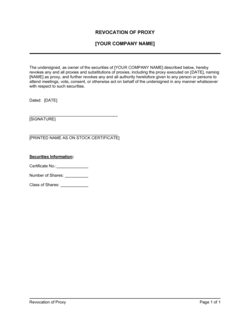
A Revocation of Power of Attorney is a legally binding document through which a principal formally cancels all authority previously granted to an agent under an existing power of attorney. Once executed, notarized, and delivered to the agent and relevant third parties, it strips the former agent of any right to sign documents, conduct transactions, or otherwise act on the principal's behalf. The revocation identifies the original POA by execution date and type, states the cancellation in unambiguous terms, directs the return of all copies, and protects third parties who acted in good faith before receiving written notice. This free Word download gives you a structured, court-ready starting point you can edit and export as PDF in minutes.

Why You Need This Document

Without a formal written revocation, an agent's authority under the original power of attorney technically remains in force β€” regardless of what you may have said verbally or assumed. Banks, land registries, and courts are not bound by informal instructions; they will continue honoring the original POA until they receive a signed, notarized written revocation. The consequences of delay are concrete: a former agent can sign contracts, move funds, or transfer property while the original document remains unrevoked, and transactions completed before the institution receives written notice are generally binding on the principal. A properly drafted and served revocation closes that window immediately, creates a clear paper trail for any future dispute, and satisfies the formal requirements of land registries and financial institutions in the US, Canada, the UK, and most EU member states. This template provides the structure to do it correctly the first time.

Which variant fits your situation?

If your situation is…Use this template
Revoking a general durable power of attorney granted to a family memberRevocation of Durable Power of Attorney
Canceling a financial POA given to a bank or financial institutionRevocation of Financial Power of Attorney
Terminating a healthcare or medical power of attorneyRevocation of Healthcare Power of Attorney
Revoking a real estate POA used for a specific property transactionRevocation of Real Estate Power of Attorney
Replacing the current agent with a new one simultaneouslyPower of Attorney (General)
Revoking a limited or special POA tied to a single transactionRevocation of Limited Power of Attorney
Formally notifying a third party such as a bank of the revocationRevocation Notice Letter

Common mistakes to avoid

❌ Revoking verbally without a written document

Why it matters: An oral revocation is generally unenforceable against third parties. Banks and registries will continue to honor the original POA until they receive written notice, leaving the agent free to transact.

Fix: Always execute a written, notarized revocation and serve it personally or by certified mail on both the agent and all third parties holding copies of the original POA.

❌ Failing to notify third parties promptly

Why it matters: In most jurisdictions, a third party who acts on a POA in good faith before receiving actual written notice of revocation is protected β€” the principal may be bound by those transactions.

Fix: Serve copies of the executed revocation on every bank, broker, government office, and counterparty that relied on the original POA within the same business day or the day after signing.

❌ Omitting notarization when the original POA was notarized

Why it matters: Land registries, financial institutions, and courts will refuse an un-notarized revocation of a notarized POA, leaving the original authority technically in force.

Fix: Execute the revocation before a notary public, obtain the seal, and confirm that the notarial form matches the requirements of the governing jurisdiction.

❌ Not revoking a durable POA while the principal still has capacity

Why it matters: A durable POA survives incapacity. If you wait until capacity is in question, the revocation itself may be challenged as invalid β€” leaving the original agent's authority intact.

Fix: Execute the revocation as soon as the decision is made, while mental capacity is unambiguous, and have the notary note the principal's apparent capacity at the time of signing.

❌ Forgetting to name successor agents in the revocation

Why it matters: Most POAs name a successor or alternate agent who steps in if the primary agent is unable to act. A revocation that only names the primary agent leaves successor agents with unrevoked authority.

Fix: Explicitly name and revoke the authority of every agent β€” primary, successor, and substitute β€” identified in the original POA.

❌ Using the revocation as a de facto new POA by conditioning the revocation

Why it matters: Adding conditions to a revocation β€” such as 'revoked unless the agent completes X' β€” creates a hybrid document that is difficult to enforce and may be interpreted as neither a valid revocation nor a valid POA.

Fix: Keep the revocation unconditional. If you want the agent to complete a specific task first, use a side agreement or a new limited POA, and execute the revocation separately with a future effective date.

The 10 key clauses, explained

Identification of the Principal

In plain language: States the full legal name, address, and identifying details of the person revoking the authority so there is no ambiguity about who is acting.

Sample language
I, [PRINCIPAL FULL LEGAL NAME], of [PRINCIPAL ADDRESS], [CITY, STATE/PROVINCE, ZIP/POSTAL CODE], hereby revoke all powers of attorney previously granted by me.

Common mistake: Using a nickname or partial name instead of the exact legal name that appears on the original POA β€” creating a mismatch that third parties may use to question the revocation's validity.

Reference to the Original Power of Attorney

In plain language: Identifies the specific POA being revoked by execution date, type, and the agent's name, so it is clear exactly which authority is being canceled.

Sample language
This revocation applies specifically to the [TYPE] Power of Attorney executed by me on [DATE], appointing [AGENT FULL LEGAL NAME] of [AGENT ADDRESS] as my attorney-in-fact.

Common mistake: Omitting the original POA's execution date. Without it, a third party holding an old version of the POA cannot confirm which document is being revoked.

Statement of Revocation

In plain language: The operative clause that expressly cancels all authority granted to the named agent, leaving no room for interpretation that a partial or conditional cancellation was intended.

Sample language
I hereby revoke, cancel, and terminate all powers, authorities, and discretions granted to [AGENT FULL LEGAL NAME] under the above-referenced Power of Attorney, effective [EFFECTIVE DATE / immediately upon delivery].

Common mistake: Using ambiguous language such as 'I wish to cancel' or 'I no longer authorize' instead of a direct, unconditional declaration of revocation β€” courts have found such language insufficient in some jurisdictions.

Scope of Revocation

In plain language: Clarifies whether all previously granted authorities are revoked or only specific powers, and whether the revocation covers any successor or substitute agents named in the original POA.

Sample language
This revocation applies to all powers granted under the referenced POA, including any authority conferred on successor or substitute agents named therein, and includes all financial, real property, and business transaction authority.

Common mistake: Failing to mention successor agents named in the original POA β€” they retain valid authority unless the revocation expressly names and removes them.

Return of Documents

In plain language: Directs the former agent to return all originals and copies of the revoked POA and any documents executed under it, limiting the risk of continued unauthorized use.

Sample language
The former agent is hereby directed to immediately cease all activities under the revoked Power of Attorney and to return all originals and copies of same to [PRINCIPAL NAME] at [ADDRESS] within [X] days of receipt of this notice.

Common mistake: Omitting a return deadline. Without one, the former agent faces no urgency to surrender documents, and the risk of continued unauthorized transactions persists.

Effective Date

In plain language: States precisely when the revocation takes effect β€” immediately upon delivery to the agent, on a specified calendar date, or upon recording in a public registry.

Sample language
This Revocation of Power of Attorney is effective [immediately upon delivery to the agent / as of [SPECIFIC DATE]], and supersedes any prior authorization given to the above-named agent.

Common mistake: Leaving the effective date blank. In some jurisdictions this defaults to the date of signing, which may not align with when the agent or third parties actually receive notice β€” creating a window of unauthorized but technically valid acts.

Notice to Third Parties

In plain language: Instructs the principal to serve copies of the revocation on all institutions and persons that relied on the original POA, and records that notice has been given.

Sample language
The principal hereby represents that notice of this revocation has been provided, or will be provided promptly, to all third parties who have received or relied upon the revoked Power of Attorney, including but not limited to [BANK NAME], [INSTITUTION NAME], and any relevant government registries.

Common mistake: Executing the revocation but failing to serve it on the bank or land registry. An agent who continues to transact before receiving notice may bind the principal to those acts under the 'protection of third parties' rule in most jurisdictions.

Indemnification of Third Parties

In plain language: Protects third parties who acted in good faith on the original POA before receiving notice of revocation, acknowledging that such transactions remain valid.

Sample language
Any third party who in good faith relied upon the revoked Power of Attorney prior to actual receipt of this revocation notice shall be held harmless for transactions completed before such notice was received.

Common mistake: Omitting this clause. Without it, the document is silent on prior good-faith transactions β€” creating potential disputes with institutions that processed the agent's instructions before notice arrived.

Signature Block and Notarization

In plain language: Provides space for the principal's wet signature, date, and β€” where required β€” acknowledgment before a notary public, which is necessary for the revocation to be recorded in public registries.

Sample language
Executed this [DAY] day of [MONTH], [YEAR], by [PRINCIPAL FULL LEGAL NAME]. State of [STATE], County of [COUNTY]. Before me, the undersigned notary public, personally appeared [PRINCIPAL NAME], known to me or proved by satisfactory evidence to be the person named above.

Common mistake: Signing without notarization when the original POA was notarized. Most registries β€” including land title offices and financial institutions β€” will refuse to accept an un-notarized revocation of a notarized POA.

Governing Law

In plain language: Specifies the jurisdiction whose law governs the interpretation and enforcement of the revocation, aligning it with the law that governed the original POA.

Sample language
This Revocation of Power of Attorney shall be governed by and construed in accordance with the laws of the State of [STATE] / Province of [PROVINCE] / [COUNTRY], without regard to conflict-of-law principles.

Common mistake: Choosing a governing law different from the one in the original POA. Mismatched governing jurisdictions can create procedural complications if the revocation is ever challenged.

How to fill it out

  1. 1

    Gather the original power of attorney document

    Retrieve the original POA to confirm the exact execution date, the agent's full legal name and address, the type of POA (general, durable, limited, healthcare), and any successor agents named.

    πŸ’‘ Check whether the original POA was recorded in a public registry β€” if so, the revocation must also be recorded in the same registry to be effective against third parties.

  2. 2

    Enter the principal's full legal name and address

    Use the exact name that appears on the original POA and any government-issued ID. Include your full mailing address. Inconsistencies between the revocation and the original document give third parties grounds to delay processing.

    πŸ’‘ If your legal name has changed since the original POA was executed, note both names: '[CURRENT NAME], formerly known as [PRIOR NAME].'

  3. 3

    Identify the original POA and the agent being revoked

    Enter the execution date of the original POA, its type, and the full legal name and address of the agent whose authority you are canceling. If the original POA named successor agents, list them here as well.

    πŸ’‘ Pull the agent's address from the original POA rather than using a current address β€” matching the document record removes any ambiguity about identity.

  4. 4

    Insert the effective date

    Decide whether the revocation takes effect immediately upon delivery or on a specific future date. If you need the agent to complete a specific transaction before the revocation kicks in, set a future date and state any exceptions clearly.

    πŸ’‘ Never back-date a revocation. Courts treat back-dating as a misrepresentation, which can void the document and expose you to liability for the agent's intervening acts.

  5. 5

    Add the return-of-documents instruction and deadline

    Specify a deadline β€” typically 5 to 10 business days β€” by which the former agent must return all originals and copies of the revoked POA to you. Include your return address.

    πŸ’‘ Send the revocation by certified mail with return receipt so you have proof of delivery and the date the agent received notice.

  6. 6

    Sign before a notary public

    Execute the document in the presence of a notary public and obtain the notarial seal. Most financial institutions and all land registries require notarization to process a revocation.

    πŸ’‘ Bring two forms of government-issued photo ID to the notary appointment β€” some jurisdictions require witnesses in addition to the notary.

  7. 7

    Serve notice on the agent and all relevant third parties

    Deliver a copy of the executed revocation to the agent and to every bank, broker, registry, or institution that holds a copy of the original POA or has transacted under it. Keep a log of who was notified and when.

    πŸ’‘ File the revocation with the same county recorder or land registry where the original POA was recorded β€” unrecorded revocations do not bind third parties who continue dealing with the agent in good faith.

  8. 8

    Store the executed revocation securely

    Keep the original executed revocation, copies of all delivery receipts, and a log of third-party notifications together in one file. If you are simultaneously appointing a new agent, execute the new POA on or after the revocation's effective date.

    πŸ’‘ Upload the signed document to a secure cloud folder and share it with your attorney or estate planner so it is accessible if ever challenged.

Frequently asked questions

What is a revocation of power of attorney?

A revocation of power of attorney is a legal document that formally cancels an existing POA and removes all authority previously granted to the named agent. It must be in writing, signed by the principal, and β€” in most jurisdictions β€” notarized to be effective against third parties such as banks and land registries. Simply telling the agent their authority is canceled is not sufficient in the majority of cases.

When should I revoke a power of attorney?

Revoke a POA whenever the original purpose has been fulfilled, the relationship with the agent has changed, you are replacing the agent with someone else, or you no longer need the arrangement. For durable POAs, revoke while you still have full mental capacity β€” waiting until capacity is uncertain makes the revocation itself vulnerable to challenge. Business owners should revoke immediately when a signatory employee departs or a partnership dissolves.

Does revoking a power of attorney need to be notarized?

In most US states, Canadian provinces, and UK jurisdictions, notarization is required if the original POA was notarized or recorded. Land registries and financial institutions typically refuse un-notarized revocations. Even where not strictly required by statute, notarization is strongly recommended because it establishes the principal's identity and capacity at the time of signing β€” making a challenge far harder to sustain.

Can a power of attorney be revoked verbally?

An oral revocation may end the agent's authority as between the principal and the agent, but it provides no protection against third parties who continue to act on the original written POA in good faith. Practically speaking, banks, brokers, and registries will not accept an oral revocation β€” you must provide a signed, notarized written document before they will stop honoring the agent's instructions.

Does revoking a power of attorney automatically notify banks and other institutions?

No. Executing the revocation document does not automatically inform anyone. You must actively deliver a copy to each institution that holds a version of the original POA or has transacted under it. Until an institution receives actual written notice, it is legally protected when it acts on the agent's instructions in good faith. This is one of the most consequential steps and is frequently overlooked.

What is the difference between revoking a general and a durable power of attorney?

A general POA terminates automatically if the principal becomes incapacitated; a durable POA explicitly survives incapacity. The revocation process is identical for both, but timing is critical for durable POAs β€” the principal must have legal capacity at the moment of signing the revocation. If capacity is disputed, the revocation can be challenged, and courts may require medical evidence to uphold it.

Can I revoke a power of attorney if the agent refuses to return the original document?

Yes. The revocation is effective once properly executed and delivered to the agent regardless of whether the agent cooperates or returns the original. If the agent refuses, serve copies of the executed revocation directly on every relevant third party and institution. You may also consider filing the revocation in a public registry so that anyone searching title or authority records can see the cancellation. Legal counsel can assist with injunctive relief if the agent continues to act after receiving notice.

How does revoking a power of attorney affect transactions the agent already completed?

Transactions completed by the agent before the revocation was delivered are generally valid and binding on the principal, provided the agent acted within the scope of the original POA. The revocation is not retroactive. If the agent acted outside the POA's scope or committed fraud, those transactions may be challenged separately β€” but the revocation itself only cuts off future authority, not past acts.

Do I need a lawyer to revoke a power of attorney?

For a straightforward revocation of a simple financial or general POA, a well-drafted template is typically sufficient. Legal counsel is advisable when the original POA governed complex business assets, real property transactions, or healthcare decisions; when the agent has already taken disputed actions; when there are concerns about the principal's capacity; or when the revocation needs to be recorded in multiple jurisdictions. A one-hour attorney review typically costs $150–$400 and is worthwhile for any high-value or contentious situation.

How this compares to alternatives

vs Power of Attorney (General)

A general power of attorney grants broad authority to an agent across financial, legal, and business matters. A revocation of power of attorney does the opposite β€” it formally cancels that grant. If you are appointing a new agent at the same time, execute both documents together but ensure the revocation's effective date precedes or matches the new POA's start date to avoid overlapping authority.

vs Limited Power of Attorney

A limited POA restricts the agent to a single transaction or defined scope and often expires automatically on a specified date or upon task completion. A revocation is needed when you want to cancel a limited POA before it expires naturally, or when the agent has exceeded the defined scope. If the limited POA expired by its own terms, a separate revocation is technically unnecessary but still recommended for clarity.

vs Letter of Authorization

A letter of authorization grants narrower, often informal permission for a specific act β€” picking up a package, attending a meeting on your behalf. It does not confer the broad legal authority a POA does and typically does not require notarization. A letter of revocation or simple notice is usually sufficient to cancel it, whereas a POA revocation requires a formal notarized document.

vs Resignation of Agent

A resignation of agent is a document the agent executes to voluntarily relinquish authority under an existing POA. A revocation of POA is initiated by the principal to unilaterally remove authority. Both end the agent's role, but only the principal's revocation protects against an agent who will not resign voluntarily, and only the revocation gives the principal direct control over the effective date and notice process.

Industry-specific considerations

Real Estate

Revocations must be recorded with the county recorder or land registry to cut off an agent's authority to execute deeds, mortgages, or transfer instruments on real property.

Financial Services

Banks and brokerage firms require a notarized written revocation before removing an agent from account-level authority, and many have their own internal forms to accompany the revocation.

Healthcare

Revoking a healthcare POA requires immediate written notice to the attending physician, hospital, and any other healthcare provider currently holding a copy of the original authorization.

Professional Services

Law firms, accounting practices, and consulting businesses use revocations when partners or authorized signatories depart, requiring simultaneous notice to clients, courts, and licensing bodies.

Jurisdictional notes

United States

POA and revocation law is state-specific. Most states require notarization and two witnesses for a durable POA revocation. California requires the revocation to be recorded with the county recorder if the original POA was recorded. The Uniform Power of Attorney Act (adopted in many states) provides that a third party who acts in good faith before receiving written notice of revocation is protected. Some states β€” including Florida and New York β€” have mandatory statutory forms.

Canada

Each province governs POA revocations separately. Ontario's Substitute Decisions Act requires the revocation to be in writing and signed before a witness; notarization is required for real property transactions. Quebec uses the mandate system under the Civil Code, and revocations of mandates must follow Quebec-specific formalities β€” French language is required for provincially regulated documents. British Columbia requires a signed, witnessed revocation delivered to the attorney.

United Kingdom

In England and Wales, a Lasting Power of Attorney (LPA) registered with the Office of the Public Guardian (OPG) cannot be revoked by a simple written document alone β€” the principal must notify the OPG using form LPA005 and have capacity confirmed. An ordinary (non-lasting) POA can be revoked in writing without registration formalities. Scotland has separate rules under the Adults with Incapacity Act 2000. Northern Ireland follows broadly similar rules to England and Wales.

European Union

Revocation requirements vary significantly by member state. In Germany, a written revocation must be delivered to the agent and any third party holding the Vollmacht original. French law allows revocation at any time but requires notification to third parties through a huissier (bailiff) for formal effectiveness against them. Spain requires notarial revocation if the original POA was notarized, and the revocation must be entered in the Notarial Register. Cross-border POAs within the EU may require compliance with both the issuing and the enforcing member state's formalities.

Template vs lawyer β€” what fits your deal?

PathBest forCostTime
Use the templateIndividuals revoking a straightforward financial or general POA where the agent is cooperative and no transactions are in disputeFree15–30 minutes plus notary appointment
Template + legal reviewBusiness owners revoking a signatory's authority over company assets, or anyone revoking a durable POA involving real property$150–$400 for a one-hour attorney review1–2 business days
Custom draftedComplex situations involving disputed transactions, incapacity challenges, multiple jurisdictions, or contested agent conduct$500–$2,500+3–10 business days

Glossary

Principal
The person who originally granted the power of attorney and who is now revoking it.
Agent (Attorney-in-Fact)
The individual authorized under the original POA to act on the principal's behalf β€” whose authority is terminated by this document.
Power of Attorney (POA)
A legal document authorizing one person to act on behalf of another in legal, financial, or medical matters.
Durable Power of Attorney
A POA that remains in effect even if the principal becomes mentally incapacitated β€” requires explicit revocation while the principal still has capacity.
Revocation
The formal legal act of canceling or withdrawing an authority previously granted, effective from a specified date or immediately upon delivery.
Notarization
The process by which a notary public verifies the identity of the signatory and witnesses the signature, often required to make a revocation valid against third parties.
Notice
The act of formally informing the agent and any third parties β€” such as banks, registries, or courts β€” that the original POA has been canceled.
Effective Date
The specific calendar date on which the revocation takes legal effect; if omitted, revocation typically takes effect upon delivery to the agent.
Third Party
Any person or institution β€” bank, government office, counterparty β€” that relied on the original POA and must be notified of its cancellation.
Springing Power of Attorney
A POA that only activates upon the occurrence of a triggering event, such as incapacity; revoking it before the trigger fires follows the same process as any other POA.
Capacity
The legal and mental ability of a principal to make decisions and execute legal documents β€” required at the time of signing the revocation.

Part of your Business Operating System

This document is one of 3,000+ business & legal templates included in Business in a Box.

  • Fill-in-the-blanks β€” ready in minutes
  • 100% customizable Word document
  • Compatible with all office suites
  • Export to PDF and share electronically

Create your document in 3 simple steps.

From template to signed document β€” all inside one Business Operating System.
1
Download or open template

Access over 3,000+ business and legal templates for any business task, project or initiative.

2
Edit and fill in the blanks with AI

Customize your ready-made business document template and save it in the cloud.

3
Save, Share, Send, Sign

Share your files and folders with your team. Create a space of seamless collaboration.

Save time, save money, and create top-quality documents.

β˜…β˜…β˜…β˜…β˜…

"Fantastic value! I'm not sure how I'd do without it. It's worth its weight in gold and paid back for itself many times."

Managing Director Β· Mall Farm
Robert Whalley
Managing Director, Mall Farm Proprietary Limited
β˜…β˜…β˜…β˜…β˜…

"I have been using Business in a Box for years. It has been the most useful source of templates I have encountered. I recommend it to anyone."

Business Owner Β· 4+ years
Dr Michael John Freestone
Business Owner
β˜…β˜…β˜…β˜…β˜…

"It has been a life saver so many times I have lost count. Business in a Box has saved me so much time and as you know, time is money."

Owner Β· Upstate Web
David G. Moore Jr.
Owner, Upstate Web

Run your business with a system β€” not scattered tools

Stop downloading documents. Start operating with clarity. Business in a Box gives you the Business Operating System used by over 250,000 companies worldwide to structure, run, and grow their business.

Start freeΒ Β·Β No credit card required