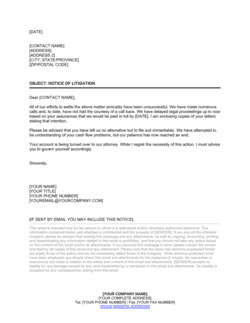
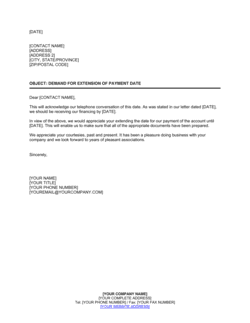
Notice of Impending Litigation After Unproductive Arrangement Template

Free Word download β€’ Edit online β€’ Save & share with Drive β€’ Export to PDF

1 pageβ€’20–25 min to fillβ€’Difficulty: Standard
Learn more ↓
FreeNotice of Impending Litigation After Unproductive Arrangement Template

At a glance

What it is
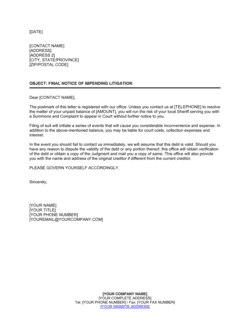
A Notice of Impending Litigation After Unproductive Arrangement is a formal business letter sent when prior attempts to resolve a dispute β€” payment negotiations, informal settlements, or structured arrangements β€” have failed to produce a satisfactory outcome. This free Word download gives you a ready-to-edit template you can customize with the facts of your dispute, export as PDF, and send as a final warning before initiating court proceedings.
When you need it
Use it when a debtor, counterparty, or former business partner has failed to honor a previously agreed arrangement β€” such as a payment plan, settlement, or resolution β€” and all reasonable attempts at negotiation have been exhausted. It signals that legal action will follow unless the recipient acts by a specific deadline.
What's inside
Sender and recipient identification, a factual summary of the prior arrangement and how it failed, a clear statement of the amount owed or obligation unmet, a firm deadline for compliance, and explicit notice that litigation will commence if the deadline is not met.

What is a Notice of Impending Litigation After Unproductive Arrangement?

A Notice of Impending Litigation After Unproductive Arrangement is a formal business letter sent when a prior attempt to resolve a dispute β€” a payment plan, negotiated settlement, or other structured arrangement β€” has failed to produce the agreed outcome. It puts the non-compliant party on written notice that legal proceedings will commence by a specific deadline unless they pay the outstanding sum or fulfill the unmet obligation. Unlike a first-round demand letter, this notice carries the weight of a documented history: the parties already attempted a resolution, and it did not work. That context makes the notice harder to dismiss and strengthens the sender's position in any subsequent litigation.

Why You Need This Document

When an arrangement breaks down, silence is your worst response. Without a formal notice on record, the other party can claim in court that they were never formally warned, that the terms were unclear, or that you accepted the situation by not escalating. This notice closes every one of those arguments. It creates a timestamped, factual record of the failed arrangement, the specific non-compliance, the amount outstanding, and the final opportunity you gave the recipient to make it right. Courts in most jurisdictions expect to see evidence of pre-litigation steps before awarding costs β€” this document provides exactly that. It also has a practical effect well before any lawsuit is filed: a large share of recipients who ignored informal follow-ups will act when they receive a document that uses the word "litigation" and sets a firm date. This template gives you that document in 20 minutes, without a lawyer's invoice attached.

Which variant fits your situation?

If your situation is…Use this template
Dispute over unpaid invoices with no prior arrangementDemand Letter for Payment
Breach of contract with no settlement discussion yet attemptedNotice of Breach of Contract
Failed payment arrangement with a specific dollar amount outstandingNotice of Impending Litigation After Unproductive Arrangement
Final warning before referring matter to a collections agencyFinal Collection Notice
Dispute with a contractor who has not remedied defective workNotice to Cure
Terminating a contract due to ongoing non-performanceNotice of Contract Termination

Common mistakes to avoid

❌ Using vague language about legal action

Why it matters: Phrases like 'may consider pursuing remedies' signal that the sender is not serious, reducing the pressure on the recipient to act before the deadline.

Fix: State explicitly that legal proceedings will commence if the deadline is not met β€” no hedging, no conditional phrasing.

❌ Omitting the prior arrangement details

Why it matters: Without a clear description of what was agreed and how it failed, the recipient can dispute the factual basis of the notice and delay resolution.

Fix: Include the date, terms, and form of the prior arrangement, and attach any supporting documentation such as signed agreements or email confirmations.

❌ Setting an unreasonably short deadline

Why it matters: A deadline of 24–48 hours on a significant claim may be characterized by a court as acting in bad faith, which can prejudice the sender's position.

Fix: Use a 7-to-14-day deadline as the standard range β€” sufficient to demonstrate urgency while remaining defensible if challenged.

❌ Sending the notice to the wrong contact

Why it matters: A notice sent to a general inbox or junior employee rather than the accountable party may not be read by anyone with authority to act, causing the deadline to pass without response.

Fix: Address the notice to the individual or role with authority to authorize payment or compliance, and copy the company's registered address where applicable.

❌ Threatening remedies not available in the jurisdiction

Why it matters: Claiming you will pursue criminal charges for a civil debt, for example, can constitute an unlawful threat and expose the sender to a counterclaim.

Fix: Limit consequences to legally available civil remedies β€” judgment, enforcement of debt, recovery of court costs β€” and avoid characterizing the breach as criminal.

❌ No proof of delivery

Why it matters: If the matter proceeds to litigation, the recipient may claim they never received the notice, undermining the entire pre-litigation paper trail.

Fix: Send the notice by registered mail, courier with signature confirmation, or email with read-receipt, and retain all delivery evidence on file.

The 9 key clauses, explained

Header and parties

In plain language: Identifies the sender and recipient by full legal name and address, and establishes the date the notice was issued.

Sample language
[SENDER FULL NAME / COMPANY NAME] | [ADDRESS] | [DATE] | Addressed to: [RECIPIENT FULL NAME / COMPANY NAME] | [RECIPIENT ADDRESS]

Common mistake: Using a trade name instead of the registered legal entity name β€” this can create enforcement complications if the matter proceeds to court.

Reference to prior arrangement

In plain language: States the date, nature, and key terms of the arrangement that was previously agreed upon between the parties.

Sample language
On [DATE], the parties entered into an arrangement whereby [RECIPIENT NAME] agreed to [DESCRIPTION OF ARRANGEMENT, e.g., pay $[AMOUNT] in monthly instalments of $[X] beginning [DATE]].

Common mistake: Describing the arrangement vaguely or without dates β€” specific details prevent the recipient from claiming the arrangement was different from what is described.

Summary of non-compliance

In plain language: Explains precisely how and when the recipient failed to fulfill the agreed arrangement, including missed payments or specific obligations not met.

Sample language
Notwithstanding the foregoing, [RECIPIENT NAME] has failed to comply with the terms of the arrangement. Specifically, [RECIPIENT NAME] has [missed payments totalling $[AMOUNT] / failed to [SPECIFIC OBLIGATION]] as of [DATE].

Common mistake: Overstating the breach or including disputed facts β€” inaccuracies undermine the credibility of the notice and can be used against the sender in court.

Amount outstanding or obligation unmet

In plain language: States clearly and specifically the total amount owed or the precise obligation that remains unfulfilled as of the date of the notice.

Sample language
As of the date of this notice, the outstanding balance owed by [RECIPIENT NAME] to [SENDER NAME] is $[AMOUNT], inclusive of [any accrued interest / fees / costs as applicable].

Common mistake: Omitting interest or fees that were part of the original agreement β€” understating the amount owed can waive those entitlements.

Final deadline for compliance

In plain language: Sets a specific date β€” typically 7 to 14 days from the notice date β€” by which the recipient must pay or comply to avoid litigation.

Sample language
You are hereby required to remit full payment of $[AMOUNT] / fulfill [OBLIGATION] no later than [SPECIFIC DATE] ('the Deadline').

Common mistake: Setting an unreasonably short deadline β€” courts may view a 24- or 48-hour window as acting in bad faith, particularly for significant sums.

Statement of intent to litigate

In plain language: Explicitly states that failure to meet the deadline will result in the sender filing legal proceedings to recover the amount owed plus costs.

Sample language
If full payment / compliance is not received by the Deadline, [SENDER NAME] will have no alternative but to commence legal proceedings against you without further notice, seeking recovery of the outstanding amount plus court costs and legal fees.

Common mistake: Using conditional or hedged language such as 'may consider legal action' β€” this weakens the notice and reduces the pressure on the recipient to act.

Consequences of litigation

In plain language: Briefly describes what the recipient stands to face if litigation proceeds β€” judgment, credit impact, enforcement costs, and additional liability.

Sample language
Should this matter proceed to litigation, [SENDER NAME] will seek judgment for the full outstanding amount of $[AMOUNT], plus interest at [RATE]% per annum, court filing fees, and reasonable legal costs, all of which may be enforced against you.

Common mistake: Threatening remedies that are not legally available in the applicable jurisdiction β€” this exposes the sender to a counterclaim for unlawful threats.

Contact details and invitation to resolve

In plain language: Provides the sender's contact information and leaves the door open for the recipient to make contact before the deadline to discuss resolution.

Sample language
Should you wish to discuss this matter prior to the Deadline, you may contact [SENDER NAME] at [PHONE NUMBER] / [EMAIL ADDRESS]. This invitation to contact does not extend the Deadline or waive any rights.

Common mistake: Omitting contact details entirely β€” a recipient who wants to pay or resolve the matter but has no way to reach the sender may default to doing nothing.

Closing and sender signature block

In plain language: Closes the letter formally, identifies the sender by name and title, and includes the sender's signature.

Sample language
Yours faithfully, | [SENDER FULL NAME] | [TITLE] | [COMPANY NAME] | [DATE]

Common mistake: Closing with an informal sign-off β€” language like 'Thanks' or 'Best regards' undercuts the formal, legally serious tone of the notice.

How to fill it out

  1. 1

    Enter the sender and recipient details

    Add both parties' full legal names, addresses, and the issue date in the header. Use registered entity names rather than trade names or abbreviations.

    πŸ’‘ If sending on behalf of a company, include your title β€” this establishes that the notice is an official corporate communication, not a personal complaint.

  2. 2

    Describe the prior arrangement with specifics

    Summarize the arrangement that was previously agreed β€” the date it was made, the payment schedule or obligation, and the form it took (written agreement, email exchange, verbal arrangement confirmed in writing).

    πŸ’‘ Attach a copy of the original arrangement to the notice wherever possible β€” it prevents the recipient from disputing the terms described.

  3. 3

    Document the non-compliance clearly

    State exactly which obligations were not met and when the failures occurred. Include specific dates, missed payment amounts, and any prior follow-up attempts you have already made.

    πŸ’‘ Limit this section to documented facts. Avoid characterizations like 'deliberate' or 'fraudulent' unless you are prepared to prove them in court.

  4. 4

    State the total amount outstanding

    Calculate and state the precise sum owed as of the date of the notice, including any interest or fees provided for under the original arrangement.

    πŸ’‘ Show the math β€” principal plus interest plus any applicable fees β€” so the recipient cannot dispute the figure on procedural grounds.

  5. 5

    Set a firm, reasonable deadline

    Insert a specific calendar date for compliance β€” 7 to 14 days from the issue date is typical. Avoid ranges or vague language like 'within a reasonable time.'

    πŸ’‘ For larger amounts or complex obligations, allow 14 days rather than 7 β€” it is harder for a court to view 14 days as bad faith, and it still creates real urgency.

  6. 6

    Review and send by a traceable method

    Proofread the completed notice against your records, then send it by a method that creates a delivery record β€” registered mail, courier, or email with read-receipt or delivery confirmation.

    πŸ’‘ Retain a copy of the sent notice and proof of delivery β€” both will be required if the matter proceeds to litigation.

Frequently asked questions

What is a notice of impending litigation after an unproductive arrangement?

It is a formal business letter sent after a prior agreement β€” such as a payment plan or negotiated settlement β€” has failed to produce the expected result. It notifies the recipient that legal action will commence by a specific deadline unless they pay the outstanding amount or fulfill the unmet obligation. It serves as the final documented step before filing a lawsuit.

When should I send this notice instead of a standard demand letter?

Use this notice specifically when a prior arrangement has already been attempted and has broken down. A standard demand letter is appropriate for a first escalation where no arrangement exists. This notice carries more weight because it establishes a documented history of failed negotiation, which strengthens your position if the matter reaches court.

Does sending this notice guarantee I can sue if the deadline passes?

The notice itself does not create a right to sue β€” your right to litigate arises from the underlying breach of the original agreement. What the notice does is document your attempts to resolve the matter before litigation, which courts typically expect to see. In some jurisdictions, pre-litigation notice is a procedural requirement for certain types of claims, particularly in small claims and civil courts.

How long a deadline should I give in the notice?

Seven to fourteen days is the standard range. A 7-day deadline is appropriate for smaller amounts where urgency is real. A 14-day window is more defensible for larger sums or complex obligations where a court might otherwise question whether the sender acted reasonably. Avoid deadlines shorter than 5 business days on any significant claim.

Does this letter need to be signed or notarized?

No notarization is required for a notice of this type β€” it is a business letter, not a legal instrument. A signature by the sender or an authorized representative of their company is standard practice and reinforces the formal character of the notice, but the letter carries weight based on its contents and delivery rather than any formal execution requirement.

Should I send this notice by email or by post?

The safest approach is to send it by both registered mail and email, retaining proof of each. Registered mail creates a legal delivery record that is difficult to dispute. Email with read-receipt provides speed. Using both ensures that a claim of non-receipt is effectively impossible to sustain and preserves your evidence trail if the matter proceeds to court.

Can I send this notice myself, or do I need a lawyer?

For most straightforward disputes involving unpaid debts or failed payment arrangements, a well-drafted notice from this template is sufficient and does not require a lawyer to prepare or send. Engaging a lawyer to send the notice on their letterhead can increase its psychological impact on the recipient. Consider legal involvement when the amount is significant, the facts are disputed, or the recipient is likely to respond with a counter-claim.

What happens if the recipient ignores the notice?

If the deadline passes without payment or compliance, you have a documented record showing the dispute, the prior arrangement, the non-compliance, and the final warning given β€” all of which support your claim in litigation or small claims court. You can then file proceedings with confidence that you have followed the expected pre-litigation steps and that the recipient had a fair opportunity to resolve the matter.

Is this the same as a cease-and-desist letter?

No. A cease-and-desist letter demands that the recipient stop a particular activity β€” such as infringing intellectual property or making defamatory statements. This notice is focused on compelling payment or fulfillment of a financial or contractual obligation following a failed arrangement. Both are pre-litigation tools, but they address different types of disputes and are structured differently.

How this compares to alternatives

vs Demand Letter for Payment

A demand letter is a first-escalation tool sent when no prior arrangement exists. A notice of impending litigation after an unproductive arrangement is specifically used after a prior resolution attempt has failed, carrying a stronger factual and procedural foundation. Use the demand letter first; use this notice when it has not produced compliance.

vs Notice of Breach of Contract

A breach of contract notice is sent when a party has violated the terms of a formal contract for the first time. This notice is used further down the escalation chain, after a breach has been identified, an arrangement to remedy it was attempted, and that arrangement itself has failed. The breach notice opens the dispute; this notice closes it.

vs Final Collection Notice

A final collection notice is typically an administrative document in a collections workflow, often sent by an accounts-receivable team before handing the account to a collections agency. This notice is a legal escalation document that explicitly threatens court proceedings β€” it carries more formal weight and is more likely to prompt a response from sophisticated counterparties.

vs Contract Termination Letter

A contract termination letter ends the ongoing relationship between parties. This notice does not terminate the contract β€” it demands that the other party fulfill an obligation and signals litigation if they refuse. The two documents may be used in sequence: terminate the contract first, then pursue outstanding amounts with this notice.

Industry-specific considerations

Financial Services and Lending

Used by lenders and credit managers to escalate delinquent borrowers after a payment restructuring has broken down, preserving the audit trail before referring to legal counsel.

Construction and Contracting

Issued by contractors or subcontractors after a client has failed to honor an agreed payment schedule for completed work or materials supplied.

Professional Services

Sent by law firms, consultancies, and agencies when a client has defaulted on a negotiated settlement or extended payment plan for outstanding fees.

Real Estate and Property Management

Used by landlords and property managers after a tenant's arrears repayment plan has collapsed, signaling the next step before commencing eviction or civil proceedings.

Template vs pro β€” what fits your needs?

PathBest forCostTime
Use the templateBusiness owners, freelancers, and AR teams managing straightforward unpaid-debt or failed-arrangement disputes below $10,000Free15–30 minutes
Template + professional reviewDisputes involving amounts over $10,000, complex prior arrangements, or counterparties likely to respond with legal representation$150–$400 for a brief lawyer review before sending1–2 business days
Custom draftedHigh-value commercial disputes, matters where the facts are actively contested, or situations requiring a lawyer's letterhead to maximize impact$400–$1,200 depending on complexity2–5 business days

Glossary

Impending Litigation
A formal warning that a lawsuit will be filed unless the recipient takes a specified corrective action by a set deadline.
Unproductive Arrangement
A prior agreement β€” such as a payment plan or negotiated settlement β€” that failed to produce the intended result because one party did not comply.
Demand Letter
A written notice requesting payment or performance and stating the consequences of non-compliance, sent before filing a lawsuit.
Cure Period
The deadline window given to the recipient to remedy a breach or fulfill an obligation before further legal action is taken.
Breach of Agreement
The failure of a party to meet the obligations they committed to under a contract or arrangement, whether written or verbal.
Cause of Action
The legal basis on which a claimant intends to sue β€” for example, breach of contract, unjust enrichment, or unpaid debt.
Pre-Litigation Notice
Any formal communication sent to a potential defendant before a lawsuit is filed, documenting the dispute and providing a final opportunity to resolve it.
Default
The failure to fulfill a financial or contractual obligation by the date it was due, triggering escalation rights for the other party.
Without Prejudice
A designation on communications indicating they cannot be used as evidence in court, typically applied during settlement negotiations β€” notably absent from this type of notice, which is intended to be on the record.
Costs and Damages
The monetary remedies a claimant may seek in litigation, including the unpaid amount, legal fees, interest, and any consequential losses caused by the breach.

Part of your Business Operating System

This document is one of 3,000+ business & legal templates included in Business in a Box.

  • Fill-in-the-blanks β€” ready in minutes
  • 100% customizable Word document
  • Compatible with all office suites
  • Export to PDF and share electronically

Create your document in 3 simple steps.

From template to signed document β€” all inside one Business Operating System.
1
Download or open template

Access over 3,000+ business and legal templates for any business task, project or initiative.

2
Edit and fill in the blanks with AI

Customize your ready-made business document template and save it in the cloud.

3
Save, Share, Send, Sign

Share your files and folders with your team. Create a space of seamless collaboration.

Save time, save money, and create top-quality documents.

β˜…β˜…β˜…β˜…β˜…

"Fantastic value! I'm not sure how I'd do without it. It's worth its weight in gold and paid back for itself many times."

Managing Director Β· Mall Farm
Robert Whalley
Managing Director, Mall Farm Proprietary Limited
β˜…β˜…β˜…β˜…β˜…

"I have been using Business in a Box for years. It has been the most useful source of templates I have encountered. I recommend it to anyone."

Business Owner Β· 4+ years
Dr Michael John Freestone
Business Owner
β˜…β˜…β˜…β˜…β˜…

"It has been a life saver so many times I have lost count. Business in a Box has saved me so much time and as you know, time is money."

Owner Β· Upstate Web
David G. Moore Jr.
Owner, Upstate Web

Run your business with a system β€” not scattered tools

Stop downloading documents. Start operating with clarity. Business in a Box gives you the Business Operating System used by over 250,000 companies worldwide to structure, run, and grow their business.

Free Forever PlanΒ Β·Β No credit card required