Notice of Intention to Sell Goods After Breach Template

Free Word download β€’ Edit online β€’ Save & share with Drive β€’ Export to PDF

1 pageβ€’15–25 min to fillβ€’Difficulty: Standard
Learn more ↓
FreeNotice of Intention to Sell Goods After Breach Template

At a glance

What it is
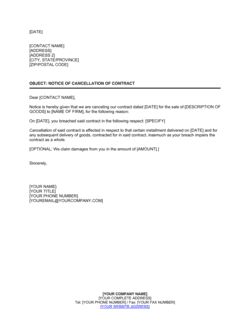
A Notice of Intention to Sell Goods After Breach is a formal business letter a seller sends to a buyer who has defaulted on a purchase agreement β€” typically by failing to pay or failing to collect ordered goods β€” to notify them that the goods will be resold if the breach is not remedied within a specified deadline. This free Word download can be edited online and exported as PDF in minutes.
When you need it
Use it when a buyer has failed to pay for or collect goods by the contractually agreed date and you need to formally preserve your right to resell the goods and claim any resulting loss from the defaulting party.
What's inside
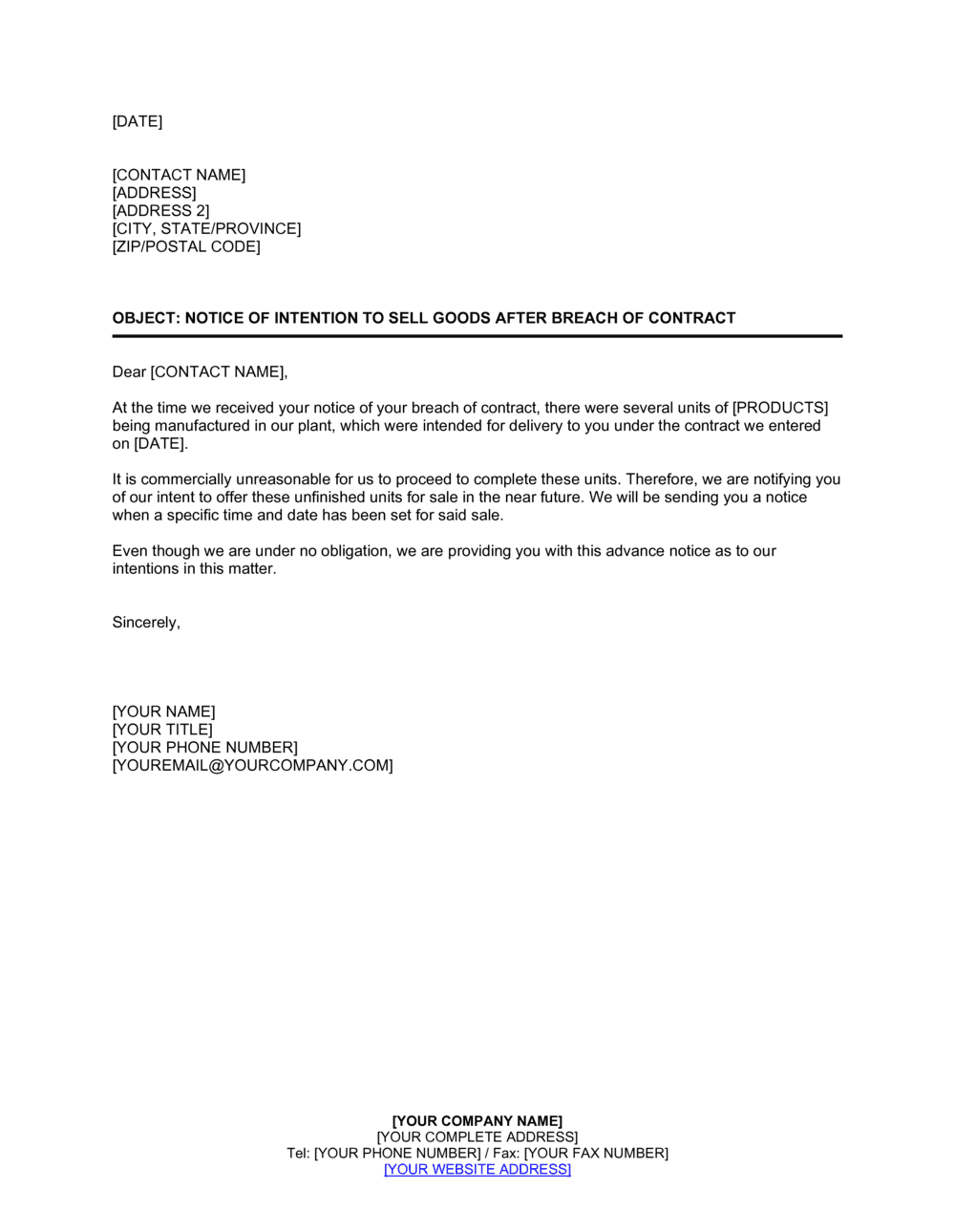
Seller and buyer identification, a reference to the original purchase agreement, a description of the goods and amounts owed, a clear cure deadline, and a statement of the seller's intent to resell and recover any shortfall.

What is a Notice of Intention to Sell Goods After Breach?

A Notice of Intention to Sell Goods After Breach is a formal business letter a seller sends to a buyer who has defaulted on a purchase agreement β€” typically by failing to pay for or collect goods by the contractually agreed date. The notice informs the buyer that the seller intends to resell the goods to a third party if the breach is not remedied within a stated deadline, and that the buyer will remain liable for any shortfall between the original contract price and the resale price. It is a procedural step that both protects the seller's right to recover losses and gives the buyer a final, documented opportunity to cure before the seller acts.

Why You Need This Document

Reselling goods held for a defaulting buyer without proper notice exposes you to a counterclaim that you acted prematurely or failed to give the buyer a reasonable chance to perform. A formal written notice establishes the timeline on record, satisfies the procedural requirements that many jurisdictions impose before a seller can exercise resale remedies, and explicitly preserves your right to recover the deficiency and resale costs. Without it, recovering the gap between the contract price and a lower resale price becomes significantly harder β€” a buyer's lawyer will argue you had no documented basis to sell. This template gives you a complete, professionally worded notice you can issue in minutes, with every essential clause in place.

Which variant fits your situation?

If your situation is…Use this template
Buyer has not paid and has not collected the goodsNotice of Intention to Sell Goods After Breach
Buyer has paid but refuses to accept deliveryNotice of Rejection of Goods
Buyer has partially paid and you wish to recover the balanceDemand Letter for Payment
Buyer has already defaulted and goods have been resold at a lossClaim for Damages After Resale
You want to formally terminate the purchase agreement entirelyNotice of Termination of Contract
Goods are perishable and you need to act without a cure periodImmediate Notice of Resale (Perishable Goods)

Common mistakes to avoid

❌ Vague description of the breach

Why it matters: A notice that fails to specify which obligation was breached and when it was due gives the buyer grounds to ignore or dispute the notice, undermining your remedies.

Fix: State the exact obligation, the contractual due date, and the amounts outstanding. Quote directly from the purchase order or agreement where possible.
❌ Too-short cure period

Why it matters: A cure window of fewer than 7 days in a commercial context may be treated as procedurally inadequate, weakening your right to claim resale costs and deficiency.

Fix: Allow 7 to 14 business days as a minimum cure period unless the contract explicitly specifies a shorter window or the goods are perishable.

❌ Omitting the reservation of rights clause

Why it matters: Without it, the buyer may argue that issuing this notice constitutes an election of remedy, preventing you from pursuing additional claims such as consequential damages.

Fix: Always include a standard 'without prejudice to other rights and remedies' clause before the closing of the letter.

❌ Sending the notice to the wrong contact

Why it matters: A notice sent to a project manager or salesperson instead of the buyer's legal or accounts-payable department may not be treated as formal notice, restarting the clock.

Fix: Address the notice to the buyer's registered office or the contact designated for legal notices in the original agreement, and copy accounts payable.

The 9 key clauses, explained

Header and parties identification

In plain language: Identifies the sender (seller) and recipient (buyer) with full legal names, addresses, and the date of the notice.

Sample language
[SELLER COMPANY NAME] | [SELLER ADDRESS] | [DATE] | To: [BUYER FULL LEGAL NAME] | [BUYER ADDRESS]

Common mistake: Using a trading name instead of the buyer's registered legal entity name β€” this creates enforceability problems if you later pursue the deficiency in court.

Subject line and reference

In plain language: States the purpose of the letter and references the original purchase agreement or order number so the recipient can immediately identify the transaction.

Sample language
Re: Notice of Intention to Sell Goods β€” Purchase Order No. [PO NUMBER] dated [DATE] / Agreement dated [DATE]

Common mistake: Omitting the original agreement reference number. Without it, the buyer may claim confusion, delaying any cure or response.

Statement of the breach

In plain language: Clearly sets out the specific obligation the buyer has failed to meet β€” payment, collection, or both β€” including the amounts owed and the dates by which obligations were due.

Sample language
As of [DATE], you have failed to [pay the sum of $[AMOUNT] / collect the goods described below] in accordance with the terms of the above-referenced agreement, which required [PAYMENT / COLLECTION] by [DUE DATE].

Common mistake: Being vague about the nature of the breach. A notice that says 'you have not fulfilled your obligations' without stating which obligation and which deadline is too imprecise to trigger a cure obligation.

Description of the goods

In plain language: Identifies the specific goods at issue β€” description, quantity, unit price, and total contract value β€” so there is no dispute about what is being held and what will be resold.

Sample language
The goods subject to this notice are: [DESCRIPTION OF GOODS], Quantity: [X] units, Unit Price: $[X], Total Contract Value: $[AMOUNT].

Common mistake: Using a generic description like 'the goods ordered.' If the buyer disputes which goods are involved, a vague description undermines your notice.

Cure period and deadline

In plain language: Gives the buyer a specific number of days to remedy the breach β€” typically 7 to 14 days from the date of the notice β€” before the seller proceeds to resell.

Sample language
Unless you remedy the above breach by [DATE] (being [X] days from the date of this notice) by [paying the outstanding amount in full / collecting the goods], we will proceed to sell the goods to a third party.

Common mistake: Setting an unrealistically short cure period β€” fewer than 7 days for a commercial transaction β€” which some courts treat as procedurally inadequate and which weakens your damages claim.

Statement of intention to resell

In plain language: Formally declares the seller's intent to resell the goods on or after the deadline if the breach is not cured, preserving the seller's right to recover any resulting shortfall.

Sample language
In the event the breach is not remedied by the above deadline, [SELLER COMPANY NAME] hereby gives notice of its intention to resell the goods described above and to hold you liable for any deficiency between the resale price and the original contract price, plus reasonable costs of resale.

Common mistake: Failing to mention recovery of resale costs. Sellers who omit this often cannot later claim storage, remarketing, or transaction costs from the defaulting buyer.

Reservation of rights

In plain language: States that sending this notice does not waive any other remedies the seller may have under the contract or applicable law.

Sample language
This notice is given without prejudice to any other rights or remedies available to [SELLER COMPANY NAME] under the agreement or at law, all of which are expressly reserved.

Common mistake: Omitting this clause entirely. Without a reservation of rights, the buyer may argue that issuing this notice was an election of remedy that bars the seller from pursuing other claims.

Contact details and response instruction

In plain language: Tells the buyer exactly who to contact and how to cure the breach β€” payment method, collection logistics, or both β€” removing any practical excuse for non-response.

Sample language
To remedy this breach, please contact [CONTACT NAME] at [EMAIL] / [PHONE] no later than [DATE]. Payment should be made by [PAYMENT METHOD] to [ACCOUNT DETAILS / ADDRESS].

Common mistake: Providing only an email address with no fallback. If the email bounces or goes unread, the seller has no record of a meaningful attempt to offer the buyer a path to cure.

Closing and sender signature block

In plain language: Closes the letter formally with the sender's name, title, and company, providing a clear record of who issued the notice and on whose authority.

Sample language
Yours faithfully, [AUTHORIZED SIGNATORY NAME] | [TITLE] | [SELLER COMPANY NAME] | [DATE]

Common mistake: Signing with an illegible signature and no printed name or title. If the notice is later relied upon in a dispute, the sender must be clearly identifiable.

How to fill it out

  1. 1

    Enter seller and buyer legal details

    Add the seller's full registered company name and address at the top, then address the letter to the buyer's full legal entity name and registered or last known address.

    πŸ’‘ Verify the buyer's legal name against the original signed purchase order or contract β€” trade names and legal entity names often differ.

  2. 2

    Reference the original agreement

    Insert the purchase order number, agreement date, or both in the subject line so the buyer can immediately identify the transaction in dispute.

    πŸ’‘ If you have multiple outstanding orders from the same buyer, issue a separate notice for each to keep the paper trail clean.

  3. 3

    Describe the breach precisely

    State the specific obligation breached, the amount owed or the collection deadline missed, and the exact date by which performance was due.

    πŸ’‘ Pull the exact due date from the signed contract or PO β€” quoting the wrong date gives the buyer an easy rebuttal.

  4. 4

    Itemize the goods

    List each product with its description, quantity, unit price, and total contract value. Attach a copy of the original purchase order as an exhibit if the goods list is lengthy.

    πŸ’‘ Matching the goods description exactly to the language in the purchase order eliminates any scope for the buyer to claim the notice refers to different goods.

  5. 5

    Set the cure deadline

    Insert a specific calendar date β€” typically 7 to 14 days from the date you send the notice β€” by which the buyer must pay or collect.

    πŸ’‘ Send the notice by a tracked method (courier, registered mail, or email with read receipt) so you have documented proof of the date of receipt.

  6. 6

    State resale intent and deficiency claim

    Confirm that failure to cure by the deadline will result in resale and that the buyer remains liable for any shortfall between the resale price and the original contract price plus resale costs.

    πŸ’‘ Keep a detailed record of resale marketing efforts and actual sale price β€” this documentation is essential if you later sue for the deficiency.

  7. 7

    Add contact details for the cure

    Provide the name, email, and phone number of the person the buyer should contact to arrange payment or collection, along with specific payment instructions.

    πŸ’‘ Include at least two contact methods so the buyer cannot later claim they had no way to respond.

Frequently asked questions

What is a notice of intention to sell goods after breach?

It is a formal letter a seller sends to a buyer who has defaulted on a purchase contract β€” by failing to pay or collect ordered goods β€” to notify them that the goods will be resold unless the breach is remedied within a stated deadline. It documents the seller's intent, preserves the right to recover any resale shortfall, and gives the buyer a final opportunity to cure before the seller acts.

When should I send this notice?

Send it as soon as the buyer's payment or collection deadline has passed and you have confirmed the breach is not a simple administrative delay. The earlier you issue the notice, the sooner the cure period begins and the sooner you can act β€” important when goods are deteriorating, taking up storage space, or needed for other customers.

Is a cure period legally required before I can resell the goods?

In most commercial contexts, giving the buyer reasonable notice and a cure opportunity before reselling is considered best practice and strengthens your legal position. The required period varies by jurisdiction and contract terms, but 7 to 14 days is widely accepted for non-perishable goods. Always check your original contract for any specified notice requirements before acting.

Can I recover the difference if I resell the goods at a lower price?

Yes, in most jurisdictions a seller who resells goods after a buyer's breach can claim the deficiency β€” the difference between the original contract price and the resale price β€” plus reasonable resale costs such as storage, remarketing, and transaction fees. The notice should explicitly state this intention to preserve the claim.

Does sending this notice end the original contract?

Not automatically. This notice declares your intention to resell and recover losses β€” it does not necessarily terminate all obligations under the original agreement. Include a reservation of rights clause to make clear you are not waiving other contractual remedies. If you also want to terminate the contract, issue a separate notice of termination.

Does the notice need to be signed to be valid?

A wet signature is not strictly required for most commercial notices of this type, but the notice should clearly identify the authorized sender β€” full name, title, and company β€” to be taken seriously and to support any subsequent legal action. Sending it from a business email address with a named signatory is sufficient in most cases.

What records should I keep after sending this notice?

Keep a copy of the notice, proof of delivery (tracked courier receipt, read-receipt confirmation, or registered mail certificate), the original purchase order or agreement, and all subsequent resale documentation including marketing efforts, offers received, and the final sale price. This paper trail is essential if you later pursue the deficiency in court.

Can I use this notice for perishable goods?

This template suits non-perishable or standard commercial goods. For perishable goods, a shorter or even immediate-resale notice may be warranted to satisfy your mitigation obligation. Consider consulting a lawyer or using a specialist template designed for perishable goods if the situation is time-critical.

How this compares to alternatives

vs Demand Letter for Payment

A demand letter requests payment of an outstanding debt but does not address what happens to physical goods the seller is holding. A notice of intention to sell goods after breach specifically covers the resale of those goods and the recovery of any deficiency. Use a demand letter when the buyer has received the goods but not paid; use this notice when the goods are still with the seller.

vs Notice of Termination of Contract

A termination notice ends the contractual relationship entirely and typically triggers wind-down obligations on both sides. This notice is narrower β€” it addresses the specific remedy of reselling held goods without necessarily terminating all other contract terms. Where both remedies are needed, issue this notice first, then follow with a termination notice.

vs Breach of Contract Letter

A general breach of contract letter documents the breach and demands remedy but does not commit the sender to any specific action regarding goods. The notice of intention to sell is more specific: it states exactly what will happen to the goods if the breach is not cured, making it operationally actionable rather than just a formal complaint.

vs Collection Letter

A collection letter is a soft-to-firm sequence aimed at recovering a debt, typically without mentioning what happens to physical goods. This notice is a single, decisive document that signals a specific legal remedy β€” resale β€” rather than a graduated request for payment. It is appropriate when the debt is secured by goods the seller still holds.

Industry-specific considerations

Wholesale and Distribution

High-volume orders and thin margins make rapid resale critical; this notice triggers the clock so goods can be remarketed before market prices shift.

Manufacturing

Custom-manufactured goods with limited alternative buyers make the deficiency claim especially important β€” the notice preserves that right from the outset.

Retail and E-commerce

Seasonal inventory and storage constraints mean a prompt notice and short cure window reduce both financial loss and warehousing costs.

Construction and Building Materials

Large-value material orders where buyer insolvency is a risk benefit from a formal notice that clearly establishes the seller's priority claim to resale proceeds.

Template vs pro β€” what fits your needs?

PathBest forCostTime
Use the templateBusinesses issuing a standard commercial resale notice for non-perishable goods under an ordinary purchase agreementFree10–15 minutes
Template + professional reviewHigher-value transactions, custom-manufactured goods, or buyers showing signs of insolvency$100–$300 for a solicitor or commercial lawyer review1–2 business days
Custom draftedComplex multi-party supply chains, international buyers, or situations where litigation is already anticipated$500–$1,500+3–5 business days

Glossary

Breach of Contract
A failure by one party to fulfil an obligation set out in a binding agreement, such as failing to pay for or collect goods by the agreed date.
Cure Period
A defined window of time given to the breaching party to remedy their default before the other party exercises a contractual remedy.
Resale
The seller's act of selling goods to a third party after the original buyer defaults, typically to mitigate the seller's financial loss.
Mitigation of Loss
The legal obligation on an injured party to take reasonable steps to reduce the damage caused by the other party's breach.
Deficiency
The shortfall between the original contract price and the amount recovered on resale, which the defaulting buyer typically remains liable for.
Purchase Order (PO)
A buyer-issued document authorizing a purchase at agreed price and quantity, which forms the basis of the seller's contractual claim.
Lien
A legal right a seller may hold over goods in their possession as security for an unpaid debt owed by the buyer.
Liquidated Damages
A pre-agreed sum specified in the contract that represents the parties' estimate of loss in the event of a defined breach.
Notice in Writing
A formal communication that creates a documented record of a legal action or intention, typically required before exercising a remedy.
Seller's Remedies
The legal options available to a seller when a buyer breaches a sales contract, including withholding delivery, reselling goods, and claiming damages.

Part of your Business Operating System

This document is one of 3,000+ business & legal templates included in Business in a Box.

  • Fill-in-the-blanks β€” ready in minutes
  • 100% customizable Word document
  • Compatible with all office suites
  • Export to PDF and share electronically

Create your document in 3 simple steps.

From template to signed document β€” all inside one Business Operating System.
1
Download or open template

Access over 3,000+ business and legal templates for any business task, project or initiative.

2
Edit and fill in the blanks with AI

Customize your ready-made business document template and save it in the cloud.

3
Save, Share, Send, Sign

Share your files and folders with your team. Create a space of seamless collaboration.

Save time, save money, and create top-quality documents.

β˜…β˜…β˜…β˜…β˜…

"Fantastic value! I'm not sure how I'd do without it. It's worth its weight in gold and paid back for itself many times."

Managing Director Β· Mall Farm
Robert Whalley
Managing Director, Mall Farm Proprietary Limited
β˜…β˜…β˜…β˜…β˜…

"I have been using Business in a Box for years. It has been the most useful source of templates I have encountered. I recommend it to anyone."

Business Owner Β· 4+ years
Dr Michael John Freestone
Business Owner
β˜…β˜…β˜…β˜…β˜…

"It has been a life saver so many times I have lost count. Business in a Box has saved me so much time and as you know, time is money."

Owner Β· Upstate Web
David G. Moore Jr.
Owner, Upstate Web

Run your business with a system β€” not scattered tools

Stop downloading documents. Start operating with clarity. Business in a Box gives you the Business Operating System used by over 250,000 companies worldwide to structure, run, and grow their business.

Start freeΒ Β·Β No credit card required