Notice of Credit Limit Template

Free Word download β€’ Edit online β€’ Save & share with Drive β€’ Export to PDF

1 pageβ€’15–20 min to fillβ€’Difficulty: Standard
Learn more ↓
FreeNotice of Credit Limit Template

At a glance

What it is
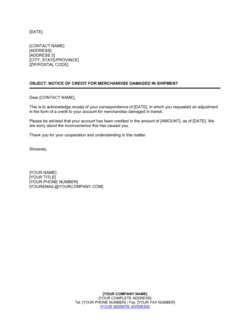
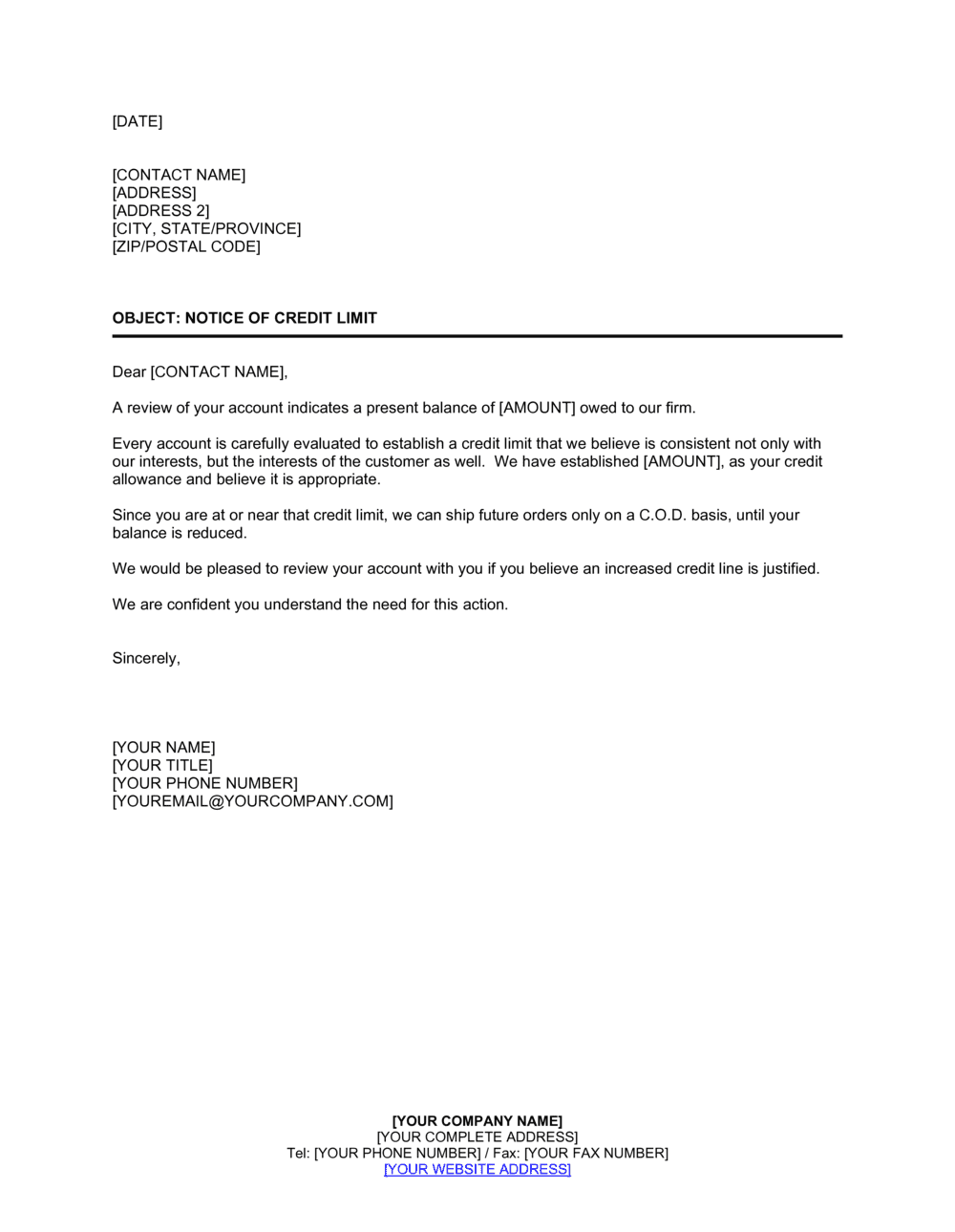
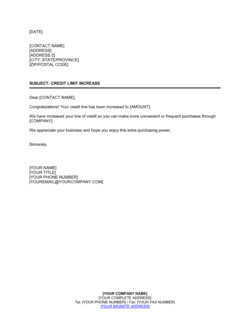
A Notice of Credit Limit is a formal business letter a supplier or creditor sends to a customer to communicate the approved credit amount extended to that customer's account. This template is a free Word download you can edit online and export as PDF β€” covering the credit amount, payment terms, effective date, and any conditions attached to the credit facility.
When you need it
Use it when onboarding a new business customer on open-account terms, when revising an existing customer's credit limit upward or downward, or when formally confirming a credit decision made after a credit review.
What's inside
Sender and recipient details, account reference, the approved credit limit amount, effective date, applicable payment terms, any conditions or restrictions on the credit, and a closing that invites the customer to contact you with questions.

What is a Notice of Credit Limit?

A Notice of Credit Limit is a formal business letter issued by a supplier, creditor, or vendor to a customer that communicates the approved maximum balance the customer is permitted to carry on open-account trading terms. It records the credit ceiling in writing, establishes the effective date, and specifies the payment terms that govern the account β€” creating a clear, documented record of the credit arrangement for both parties. Unlike a credit application, which the customer completes to request credit, the notice of credit limit is the creditor's formal response confirming what has been approved and under what conditions.

Why You Need This Document

Operating open-account trade credit without a written notice exposes your business to disputes over terms, order hold disagreements, and collections complications. When a customer's balance approaches their limit and you place new orders on hold, they will argue the limit was never communicated β€” and without a dated, signed-off letter in the file, that argument has traction. A notice of credit limit eliminates that ambiguity by putting the approved amount, effective date, and payment terms on paper before the first invoice is issued. It also gives you a clean audit trail for credit reviews, supports your accounts receivable team when escalating overdue accounts, and signals to customers that your credit function is managed professionally β€” which itself reduces late payment rates.

Which variant fits your situation?

If your situation is…Use this template
Informing a new customer of their initial approved credit limitNotice of Credit Limit (New Account)
Reducing a customer's credit limit due to late payments or riskNotice of Credit Limit Reduction
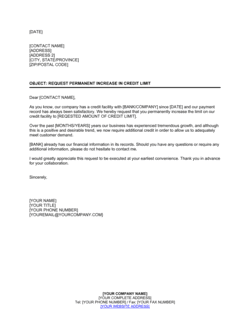
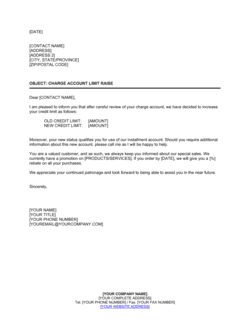
Increasing a customer's credit limit after positive payment historyNotice of Credit Limit Increase
Suspending credit and requiring prepayment for future ordersNotice of Credit Suspension
Formally placing a delinquent account on holdCredit Hold Notice
Notifying a customer that credit has been declined entirelyCredit Denial Letter

Common mistakes to avoid

❌ Omitting the effective date

Why it matters: Without a stated effective date, there is no clear record of when the credit limit became active. This creates ambiguity in credit reviews and complicates dispute resolution.

Fix: Always include the specific calendar date the limit takes effect β€” typically the date the letter is issued or the date the account was approved.
❌ Using vague payment terms

Why it matters: Phrases like 'payment due promptly' or 'per our standard terms' are interpreted inconsistently and give the customer no clear deadline to work with.

Fix: State the exact number of days β€” 'Net 30 from invoice date' β€” and the late-payment interest rate, so the terms are unambiguous on the face of the letter.

❌ Sending to the wrong contact

Why it matters: A notice sent to a sales contact instead of the accounts payable department may sit unread until an order is placed on hold, creating friction and goodwill damage.

Fix: Confirm the accounts payable contact name and email address before issuing the letter, and copy the primary commercial contact as well.

❌ Not retaining a copy in the customer file

Why it matters: If a customer later disputes the terms of their credit arrangement or a collections matter arises, a missing notice letter weakens your documentation trail significantly.

Fix: Save a dated, final PDF of every notice issued to each customer's account file, alongside their credit application and any subsequent adjustment letters.

The 8 key clauses, explained

Sender and recipient header

In plain language: Identifies the creditor (sender) and the customer (recipient) with full legal names, addresses, account numbers, and the letter date.

Sample language
[COMPANY NAME] | [ADDRESS] | [CITY, STATE, ZIP] | Date: [DATE] | To: [CUSTOMER LEGAL NAME] | Account No.: [ACCOUNT NUMBER]

Common mistake: Using a trade or brand name instead of the customer's registered legal entity name β€” this weakens the document's value as a formal record if a dispute over the credit arrangement arises later.

Subject line and reference

In plain language: A concise subject line that tells the recipient exactly what the letter is about before they read the body.

Sample language
Re: Notice of Credit Limit β€” Account No. [ACCOUNT NUMBER]

Common mistake: Omitting the account number from the subject line. Without it, customers with multiple accounts cannot immediately identify which account the notice applies to.

Opening statement

In plain language: States the purpose of the letter clearly in the first sentence β€” that a credit limit has been approved and applied to the customer's account.

Sample language
We are pleased to inform you that [COMPANY NAME] has approved a credit limit of $[AMOUNT] on your account effective [EFFECTIVE DATE].

Common mistake: Burying the credit amount several paragraphs in. The limit is the most important piece of information β€” state it in the first sentence.

Credit limit amount and effective date

In plain language: States the approved credit ceiling in figures and in words, and the exact date from which it takes effect.

Sample language
Your approved credit limit is [AMOUNT IN WORDS] ($[AMOUNT IN FIGURES]) effective [DATE].

Common mistake: Stating only the dollar figure without the effective date. Without a date, there is no clear record of when the limit became active, complicating future credit reviews or disputes.

Payment terms

In plain language: Specifies how and when invoices must be paid β€” the standard terms the customer must meet to keep the credit facility in good standing.

Sample language
All invoices issued against this account are payable within [NET 30 / NET 60] days of the invoice date. Balances unpaid after [X] days will accrue interest at [RATE]% per month.

Common mistake: Referencing 'standard terms' without specifying them. Customers and internal teams need the exact payment window in the letter itself β€” not a pointer to a separate document they may not have.

Conditions and restrictions

In plain language: Lists any conditions attached to the credit β€” such as annual review requirements, required financial disclosures, or restrictions on the types of goods covered.

Sample language
This credit limit is subject to annual review and may be adjusted at [COMPANY NAME]'s discretion. The credit facility applies to purchases of [PRODUCT/SERVICE CATEGORY] only and does not extend to [EXCLUSIONS, IF ANY].

Common mistake: Omitting conditions entirely when conditions exist. If the credit is subject to annual review or restricted to certain product lines, stating that in writing protects the creditor's right to adjust or revoke the limit without notice.

Consequences of exceeding the limit

In plain language: Explains what happens if the customer's outstanding balance exceeds the approved limit β€” typically, new orders are held until the balance is reduced.

Sample language
Orders that would cause your outstanding balance to exceed $[AMOUNT] will be placed on hold pending payment sufficient to bring your balance within the approved limit.

Common mistake: Leaving this clause out on the assumption it is understood. Without explicit written notice, customers may dispute an order hold as arbitrary.

Closing and contact information

In plain language: Invites the customer to contact the sender with questions and provides a named contact, phone number, and email address.

Sample language
If you have any questions regarding your account or credit terms, please contact [NAME] at [PHONE] or [EMAIL]. We look forward to a continued business relationship.

Common mistake: Signing off with a generic 'contact us' and no named individual. A named contact reduces inbound confusion and signals professional account management.

How to fill it out

  1. 1

    Enter your company's details in the header

    Add your company's legal name, mailing address, phone number, and the date you are issuing the letter. These appear at the top of the letter.

    πŸ’‘ Use the same legal entity name that appears on your invoices and account agreements so records align.

  2. 2

    Add the customer's legal name and account number

    Enter the customer's registered business name, billing address, and their account number in your system. Confirm the legal name matches your credit application on file.

    πŸ’‘ Pull the legal name directly from the customer's credit application or trade reference form β€” never rely on what appears on email signatures.

  3. 3

    State the approved credit limit and effective date

    Enter the approved limit in both figures and words, and confirm the exact date it takes effect. Both formats reduce the risk of misreading.

    πŸ’‘ Set the effective date to the date you send the letter or the date the account was approved β€” not a retroactive date β€” to keep your records clean.

  4. 4

    Specify the payment terms

    State the exact number of days the customer has to pay each invoice (e.g., Net 30) and any late-payment interest rate you apply after the due date.

    πŸ’‘ If your payment terms differ from your standard terms for this customer β€” due to risk or volume β€” note that explicitly so it does not conflict with your invoice template.

  5. 5

    Add any conditions or restrictions

    Include any conditions tied to the credit β€” annual review dates, required financial statement submissions, or product-category restrictions. If there are none, delete this paragraph.

    πŸ’‘ Even a simple 'subject to annual review' clause gives you documented flexibility to adjust the limit without creating a breach-of-agreement argument.

  6. 6

    Add closing contact details and send

    Name the specific person responsible for this account, their direct phone number, and email. Export the letter as PDF and send by email with a read-receipt request, or post by recorded mail for formal purposes.

    πŸ’‘ Retain the signed-off version in your accounts receivable file alongside the customer's credit application β€” you may need both if the account ever goes to collections.

Frequently asked questions

What is a notice of credit limit?

A notice of credit limit is a formal business letter from a supplier or creditor to a customer that states the maximum balance the customer is permitted to carry on open-account terms. It documents the approved credit amount, the effective date, the payment terms that apply, and any conditions attached to the credit facility. It functions as both a customer communication and an internal records document.

When should I send a notice of credit limit?

Send it when approving a new customer for open-account trading, when increasing or decreasing an existing customer's limit following a credit review, or when formalizing credit terms that were previously agreed verbally or informally. Any time the credit amount or payment terms change, a new notice should be issued and retained in the customer's file.

Is a notice of credit limit legally binding?

A notice of credit limit is not a contract in itself, but it is a formal record of a credit decision that can be referenced in billing disputes, collections proceedings, or account reviews. When paired with a signed credit application or trade account agreement, it strengthens the creditor's documented position on the terms extended to the customer.

What payment terms should I include in the notice?

State the exact payment window β€” Net 30, Net 45, or Net 60 from invoice date are the most common for B2B trade credit. Include the late-payment interest rate or fee if you apply one. Avoid vague language like 'due on receipt' or 'per standard terms' β€” spell out the specific number of days on the face of the letter so there is no ambiguity.

Can I reduce a customer's credit limit without notice?

In most jurisdictions, a creditor can reduce or revoke a trade credit limit at their discretion unless a signed agreement states otherwise. However, providing written notice before the reduction takes effect is strongly recommended β€” it gives the customer a fair opportunity to manage their orders, reduces disputes, and maintains the business relationship. Sudden, unannounced reductions are a common source of customer complaints.

How is a notice of credit limit different from a credit application?

A credit application is filled out by the customer requesting credit β€” it captures their business details, financial references, and authorized signatures. A notice of credit limit is the supplier's response, communicating the credit decision and terms. The application initiates the process; the notice closes it and should be issued after every approved credit decision.

What happens if a customer exceeds their credit limit?

Typically, new orders are placed on hold until the customer makes payment sufficient to bring their outstanding balance back within the approved limit. Your notice of credit limit should state this consequence explicitly so the customer is aware of it in advance and cannot claim the hold was unexpected or arbitrary.

Should I send the notice by email or post?

Email with a PDF attachment is standard for most B2B trade credit notices and is faster than postal mail. For high-value credit limits or customers with a history of disputed communications, sending by recorded mail or courier provides a stronger delivery record. Regardless of method, retain a dated copy in the customer's account file.

How this compares to alternatives

vs Credit Application Form

A credit application is completed by the customer to request credit β€” it captures business details, trade references, and authorized signatures. A notice of credit limit is the supplier's formal response communicating the approved amount and terms. The application comes first; the notice follows every approved credit decision.

vs Past Due Notice

A past due notice is sent after the fact when a customer has failed to pay within agreed terms. A notice of credit limit is sent proactively when credit is approved or changed. One sets the terms; the other enforces them. Both should reference the same account number and payment terms.

vs Credit Hold Notice

A credit hold notice suspends a customer's credit facility due to an overdue balance or risk event. A notice of credit limit establishes or updates the credit ceiling under normal operating conditions. The credit limit notice defines the facility; the credit hold suspends it.

vs Collection Letter

A collection letter demands payment on an overdue invoice and may reference escalation steps. A notice of credit limit is a proactive communication sent at account setup or after a credit review β€” before any payment problem exists. A well-issued credit limit notice reduces the need for collection letters by setting clear expectations upfront.

Industry-specific considerations

Wholesale and Distribution

Wholesalers routinely issue credit limit notices to retailers and resellers before the first shipment to formalize open-account arrangements and reduce overdue balance risk.

Manufacturing

Manufacturers use credit limit notices to manage exposure across large customer bases, particularly when selling to smaller buyers who place recurring orders against annual credit facilities.

Professional Services

Agencies and consultancies that bill in arrears use credit limit notices to cap unbilled exposure on retainer clients and set clear collection expectations from the start of an engagement.

Retail and E-commerce

B2B retailers extending trade credit to corporate buyers or resellers issue credit limit notices to document approved balances and avoid disputes over account holds during peak ordering periods.

Template vs pro β€” what fits your needs?

PathBest forCostTime
Use the templateAny business extending trade credit to B2B customers on standard open-account termsFree5–10 minutes per letter
Template + professional reviewBusinesses with large credit exposures or customers in regulated industries requiring bespoke terms$100–$300 (accountant or credit manager review)1–2 hours
Custom draftedHigh-value institutional credit arrangements with complex conditions, covenants, or cross-border terms$500–$2,000+ (legal or credit specialist)1–5 days

Glossary

Credit Limit
The maximum outstanding balance a supplier will allow a customer to carry on open-account terms at any one time.
Open-Account Terms
A trade arrangement in which goods or services are delivered before payment, with the buyer invoiced for payment within an agreed period.
Payment Terms
The conditions under which a buyer must settle an invoice β€” for example, Net 30, meaning full payment is due 30 days from the invoice date.
Trade Credit
Short-term credit extended by a supplier to a business customer, allowing the customer to purchase now and pay later.
Credit Review
A periodic reassessment of a customer's creditworthiness β€” based on payment history, financial condition, and order volume β€” used to adjust credit limits.
Effective Date
The specific calendar date from which the stated credit limit applies to the customer's account.
Accounts Receivable
Money owed to a business by its customers for goods or services already delivered but not yet paid for.
Credit Hold
A temporary suspension of a customer's credit facility, typically triggered by overdue balances or a deterioration in creditworthiness.
Days Sales Outstanding (DSO)
The average number of days it takes a business to collect payment after a sale, used to measure the efficiency of credit and collections.

Part of your Business Operating System

This document is one of 3,000+ business & legal templates included in Business in a Box.

  • Fill-in-the-blanks β€” ready in minutes
  • 100% customizable Word document
  • Compatible with all office suites
  • Export to PDF and share electronically

Create your document in 3 simple steps.

From template to signed document β€” all inside one Business Operating System.
1
Download or open template

Access over 3,000+ business and legal templates for any business task, project or initiative.

2
Edit and fill in the blanks with AI

Customize your ready-made business document template and save it in the cloud.

3
Save, Share, Send, Sign

Share your files and folders with your team. Create a space of seamless collaboration.

Save time, save money, and create top-quality documents.

β˜…β˜…β˜…β˜…β˜…

"Fantastic value! I'm not sure how I'd do without it. It's worth its weight in gold and paid back for itself many times."

Managing Director Β· Mall Farm
Robert Whalley
Managing Director, Mall Farm Proprietary Limited
β˜…β˜…β˜…β˜…β˜…

"I have been using Business in a Box for years. It has been the most useful source of templates I have encountered. I recommend it to anyone."

Business Owner Β· 4+ years
Dr Michael John Freestone
Business Owner
β˜…β˜…β˜…β˜…β˜…

"It has been a life saver so many times I have lost count. Business in a Box has saved me so much time and as you know, time is money."

Owner Β· Upstate Web
David G. Moore Jr.
Owner, Upstate Web

Run your business with a system β€” not scattered tools

Stop downloading documents. Start operating with clarity. Business in a Box gives you the Business Operating System used by over 250,000 companies worldwide to structure, run, and grow their business.

Free Forever PlanΒ Β·Β No credit card required