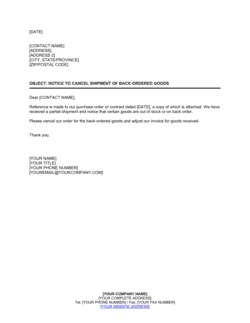
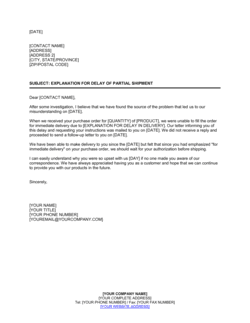
Notice of Receipt on Incomplete Shipment Template

Free Word download β€’ Edit online β€’ Save & share with Drive β€’ Export to PDF

1 pageβ€’15–25 min to fillβ€’Difficulty: Standard
Learn more ↓
FreeNotice of Receipt on Incomplete Shipment Template

At a glance

What it is
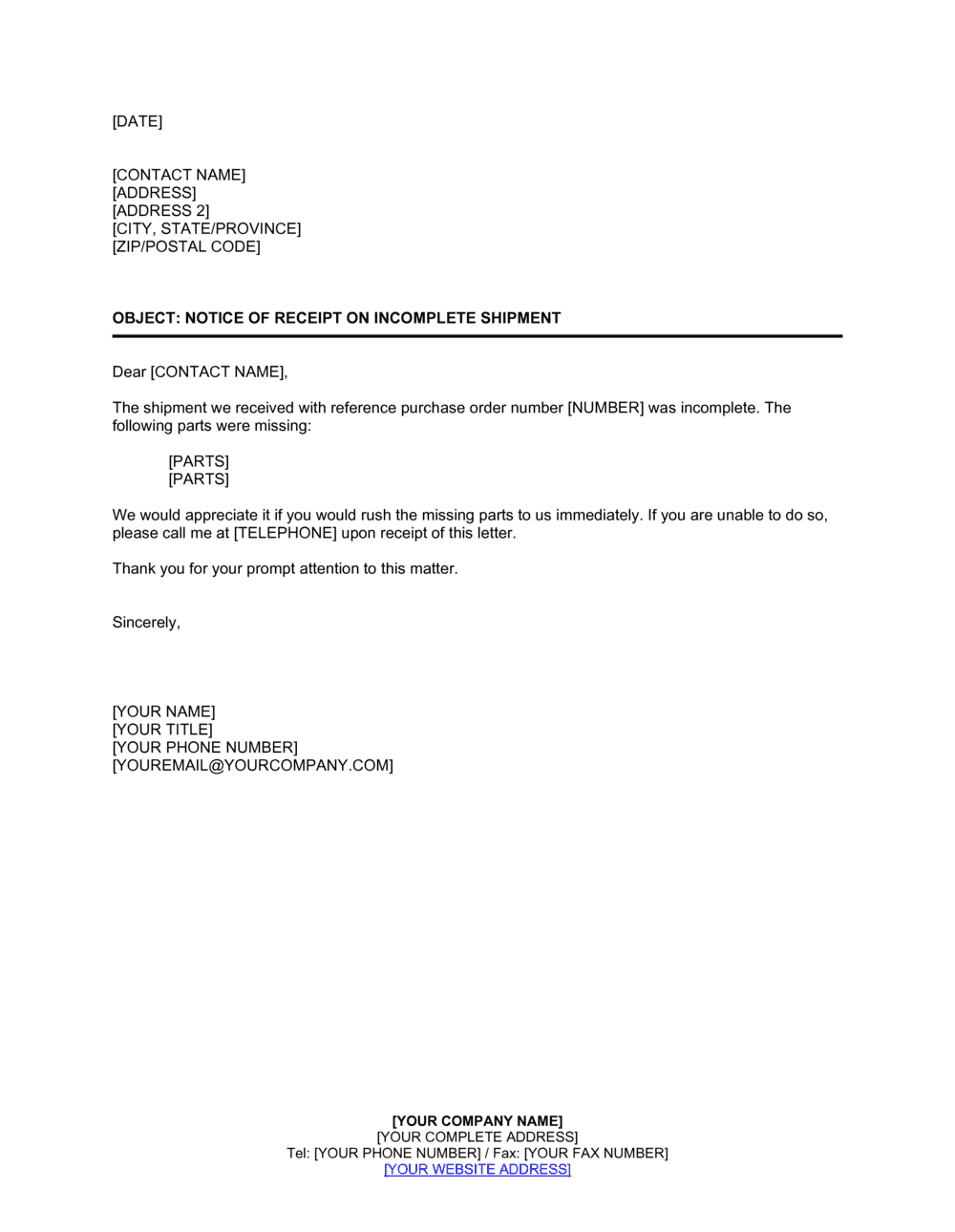
A Notice of Receipt on Incomplete Shipment is a formal business letter sent by a buyer to a supplier or carrier when delivered goods fall short of the quantity or items specified on a purchase order or invoice. This free Word download gives you a ready-to-edit template you can complete in minutes and export as PDF to send by email or post.
When you need it
Send it as soon as you inspect a delivery and confirm the shipment is short β€” ideally within 24 to 48 hours of receipt. Prompt written notice establishes the discrepancy on record before goods are processed further and before the supplier can claim the shortage was not reported.
What's inside
Sender and recipient details, reference to the original purchase order and invoice numbers, a specific description of the shortfall, a request for the missing items or a credit, and a deadline for the supplier's response.

What is a Notice of Receipt on Incomplete Shipment?

A Notice of Receipt on Incomplete Shipment is a formal business letter sent by a buyer to a supplier immediately after a delivery is found to contain fewer items than were specified on the original purchase order or invoice. It documents the precise shortfall β€” by item description, SKU, and quantity β€” creates a timestamped written record of the discrepancy, and formally requests that the supplier either deliver the outstanding goods by a specific date or issue a credit note for the undelivered amount. Unlike an informal email complaint, a properly formatted notice establishes the factual basis for a dispute, satisfies inspection-period requirements under most supply contracts, and can be used as evidence if the matter escalates.

Why You Need This Document

Without a written notice sent promptly after delivery, you lose the ability to enforce your rights under the supply contract. Suppliers routinely reject verbal or informal shortage claims made days after delivery, citing the absence of timely written notification. A missing shortfall notice also leaves your accounts payable team with no documented basis to withhold or reduce payment on the outstanding invoice β€” meaning you may end up paying in full for goods you never received. For manufacturing, retail, or construction businesses, unresolved incomplete shipments delay production schedules, cause stock-outs, and expose you to your own customer penalties. This template lets you send a complete, professional, and evidence-backed notice in under 15 minutes β€” giving you the paper trail you need to get the missing goods or the credit you are owed.

Which variant fits your situation?

If your situation is…Use this template
Goods were delivered but some items are damaged, not missingNotice of Receipt of Damaged Goods
Wrong items were delivered instead of the ordered onesNotice of Incorrect Shipment
Shipment has not arrived at all past the agreed delivery dateNotice of Late Delivery
Formally disputing the supplier's invoice due to the shortageInvoice Dispute Letter
Requesting a credit note to offset the undelivered itemsCredit Note Request Letter
Escalating an unresolved shortage to a formal supplier complaintSupplier Complaint Letter
Returning the incomplete shipment and cancelling the orderOrder Cancellation Letter

Common mistakes to avoid

❌ Waiting more than 48 hours to send the notice

Why it matters: Most supply contracts and standard trading terms require discrepancies to be reported within 24–72 hours of delivery. A late notice can be rejected by the supplier as outside the inspection window, leaving the buyer with no remedy.

Fix: Inspect every delivery on the day of receipt and send the notice within 24 hours of confirming the shortage. Use this template to reduce drafting time to under 10 minutes.

❌ Using vague quantity descriptions

Why it matters: Phrases like 'several items were missing' give the supplier grounds to dispute the claim or respond with their own estimate of what was short, dragging out resolution.

Fix: List every missing item by SKU, ordered quantity, received quantity, and outstanding quantity. Attach the GRN to support the figures.

❌ No deadline for the supplier's response

Why it matters: Without a stated deadline, the supplier has no urgency to respond, and the resolution timeline is entirely in their hands β€” often extending weeks beyond the original due date.

Fix: State a specific response deadline β€” '5 business days from the date of this letter' β€” and name the consequence of non-response, such as withholding payment on the outstanding invoice balance.

❌ Sending without supporting documentation attached

Why it matters: A notice without a packing slip or GRN attached is easy for a supplier to dismiss as unsubstantiated, particularly if their shipping records show the full quantity was dispatched.

Fix: Always attach the packing slip, your Goods Receipt Note, and photographs taken at inspection. Reference each document in the letter body so the supplier knows what to review.

The 9 key clauses, explained

Sender and recipient details

In plain language: Identifies the buyer's company name and address, the supplier's name and address, the date of the letter, and the contact person on each side.

Sample language
[BUYER COMPANY NAME] | [ADDRESS] | [DATE] | To: [SUPPLIER CONTACT NAME], [SUPPLIER COMPANY NAME], [SUPPLIER ADDRESS]

Common mistake: Addressing the letter to a sales rep rather than the supplier's accounts or dispatch department β€” the wrong recipient can delay resolution by days while the letter is internally rerouted.

Subject line and reference numbers

In plain language: States the letter's purpose in one line and includes the original purchase order number, invoice number, and delivery date so the supplier can pull the transaction immediately.

Sample language
Subject: Notice of Incomplete Shipment β€” PO #[PURCHASE ORDER NUMBER] / Invoice #[INVOICE NUMBER] / Delivery Date: [DATE]

Common mistake: Omitting the PO or invoice number. Without these references, the supplier's team cannot locate the transaction quickly, and resolution is delayed.

Confirmation of receipt

In plain language: Acknowledges that a delivery was received on the stated date and from the named carrier, establishing the baseline fact of partial receipt.

Sample language
On [DATE], we received a shipment from [CARRIER NAME] in reference to the above purchase order. Upon inspection, we found the delivery to be incomplete as detailed below.

Common mistake: Skipping the receipt confirmation and jumping straight to the complaint. Without acknowledging what did arrive, the letter lacks the factual foundation needed if the matter escalates to a formal dispute.

Description of the shortfall

In plain language: Lists each missing item by SKU or product description, the quantity ordered, the quantity received, and the quantity outstanding β€” as a table or itemized list.

Sample language
Item: [PRODUCT NAME / SKU] | Ordered: [QTY] units | Received: [QTY] units | Outstanding: [QTY] units

Common mistake: Describing the shortage in vague terms such as 'several boxes were missing.' Courts and suppliers both require specific quantities and item identifiers to act on a claim.

Reference to supporting documentation

In plain language: Notes that copies of the packing slip, goods receipt note, or photographs are attached to substantiate the reported discrepancy.

Sample language
Please find enclosed copies of the original packing slip, our Goods Receipt Note #[GRN NUMBER], and photographs taken at the time of inspection.

Common mistake: Sending the notice without any attachments. Attaching the packing slip and GRN at the outset prevents the supplier from later disputing that the shortage was properly documented.

Statement of impact

In plain language: Briefly describes the operational or financial consequence of the shortfall β€” production delays, sales impact, or inability to fulfill customer orders β€” to convey urgency.

Sample language
The outstanding [QTY] units of [PRODUCT] are required to fulfil customer orders scheduled for [DATE]. Each day of delay results in [CONSEQUENCE β€” e.g., production downtime / penalties under our own customer contracts].

Common mistake: Leaving out the impact entirely. Suppliers prioritize resolution faster when they understand the downstream consequence of the shortage.

Requested remedy and options

In plain language: States clearly what the buyer wants β€” delivery of outstanding items by a specific date, a credit note, or a partial refund β€” and lists the options in order of preference.

Sample language
We request that you either (a) deliver the outstanding [QTY] units no later than [DATE], or (b) issue a credit note for $[AMOUNT] against Invoice #[INVOICE NUMBER] within [X] business days.

Common mistake: Requesting a remedy without specifying a deadline. An open-ended request gives the supplier no urgency and no measurable commitment to track.

Response deadline and escalation notice

In plain language: Asks the supplier to confirm the chosen remedy within a defined number of business days and states what the buyer will do if no response is received.

Sample language
Please confirm your chosen course of action within [5] business days of this letter. If we do not receive a response by [DATE], we reserve the right to withhold payment on the outstanding invoice balance pending resolution.

Common mistake: Threatening escalation without specifying it. Vague language like 'we will take further action' carries no weight; a specific consequence β€” withheld payment, chargeback, or legal referral β€” is more effective.

Closing and signature block

In plain language: Closes the letter professionally, provides the name and title of the authorized signatory, and includes direct contact details for follow-up.

Sample language
We trust this matter will be resolved promptly. Please contact [NAME], [TITLE], at [EMAIL] / [PHONE] should you require any further information. Yours sincerely, [AUTHORIZED SIGNATORY NAME], [TITLE], [COMPANY NAME]

Common mistake: Closing without providing a direct contact. If the supplier's team has a question and cannot reach anyone specific, the response is delayed and the resolution timeline slips.

How to fill it out

  1. 1

    Gather the shipment documents before writing

    Pull the original purchase order, the supplier's invoice, the carrier's bill of lading, and the packing slip. You will need PO and invoice numbers, item SKUs, and ordered quantities to complete the letter accurately.

    πŸ’‘ Photograph the delivery β€” outer packaging, packing slip, and received items β€” immediately upon inspection. These images are your strongest evidence if the supplier disputes the shortage.

  2. 2

    Complete the sender and recipient details

    Enter your company's full name and address at the top, the date, and the supplier's full legal name, address, and the name of their accounts or dispatch contact.

    πŸ’‘ Address the letter to the supplier's accounts payable or dispatch manager by name β€” a named recipient gets actioned faster than one addressed to a generic department.

  3. 3

    Fill in the subject line with all reference numbers

    Enter the purchase order number, invoice number, and the date goods were received. This allows the supplier to locate the transaction in their system without a back-and-forth.

    πŸ’‘ If the carrier assigned a tracking or consignment number, include that too β€” it helps the supplier trace whether the shortage originated in their warehouse or in transit.

  4. 4

    Describe the shortfall item by item

    List every missing item with its SKU or product description, the quantity ordered, the quantity received, and the quantity outstanding. A table format is clearest.

    πŸ’‘ Cross-reference your Goods Receipt Note against the packing slip line by line. Discrepancies between those two documents tell you whether items were packed but lost in transit, or never packed.

  5. 5

    Attach supporting documents

    Include copies of the packing slip, your Goods Receipt Note, and any photographs taken at receipt. Reference each attachment in the body of the letter.

    πŸ’‘ Send attachments as PDFs rather than editable files β€” this prevents accidental or intentional alteration after the fact.

  6. 6

    State your preferred remedy and a firm deadline

    Choose whether you want the outstanding items delivered by a specific date or a credit note issued, and state that clearly. Set a response deadline of 3 to 5 business days.

    πŸ’‘ Offer two options β€” delivery or credit β€” and let the supplier choose. Giving a choice speeds up their internal approval process compared to a single demand.

  7. 7

    Send and record the communication

    Send the completed letter to the supplier's accounts or dispatch contact by email (with read receipt) and retain a copy in your supplier file alongside the supporting documents.

    πŸ’‘ Follow up with a brief email on the day after your deadline if no response has been received. Attach the original notice again as a PDF in that follow-up.

Frequently asked questions

What is a notice of receipt on incomplete shipment?

A notice of receipt on incomplete shipment is a formal written letter sent by a buyer to a supplier when a delivery contains fewer items than were ordered and invoiced. It documents the discrepancy, identifies the missing goods by item and quantity, and formally requests either delivery of the outstanding items or a credit note for the shortfall amount. Sending this notice in writing creates a timestamped record that protects the buyer's rights under the supply contract.

When should I send a notice of incomplete shipment?

Send the notice within 24 to 48 hours of receiving and inspecting the delivery. Most supply contracts and standard commercial terms require discrepancies to be reported within a defined inspection window β€” typically 24 to 72 hours. Waiting longer risks the supplier rejecting your claim on the grounds that the shortage was not raised promptly.

What documents should I attach to the notice?

Attach copies of the original purchase order, the supplier's invoice, the carrier's packing slip, your internal Goods Receipt Note, and any photographs taken at the time of inspection. These documents substantiate the quantities you ordered versus what was actually received and make it harder for the supplier to dispute the claim.

Can I withhold payment if the shipment is incomplete?

In most jurisdictions, you are entitled to withhold the portion of an invoice that corresponds to undelivered goods. However, withholding payment for items that were delivered can trigger late-payment penalties or damage the supplier relationship. The safest approach is to pay for goods received, formally dispute the balance in writing using this notice, and request a credit note for the shortfall. Consider reviewing your supply contract terms before withholding any payment.

What if the supplier disputes the shortage?

If the supplier's records show the full quantity was dispatched, the shortage may have occurred in transit. In that case, the claim shifts to the carrier. Your bill of lading and carrier's delivery receipt will show whether the shortage was present when goods left the warehouse or when they arrived. Having photographs and a signed GRN taken at delivery is essential for resolving carrier disputes.

Is a notice of incomplete shipment legally binding?

The notice itself is not a contract or a legally binding instrument β€” it is a formal communication that creates a documented record. Its value lies in establishing the date and content of your claim, which becomes critical evidence if the dispute escalates to arbitration or litigation. Sending it promptly and in writing is what gives it its practical force.

What is the difference between an incomplete shipment and a damaged goods notice?

An incomplete shipment notice addresses missing items β€” goods that were ordered but not delivered at all. A damaged goods notice addresses items that were delivered but arrived in an unusable or non-conforming condition. The two situations require separate letters because the remedy differs: incomplete shipments call for delivery of outstanding items or a credit, while damaged goods claims typically involve return, replacement, or insurance proceedings.

How formal does this letter need to be?

The letter should use standard business letter formatting β€” company letterhead, a clear subject line with reference numbers, numbered paragraphs or a table for the shortfall details, and a professional closing. It does not need to use legal language, but it must be specific and factual. Vague or informal notices are harder to enforce and easier for suppliers to set aside.

How this compares to alternatives

vs Notice of Receipt of Damaged Goods

A damaged goods notice covers items that arrived in a broken or non-conforming state. An incomplete shipment notice covers items that were simply not delivered. Use the damaged goods notice when you can count all units but some are unusable; use this template when the unit count itself is short.

vs Late Delivery Notice

A late delivery notice is sent when a shipment has not arrived at all past the agreed date. An incomplete shipment notice is sent after a delivery has arrived but is short on quantity. If nothing has arrived, use the late delivery notice; if something arrived but less than ordered, use this template.

vs Order Cancellation Letter

An order cancellation letter terminates the purchase order entirely and typically triggers a return or refund. An incomplete shipment notice keeps the order open and requests fulfillment of the outstanding items or a credit adjustment. Use the cancellation letter only when you no longer want the missing goods.

vs Supplier Complaint Letter

A supplier complaint letter is a broader escalation document addressing repeated failures, quality issues, or relationship-level concerns. An incomplete shipment notice is a transaction-specific, operational communication about a single delivery discrepancy. Send the incomplete shipment notice first; escalate to a formal complaint only if the issue recurs or goes unresolved.

Industry-specific considerations

Manufacturing

Raw material shortfalls halt production lines; incomplete shipment notices are issued same-day to trigger emergency back-orders and avoid line-stoppage penalties.

Retail and E-commerce

Missing SKUs cause out-of-stock events and lost sales; buyers use these notices to request immediate replenishment or invoice credits before the selling season ends.

Food and Beverage

Short deliveries affect production schedules with perishable inputs; notices must be sent within hours of receipt due to the time-sensitive nature of the goods.

Construction and Trades

Missing materials delay site schedules and trigger subcontractor penalties; notices document the shortfall to support claims against the supplier for consequential costs.

Template vs pro β€” what fits your needs?

PathBest forCostTime
Use the templateAny business needing to document a delivery shortfall and request resolution from a supplierFree10–15 minutes per notice
Template + professional reviewHigh-value shortfalls where the invoice dispute exceeds $10,000 or the supply contract has specific claims procedures$100–$300 for a commercial lawyer or procurement consultant review1–2 business days
Custom draftedInternational supply disputes, letters of claim under a formal contract, or situations involving carrier liability and insurance$300–$8002–5 business days

Glossary

Short Shipment
A delivery in which the quantity of goods actually received is less than the quantity stated on the purchase order, packing slip, or invoice.
Packing Slip
A document included with a shipment that lists every item and quantity packed β€” used to verify what was sent against what was ordered.
Purchase Order (PO)
A buyer-issued document authorizing a specific quantity of goods at an agreed price, which the seller is contractually obligated to fulfill.
Bill of Lading
A carrier-issued document acknowledging receipt of goods for shipment; it lists quantities and serves as evidence of what left the seller's facility.
Goods Receipt Note (GRN)
An internal warehouse document recording the quantity and condition of goods actually received, used to match against the purchase order and invoice.
Credit Note
A document issued by a supplier reducing the amount owed by the buyer, typically used to adjust an invoice when fewer goods were delivered than billed.
Inspection Period
The window of time after delivery during which the buyer is entitled to inspect goods and raise discrepancies β€” often defined in the supply contract or terms of sale.
Backorder
A supplier's commitment to ship the outstanding quantity from a short shipment at a later date once stock becomes available.
Proof of Delivery (POD)
A carrier-issued or recipient-signed document confirming delivery occurred, including the date, time, and condition of the consignment as received.
Discrepancy Report
An internal record documenting the difference between ordered, shipped, and received quantities β€” often attached to a notice of incomplete shipment as supporting evidence.

Part of your Business Operating System

This document is one of 3,000+ business & legal templates included in Business in a Box.

  • Fill-in-the-blanks β€” ready in minutes
  • 100% customizable Word document
  • Compatible with all office suites
  • Export to PDF and share electronically

Create your document in 3 simple steps.

From template to signed document β€” all inside one Business Operating System.
1
Download or open template

Access over 3,000+ business and legal templates for any business task, project or initiative.

2
Edit and fill in the blanks with AI

Customize your ready-made business document template and save it in the cloud.

3
Save, Share, Send, Sign

Share your files and folders with your team. Create a space of seamless collaboration.

Save time, save money, and create top-quality documents.

β˜…β˜…β˜…β˜…β˜…

"Fantastic value! I'm not sure how I'd do without it. It's worth its weight in gold and paid back for itself many times."

Managing Director Β· Mall Farm
Robert Whalley
Managing Director, Mall Farm Proprietary Limited
β˜…β˜…β˜…β˜…β˜…

"I have been using Business in a Box for years. It has been the most useful source of templates I have encountered. I recommend it to anyone."

Business Owner Β· 4+ years
Dr Michael John Freestone
Business Owner
β˜…β˜…β˜…β˜…β˜…

"It has been a life saver so many times I have lost count. Business in a Box has saved me so much time and as you know, time is money."

Owner Β· Upstate Web
David G. Moore Jr.
Owner, Upstate Web

Run your business with a system β€” not scattered tools

Stop downloading documents. Start operating with clarity. Business in a Box gives you the Business Operating System used by over 250,000 companies worldwide to structure, run, and grow their business.

Start freeΒ Β·Β No credit card required