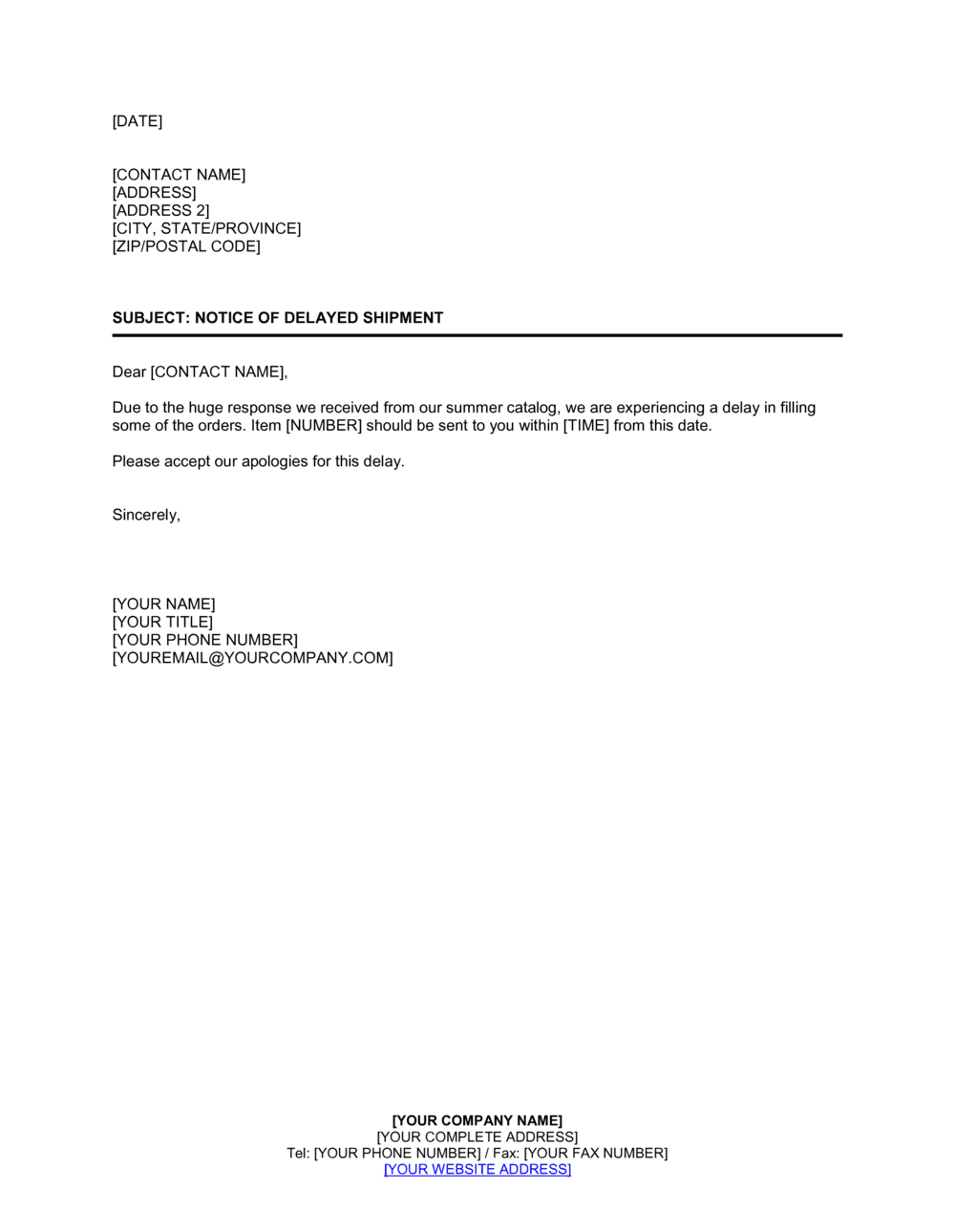
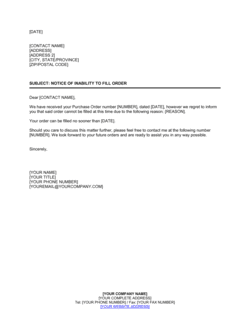
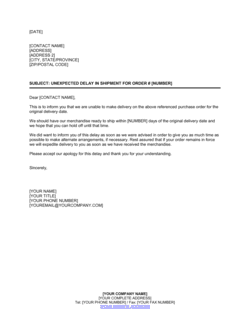
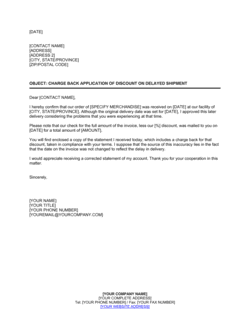
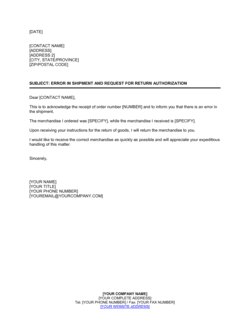
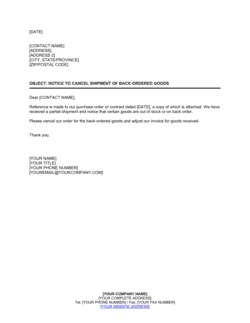
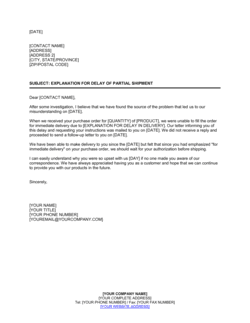
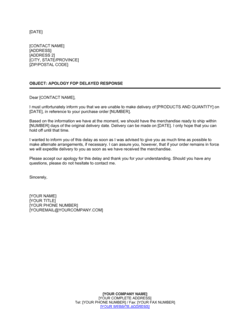
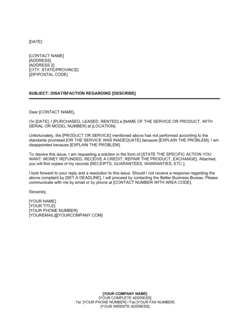
Notice of Delayed Shipment Template

Free Word download β€’ Edit online β€’ Save & share with Drive β€’ Export to PDF

1 pageβ€’15–20 min to fillβ€’Difficulty: Standard
Learn more ↓
FreeNotice of Delayed Shipment Template

At a glance

What it is
A Notice of Delayed Shipment is a formal business letter a seller or supplier sends to a customer or buyer to communicate that an order will not arrive on the originally promised date. This free Word download gives you a ready-to-edit template you can personalize with order details, delay reasons, and a revised delivery estimate, then send by email or post in minutes.
When you need it
Use it as soon as you become aware that a shipment will be late β€” whether due to supplier issues, carrier delays, inventory shortfalls, customs holds, or production problems. Proactive notification before the customer follows up preserves trust and reduces disputes.
What's inside
Sender and recipient details, order reference and original delivery date, a clear statement of the delay, the specific reason for the delay, a revised estimated delivery date, any interim remedies or next steps, and a professional closing with contact information for follow-up.

What is a Notice of Delayed Shipment?

A Notice of Delayed Shipment is a formal business letter a seller, supplier, or logistics provider sends to a buyer or customer to communicate that an order will not be delivered on the originally agreed date. It identifies the specific order by reference number, states the reason for the delay in concrete terms, provides a revised estimated delivery date, and β€” where applicable β€” outlines any remedy the sender is offering to offset the inconvenience. Unlike a generic apology email, a properly structured delay notice gives the recipient everything they need to update their own operations: the new timeline, a point of contact, and any options available to them.

Why You Need This Document

Failing to send a timely, professional delay notice is one of the most preventable causes of customer disputes and lost accounts. A buyer who discovers the delay on their own β€” by checking a tracking number or missing a production deadline β€” experiences the same operational disruption plus the additional frustration of not being informed. The cost is concrete: escalated complaints, cancellation requests, and, in B2B relationships, contractual penalty clauses that a documented notice of force majeure or commercial disruption can help mitigate. This template gives you a structured, professionally worded notice you can complete in under ten minutes, send before the customer asks, and file as evidence of good-faith communication β€” protecting both the relationship and your position if a dispute follows.

Which variant fits your situation?

If your situation is…Use this template
Delay caused by the carrier after the order has already shippedNotice of Delayed Shipment (Carrier Delay)
Product is out of stock and no delivery date is confirmed yetBackorder Notification Letter
Order has been lost in transit and must be reshippedLost Shipment Notice
Delay caused by customs or import clearanceNotice of Delayed Shipment (Customs Hold)
Customer requests cancellation due to a delayOrder Cancellation Confirmation Letter
Communicating a broad supply disruption affecting multiple ordersSupply Chain Disruption Notice
Following up after the rescheduled delivery date has also passedSecond Notice of Delayed Shipment

Common mistakes to avoid

❌ Waiting for the customer to ask before notifying

Why it matters: A customer who discovers the delay on their own β€” by tracking the shipment or missing a production deadline β€” loses trust immediately. Reactive communication signals disorganization.

Fix: Send the notice as soon as you have confirmed information about the delay, even if the revised date is not yet finalized. A preliminary notice with a follow-up commitment is better than silence.

❌ Giving a vague or overly optimistic revised date

Why it matters: If the second promised date is also missed, the relationship damage is far greater than the original delay. Customers plan around revised dates.

Fix: Verify the revised date with your carrier, warehouse, or supplier before writing it in the letter. If you cannot confirm a date, give a range and explain when you will have certainty.

❌ Using a generic explanation with no specific cause

Why it matters: Phrases like 'unforeseen circumstances' without detail sound evasive and make customers suspect the problem is more serious or systemic than it actually is.

Fix: State the actual cause in one sentence β€” 'a temporary shortage of [component]' or 'carrier delays affecting shipments to the [region] area' β€” even if you cannot share full details.

❌ No named contact for follow-up

Why it matters: Directing customers to a generic support inbox slows response time and signals low priority. Customers with urgent operational needs will escalate directly to a sales rep or management.

Fix: Include the name, email, and phone number of the account manager or customer service lead handling the order. Name-specific accountability reduces escalation rates.

The 8 key clauses, explained

Header β€” Sender and recipient details

In plain language: Identifies the sending company, the recipient, the date, and the subject line so the letter can be filed and referenced immediately.

Sample language
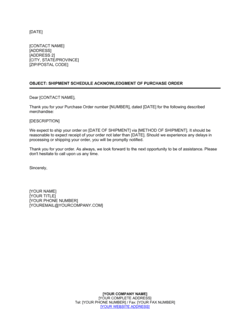
[COMPANY NAME] | [ADDRESS] | [DATE] To: [CUSTOMER NAME / COMPANY] [CUSTOMER ADDRESS] Subject: Notice of Delayed Shipment β€” Order #[ORDER NUMBER]

Common mistake: Omitting the order number from the subject line, which forces the recipient to search their records before they can act on the notice.

Opening acknowledgment

In plain language: Opens with a direct statement that the shipment will be delayed, referencing the order and the original promised delivery date.

Sample language
We are writing to inform you that your order #[ORDER NUMBER], originally scheduled for delivery on [ORIGINAL DATE], will be delayed beyond its anticipated arrival date.

Common mistake: Burying the delay notification in the second or third paragraph. Recipients need the key fact β€” the delay β€” in the very first sentence.

Reason for the delay

In plain language: Explains the specific cause of the delay in plain, honest terms without assigning excessive blame to third parties.

Sample language
This delay is due to [REASON β€” e.g., an unexpected shortage of raw materials / a disruption at our regional distribution center / carrier service interruptions in the [REGION] area].

Common mistake: Providing a vague explanation like 'unforeseen circumstances' with no specifics. Customers are less likely to accept the delay without a credible, concrete reason.

Revised delivery estimate

In plain language: States the new expected delivery date as precisely as possible, or provides a date range if the exact date is still uncertain.

Sample language
We currently estimate your order will be delivered by [REVISED DATE]. We will provide an updated notice immediately if this timeline changes.

Common mistake: Giving an optimistic revised date without confirming it with the carrier or warehouse β€” a second missed date damages trust far more than the original delay.

Impact statement and apology

In plain language: Acknowledges the inconvenience the delay causes the buyer and expresses a genuine, brief apology.

Sample language
We understand this delay may disrupt your operations and sincerely apologize for the inconvenience this causes [CUSTOMER NAME / your team].

Common mistake: Writing an overly long or defensive apology that shifts focus from solutions to the sender's own difficulties. Keep the apology brief and customer-facing.

Remedies or next steps

In plain language: Offers any applicable compensation, alternative options, or interim actions the seller will take β€” such as expedited shipping, a discount, or a partial shipment.

Sample language
As a gesture of goodwill, we are [offering expedited shipping at no additional cost / applying a [X]% discount to your next order / able to partially fulfill your order by [DATE] if that would be helpful].

Common mistake: Offering no remedy at all for a delay that materially affects the buyer's operations. Even a small, concrete gesture improves retention and reduces escalation.

Instructions for questions or changes

In plain language: Directs the recipient to a specific contact β€” name, email, and phone β€” if they need to modify, cancel, or follow up on the order.

Sample language
If you have questions, wish to modify your order, or need to discuss alternative arrangements, please contact [NAME] at [EMAIL] or [PHONE NUMBER] by [DATE / anytime during business hours].

Common mistake: Pointing customers to a generic inbox like 'support@company.com' without a named contact. Personalized contact details reduce response time and signal accountability.

Closing statement

In plain language: Closes professionally, reaffirms the business relationship, and expresses commitment to fulfilling the order.

Sample language
We value your business and remain fully committed to completing your order as promptly as possible. Thank you for your patience and understanding. Sincerely, [SENDER NAME] [TITLE], [COMPANY NAME]

Common mistake: Closing with a generic 'Thank you for your business' that ignores the delay. The closing should specifically acknowledge the disruption and reaffirm commitment to the customer.

How to fill it out

  1. 1

    Enter sender and recipient details in the header

    Fill in your company name, address, and date at the top. Add the customer's full name or company name, billing address, and the order or PO number in the subject line.

    πŸ’‘ Use the exact PO number the customer issued β€” not your internal order ID β€” so their accounts payable and operations teams can match it instantly.

  2. 2

    State the delay clearly in the opening sentence

    The first sentence must tell the reader what happened: the shipment is delayed, reference the order number, and state the original expected delivery date.

    πŸ’‘ Write this sentence as if the reader has no context. They may forward it to a manager who has never seen the order.

  3. 3

    Describe the specific reason for the delay

    Provide one to two sentences explaining the actual cause β€” carrier disruption, production issue, customs hold, or inventory shortage. Be specific without oversharing operational details.

    πŸ’‘ Avoid blaming a third party by name unless it is relevant to the customer (e.g., a named carrier they booked). Blame-shifting comes across as defensive.

  4. 4

    Confirm the revised delivery date

    Enter the new expected delivery date. If it is genuinely uncertain, provide a date range and commit to sending an updated notice within a defined number of days.

    πŸ’‘ Confirm the revised date with your warehouse or carrier before sending β€” committing to a second date you cannot meet compounds the problem significantly.

  5. 5

    Add an apology and any remedy you are offering

    Write one sentence of genuine apology, then describe any remedy: expedited shipping, a discount, or a partial shipment. If no remedy is applicable, acknowledge the inconvenience directly.

    πŸ’‘ A remedy does not need to be large β€” a 5% discount code or free next-day shipping on the delayed order can be enough to prevent a cancellation or complaint.

  6. 6

    Add a named contact for follow-up

    Include a specific person's name, direct email, and phone number. State the hours or deadline by which they should reach out if they need to make changes.

    πŸ’‘ Set a follow-up reminder for yourself to proactively update the customer again if the revised date approaches without the shipment dispatching.

Frequently asked questions

What is a notice of delayed shipment?

A notice of delayed shipment is a formal letter or email a seller or supplier sends to a buyer when an order will not arrive on the originally promised date. It identifies the affected order, explains the cause of the delay, provides a revised estimated delivery date, and typically includes an apology and any remedies the seller is offering. Sending it promptly protects business relationships and reduces dispute risk.

When should I send a shipment delay notice?

Send it as soon as you have confirmed the delay β€” ideally before the original delivery date passes and certainly before the customer contacts you to ask. If the new date is uncertain, send a preliminary notice acknowledging the delay and commit to a follow-up with a confirmed date within a specific number of days. Proactive communication consistently outperforms reactive damage control.

What should a delayed shipment notice include?

At minimum: the order or PO number, the original expected delivery date, a clear statement that the shipment is delayed, the specific reason for the delay, the revised estimated delivery date, an apology, any remedy being offered, and a named contact for follow-up. Missing the revised date or the contact information are the two most common gaps.

Does a notice of delayed shipment need to be signed?

No signature is required for a delayed shipment notice to be effective. It is a formal business communication, not a binding contract amendment. Including the sender's printed name and title is standard practice and sufficient. If the delay triggers contractual penalties or requires a formal agreement to extend the delivery deadline, a separate amendment to the underlying purchase agreement may be needed.

Can a delayed shipment notice protect me legally?

Yes, in a practical sense. A timely, documented notice demonstrates good faith, establishes a clear record of communication, and can support a force majeure or commercial impracticability argument if the delay results in a breach-of-contract claim. It does not eliminate liability if the contract specifies firm delivery dates with penalties, but it reduces the likelihood of disputes and strengthens your position if one arises. Consider consulting a lawyer if the delayed order involves significant financial exposure or contractual penalty clauses.

What is the difference between a delayed shipment notice and a backorder notice?

A delayed shipment notice applies when the order exists and the goods are available but will arrive later than promised β€” due to a carrier, production, or customs issue. A backorder notice means the item is currently out of stock and cannot ship until inventory is replenished, with no confirmed ship date in some cases. Both require prompt customer communication, but backorders typically involve greater uncertainty about the timeline.

Should I offer a remedy in every delayed shipment notice?

Not always, but it is strongly advisable when the delay is significant β€” more than a few days β€” or when the customer is a key account with operational dependencies on the order. Even a modest gesture, such as expedited shipping at no charge or a small discount on the next order, substantially reduces escalation and cancellation rates. For minor one-day delays with low-value orders, a clear explanation and an apology are typically sufficient.

How do I handle a customer who wants to cancel after receiving a delay notice?

Acknowledge the cancellation request promptly and professionally. If cancellation is contractually permitted, issue an order cancellation confirmation and process any refund per your terms. If the contract restricts cancellation mid-fulfillment, explain the relevant terms clearly and offer an alternative remedy β€” partial shipment, expedited delivery, or a discount. Do not contest the cancellation aggressively; preserving the relationship for future orders is usually worth more than a single disputed transaction.

Can I use this template for international shipments?

Yes. The template works for both domestic and international delayed shipments. For international orders, add the relevant customs reference number or airway bill number to the order details, reference the specific border or customs hold if applicable, and note any import duty or documentation issues that are contributing to the delay. For shipments subject to formal trade terms (Incoterms), reference the agreed delivery term (e.g., DDP, FOB) when explaining where responsibility for the delay sits.

How this compares to alternatives

vs Backorder Notification Letter

A backorder notification addresses items that cannot ship because they are out of stock, with no confirmed ship date. A delayed shipment notice applies when the goods exist and will ship but will arrive later than originally promised. The key distinction is whether a ship date can be confirmed β€” if yes, use a delayed shipment notice; if no confirmed date exists, use a backorder notification.

vs Order Cancellation Confirmation Letter

An order cancellation confirmation documents the mutual agreement to cancel an order entirely and outlines any refund or credit terms. A delayed shipment notice is sent before cancellation is considered β€” its purpose is to preserve the order and the relationship by communicating proactively. If a customer responds to the delay notice by requesting cancellation, an order cancellation letter is the appropriate follow-up document.

vs Apology Letter to Customer

A general apology letter addresses a broad range of service failures without operational specifics. A delayed shipment notice is operationally specific β€” it includes the order number, original and revised dates, delay cause, and next steps. For a shipping delay, the notice format is always preferable because it gives the customer the information they need to act, not just an expression of regret.

vs Delivery Confirmation Letter

A delivery confirmation letter is sent after the shipment has successfully arrived, providing proof of receipt and closing the transaction loop. A delayed shipment notice is sent before delivery when the timeline has changed. Together they bracket the fulfillment lifecycle: the delay notice manages expectations mid-process; the delivery confirmation closes it out.

Industry-specific considerations

Retail and E-commerce

High order volumes mean delay notices are often templated and sent in batches; linking to live tracking URLs within the letter reduces inbound support contacts significantly.

Manufacturing and Industrial Supply

Production line dependencies make delivery accuracy critical; delay notices for component orders often require a formal timeline extension to the underlying purchase agreement.

Food and Beverage

Perishable goods and tight replenishment windows mean delay notices must be sent within hours of confirmation; substitute product offers or credit notes are standard accompanying remedies.

Construction and Building Materials

Material delays cascade into contractor schedules and subcontractor commitments; notices should specify which phase or trade will be affected and by how many days.

Template vs pro β€” what fits your needs?

PathBest forCostTime
Use the templateAny business needing to notify customers of delayed shipments quickly and professionallyFree5–10 minutes per notice
Template + professional reviewHigh-value B2B orders with contractual penalty clauses or formal Incoterms delivery obligations$100–$300 (legal or operations advisor review)1–2 hours
Custom draftedEnterprise supply agreements where delay notices trigger formal contractual cure periods or liquidated damages$500–$1,500 (commercial lawyer drafting)1–3 days

Glossary

Estimated Delivery Date (EDD)
The date a seller or carrier projects a shipment will reach the buyer β€” not a guaranteed date unless contractually specified.
Purchase Order (PO) Number
A unique reference number issued by the buyer to identify a specific order, used to match invoices, shipments, and correspondence.
Force Majeure
An unforeseen event beyond a party's control β€” such as a natural disaster, strike, or pandemic β€” that excuses or delays contractual performance.
Carrier
The transportation company (e.g., FedEx, UPS, DHL, freight broker) responsible for physically moving the shipment from seller to buyer.
Backorder
A status indicating that an ordered item is temporarily out of stock but will be fulfilled once inventory is replenished.
Lead Time
The total time between placing an order and receiving delivery, including production, processing, and transit.
Bill of Lading (BOL)
A shipping document issued by a carrier that serves as a receipt for goods, a shipment contract, and evidence of title for certain transactions.
Transit Time
The number of days a shipment is in active transit from the origin facility to the delivery destination.
Customs Hold
A delay imposed by border authorities while they inspect, verify documentation for, or assess duties on an international shipment.
Remedy
A corrective action offered to the buyer in response to a delay β€” such as expedited re-shipping, a discount, or a partial refund.

Part of your Business Operating System

This document is one of 3,000+ business & legal templates included in Business in a Box.

  • Fill-in-the-blanks β€” ready in minutes
  • 100% customizable Word document
  • Compatible with all office suites
  • Export to PDF and share electronically

Create your document in 3 simple steps.

From template to signed document β€” all inside one Business Operating System.
1
Download or open template

Access over 3,000+ business and legal templates for any business task, project or initiative.

2
Edit and fill in the blanks with AI

Customize your ready-made business document template and save it in the cloud.

3
Save, Share, Send, Sign

Share your files and folders with your team. Create a space of seamless collaboration.

Save time, save money, and create top-quality documents.

β˜…β˜…β˜…β˜…β˜…

"Fantastic value! I'm not sure how I'd do without it. It's worth its weight in gold and paid back for itself many times."

Managing Director Β· Mall Farm
Robert Whalley
Managing Director, Mall Farm Proprietary Limited
β˜…β˜…β˜…β˜…β˜…

"I have been using Business in a Box for years. It has been the most useful source of templates I have encountered. I recommend it to anyone."

Business Owner Β· 4+ years
Dr Michael John Freestone
Business Owner
β˜…β˜…β˜…β˜…β˜…

"It has been a life saver so many times I have lost count. Business in a Box has saved me so much time and as you know, time is money."

Owner Β· Upstate Web
David G. Moore Jr.
Owner, Upstate Web

Run your business with a system β€” not scattered tools

Stop downloading documents. Start operating with clarity. Business in a Box gives you the Business Operating System used by over 250,000 companies worldwide to structure, run, and grow their business.

Start freeΒ Β·Β No credit card required