Notice and Tender by Debtor Template

Free Word download • Edit online • Save & share with Drive • Export to PDF

1 page15–25 min to fillDifficulty: Standard
Learn more ↓
FreeNotice and Tender by Debtor Template

At a glance

What it is
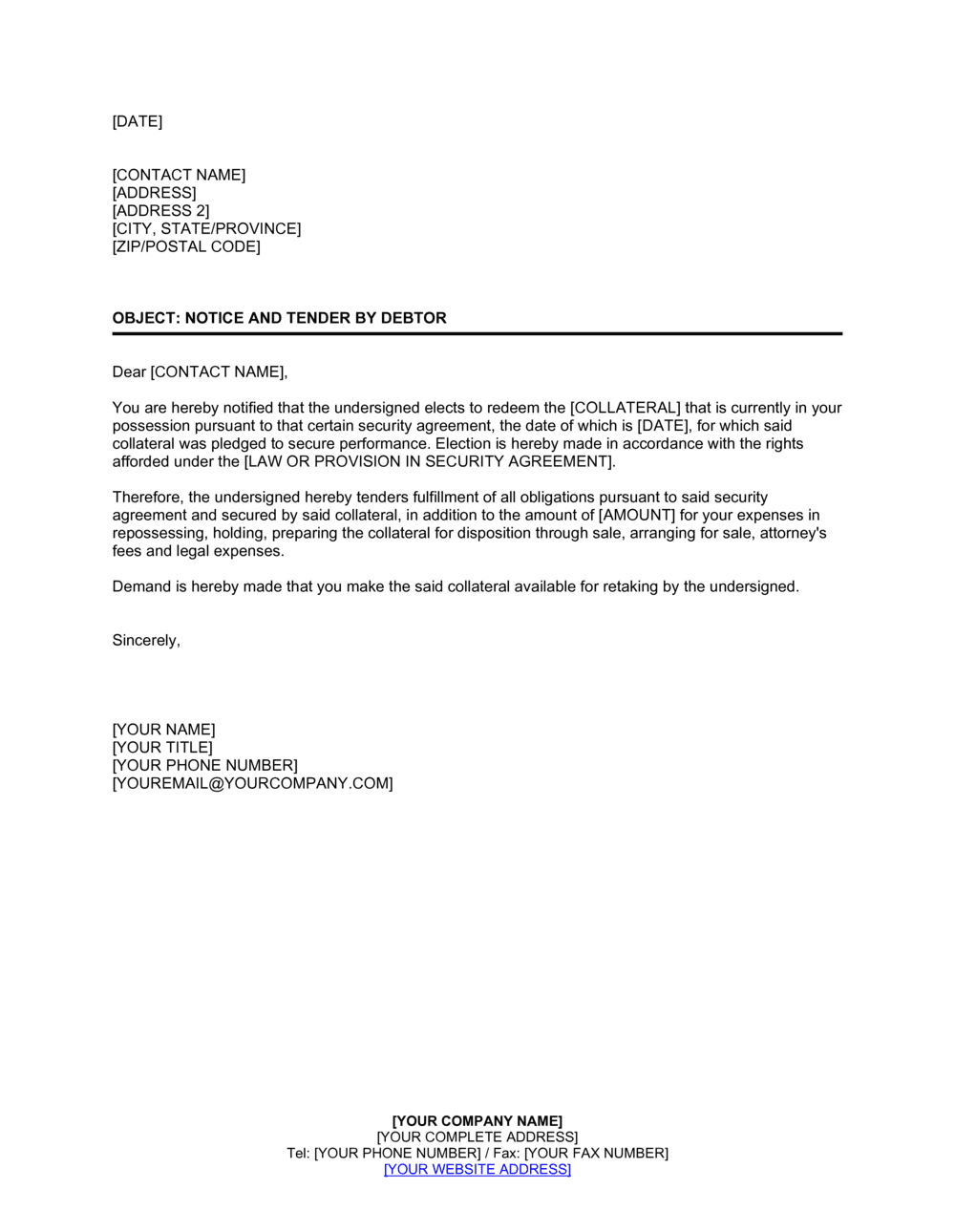
A Notice and Tender by Debtor is a formal written letter a debtor sends to a creditor to officially notify them that payment of an outstanding debt is being tendered — offered or remitted — in full or partial satisfaction of the obligation. This free Word download gives you a ready-to-use template you can edit online and send within minutes, creating a written record that payment was formally offered on a specific date.
When you need it
Use it when you are ready to pay a debt and want a documented record that tender was made — especially when the creditor has been unresponsive, when a dispute exists over the amount owed, or when you need to stop interest or penalties from accruing by demonstrating timely tender.
What's inside
Debtor and creditor identification, a clear statement of the debt being tendered, the amount offered and payment method, the date of tender, any conditions on acceptance, and a request for written acknowledgment of receipt and discharge.

What is a Notice and Tender by Debtor?

A Notice and Tender by Debtor is a formal letter a debtor sends to a creditor to officially offer payment of an outstanding debt, document the date and terms of that offer, and assert the legal consequences that flow from a valid tender. Unlike simply mailing a check, this letter creates a written record that payment was made under specific conditions — enabling the debtor to halt the accrual of interest and penalties, establish a discharge date, and protect against future claims that the debt remains unsatisfied. For disputed debts, the notice can include accord and satisfaction language that binds the creditor to accept the tendered amount as full settlement upon receipt.

Why You Need This Document

Paying a debt without a formal tender notice leaves you exposed in ways that are easy to overlook. A creditor who later claims the payment was late, short, or never received faces no documented counter-evidence — and interest continues to accrue until a court decides otherwise. For disputed amounts, tendering payment without explicit accord and satisfaction language means the creditor can cash your check and still sue for the difference. A properly drafted Notice and Tender by Debtor closes these gaps: it timestamps your offer, specifies the amount and instrument, and sets the legal terms under which acceptance discharges the full obligation. This template gives you a professionally structured starting point that takes fifteen minutes to complete and generates a document that can stand as evidence in a collections dispute or court proceeding.

Which variant fits your situation?

If your situation is…Use this template
Paying a debt in full and requesting written dischargeNotice and Tender by Debtor (Full Payment)
Proposing a partial payment as settlement of a disputed amountDebt Settlement Offer Letter
Demanding acknowledgment that a creditor has refused valid tenderNotice of Refusal of Tender
Notifying a creditor of inability to pay and requesting a payment planHardship Letter to Creditor
Requesting a final payoff amount before remitting fundsPayoff Request Letter
Formally disputing a debt before tendering any paymentDebt Dispute Letter

Common mistakes to avoid

❌ Tendering an unverified or approximate amount

Why it matters: A creditor can lawfully reject a tender that does not cover the full balance due as of the tender date, including accrued interest and any contractual fees. Rejection restarts the clock on interest accrual.

Fix: Request a formal payoff statement from the creditor before sending the notice and tender the exact amount stated, as of the specified effective date.
❌ Sending without proof of delivery

Why it matters: If the creditor denies receiving the tender, you have no legal record that the offer was made — and interest continues to accrue as if no tender occurred.

Fix: Send by certified mail with return receipt requested, or by email with read receipt and follow-up confirmation. Retain all delivery records with the letter copy.

❌ Omitting the accord and satisfaction language on disputed debts

Why it matters: Without explicit language stating that acceptance constitutes full satisfaction, a creditor can accept a partial payment and sue for the remainder, even if they cashed the check.

Fix: Include a clear clause stating that endorsement or acceptance of payment constitutes full and final discharge of all amounts claimed under the referenced obligation.

❌ Addressing the notice to the wrong party

Why it matters: If the debt has been sold or assigned, tendering payment to the original creditor does not discharge the obligation held by the new debt holder.

Fix: Verify the current holder of the debt before sending — check your most recent collection notice or credit report to identify who legally owns the claim.

The 9 key clauses, explained

Header and date

In plain language: Identifies the letter as a formal legal notice, records the exact date of tender, and establishes a timestamped record of when the offer was made.

Sample language
NOTICE AND TENDER BY DEBTOR Date: [DATE] Sent via: [CERTIFIED MAIL / EMAIL WITH DELIVERY RECEIPT]

Common mistake: Omitting the transmission method — sending without certified mail or delivery confirmation means you cannot prove the creditor received the notice.

Parties identification

In plain language: States the full legal names and addresses of both the debtor and the creditor so there is no ambiguity about who is making the tender and to whom.

Sample language
From: [DEBTOR FULL NAME], [DEBTOR ADDRESS] To: [CREDITOR FULL NAME / ENTITY NAME], [CREDITOR ADDRESS]

Common mistake: Using a nickname or trade name instead of the creditor's registered legal entity name, which can complicate discharge documentation.

Reference to the underlying debt

In plain language: Identifies the specific debt being tendered — account number, loan reference, invoice number, or contract date — so the creditor can match the payment to the correct obligation.

Sample language
Re: Tender of Payment — Account No. [ACCOUNT NUMBER] / Loan Agreement dated [DATE] / Invoice No. [INVOICE NUMBER]

Common mistake: Referencing only a dollar amount without a specific account or agreement identifier, leaving room for the creditor to misapply the payment to a different balance.

Statement of amount tendered

In plain language: States the precise dollar amount being offered, the currency, and whether it represents full or partial satisfaction of the debt.

Sample language
Debtor hereby tenders the sum of $[AMOUNT] ([WRITTEN AMOUNT] DOLLARS) as [full / partial] satisfaction of the outstanding balance due under the above-referenced obligation.

Common mistake: Stating 'approximately' or a range rather than an exact figure — any ambiguity allows the creditor to reject the tender as insufficient.

Description of payment method

In plain language: Specifies how payment is being made — certified check, wire transfer, money order, or ACH — and provides any reference numbers so the creditor can verify receipt.

Sample language
Payment is tendered by [CERTIFIED CHECK No. / WIRE TRANSFER REFERENCE No. / MONEY ORDER No.] in the amount of $[AMOUNT], enclosed herewith / transmitted on [DATE].

Common mistake: Tendering cash without a traceable instrument — cash offers cannot be verified after the fact if the creditor disputes receipt.

Basis and legal effect of tender

In plain language: Explains that the tender is made pursuant to the underlying agreement and that, upon acceptance, the debt will be fully discharged. It also notes that refusal of a valid tender stops the accrual of further interest or penalties.

Sample language
This tender is made pursuant to [AGREEMENT / NOTE / INVOICE] dated [DATE]. Debtor asserts that acceptance of this payment constitutes full and final satisfaction of the debt. In the event Creditor refuses this valid tender, Debtor reserves all rights, including cessation of interest accrual from the date hereof.

Common mistake: Omitting any reference to the legal effect of tender — without it, the letter reads as a casual payment transmittal rather than a formal legal notice.

Conditions of acceptance

In plain language: States any conditions the debtor places on acceptance — for example, that cashing the check constitutes acknowledgment of full satisfaction — and flags if the payment is offered as accord and satisfaction of a disputed amount.

Sample language
Acceptance of this payment by Creditor shall constitute full satisfaction and discharge of all amounts owed by Debtor under the above-referenced obligation. If the debt amount is disputed, endorsement or deposit of the enclosed instrument shall constitute Creditor's agreement to accept this sum in full settlement.

Common mistake: Skipping this clause when the debt amount is disputed — without it, a creditor can accept partial payment and still sue for the remainder.

Request for written acknowledgment

In plain language: Asks the creditor to confirm in writing that the payment was received and that the debt is discharged, and sets a reasonable deadline for the response.

Sample language
Debtor requests that Creditor provide written acknowledgment of receipt and confirmation of discharge of the above-referenced debt within [10] business days of receipt of this notice.

Common mistake: Not including a response deadline — open-ended acknowledgment requests are routinely ignored, leaving the debtor without a discharge confirmation.

Closing and signature block

In plain language: Closes the letter formally with the debtor's printed name, title (if applicable), and contact information for the creditor's response.

Sample language
Respectfully submitted, [DEBTOR FULL NAME] [TITLE, if applicable] [ADDRESS] [PHONE] [EMAIL]

Common mistake: Leaving out a return address or contact detail — without a way to respond, the creditor has no channel to send discharge confirmation.

How to fill it out

  1. 1

    Identify the debt and gather supporting documents

    Pull the original loan agreement, invoice, or account statement that created the obligation. Confirm the exact outstanding balance including any accrued interest as of the tender date.

    💡 Request a written payoff quote from the creditor before sending the notice — this eliminates any dispute about the amount owed.

  2. 2

    Enter both parties' full legal names and addresses

    Use the creditor's registered legal entity name as it appears on the original agreement. Include the debtor's full legal name and current mailing address.

    💡 If the debt has been sold or assigned to a collections agency, address the notice to the current holder of the debt, not the original creditor.

  3. 3

    Complete the reference line

    Fill in the account number, loan reference, or invoice number so the creditor can immediately match the letter to the correct obligation in their records.

    💡 Include all reference identifiers you have — account number, original creditor name, and assigned collections reference — to prevent misapplication of funds.

  4. 4

    State the exact amount tendered and the basis

    Enter the precise dollar figure and indicate whether this is full or partial payment. If the amount is disputed, note that the payment is offered as accord and satisfaction.

    💡 Spell out the dollar amount in words as well as numerals — 'Ten Thousand Dollars ($10,000.00)' — to eliminate any transcription dispute.

  5. 5

    Describe the payment instrument and attach or transmit it

    Specify the check number, wire reference, or money order number being tendered. If enclosing a check, attach it to the letter; if wiring funds, include the confirmation number and transmission date.

    💡 Always use a traceable payment instrument — certified check, wire transfer, or money order — rather than cash or a personal check, which cannot be verified if lost.

  6. 6

    Set a deadline for acknowledgment and send via tracked delivery

    Specify a response deadline of 10–15 business days and send the letter by certified mail with return receipt requested, or by email with read receipt, retaining proof of delivery.

    💡 Keep copies of the letter, the payment instrument, and the delivery confirmation together in a single file — this is your evidence if the creditor later disputes receipt or discharge.

Frequently asked questions

What is a notice and tender by debtor?

A notice and tender by debtor is a formal letter a debtor sends to a creditor to officially offer payment of an outstanding debt, create a written record of that offer, and assert the legal consequences of the tender — including halting interest accrual if the creditor refuses a valid offer. It is distinct from simply mailing a check because it establishes a documented legal act of tender with a specific date and stated conditions.

Why should I send a formal notice instead of just paying the debt?

A formal notice creates a timestamped legal record that payment was offered on a specific date under specific conditions. This record matters if the creditor later claims the payment was late, insufficient, or never received. It also allows you to assert that interest stopped accruing from the tender date and, for disputed debts, that acceptance of payment constituted full satisfaction — protections you lose if you simply mail a check without a covering notice.

Does a valid tender stop interest from accruing?

In most jurisdictions, a valid tender of the full amount owed halts the further accrual of interest and penalties from the date of tender — even if the creditor refuses to accept the payment. The key requirements are that the amount tendered is correct, the offer is unconditional, and the tender is documented. Consider consulting a lawyer if you are relying on this principle in a significant dispute, as the specifics vary by jurisdiction and the terms of the underlying agreement.

What happens if the creditor refuses my tender?

If the creditor refuses a valid tender, the debtor's obligation to pay typically remains, but the creditor generally cannot recover additional interest or costs accruing after the date of refusal in many jurisdictions. A documented refusal also strengthens your position if the creditor later sues — courts look unfavorably on creditors who refuse payment without cause. Retain all evidence of your tender and the creditor's refusal.

Can I use this letter to settle a disputed debt for less than the full amount?

Yes — if you include accord and satisfaction language stating that acceptance of the payment constitutes full and final settlement of all amounts claimed. Under the doctrine of accord and satisfaction, a creditor who accepts a check marked as full settlement of a disputed or unliquidated debt may be barred from pursuing the remainder. The debt must be genuinely disputed — this does not apply to liquidated, undisputed debts.

What payment method should I use when tendering?

Always use a traceable instrument: a certified check, bank money order, or wire transfer. Certified checks and money orders provide a paper trail and cannot be reversed or denied. Wire transfers generate a confirmation reference number. Avoid tendering cash — there is no independent record of delivery or amount, and a creditor can simply claim it was never received.

Do I need a lawyer to send a notice and tender by debtor?

For routine payment of a known, undisputed balance, a well-completed template is sufficient. Engage a lawyer when the debt is large, the amount is disputed, the creditor has already filed suit, or you intend to rely on the tender as a legal defense against further interest or collection. A brief attorney review typically costs $100–$300 and is worthwhile when significant money or litigation risk is involved.

How does this letter differ from a demand letter?

A demand letter comes from the creditor, requiring the debtor to pay or face legal action. A notice and tender by debtor flows in the opposite direction — from the debtor to the creditor — formally offering payment and asserting the legal consequences of that offer. The two documents often arise in the same collection sequence: a creditor sends a demand letter; the debtor responds with a notice and tender.

How this compares to alternatives

vs Debt Settlement Offer Letter

A debt settlement offer letter proposes paying less than the full balance to settle a debt — it initiates a negotiation and does not transmit payment. A notice and tender by debtor accompanies an actual payment, asserts the legal effect of that tender, and requests written discharge. Use a settlement letter to open a negotiation; use a tender notice when you are ready to pay.

vs Demand Letter

A demand letter flows from creditor to debtor, threatening legal action if payment is not made. A notice and tender by debtor flows from debtor to creditor, formally offering payment. They address opposite sides of the same collection sequence and should not be confused — the tender notice is the debtor's formal response to a creditor's demand.

vs Promissory Note

A promissory note creates the debt obligation — it is the instrument the debtor signs to promise repayment. A notice and tender by debtor is sent at the end of that obligation to document that payment has been made. One creates the duty to pay; the other records its fulfillment.

vs Debt Acknowledgment Letter

A debt acknowledgment letter is sent by the debtor to confirm that a debt exists and is owed — often reviving a statute-of-limitations clock. A notice and tender by debtor is sent to discharge the debt by transmitting payment. The acknowledgment confirms liability; the tender notice ends it.

Industry-specific considerations

Real Estate

Used to tender mortgage payoffs, satisfy mechanics' liens, or remit overdue HOA assessments with a formal record of the payoff date.

Professional Services

Businesses disputing a consultant's or law firm's invoice use this letter to tender an agreed or contested amount and lock in a discharge date.

Retail and E-commerce

Retailers tendering overdue supplier balances use the notice to document timely payment and prevent chargebacks or credit holds from vendors.

Construction

Contractors and subcontractors use tender notices to satisfy disputed progress-payment invoices and prevent lien claims from escalating.

Template vs pro — what fits your needs?

PathBest forCostTime
Use the templateDebtors tendering payment on undisputed balances or routine business invoicesFree10–15 minutes
Template + professional reviewDisputed debts, accord and satisfaction situations, or any balance over $5,000$100–$300 for a brief attorney review1–2 business days
Custom draftedComplex commercial disputes, pre-litigation scenarios, or debts subject to pending court proceedings$300–$800+2–5 business days

Glossary

Tender
A formal offer to pay a debt or perform an obligation, made in a manner that gives the creditor a genuine opportunity to accept.
Debtor
The party who owes a sum of money or is obligated to perform under a contract.
Creditor
The party to whom a debt is owed or who holds a legal right to receive payment.
Discharge
The release of a debtor from a legal obligation, typically occurring when a debt is paid in full and the creditor acknowledges satisfaction.
Accord and Satisfaction
A legal concept where a creditor accepts a lesser payment in full settlement of a disputed or unliquidated debt, extinguishing the original obligation.
Accrual of Interest
The ongoing accumulation of interest charges on an unpaid balance, which a valid and timely tender can halt in many jurisdictions.
Demand Letter
A letter from a creditor requiring the debtor to pay or perform — the Notice and Tender by Debtor is effectively the debtor's formal response.
Liquidated Debt
A debt whose amount is fixed, certain, and not subject to a good-faith dispute between the parties.
Payoff Amount
The exact total required to fully satisfy a debt on a specific date, including principal, accrued interest, and any applicable fees.

Part of your Business Operating System

This document is one of 3,000+ business & legal templates included in Business in a Box.

  • Fill-in-the-blanks — ready in minutes
  • 100% customizable Word document
  • Compatible with all office suites
  • Export to PDF and share electronically

Create your document in 3 simple steps.

From template to signed document — all inside one Business Operating System.
1
Download or open template

Access over 3,000+ business and legal templates for any business task, project or initiative.

2
Edit and fill in the blanks with AI

Customize your ready-made business document template and save it in the cloud.

3
Save, Share, Send, Sign

Share your files and folders with your team. Create a space of seamless collaboration.

Save time, save money, and create top-quality documents.

★★★★★

"Fantastic value! I'm not sure how I'd do without it. It's worth its weight in gold and paid back for itself many times."

Managing Director · Mall Farm
Robert Whalley
Managing Director, Mall Farm Proprietary Limited
★★★★★

"I have been using Business in a Box for years. It has been the most useful source of templates I have encountered. I recommend it to anyone."

Business Owner · 4+ years
Dr Michael John Freestone
Business Owner
★★★★★

"It has been a life saver so many times I have lost count. Business in a Box has saved me so much time and as you know, time is money."

Owner · Upstate Web
David G. Moore Jr.
Owner, Upstate Web

Run your business with a system — not scattered tools

Stop downloading documents. Start operating with clarity. Business in a Box gives you the Business Operating System used by over 250,000 companies worldwide to structure, run, and grow their business.

Start free · No credit card required