Network Security Policy Template

Free Word download β€’ Edit online β€’ Save & share with Drive β€’ Export to PDF

4 pagesβ€’20–30 min to fillβ€’Difficulty: Standard
Learn more ↓
FreeNetwork Security Policy Template

At a glance

What it is
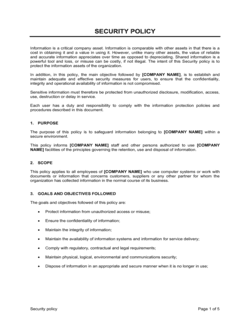
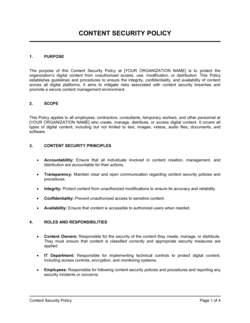
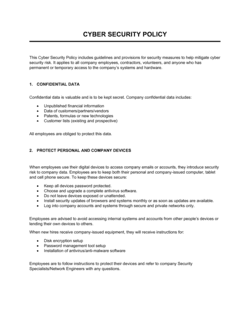
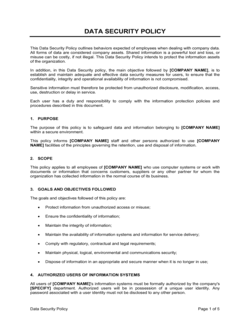
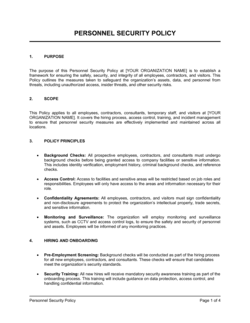
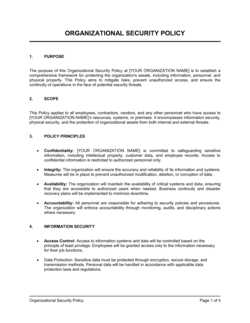
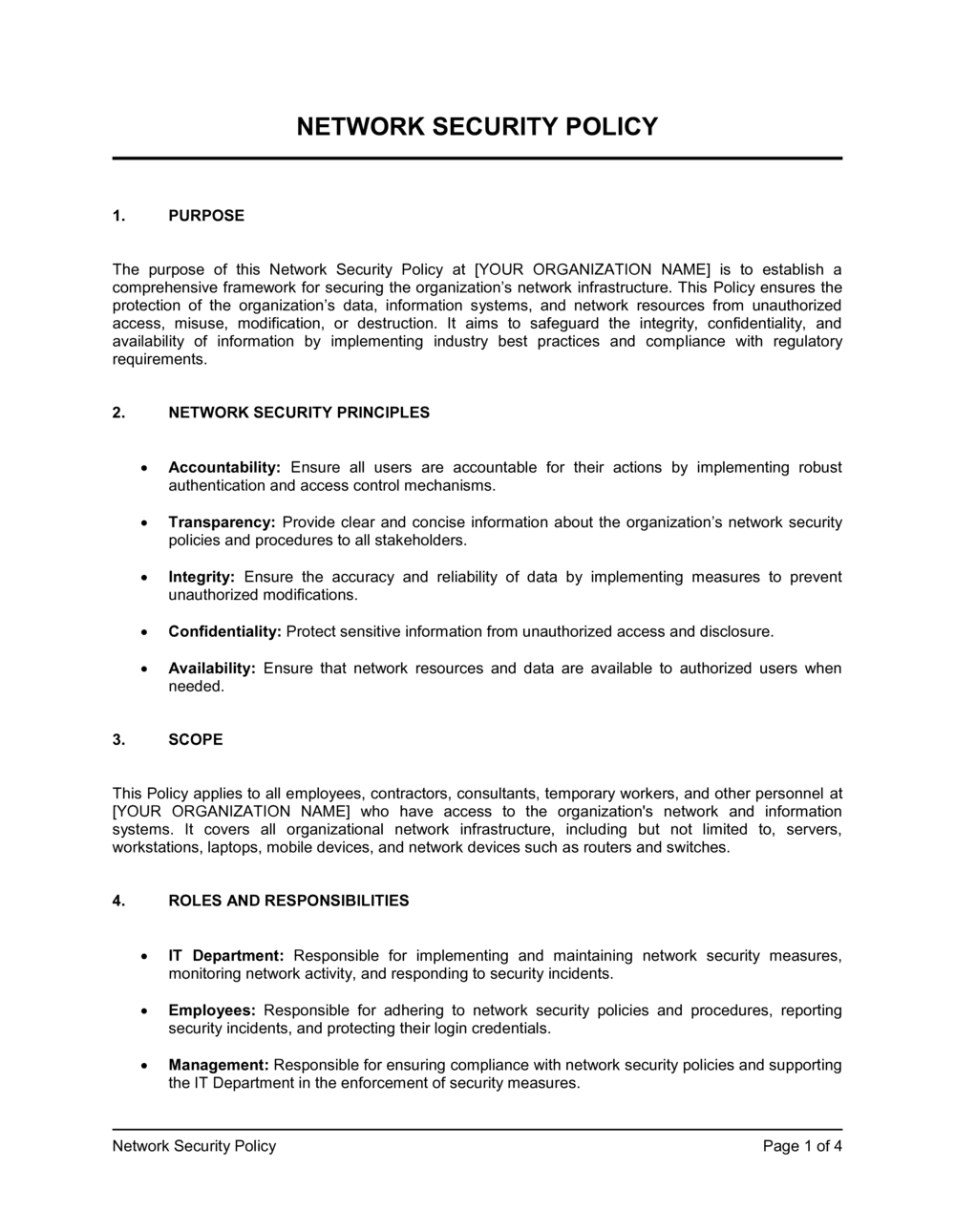
A Network Security Policy is a formal operational document that defines the rules, responsibilities, and technical controls governing how an organization protects its computer networks, systems, and data from unauthorized access, misuse, and breaches. This free Word download gives you a structured, ready-to-edit template you can customize for your organization's size, infrastructure, and compliance requirements, then export as PDF for distribution and acknowledgment.
When you need it
Use it when onboarding employees to establish baseline security expectations, when preparing for a compliance audit (SOC 2, ISO 27001, HIPAA, or PCI DSS), or when a security incident reveals that your current controls lack a written governing framework. It is also required documentation for many cyber insurance applications.
What's inside
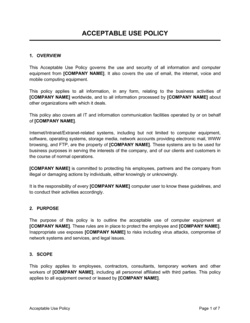
Purpose and scope, roles and responsibilities, acceptable use rules, access control requirements, data classification and handling standards, incident response procedures, remote access and VPN policy, third-party vendor requirements, and policy enforcement and review cadence.

What is a Network Security Policy?

A Network Security Policy is a formal operational document that establishes the rules, roles, and technical controls an organization uses to protect its computer networks, connected systems, and data assets from unauthorized access, misuse, disruption, and breach. It defines who can access what, under what conditions, using which approved methods β€” covering everything from password requirements and multi-factor authentication to patch management cadences, remote access protocols, and vendor security obligations. Unlike a general IT policy, a network security policy is specific enough to serve as an auditable control document for compliance frameworks including SOC 2, ISO 27001, HIPAA, and PCI DSS.

Why You Need This Document

Operating without a written network security policy leaves your organization exposed in four concrete ways. First, you have no enforceable baseline β€” employees, contractors, and vendors make individual security decisions with no documented standard to hold them to. Second, cyber insurers increasingly decline or limit coverage for organizations that cannot produce a current, signed security policy during underwriting. Third, compliance audits for SOC 2, HIPAA, and PCI DSS treat the absence of a documented policy as a significant control gap, triggering findings that delay certification and damage client trust. Fourth, when a breach occurs, the absence of a written policy makes it nearly impossible to demonstrate reasonable care to regulators, customers, or legal counsel. This template gives you a structured, immediately customizable starting point β€” so you can stop operating on informal norms and start enforcing documented, auditable standards.

Which variant fits your situation?

If your situation is…Use this template
Governing the full scope of an organization's information security programInformation Security Policy
Defining rules for employee use of company devices and the internetAcceptable Use Policy
Setting procedures for detecting and responding to security incidentsIncident Response Plan
Governing access to systems and data by third-party vendorsThird-Party Vendor Security Policy
Meeting HIPAA requirements for protecting electronic health informationHIPAA Security Policy
Establishing rules for employees working remotely or from homeRemote Work Policy
Documenting how the organization classifies and handles sensitive dataData Classification Policy

Common mistakes to avoid

❌ Scoping out cloud and remote environments

Why it matters: A policy that only addresses on-premises infrastructure leaves the most actively exploited attack surfaces β€” cloud misconfigurations and remote access endpoints β€” completely ungoverned.

Fix: Explicitly list every cloud platform, SaaS application, and remote access method in the scope section before finalizing the document.

❌ Using vague language for technical requirements

Why it matters: Requirements like 'use strong passwords' or 'keep software up to date' are unauditable and unenforceable β€” every employee interprets them differently.

Fix: Replace every qualitative standard with a specific, measurable one: minimum character counts, MFA on all remote sessions, and patch windows expressed in days.

❌ No named incident reporting contact

Why it matters: When employees don't know who to call during a suspected breach, incidents go unreported for hours or days β€” dramatically increasing the cost and scope of damage.

Fix: Include a specific email address, phone number, or helpdesk ticket URL in the incident reporting section, and test it quarterly.

❌ Never reviewing the policy after publication

Why it matters: A policy written in 2022 that hasn't been updated misses cloud-native threats, hybrid work realities, and current compliance requirements β€” and signals to auditors that security is not actively managed.

Fix: Assign a named policy owner, schedule an annual review on a fixed calendar date, and require an out-of-cycle review after any significant incident or infrastructure change.

The 10 key sections, explained

Purpose and scope

Roles and responsibilities

Acceptable use

Access control and authentication

Data classification and handling

Network security controls

Remote access and bring-your-own-device (BYOD)

Incident detection and response

Third-party and vendor security

Policy enforcement, exceptions, and review

How to fill it out

  1. 1

    Define the scope before anything else

    List every environment the policy must cover: on-premises servers, cloud platforms (AWS, Azure, Google Cloud), SaaS applications, employee devices, and contractor access. Incomplete scope is the most common gap found in security audits.

    πŸ’‘ Pull your asset inventory and cloud account list before you write the scope section β€” if a system isn't listed, it won't be protected.

  2. 2

    Assign named owners to each responsibility

    For every obligation in the policy β€” patch management, access reviews, incident reporting, vendor assessments β€” enter a specific job title or team, not a generic 'IT department.' Include escalation contacts with email addresses or ticketing system references.

    πŸ’‘ Policies with named owners are enforced at 3Γ— the rate of policies that assign responsibility to anonymous departments.

  3. 3

    Complete the data classification matrix

    List the specific data types your organization handles (customer PII, payment data, employee records, source code, financial reports) and assign each to a classification tier. Then complete the handling rules for each tier: encryption requirements, storage locations, and approved transmission methods.

    πŸ’‘ Anchor at least one concrete data example per classification tier β€” 'Restricted includes credit card numbers and Social Security numbers' is more useful than a tier definition alone.

  4. 4

    Set specific, measurable technical control requirements

    Replace vague requirements like 'use strong passwords' with specific standards: minimum 12-character passwords, MFA required for all remote access, patches applied within 30 days for critical CVEs. Auditors and insurers check for specificity, not intent.

    πŸ’‘ Align your technical standards with the CIS Controls or NIST SP 800-53 framework β€” both are free and widely accepted as audit benchmarks.

  5. 5

    Document the incident reporting path

    Write a single, clear reporting chain: who employees call or email when they suspect an incident, what information to include, and what happens within the first 4 hours. Include a 24/7 contact method if your organization handles sensitive data.

    πŸ’‘ Run a tabletop exercise after publishing the policy β€” ask three employees to describe how they would report a phishing email. If they can't, the reporting path needs to be clearer.

  6. 6

    Add vendor security requirements and link to your agreements

    Enter the minimum security standards vendors must meet, the documentation they must provide (SOC 2 report, pen test results, security questionnaire), and reference the Data Processing Agreement or Vendor Security Addendum they must sign.

    πŸ’‘ Maintain a vendor inventory spreadsheet and cross-reference it with this section β€” it will save you hours during your next compliance audit.

  7. 7

    Set the review cadence and assign a policy owner

    Enter the annual review date, assign a named policy owner by job title, and specify that any material incident or significant infrastructure change triggers an out-of-cycle review.

    πŸ’‘ Add the annual review date to the policy owner's calendar immediately upon publication β€” no reminder means no review.

  8. 8

    Distribute and collect acknowledgments

    Send the finalized policy to all employees, contractors, and relevant vendors with a required acknowledgment (email confirmation or signature). Store acknowledgment records for at least 3 years to demonstrate compliance during audits.

    πŸ’‘ Include network security policy acknowledgment in your employee onboarding checklist so new hires sign it before they receive system access.

Frequently asked questions

What is a network security policy?

A network security policy is a formal document that defines the rules, responsibilities, and technical controls an organization uses to protect its computer networks, systems, and data from unauthorized access, misuse, and breaches. It covers access control, acceptable use, data classification, incident response, remote access, and vendor security requirements. It functions as the governing framework that all other security procedures and configurations should align to.

Who needs a network security policy?

Any organization that stores, processes, or transmits sensitive data needs a written network security policy. This includes small businesses handling customer payment data, healthcare organizations subject to HIPAA, companies processing personal data under GDPR, and any business applying for cyber liability insurance. Most compliance frameworks β€” SOC 2, ISO 27001, PCI DSS, and HIPAA β€” require a documented security policy as a prerequisite to certification.

What is the difference between a network security policy and an acceptable use policy?

A network security policy is the comprehensive governing document covering all technical controls, roles, data handling, incident response, and vendor requirements across the organization's entire network environment. An acceptable use policy (AUP) is a focused sub-document that defines specifically what employees may and may not do with company-owned systems and network connections. The AUP is typically a section within the broader network security policy, though some organizations publish it separately for easier employee distribution and acknowledgment.

Is a network security policy required by law?

No single law universally mandates a network security policy, but several regulations effectively require one. HIPAA requires covered entities to implement documented security policies protecting electronic PHI. PCI DSS Requirement 12 explicitly mandates a security policy that addresses all DSS requirements. GDPR requires documented technical and organizational measures. SOC 2 Type II audits treat the absence of a written policy as a significant control gap. Cyber insurers increasingly require evidence of a current, signed security policy before issuing or renewing coverage.

How long should a network security policy be?

For most small to mid-size organizations, 8–15 pages covers the core sections adequately. Larger enterprises or those subject to multiple compliance frameworks often maintain a master policy of 20–30 pages supplemented by separate procedure documents for specific controls. Avoid the temptation to make the policy exhaustive β€” a focused, readable 10-page document that employees actually follow is more effective than a 60-page document no one reads.

How often should a network security policy be reviewed?

At minimum, review the policy annually and update it to reflect changes in infrastructure, compliance requirements, and the threat landscape. Also trigger an out-of-cycle review after any material security incident, a significant change in cloud or network architecture, a merger or acquisition, or entry into a new regulatory jurisdiction. Assign a named policy owner β€” not a generic IT team β€” to ensure the review actually happens.

What technical standards should a network security policy reference?

The most widely accepted benchmarks are the CIS Controls (formerly the SANS Top 20), NIST SP 800-53, and the ISO/IEC 27001 Annex A control set. For cloud environments, CIS Benchmarks for AWS, Azure, and GCP provide specific configuration standards. Aligning your policy language to one of these frameworks makes compliance audits significantly faster and gives auditors a recognized baseline against which to measure your controls.

Does a network security policy need to be signed by employees?

Yes β€” obtaining written or electronic acknowledgment from all employees and relevant contractors is a best practice required by most compliance frameworks. Acknowledgment confirms the individual received, read, and agrees to comply with the policy. Store acknowledgment records for at least three years. Incorporate acknowledgment into the onboarding checklist so new hires sign before receiving system access credentials.

What is the difference between a network security policy and an incident response plan?

A network security policy establishes the preventive rules and controls that govern everyday network use and access. An incident response plan is a procedural document that activates when a breach or security event occurs, detailing specific steps for detection, containment, eradication, recovery, and post-incident review. The network security policy should reference the incident response plan and define the threshold and reporting path that triggers it, but the two documents serve distinct purposes.

How this compares to alternatives

vs Information Security Policy

An information security policy governs the full scope of an organization's information assets β€” including physical security, personnel security, and business continuity β€” beyond just network infrastructure. A network security policy focuses specifically on network access controls, perimeter defenses, remote access, and connected device security. Larger organizations maintain both; smaller organizations often combine them into a single document.

vs Acceptable Use Policy

An acceptable use policy is an employee-facing document defining what is and is not permitted when using company systems and network connections. A network security policy is the broader governing framework that includes technical controls, vendor requirements, incident response, and data classification in addition to acceptable use rules. The AUP is typically a section within the network security policy or a standalone document derived from it.

vs Incident Response Plan

A network security policy establishes preventive controls and everyday rules for network use. An incident response plan is a reactive procedural document that activates when a security event occurs. The two documents work together β€” the security policy defines the controls and reporting thresholds; the incident response plan prescribes the step-by-step actions that follow when those thresholds are crossed.

vs Data Classification Policy

A data classification policy defines how an organization categorizes its data by sensitivity and specifies the handling, storage, and disposal rules for each tier. A network security policy references data classification standards to determine which controls apply to which data flows and storage environments. Organizations subject to multiple data privacy regulations often publish the data classification policy as a standalone document that is incorporated by reference into the network security policy.

Industry-specific considerations

Healthcare

HIPAA Security Rule requires documented policies covering electronic PHI access controls, audit logging, encryption, and breach notification procedures.

Financial Services

PCI DSS, SOX, and GLBA each impose specific network security documentation requirements; cardholder data environments require network segmentation with documented evidence.

SaaS / Technology

SOC 2 Type II audits treat the network security policy as a foundational control; customer contracts increasingly require vendors to provide a copy of their current policy.

Professional Services

Law firms, accounting firms, and consultancies handling client confidential data face client-driven security questionnaires that require a documented and current network security policy.

Template vs pro β€” what fits your needs?

PathBest forCostTime
Use the templateSmall to mid-size businesses establishing a written security policy for the first time or for cyber insurance applicationsFree3–6 hours to customize and finalize
Template + professional reviewOrganizations preparing for SOC 2, ISO 27001, or HIPAA audits where the policy must align to a specific control framework$500–$2,000 for an IT security consultant or vCISO review1–2 weeks
Custom draftedEnterprises in regulated industries (healthcare, financial services, government contracting) with complex multi-environment infrastructure and formal audit obligations$3,000–$15,000 for a full security assessment and policy suite4–8 weeks

Glossary

Access Control
The practice of restricting who can view, modify, or use specific systems and data based on defined roles and permissions.
Acceptable Use Policy (AUP)
A component of the network security policy that specifies what employees may and may not do with company-owned systems, devices, and network connections.
Multi-Factor Authentication (MFA)
A login method requiring users to verify their identity with two or more independent credentials β€” typically a password plus a phone-based code or biometric.
Least Privilege Principle
The practice of granting each user only the minimum system access needed to perform their job function, reducing the damage potential of compromised accounts.
VPN (Virtual Private Network)
An encrypted tunnel that extends a private network over a public internet connection, used to secure remote access to company systems.
Data Classification
A framework that categorizes data by sensitivity β€” typically Public, Internal, Confidential, and Restricted β€” to determine appropriate handling and protection requirements.
Incident Response
The structured process an organization follows when a security event occurs, covering detection, containment, eradication, recovery, and post-incident review.
Patch Management
The systematic process of applying software updates and security fixes to operating systems, applications, and firmware to close known vulnerabilities.
Penetration Testing
An authorized simulated cyberattack on a system or network, performed to identify exploitable vulnerabilities before a real attacker does.
Zero Trust Architecture
A security model that assumes no user or device is inherently trusted, requiring continuous verification for every access request regardless of network location.

Part of your Business Operating System

This document is one of 3,000+ business & legal templates included in Business in a Box.

  • Fill-in-the-blanks β€” ready in minutes
  • 100% customizable Word document
  • Compatible with all office suites
  • Export to PDF and share electronically

Create your document in 3 simple steps.

From template to signed document β€” all inside one Business Operating System.
1
Download or open template

Access over 3,000+ business and legal templates for any business task, project or initiative.

2
Edit and fill in the blanks with AI

Customize your ready-made business document template and save it in the cloud.

3
Save, Share, Send, Sign

Share your files and folders with your team. Create a space of seamless collaboration.

Save time, save money, and create top-quality documents.

β˜…β˜…β˜…β˜…β˜…

"Fantastic value! I'm not sure how I'd do without it. It's worth its weight in gold and paid back for itself many times."

Managing Director Β· Mall Farm
Robert Whalley
Managing Director, Mall Farm Proprietary Limited
β˜…β˜…β˜…β˜…β˜…

"I have been using Business in a Box for years. It has been the most useful source of templates I have encountered. I recommend it to anyone."

Business Owner Β· 4+ years
Dr Michael John Freestone
Business Owner
β˜…β˜…β˜…β˜…β˜…

"It has been a life saver so many times I have lost count. Business in a Box has saved me so much time and as you know, time is money."

Owner Β· Upstate Web
David G. Moore Jr.
Owner, Upstate Web

Run your business with a system β€” not scattered tools

Stop downloading documents. Start operating with clarity. Business in a Box gives you the Business Operating System used by over 250,000 companies worldwide to structure, run, and grow their business.

Start freeΒ Β·Β No credit card required