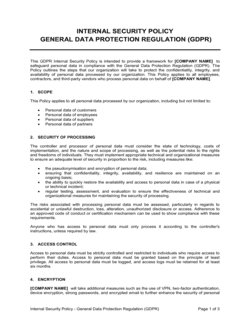
GDPR Security Policy Template

Free Word download β€’ Edit online β€’ Save & share with Drive β€’ Export to PDF

3 pagesβ€’20–25 min to fillβ€’Difficulty: Standard
Learn more ↓
FreeGDPR Security Policy Template

At a glance

What it is
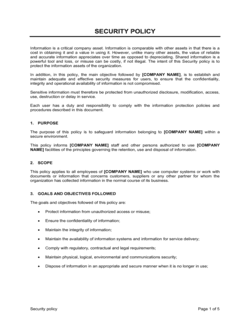
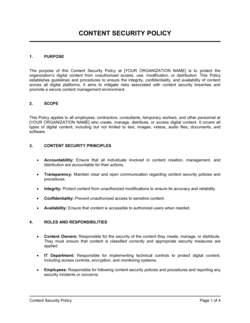
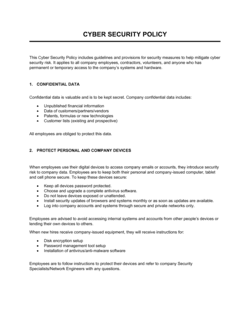
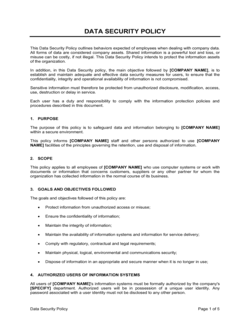
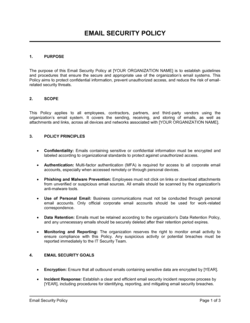
A GDPR Security Policy is a formal written document that defines how an organisation protects personal data in compliance with Article 32 of the General Data Protection Regulation. This free Word download gives you a structured, editable template covering technical and organisational measures, access controls, breach response, and staff responsibilities β€” ready to export as PDF and share with regulators, clients, or auditors.
When you need it
Use it when your organisation processes personal data belonging to EU or UK residents, when a client's data processing agreement requires evidence of security controls, or when preparing for a supervisory authority audit or ISO 27001 gap assessment.
What's inside
Policy scope and objectives, data classification framework, technical and organisational security measures, access control and authentication requirements, data breach detection and notification procedures, staff training obligations, third-party processor requirements, and policy review schedule.

What is a GDPR Security Policy?

A GDPR Security Policy is a formal written document that defines the technical and organisational measures an organisation has implemented to protect personal data in compliance with Article 32 of the General Data Protection Regulation. It covers the full security framework governing personal data: encryption standards, access control rules, vulnerability management, data breach detection and response procedures, staff training requirements, and the security obligations imposed on third-party processors. Unlike a broad Data Protection Policy, which addresses all GDPR principles, a Security Policy focuses specifically on the security dimension β€” translating the regulation's risk-based requirements into documented, auditable controls that apply to every person and system that touches personal data.

Why You Need This Document

Without a written GDPR Security Policy, your organisation cannot demonstrate the accountability that Article 5(2) requires β€” and in a regulatory investigation or client due diligence process, the absence of documentation is treated as evidence of non-compliance, not neutral ground. Supervisory authorities such as the ICO and CNIL routinely request security policies when investigating breaches; organisations that cannot produce one face increased fines and enforcement scrutiny. Enterprise clients and procurement teams now require a documented security policy as a standard condition before signing data processing agreements. On the operational side, undocumented security controls are inconsistently applied β€” staff make ad hoc decisions about access, storage, and breach escalation that contradict each other and create exploitable gaps. This template gives you a structured, regulation-aligned starting point that you can adapt to your systems and processing activities in a matter of hours, establishing the documented baseline that regulators, clients, and auditors expect to see.

Which variant fits your situation?

If your situation is…Use this template
Establishing a broad internal data protection frameworkGDPR Data Protection Policy
Documenting lawful bases and data flows across the businessGDPR Compliance Checklist
Managing an active personal data breach incidentData Breach Response Plan
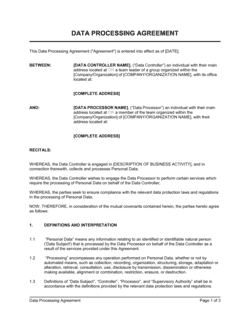
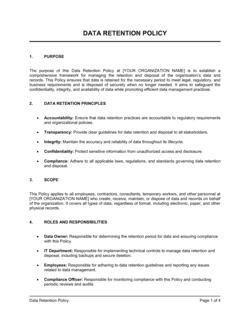
Setting rules for how long personal data is retained and deletedData Retention Policy
Controlling access by third-party vendors to personal dataData Processing Agreement
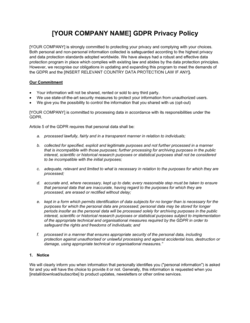
Communicating data rights to website visitors and customersPrivacy Policy
Documenting security controls for ISO 27001 or SOC 2 alignmentInformation Security Policy

Common mistakes to avoid

❌ Documenting aspirational controls rather than implemented ones

Why it matters: A policy describing controls that are not yet in place creates a compliance gap on day one β€” if a breach occurs, regulators will measure your actual security against your stated policy and find the two inconsistent.

Fix: Audit your current technical and organisational measures before drafting. Only document controls that are already operational; move planned controls to a separate implementation roadmap.
❌ Starting the 72-hour breach clock from confirmation rather than awareness

Why it matters: GDPR Article 33 starts the clock when the controller 'becomes aware' of a breach β€” not when it is confirmed. Misreading this leads to late notifications, which regulators treat as an aggravating factor in fine calculations.

Fix: Update your breach procedure to state explicitly that the 72-hour window opens the moment a suspected breach is reported internally, and start the assessment process immediately.

❌ Omitting third-party processor requirements

Why it matters: Controllers are liable for breaches caused by processors acting under their instructions. A policy that only governs internal staff leaves the highest-risk attack surface β€” third-party SaaS tools, cloud providers, and outsourced services β€” completely unaddressed.

Fix: Add a vendor security section requiring a signed DPA, a completed security assessment, and a defined breach notification obligation before any processor receives personal data.

❌ No periodic access review process

Why it matters: Without scheduled access reviews, former employees, transferred staff, and over-privileged accounts accumulate over time β€” creating exactly the kind of unauthorised access risk GDPR Article 32 requires organisations to prevent.

Fix: Define a specific review cadence β€” quarterly for privileged accounts, every 180 days for standard users β€” and assign a named owner responsible for running each review and documenting the outcome.

The 9 key sections, explained

Policy scope and objectives

Data classification framework

Technical security measures

Organisational security measures

Access control and authentication

Data breach detection and notification

Staff training and awareness

Third-party processor security requirements

Policy review and version control

How to fill it out

  1. 1

    Define the scope and link to your processing activities

    Identify every system, location, and category of personal data in scope. Cross-reference your Records of Processing Activities (ROPA) to ensure the policy covers every processing operation your organisation conducts.

    πŸ’‘ If you do not yet have a ROPA, completing one before drafting this policy will save you significant rework β€” the ROPA reveals exactly which systems and data types need to be addressed.

  2. 2

    Classify your data by sensitivity tier

    Map each category of personal data you process to a sensitivity tier and assign baseline security requirements. Make sure special category data under GDPR Article 9 β€” health, biometric, racial origin β€” is in the highest tier with the strongest controls.

    πŸ’‘ Keep the tiers to three levels maximum. More than three tiers creates operational confusion and leads to inconsistent application by staff.

  3. 3

    Document implemented technical controls β€” not aspirational ones

    List the encryption standards, endpoint protection tools, patch management cadence, and network security measures currently in operation. Specify product names, versions, and configuration standards where relevant.

    πŸ’‘ Write this section in the past tense ('data in transit is encrypted') rather than future tense ('data will be encrypted') β€” regulators read future tense as evidence the control is not yet in place.

  4. 4

    Set access control rules and an authentication standard

    Define the least-privilege principle as the default access model, specify MFA requirements for remote and high-risk system access, and document the joiner/mover/leaver process for provisioning and revoking access rights.

    πŸ’‘ State a specific revocation timeline β€” '24 hours of departure' is defensible; 'promptly' is not.

  5. 5

    Write the breach response procedure with clear timelines

    Map the internal escalation path from initial detection through containment, DPO assessment, regulatory notification, and individual notification. Assign a named role β€” not just a job title β€” to each step.

    πŸ’‘ Pre-populate the supervisory authority's online breach notification portal URL and your ICO/CNIL account details in the appendix so the team is not searching for them during an incident.

  6. 6

    Specify training requirements and record-keeping

    State the training format (e-learning, live session, or workshop), the completion deadline for new starters, the annual refresh requirement, and where completion records are stored.

    πŸ’‘ Tie training records to a named HR or LMS field so you can export a completion report in minutes during an audit β€” a manual spreadsheet is a significant audit liability.

  7. 7

    Assign policy ownership and set a review date

    Name the DPO or IT manager responsible for annual review, set the next review date on the cover page, and define the triggers for an out-of-cycle update (breach, new system, law change).

    πŸ’‘ Add the annual review as a recurring calendar event at publication β€” policies that miss their review date are treated by regulators as evidence of a non-functional compliance programme.

Frequently asked questions

What is a GDPR Security Policy?

A GDPR Security Policy is a formal written document that describes the technical and organisational measures an organisation has implemented to protect personal data in compliance with Article 32 of the General Data Protection Regulation. It covers encryption standards, access controls, breach response procedures, staff training requirements, and third-party processor obligations. Regulators, enterprise clients, and auditors use it as evidence that an organisation takes data security seriously.

Is a GDPR Security Policy legally required?

Article 32 of the GDPR requires controllers and processors to implement appropriate technical and organisational security measures, but it does not prescribe a single document format. In practice, supervisory authorities expect a written policy as part of the accountability evidence required under Article 5(2). Organisations without a documented policy face difficulty demonstrating compliance during audits and are more exposed to enforcement action following a breach.

What is the difference between a GDPR Security Policy and a GDPR Data Protection Policy?

A Data Protection Policy is a broader governance document covering all GDPR principles β€” lawful bases, data subject rights, retention, and accountability. A Security Policy focuses specifically on Article 32 technical and organisational measures: how data is protected from unauthorised access, alteration, or loss. Most organisations need both β€” the Security Policy implements the security obligations referenced in the broader Data Protection Policy.

Does a GDPR Security Policy need to cover third-party processors?

Yes. Controllers are responsible under Article 28 for ensuring that processors provide sufficient guarantees of appropriate security measures. A Security Policy that governs only internal staff but does not address vendor and processor requirements leaves a significant compliance gap. The policy should require a signed Data Processing Agreement and a minimum security baseline before any processor receives personal data.

What technical measures should a GDPR Security Policy document?

Article 32 lists pseudonymisation and encryption, the ability to ensure ongoing confidentiality, integrity, availability, and resilience of processing systems, and the ability to restore data after an incident. In practice, this translates to documented encryption standards (TLS version, AES key length), endpoint protection, vulnerability management cadence, patch timelines, network segmentation, and secure backup procedures.

How often should a GDPR Security Policy be reviewed?

Annual review is the standard expectation for most organisations. An out-of-cycle review is required following a data breach, a significant change to processing systems or data flows, a relevant change in applicable law, or a failed audit finding. The review date and version number should appear on the cover page, and all staff with access to personal data should acknowledge the current version within 30 days of publication.

Does the GDPR Security Policy apply to UK organisations post-Brexit?

Yes. The UK retained the GDPR in domestic law as the UK GDPR, which mirrors the EU GDPR's Article 32 security requirements. UK organisations processing personal data of UK residents are subject to UK GDPR and ICO oversight. Organisations that also process EU resident data must additionally comply with EU GDPR β€” in practice, a single policy addressing both is typically sufficient.

Who should own the GDPR Security Policy?

Ownership typically sits with the Data Protection Officer, where one is appointed, in collaboration with the IT Manager or CISO. For smaller organisations without a dedicated DPO, the policy owner is usually the person with day-to-day responsibility for data protection compliance β€” often the COO or IT lead. The owner is responsible for annual review, incident-triggered updates, and ensuring staff acknowledge the current version.

Can a GDPR Security Policy be used as evidence in a regulatory investigation?

Yes β€” and this is one of its primary purposes. Supervisory authorities routinely request copies of security policies when investigating data breaches or responding to complaints. A well-maintained, dated, and version-controlled policy that accurately reflects implemented controls is evidence of the accountability principle under Article 5(2). A missing, outdated, or aspirational policy, by contrast, is treated as an aggravating factor and can increase the severity of any fine issued.

How this compares to alternatives

vs GDPR Data Protection Policy

A Data Protection Policy is a broad governance document covering all six GDPR principles, lawful bases, data subject rights, and accountability obligations. A GDPR Security Policy focuses specifically on Article 32 technical and organisational measures. Most organisations need both β€” the Data Protection Policy sets the framework; the Security Policy implements the security layer within it.

vs Data Processing Agreement

A Data Processing Agreement is a contract between a controller and a processor that governs how the processor handles personal data on the controller's behalf, as required by Article 28. A GDPR Security Policy is an internal governance document describing the organisation's own security controls. The DPA references the controller's security standards; the Security Policy defines what those standards are.

vs Data Retention Policy

A Data Retention Policy governs how long personal data is kept and the process for secure deletion β€” addressing the storage limitation principle under Article 5(1)(e). A GDPR Security Policy governs how data is protected while it is being held. Both are needed: secure deletion is one technical measure within the Security Policy's scope, but the retention schedule itself belongs in a separate document.

vs Information Security Policy

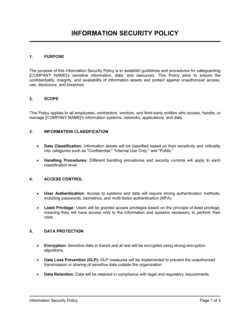
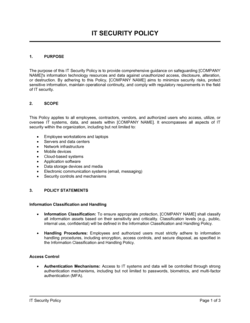
An Information Security Policy is a broader IT governance document covering all organisational data β€” confidential business information, intellectual property, and financial records β€” not just personal data subject to GDPR. A GDPR Security Policy is scoped specifically to personal data and maps its controls to GDPR Article 32. Organisations subject to ISO 27001 or SOC 2 typically maintain both, with the GDPR Security Policy as a supplementary annex to the broader IS Policy.

Industry-specific considerations

SaaS / Technology

B2B SaaS vendors routinely face client security questionnaires requiring a documented GDPR Security Policy as a condition of contract signature.

Healthcare

Health data is special category data under Article 9, requiring enhanced security measures and explicit documentation of controls governing electronic health records and diagnostic systems.

Financial Services

Overlapping requirements from PCI DSS, FCA expectations, and GDPR mean financial services firms need a security policy that explicitly maps to each regulatory framework.

Retail / E-commerce

Large volumes of customer transaction data, cookie data, and marketing profiles make e-commerce operators a frequent target of supervisory authority investigations and enforcement.

Professional Services

Law firms, accountants, and consultancies process confidential client personal data under professional secrecy obligations that align directly with GDPR Article 32 requirements.

HR / Staffing

Employee data β€” payroll, performance records, health information β€” is among the most sensitive personal data an organisation processes, making a documented security policy essential for HR platforms and staffing agencies.

Template vs pro β€” what fits your needs?

PathBest forCostTime
Use the templateSMEs, startups, and non-regulated organisations that need a documented Article 32 policy without dedicated legal or security staffFree2–4 hours
Template + professional reviewOrganisations in regulated industries, those processing special category data, or those facing imminent client due diligence or an ICO audit$300–$1,000 for a DPO or data protection solicitor review3–5 days
Custom draftedLarge enterprises, data processors handling EU and UK data at scale, or organisations building GDPR into an ISO 27001 or SOC 2 programme$2,000–$8,000 for a specialist data protection consultancy2–6 weeks

Glossary

Article 32
The GDPR provision requiring controllers and processors to implement technical and organisational measures appropriate to the risk of processing personal data.
Personal Data
Any information that relates to an identified or identifiable living individual β€” including names, email addresses, IP addresses, and location data.
Data Controller
The organisation that determines the purposes and means of processing personal data and bears primary accountability under the GDPR.
Data Processor
A third party that processes personal data on behalf of a controller, under a written data processing agreement.
Pseudonymisation
Processing personal data so it can no longer be attributed to a specific individual without additional separately stored information.
Data Breach
A security incident that results in accidental or unlawful destruction, loss, alteration, or unauthorised disclosure of personal data.
Technical and Organisational Measures (TOMs)
The combined set of IT security controls and internal procedures an organisation uses to protect personal data β€” the core deliverable of an Article 32 policy.
Data Protection Impact Assessment (DPIA)
A structured process to identify and minimise data protection risks before starting a high-risk processing activity.
Accountability Principle
The GDPR requirement that controllers not only comply with the regulation but are able to demonstrate that compliance through documented evidence.
Supervisory Authority
The national data protection regulator β€” such as the ICO in the UK or the CNIL in France β€” that enforces GDPR obligations and can issue fines.

Part of your Business Operating System

This document is one of 3,000+ business & legal templates included in Business in a Box.

  • Fill-in-the-blanks β€” ready in minutes
  • 100% customizable Word document
  • Compatible with all office suites
  • Export to PDF and share electronically

Create your document in 3 simple steps.

From template to signed document β€” all inside one Business Operating System.
1
Download or open template

Access over 3,000+ business and legal templates for any business task, project or initiative.

2
Edit and fill in the blanks with AI

Customize your ready-made business document template and save it in the cloud.

3
Save, Share, Send, Sign

Share your files and folders with your team. Create a space of seamless collaboration.

Save time, save money, and create top-quality documents.

β˜…β˜…β˜…β˜…β˜…

"Fantastic value! I'm not sure how I'd do without it. It's worth its weight in gold and paid back for itself many times."

Managing Director Β· Mall Farm
Robert Whalley
Managing Director, Mall Farm Proprietary Limited
β˜…β˜…β˜…β˜…β˜…

"I have been using Business in a Box for years. It has been the most useful source of templates I have encountered. I recommend it to anyone."

Business Owner Β· 4+ years
Dr Michael John Freestone
Business Owner
β˜…β˜…β˜…β˜…β˜…

"It has been a life saver so many times I have lost count. Business in a Box has saved me so much time and as you know, time is money."

Owner Β· Upstate Web
David G. Moore Jr.
Owner, Upstate Web

Run your business with a system β€” not scattered tools

Stop downloading documents. Start operating with clarity. Business in a Box gives you the Business Operating System used by over 250,000 companies worldwide to structure, run, and grow their business.

Free Forever PlanΒ Β·Β No credit card required