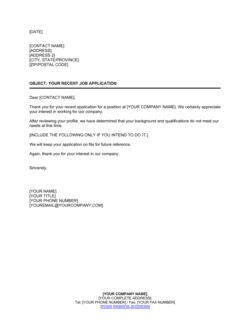
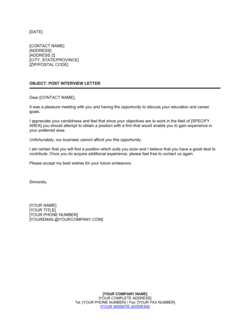
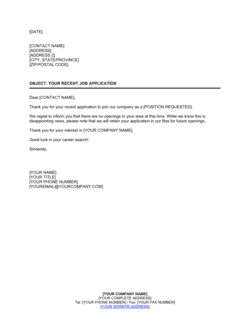
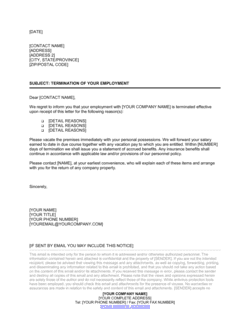
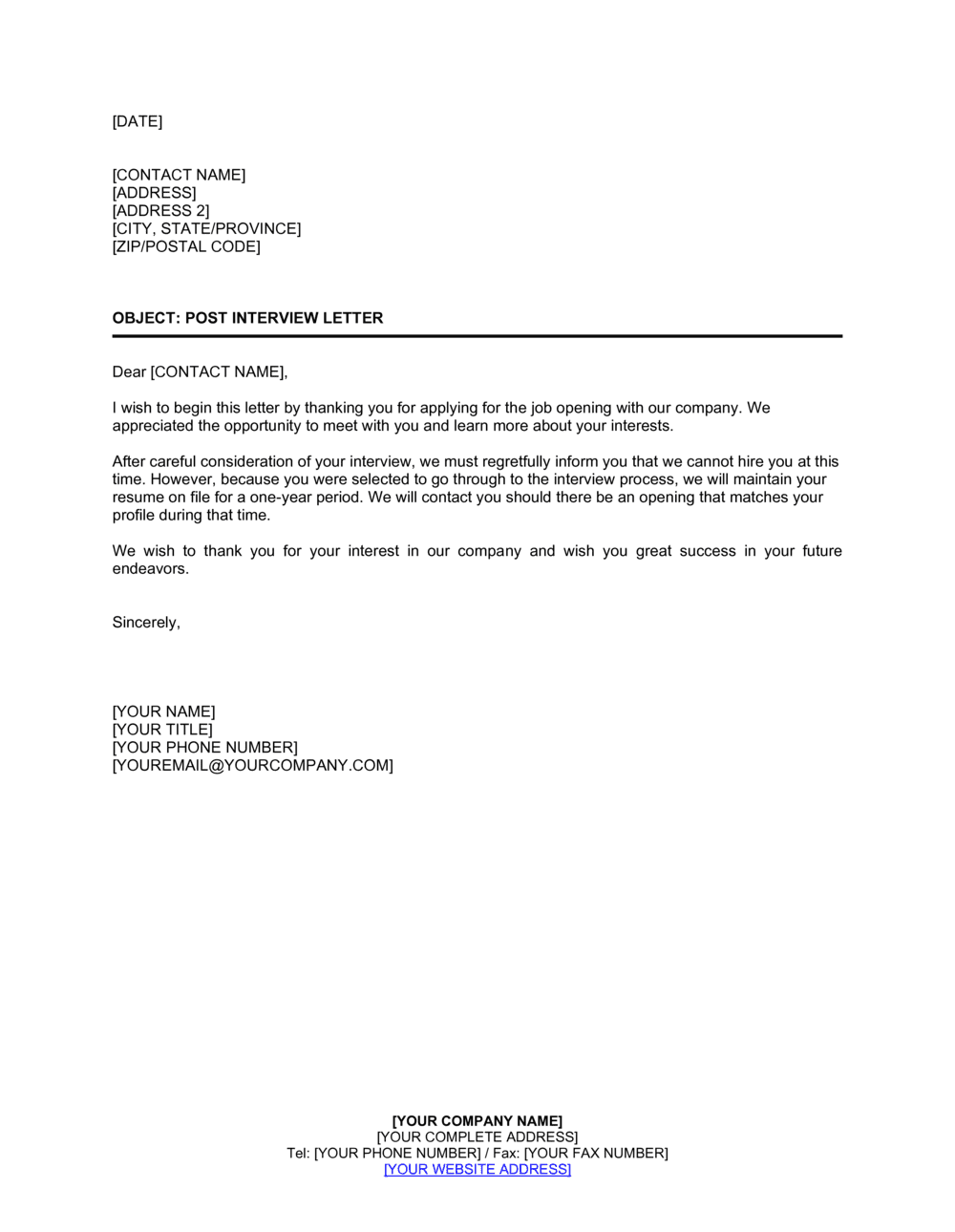
Negative Response to Job Candidate_Postinterview Template

Free Word download β€’ Edit online β€’ Save & share with Drive β€’ Export to PDF

1 pageβ€’20–25 min to fillβ€’Difficulty: Standardβ€’Signature requiredβ€’Legal review recommended
Learn more ↓
FreeNegative Response to Job Candidate_Postinterview Template

At a glance

What it is
A Negative Response to Job Candidate Post-Interview is a formal written communication an employer sends to an interviewed candidate to inform them they have not been selected for the position. This free Word download gives HR teams and hiring managers a legally defensible, professionally worded template they can edit online and export as PDF β€” closing the hiring loop without creating discrimination liability or contractual obligations.
When you need it
Use it immediately after a hiring decision is made for any candidate who completed at least one interview, whether in-person, by phone, or by video. Sending a timely, written notice protects the employer legally and preserves the candidate's experience with your brand.
What's inside
Employer and candidate identification, reference to the specific role and interview date, a clear declination statement, optional brief rationale, a goodwill close, and a signature block. Each element is drafted to avoid language that could be construed as discriminatory or as an implied promise of future employment.

What is a Negative Response to Job Candidate Post-Interview?

A Negative Response to Job Candidate Post-Interview is a formal written communication an employer sends to a job candidate who has completed one or more interviews but has not been selected for the position. Unlike an informal email or a verbal "we'll be in touch," this document provides a clear, signed, legally defensible record of the employer's hiring decision β€” identifying both parties, referencing the specific role and interview, stating the declination directly, and closing professionally. Because the candidate has already invested significant time in the process, the letter's language must be precise: it closes the application without creating an implied future employment obligation, without referencing protected characteristics, and without contradicting the documented selection criteria used to make the decision.

Why You Need This Document

Failing to send a written post-interview rejection β€” or sending one with careless language β€” exposes your organization on two fronts simultaneously. Legally, a rejected candidate who belongs to a protected class and receives no written communication, or receives a letter with language that references personal observations rather than documented job criteria, has a stronger foundation for an EEOC complaint or employment tribunal claim. Practically, candidates who interview and hear nothing consistently post negative employer-brand reviews that your future hires will read. A clearly worded, promptly delivered rejection letter demonstrates that your hiring process is fair, documented, and respectful β€” which is the first line of defense in any discrimination inquiry and the single most cost-effective investment in your employer reputation. This template gives HR teams and hiring managers a legally reviewed, neutral starting point they can deploy in under ten minutes, with the structure and language already calibrated to minimize liability across multiple jurisdictions.

Which variant fits your situation?

If your situation is…Use this template
Declining a candidate after a first-round phone or video screenNegative Response to Job Candidate (Pre-Interview)
Declining a candidate after a multi-round final interviewNegative Response to Job Candidate Post-Interview
Declining an internal employee who applied for a promotionInternal Candidate Rejection Letter
Placing a candidate on hold for a future openingCandidate Hold Letter
Rescinding an offer already extended to a candidateJob Offer Rescission Letter
Declining a candidate after a resume review with no interviewNegative Response to Job Application Letter
Sending a rejection with an invitation to apply for a different roleRejection with Alternate Role Referral Letter

Common mistakes to avoid

❌ Referencing protected characteristics in the rationale

Why it matters: Even a complimentary reference to age, accent, appearance, or cultural background in a rejection letter can be cited as direct evidence of discriminatory intent in an EEOC complaint or employment tribunal claim.

Fix: Limit any rationale to documented, job-related criteria β€” specific skills, years of experience in a defined area, or a required certification. If in doubt, omit the rationale entirely.

❌ Sending a rejection weeks after the interview with no interim communication

Why it matters: Long delays signal disrespect for the candidate's time and consistently generate negative employer-brand reviews on platforms like Glassdoor, which prospective candidates and future hires read.

Fix: Establish an internal SLA of 48–72 hours from hiring decision to rejection letter. Automate a holding message at the 5-business-day mark if the decision is still pending.

❌ Using vague language that implies a future commitment

Why it matters: Phrases like 'not at this time' or 'we will definitely keep you in mind' can be interpreted as a promise of future consideration β€” and when that candidate applies again and is declined, the inconsistency can appear pretextual.

Fix: Use definitive language for the current decision ('we have decided to move forward with another candidate') and conditional language for any future reference ('if a suitable opportunity arises, we may be in touch').

❌ Signing as 'The Hiring Team' without an individual's name

Why it matters: Anonymous rejections feel dismissive and, in jurisdictions that require a signed written communication, may not satisfy the formal requirement. They also prevent the candidate from knowing who to address if they have a legitimate follow-up query.

Fix: Always include an individual's full name, title, and direct contact information in the signature block β€” even if that person is an HR coordinator rather than the hiring manager.

❌ Storing rejection letters separately from the candidate's application file

Why it matters: If a discrimination claim is filed, you need to produce the full hiring record β€” application, interview notes, and rejection letter β€” as a single coherent file. Fragmented records look like incomplete or altered documentation.

Fix: Attach the sent rejection letter to the candidate's record in your ATS or HR system at the time of sending, and retain it for the jurisdiction-required period (minimum 1 year in the US under EEOC record-retention rules).

❌ Providing verbal feedback that contradicts the written letter

Why it matters: If a recruiter calls a candidate to soften the blow and says something inconsistent with the written letter β€” or reveals a selection rationale not in the letter β€” the verbal communication can be introduced as evidence in a discrimination claim.

Fix: Align all verbal and written communications before either is delivered. If you offer verbal feedback, script it from the same documented, job-criteria-based rationale used in the letter.

The 8 key clauses, explained

Date and Employer Identification

In plain language: States the date the letter is issued and identifies the employer β€” full legal entity name, address, and the name and title of the signatory.

Sample language
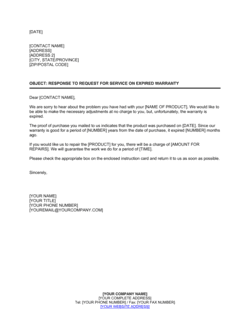
[DATE] | [EMPLOYER LEGAL NAME] | [ADDRESS] | [CITY, STATE, ZIP] | [SIGNATORY NAME], [TITLE]

Common mistake: Using a personal email address or informal name instead of the company's official letterhead details β€” this weakens the document's standing as official employer correspondence.

Candidate Identification and Role Reference

In plain language: Addresses the candidate by full name and references the specific position title and the date(s) of the interview, so there is no ambiguity about which application is being declined.

Sample language
Dear [CANDIDATE FULL NAME], Thank you for taking the time to interview for the position of [JOB TITLE] on [INTERVIEW DATE(S)].

Common mistake: Omitting the interview date or using a generic 'recent interview' reference. If the candidate applied for multiple roles, this creates confusion and can look careless or dismissive.

Clear Declination Statement

In plain language: A direct, unambiguous sentence informing the candidate they have not been selected for the role. Vague language increases the risk of misunderstanding and potential legal disputes.

Sample language
After careful consideration, we have decided to move forward with another candidate whose qualifications more closely match the requirements of the role at this time.

Common mistake: Using language like 'we have decided not to proceed with your application at this time' without clarity on what 'at this time' means β€” candidates may interpret this as a future commitment.

Neutral Rationale Statement (Optional)

In plain language: A brief, job-criteria-based explanation for the decision. When included, it must refer only to qualifications, experience, or skills β€” never to personal characteristics.

Sample language
We were seeking a candidate with [SPECIFIC SKILL OR EXPERIENCE LEVEL] in [AREA], which was identified as a critical requirement for this role.

Common mistake: Providing a rationale that references personal observations about the candidate's age, accent, appearance, or cultural background β€” even phrased as a compliment, this creates discrimination liability.

Confidentiality of Selection Process

In plain language: A brief statement that the employer's selection criteria, interview scores, and comparative candidate assessments are confidential and will not be shared.

Sample language
Please note that our internal evaluation and selection process, including assessments of all candidates considered for this role, is confidential.

Common mistake: Omitting this clause and then verbally sharing comparative interview feedback with the rejected candidate β€” creating a paper trail that could be used in a discrimination claim.

Talent Pool or Future Opportunities Clause

In plain language: An optional, carefully worded invitation to be considered for future roles β€” included only when genuine and worded to avoid creating an expectation or implied promise of employment.

Sample language
We were impressed by your background and, with your permission, would like to retain your details for consideration in future opportunities that may align with your experience.

Common mistake: Using this clause as a consolation phrase without any intent to follow through. If a candidate later applies again and is rejected a second time, the inconsistency can be used as evidence of discriminatory intent.

Goodwill and Professional Close

In plain language: A brief, sincere closing that thanks the candidate for their time, acknowledges the effort of the interview process, and wishes them well β€” preserving goodwill and protecting employer brand.

Sample language
We appreciate the time and effort you invested in the interview process and wish you every success in your job search and future career.

Common mistake: Using overly formulaic language like 'we will keep your CV on file' without the confidentiality and talent pool clause β€” this creates an implied record-retention promise you may not be able to fulfill.

Signature Block

In plain language: Identifies the signatory by name, title, and department, with a handwritten or e-signature. The letter should be signed by the HR manager or direct hiring manager β€” not an anonymous 'Hiring Team'.

Sample language
Sincerely, [SIGNATORY NAME] | [TITLE] | [DEPARTMENT] | [EMPLOYER LEGAL NAME] | [EMAIL] | [PHONE]

Common mistake: Signing as 'The Hiring Team' or 'HR Department' without an individual's name. Anonymous rejections are perceived as dismissive, damage employer brand, and in some jurisdictions may not satisfy the requirement for a signed written communication.

How to fill it out

  1. 1

    Enter the employer's legal name and contact details

    Use the full registered legal name of the employing entity, not a trading name or abbreviation. Include the company address and the signatory's name and title.

    πŸ’‘ Set up a letterhead version of the template once with your company details pre-filled β€” this prevents inconsistencies across high-volume hiring cycles.

  2. 2

    Address the candidate by full name

    Use the candidate's full name as provided on their application. Avoid 'Dear Applicant' or 'Dear Candidate' β€” personalization is both more professional and reduces the appearance of a mass-rejection process.

    πŸ’‘ Double-check the spelling of the candidate's name against their resume or application before sending β€” misspelling a name in a rejection letter is a memorable brand failure.

  3. 3

    Reference the specific role and interview date

    State the exact job title and include the date of the most recent interview. If there were multiple rounds, reference the final interview date.

    πŸ’‘ If your ATS tracks interview dates, pull this data directly rather than relying on memory β€” accuracy here prevents the letter from being challenged as misdirected.

  4. 4

    Write the declination statement in plain, direct language

    State clearly that the candidate was not selected. Use past tense and refer to business criteria β€” 'we have selected a candidate whose experience more closely aligns with the role requirements' β€” not personal comparisons.

    πŸ’‘ Read the declination sentence aloud before finalizing. If it sounds apologetic to the point of ambiguity, it needs to be clearer.

  5. 5

    Decide whether to include a rationale

    A rationale is optional. If included, limit it to one sentence referencing a documented, job-related criterion. If you are uncertain whether your rationale references a protected characteristic even indirectly, omit it.

    πŸ’‘ Have HR or legal review any rationale language before including it in the template β€” a single problematic phrase repeated across hundreds of rejections becomes a class-action trigger.

  6. 6

    Add the talent pool clause only if you mean it

    Include the invitation to retain the candidate's details only for roles where you genuinely anticipate future openings at a comparable level and intend to follow through.

    πŸ’‘ If your ATS does not have a talent pool feature or you do not plan to action it, omit this clause entirely β€” a promise you cannot keep is worse than no promise at all.

  7. 7

    Sign and send within 48–72 hours of the hiring decision

    The signatory should be the HR manager or the direct hiring manager. Send the letter via email with the PDF attached, or by post for senior roles where a physical letter is customary.

    πŸ’‘ Set a rejection-letter SLA in your hiring process β€” 48 hours from decision to send. Candidates who interview and hear nothing for two weeks post-interview are the most likely to leave negative employer-brand reviews.

Frequently asked questions

What is a post-interview rejection letter?

A post-interview rejection letter is a formal written communication an employer sends to a job candidate who completed one or more interviews but was not selected for the position. It closes the hiring loop professionally, informs the candidate of the decision clearly, and creates a documented record of the employer's hiring process β€” which can be important if a discrimination complaint is ever filed.

Are employers legally required to send a rejection letter after an interview?

In most jurisdictions, there is no universal legal obligation to send a rejection letter after an interview. However, failure to communicate a decision β€” particularly after multiple interview rounds β€” creates employer-brand damage and may complicate discrimination defenses. Some jurisdictions and regulated industries have specific record-keeping and notification requirements that make written rejection notices effectively mandatory in practice.

What should a post-interview rejection letter include?

At minimum: the employer's name and contact details, the candidate's full name, a reference to the specific role and interview date, a clear and direct declination statement, an optional brief rationale limited to documented job criteria, a professional goodwill close, and a signed individual name and title. Do not include references to protected characteristics, personal observations, or language that implies a future hiring commitment.

Should a rejection letter explain why the candidate was not selected?

Including a rationale is optional and carries legal risk if not carefully worded. When included, it should reference only documented, job-related criteria β€” specific skills, required certifications, or years of experience in a defined area. Never reference interview impressions about personality, communication style, or cultural fit without a documented, objective definition of those criteria tied to the role.

How soon after a hiring decision should the rejection letter be sent?

Best practice is within 48–72 hours of the hiring decision. Delays beyond five business days β€” particularly after multiple interview rounds β€” generate negative employer-brand reviews and create the impression that the candidate was kept as a backup option. For senior roles, a phone call followed by a written letter on the same day is considered standard.

How long should employers retain post-interview rejection letters?

In the US, EEOC regulations require employers with 15 or more employees to retain all hiring records β€” including rejection letters β€” for a minimum of one year from the date of the hiring decision or the date the record was created, whichever is later. In Canada, provincial human rights legislation typically requires a two-year retention period. The UK Equality Act and GDPR considerations in the EU generally recommend six months to one year. Consult legal counsel for your specific jurisdiction.

Can a candidate use a rejection letter as evidence in a discrimination claim?

Yes. A rejection letter is a document produced by the employer and can be introduced as evidence in an EEOC charge, employment tribunal claim, or civil lawsuit. This is precisely why neutral, criteria-based language is essential. Rejection letters that contain subjective observations, references to protected characteristics, or statements inconsistent with the documented selection rationale are among the most damaging exhibits in discrimination cases.

Is it appropriate to offer feedback to a rejected candidate in the letter?

Detailed performance feedback in a rejection letter is generally not recommended, as it creates a written record of subjective assessments that can be challenged. If feedback is offered β€” which some employers do for final-round candidates as a goodwill gesture β€” it should be limited to one or two documented, job-criteria-based observations and should be scripted in advance by HR to ensure consistency across all candidates in the same hiring process.

How this compares to alternatives

vs Negative Response to Job Application (Pre-Interview)

A pre-interview rejection is sent after reviewing a resume or application, before any interview takes place. A post-interview rejection is sent after the candidate has invested time in one or more interviews. Post-interview letters carry higher legal and brand stakes and require more careful language because the employer has had direct, documented interaction with the candidate.

vs Job Offer Letter

A job offer letter is the affirmative counterpart β€” it confirms selection, states compensation, and initiates the employment relationship. A rejection letter closes out the candidate's application with no employment obligation. Both should be issued promptly after the hiring decision and signed by an authorized individual.

vs Employee Dismissal Letter

An employee dismissal letter terminates an existing employment relationship and carries statutory notice, severance, and procedural requirements. A post-interview rejection letter declines a candidate before employment begins and carries no termination obligations β€” but carries its own anti-discrimination compliance requirements.

vs Job Offer Rescission Letter

A job offer rescission letter withdraws an offer already extended to a candidate β€” after acceptance, it may create a breach of contract claim depending on the jurisdiction and how the offer was worded. A post-interview rejection letter is issued before any offer is made and carries no contractual employment obligations, though it must still comply with anti-discrimination law.

Industry-specific considerations

Technology / SaaS

High-volume technical hiring means rejection letters must be templated for consistency; candidates often share experiences publicly, making employer-brand language especially important.

Financial Services

Regulated hiring processes in banking and financial services require documented record-keeping of all candidate communications, including rejections, to satisfy audits and licensing body requirements.

Healthcare

Credential and licensure requirements are common objective criteria for rejections; letters must reference these documented requirements carefully to avoid disability or national-origin discrimination claims.

Professional Services

Law firms, consulting firms, and accounting practices handle competitive hiring processes with multiple rounds; post-final-round rejections for senior candidates often require a phone call followed by a formal written letter.

Jurisdictional notes

United States

Title VII of the Civil Rights Act, the ADA, the ADEA, and EEOC regulations prohibit discrimination in hiring based on race, sex, age (40+), disability, religion, and national origin. Employers with 15 or more employees must retain hiring records β€” including rejection letters β€” for at least one year. Some states, including California and New York, impose additional protected categories and shorter adverse-action timelines. At-will employment doctrine does not apply at the pre-hire stage.

Canada

Each province's Human Rights Code prohibits discrimination in hiring on grounds including race, sex, age, disability, religion, and sexual orientation. Ontario's Human Rights Code and BC's Human Rights Code are among the most actively enforced. Employers are generally advised to retain hiring records for two years. Quebec employers must comply with the Charter of Human Rights and Freedoms, and French-language requirements may apply to written communications issued in Quebec.

United Kingdom

The Equality Act 2010 prohibits discrimination in recruitment on the basis of nine protected characteristics, including age, disability, race, religion, sex, and sexual orientation. Rejected candidates have three months from the act of discrimination to file a tribunal claim. UK GDPR requires that candidate personal data collected during the interview process be retained for no longer than necessary β€” typically six months to one year β€” and that candidates be informed of the retention period.

European Union

The EU Employment Equality Framework Directive prohibits discrimination in hiring across all member states on grounds of religion, disability, age, and sexual orientation. GDPR requires that candidate data β€” including rejection letters β€” be retained for only as long as necessary and that candidates be informed of their right to access, correct, or delete their personal data. Retention periods vary by member state, typically ranging from six months (Germany) to one year (France). Some member states require employers to provide a written statement of reasons for rejection on request.

Template vs lawyer β€” what fits your deal?

PathBest forCostTime
Use the templateStandard post-interview rejections for non-executive roles where hiring criteria are documented and consistentFree5–10 minutes per letter
Template + legal reviewHigh-volume hiring processes, final-round executive rejections, or any situation where a protected-class candidate was interviewed$150–$400 for an HR attorney or employment counsel review of the template1–3 days for the review; 5 minutes per letter thereafter
Custom draftedPost-interview rejections where a discrimination complaint is anticipated, a candidate has already retained legal counsel, or the company operates in a heavily regulated or unionized environment$500–$2,000+ per letter or situation3–7 days

Glossary

Post-Interview Rejection
A formal written notice sent to a job candidate who has completed one or more interviews but has not been selected for the position.
Adverse Action Notice
A legally required written notification β€” most common in consumer credit contexts but increasingly applied in hiring β€” informing an applicant of a negative decision and, in some jurisdictions, the reasons for it.
Disparate Impact
An unintentional employment practice that disproportionately disadvantages a protected group, even if the policy appears neutral on its face.
Protected Characteristic
A personal attribute β€” such as race, sex, age, disability, religion, or national origin β€” that employment laws prohibit employers from using as the basis for hiring decisions.
At-Will Employment
An employment relationship (common in most US states) that either party may end at any time for any lawful reason β€” but the hiring stage is governed by anti-discrimination law regardless of at-will status.
Employer Brand
The reputation and perception a company holds as a place to work, shaped significantly by how it treats candidates throughout the hiring process β€” including rejections.
Selection Criteria
The documented, job-related standards an employer uses to evaluate and compare candidates β€” qualifications, skills, experience, and competencies.
Talent Pool
A database or pipeline of vetted candidates an employer keeps on file for future openings, often populated by strong candidates who were not selected for the original role.
EEOC
The US Equal Employment Opportunity Commission β€” the federal agency that enforces federal employment discrimination laws and investigates discrimination charges filed by candidates or employees.
Record Retention
The obligation to keep hiring-related documents β€” applications, interview notes, rejection letters β€” for a defined period (typically 1–3 years in the US) to respond to audits or discrimination claims.

Part of your Business Operating System

This document is one of 3,000+ business & legal templates included in Business in a Box.

  • Fill-in-the-blanks β€” ready in minutes
  • 100% customizable Word document
  • Compatible with all office suites
  • Export to PDF and share electronically

Create your document in 3 simple steps.

From template to signed document β€” all inside one Business Operating System.
1
Download or open template

Access over 3,000+ business and legal templates for any business task, project or initiative.

2
Edit and fill in the blanks with AI

Customize your ready-made business document template and save it in the cloud.

3
Save, Share, Send, Sign

Share your files and folders with your team. Create a space of seamless collaboration.

Save time, save money, and create top-quality documents.

β˜…β˜…β˜…β˜…β˜…

"Fantastic value! I'm not sure how I'd do without it. It's worth its weight in gold and paid back for itself many times."

Managing Director Β· Mall Farm
Robert Whalley
Managing Director, Mall Farm Proprietary Limited
β˜…β˜…β˜…β˜…β˜…

"I have been using Business in a Box for years. It has been the most useful source of templates I have encountered. I recommend it to anyone."

Business Owner Β· 4+ years
Dr Michael John Freestone
Business Owner
β˜…β˜…β˜…β˜…β˜…

"It has been a life saver so many times I have lost count. Business in a Box has saved me so much time and as you know, time is money."

Owner Β· Upstate Web
David G. Moore Jr.
Owner, Upstate Web

Run your business with a system β€” not scattered tools

Stop downloading documents. Start operating with clarity. Business in a Box gives you the Business Operating System used by over 250,000 companies worldwide to structure, run, and grow their business.

Free Forever PlanΒ Β·Β No credit card required