Board Resolution to Lease Motor Vehicle Template

Free Word download • Edit online • Save & share with Drive • Export to PDF

1 page20–25 min to fillDifficulty: StandardSignature requiredLegal review recommended
Learn more ↓
FreeBoard Resolution to Lease Motor Vehicle Template

At a glance

What it is
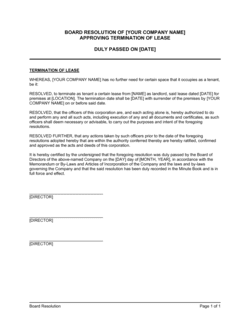
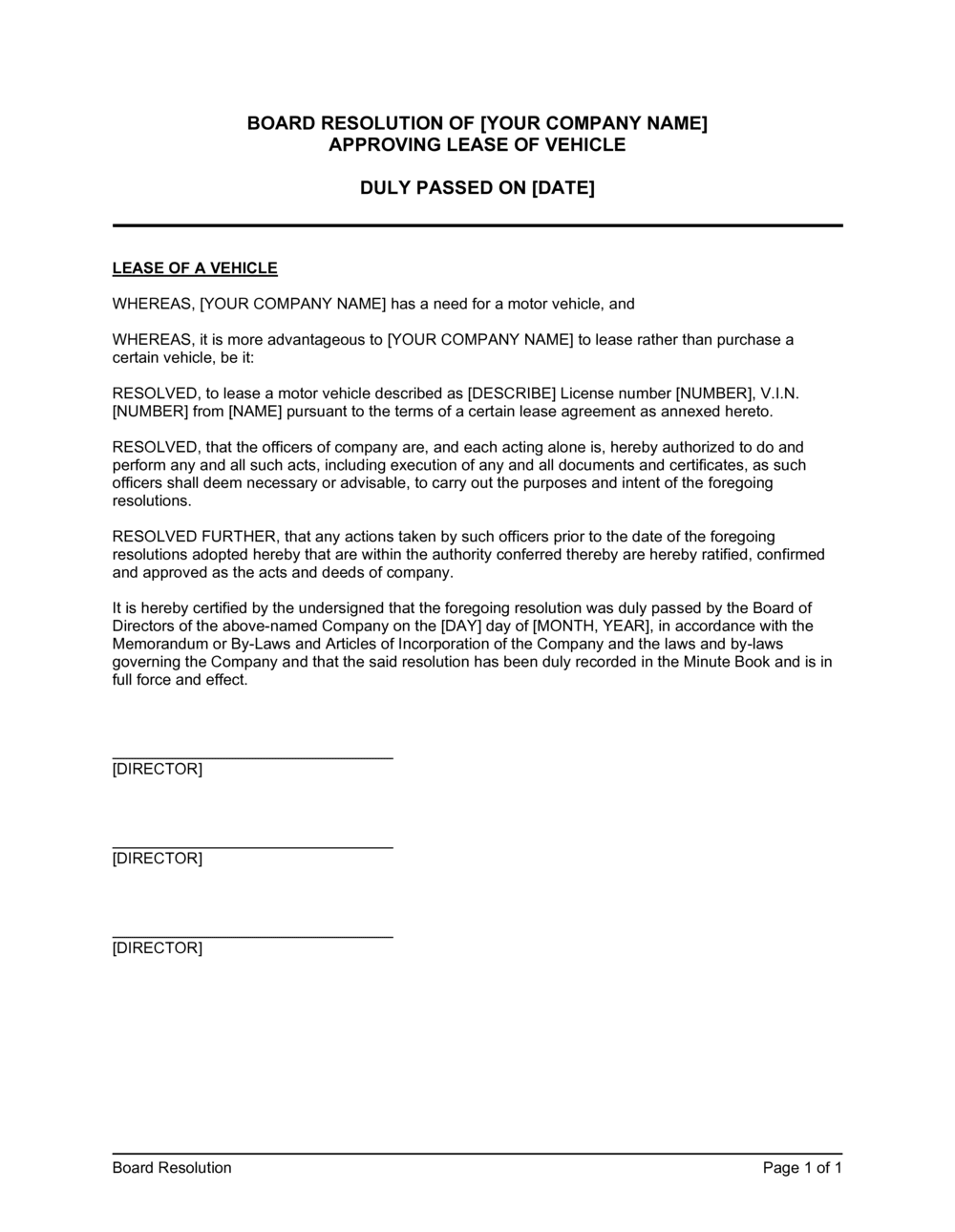
A Board Resolution To Lease Motor Vehicle is a formal corporate document in which a company's board of directors votes to authorize the leasing of one or more vehicles for business use and designates specific officers to sign the lease agreement on the company's behalf. This free Word download gives you a ready-to-edit resolution you can complete in minutes and export as PDF for execution, filing, or presentation to a lessor.
When you need it
Use it whenever a corporation, LLC, or other entity intends to enter a vehicle lease and the lessor, lender, or internal governance policy requires documented board approval before the agreement is signed. It is also required when internal bylaws or an operating agreement mandate board authorization for any financial commitment above a defined threshold.
What's inside
Corporate identification details, meeting or written-consent recitals, the specific resolution language authorizing the lease, vehicle description and principal lease terms, designation of authorized signatories, and officer certification confirming the resolution was duly adopted.

What is a Board Resolution To Lease Motor Vehicle?

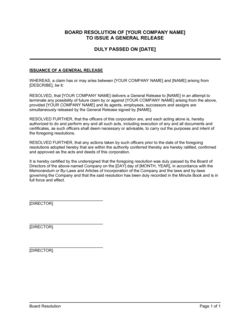
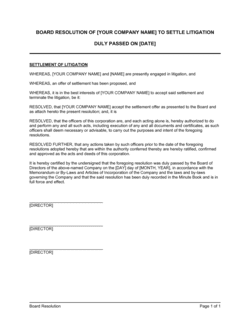
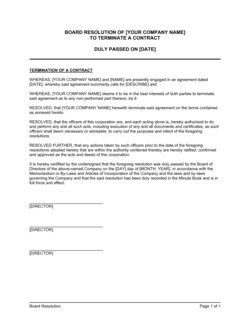
A Board Resolution To Lease Motor Vehicle is a formal corporate document in which a company's board of directors officially votes to authorize the entity to enter into a vehicle lease agreement and designates one or more named officers to execute that agreement on the company's behalf. The resolution records the specific vehicle, the lessor, the material lease terms, and the scope of the authorized signatory's authority — creating a permanent entry in the corporate minute book that confirms the transaction was approved at the governance level before any binding commitment was made. It functions as the bridge between internal corporate authority and the external contract with the lessor.

Why You Need This Document

Without a board resolution, a vehicle lease signed by a company officer may lack the documented corporate authority a lessor, auditor, or court requires to treat the transaction as a valid corporate act. Lessors and fleet financing companies routinely require a certified copy of a board resolution before processing a commercial lease — and without one, the closing stalls. Internally, the absence of a resolution exposes the signing officer to personal liability questions if the lease is later disputed, and leaves the company without a clear audit trail connecting the lease liability to a formal board decision. A properly adopted resolution also protects the corporate veil by demonstrating that directors exercised oversight before the company incurred a long-term financial obligation. This template gives you a compliant, professionally drafted starting point that most lessors will accept as sufficient signing authority, eliminating the delays that come from submitting an informal authorization letter in its place.

Which variant fits your situation?

If your situation is…Use this template
Leasing a single company car for an executiveBoard Resolution To Lease Motor Vehicle
Leasing multiple vehicles under a fleet agreementBoard Resolution To Lease Motor Vehicle (Fleet)
Purchasing rather than leasing a vehicle outrightBoard Resolution To Purchase Motor Vehicle
Financing a vehicle purchase through a loanBoard Resolution To Obtain Financing
Authorizing a general corporate lease (office, equipment)Board Resolution To Lease Property
Authorizing an officer to sign any agreement on behalf of the companyBoard Resolution Granting Signing Authority
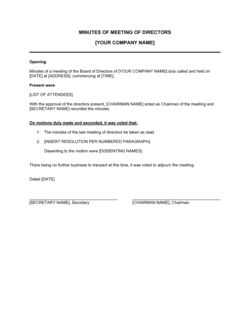
Documenting all actions taken at a full board meetingBoard Meeting Minutes

Common mistakes to avoid

❌ Using the company's trade name instead of its registered legal name

Why it matters: The resolution must exactly match the entity name on the lease and corporate filings. A mismatch gives the lessor grounds to reject the resolution and can delay or void the lease closing.

Fix: Look up the entity name on your state's official business registry and copy it character-for-character — including punctuation and the entity designator — into every name field in the resolution.

❌ Adopting the resolution after the lease is already signed

Why it matters: A resolution that post-dates the lease execution does not authorize the transaction — it attempts to ratify an already-completed act, which some jurisdictions and lessors will not accept as sufficient corporate authority.

Fix: Pass the resolution and obtain all required signatures before the authorized officer executes the lease. Build the resolution step into your lease approval checklist so it cannot be skipped.

❌ Authorizing a title rather than naming a specific individual

Why it matters: If the person holding the authorized title leaves before the lease is signed, the lessor cannot confirm who is authorized, stalling the transaction until a new resolution is passed.

Fix: Name the authorized signatory by full legal name and title. If officer turnover is a concern, authorize a primary and a named backup signatory in the same resolution.

❌ Omitting a total-commitment dollar cap

Why it matters: An uncapped authorization gives the signing officer discretion to accept lease terms — extended terms, balloon payments, excessive mileage penalties — that the board has not evaluated or approved.

Fix: Calculate the full lease obligation including all fees and include a not-to-exceed amount in the authorization clause. Require a new resolution for any amendment that increases the total commitment.

The 8 key clauses, explained

Corporate identification and authority recitals

In plain language: Opens the resolution by identifying the company's full legal name, state or jurisdiction of incorporation, and the authority under which the board is acting — typically the bylaws and applicable corporate statute.

Sample language
WHEREAS, [COMPANY LEGAL NAME], a [STATE] [ENTITY TYPE] (the 'Company'), is duly organized and existing under the laws of [STATE/JURISDICTION]; and WHEREAS, the board of directors is authorized under Article [X] of the Company's bylaws to approve financial commitments in excess of $[THRESHOLD];

Common mistake: Using the trade name or DBA instead of the registered legal entity name. The resolution must match the entity name on the lease agreement and corporate filing exactly, or the lessor's title search will flag a discrepancy.

Meeting or written-consent recital

In plain language: States whether the resolution was adopted at a duly noticed meeting with a quorum present, or by written consent in lieu of meeting, and records the date.

Sample language
The undersigned, being all the directors of [COMPANY NAME], hereby adopt the following resolution by written consent in lieu of a special meeting, effective [DATE], pursuant to [STATE] [CORPORATE STATUTE CITATION].

Common mistake: Omitting the date and the form of adoption. An undated resolution gives a lessor or auditor no way to confirm the authorization preceded the lease signing — creating a corporate formalities gap.

Resolution to authorize the lease

In plain language: The operative clause in which the board formally resolves to approve the vehicle lease — specifying the lessor, the vehicle, the term, and the approximate monthly payment or total commitment.

Sample language
RESOLVED, that the Company is hereby authorized to enter into a vehicle lease agreement with [LESSOR NAME] for a [YEAR] [MAKE] [MODEL] (VIN: [VIN NUMBER]) for a term of [X] months at approximately $[MONTHLY PAYMENT] per month, for a total commitment not to exceed $[TOTAL AMOUNT].

Common mistake: Approving the lease without specifying a dollar cap. An open-ended resolution gives the authorized officer unlimited flexibility to negotiate terms the board has not reviewed — including balloon payments, mileage penalties, or insurance requirements.

Vehicle and lease term description

In plain language: Describes the specific vehicle being leased — year, make, model, VIN if known — and the material commercial terms: lease start date, term in months, monthly payment, mileage allowance, and purchase option if any.

Sample language
The vehicle to be leased is a [YEAR] [MAKE] [MODEL], VIN [XXXXXX], leased from [LESSOR] commencing [START DATE] for [X] months, with a monthly payment of $[AMOUNT], an annual mileage allowance of [X] miles, and a residual purchase option of $[AMOUNT] at term end.

Common mistake: Describing the vehicle as 'a motor vehicle to be selected' without any specifics. Lessors require that the resolution reference the actual vehicle before they will rely on it as signing authority.

Designation of authorized signatories

In plain language: Names the specific officer or officers authorized to sign the lease and any ancillary documents — insurance certificates, delivery receipts, title applications — on the company's behalf.

Sample language
RESOLVED FURTHER, that [OFFICER NAME], [TITLE], is hereby authorized and directed to execute and deliver the lease agreement and any related documents on behalf of the Company, and that the Company's actions in connection therewith are hereby ratified and approved.

Common mistake: Authorizing a title ('the CEO') rather than a named individual. If the CEO changes before signing, the lessor has no way to verify whether the current holder of that title is the same person the board intended to authorize.

Scope of authority and ancillary actions

In plain language: Grants the authorized officer the power to negotiate final terms within the board's approved parameters, execute ancillary agreements, provide insurance certificates, and take all actions necessary to complete the lease.

Sample language
RESOLVED FURTHER, that the authorized officer is empowered to negotiate, execute, and deliver any agreements, instruments, or certificates necessary or appropriate to complete the lease transaction, including but not limited to insurance certificates, DMV filings, and delivery receipts.

Common mistake: Restricting authority so narrowly that the officer cannot sign a required insurance binder or title application — causing the lease to stall at closing because no one has authority to execute the ancillary paperwork.

Ratification of prior acts

In plain language: Retroactively confirms any actions already taken by officers in connection with the lease negotiation — such as submitting a credit application or signing a letter of intent — as authorized corporate acts.

Sample language
RESOLVED FURTHER, that all acts, transactions, and agreements heretofore taken or entered into by any officer of the Company in connection with the vehicle lease contemplated herein are hereby ratified, confirmed, and approved in all respects.

Common mistake: Including a blanket ratification without limiting it to the specific lease transaction. An unlimited ratification clause can inadvertently authorize other officer actions the board has not reviewed.

Officer certification block

In plain language: A signed statement by the corporate secretary or another officer certifying that the resolution is a true and accurate record, that the required quorum or written consent was obtained, and that the resolution is in full force.

Sample language
I, [CORPORATE SECRETARY NAME], Secretary of [COMPANY NAME], hereby certify that the foregoing is a true and complete copy of a resolution duly adopted by the board of directors of [COMPANY NAME] on [DATE], and that said resolution has not been amended, rescinded, or revoked and remains in full force and effect.

Common mistake: Having the same officer sign both the resolution as an authorized director and the certification as corporate secretary. Most lessors and banks require the certifying officer to be different from the authorized signatory.

How to fill it out

  1. 1

    Insert the company's full registered legal name and jurisdiction

    Enter the exact corporate name as it appears on your certificate of incorporation or articles of organization, including the entity designator (Inc., LLC, Corp.). Add the state or country of formation.

    💡 Cross-reference your state's business registry to confirm the exact spelling — even a punctuation difference can cause a lessor to reject the resolution.

  2. 2

    Choose meeting or written-consent adoption

    Decide whether the resolution will be adopted at a noticed board meeting (record the date, location, and quorum present) or by written consent in lieu of meeting (all required directors must sign). Check your bylaws for which method is permitted and what majority is required.

    💡 Written consent is faster for small boards but requires every required director's signature. If you cannot get all signatures, call a meeting instead.

  3. 3

    Describe the vehicle and lease terms precisely

    Enter the vehicle's year, make, model, and VIN (if available). Add the lessor's legal name, lease start date, term in months, monthly payment, annual mileage allowance, and any residual purchase option.

    💡 If the VIN is not yet assigned, describe the vehicle as specifically as possible and amend the resolution with the VIN before the lease is executed.

  4. 4

    Set a total-commitment dollar cap

    Calculate the full lease obligation — monthly payment × term plus any fees, penalties, or purchase option — and enter this as the not-to-exceed amount in the authorization clause.

    💡 Include a 10–15% buffer above the base calculation to cover potential mileage overages or optional add-ons without requiring a second resolution.

  5. 5

    Name the authorized signatory by full name and title

    Enter the specific individual authorized to sign the lease — do not use a title alone. If you want a backup signatory, name a second officer explicitly.

    💡 Confirm the signatory's name matches the signature block on their government-issued ID, as lessors often verify identity at signing.

  6. 6

    Obtain director signatures or written consents

    Have each required director sign the resolution (or the written-consent page) with their full name, title, and the date of signature. Confirm that your quorum or unanimous-consent requirement is met.

    💡 Date each signature individually — backdating all signatures to a single date when directors signed on different days can create an enforceability issue.

  7. 7

    Complete the corporate secretary certification

    Have the corporate secretary — or another officer who did not sign as an authorized director — complete and sign the certification block, confirming the resolution was duly adopted and remains in effect.

    💡 Keep the signed original in the corporate minute book and provide a certified copy to the lessor. Never alter the certified copy after it has been delivered.

  8. 8

    File and distribute the executed resolution

    Place the original in your corporate record book, provide a certified copy to the lessor, and retain a PDF copy in your document management system linked to the corresponding lease agreement.

    💡 If your company uses a registered agent for corporate records, send them a copy so your minute book remains current and accessible for audits or due diligence.

Frequently asked questions

What is a board resolution to lease a motor vehicle?

A board resolution to lease a motor vehicle is a formal corporate document in which the board of directors votes to authorize the company to enter a specific vehicle lease and designates one or more officers to sign the agreement on the company's behalf. It creates a documented corporate record confirming that the lease commitment was properly approved at the board level before any binding obligation was incurred.

When is a board resolution required to lease a vehicle?

A resolution is typically required in three situations: when the company's bylaws mandate board approval for financial commitments above a defined threshold; when the lessor or financing institution requires documented signing authority before processing the transaction; or when corporate governance best practices call for board approval of any long-term liability. Even where not strictly required, passing a resolution protects the officer who signs and maintains the corporate veil.

Can a single-member LLC use this resolution?

A single-member LLC managed by its sole member typically does not have a board of directors, so a formal board resolution may not apply. Instead, the sole member would pass a member resolution or manager resolution authorizing the lease. Multi-member LLCs with a manager-managed structure should check their operating agreement to determine whether manager or member approval is required for vehicle leases above a specified value.

Does the resolution need to be notarized?

Notarization is not required for a board resolution in most US states, Canadian provinces, or UK jurisdictions. The lessor's standard requirement is a certified copy signed by the corporate secretary, not a notarized document. However, some international lessors, government fleet programs, or secured financing arrangements may require notarization — confirm with the lessor before execution.

What details about the vehicle should the resolution include?

At minimum the resolution should identify the vehicle by year, make, model, and VIN (if available), the lessor's legal name, the lease term in months, the monthly payment, and the total commitment amount. Including the annual mileage allowance and any purchase option is also advisable. Vague descriptions like 'a motor vehicle to be selected' are often rejected by lessors as insufficient to establish specific authorization.

What is the difference between this resolution and a vehicle lease agreement?

The board resolution is an internal corporate governance document that authorizes the company to enter the lease and names who may sign on its behalf. The vehicle lease agreement is the binding contract between the company and the lessor that governs the actual terms of the lease — payment, mileage, maintenance obligations, and end-of-term options. Both documents are required: the resolution provides the authority; the lease agreement is the transaction itself.

Does the same officer who signs the resolution also sign the lease?

The officer named as authorized signatory in the resolution signs the lease agreement. However, the corporate secretary — or another officer separate from the authorized signatory — should sign the certification block on the resolution. Lessors and banks require the certifying officer to be different from the signatory to confirm independent verification that the resolution was duly adopted.

How long should the company keep the signed resolution?

The signed resolution should be retained for the duration of the lease plus at least seven years after the lease ends, in line with general corporate record retention best practices and the statute of limitations for contract claims in most jurisdictions. Store the original in the corporate minute book and maintain a PDF backup linked to the lease file in your document management system.

How this compares to alternatives

vs Vehicle Lease Agreement

A vehicle lease agreement is the binding contract between the company and the lessor that sets out payment terms, mileage limits, maintenance obligations, and end-of-term options. The board resolution authorizes the company to enter that agreement and designates who may sign it. You need both documents — the resolution does not replace the lease agreement, and the lease agreement has no corporate authority without the resolution.

vs Board Meeting Minutes

Board meeting minutes record everything discussed and decided at a full board meeting — agenda items, attendance, votes, and action items across all topics. A board resolution is a focused, standalone document that records a single specific action and is often adopted by written consent without a full meeting. For a routine vehicle lease, a standalone resolution is faster and sufficient; minutes are required when the lease is one of several agenda items at a noticed meeting.

vs Board Resolution To Purchase Motor Vehicle

A purchase resolution authorizes the outright acquisition of a vehicle and typically references a purchase agreement, sales price, and title transfer. A lease resolution authorizes a rental arrangement with no transfer of ownership. The accounting treatment, tax implications, and balance-sheet impact differ significantly — an operating lease does not appear as an asset, whereas a purchase or finance lease does.

vs Limited Signing Authority Letter

A signing authority letter grants an individual the power to execute documents on behalf of the company but is not a formal board action and does not carry the same evidentiary weight as a board resolution. Most commercial lessors and fleet financing companies specifically require a certified board resolution, not a letter, as proof of corporate authorization. Use the resolution for any transaction a third party will rely on.

Industry-specific considerations

Transportation and logistics

Fleet vehicle leases are a core operational expense; resolutions are passed regularly for each new vehicle addition and must reference fleet agreement master terms.

Professional services

Partner or executive vehicles leased as a business benefit require documented board approval to ensure the expense is properly authorized and deductible as a business cost.

Construction and trades

Heavy-duty trucks and specialty vehicles leased for project sites require resolutions that specify VIN, payload class, and any equipment financing attached to the vehicle.

Healthcare

Medical practices and health systems leasing patient transport or mobile clinic vehicles must document board authorization to satisfy both corporate governance and nonprofit compliance requirements.

Jurisdictional notes

United States

Corporate authority to enter leases is governed by each state's business corporation act and the company's bylaws. Delaware, Nevada, and most other states permit written consent in lieu of meeting for routine authorizations. Under ASC 842, operating leases with terms over 12 months must be recorded on the balance sheet, so the resolution should clearly identify whether the arrangement is an operating or finance lease for accounting classification purposes.

Canada

Federal corporations under the Canada Business Corporations Act and provincial corporations under acts such as the Ontario Business Corporations Act may pass resolutions by written consent if authorized by the articles or bylaws. Quebec civil law applies distinct rules for entities incorporated provincially there. IFRS 16, adopted by Canadian public companies, requires most leases to be recognized on the balance sheet, making the resolution's characterization of the lease type important for financial reporting.

United Kingdom

Under the Companies Act 2006, directors of a UK private limited company may pass written resolutions signed by a simple majority (or unanimously for private companies using the written resolution procedure). The resolution should reference the company's registered number and be filed in the statutory books. IFRS 16 applies to all UK-listed entities, and FRS 102 imposes similar treatment for smaller companies — the resolution should identify the lease classification.

European Union

Corporate authorization requirements vary by member state — German GmbH resolutions require shareholder approval for commitments above thresholds set in the articles; French SAS entities have flexibility to define internal authorization rules in their statuts. All EU-listed companies apply IFRS 16, requiring most vehicle leases to be capitalized. For cross-border leases within the EU, confirm that the resolution format satisfies the lessor's home-country requirements, as some lessors require notarization or apostille certification.

Template vs lawyer — what fits your deal?

PathBest forCostTime
Use the templateStandard single-vehicle or small-fleet leases for established corporations with straightforward bylaws in a single jurisdictionFree15–30 minutes
Template + legal reviewMulti-vehicle fleet authorizations, cross-border leases, or situations where the lease includes a finance or capital-lease structure recorded on the balance sheet$150–$4001–2 business days
Custom draftedPublicly traded companies, regulated industries, or leases tied to secured financing where the lender requires custom resolution language$500–$1,500+3–7 business days

Glossary

Board Resolution
A formal written record of a decision made by a company's board of directors, which creates a binding corporate action and becomes part of the official corporate record.
Written Consent in Lieu of Meeting
A procedure allowing directors to adopt a resolution by signing a written document instead of convening a physical or virtual meeting, permitted in most jurisdictions when all or a required majority of directors sign.
Authorized Signatory
An officer or director specifically named in the resolution as having the power to execute the lease agreement on the corporation's behalf.
Operating Lease
A vehicle lease structure in which the company pays for use of the vehicle over a fixed term without acquiring ownership, and the asset remains on the lessor's balance sheet.
Finance Lease (Capital Lease)
A lease arrangement in which substantially all the risks and rewards of ownership transfer to the lessee, typically recorded as a liability on the company's balance sheet under IFRS 16 and ASC 842.
Corporate Formalities
The procedural requirements a corporation must observe — holding meetings, recording minutes, passing resolutions — to maintain the legal separation between the entity and its owners.
Quorum
The minimum number of directors who must be present or consent for a board vote to be legally valid, as defined by the company's bylaws or governing statute.
Officer Certification
A statement signed by the corporate secretary or another officer confirming that the resolution was duly adopted in accordance with the company's governing documents and applicable law.
Lessor
The party who owns the vehicle and grants the right to use it in exchange for periodic lease payments — typically a dealership, bank, or fleet management company.
Lessee
The company that takes possession of and uses the vehicle under the lease agreement in exchange for making the agreed periodic payments.
Recital
Introductory clauses in a resolution that set out the background facts and reasons for the board's action — typically beginning with 'WHEREAS.'

Part of your Business Operating System

This document is one of 3,000+ business & legal templates included in Business in a Box.

  • Fill-in-the-blanks — ready in minutes
  • 100% customizable Word document
  • Compatible with all office suites
  • Export to PDF and share electronically

Create your document in 3 simple steps.

From template to signed document — all inside one Business Operating System.
1
Download or open template

Access over 3,000+ business and legal templates for any business task, project or initiative.

2
Edit and fill in the blanks with AI

Customize your ready-made business document template and save it in the cloud.

3
Save, Share, Send, Sign

Share your files and folders with your team. Create a space of seamless collaboration.

Save time, save money, and create top-quality documents.

★★★★★

"Fantastic value! I'm not sure how I'd do without it. It's worth its weight in gold and paid back for itself many times."

Managing Director · Mall Farm
Robert Whalley
Managing Director, Mall Farm Proprietary Limited
★★★★★

"I have been using Business in a Box for years. It has been the most useful source of templates I have encountered. I recommend it to anyone."

Business Owner · 4+ years
Dr Michael John Freestone
Business Owner
★★★★★

"It has been a life saver so many times I have lost count. Business in a Box has saved me so much time and as you know, time is money."

Owner · Upstate Web
David G. Moore Jr.
Owner, Upstate Web

Run your business with a system — not scattered tools

Stop downloading documents. Start operating with clarity. Business in a Box gives you the Business Operating System used by over 250,000 companies worldwide to structure, run, and grow their business.

Start free · No credit card required