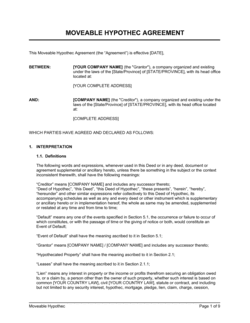
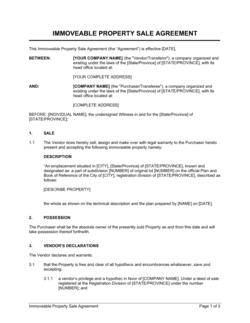
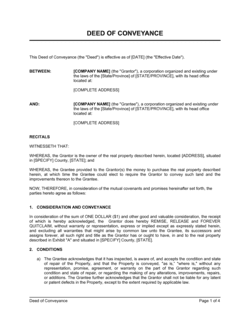
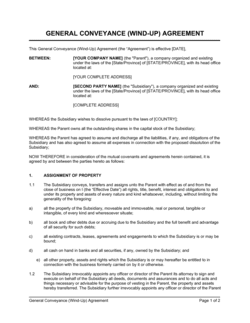
General Conveyance Agreement Moveable & Immoveable Template

Free Word download • Edit online • Save & share with Drive • Export to PDF

3 pages25–30 min to fillDifficulty: ComplexSignature requiredLegal review recommended
Learn more ↓
FreeGeneral Conveyance Agreement Moveable & Immoveable Template

At a glance

What it is
A General Conveyance Agreement is a legally binding document that formally transfers ownership of moveable property (equipment, inventory, vehicles, receivables) and/or immoveable property (land, buildings, fixtures) from a transferor to a transferee. This free Word download provides a structured starting point you can edit online and export as PDF — covering consideration, title warranties, delivery conditions, and representations in a single document.
When you need it
Use it whenever a business sale, asset acquisition, loan security arrangement, estate settlement, or corporate restructuring requires the formal transfer of ownership of identified assets from one party to another. It is particularly critical when a transaction involves both classes of property — moveable and immoveable — and a single governing instrument is needed.
What's inside
Identification of all transferred assets by class and description, the agreed consideration and payment schedule, title warranties and representations, delivery and possession mechanics, encumbrance disclosures, conditions precedent, and governing law. Schedules list specific moveable and immoveable assets with legal descriptions where required.

What is a General Conveyance Agreement (Moveable & Immoveable)?

A General Conveyance Agreement is a legally binding instrument that formally transfers ownership of both moveable property — such as equipment, vehicles, inventory, and receivables — and immoveable property — such as land, buildings, and permanently affixed fixtures — from a transferor to a transferee in a single, comprehensive document. It records the agreed consideration, identifies every asset being transferred through detailed schedules, provides title warranties backed by indemnification, discloses known encumbrances, and establishes the conditions under which title and possession pass. Unlike a simple bill of sale, a General Conveyance Agreement is designed for transactions where multiple asset classes are involved and where the legal formality of a documented transfer is necessary to protect both parties and satisfy third-party registry requirements.

Why You Need This Document

Without a properly executed conveyance agreement, title to the transferred assets may not legally pass — leaving the transferee exposed to the transferor's creditors, competing claims from other purchasers, and challenges from public registries that require a formal instrument before recording a change of ownership. For immoveable property, an unregistered transfer is generally ineffective against a subsequent buyer who registers first. For moveable property, a transferee who fails to obtain a clear conveyance and conduct lien searches may take assets subject to undisclosed security interests that a creditor can enforce at any time. The indemnification and warranty clauses in this agreement also give the transferee a contractual remedy if a title defect surfaces after closing — without them, the only recourse is the more costly route of tort litigation. This template gives you a professionally structured starting point that covers the full scope of a mixed-asset transfer, reducing the risk of unenforceable provisions and registration delays.

Which variant fits your situation?

If your situation is…Use this template
Transferring only real property — land and buildings — with no associated moveable assetsReal Estate Purchase Agreement
Selling a business as a going concern including goodwill and contractsBusiness Purchase Agreement
Granting a security interest in moveable assets without transferring ownershipGeneral Security Agreement
Transferring only personal property between individuals with simple termsBill of Sale
Conveying assets as part of a corporate merger or amalgamationAsset Purchase Agreement
Transferring a vehicle as a standalone moveable assetVehicle Bill of Sale
Assigning receivables or intangible property rights to a third partyAssignment Agreement

Common mistakes to avoid

❌ Vague asset descriptions in the schedules

Why it matters: Courts require sufficient specificity to identify each asset conveyed. A description like 'all equipment on the premises' gives the transferee no protection if the transferor removes items before closing.

Fix: List every moveable asset with serial number, make, model, and location; use the exact legal description for each parcel of immoveable property copied from the current registry record.

❌ Choosing a governing law inconsistent with the property's location

Why it matters: Most jurisdictions apply the lex situs rule — the law of where land is physically located governs its transfer, overriding any contractual choice-of-law clause.

Fix: Use the jurisdiction where the immoveable property is located as the governing law, and if assets span multiple jurisdictions, address each property's jurisdiction separately in the schedules.

❌ No cap on indemnification liability

Why it matters: An uncapped indemnity can expose a transferor to claims that dwarf the sale price — a scenario that may make the transaction uninsurable and deter the transferor from proceeding.

Fix: Negotiate a liability cap tied to the purchase price (e.g., 100% of consideration for title defects, 25% for general warranty breaches) and a survival period of 12–24 months post-closing.

❌ Signing the agreement after the assets have already been delivered

Why it matters: In several jurisdictions, a conveyance executed after possession has passed raises questions about the timing of title transfer, registration priority, and whether the instrument is validly backdated.

Fix: Execute the conveyance agreement before or simultaneously with the transfer of possession, and register the instrument immediately upon execution.

❌ Omitting PPSA or UCC lien searches on moveable assets

Why it matters: A transferee who takes moveable property subject to an undisclosed registered security interest may take possession but not free title — the secured creditor can repossess the assets.

Fix: Run a personal property registry search in every jurisdiction where the moveable assets are ordinarily kept, under all names the transferor has used, before signing.

❌ No outside date on conditions precedent

Why it matters: An open-ended condition allows either party to delay closing indefinitely by claiming the condition is still pending, creating uncertainty and potential loss of alternative buyers or financing.

Fix: Assign a firm calendar date to each condition precedent and include a mutual termination right — with return of any deposit — if conditions are not satisfied by that date.

The 10 key clauses, explained

Parties and recitals

In plain language: Identifies the transferor and transferee by full legal name, entity type, and jurisdiction, and states the background purpose of the conveyance.

Sample language
This General Conveyance Agreement is entered into as of [DATE] between [TRANSFEROR LEGAL NAME], a [ENTITY TYPE] organized under the laws of [JURISDICTION] ('Transferor'), and [TRANSFEREE LEGAL NAME], a [ENTITY TYPE] organized under the laws of [JURISDICTION] ('Transferee').

Common mistake: Using a trade name instead of the registered legal entity name — if the registered name does not match, third-party registries and land registries will reject the conveyance.

Description and schedule of assets

In plain language: Identifies every asset being transferred, divided into moveable and immoveable categories, with sufficient particularity that each item can be unambiguously located and verified.

Sample language
The assets conveyed hereunder are described in Schedule A (Immoveable Property) and Schedule B (Moveable Property) attached hereto and incorporated by reference. Schedule A contains legal descriptions of each parcel; Schedule B contains serial numbers, make, model, and location of each item of moveable property.

Common mistake: Describing assets in vague terms such as 'all equipment located on the premises' — courts require enough specificity to identify each asset, and vague descriptions void the conveyance for those items.

Consideration and payment

In plain language: States the total purchase price or other consideration, how and when it is to be paid, and what happens if payment is not made on time.

Sample language
In consideration of the sum of $[AMOUNT] (the 'Purchase Price'), payable as follows: (a) $[DEPOSIT AMOUNT] on execution; (b) the balance of $[BALANCE] on the Closing Date by wire transfer to [ACCOUNT DETAILS]. Time is of the essence with respect to payment.

Common mistake: Omitting 'time is of the essence' language — without it, a delayed payment may not automatically constitute a breach entitling the transferor to rescind the agreement.

Warranty of title and authority

In plain language: The transferor confirms they hold clear title to all listed assets, have the legal right to transfer them, and that no undisclosed encumbrances exist.

Sample language
Transferor warrants that: (a) it is the sole legal and beneficial owner of the Assets; (b) it has full authority to enter into and perform this Agreement; and (c) the Assets are free and clear of all liens, charges, mortgages, and encumbrances except as disclosed in Schedule C.

Common mistake: Providing a warranty without conducting a lien search first — an undisclosed encumbrance discovered after closing triggers warranty liability and can unwind the transaction entirely.

Representations and disclosures

In plain language: The transferor makes factual statements about the condition, use, regulatory status, and known defects of the assets, giving the transferee a factual basis for the transaction.

Sample language
Transferor represents that: (a) the Moveable Property is in [CONDITION — good working order / as-is]; (b) the Immoveable Property is not subject to any outstanding municipal orders or environmental remediation requirements except as disclosed; and (c) all property taxes are current as of [DATE].

Common mistake: Using 'as-is' without explicitly stating it in the representations clause and having the transferee acknowledge it in writing — undisclosed material defects can still give rise to misrepresentation claims.

Conditions precedent to closing

In plain language: Lists the events or deliverables that must be satisfied before the transfer becomes legally effective — such as regulatory approvals, discharge of mortgages, or board authorizations.

Sample language
The obligations of each party are conditional upon: (a) receipt of all required regulatory and governmental approvals by [DATE]; (b) discharge of the mortgage registered against [PROPERTY DESCRIPTION] by [DATE]; and (c) delivery of board resolutions authorizing the transaction by each party.

Common mistake: Setting conditions with no outside date — an open-ended condition can be used strategically to delay or avoid closing indefinitely.

Delivery and possession

In plain language: Specifies the date on which physical possession of each class of asset transfers, where delivery takes place, and who bears risk of loss between signing and possession.

Sample language
Delivery of Moveable Property shall occur at [ADDRESS] on [DATE] at [TIME]. Delivery of Immoveable Property shall be by key handover and vacant possession on the Closing Date. Risk of loss passes to Transferee upon delivery of each asset class.

Common mistake: Failing to specify when risk of loss transfers — if a fire destroys a building between signing and closing and the contract is silent, courts in different jurisdictions reach opposite conclusions on who bears the loss.

Encumbrance schedule and discharge obligations

In plain language: Discloses all known liens, mortgages, and charges on the assets and states which party is responsible for discharging them before or at closing.

Sample language
The Assets are subject to the encumbrances listed in Schedule C. Transferor shall discharge or cause to be discharged all encumbrances listed in Schedule C at or before the Closing Date and shall provide documentary evidence of discharge to Transferee.

Common mistake: Listing encumbrances on an immoveable property but omitting PPSA or UCC financing statements registered against moveable assets — a buyer who fails to check both registries may take subject to an undisclosed security interest.

Indemnification

In plain language: Each party agrees to compensate the other for losses arising from a breach of their representations, warranties, or obligations under the agreement.

Sample language
Transferor shall indemnify, defend, and hold harmless Transferee from and against any losses, claims, damages, and expenses arising from: (a) any breach of Transferor's representations or warranties; (b) any encumbrance not disclosed in Schedule C; or (c) any pre-closing liability relating to the Assets.

Common mistake: No cap on indemnification exposure — an uncapped indemnity can expose the transferor to claims exceeding the transaction value, making the deal uninsurable and the clause commercially unreasonable.

Governing law and dispute resolution

In plain language: States which jurisdiction's law governs the agreement and how disputes are resolved — litigation, arbitration, or mediation.

Sample language
This Agreement shall be governed by and construed in accordance with the laws of [JURISDICTION], without regard to conflict-of-law principles. Any dispute shall be resolved by binding arbitration administered by [BODY] in [CITY], except that either party may seek injunctive relief in any court of competent jurisdiction.

Common mistake: Choosing a governing law with no connection to the location of the immoveable property — in most jurisdictions, the lex situs (law of the place where land is situated) governs immoveable property regardless of what the contract says.

How to fill it out

  1. 1

    Identify all parties with full legal names

    Enter the registered legal name, entity type, and jurisdiction of incorporation for both the transferor and transferee. Confirm names against corporate registry filings before signing.

    💡 For immoveable property, the transferor's name on this agreement must match the name on the existing title record exactly — a mismatch requires a corrective affidavit that delays closing.

  2. 2

    Complete Schedule A with legal property descriptions

    For each parcel of immoveable property, copy the legal description exactly as it appears in the current deed or land registry record. Include lot number, plan number, and municipality.

    💡 Obtain a current title search or land registry printout before completing this schedule — relying on an old deed may miss recent subdivisions or boundary changes.

  3. 3

    Complete Schedule B with moveable asset details

    List every moveable asset to be conveyed with make, model, serial number, year, and current location. For inventory, attach a dated inventory count certified by both parties.

    💡 Walk the premises together with the transferee before signing and cross-reference the physical inventory against Schedule B — disputes over missing assets are common and expensive.

  4. 4

    State the consideration and payment mechanics

    Enter the total purchase price, deposit amount, balance, payment method (wire, certified cheque), and the closing date. Add late-payment interest if applicable.

    💡 Include a specific account number for wire transfers and confirm banking details with the receiving party by phone before closing — wire fraud is common in real estate and asset transactions.

  5. 5

    Complete Schedule C with all known encumbrances

    Run a PPSA or UCC lien search against all moveable assets and a title search against all immoveable property. List every result — mortgage, charge, financing statement, or caveat — in Schedule C with the registered instrument number.

    💡 Search under every name variation the transferor has used in the past five years — legal name, trade names, and former names — to catch all registered interests.

  6. 6

    Set conditions precedent with firm outside dates

    List every condition that must be satisfied before closing and assign a specific calendar date by which each must be met. Include a termination right if conditions are not satisfied by the outside date.

    💡 Build in at least 5–10 business days of buffer between your last condition deadline and the closing date to accommodate processing delays.

  7. 7

    Confirm delivery logistics and risk-of-loss transfer

    Specify the exact location, date, and time for delivery of moveable assets. For immoveable property, confirm vacant possession and key handover arrangements. State expressly when risk of loss passes for each asset class.

    💡 Arrange property insurance effective from the risk-of-loss transfer date — a gap in coverage between the transferor's cancellation and the transferee's binding date is a common source of uninsured losses.

  8. 8

    Execute and register as required

    Both parties must sign before a witness or notary as required by the governing jurisdiction. File or register the conveyance instrument with the applicable land registry, personal property registry, or corporate registry within the prescribed timeframe.

    💡 Registration deadlines vary by jurisdiction — in some provinces and US states, an unregistered conveyance is ineffective against third parties even if the parties have signed. Register promptly.

Frequently asked questions

What is a General Conveyance Agreement?

A General Conveyance Agreement is a legally binding document that transfers ownership of property — both moveable assets such as equipment and inventory and immoveable assets such as land and buildings — from a transferor to a transferee. It identifies the assets with specificity, states the consideration paid, includes title warranties, and records the conditions under which delivery and title passage occur. It is commonly used in business sales, corporate reorganizations, and estate settlements where multiple asset classes are transferred in a single transaction.

What is the difference between moveable and immoveable property in a conveyance?

Moveable property includes assets that can be physically relocated — equipment, vehicles, inventory, receivables, and personal effects. Immoveable property includes land, buildings, and fixtures permanently attached to land. The legal rules governing transfer differ significantly: immoveable property typically requires registration in a public land registry to bind third parties, while moveable property may be transferred by delivery and registration in a personal property registry. A general conveyance agreement addresses both classes in a single instrument, which is particularly useful when a business owns both.

When do I need a General Conveyance Agreement rather than a simpler Bill of Sale?

A Bill of Sale is appropriate for transferring a single item of moveable property in a simple transaction. A General Conveyance Agreement is needed when the transfer involves multiple asset classes — especially both moveable and immoveable property — or when the transaction requires title warranties, encumbrance schedules, conditions precedent, and indemnification provisions that a standard Bill of Sale does not cover. Business sales, secured lending transactions, and corporate restructurings typically require a General Conveyance Agreement.

Does a conveyance agreement need to be registered?

For immoveable property, registration with the applicable land registry is typically required to bind third parties — an unregistered conveyance is generally valid between the parties but does not protect against a subsequent purchaser or creditor who registers first. For moveable property, registration under a personal property security regime (PPSA in Canada, UCC Article 9 in the US) is not required to transfer ownership but is necessary to protect the transferee's title against the transferor's creditors. Requirements vary by jurisdiction, so legal advice is recommended.

What warranties does the transferor typically give in a conveyance agreement?

The transferor typically warrants that it holds clear legal and beneficial title to all assets, has the authority to transfer them, and that no undisclosed encumbrances exist. For immoveable property, this commonly includes confirmation that there are no outstanding municipal orders, environmental notices, or zoning violations. For moveable property, it includes confirmation that no PPSA or UCC financing statements are registered against the assets except as disclosed. Warranties are backed by an indemnification clause that compensates the transferee for losses arising from a breach.

Can one conveyance agreement cover assets in multiple jurisdictions?

Yes, but with important caveats. Immoveable property in each jurisdiction is governed by the local law of that jurisdiction regardless of the choice-of-law clause in the agreement — this is the lex situs rule. Practically, this means a single agreement can document the parties' commercial arrangement, but separate jurisdiction-specific transfer instruments (deeds, notarial acts) may be required for land in each location. Legal counsel in each jurisdiction should confirm local registration requirements before closing.

Is notarization required for a General Conveyance Agreement?

Requirements vary by jurisdiction and asset type. In Quebec, France, and many civil-law countries, a notarial deed is required for any transfer of immoveable property. In common-law jurisdictions such as most US states, England, and most Canadian provinces, notarization of the conveyance agreement itself is typically not required, though the deed of transfer registered against the land may require witnessing or specific formalities. Always confirm local requirements before closing.

What happens if the transferor cannot deliver clear title at closing?

If the transferor breaches its warranty of title or fails to discharge a disclosed encumbrance by closing, the transferee typically has the right to terminate the agreement and recover the deposit, claim specific performance to compel the transfer with a price reduction, or seek damages under the indemnification clause. Including a clear remedies clause and a definition of material breach in the agreement avoids ambiguity about which remedies are available and whether they are exclusive.

Do I need a lawyer to complete a General Conveyance Agreement?

For straightforward asset transfers of low to moderate value where title is clear and no encumbrances exist, a high-quality template reviewed by the parties may be sufficient. Legal review is strongly recommended when the transaction involves immoveable property (which requires compliance with local land transfer formalities), when the purchase price is material, when encumbrances must be discharged at closing, or when the assets span multiple jurisdictions. A 2–4 hour lawyer review typically costs $500–$1,500 and is warranted for any transaction above $50,000.

How this compares to alternatives

vs Bill of Sale

A Bill of Sale covers the transfer of a single item or a simple list of moveable assets without warranties of title, encumbrance schedules, or conditions precedent. A General Conveyance Agreement is the appropriate instrument when the transfer involves both moveable and immoveable property, requires title warranties backed by indemnification, or involves conditions that must be satisfied before closing. Use a Bill of Sale for simple personal property transfers; use a General Conveyance Agreement for complex business or real property transactions.

vs Asset Purchase Agreement

An Asset Purchase Agreement is a comprehensive commercial contract that governs the terms of a business asset acquisition — including representations about the business, employee matters, assumed liabilities, and post-closing covenants. A General Conveyance Agreement is the transfer instrument that executes the actual change in title at closing, often as a closing deliverable under an Asset Purchase Agreement. In complex transactions, both documents are used: the Asset Purchase Agreement governs the deal; the General Conveyance Agreement effects the transfer.

vs General Security Agreement

A General Security Agreement grants a security interest over assets as collateral for a debt without transferring ownership — the debtor retains title and possession. A General Conveyance Agreement transfers full ownership from one party to another. The distinction matters for lenders: a security agreement preserves the borrower's ownership while creating a priority claim; a conveyance is used only when ownership is actually changing hands, such as in a sale or debt-satisfaction transfer.

vs Real Estate Purchase Agreement

A Real Estate Purchase Agreement governs the sale of land and buildings alone, with terms specific to property transactions such as home inspection conditions, title insurance, and mortgage financing conditions. A General Conveyance Agreement is broader — it covers both immoveable and moveable property together and is appropriate when a transaction involves significant moveable assets alongside real property. Where the transaction is purely real estate with no associated moveable assets, a jurisdiction-specific Real Estate Purchase Agreement is the more appropriate and complete instrument.

Industry-specific considerations

Commercial real estate

Conveys land and buildings alongside FF&E (furniture, fixtures, and equipment) in a single instrument, with Schedule A covering the legal property description and Schedule B covering all moveable assets included in the sale.

Manufacturing

Transfers production facilities (immoveable) and machinery, tooling, inventory, and vehicles (moveable) in business-sale or intra-group restructuring transactions, with PPSA or UCC lien searches essential for moveable assets.

Financial services and lending

Used by lenders taking a conveyance of assets in satisfaction of a debt, or in loan workouts where a borrower voluntarily transfers secured assets in lieu of foreclosure, requiring precise encumbrance disclosure and discharge mechanics.

Professional services

Conveys office premises and leasehold improvements (immoveable) alongside equipment, client files, and work-in-progress (moveable) when a professional practice is sold, with regulatory body consent conditions often required.

Jurisdictional notes

United States

Transfer of real property requires a deed (warranty, quitclaim, or grant deed depending on the state) recorded with the county recorder or register of deeds — the conveyance agreement alone does not transfer title. Moveable personal property transfers are governed by UCC Article 2 (goods) or Article 9 (secured transactions). Most states impose a real estate transfer tax or documentary stamp tax on the recorded consideration. State-specific deed formalities — witnesses, notarization, grantor-grantee indexing — vary and must be confirmed locally.

Canada

Real property transfer requirements vary by province — most provinces use a land titles or registry system requiring a transfer instrument registered by a lawyer or notary. Quebec requires a notarial deed for any immoveable property transfer. PPSA registration is required in each province where moveable assets are ordinarily kept to protect the transferee against the transferor's creditors. Land transfer taxes apply in most provinces; Ontario and Toronto impose additional municipal taxes on residential and commercial property above specified thresholds.

United Kingdom

Transfer of land in England and Wales requires a TR1 or TP1 form registered with HM Land Registry; Scottish property transfers use a Disposition registered in the Land Register of Scotland. Stamp Duty Land Tax (SDLT) applies in England; Land Transaction Tax (LTT) applies in Wales; Land and Buildings Transaction Tax (LBTT) applies in Scotland. Moveable property (chattels) transfers are governed by the Sale of Goods Act 1979 and require no formal registration. Legal completion and registration must occur promptly as an unregistered transfer does not bind a subsequent purchaser for value.

European Union

Immoveable property transfer requirements are set by each member state — France and Spain require a notarial deed (acte authentique / escritura pública); Germany requires a notarized agreement and entry in the Grundbuch (land register). Transfer taxes and notary fees vary significantly: France imposes droits de mutation of approximately 5–6% on non-new property; Germany's Grunderwerbsteuer ranges from 3.5–6.5% by state. GDPR considerations arise when customer data or employee records are included among the transferred assets. Cross-border EU conveyances should confirm whether EU Succession Regulation 650/2012 or Rome I Regulation principles affect governing law selection.

Template vs lawyer — what fits your deal?

PathBest forCostTime
Use the templateSimple intra-company asset transfers of clear-title moveable property between related entities where no immoveable property or third-party encumbrances are involvedFree1–2 hours
Template + legal reviewBusiness asset sales up to $250K involving both moveable and immoveable property in a single jurisdiction with clear title$500–$1,5002–5 business days
Custom draftedMulti-jurisdictional transfers, transactions above $250K, assets subject to encumbrances requiring discharge, or conveyances as part of a secured lending or insolvency arrangement$2,000–$10,000+1–4 weeks

Glossary

Conveyance
The legal act of transferring title or ownership of property from one party to another by means of a written instrument.
Transferor
The party who currently holds title to the property and is transferring it to another — equivalent to the seller or grantor in a sale context.
Transferee
The party receiving title to the property — equivalent to the buyer or grantee.
Moveable Property
Property that can be physically relocated without damage or loss of identity, including equipment, vehicles, inventory, and financial instruments.
Immoveable Property
Property fixed to land or permanently attached to a structure — typically land, buildings, and fixtures — that cannot be moved without alteration.
Consideration
The value exchanged between parties to make the agreement binding — typically a monetary purchase price, assumption of debt, or transfer of other assets.
Title
Legal ownership of property, including the right to possess, use, and dispose of it — distinct from mere physical possession.
Encumbrance
Any claim, lien, mortgage, charge, or restriction on property that may limit the transferor's ability to convey clear title.
Warranty of Title
A transferor's promise that they hold clear title and have the legal right to transfer the property free of undisclosed encumbrances.
Conditions Precedent
Events or acts that must occur before the conveyance becomes effective — such as regulatory approval, payment in full, or discharge of an existing mortgage.
Fixtures
Items originally moveable that have been permanently affixed to land or a building, causing them to be treated legally as immoveable property.
Possession Date
The agreed date on which physical control of the property transfers to the transferee, which may differ from the date title legally passes.

Part of your Business Operating System

This document is one of 3,000+ business & legal templates included in Business in a Box.

  • Fill-in-the-blanks — ready in minutes
  • 100% customizable Word document
  • Compatible with all office suites
  • Export to PDF and share electronically

Create your document in 3 simple steps.

From template to signed document — all inside one Business Operating System.
1
Download or open template

Access over 3,000+ business and legal templates for any business task, project or initiative.

2
Edit and fill in the blanks with AI

Customize your ready-made business document template and save it in the cloud.

3
Save, Share, Send, Sign

Share your files and folders with your team. Create a space of seamless collaboration.

Save time, save money, and create top-quality documents.

★★★★★

"Fantastic value! I'm not sure how I'd do without it. It's worth its weight in gold and paid back for itself many times."

Managing Director · Mall Farm
Robert Whalley
Managing Director, Mall Farm Proprietary Limited
★★★★★

"I have been using Business in a Box for years. It has been the most useful source of templates I have encountered. I recommend it to anyone."

Business Owner · 4+ years
Dr Michael John Freestone
Business Owner
★★★★★

"It has been a life saver so many times I have lost count. Business in a Box has saved me so much time and as you know, time is money."

Owner · Upstate Web
David G. Moore Jr.
Owner, Upstate Web

Run your business with a system — not scattered tools

Stop downloading documents. Start operating with clarity. Business in a Box gives you the Business Operating System used by over 250,000 companies worldwide to structure, run, and grow their business.

Free Forever Plan · No credit card required