Release Of Mortgage Template

Free Word download • Edit online • Save & share with Drive • Export to PDF

1 page20–30 min to fillDifficulty: StandardSignature requiredLegal review recommended
Learn more ↓
FreeRelease Of Mortgage Template

At a glance

What it is
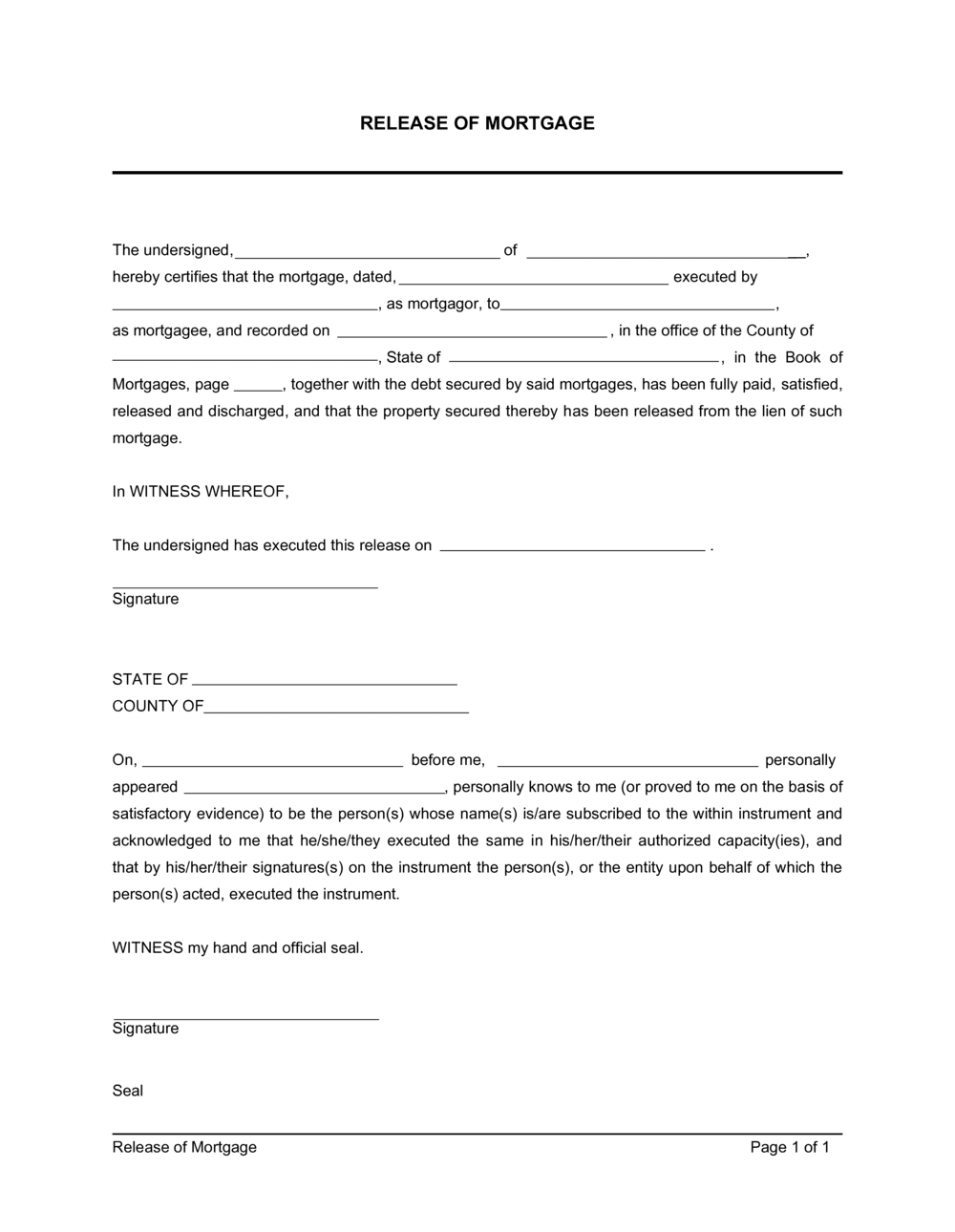
A Release of Mortgage is a legally binding document issued by a lender confirming that a borrower has fully repaid a mortgage loan and that the lender's lien on the property is extinguished. This template is a free Word download you can edit online and export as PDF — ready for notarization and recording with the appropriate land registry or county recorder's office.
When you need it
Use it when a borrower makes the final mortgage payment and the lender must formally discharge the lien from the property's title record. It is also required when a loan is paid off early through refinancing or a lump-sum payoff, or when a partial release is needed after a portion of the secured property is sold.
What's inside
Lender and borrower identification, original mortgage details including recording information, a declaration that the debt has been fully satisfied, a formal release of lien, and signature blocks for notarized execution by the authorized lender representative.

What is a Release of Mortgage?

A Release of Mortgage is a legally binding instrument issued by a lender — the mortgagee — confirming that a borrower has fully satisfied a mortgage debt and formally discharging the lender's lien from the real property that served as collateral. Once notarized and recorded with the appropriate county recorder, register of deeds, or land registry office, it removes the mortgage encumbrance from the property's public title record and restores unencumbered ownership to the borrower. Depending on jurisdiction, the document may also be called a satisfaction of mortgage, mortgage discharge, or — where a deed of trust was the original security instrument — a deed of reconveyance. The key operative effect is identical: the lien is extinguished, the chain of title is cleared, and the property may be sold or refinanced without the encumbrance appearing in a title search.

Why You Need This Document

Without a recorded release, the mortgage remains an active lien on the public title record even after the debt is paid in full — indefinitely. Every future title search will surface the open mortgage, and no title insurer will issue a clean policy until the lien is discharged. In practice, this means the borrower cannot sell the property or close a refinance without first resolving the unrecorded payoff, often at significant delay and cost. For lenders, failing to issue and record a release within the statutory window — which runs from 30 to 90 days in most US states — triggers penalties, statutory damages, and attorney's fee awards payable to the borrower. A properly drafted, notarized, and recorded release eliminates all of these risks in a single instrument, gives the borrower documentary proof of clear title, and closes the lender's file with a clean and defensible paper trail.

Which variant fits your situation?

If your situation is…Use this template
Full repayment of a residential or commercial mortgageRelease of Mortgage
Partial payoff releasing only a portion of the secured parcelsPartial Release of Mortgage
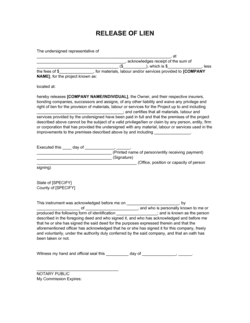
Releasing a mechanics lien or construction lien on real propertyRelease of Lien
Confirming full satisfaction of a deed of trust in a non-judicial stateDeed of Reconveyance
Borrower and lender agreeing to cancel all secured obligationsMortgage Discharge Agreement
Lender acknowledging receipt of payoff and releasing personal guaranteesRelease and Discharge of Guarantee
Subordinating rather than releasing a second mortgage upon refinancingSubordination Agreement

Common mistakes to avoid

❌ Misquoting the original recording information

Why it matters: A single transposed digit in the book number, page, or instrument number means the release cannot be linked to the correct lien — the county recorder will reject it or it will be missed in a title search, leaving the property encumbered.

Fix: Pull the exact recording details directly from the county recorder's database and verify them character by character before completing the template. Have a second person review the numbers.

❌ Releasing before confirming cleared funds

Why it matters: A release executed before the payoff funds clear gives the borrower a clean title while the lender still faces the risk of a reversed payment — leaving no lien to secure the now-unsecured debt.

Fix: Establish a written policy requiring payoff funds to clear the lender's account — typically 3–5 business days for wire transfers — before the release is signed and dated.

❌ Using a non-conforming notary acknowledgment

Why it matters: Most county recorders reject instruments with out-of-state or non-statutory notary acknowledgment language, delaying recording by weeks and potentially requiring a corrective affidavit.

Fix: Use the notary acknowledgment language published by the recorder's office or state statute in the jurisdiction where the property is located — not the jurisdiction where the lender is located.

❌ Failing to record the release promptly

Why it matters: An unrecorded release does not clear the lien from the public title record. The property will show an open mortgage in any title search, blocking a future sale or refinance until the release is recorded.

Fix: Include recording instructions in the release document itself and follow up with the borrower or closing agent within 10 business days of delivery to confirm the instrument has been recorded.

❌ Wrong releasing party when the loan was assigned

Why it matters: If the original lender sold the loan to a servicer or investor, the original lender has no authority to release — only the current holder of record can discharge the lien. A release from a party with no recorded interest in the mortgage is void.

Fix: Search the county recorder's database for all assignments recorded after the original mortgage. The party executing the release must be the most recent assignee of record, or have a recorded power of attorney from that party.

❌ Omitting the full legal property description

Why it matters: A release that identifies the property only by street address or parcel number — without the metes-and-bounds or lot-and-block legal description — may be rejected by the recorder or held unenforceable as insufficiently specific.

Fix: Copy the full legal description verbatim from the original mortgage instrument or the most recent recorded deed, including any easements or appurtenances referenced in the original conveyance.

The 9 key clauses, explained

Parties identification

In plain language: Identifies the lender (mortgagee) by full legal name and address and the borrower (mortgagor) by full legal name — establishing who is releasing the lien and whose debt has been satisfied.

Sample language
This Release of Mortgage is made by [LENDER FULL LEGAL NAME], a [ENTITY TYPE] organized under the laws of [STATE/PROVINCE] ('Mortgagee'), in favor of [BORROWER FULL LEGAL NAME] ('Mortgagor').

Common mistake: Using a trade name or DBA instead of the lender's registered legal entity name. If the name on the release does not exactly match the name on the original recorded mortgage, the county recorder may reject the filing.

Original mortgage reference

In plain language: Cites the date, book, page or instrument number, and recording jurisdiction of the original mortgage so the release can be matched to the correct lien in the public record.

Sample language
Reference is made to that certain Mortgage dated [DATE], executed by Mortgagor in favor of Mortgagee, recorded on [RECORDING DATE] in Book [BOOK NO.], Page [PAGE NO.], Instrument No. [INSTRUMENT NO.], in the records of [COUNTY/PARISH], [STATE].

Common mistake: Transcribing the book, page, or instrument number incorrectly. A single digit error means the release cannot be matched to the original lien and will be rejected by the recorder or flagged in a title search.

Property description

In plain language: Sets out the full legal description of the real property being released — typically the metes-and-bounds or lot-and-block description from the original mortgage — and includes the property's street address and parcel number.

Sample language
The property subject to this Release is legally described as: [FULL LEGAL DESCRIPTION], also known as [STREET ADDRESS], [CITY], [STATE] [ZIP], Parcel ID: [PARCEL NUMBER].

Common mistake: Using only the street address without the legal description. The legal description from the county deed or original mortgage is the binding identifier — a street address alone is insufficient for recording.

Acknowledgment of full satisfaction

In plain language: States that the borrower has fully paid the mortgage debt and all obligations secured by the lien, and that no further amounts are owed under the original mortgage instrument.

Sample language
Mortgagee hereby acknowledges receipt of the full payoff of the indebtedness secured by the above-described Mortgage, including all principal, interest, fees, and charges. The Mortgage debt has been fully paid and satisfied.

Common mistake: Omitting the phrase 'including all principal, interest, fees, and charges.' A narrower acknowledgment can leave open a dispute about whether ancillary charges — prepayment penalties, late fees, or escrow shortfalls — were included in the payoff.

Release and discharge of lien

In plain language: The operative clause formally discharging the lender's lien and releasing the property from the encumbrance created by the original mortgage.

Sample language
Mortgagee hereby releases and forever discharges the above-described property from the lien and encumbrance of the above-referenced Mortgage, and quitclaims all right, title, and interest held by Mortgagee in said property by virtue of said Mortgage.

Common mistake: Drafting release language that only cancels the note but not the lien itself. The release must expressly discharge the recorded mortgage instrument — canceling the promissory note alone does not remove the lien from the public record.

Authority and authorization

In plain language: Confirms that the individual signing on behalf of the lender has actual authority to execute the release — critical when the lender is a corporation, LLC, bank, or trust.

Sample language
The undersigned represents that [he/she/they] is a duly authorized officer of Mortgagee with full authority to execute this Release of Mortgage on behalf of Mortgagee.

Common mistake: Having an employee sign without verifying their signing authority. A release signed by someone without authority to bind the lender can be challenged, delaying or voiding the title clearing.

Notarization block

In plain language: Provides the acknowledgment form for the notary public to complete, confirming the identity of the signer and the voluntary nature of the execution — required for recording in all US states and most other jurisdictions.

Sample language
State of [STATE], County of [COUNTY]. Before me, the undersigned Notary Public, personally appeared [SIGNER NAME], known to me to be the [TITLE] of [LENDER NAME], and acknowledged that [he/she/they] executed the foregoing instrument for the purposes therein stated. My Commission expires: [DATE].

Common mistake: Using a generic notary block that does not match the state's required acknowledgment language. Many states mandate specific statutory acknowledgment wording — a nonconforming block can cause the county recorder to reject the document.

Governing law and recording instruction

In plain language: Specifies the jurisdiction whose law governs the document and directs the borrower or their agent to record the release with the appropriate county or land registry office.

Sample language
This Release shall be governed by the laws of [STATE/PROVINCE]. Mortgagor is directed to record this Release with the [COUNTY RECORDER / REGISTER OF DEEDS / LAND REGISTRY OFFICE] of [COUNTY/JURISDICTION] at Mortgagor's expense.

Common mistake: Failing to include recording instructions. Borrowers unfamiliar with real estate procedure sometimes store the release without recording it — leaving the lien technically active on the public record even though the debt is paid.

Signature and execution block

In plain language: Provides the dated signature line for the authorized lender representative and a space for a witness signature where required by state or provincial law.

Sample language
IN WITNESS WHEREOF, Mortgagee has executed this Release of Mortgage as of [DATE]. [LENDER LEGAL NAME] By: ___________________________ Name: [AUTHORIZED SIGNATORY NAME] Title: [TITLE] Witness: ___________________________

Common mistake: Dating the release before the payoff is actually received and confirmed. A prematurely dated release creates a risk that the lien is discharged before the funds clear — exposing the lender to a loss if the payment reverses.

How to fill it out

  1. 1

    Retrieve the original recorded mortgage

    Pull the original mortgage document from the county recorder's public record to obtain the exact recording date, book number, page number or instrument number, and legal description of the property.

    💡 Cross-reference the recorder's online database against the physical document — data entry errors in public records do occur, and the release must match the recorded instrument exactly.

  2. 2

    Confirm the payoff amount and receipt of funds

    Obtain a formal payoff statement from your loan servicer or accounting records showing the total amount paid, including principal, interest through the payoff date, and all fees. Do not prepare or sign the release until funds have cleared.

    💡 Issue the release within the statutory window required in your jurisdiction — most US states require release within 30–90 days of payoff, and penalties apply for late filing.

  3. 3

    Enter parties and mortgage reference details

    Fill in the lender's full registered legal name, the borrower's full legal name, and all mortgage reference fields — recording date, book, page, and instrument number — exactly as they appear on the recorded original.

    💡 If the original loan was sold or assigned, the releasing party must be the current holder of record — not the original lender. Check the chain of assignments in the county record.

  4. 4

    Insert the full legal property description

    Copy the legal description verbatim from the original mortgage or the property deed. Include the parcel identification number and street address as secondary identifiers.

    💡 Do not paraphrase or abbreviate the legal description. Even minor wording changes can create a mismatch that prevents recording.

  5. 5

    Complete the satisfaction and release clauses

    Confirm that all principal, interest, fees, and charges have been paid, and that the lien is fully and forever discharged. Ensure the release language expressly references the recorded mortgage instrument by its recording details.

    💡 If the payoff satisfied multiple related instruments — a note, a mortgage, and a security agreement — list all of them in the satisfaction clause.

  6. 6

    Verify signing authority and obtain notarization

    Confirm the signer is authorized under the lender's governing documents (corporate resolution, LLC operating agreement, or power of attorney). Have the signer appear before a licensed notary public with valid government-issued ID.

    💡 Use the notary acknowledgment language prescribed by the recording state — not a generic form. Many state recorder websites publish the required statutory language.

  7. 7

    Deliver and record the release

    Provide the original notarized release to the borrower or their closing agent. Instruct them to record it with the county recorder, register of deeds, or land registry office in the county where the property is located and pay the applicable recording fee.

    💡 Confirm recording by obtaining a conformed copy with the recorder's stamp and instrument number — retain it in your loan file and provide a copy to the borrower.

  8. 8

    Update your loan records and notify relevant parties

    Mark the loan as closed in your loan management system, archive all payoff and recording documentation, and notify the borrower's title insurer if a title policy is in place.

    💡 Send the borrower a written confirmation letter referencing the recorded instrument number — this gives them a clean paper trail for any future title question.

Frequently asked questions

What is a release of mortgage?

A release of mortgage is a legal document issued by a lender confirming that a borrower has fully repaid a mortgage loan and that the lender's lien on the property is extinguished. Once notarized and recorded with the county recorder or land registry, it removes the mortgage from the property's public title record, giving the owner clear title free of that encumbrance. It is also called a satisfaction of mortgage, mortgage discharge, or — where a deed of trust was used — a deed of reconveyance.

When does a lender need to issue a release of mortgage?

A lender must issue a release whenever the secured mortgage debt is fully paid — whether through scheduled monthly payments reaching term, an early payoff from a refinance, or a lump-sum settlement. In most US states, the lender is legally required to provide the release within 30–90 days of receiving full payoff. Failure to release within the statutory period typically exposes the lender to penalties, damages, and attorney's fees payable to the borrower.

Does a release of mortgage need to be notarized?

Yes, in virtually all US states and Canadian provinces, a release of mortgage must be notarized before it can be accepted for recording in the public land record. The notary verifies the identity of the signing party and witnesses their signature. Many states also require the notary's acknowledgment to follow specific statutory language — a generic acknowledgment block may be rejected by the county recorder.

Who is responsible for recording the release of mortgage?

In most jurisdictions, the lender is responsible for preparing the release and delivering it to the borrower, while the borrower or their closing agent is responsible for recording it with the county recorder and paying the recording fee. However, some lenders and mortgage servicers record the release directly as part of their post-payoff process. The release has no effect on the public title record until it is actually recorded — delivery alone is insufficient.

What is the difference between a release of mortgage and a deed of reconveyance?

Both documents accomplish the same goal — removing a lender's security interest from real property after the loan is repaid — but they apply to different security instruments. A release of mortgage applies when the original loan was secured by a traditional mortgage, where the borrower holds legal title and grants a lien to the lender. A deed of reconveyance applies when the loan was secured by a deed of trust, where legal title was transferred to a third-party trustee. Deeds of trust are standard in California, Texas, and about 30 other US states.

What happens if a lender fails to release the mortgage after payoff?

If the lien remains on the public record after full payoff, the borrower cannot sell or refinance the property without resolving the open mortgage. Most US states allow the borrower to file a court action to compel the lender to release, and many states impose statutory penalties of $500–$2,500 per day of delay, plus attorney's fees. The borrower may also be able to record a certificate of satisfaction supported by payoff documentation if the lender fails to respond within the statutory window.

Can a release of mortgage be used for a partial payoff?

A standard release of mortgage discharges the entire lien after full payoff of the debt. If only a portion of the secured property is sold or paid off — common in construction and land development — a partial release of mortgage is required. A partial release identifies the specific parcel or portion being released, confirms the portion of the debt attributed to that parcel has been satisfied, and leaves the remaining lien intact over the unreleased portion.

How long does it take to record a release of mortgage?

Recording timelines vary significantly by county. Urban counties with electronic recording systems typically process documents within 1–5 business days. Rural counties with manual recording may take 2–6 weeks. Once recorded, the instrument number and recording date are stamped on the document, and the recording details are indexed in the public record. Always request a conformed copy with the recording stamp as proof.

Do I need a lawyer to prepare a release of mortgage?

For a straightforward residential or commercial payoff between a domestic private lender and borrower in a single jurisdiction, a well-drafted template is often sufficient. Engage a real estate attorney when the original loan was assigned multiple times and the chain of title is unclear, when the borrower disputes the payoff amount, when the property spans multiple parcels or jurisdictions, or when the lender is an estate, trust, or foreign entity with complex signing authority requirements.

How this compares to alternatives

vs Deed of Reconveyance

A deed of reconveyance is the functional equivalent of a release of mortgage but applies specifically to loans secured by a deed of trust — the standard security instrument in roughly 30 US states including California and Texas. In a deed of trust, legal title vests in a trustee; the reconveyance transfers it back to the borrower. Use a release of mortgage where a traditional mortgage was recorded; use a deed of reconveyance where a deed of trust was used.

vs Mortgage Discharge Agreement

A mortgage discharge agreement is a bilateral contract between lender and borrower agreeing to cancel the mortgage — sometimes used when the payoff involves a negotiated settlement or disputed amount. A release of mortgage is a unilateral instrument issued by the lender as a matter of right once full payment is confirmed. For clean, undisputed payoffs, a release of mortgage is simpler and more appropriate.

vs Release of Lien

A release of lien is a broader category covering any recorded lien on real or personal property — including mechanics liens, judgment liens, and tax liens — not just mortgage liens. A release of mortgage is the specific instrument for discharging a recorded mortgage or deed of trust after loan payoff. Use a release of lien when the encumbrance is a mechanics lien or judgment; use a release of mortgage for a paid-off home or commercial loan.

vs Promissory Note Cancellation

A promissory note cancellation acknowledges that the underlying debt instrument has been paid and voids the note — but it does not discharge the recorded lien on the real property. A release of mortgage is the recorded instrument that actually clears the encumbrance from the public title record. Both documents should be produced at payoff; canceling the note without recording a release leaves the lien technically active.

Industry-specific considerations

Real Estate

Releases are required at every residential and commercial property closing where an existing mortgage must be discharged before title can be conveyed free and clear to a buyer.

Banking and Financial Services

Banks and credit unions must track and issue releases within statutory windows across multiple states, making standardized templates and workflow controls critical to avoiding statutory penalties.

Construction and Development

Construction lenders routinely issue partial releases as individual lots or units are sold out of a larger secured development, requiring careful parcel-by-parcel legal descriptions.

Professional Services

Real estate attorneys and title companies prepare releases on behalf of lender clients and must ensure the recording details, notary language, and legal description conform to local recorder requirements in each county.

Jurisdictional notes

United States

Releases must be notarized and recorded with the county recorder, register of deeds, or land court in the county where the property is located. Statutory deadlines to release range from 30 days (e.g., Florida) to 90 days (e.g., New York) after payoff, with penalties for late filing. Roughly 30 states use deeds of trust instead of traditional mortgages — in those states, a deed of reconveyance is the correct instrument. Notary acknowledgment language must conform to each state's statutory form.

Canada

Mortgage discharge procedures are governed provincially. In Ontario, a discharge of charge is filed with the Land Registry Office under the Land Registration Reform Act; electronic registration through Teraview is standard for lawyers. In Quebec, a radiation of hypothec is required and must be filed with the Quebec Land Register by a notary. British Columbia uses a discharge of mortgage filed with the Land Title Office. Each province has different forms and filing fees.

United Kingdom

In England and Wales, a mortgage is discharged by completing Land Registry Form DS1 (discharge of a registered charge) or DS3 (partial discharge) and submitting it to HM Land Registry. Electronic discharge through the Land Registry Business Gateway is available to licensed conveyancers. In Scotland, a Discharge of Standard Security is registered with Registers of Scotland. Lenders must discharge the charge within a reasonable time after full repayment — failure can give rise to a claim in damages.

European Union

Mortgage release procedures vary significantly by member state and are governed by national property and land registration law rather than EU-wide regulation. In Germany, a Löschungsbewilligung (cancellation consent) must be filed with the Grundbuchamt (land registry). In France, a mainlevée d'hypothèque is filed with the Service de la publicité foncière. GDPR considerations apply where the release document contains personal data processed by a financial institution. Cross-border EU mortgage transactions may involve multiple national registries.

Template vs lawyer — what fits your deal?

PathBest forCostTime
Use the templatePrivate lenders and small business owners handling a straightforward single-parcel payoff with no chain-of-assignment complicationsFree30–60 minutes
Template + legal reviewLenders dealing with assigned loans, commercial properties, multi-parcel releases, or unfamiliar state recording requirements$300–$7001–3 business days
Custom draftedComplex commercial mortgage payoffs, disputed loan balances, foreign lender entities, or properties spanning multiple jurisdictions$1,000–$3,500+1–2 weeks

Glossary

Lien
A legal claim a lender holds against a property as security for a debt, giving the lender the right to foreclose if the borrower defaults.
Mortgagee
The lender who holds the mortgage lien on the property — the party who issues the release once the loan is repaid.
Mortgagor
The borrower who grants the mortgage lien to the lender in exchange for the loan funds.
Satisfaction of Mortgage
An alternative term for a release of mortgage, used in some states and provinces to mean the same document confirming a loan has been fully repaid and the lien discharged.
Deed of Reconveyance
The functional equivalent of a release of mortgage used in states where the property was originally secured by a deed of trust rather than a traditional mortgage.
Recording
The act of filing a legal document with the county recorder, land registry, or register of deeds so it becomes part of the public property record.
Clear Title
Ownership of real property free from liens, encumbrances, or competing claims that could affect the owner's right to sell or transfer the property.
Notarization
The process by which a licensed notary public verifies the identity of a signing party and witnesses their signature, which is typically required for documents recorded in the public land record.
Payoff Amount
The exact dollar figure, including principal, accrued interest, and fees, required to fully satisfy a mortgage loan on a specific date.
Encumbrance
Any claim, lien, charge, or liability attached to real property that limits its free transfer — a mortgage is one of the most common encumbrances.
Chain of Title
The chronological sequence of ownership records and encumbrances for a property, including all mortgages and their releases, traceable through the public land record.

Part of your Business Operating System

This document is one of 3,000+ business & legal templates included in Business in a Box.

  • Fill-in-the-blanks — ready in minutes
  • 100% customizable Word document
  • Compatible with all office suites
  • Export to PDF and share electronically

Create your document in 3 simple steps.

From template to signed document — all inside one Business Operating System.
1
Download or open template

Access over 3,000+ business and legal templates for any business task, project or initiative.

2
Edit and fill in the blanks with AI

Customize your ready-made business document template and save it in the cloud.

3
Save, Share, Send, Sign

Share your files and folders with your team. Create a space of seamless collaboration.

Save time, save money, and create top-quality documents.

★★★★★

"Fantastic value! I'm not sure how I'd do without it. It's worth its weight in gold and paid back for itself many times."

Managing Director · Mall Farm
Robert Whalley
Managing Director, Mall Farm Proprietary Limited
★★★★★

"I have been using Business in a Box for years. It has been the most useful source of templates I have encountered. I recommend it to anyone."

Business Owner · 4+ years
Dr Michael John Freestone
Business Owner
★★★★★

"It has been a life saver so many times I have lost count. Business in a Box has saved me so much time and as you know, time is money."

Owner · Upstate Web
David G. Moore Jr.
Owner, Upstate Web

Run your business with a system — not scattered tools

Stop downloading documents. Start operating with clarity. Business in a Box gives you the Business Operating System used by over 250,000 companies worldwide to structure, run, and grow their business.

Start free · No credit card required