Master Franchise Agreement Template

Free Word download • Edit online • Save & share with Drive • Export to PDF

24 pages40–55 min to fillDifficulty: ExpertSignature requiredLegal review recommended
Learn more ↓
FreeMaster Franchise Agreement Template

At a glance

What it is
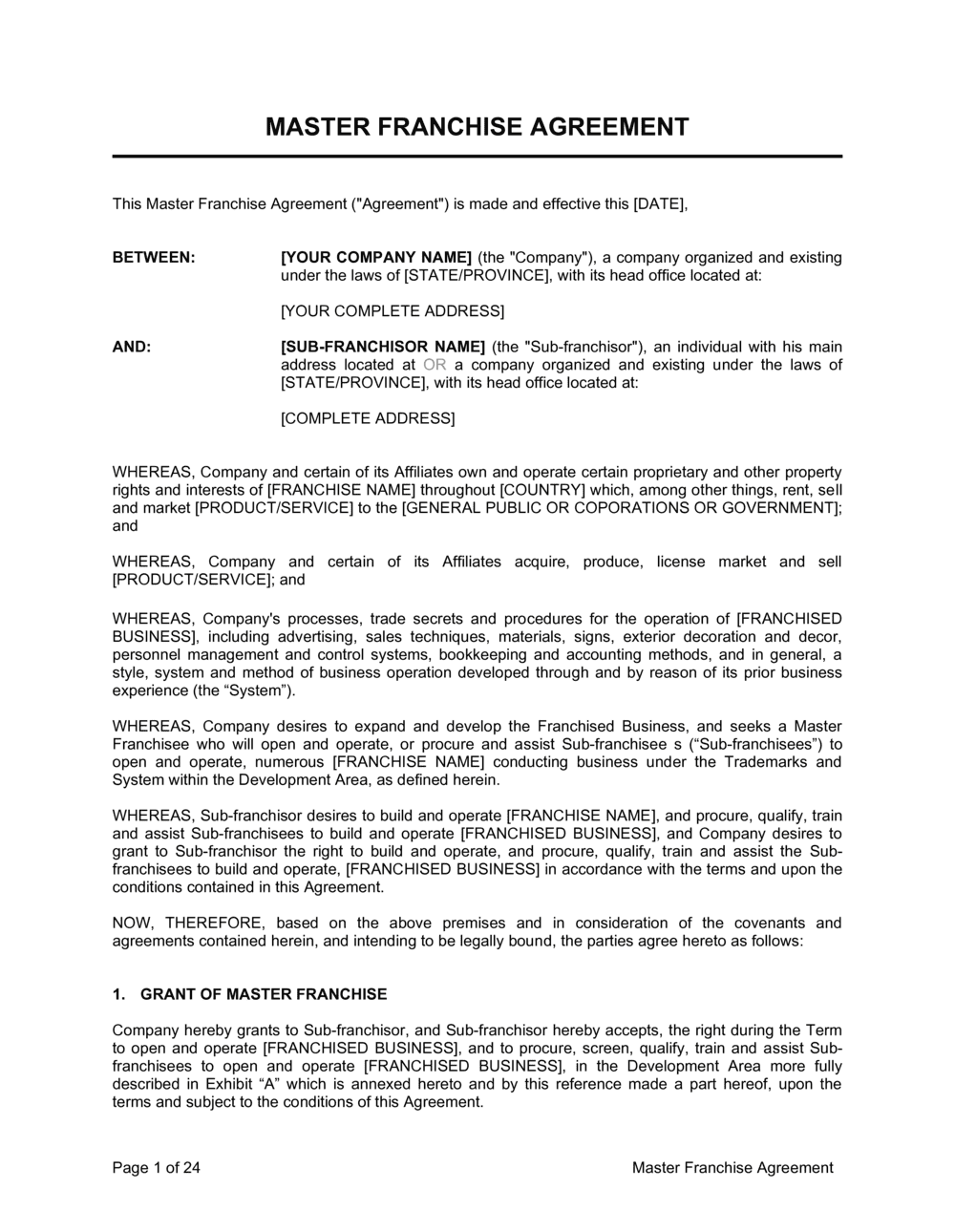
A Master Franchise Agreement is a legally binding contract between a franchisor and a master franchisee that grants the right to sub-franchise a brand across a defined territory — such as a country, state, or region. This free Word download gives you a structured starting point covering territory exclusivity, development schedules, fees, sub-franchisee obligations, IP licensing, and termination, which you can edit online and export as PDF.
When you need it
Use it when expanding a franchise system into a new geographic market by appointing a local operator to recruit, train, and manage sub-franchisees on your behalf. It is also used by investors acquiring master rights to an established brand in a territory where the franchisor does not operate directly.
What's inside
Territory grant and exclusivity, development schedule and minimum unit obligations, initial and ongoing fee structures, sub-franchising rights and obligations, IP license and brand standards, training and operational support, reporting and auditing, and termination and transfer provisions.

What is a Master Franchise Agreement?

A Master Franchise Agreement is a legally binding contract in which a franchisor grants a master franchisee the right to develop, operate, and sub-franchise a brand system within a defined territory — such as an entire country, a group of states, or a geographic region. Unlike a standard unit franchise agreement, which covers a single location, a master franchise agreement appoints the master franchisee to function as a local franchisor: recruiting individual operators, signing sub-franchise agreements, collecting fees, enforcing brand standards, and providing training and support — all within the boundaries set by the original franchisor. The master franchisee earns income by retaining a share of the initial franchise fees and ongoing royalties paid by sub-franchisees, while remitting the contractually agreed portion to the franchisor.

Why You Need This Document

Expanding a franchise system across a new territory without a properly structured master franchise agreement exposes the franchisor to four serious risks simultaneously. First, without a precise territory definition and development schedule, the master franchisee has no binding obligation to actually build out the market — your brand can remain dormant in a region for years with no recourse. Second, without explicit reversion and novation clauses, terminating an underperforming master franchisee leaves sub-franchisees operating under your brand with no legal relationship to you — creating liability and brand-damage scenarios that take years of litigation to resolve. Third, without a direct audit right over sub-franchisees, royalty income depends entirely on the master franchisee's self-reporting. Fourth, without IP license termination provisions, a master franchisee who defaults may continue using your trademarks and trade dress after the relationship ends. This template gives franchisors and master franchisees a structured starting point for all of these provisions, reducing the time and cost to reach an executable first draft before engaging franchise-specialist legal counsel.

Which variant fits your situation?

If your situation is…Use this template
Granting rights to a single franchisee to operate one unitFranchise Agreement
Granting rights to open multiple units without sub-franchisingArea Development Agreement
Licensing a brand for product distribution without operating unitsTrademark License Agreement
Appointing a local agent to sell franchise units on commissionFranchise Broker Agreement
Defining brand standards and operational requirements for all franchiseesFranchise Operations Manual
Disclosing material terms to a prospective franchisee before signingFranchise Disclosure Document (FDD)
Transferring an existing master franchise to a new buyerFranchise Transfer Agreement

Common mistakes to avoid

❌ Vague territory definition without an attached map or schedule

Why it matters: Ambiguous territory boundaries generate disputes the moment two master franchisees recruit in the same metropolitan area or the franchisor considers granting rights in an adjacent region.

Fix: Attach a signed Schedule A with a map and a list of postal codes or administrative regions. Both parties should initial the schedule at execution.

❌ No direct audit right over sub-franchisees

Why it matters: Restricting audit rights to the master franchisee's records gives a single operator control over all royalty reporting, masking systematic under-reporting that can cost the franchisor material royalty income over a 10-year term.

Fix: Include an express right for the franchisor to audit sub-franchisee books directly, on reasonable notice, and state that the master franchisee must facilitate such access.

❌ Omitting a reversion clause for sub-franchise agreements on termination

Why it matters: Without reversion language, terminating the master franchise leaves sub-franchisees operating under agreements with no legal counterparty — creating brand and liability exposure that is expensive to resolve through litigation.

Fix: Include an automatic assignment or novation clause stating that all sub-franchise agreements vest in the franchisor on termination, and seek sub-franchisee consent to novation at the time each unit agreement is signed.

❌ Automatic renewal without a full-compliance condition

Why it matters: A master franchise agreement that renews automatically regardless of development-schedule performance or ongoing defaults removes the franchisor's most effective commercial lever for enforcing obligations.

Fix: Condition renewal on: no outstanding Events of Default, full Development Schedule compliance, payment of a renewal fee, and execution of the then-current form of master franchise agreement.

❌ No foreign-exchange mechanism in international agreements

Why it matters: Fee disputes arising from currency fluctuations are among the most common sources of cross-border franchise litigation; a 20% exchange-rate move over a 10-year term can materially alter the economics for one party.

Fix: State the invoiced currency, the payment currency, and the exchange-rate reference (e.g., mid-market rate on the payment date per a named financial data provider) in the fees clause.

❌ Allowing the master franchisee to modify the unit franchise agreement without approval

Why it matters: A master franchisee who grants sub-franchisees larger protected areas, lower royalties, or weaker compliance obligations creates a two-tier system that undermines brand standards and sets precedents the franchisor cannot easily reverse.

Fix: State that the approved unit franchise agreement may not be modified in any material respect without prior written consent of the franchisor, and define 'material' to include any change to fees, territory, term, or brand-standards obligations.

The 10 key clauses, explained

Territory grant and exclusivity

In plain language: Defines the precise geographic boundaries of the master franchisee's territory and whether those rights are exclusive, semi-exclusive, or non-exclusive.

Sample language
[FRANCHISOR NAME] hereby grants to [MASTER FRANCHISEE NAME] the exclusive right to develop and sub-franchise the [BRAND NAME] System within the territory described in Schedule A ('Territory'), subject to the terms of this Agreement.

Common mistake: Defining territory by political boundaries (e.g., 'the country of Mexico') without attaching a map or postal-code schedule. Disputes over border towns and shared metropolitan areas are extremely common without precise geographic definitions.

Development schedule and minimum unit obligations

In plain language: Sets the number of units the master franchisee must open or sub-franchise by defined milestone dates, with the consequence of losing exclusivity or triggering termination if missed.

Sample language
Master Franchisee shall open or cause to be opened the number of Units set out in Schedule B by the dates specified therein. Failure to meet any Development Milestone shall, at Franchisor's election, convert the Territory to non-exclusive or constitute an Event of Default.

Common mistake: Setting development milestones without defining what counts as an 'open' unit — signed agreement only, or physically operating and trading. This ambiguity lets underperforming master franchisees claim milestones they have not genuinely met.

Fees: initial, royalty, and marketing fund

In plain language: States the master franchise fee paid upfront, the royalty split on sub-franchisee fees, the marketing fund contribution rate, and the mechanics for collection and remittance to the franchisor.

Sample language
Master Franchisee shall pay to Franchisor: (a) a Master Franchise Fee of $[AMOUNT] upon execution; (b) [X]% of all Initial Franchise Fees collected from Sub-Franchisees; and (c) [Y]% of all ongoing royalties collected from Sub-Franchisees, payable monthly within [15] days of month-end.

Common mistake: Omitting a mechanism for auditing sub-franchisee gross sales independently. If the master franchisee controls all reporting, the franchisor has no reliable basis to verify royalty calculations.

Sub-franchising rights and obligations

In plain language: Grants the master franchisee the right to execute unit franchise agreements with sub-franchisees and sets the standards those agreements must meet, including mandatory approval by the franchisor.

Sample language
Master Franchisee is hereby authorized to grant unit franchises within the Territory using the form of Unit Franchise Agreement approved in writing by Franchisor from time to time. No material modification to the approved form shall be made without Franchisor's prior written consent.

Common mistake: Allowing the master franchisee to modify the unit franchise agreement template without franchisor approval. A master franchisee who grants sub-franchisees weaker brand-standards obligations or longer protected radii creates compliance problems that are costly and legally complex to unwind.

Intellectual property license

In plain language: Grants a limited, non-transferable license to use the franchisor's trademarks, trade dress, proprietary software, and confidential operating systems within the territory, and restricts any use outside the scope of the agreement.

Sample language
Franchisor grants to Master Franchisee a non-exclusive, non-transferable, royalty-bearing license to use the Marks and Proprietary Systems solely in connection with the operation and sub-franchising of [BRAND NAME] Units within the Territory during the Term.

Common mistake: Granting an outright IP license rather than a conditional license that terminates automatically on expiration or termination of the master franchise agreement. An unconditional license can survive the business relationship and is extremely difficult to claw back.

Training and operational support

In plain language: Specifies the initial training the franchisor provides to the master franchisee, the master franchisee's obligation to train its sub-franchisees, and the ongoing support structure — field visits, helpdesk, technology updates.

Sample language
Franchisor shall provide Master Franchisee with initial training of [X] days at [LOCATION] covering operations, brand standards, and sub-franchisee recruitment ('Initial Training'). Master Franchisee shall, at its cost, replicate such training for each Sub-Franchisee prior to that Sub-Franchisee's opening date.

Common mistake: No obligation on the master franchisee to complete training before commencing sub-franchising activity. A master franchisee who begins recruiting sub-franchisees before completing training disseminates incomplete or incorrect brand standards from day one.

Reporting, auditing, and record-keeping

In plain language: Requires the master franchisee to submit regular financial and operational reports, maintain books and records in a specified format, and grant the franchisor the right to audit sub-franchisee operations directly.

Sample language
Master Franchisee shall submit to Franchisor monthly reports in the format set out in Schedule C within [10] business days of each month-end. Franchisor reserves the right, on [5] business days' written notice, to audit the books and records of Master Franchisee and any Sub-Franchisee.

Common mistake: Restricting audit rights to the master franchisee's records only, without a direct right to audit sub-franchisees. This creates a single reporting chokepoint that the master franchisee controls, masking systemic compliance failures.

Term and renewal

In plain language: Sets the initial duration of the master franchise agreement, the conditions under which it may be renewed, the fee payable on renewal, and any changes to terms on renewal.

Sample language
The initial Term of this Agreement is [10] years from the Effective Date. Master Franchisee may renew for one additional term of [5] years, provided that: (a) no Event of Default has occurred; (b) Master Franchisee has met all Development Milestones; and (c) Master Franchisee pays a renewal fee of $[AMOUNT].

Common mistake: Automatic renewal language without a condition that the master franchisee must be in full compliance. An agreement that renews despite ongoing defaults gives the master franchisee no incentive to cure non-compliance before the renewal date.

Termination and consequences

In plain language: Lists the events that allow either party to terminate the agreement — with or without cure periods — and specifies what happens to sub-franchisee agreements, territory rights, and IP licenses upon termination.

Sample language
Upon termination or expiration of this Agreement: (a) all rights granted to Master Franchisee revert immediately to Franchisor; (b) Franchisor may, at its election, assume or novate all Sub-Franchise Agreements directly; and (c) Master Franchisee shall immediately cease all use of the Marks and Proprietary Systems.

Common mistake: No reversion clause for sub-franchise agreements. If the master franchise terminates without reversion language, the sub-franchisees have no direct relationship with the original franchisor and may continue operating under a brand they no longer have the right to use.

Governing law, dispute resolution, and jurisdiction

In plain language: Specifies which jurisdiction's law governs the agreement, how disputes are resolved — arbitration, mediation, or litigation — and which courts have exclusive jurisdiction.

Sample language
This Agreement is governed by the laws of [STATE/COUNTRY]. Any dispute arising out of or in connection with this Agreement shall be referred to binding arbitration under the [AAA/ICC] Rules in [CITY], conducted in the [ENGLISH] language, except claims for injunctive relief which may be brought in any competent court.

Common mistake: Choosing a governing law in the franchisor's home jurisdiction without considering mandatory franchise disclosure and relationship laws in the master franchisee's territory. Many jurisdictions apply local franchise law regardless of the contractual choice-of-law clause.

How to fill it out

  1. 1

    Identify the parties and their legal entities

    Enter the franchisor's full registered corporate name, jurisdiction of incorporation, and registered address alongside the master franchisee's legal entity details. Both parties must sign as their legal entities, not as individuals or trading names.

    💡 Request a certificate of incorporation or equivalent for the master franchisee entity before execution — master franchise rights should never be granted to an individual who intends to incorporate later.

  2. 2

    Define the territory precisely in Schedule A

    Attach a map or postal-code list as Schedule A and reference it in the territory grant clause. Avoid political-boundary descriptions alone; specify whether border metropolitan areas are included or excluded.

    💡 Use GIS data or official postal authority lists to define territory boundaries — subjective descriptions like 'the greater [CITY] area' generate disputes at the first renewal negotiation.

  3. 3

    Set the development schedule in Schedule B

    Agree on the number of units to be open or under agreement by specific dates — Year 1, Year 2, Year 3 — and define exactly what 'open' means: a signed sub-franchise agreement, a completed fit-out, or a trading unit.

    💡 Build a 10–15% buffer into early milestones; first-territory master franchisees almost always take longer than projected. Overly aggressive milestones lead to disputes and renegotiations rather than growth.

  4. 4

    Complete the fee structure and remittance mechanics

    Enter the upfront master franchise fee, the royalty split percentages for initial fees and ongoing royalties, and the payment schedule. Specify the currency, bank account details for remittance, and the reporting period.

    💡 State the currency explicitly and include a foreign-exchange clause if the franchisor and master franchisee operate in different currency zones — exchange-rate risk is a common source of fee disputes in international deals.

  5. 5

    Attach or reference the approved unit franchise agreement

    Include the approved form of unit franchise agreement as a schedule or reference it by version number, and state clearly that no material modification is permitted without prior written franchisor approval.

    💡 Keep the approved unit franchise agreement as a standalone versioned document so you can update it without amending the master franchise agreement itself.

  6. 6

    Set training obligations and timelines

    Specify the initial training program the franchisor delivers, the training the master franchisee must deliver to each sub-franchisee, and any ongoing certification requirements for territory management staff.

    💡 Include a training completion condition precedent — the master franchisee should not be permitted to recruit sub-franchisees until initial training is certified as complete.

  7. 7

    Draft termination and reversion mechanics carefully

    List the events of default and applicable cure periods, then explicitly state that all sub-franchise agreements revert to the franchisor on termination. Include a step-in right so the franchisor can assume direct management of sub-franchisees during the cure period.

    💡 Have your legal counsel confirm that the reversion and step-in provisions are enforceable under the governing law of the territory before execution — some jurisdictions require sub-franchisees to consent to novation.

  8. 8

    Execute before the master franchisee takes any recruitment actions

    Both parties must sign the agreement before the master franchisee begins marketing sub-franchise opportunities, collecting expressions of interest, or representing themselves as an authorized representative of the brand in the territory.

    💡 Use a dated execution page with a witness or notary where required by local franchise law — several jurisdictions impose registration or disclosure obligations that must be satisfied before the agreement is signed.

Frequently asked questions

What is a master franchise agreement?

A master franchise agreement is a contract between a franchisor and a master franchisee that grants the right to develop and sub-franchise a brand within a defined territory. Unlike a standard unit franchise agreement — which covers a single location — a master franchise agreement appoints the master franchisee to act as a local franchisor, recruiting and supporting individual operators on the original franchisor's behalf. It covers territory rights, development obligations, fee structures, IP licensing, training, and termination.

What is the difference between a master franchise agreement and a unit franchise agreement?

A unit franchise agreement grants one franchisee the right to operate a single location under the brand. A master franchise agreement grants the right to sub-franchise an entire territory — the master franchisee effectively acts as the franchisor within their region, signing unit agreements with individual operators, collecting fees, and enforcing brand standards locally. The master franchise agreement governs the relationship between the original franchisor and the master franchisee; the unit franchise agreement governs each individual sub-franchisee within the territory.

What rights does a master franchisee receive?

A master franchisee typically receives exclusive rights to develop and sub-franchise the brand within a defined territory, the right to collect a share of initial franchise fees and ongoing royalties from sub-franchisees, an IP license covering trademarks and proprietary systems, and the right to use the franchisor's operations manual and training programs. These rights are conditional on meeting development-schedule milestones and paying fees to the franchisor on time.

How much does a master franchise agreement typically cost?

Master franchise fees vary widely by brand, market size, and industry. For mid-size domestic brands entering a single foreign country, upfront master fees typically range from $50,000 to $500,000. International rights to large consumer brands can cost $1 million or more. In addition to the upfront fee, master franchisees remit a percentage of all fees collected from sub-franchisees — typically 40–60% of ongoing royalties — to the original franchisor throughout the term.

Is a master franchise agreement required to be registered or disclosed?

In the United States, franchise disclosure requirements under the FTC Franchise Rule apply to the offer and sale of franchises at both the master and unit level in most circumstances. Several US states have additional registration requirements. In Australia, Canada, and the EU, jurisdiction-specific disclosure laws may apply. Always confirm local franchise disclosure and registration obligations before executing a master franchise agreement, as failure to comply can render the agreement voidable and expose the franchisor to regulatory penalties.

What happens to sub-franchisees if the master franchise agreement is terminated?

If the master franchise agreement is properly drafted, sub-franchise agreements will revert to the original franchisor upon termination through a reversion or novation clause. This allows the franchisor to maintain direct relationships with operating units rather than leaving sub-franchisees without a legal counterparty. Without a reversion clause, termination can leave sub-franchisees in legal limbo — operating a brand they no longer have the right to use — which is costly and time-consuming to resolve through litigation.

Can a master franchisee transfer their rights to another party?

Transfer rights are contractually defined and typically require prior written consent from the franchisor. Most master franchise agreements permit transfer to an approved third party subject to the franchisor's right of first refusal, payment of a transfer fee, the proposed transferee meeting qualification criteria, and the transferee signing the then-current form of master franchise agreement. Unapproved transfers are generally treated as events of default triggering termination rights.

How long does a master franchise agreement typically last?

Initial terms of 10 years are standard for master franchise agreements, reflecting the significant capital investment and territory development obligations. Renewal terms of 5 years are common, conditional on full compliance and payment of a renewal fee. Some large international deals use longer initial terms of 15 or 20 years for major markets where the development obligation and infrastructure investment are particularly substantial.

Do I need a lawyer to review a master franchise agreement?

Yes — a master franchise agreement is one of the most complex commercial contracts in franchise law, typically running 50–80 pages with multiple schedules. Material obligations — territory rights, development schedules, royalty splits, reversion mechanics, and IP licensing — require careful legal review before execution. In most jurisdictions, the financial exposure of a master franchise makes the cost of a thorough legal review ($2,000–$8,000) a small fraction of the potential liability from signing a poorly negotiated agreement.

How this compares to alternatives

vs Franchise Agreement

A standard franchise agreement governs a single-unit operator and creates a direct relationship between the franchisor and one franchisee. A master franchise agreement grants territory-wide development and sub-franchising rights, appointing the master franchisee to act as a local franchisor. Use a unit franchise agreement for individual location grants and a master franchise agreement when appointing a regional or national development partner.

vs Area Development Agreement

An area development agreement grants one party the right to open multiple units within a territory on a defined schedule — but without the right to sub-franchise. The developer operates every unit themselves. A master franchise agreement grants sub-franchising rights, allowing the master franchisee to recruit and support third-party operators. Choose an area development agreement when one operator can realistically open all planned units; choose a master franchise agreement when local sub-franchising is needed to achieve territory coverage.

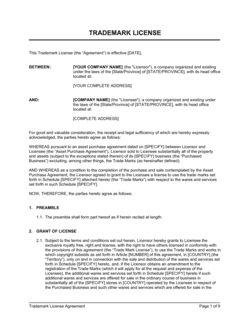
vs Trademark License Agreement

A trademark license agreement grants the right to use a brand's marks for product manufacturing or distribution — without the operational system, training obligations, and sub-franchising rights of a master franchise. A master franchise agreement bundles IP licensing with operational standards, fee structures, and development obligations. Use a trademark license for product-only brand extensions and a master franchise agreement when the full franchise system — including unit operations and sub-franchising — is being deployed.

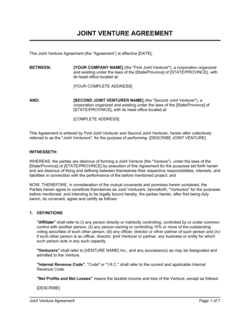
vs Joint Venture Agreement

A joint venture creates a shared-ownership entity between the franchisor and a local partner for market entry, with both parties contributing capital and sharing profits and losses. A master franchise agreement keeps ownership of the brand entirely with the franchisor while delegating territory development to the master franchisee as a licensee. Joint ventures are preferred when the franchisor wants operational control and profit participation; master franchise agreements suit franchisors who prefer a capital-light expansion model with a fixed fee and royalty income stream.

Industry-specific considerations

Food and Beverage

Health and safety compliance obligations cascade from the franchisor through the master franchisee to each sub-franchisee, making audit and inspection rights particularly critical in this sector.

Retail

Store-format compliance, planogram standards, and supplier lists controlled by the franchisor require the master franchise agreement to include enforceable brand-standards and supply-chain obligations.

Professional Services

Licensing and professional indemnity requirements vary by territory; the master franchise agreement must address how regulatory compliance obligations flow through to individual sub-franchisee practitioners.

Fitness and Wellness

Equipment standards, instructor certification, and brand-experience consistency across sub-franchisees require robust training obligations and ongoing quality-audit rights embedded in the agreement.

Jurisdictional notes

United States

The FTC Franchise Rule requires franchisors to provide a Franchise Disclosure Document (FDD) to prospective franchisees — including master franchisees — at least 14 calendar days before any agreement is signed or payment made. Approximately 14 states have additional franchise registration requirements. Post-termination non-compete enforceability varies sharply by state; California and Minnesota effectively void most post-term restrictions. FDD Item 20 must disclose all master franchisees and sub-franchisees.

Canada

Five provinces — Ontario, Alberta, British Columbia, Manitoba, and New Brunswick — have franchise disclosure legislation requiring delivery of a disclosure document at least 14 days before signing or payment. The Arthur Wishart Act in Ontario and equivalent provincial statutes provide franchisees with a right of rescission for non-disclosure. Quebec's Civil Law system applies different principles to franchise relationships; agreements intended to cover Quebec should be reviewed by Quebec-qualified counsel. There is no federal franchise-specific statute in Canada.

United Kingdom

The UK has no specific franchise disclosure legislation; franchise agreements are governed by general contract law. The British Franchise Association (BFA) sets voluntary industry standards. Master franchise agreements should address post-Brexit IP registration — EU Trade Mark registrations no longer automatically cover the UK, and separate UK trade mark registrations are required to support the IP license grant. Non-compete clauses are enforceable in the UK if reasonable in scope and duration, typically up to 2 years post-termination for master franchisees.

European Union

EU franchise disclosure requirements vary by member state — France, Spain, Italy, and Belgium have specific pre-sale disclosure obligations, while other member states rely on general commercial law. The EU Vertical Block Exemption Regulation (VBER) 2022 governs the competition-law treatment of territorial exclusivity and non-compete obligations in franchise agreements; exclusive territory grants exceeding 5 years or post-term non-competes require individual assessment. GDPR applies to any sharing of sub-franchisee or customer data between the franchisor and master franchisee, requiring a data-processing agreement alongside the master franchise agreement.

Template vs lawyer — what fits your deal?

PathBest forCostTime
Use the templateFranchisors reviewing structure, preparing a first draft for legal review, or familiarizing themselves with standard master franchise termsFree2–4 hours to complete initial draft
Template + legal reviewDomestic master franchise grants in a single jurisdiction where standard terms apply and the deal value is under $500K$2,000–$5,000 for franchise-specialist legal review and negotiation support1–3 weeks
Custom draftedInternational master franchise agreements, multi-territory deals, regulated industries, or franchise systems with complex IP and technology licensing$8,000–$25,000+ depending on jurisdiction complexity and negotiation rounds4–12 weeks

Glossary

Master Franchisee
The entity granted the right to sub-franchise a brand within a defined territory, acting as a local franchisor to individual unit operators.
Territory
The exclusive geographic area — country, region, or set of postal codes — within which the master franchisee holds development and sub-franchising rights.
Development Schedule
A contractual timeline requiring the master franchisee to open or sub-franchise a minimum number of units by specified dates as a condition of maintaining exclusivity.
Sub-Franchisee
An individual or entity that enters into a unit franchise agreement with the master franchisee rather than directly with the original franchisor.
Royalty Split
The contractually agreed division of ongoing royalty fees between the original franchisor and the master franchisee — typically expressed as a percentage of the gross royalty collected from sub-franchisees.
Initial Franchise Fee
A one-time upfront fee paid by each sub-franchisee to the master franchisee upon signing a unit franchise agreement, a portion of which is remitted to the franchisor.
Area Representative
A less-common alternative to a master franchisee who recruits and supports franchisees in a territory but does not hold sub-franchising rights or collect fees directly.
System Standards
The franchisor's documented operational, marketing, and quality requirements that all franchisees — including sub-franchisees — must follow to maintain brand compliance.
Reversion
The return of territory rights and sub-franchise agreements to the original franchisor upon expiration or termination of the master franchise agreement.
Minimum Performance Obligation (MPO)
A contractual threshold — such as a minimum number of open units or gross sales — that the master franchisee must meet to retain territorial exclusivity.
Franchise Disclosure Document (FDD)
A pre-sale disclosure document required in the US and several other jurisdictions that provides prospective franchisees with 23 standardized categories of material information.
Intellectual Property (IP) License
The grant within the master franchise agreement permitting the master franchisee and its sub-franchisees to use the franchisor's trademarks, trade dress, and proprietary systems.

Part of your Business Operating System

This document is one of 3,000+ business & legal templates included in Business in a Box.

  • Fill-in-the-blanks — ready in minutes
  • 100% customizable Word document
  • Compatible with all office suites
  • Export to PDF and share electronically

Create your document in 3 simple steps.

From template to signed document — all inside one Business Operating System.
1
Download or open template

Access over 3,000+ business and legal templates for any business task, project or initiative.

2
Edit and fill in the blanks with AI

Customize your ready-made business document template and save it in the cloud.

3
Save, Share, Send, Sign

Share your files and folders with your team. Create a space of seamless collaboration.

Save time, save money, and create top-quality documents.

★★★★★

"Fantastic value! I'm not sure how I'd do without it. It's worth its weight in gold and paid back for itself many times."

Managing Director · Mall Farm
Robert Whalley
Managing Director, Mall Farm Proprietary Limited
★★★★★

"I have been using Business in a Box for years. It has been the most useful source of templates I have encountered. I recommend it to anyone."

Business Owner · 4+ years
Dr Michael John Freestone
Business Owner
★★★★★

"It has been a life saver so many times I have lost count. Business in a Box has saved me so much time and as you know, time is money."

Owner · Upstate Web
David G. Moore Jr.
Owner, Upstate Web

Run your business with a system — not scattered tools

Stop downloading documents. Start operating with clarity. Business in a Box gives you the Business Operating System used by over 250,000 companies worldwide to structure, run, and grow their business.

Start free · No credit card required