Goal Setting Traps To Avoid Template

Free to read β€’ Save or share with one click

FreeGoal Setting Traps To Avoid Template

At a glance

What it is
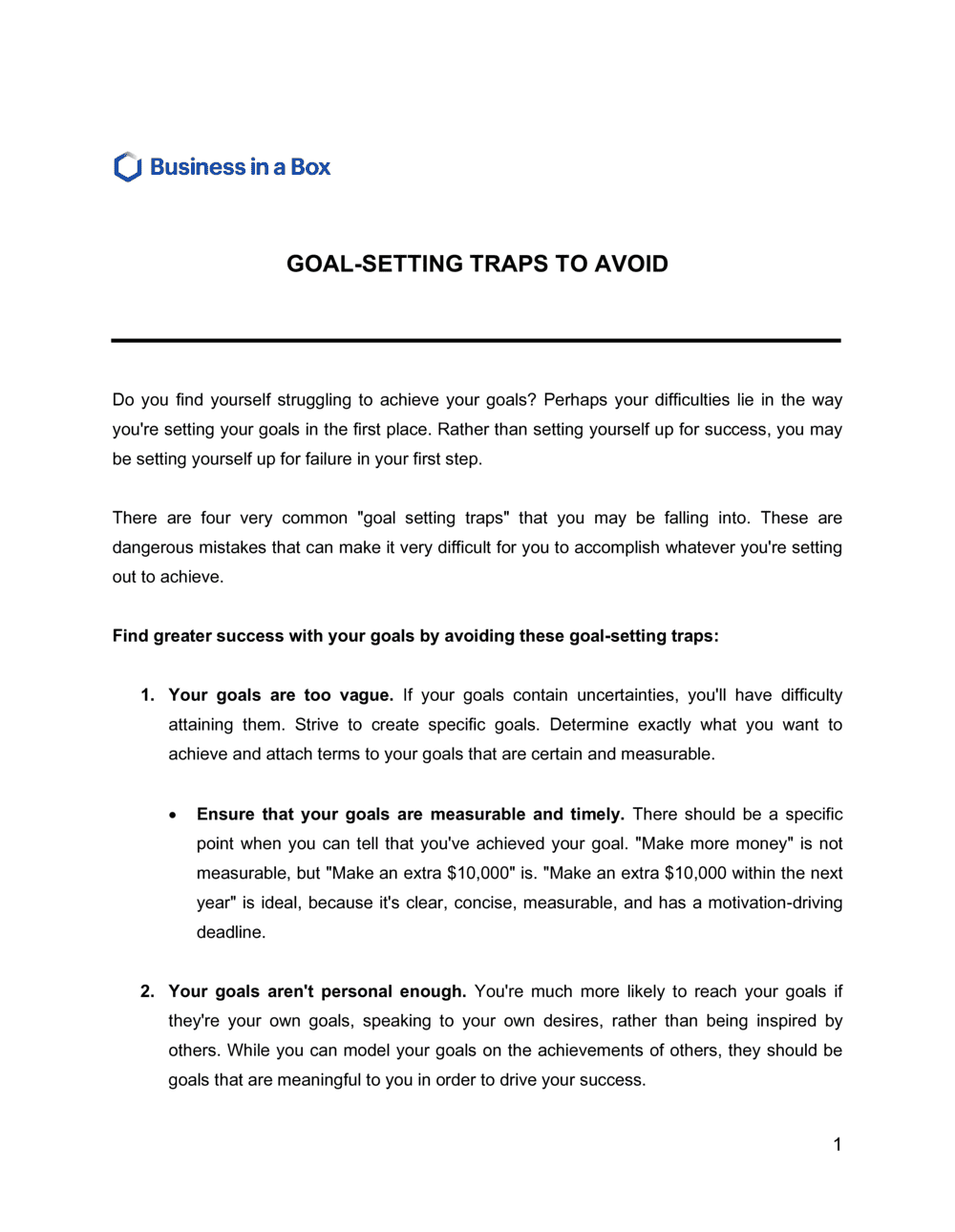
Goal Setting Traps To Avoid is a structured reference and planning document that identifies the most common mistakes individuals, managers, and organizations make when setting goals β€” and provides concrete corrective guidance for each. This free Word download gives you a ready-to-use framework you can edit online, customize for your team or performance cycle, and export as PDF to share with direct reports or leadership.
When you need it
Use it at the start of an annual planning cycle, during quarterly OKR reviews, or when a team repeatedly sets goals that go unmet. It is especially useful when onboarding new managers or establishing a consistent goal-setting standard across departments.
What's inside
Descriptions of the most common goal-setting traps β€” including vague targets, unmeasurable outcomes, misaligned priorities, and unrealistic timelines β€” paired with diagnostic questions and corrective actions for each. The document also includes a goal audit checklist and a quick-reference summary for manager training.

What is a Goal Setting Traps To Avoid document?

A Goal Setting Traps To Avoid document is a structured planning and diagnostic reference that identifies the most common mistakes made during goal-setting cycles β€” vague targets, missing baselines, diffused ownership, activity-as-outcome confusion, and disconnected priorities β€” and provides concrete corrective actions for each. It functions as both a pre-launch checklist and a mid-cycle audit tool, giving managers and teams a systematic way to stress-test goals before they are finalized and communicated. Unlike a goal-setting template that prescribes how to write goals, this document works backward from known failure patterns to eliminate the specific errors that cause well-intentioned goals to go unmet.

Why You Need This Document

Most missed goals are not the result of poor effort β€” they are the result of goals that were never set up to succeed. Vague language that felt collaborative in the planning meeting becomes a source of conflict at year-end. Goals assigned to a team rather than a named individual are reliably deprioritized the moment competing demands arrive. Activity metrics that masquerade as outcomes let teams stay busy while delivering nothing measurable. Without a structured trap-review process, these errors repeat every planning cycle because they are invisible in the moment of goal-setting. This document makes the invisible visible, before the cycle begins, when there is still time to fix the goal rather than explain the miss. For organizations where goals feed into performance reviews, compensation decisions, or funding milestones, the cost of poorly formed goals extends beyond missed targets to legal exposure, employee disputes, and misallocated resources.

Which variant fits your situation?

If your situation is…Use this template
Setting individual employee performance goals for an annual reviewPerformance Review Template
Defining quarterly objectives and key results for a teamOKR Template
Creating a personal development plan tied to specific goalsIndividual Development Plan
Documenting company-wide strategic goals for the yearStrategic Planning Template
Setting goals for a specific project with milestones and ownersProject Plan Template
Tracking goal progress throughout the quarter or yearKPI Dashboard Template
Conducting a mid-year goal review and resetPerformance Improvement Plan

Common mistakes to avoid

❌ Setting goals without a baseline metric

Why it matters: If you do not know the starting point, you cannot measure progress or prove improvement. 'Increase customer satisfaction' means nothing without a current NPS or CSAT score to move from.

Fix: Before finalizing any goal, document the current measured value of the metric you intend to move. If the baseline does not exist yet, make establishing it the first milestone of the goal.

❌ Assigning a goal to a team instead of a named individual

Why it matters: Shared accountability reliably produces no accountability. When a goal is owned by 'the marketing team,' every individual assumes someone else is tracking it.

Fix: Name one person as the goal owner on every goal. Contributors can be listed separately, but a single owner is responsible for progress and escalation.

❌ Setting too many goals simultaneously

Why it matters: Teams with more than five active goals at a time consistently underperform on all of them. Attention and resources fragment, and nothing receives the focus needed to move the needle.

Fix: Limit active goals to three to five per person or team per cycle. If everything is a priority, nothing is. Force a ranked prioritization before the cycle begins.

❌ Skipping the mid-cycle review

Why it matters: Goals set without scheduled check-ins drift silently. By the time year-end arrives, the goal may be irrelevant, the timeline missed, or the metric undocumented.

Fix: Schedule at least one formal midpoint review for every goal at the same time the goal is set. Put it on the calendar before the document leaves the room.

❌ Using activity as a proxy for outcome

Why it matters: A goal to 'hold 10 customer interviews per quarter' measures effort, not impact. Activity-based goals let teams feel busy while generating no measurable business result.

Fix: Reframe every activity-based goal as the outcome the activity is meant to produce. '10 customer interviews' becomes 'identify three validated pain points supported by customer interview data by [DATE].'

❌ Failing to connect individual goals to company priorities

Why it matters: Goals that are not visibly linked to an organizational priority get deprioritized the moment a conflict arises β€” and they always arise. Disconnected goals also undermine performance review credibility.

Fix: Add a single line to every goal stating which company or departmental priority it supports. If no connection can be made, the goal should not exist.

The 10 key clauses, explained

Trap identification header

In plain language: Names the specific trap clearly so readers can recognize it in their own planning process before the damage is done.

Sample language
Trap #[NUMBER]: [TRAP NAME] β€” [ONE-SENTENCE DESCRIPTION OF THE TRAP AND WHY IT OCCURS].

Common mistake: Labeling traps too vaguely (e.g., 'bad goal setting') rather than naming the precise behavior. Vague labels do not prompt self-recognition or corrective action.

Trap description and root cause

In plain language: Explains what the trap looks like in practice and why people fall into it β€” typically a cognitive bias, time pressure, or missing information.

Sample language
This trap occurs when [SPECIFIC BEHAVIOR]. The root cause is typically [ROOT CAUSE β€” e.g., 'starting the goal-setting process without first reviewing strategy'] which leads to [CONSEQUENCE].

Common mistake: Describing the symptom without the root cause. Teams that understand only what went wrong repeat the mistake; teams that understand why are able to prevent it.

Diagnostic question

In plain language: A single pointed question that helps a manager or individual self-diagnose whether they have fallen into this trap with a current goal.

Sample language
Ask yourself: [DIAGNOSTIC QUESTION β€” e.g., 'Can you state in one sentence exactly what success looks like on this goal, and what number confirms it?']

Common mistake: Using yes/no diagnostic questions instead of open-ended ones. Binary questions let people rationalize past the trap; open-ended questions surface the real gap.

Real-world example

In plain language: A concrete, anonymized scenario that illustrates the trap in a recognizable business context.

Sample language
Example: [ROLE/TEAM] set a goal to '[VAGUE GOAL TEXT]' for [TIMEFRAME]. Because [MISSING ELEMENT], the team [CONSEQUENCE β€” e.g., 'reached the end of Q3 with no shared definition of done and no measurable result'].

Common mistake: Using generic examples ('a company once tried to grow') that readers cannot map to their own context. Industry-specific or role-specific examples drive recognition and behavior change.

Corrective action

In plain language: A specific, actionable fix the reader can apply immediately to the goals they are currently setting or reviewing.

Sample language
Fix: Before finalizing this goal, [SPECIFIC ACTION β€” e.g., 'write the success metric in the format: from [BASELINE] to [TARGET] by [DATE], tracked via [DATA SOURCE]'].

Common mistake: Offering advice like 'be more specific' without a concrete rewriting formula. Actionable fixes include templates, prompts, or checklists β€” not directives.

Warning signs checklist

In plain language: A short list of observable warning signs that the trap is present in a goal as currently written.

Sample language
Warning signs: (a) the goal uses words like 'improve,' 'increase,' or 'support' without a number; (b) no single person is named as accountable owner; (c) the goal has not been connected to a company priority.

Common mistake: Including more than five warning signs per trap. Long checklists are skipped. Three to four concrete signals are more likely to be used in a real review.

Goal rewrite prompt

In plain language: A before-and-after rewriting exercise that shows exactly how to transform a trap-laden goal into a well-formed one.

Sample language
Before: '[WEAK GOAL EXAMPLE β€” e.g., Improve customer satisfaction].' After: '[STRONG GOAL EXAMPLE β€” e.g., Increase NPS from 32 to 45 by December 31, [YEAR], measured via monthly Medallia survey]'.

Common mistake: Using 'before' examples that are so obviously bad no one would recognize them as their own. Subtly flawed examples β€” ones that look reasonable at first glance β€” drive more learning.

Accountability and ownership clause

In plain language: Documents who is responsible for each goal, who supports it, and how progress will be reported and to whom.

Sample language
Goal Owner: [NAME/ROLE]. Supporting contributors: [NAMES/ROLES]. Progress reported to: [MANAGER/COMMITTEE] on [CADENCE β€” e.g., bi-weekly]. Escalation path if off-track: [PROCESS].

Common mistake: Assigning a goal to a team rather than a named individual. Shared ownership without a single accountable person reliably produces the diffusion of responsibility β€” no one acts because everyone assumes someone else will.

Review and reset cadence

In plain language: Defines when and how each goal will be reviewed, what triggers a mid-cycle reset, and what the process is for revising targets that have become irrelevant.

Sample language
Scheduled reviews: [DATES/FREQUENCY]. A goal reset is triggered when [CONDITION β€” e.g., 'the underlying business assumption changes or progress falls below 50% of the expected pace at the midpoint']. Reset process: [STEPS].

Common mistake: Setting goals with no review cadence. Without scheduled check-ins, goal drift goes undetected until year-end, when it is too late to course-correct.

Goal audit summary and sign-off

In plain language: A one-page checklist confirming that each goal clears the common traps before it is finalized and communicated.

Sample language
Goal Audit Checklist β€” confirmed by [NAME/ROLE] on [DATE]: [ ] Specific and measurable [ ] Single accountable owner named [ ] Aligned to [COMPANY/TEAM PRIORITY] [ ] Achievable within resource constraints [ ] Time-bound with a specific deadline [ ] Baseline metric documented [ ] Review cadence scheduled.

Common mistake: Treating the audit as a bureaucratic sign-off rather than a substantive review. The checklist should be completed by the goal owner and reviewed by the manager together, not rubber-stamped.

How to fill it out

  1. 1

    List all current goals before reviewing traps

    Before opening the traps document, write out every goal your team or individual has committed to for the current cycle. Do not edit them yet β€” capture them as they were originally stated.

    πŸ’‘ Seeing goals written out verbatim, before applying any framework, reveals phrasing problems that felt invisible during the original setting conversation.

  2. 2

    Work through each trap section in order

    For each trap, read the description, answer the diagnostic question as it applies to your listed goals, and note which goals trigger a warning sign.

    πŸ’‘ Do this review with the goal owner present, not alone. The owner's reaction to the diagnostic question is often as informative as the answer itself.

  3. 3

    Apply the goal rewrite prompt to flagged goals

    For every goal that triggered a warning sign, use the rewrite prompt in that trap section to draft a revised version with a specific metric, named owner, and deadline.

    πŸ’‘ Rewrite the goal in a single sentence. If you cannot state it in one sentence with a number and a date, it is not ready to be finalized.

  4. 4

    Complete the accountability and ownership clause

    For each revised goal, fill in the named goal owner, supporting contributors, reporting cadence, and escalation path. One owner per goal β€” not a team name.

    πŸ’‘ If two people both believe they own the same goal, that ambiguity will surface as a conflict at the worst possible time. Resolve it now.

  5. 5

    Schedule review dates before finalizing

    Enter specific review dates for each goal β€” at least one midpoint check-in and one end-of-cycle review. Add these to the calendar before the document is distributed.

    πŸ’‘ Mid-cycle reviews that are scheduled in advance have a 3Γ— higher completion rate than those added reactively when a goal appears off-track.

  6. 6

    Complete the goal audit checklist for every goal

    Run each finalized goal through the audit checklist. Any unchecked item is a known risk β€” either resolve it before launch or document the accepted risk and the mitigation plan.

    πŸ’‘ A goal that fails two or more checklist items should be sent back for revision, not launched with known gaps.

  7. 7

    Distribute and confirm shared understanding

    Share the finalized document with every person named as a goal owner or contributor. Ask each person to confirm in writing that they understand what success looks like and what their role is.

    πŸ’‘ Verbal confirmation in a meeting is not sufficient. A written confirmation creates a record and surfaces misunderstandings before work begins.

  8. 8

    Archive the pre-revision goal list alongside the final document

    Keep the original, unedited goal list from Step 1 as a reference. Comparing it to the final revised goals at year-end reveals patterns in your team's default goal-setting mistakes.

    πŸ’‘ Most teams repeat the same two or three traps every cycle. The pattern only becomes visible when you have the before-and-after record to compare.

Frequently asked questions

What are the most common goal setting traps to avoid?

The most common goal setting traps are setting vague goals without measurable outcomes, assigning shared ownership rather than naming one accountable person, setting too many goals at once, skipping mid-cycle reviews, using activity metrics instead of outcome metrics, and failing to connect individual goals to company priorities. Each of these traps produces predictable failures β€” missed deadlines, disputed results, or goals that are quietly abandoned mid-cycle.

Why do smart people still fall into goal setting traps?

Most goal setting traps are caused by time pressure and cognitive shortcuts, not lack of knowledge. Managers under pressure to finalize goals quickly default to vague language because it feels collaborative and avoids conflict. The trap of over-optimism β€” setting stretch targets without checking resource constraints β€” is reinforced by organizational cultures that reward ambition over accuracy. A structured checklist applied consistently is more effective than trying to rely on judgment under deadline pressure.

How is this document different from a SMART goals template?

A SMART goals template gives you a framework for writing better goals. This document diagnoses the specific traps people fall into even when they believe they are following the SMART framework β€” for example, goals that are technically measurable but use vanity metrics, or goals that are time-bound but have no mid-cycle review scheduled. The two documents are complementary: use this one to audit and fix goals written with a SMART template.

How many goals should a person or team have at one time?

Research on goal attainment consistently supports a limit of three to five active goals per person or team per cycle. Beyond five goals, cognitive load and resource competition reduce performance on all of them. If your team regularly sets eight to ten goals per quarter and consistently misses several, the first fix is not better goal writing β€” it is fewer goals.

What is the difference between a stretch goal and an unrealistic goal?

A stretch goal is set 20–30% above baseline performance and is accompanied by a resource plan that makes the stretch theoretically achievable. An unrealistic goal has no plausible resource or capability path to achievement β€” it is aspirational fiction. The diagnostic question is: if every assumption works out perfectly, is this achievable? A stretch goal says yes. An unrealistic goal says no even in the best case.

How do I fix goals that were already set badly earlier in the year?

Schedule an explicit mid-cycle reset meeting. Use the diagnostic questions in each trap section to identify which traps are present, then apply the corrective rewrites. Document the revised goal alongside the original so there is a record of the change and the reason for it. A mid-cycle reset is not a failure β€” the failure is waiting until year-end to acknowledge that a goal was never going to be achieved as written.

Can this template be used for personal goals, or is it designed for business teams?

The traps described in this document apply equally to personal goal setting β€” vague targets, no baseline, no review cadence, and too many simultaneous commitments are as common in personal development as in corporate planning. The language in the template is written for a business context, but the diagnostic questions and corrective actions can be applied directly to personal or professional development goals with no modification.

How often should goal setting traps be reviewed with a team?

At the start of every goal-setting cycle β€” typically annually and at each quarterly OKR review. For teams new to structured goal setting, a brief trap review at the start of the first two or three cycles builds the habit quickly. Once the patterns are internalized, an abbreviated checklist version takes less than 15 minutes and prevents the most common failures before they happen.

What is goal drift and how do I prevent it?

Goal drift is the gradual, unnoticed shift in a goal's scope, timeline, or success criteria after it has been set β€” often caused by verbal scope additions, changing priorities, or the passage of time without a formal review. Prevent it by documenting the goal in writing with a specific metric and deadline, scheduling at least one midpoint review, and requiring a formal change process (not a verbal conversation) for any modification to a finalized goal.

How this compares to alternatives

vs SMART Goals Template

A SMART goals template provides the framework for writing well-formed goals. This document identifies the traps people fall into even when using a SMART framework β€” such as technically measurable goals built on vanity metrics. Use both together: write goals with SMART, then audit them with this document.

vs Performance Review Template

A performance review template documents how an employee performed against goals already set. This document is used upstream, before goals are finalized, to prevent the mistakes that make performance reviews contentious or inconclusive. The two documents are sequential, not interchangeable.

vs Strategic Planning Template

A strategic plan sets company-level direction and priorities. This document operates at the execution layer, ensuring that the individual and team goals cascaded from strategy avoid the traps that disconnect activity from strategic intent. Strategy without trap-free goal setting is a plan that looks good on paper and fails in execution.

vs Performance Improvement Plan (PIP)

A PIP is used after performance has already fallen short of expectations. This document is used before the cycle begins to prevent the goal-setting failures that make PIPs necessary. In many cases, poor employee performance is traceable to poorly formed goals β€” this document addresses the root cause that PIPs address only after the fact.

Industry-specific considerations

Technology / SaaS

Engineering and product teams frequently fall into the activity-as-outcome trap β€” measuring story points shipped rather than user adoption or retention impact.

Professional Services

Utilization rate goals without a quality or client satisfaction counterbalance create incentives to bill hours without delivering value, a common trap in consulting and legal firms.

Retail / E-commerce

Revenue goals set without margin guardrails lead teams to discount aggressively to hit the top-line number while destroying profitability β€” a cascade trap common in seasonal retail planning.

Healthcare

Patient throughput goals set without quality-of-care countermetrics represent a systemic goal-setting trap unique to healthcare operations, where activity and outcome can directly conflict.

Jurisdictional notes

United States

In the US, goal-setting documents used in performance management can become relevant in employment discrimination or wrongful termination claims if goals were applied inconsistently across protected classes. Ensuring that goals are documented, objective, and consistently applied across comparable roles reduces legal exposure. At-will employment does not eliminate this risk β€” documented disparate treatment in goal setting can still form the basis of a claim.

Canada

Canadian provincial human rights codes require that performance standards β€” including goals β€” not have an adverse differential impact on protected groups. In Ontario and British Columbia, poorly documented goal-setting processes have been cited in constructive dismissal claims where employees argued that shifting or unreasonable targets made continued employment untenable. French-language requirements in Quebec mean that goal documents distributed to Quebec employees should be available in French.

United Kingdom

Under the UK Equality Act 2010, performance goals that are applied inconsistently or that disproportionately disadvantage employees in protected categories can support indirect discrimination claims. Goal-setting documentation is also relevant in unfair dismissal proceedings, where tribunals examine whether performance targets were reasonable, clearly communicated, and consistently applied before a dismissal decision was made.

European Union

EU member states have strong employee protection frameworks that require documented, objective, and proportionate performance standards before discipline or dismissal. In Germany, works councils must be consulted on performance management systems including goal-setting criteria. GDPR applies to any personal data collected in the goal-setting process β€” including performance metrics linked to named individuals β€” requiring appropriate data handling, retention limits, and employee access rights.

Template vs lawyer β€” what fits your deal?

PathBest forCostTime
Use the templateManagers, HR teams, and founders establishing a goal-setting standard for their team or organizationFree30–60 minutes per planning cycle
Template + legal reviewHR leaders building a company-wide performance management framework that includes goal-setting standards$500–$1,500 for an HR consultant or organizational development advisor review1–2 weeks
Custom draftedEnterprises integrating goal-setting standards into a legally compliant performance management system tied to compensation or termination decisions$2,000–$8,000 for HR legal counsel and organizational design consultation3–6 weeks

Glossary

SMART Goals
A goal-setting framework where each goal is Specific, Measurable, Achievable, Relevant, and Time-bound.
OKR (Objectives and Key Results)
A goal-setting method that pairs a qualitative objective with two to five measurable key results that define what success looks like.
Stretch Goal
A goal deliberately set beyond current comfortable reach, intended to drive innovation or significant effort β€” typically 20–30% above baseline expectations.
Cascading Goals
The process of aligning individual or team goals downward from organizational strategy so that every level supports the same priorities.
Vanity Metric
A measure that looks impressive on a report but does not connect to meaningful business outcomes β€” such as website visits without conversion tracking.
Key Performance Indicator (KPI)
A quantifiable metric used to evaluate progress toward a specific goal or strategic objective over a defined period.
Goal Drift
The gradual, unnoticed shift in a goal's scope, timeline, or definition after it has been set β€” often caused by missing check-in milestones.
Accountability Owner
The single named individual responsible for the outcome of a goal, distinct from contributors who support the work.
Baseline Metric
The measured starting point against which progress toward a goal is tracked β€” without a baseline, improvement cannot be quantified.
Priority Conflict
A situation where two or more goals compete for the same resources, time, or attention, making it impossible to fully achieve both simultaneously.

Part of your Business Operating System

This document is one of 3,000+ business & legal templates included in Business in a Box.

  • Fill-in-the-blanks β€” ready in minutes
  • Compatible with all office suites
  • Export to PDF and share electronically

Create your document in 3 simple steps.

From template to signed document β€” all inside one Business Operating System.
1
Download or open template

Access over 3,000+ business and legal templates for any business task, project or initiative.

2
Edit and fill in the blanks with AI

Customize your ready-made business document template and save it in the cloud.

3
Save, Share, Send, Sign

Share your files and folders with your team. Create a space of seamless collaboration.

Save time, save money, and create top-quality documents.

β˜…β˜…β˜…β˜…β˜…

"Fantastic value! I'm not sure how I'd do without it. It's worth its weight in gold and paid back for itself many times."

Managing Director Β· Mall Farm
Robert Whalley
Managing Director, Mall Farm Proprietary Limited
β˜…β˜…β˜…β˜…β˜…

"I have been using Business in a Box for years. It has been the most useful source of templates I have encountered. I recommend it to anyone."

Business Owner Β· 4+ years
Dr Michael John Freestone
Business Owner
β˜…β˜…β˜…β˜…β˜…

"It has been a life saver so many times I have lost count. Business in a Box has saved me so much time and as you know, time is money."

Owner Β· Upstate Web
David G. Moore Jr.
Owner, Upstate Web

Run your business with a system β€” not scattered tools

Stop downloading documents. Start operating with clarity. Business in a Box gives you the Business Operating System used by over 250,000 companies worldwide to structure, run, and grow their business.

Start freeΒ Β·Β No credit card required