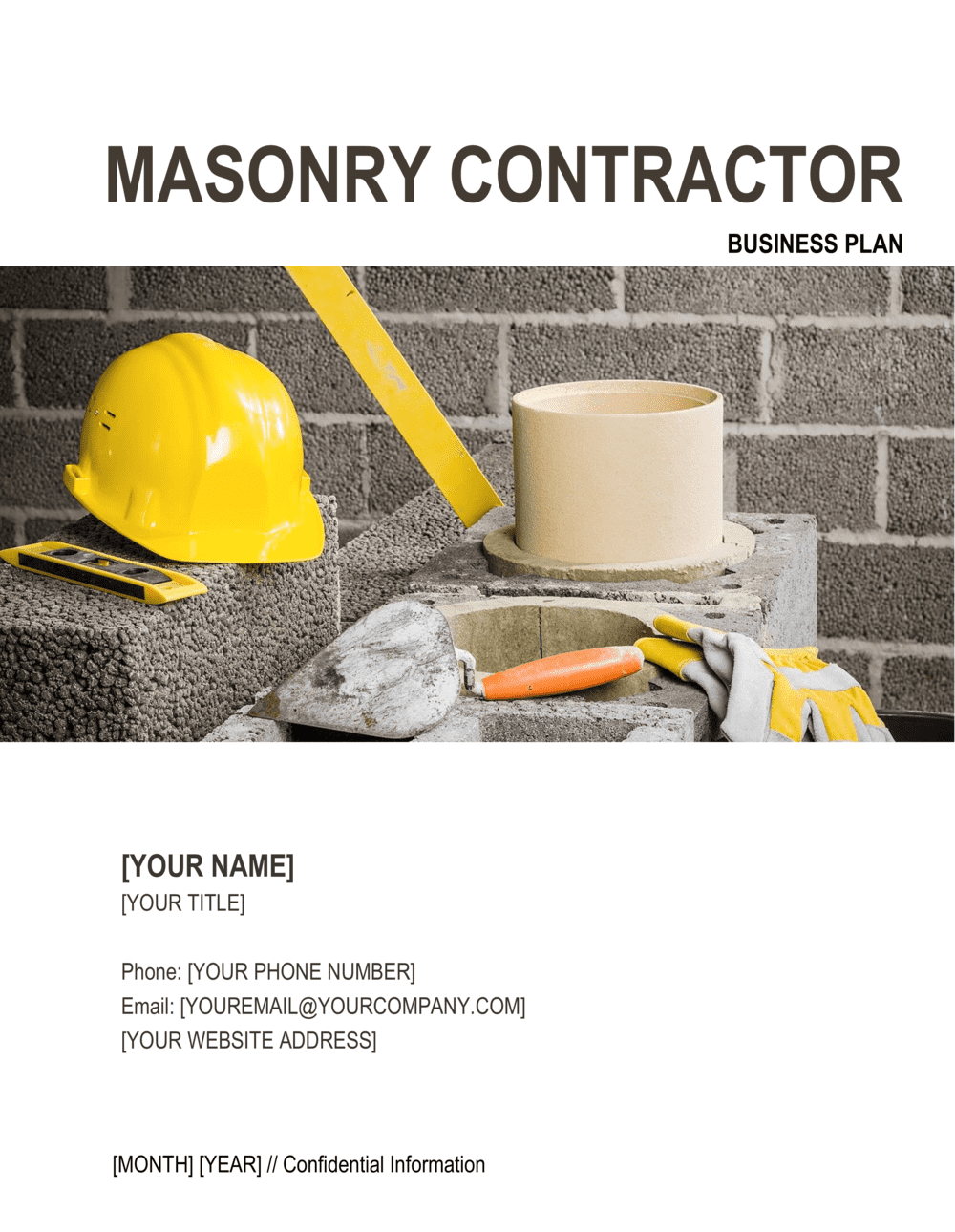
Masonry Contractor Business Plan Template

Free Word download β€’ Edit online β€’ Save & share with Drive β€’ Export to PDF

29 pagesβ€’2h 30m – 3h 20m to fillβ€’Difficulty: Expert
Learn more ↓
FreeMasonry Contractor Business Plan Template

At a glance

What it is
A Masonry Contractor Business Plan is a structured document that maps a masonry business's services, target market, competitive positioning, operational model, crew and equipment needs, and multi-year financial projections into a single reference document. This free Word download gives you an industry-specific starting point you can edit online and export as PDF to share with lenders, bonding agents, or partners.
When you need it
Use it when launching a new masonry contracting business, applying for an SBA loan or bonding approval, or formalizing a growth strategy for an existing operation looking to scale crew size or expand service lines.
What's inside
Executive summary, company overview, services and materials offered, market and competitive analysis, marketing and sales strategy, operations and crew management plan, management team, and three-year financial projections including revenue by project type, materials cost, labor cost, and cash flow.

What is a Masonry Contractor Business Plan?

A Masonry Contractor Business Plan is a structured document that defines a masonry company's service lines, target market, competitive positioning, crew and equipment model, and multi-year financial projections in a single reference document. It covers trade-specific details β€” material sourcing, journeyman labor ratios, bonding capacity, and seasonal demand patterns β€” that a generic contractor plan does not address. This free Word download gives masonry business owners an industry-calibrated starting point they can edit online and export as PDF for bank loan applications, surety bond underwriting, or internal growth planning.

Why You Need This Document

Without a written business plan, SBA loan applications stall for missing financial detail, bonding underwriters request a revised submission, and growth decisions β€” adding a second crew, purchasing a new scaffold system, entering commercial work β€” get made on instinct rather than verified numbers. The masonry contracting industry runs on bonding capacity, and bonding capacity depends on demonstrating financial stability and a credible operating plan. A plan that separates labor costs from materials costs, ties revenue projections to a specific bid volume and hit rate, and documents licensing and insurance gives lenders and surety underwriters exactly what they need to approve your application the first time. This template provides the structure so you can focus on the numbers that only you know.

Which variant fits your situation?

If your situation is…Use this template
Starting a new masonry company from scratchMasonry Contractor Business Plan (Startup)
Applying for an SBA 7(a) or SBA 504 loanBank Loan Business Plan
Quick internal planning before the first project seasonOne-Page Business Plan
Planning for a broader residential construction businessGeneral Contractor Business Plan
Launching a landscaping or hardscape-focused companyLandscaping Business Plan
Bidding on public or government construction contractsConstruction Proposal
Aligning an existing masonry business around a 3-year growth targetStrategic Plan

Common mistakes to avoid

❌ Omitting licensing and bonding details

Why it matters: Lenders and project owners verify contractor credentials before reading financial projections. A plan that skips these details signals the applicant does not understand how the industry works.

Fix: Include your state contractor license number, bonding limit, general liability coverage amount, and workers' comp carrier in the company overview section.

❌ Using national industry data without local market evidence

Why it matters: Projecting revenue from a national masonry market figure with no local data makes your revenue assumptions unverifiable and undermines lender confidence.

Fix: Pull county or city building permit totals for the past two years and use them to size your realistic serviceable market within your actual service radius.

❌ Blending labor and materials into a single cost line

Why it matters: Bonding underwriters and lenders benchmark labor and materials ratios against industry norms β€” a blended cost of goods line prevents them from doing that check and triggers a request for revision.

Fix: Separate direct costs into at least three lines: field labor, materials and supplies, and equipment. Show each as a percentage of revenue alongside the dollar amount.

❌ No bid volume or sales process documented

Why it matters: Revenue projections with no underlying sales assumptions are unverifiable. A plan that says 'we will win enough work' gives a lender nothing to evaluate.

Fix: State your monthly bid target, expected bid-hit ratio, and the two or three channels through which bids are generated. Tie these inputs directly to the revenue line in your financial model.

The 10 key sections, explained

Executive Summary

Company Overview

Services and Materials Offered

Market Analysis

Competitive Analysis

Marketing and Sales Strategy

Operations and Crew Management Plan

Management Team

Financial Projections

Funding Requirements and Use of Funds

How to fill it out

  1. 1

    Complete the company overview with licensing details

    Enter your legal entity name, state, entity type, founding date, contractor license number, bonding limit, and insurance coverages. These are the first things a lender or bonding agent will verify.

    πŸ’‘ List both your general liability coverage amount and your workers' compensation carrier β€” masonry is a high-risk trade and underwriters check this immediately.

  2. 2

    Define your services and average project values

    List the three to five masonry services that will generate the majority of your revenue. For each, note the average project value, typical project duration, and primary customer type.

    πŸ’‘ If one service type (e.g., new construction block) represents more than 50% of projected revenue, call that out explicitly β€” it shows you understand your own business model.

  3. 3

    Build the market analysis with local permit data

    Pull residential and commercial permit data from your county or city building department for the past two years. Use this to size your addressable local market rather than relying solely on national trade association statistics.

    πŸ’‘ A local data source β€” even a single year of county permit totals β€” is more credible to a regional lender than a national IBISWorld figure.

  4. 4

    Map your competitors and identify your edge

    List at least three masonry or competing trade contractors in your service area. Note their crew size, market focus, and one known weakness. Then write one specific paragraph on why your business wins against each.

    πŸ’‘ Response time, specialty certifications (historic restoration, LEED masonry), or a supplier relationship that gives you better material pricing are all defensible differentiators.

  5. 5

    Document your sales channels and bid volume targets

    Identify how you generate bids β€” GC relationships, referral programs, online leads, or direct developer outreach. Set a monthly bid volume target and an expected bid-hit ratio based on your experience or industry benchmarks.

    πŸ’‘ A bid-hit ratio of 25–35% is typical for residential masonry; commercial bid lists often run 10–20%. Use the lower end of the range for conservative revenue projections.

  6. 6

    Detail the crew structure and equipment plan

    Specify your Year 1 crew headcount by role (journeyman mason, laborer, foreman), whether equipment is owned or leased, and your OSHA safety program status. Include monthly equipment payments as a fixed cost line.

    πŸ’‘ Showing a documented safety program β€” even a simple written OSHA 10 compliance policy β€” increases bonding approval rates and can lower your insurance premium.

  7. 7

    Build the financial projections from project count up

    Start with a realistic number of projects per month, multiply by average project value, then subtract direct labor, materials, equipment costs, and monthly overhead to arrive at net income. Build monthly for Year 1, then annual for Years 2 and 3.

    πŸ’‘ Model a scenario where your bid-hit ratio comes in at 70% of target β€” if the business still covers cash needs at that level, the plan is defensible.

  8. 8

    Write the executive summary last

    Pull the single strongest data point from each section β€” local market size, your key differentiator, Year 1 revenue, and funding ask β€” and compress them into one to two pages.

    πŸ’‘ If the executive summary runs more than two pages, it is not a summary β€” cut it to the five or six facts that a lender or partner must know before reading further.

Frequently asked questions

What is a masonry contractor business plan?

A masonry contractor business plan is a structured document that defines a masonry company's services, target market, competitive positioning, crew and equipment model, and financial projections β€” typically covering three years. It is used to secure bank loans, bonding approvals, and working capital lines of credit, and to give the business owner a concrete operational roadmap for the first years of growth.

Do I need a business plan to get a masonry contractor license bond?

Most surety companies do not require a formal business plan for small contractor bonds under $50,000, but they do review financial statements and credit history. For larger bonds β€” common on commercial or public projects β€” surety underwriters typically request a business plan, two to three years of financial statements, and a schedule of completed projects. Having a plan ready accelerates underwriting and demonstrates professional maturity.

What financial projections should a masonry business plan include?

At minimum: a monthly P&L for Year 1 (and annual for Years 2–3), a cash flow statement on the same cadence, and a use-of-funds schedule if capital is being requested. Revenue should be broken out by project type. Direct costs should be separated into labor, materials, and equipment. A gross margin per project analysis and a monthly overhead schedule round out what lenders typically require.

What gross margin should a masonry contractor target?

Gross margins for masonry contractors typically range from 20–35% after deducting field labor, materials, equipment, and subcontractor costs. Residential restoration and specialty stone work tend to carry higher margins (28–35%) than competitive commercial block work (18–25%). A business plan that projects gross margins outside this range should include a specific explanation of the structural advantage that supports the deviation.

How do I estimate revenue for a new masonry business?

Start with a realistic monthly bid volume β€” how many project proposals your team can prepare per month. Apply an expected bid-hit ratio (25–35% for residential, 10–20% for commercial bid lists) to get contracts won per month. Multiply by your average project value to arrive at monthly revenue. Build this model for each service type separately, then sum for total revenue.

What makes a masonry business plan different from a general contractor plan?

A masonry-specific plan focuses on trade-specific details that a general contractor plan does not cover: material sourcing and pricing for brick, block, and stone; journeyman mason labor rates and crew ratios; specialty certifications like historic restoration or LEED masonry; bonding limits by project type; and the seasonal demand patterns common in northern markets where masonry work slows in winter.

Can I use this template for an SBA loan application?

Yes. SBA lenders require a written business plan for most 7(a) and 504 loan applications. This template covers the sections SBA lenders evaluate: executive summary, market analysis, management team, operational plan, and three-year financial projections with a use-of-funds schedule. You will also need to attach personal financial statements, tax returns, and contractor license documentation separately.

How long should a masonry contractor business plan be?

For a bank loan or bonding application, 15–25 pages plus a financial model appendix is the accepted range. A plan shorter than 12 pages typically lacks the market and financial detail lenders require. A plan longer than 30 pages risks burying key facts. Keep the body tight and move detailed schedules β€” equipment lists, project references, insurance certificates β€” to appendices.

How this compares to alternatives

vs General Contractor Business Plan

A general contractor plan covers multiple trade disciplines, subcontractor management, and broader project delivery. A masonry contractor plan focuses on a single trade's labor model, material sourcing, and specialty certifications. Use the masonry-specific plan when the business derives the majority of revenue from masonry work; use a general contractor plan if masonry is one of several self-performed trades.

vs One-Page Business Plan

A one-page plan is useful for rapid internal alignment or early ideation but lacks the financial depth and market evidence required by lenders, bonding agents, or partners. Use the one-page version to sketch the concept, then build the full masonry contractor plan before any capital or bonding application.

vs Strategic Plan

A strategic plan maps goals, initiatives, and KPIs for an existing operation over a 3–5 year horizon. A business plan adds market context, competitive analysis, and a capital structure β€” making it the external-facing document for lenders and bonding underwriters. Established masonry businesses typically need both: the business plan for financing and the strategic plan for internal execution.

vs Construction Proposal

A construction proposal is a project-specific bid document addressed to a single client or general contractor. A business plan describes the entire business β€” its strategy, financials, and growth trajectory. The proposal wins individual jobs; the business plan secures the capital and bonding capacity needed to pursue them at scale.

Industry-specific considerations

Residential Construction

Custom home brick and stone exteriors, fireplace construction, retaining walls, and driveway paver installation driven by housing starts and remodel permits.

Commercial Construction

CMU block structural and veneer work on office, retail, and industrial projects; bid through general contractor subcontract lists with prevailing wage requirements on public work.

Historic Preservation and Restoration

Tuckpointing, mortar repointing, and brick replacement on heritage structures; requires specialty certifications and knowledge of period-appropriate materials and techniques.

Landscaping and Hardscape

Outdoor living spaces, garden walls, patio pavers, and fire pit construction β€” typically residential, with higher margins and shorter project cycles than structural masonry.

Template vs pro β€” what fits your needs?

PathBest forCostTime
Use the templateIndependent masonry contractors applying for first bank loans, bonding up to $100K, or planning a first crew expansionFree1–2 weeks (15–30 hours)
Template + professional reviewSBA loan applications, bonding above $250K, or plans presented to equity partners or investors$500–$1,500 for a financial model review by an accountant or business advisor2–3 weeks
Custom draftedLarge commercial bonding programs, multi-crew scaling plans, or acquisition financing for established masonry companies$2,000–$6,000 for a professional business plan writer with construction industry experience3–6 weeks

Glossary

Prevailing Wage
The mandated hourly rate for labor on publicly funded construction projects, set by federal or state authorities for each trade category.
Bonding
A surety bond that guarantees a contractor will fulfill contractual obligations; required by most commercial and public project owners.
Bid-Hit Ratio
The number of contracts won divided by the number of bids submitted β€” a key efficiency metric for estimating and sales in contracting businesses.
Materials Cost Percentage
Masonry materials (brick, block, mortar, stone) expressed as a share of total project revenue; typically 30–45% for masonry work.
Subcontractor
A trade specialist hired by the masonry contractor to perform work outside the core masonry scope, such as concrete forming or excavation.
Change Order
A written amendment to the original contract scope, price, or schedule, signed by both parties before additional work begins.
Gross Profit per Job
Project revenue minus direct labor, materials, equipment, and subcontractor costs β€” before overhead and taxes.
Overhead Rate
Monthly fixed costs (insurance, office, equipment payments, licenses) divided by billable hours or revenue, expressed as a percentage.
Retention
A percentage of each progress payment β€” typically 5–10% β€” withheld by the project owner until final inspection and punch-list completion.
Crew Utilization Rate
Billable field hours as a percentage of total paid crew hours; a rate below 75% signals scheduling inefficiency or excessive downtime.

Part of your Business Operating System

This document is one of 3,000+ business & legal templates included in Business in a Box.

  • Fill-in-the-blanks β€” ready in minutes
  • 100% customizable Word document
  • Compatible with all office suites
  • Export to PDF and share electronically

Create your document in 3 simple steps.

From template to signed document β€” all inside one Business Operating System.
1
Download or open template

Access over 3,000+ business and legal templates for any business task, project or initiative.

2
Edit and fill in the blanks with AI

Customize your ready-made business document template and save it in the cloud.

3
Save, Share, Send, Sign

Share your files and folders with your team. Create a space of seamless collaboration.

Save time, save money, and create top-quality documents.

β˜…β˜…β˜…β˜…β˜…

"Fantastic value! I'm not sure how I'd do without it. It's worth its weight in gold and paid back for itself many times."

Managing Director Β· Mall Farm
Robert Whalley
Managing Director, Mall Farm Proprietary Limited
β˜…β˜…β˜…β˜…β˜…

"I have been using Business in a Box for years. It has been the most useful source of templates I have encountered. I recommend it to anyone."

Business Owner Β· 4+ years
Dr Michael John Freestone
Business Owner
β˜…β˜…β˜…β˜…β˜…

"It has been a life saver so many times I have lost count. Business in a Box has saved me so much time and as you know, time is money."

Owner Β· Upstate Web
David G. Moore Jr.
Owner, Upstate Web

Run your business with a system β€” not scattered tools

Stop downloading documents. Start operating with clarity. Business in a Box gives you the Business Operating System used by over 250,000 companies worldwide to structure, run, and grow their business.

Free Forever PlanΒ Β·Β No credit card required