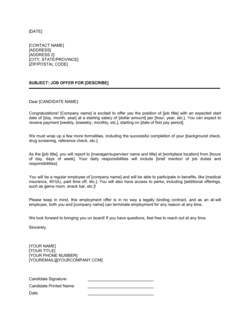
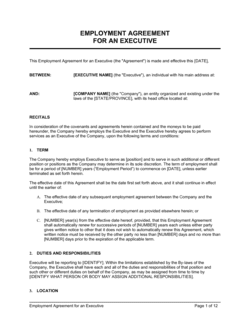
Marketing Strategist Job Description Template

Free Word download • Edit online • Save & share with Drive • Export to PDF

2 pages25–30 min to fillDifficulty: StandardSignature requiredLegal review recommended
Learn more ↓
FreeMarketing Strategist Job Description Template

At a glance

What it is
A Marketing Strategist Job Description is a binding employment document that defines the role, responsibilities, qualifications, compensation structure, reporting lines, and legal obligations for a marketing strategist hire. This free Word download lets you edit and customize every section online, then export as PDF to post publicly or attach to a formal offer letter before the employee's first day.
When you need it
Use it when opening a new marketing strategist position, replacing an existing role, or formalizing a previously informal arrangement. It becomes legally significant when attached to or incorporated by reference into an employment contract or offer letter.
What's inside
Role title and reporting structure, core duties and strategic responsibilities, required and preferred qualifications, compensation and benefits overview, confidentiality and IP assignment obligations, and at-will or fixed-term employment terms. Together these sections create a defensible record of what the employer and employee agreed the role entails from day one.

What is a Marketing Strategist Job Description?

A Marketing Strategist Job Description is a formal employment document that defines the title, reporting structure, core duties, required qualifications, compensation parameters, and legal obligations — including IP assignment and confidentiality — for a marketing strategist role. When attached to or incorporated by reference into a signed employment contract or offer letter, it creates an enforceable written record of what the employer and employee agreed the role entails from day one. It is not merely a recruiting tool: the duties clause sets the performance baseline for reviews, the qualifications block defends hiring decisions against discrimination claims, and the IP and confidentiality clauses protect the company's campaign data and audience assets after the employee leaves.

Why You Need This Document

Hiring a marketing strategist without a documented, signed job description leaves four significant gaps in your employment record simultaneously. Without a defined scope of duties, terminating an underperforming hire for cause becomes procedurally difficult — the employee can argue the expectation was never written down. Without explicit IP assignment language, the audience segments, campaign briefs, and performance analyses the strategist creates — especially on personal devices or in remote settings — may not belong to you. Without a salary range that matches what you intend to pay, you risk pay-transparency violations in the growing number of US states and Canadian provinces that require honest posted ranges. And without a document that clearly references and connects to an employment contract, the job description itself may be treated as the entire written agreement — stripping away termination notice, severance, and restrictive covenant protections you thought were in place. This template closes all four gaps in under 30 minutes.

Which variant fits your situation?

If your situation is…Use this template
Hiring a mid-level marketing strategist for a generalist brand roleMarketing Strategist Job Description
Filling a senior or lead strategist role with team management dutiesSenior Marketing Manager Job Description
Hiring specifically for digital and paid-media strategyDigital Marketing Strategist Job Description
Engaging a marketing strategist on a project or contract basisIndependent Contractor Agreement
Hiring a brand-focused content and communications strategistContent Marketing Manager Job Description
Filling a VP of Marketing or CMO role with equity and executive termsExecutive Employment Agreement
Onboarding a remote marketing strategist in a different jurisdictionRemote Work Employment Agreement

Common mistakes to avoid

❌ Using a generic job board description without customizing duties

Why it matters: A copy-pasted description that does not match actual expectations creates a gap between documented and real scope, making performance management and termination for cause harder to defend.

Fix: Replace every generic duty with a specific deliverable tied to your business model — channels you actually use, tools the team actually runs, and KPIs the role will actually own.

❌ Publishing a salary range outside what the employer will actually pay

Why it matters: Pay transparency laws in California, New York, Colorado, and several other jurisdictions require the posted range to reflect what the employer genuinely intends to offer — violations carry fines and civil liability.

Fix: Set the range based on your approved compensation band before posting. If the band is not finalized, delay posting until it is.

❌ Omitting IP assignment for remotely created work product

Why it matters: Marketing strategists create audience lists, campaign briefs, and performance analyses outside company premises and on personal devices. Without explicit language covering off-premises work, the IP ownership is ambiguous.

Fix: Include 'regardless of where or when created' language and explicitly list digital assets — audience segments, campaign data, creative files — as covered work product.

❌ Conflating the job description with the entire employment agreement

Why it matters: A standalone job description signed by both parties may be treated by courts as the full written agreement — leaving no severance formula, no termination notice period, and no governing-law clause in place.

Fix: Always attach or cross-reference a formal employment contract or offer letter that governs compensation, termination, and restrictive covenants. The job description should define the role; the contract should define the relationship.

❌ Listing degree requirements that are not demonstrably necessary for the role

Why it matters: Degree requirements that disproportionately screen out protected classes without a documented business necessity expose the employer to Title VII, Equality Act, and Human Rights Code complaints.

Fix: Add 'or equivalent practical experience' to any educational requirement and document why the credential is relevant to the specific duties of the role.

❌ Setting non-solicitation scope so broad it functions as a non-compete

Why it matters: Courts in California, the UK, and the EU routinely void overly broad post-employment restrictions that effectively prevent a person from working in their field — and some void the entire restrictive covenant block when one clause is unenforceable.

Fix: Limit non-solicitation to specific identified customers, vendors, or colleagues the employee had direct contact with, not entire industry categories.

The 10 key clauses, explained

Role title and reporting structure

In plain language: States the official job title, the department the role belongs to, and the specific person or position the marketing strategist reports to.

Sample language
Title: Marketing Strategist | Department: Marketing | Reports to: [DIRECTOR OF MARKETING / VP OF MARKETING] | Location: [CITY, STATE / REMOTE]

Common mistake: Listing a department name instead of a specific reporting title. When the direct manager is unclear, performance accountability and disciplinary processes become procedurally difficult to enforce.

Role summary and objectives

In plain language: A 2–4 sentence overview of why the role exists, what outcomes it drives, and how it connects to company-level revenue or growth goals.

Sample language
The Marketing Strategist develops and executes integrated marketing strategies that generate qualified pipeline for [COMPANY NAME]'s [PRODUCT / SERVICE LINE]. The role owns the full-funnel plan from awareness to conversion and reports results against quarterly revenue targets.

Common mistake: Writing a generic summary copied from a job board posting. Vague summaries make it difficult to terminate for cause later because the employee can argue the specific expectation was never documented.

Core duties and responsibilities

In plain language: A specific enumerated list of the marketing strategist's primary tasks — campaign planning, channel ownership, reporting, cross-functional collaboration, and budget management.

Sample language
Responsibilities include: (a) developing quarterly integrated marketing plans aligned to revenue targets; (b) owning performance across [CHANNELS]; (c) managing a budget of up to $[AMOUNT]; (d) reporting weekly KPIs to [SUPERVISOR TITLE]; (e) collaborating with sales and product teams on go-to-market launches.

Common mistake: Over-specifying tactical tasks so narrowly that normal role evolution — adding a new channel or shifting budget — requires a formal contract amendment or triggers a constructive dismissal claim.

Required qualifications

In plain language: The minimum education, years of experience, technical skills, and certifications the employer considers non-negotiable for the role.

Sample language
Required: Bachelor's degree in Marketing, Communications, or a related field (or equivalent practical experience); [X]+ years in a marketing strategy role; demonstrated proficiency with [TOOLS, e.g., HubSpot, Google Analytics, Meta Ads Manager]; experience managing budgets of $[X]+

Common mistake: Listing qualifications that disproportionately screen out protected classes — for example, requiring degrees for tasks demonstrably performable without one. This creates discriminatory hiring exposure under Title VII, the Equality Act, and equivalent statutes.

Preferred qualifications

In plain language: Additional skills, credentials, or experience that would strengthen a candidate's application but are not disqualifying if absent.

Sample language
Preferred: MBA or relevant post-graduate credential; experience in [INDUSTRY VERTICAL]; Google Ads or HubSpot certifications; demonstrated success scaling a paid acquisition channel from $[X] to $[X] monthly spend.

Common mistake: Including preferred qualifications that are indistinguishable in weight from required ones. If they are truly non-negotiable, move them to the required block — blurring the line creates inconsistent shortlisting and exposes hiring decisions to bias challenges.

Compensation, bonus, and benefits

In plain language: States the base salary range or OTE, payment frequency, any performance bonus structure, and a reference to the benefits plan.

Sample language
Base salary: $[MIN]–$[MAX] per year, paid bi-weekly. Annual performance bonus: up to [X]% of base, discretionary based on individual and company performance. Benefits: per Company's standard program as in effect from time to time.

Common mistake: Publishing a salary range that is purely aspirational and then offering below the floor. In jurisdictions with pay-transparency laws — California, New York, Colorado, and others — posting a range the employer has no intention of honoring is a statutory violation.

Intellectual property assignment

In plain language: Assigns to the employer all campaign strategies, content, data insights, creative assets, and other work product the marketing strategist creates in the course of their employment.

Sample language
All marketing strategies, creative materials, campaign data, and work product developed by Employee in connection with the Company's business are the sole property of the Company and are hereby irrevocably assigned to the Company, regardless of where or when created.

Common mistake: Omitting IP assignment entirely, or limiting it to work created on company premises. Marketing strategists frequently work remotely or on personal devices — a premises-only clause leaves campaign IP and proprietary audience data in a legal grey zone.

Confidentiality and data handling

In plain language: Prohibits the employee from disclosing customer data, campaign performance metrics, audience segmentation models, and competitive strategy outside the company during and after employment.

Sample language
Employee shall not, during or after employment, disclose or use any Confidential Information — including but not limited to customer data, campaign performance data, marketing budgets, and strategic plans — without prior written consent of the Company.

Common mistake: Failing to define 'Confidential Information' with sufficient specificity. A clause that says 'all company information is confidential' is frequently unenforceable as overbroad, particularly in the EU and UK where proportionality is required.

Non-solicitation

In plain language: Restricts the departing employee from recruiting the company's marketing staff or soliciting its customers, agency partners, or media vendors for a defined period after leaving.

Sample language
For [12] months following separation, Employee shall not (a) recruit or solicit any employee or contractor of the Company, or (b) solicit any customer, client, or vendor with whom Employee had material contact during their employment.

Common mistake: Drafting a non-solicitation clause so broadly that it effectively functions as a non-compete — for example, prohibiting contact with entire industry verticals rather than specific identified relationships. Courts strike broadly drafted non-solicitation provisions on the same public-policy grounds as non-competes.

Employment type, notice, and at-will statement

In plain language: Confirms whether employment is at-will or term-based, states the governing law, and sets out any required notice period or probationary conditions.

Sample language
This role is [at-will / fixed-term ending [DATE]]. Either party may terminate employment with [X weeks'] written notice [or immediately for Cause as defined in the governing Employment Agreement]. This description is governed by the laws of [STATE / PROVINCE / COUNTRY].

Common mistake: Including only a job description without a linked employment contract or offer letter that references it. A standalone job description can be argued to be the entire written agreement, leaving termination clauses, severance, and restrictive covenants legally unmoored.

How to fill it out

  1. 1

    Define the role title and reporting line precisely

    Enter the exact job title used in payroll and HR systems — not a marketing title — and name the specific position (e.g., VP of Marketing) to which the strategist reports directly.

    💡 Align the title to your compensation band structure before posting. Title inflation is one of the most common sources of internal pay-equity complaints.

  2. 2

    Write the role summary around outcomes, not tasks

    Describe the business result the role drives — pipeline contribution, brand awareness lift, cost-per-acquisition targets — in 2–4 sentences. Tasks come in the duties block.

    💡 A summary anchored to measurable outcomes gives you a defensible performance baseline if the hire does not work out within the first 90 days.

  3. 3

    List core duties with enough specificity to manage performance

    Enumerate 6–10 primary responsibilities. Each should be specific enough to use in a performance review or a termination-for-cause memo, but broad enough to accommodate normal role evolution without amendment.

    💡 Use the phrasing 'including but not limited to' after the duties list to preserve flexibility without weakening the scope.

  4. 4

    Separate required from preferred qualifications

    Required qualifications must be things you will screen every applicant against. Preferred qualifications are genuine tie-breakers. Review both lists for adverse-impact risk before posting — degree requirements and years-of-experience floors are under increasing legal scrutiny.

    💡 In the US, the OFCCP and EEOC both target facially neutral requirements that disproportionately exclude protected groups. Run a quick demographic check on your requirements list.

  5. 5

    Enter the salary range and bonus structure

    Enter the full base range you are genuinely willing to offer. Mark any performance bonus as discretionary unless it is contractually guaranteed. Reference benefits by category, not by specific plan details that may change.

    💡 California, New York, Colorado, Illinois, and Washington require salary ranges on job postings — check your jurisdiction before publishing.

  6. 6

    Complete the IP assignment and confidentiality clauses

    Tailor the IP assignment to cover all channels the strategist will own — paid media data, email audience lists, SEO content, and campaign creative. Define 'Confidential Information' to include customer data and campaign performance metrics specifically.

    💡 For roles managing first-party customer data, add a sentence referencing the company's privacy policy and applicable data-protection regulations to pre-empt GDPR or CCPA ambiguity.

  7. 7

    Set notice period and confirm at-will or fixed-term status

    If the role is at-will, state it prominently and reference the governing state. If fixed-term, enter the end date. Confirm a probationary period of 30–90 days if applicable.

    💡 This document should be attached to or incorporated by reference into the employment contract or offer letter signed before the employee's first day — a standalone job description creates gaps in the legal record.

  8. 8

    Have legal review before posting or signing

    A 30-minute review by an employment lawyer adds minimal cost and catches jurisdiction-specific issues — pay transparency, non-solicitation enforceability, and IP assignment carve-outs — before they become disputes.

    💡 Run the qualifications list past HR or legal if you are posting in multiple states or countries simultaneously. A single job posting can trigger pay-transparency obligations in several jurisdictions at once.

Frequently asked questions

What is a marketing strategist job description?

A marketing strategist job description is a formal document that defines the title, reporting structure, core duties, required qualifications, compensation range, and legal obligations — including confidentiality and IP assignment — for a marketing strategist role. When attached to or incorporated into an employment contract, it creates an enforceable record of the employer's and employee's agreed expectations from day one.

What does a marketing strategist do?

A marketing strategist develops integrated marketing plans aligned to business revenue or growth targets, owns performance across one or more acquisition or retention channels, manages budgets, and reports results against agreed KPIs. They typically collaborate with sales, product, and creative teams to coordinate go-to-market launches and ensure campaigns convert at target cost-per-acquisition levels. The scope varies significantly by seniority — junior strategists execute defined plans; senior strategists own the full-funnel strategy and may manage a small team.

Is a job description a legally binding document?

A job description can be legally binding when it is attached to or incorporated by reference into a signed employment contract or offer letter. On its own, it is primarily an operational document — but courts have treated standalone signed job descriptions as the full written agreement in the absence of a separate contract. Always pair it with a formal employment agreement that covers termination, severance, and restrictive covenants.

What qualifications should a marketing strategist have?

Required qualifications typically include a bachelor's degree in marketing, communications, or a related field (or equivalent experience), 3–7 years in a marketing strategy or management role, and proficiency with relevant tools such as Google Analytics, HubSpot, or paid media platforms. Preferred qualifications often include an MBA, industry-specific experience, or platform certifications. Ensure any degree requirement is justifiable as a genuine business necessity to avoid adverse-impact hiring risk.

What salary range should I post for a marketing strategist?

Marketing strategist salaries in the US typically range from $60,000 to $110,000 per year depending on market, seniority, and industry vertical, with senior or lead strategists in major markets reaching $120,000–$140,000. Post the range you genuinely intend to offer — pay transparency laws in California, New York, Colorado, Illinois, and Washington require posted ranges to reflect real compensation intent, and violations carry fines.

Should the job description include a non-compete clause?

A non-compete clause in a job description is generally inadvisable and frequently unenforceable at the job description level. Restrictive covenants are better placed in the signed employment contract where they can be supported with proper consideration. If the role involves significant access to competitive intelligence, include a targeted non-solicitation clause in the job description and address non-compete terms in the employment agreement, tailored to the governing jurisdiction.

What is the difference between a job description and a job posting?

A job posting is a public-facing advertisement designed to attract applicants — it is concise, benefits-focused, and written for a candidate audience. A job description is the internal or contractual document that defines the role's legal scope, performance expectations, and obligations. The posting is typically derived from the description but omits confidential details like IP assignment and confidentiality clauses.

Do I need a lawyer to draft a marketing strategist job description?

For standard domestic hires below senior management, a well-prepared template is typically sufficient. Engage an employment lawyer when posting across multiple jurisdictions with different pay-transparency or non-compete rules, when the role involves significant access to trade secrets, or when the hire is a senior marketing leader with material IP and data access. A 30–60 minute legal review costs $150–$400 and prevents the most common enforcement gaps.

How often should a marketing strategist job description be updated?

Review and update the job description at least annually, when the role scope changes materially — new channels, tools, or reporting lines — or when the employee is promoted. An outdated description that no longer reflects actual duties weakens performance management documentation and can complicate termination for cause if the employee argues the stated scope was never their actual job.

How this compares to alternatives

vs Marketing Manager Job Description

A marketing manager job description emphasizes team leadership, budget ownership, and cross-functional coordination. A marketing strategist description focuses on plan development, channel expertise, and performance analysis — typically without direct reports. Use the strategist description for individual contributor hires; use the manager description when the role includes people management responsibility.

vs Independent Contractor Agreement

A contractor agreement engages a self-employed marketing professional for project-based work with no employment entitlements — no benefits, no payroll tax withholding, and no IP assignment by default. A job description paired with an employment contract governs a permanent or fixed-term employee with full statutory protections. Misclassifying an employee as a contractor triggers back taxes, benefit liability, and regulatory penalties.

vs Employment Contract

An employment contract governs the legal relationship — compensation, termination, severance, non-compete, and governing law. A job description defines the operational scope — duties, qualifications, and KPIs. Neither replaces the other; the two documents work in tandem, with the job description incorporated by reference into the contract to create a complete legal employment record.

vs Executive Employment Agreement

An executive employment agreement is designed for CMO or VP-level hires with equity, change-of-control provisions, enhanced severance, and heavily negotiated non-compete terms. A marketing strategist job description covers mid-level individual contributor roles where those terms are not relevant. If the marketing strategist hire is effectively a head of marketing with equity exposure, use the executive agreement instead.

Industry-specific considerations

SaaS / Technology

Emphasis on demand generation, MQL and SQL pipeline targets, ABM strategy, and marketing automation platform ownership distinguishes tech-sector marketing strategist roles.

Retail / E-commerce

Performance marketing across paid social and search, customer lifetime value optimization, and seasonal campaign ownership are the dominant duties in retail marketing strategist descriptions.

Professional Services

Thought-leadership content strategy, RFP support, and firm-wide brand positioning are central responsibilities, with success often measured by qualified inbound leads rather than direct revenue.

Healthcare / MedTech

HIPAA-compliant messaging requirements, regulated claims language for medical products, and multi-stakeholder audience targeting add compliance layers unique to healthcare marketing strategist roles.

Financial Services

SEC, FCA, and FINRA content-approval requirements, strict data governance for customer financial data, and compliance pre-approval workflows are standard constraints on financial services marketing strategists.

Manufacturing and B2B

Trade show planning, distributor channel marketing, long sales-cycle nurture programs, and technical content strategy differentiate manufacturing marketing strategist roles from B2C equivalents.

Jurisdictional notes

United States

At-will employment is the default in 49 states. Pay transparency laws requiring salary ranges on job postings apply in California, New York, Colorado, Illinois, Washington, and others — with new states adding requirements regularly. Non-solicitation clauses are generally enforceable with reasonable scope; non-competes are banned or heavily restricted in California, Minnesota, and Oklahoma. FLSA classification as exempt or non-exempt must be verified against the role's actual duties and salary level.

Canada

At-will employment does not exist in Canada. Employment Standards Acts in each province require minimum notice or pay in lieu on termination, and contracts providing less are void. Ontario's Working for Workers Act introduced pay transparency requirements for roles paying under $100,000 CAD annually. Non-solicitation clauses are enforceable with reasonable scope and duration; non-competes are permitted only for executive-level roles in most provinces. Quebec-based postings require French-language versions under Bill 96.

United Kingdom

Employers must provide a written statement of employment particulars on or before the employee's first day. Job descriptions attached to offer letters are treated as part of the employment record. Post-employment restrictive covenants must be reasonable in scope to be enforceable under UK common law. The UK Equality Act 2010 prohibits qualifications requirements that disproportionately disadvantage protected groups without objective justification. Pay equity reporting obligations apply to employers with 250 or more employees.

European Union

The EU Pay Transparency Directive (2023/970) requires member states to implement salary transparency requirements by June 2026, including pre-application salary disclosure. GDPR requires that any reference to candidate or employee personal data processing in the job description or associated onboarding documents include a lawful basis and data retention notice. Post-employment non-solicitation clauses typically require financial compensation to be enforceable in France, Germany, and Belgium. Qualifications requirements must be objectively justified under equal-treatment directives.

Template vs lawyer — what fits your deal?

PathBest forCostTime
Use the templateStandard domestic marketing strategist hires at individual contributor level in a single US state, Canadian province, or UK entityFree20–30 minutes
Template + legal reviewMulti-state or cross-border postings, roles with significant data or IP access, or hires in jurisdictions with pay-transparency requirements$150–$400 for a 30–60 minute employment lawyer review1–2 days
Custom draftedSenior or director-level marketing hires with equity, access to trade secrets, or material non-compete requirements; regulated industries such as healthcare or financial services$800–$2,500+3–7 business days

Glossary

Job Description
A written document specifying a role's title, duties, qualifications, compensation range, and reporting structure, which forms part of the employment record.
At-Will Employment
An employment arrangement in which either the employer or employee may end the relationship at any time for any lawful reason, without advance notice — recognized in most US states.
IP Assignment
A clause that transfers ownership of any creative work, campaign strategy, data analysis, or content produced by the employee to the employer during the employment relationship.
Confidentiality Obligation
A requirement that the employee not disclose or misuse the employer's proprietary information — including customer data, campaign performance metrics, and strategic plans — during or after employment.
Non-Solicitation Clause
A post-employment restriction preventing a departing employee from recruiting the employer's staff or soliciting its customers or marketing partners for a defined period.
KPI (Key Performance Indicator)
A quantifiable metric used to evaluate how effectively a marketing strategist is achieving agreed objectives, such as cost per lead, conversion rate, or pipeline contribution.
OTE (On-Target Earnings)
Total expected compensation when the employee meets 100% of their performance targets, combining base salary and any variable or bonus component.
Probationary Period
A defined initial employment phase — typically 30 to 90 days — during which performance is formally evaluated and termination formalities may be reduced.
Exempt vs. Non-Exempt
US FLSA classification: exempt employees are not entitled to overtime pay; non-exempt employees must receive 1.5× their regular rate for hours worked beyond 40 per week.
Reporting Line
The designated supervisor or executive to whom the marketing strategist reports directly, establishing accountability within the organizational hierarchy.
Scope of Work
The defined set of duties, deliverables, and strategic activities the employee is responsible for, forming the performance baseline for reviews and termination for cause.

Part of your Business Operating System

This document is one of 3,000+ business & legal templates included in Business in a Box.

  • Fill-in-the-blanks — ready in minutes
  • 100% customizable Word document
  • Compatible with all office suites
  • Export to PDF and share electronically

Create your document in 3 simple steps.

From template to signed document — all inside one Business Operating System.
1
Download or open template

Access over 3,000+ business and legal templates for any business task, project or initiative.

2
Edit and fill in the blanks with AI

Customize your ready-made business document template and save it in the cloud.

3
Save, Share, Send, Sign

Share your files and folders with your team. Create a space of seamless collaboration.

Save time, save money, and create top-quality documents.

★★★★★

"Fantastic value! I'm not sure how I'd do without it. It's worth its weight in gold and paid back for itself many times."

Managing Director · Mall Farm
Robert Whalley
Managing Director, Mall Farm Proprietary Limited
★★★★★

"I have been using Business in a Box for years. It has been the most useful source of templates I have encountered. I recommend it to anyone."

Business Owner · 4+ years
Dr Michael John Freestone
Business Owner
★★★★★

"It has been a life saver so many times I have lost count. Business in a Box has saved me so much time and as you know, time is money."

Owner · Upstate Web
David G. Moore Jr.
Owner, Upstate Web

Run your business with a system — not scattered tools

Stop downloading documents. Start operating with clarity. Business in a Box gives you the Business Operating System used by over 250,000 companies worldwide to structure, run, and grow their business.

Start free · No credit card required