Location Scouting Template

Free Excel download • Edit online • Save & share with Drive • Export to PDF

1 page20–30 min to fillDifficulty: StandardSignature requiredLegal review recommended
Learn more ↓
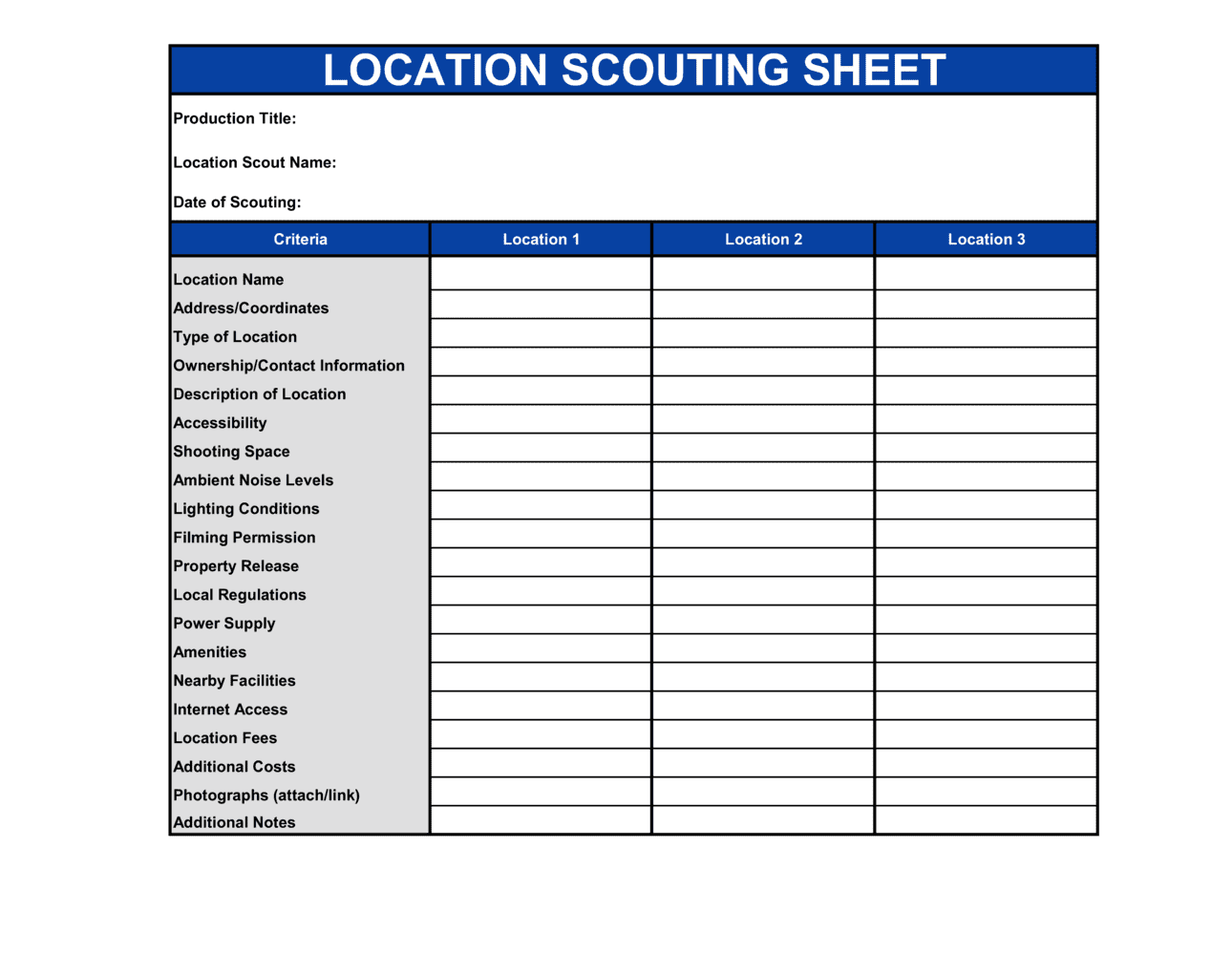
FreeXLSLocation Scouting Template

At a glance

What it is
A Location Scouting Template is a legally binding agreement between a production company or scout and a property owner that grants permission to access and photograph, film, or survey a location for creative or commercial use. This free Word download covers access rights, scouting fees, liability, confidentiality, and restoration obligations in a single structured document you can edit online and export as PDF.
When you need it
Use it before any scout enters private property to assess it as a potential filming, advertising, or event location — whether for a feature film, commercial, music video, branded content, or corporate production. It is also appropriate when a location manager needs documented authorization to photograph and share images of the property internally for production approval.
What's inside
Property access grant, scouting fee and payment terms, permitted activities during the scout, liability and insurance requirements, confidentiality obligations, restoration and damage provisions, governing law, and signature blocks for both parties.

What is a Location Scouting Template?

A Location Scouting Template is a legally binding access agreement between a production company — or an authorized scout acting on its behalf — and a private property owner that grants permission to enter, photograph, and assess the property as a potential filming, photography, or event location. It documents the scope of the visit, the scout fee paid in exchange for access, liability allocation, insurance requirements, confidentiality obligations, and the explicit understanding that the scout does not constitute a commitment to film. Unlike a casual verbal arrangement, a properly executed scouting agreement creates an enforceable record of consent that protects both parties before any representative physically enters the property.

Why You Need This Document

Without a signed scouting agreement, your scout team is on private property without legal authorization — exposing the production to trespass liability, property damage disputes, and insurance coverage gaps from the moment access begins. Property owners who allow informal visits without documentation frequently assert damage claims after the fact, claiming conditions caused by pre-existing factors were created by the scout team. Productions that skip the agreement also lose the confidentiality protection that prevents a property owner from disclosing the location address, working title, or production details — a significant risk on high-profile projects where paparazzi and press interest can compromise shooting plans. A completed location scouting template closes these gaps in under 30 minutes, establishes a professional standard that property owners respect, and satisfies the documentation requirements of production insurers, film commissions, and studio compliance teams before a single crew member arrives on site.

Which variant fits your situation?

If your situation is…Use this template
Granting full permission to film on the property after scouting approvalLocation Release Agreement
Hiring a professional location scout as an independent contractorIndependent Contractor Agreement
Renting the property for an actual shoot day rather than a scoutLocation Rental Agreement
Securing a venue for a live event or corporate functionEvent Venue Contract
Photographing or filming on public property requiring a permitFilm Permit Application Template
Protecting confidential production details shared with the property ownerNon-Disclosure Agreement
Compensating the property owner for a multi-day location holdLocation Hold Agreement

Common mistakes to avoid

❌ Accessing the property before the agreement is signed

Why it matters: Any damage, injury, or trespass claim that arises before execution is not covered by the agreement's indemnification or insurance provisions, leaving the production company fully exposed.

Fix: Make signed agreement and a delivered COI hard prerequisites before any scout team member steps onto private property — no exceptions for short-notice or 'friendly' landowners.

❌ No pre-scout condition documentation

Why it matters: Without a photographic or written baseline, any damage claim the owner makes after the scout becomes a credibility dispute the production company cannot objectively defend.

Fix: Complete a brief timestamped walkthrough video or photo set at the moment of entry, shared with the property owner, before the scout team begins work.

❌ Omitting the 'no obligation to film' clause

Why it matters: Property owners who invest time preparing for a scout sometimes claim a verbal booking commitment was made when the scout expresses enthusiasm. Without a written disclaimer, this creates a breach-of-contract exposure.

Fix: Include an explicit no-obligation clause stating that scouting access does not create any commitment to film, hold, or compensate the owner beyond the stated scout fee.

❌ Leaving permitted activities undefined

Why it matters: Scouts who fly drones, access rooftops, or photograph neighboring structures without explicit authorization can expose the production to trespass claims, FAA regulatory issues, and privacy complaints.

Fix: List every specific activity — photography, video, drone operation, structural assessment, crew headcount — and carve out any restricted areas or activities in writing before access begins.

❌ Skipping insurance requirements on low-budget productions

Why it matters: A scout team member injured on an uninsured visit can bring a personal injury claim against the property owner's homeowners or commercial policy, damaging the relationship and triggering coverage disputes.

Fix: Require a COI for every scout regardless of budget size. Production liability policies with $1M coverage are available for as little as $500 per project and cover the full scout period.

❌ Choosing governing law based on the production company's home state rather than the property location

Why it matters: Courts in the jurisdiction where the property sits often apply local real property and trespass law regardless of a contrary contractual choice-of-law clause, rendering the clause ineffective.

Fix: Default the governing law to the state, province, or country where the property is physically located unless legal counsel advises otherwise for a specific cross-border situation.

The 9 key clauses, explained

Parties and property description

In plain language: Identifies the production company or scout and the property owner as legal entities, and precisely describes the property being accessed by address and any relevant parcel or unit details.

Sample language
This Location Scouting Agreement is entered into on [DATE] between [PRODUCTION COMPANY LEGAL NAME], a [STATE/COUNTRY] [ENTITY TYPE] ('Production Company'), and [PROPERTY OWNER FULL NAME / ENTITY NAME] ('Owner'), with respect to the property located at [FULL ADDRESS], [CITY], [STATE/PROVINCE], [POSTAL CODE] ('Property').

Common mistake: Using a trade name instead of the registered legal entity for the production company. If a claim arises, enforcing indemnification against the correct legal person becomes difficult if the contracting party is misidentified.

Grant of access and permitted activities

In plain language: Specifies the exact access rights granted — photography, video recording, drone operation, crew entry — and lists any areas of the property that are off-limits during the scout.

Sample language
Owner grants Production Company and its authorized representatives access to the Property on [DATE(S)] between [START TIME] and [END TIME] for the sole purpose of conducting a location scout, including still photography and video recording of the Property's [INTERIOR / EXTERIOR / GROUNDS]. Access to [RESTRICTED AREAS] is expressly excluded.

Common mistake: Leaving permitted activities undefined and assuming good faith will govern. Without explicit scope, disputes arise when scouts use drones, access secondary structures, or share images outside the production team.

Scout fee and payment terms

In plain language: States the amount paid to the owner for granting scouting access, the payment method, and the due date — and clarifies this fee is separate from any filming fee if the location is subsequently booked.

Sample language
In consideration for granting access, Production Company shall pay Owner a scout fee of $[AMOUNT] by [PAYMENT METHOD] within [NUMBER] days of the scout date. This scout fee is non-refundable and does not constitute a deposit toward any future location filming fee.

Common mistake: Omitting a scout fee entirely and relying on goodwill. Even a nominal $50–$100 fee creates legally recognized consideration, making the access grant an enforceable agreement rather than a revocable license.

Confidentiality

In plain language: Prevents both parties from disclosing the production's title, plot details, or casting — and prevents the production company from sharing property images externally without the owner's prior consent.

Sample language
Each party agrees to keep confidential all non-public information disclosed in connection with this Agreement, including the identity of the Production, the title '[WORKING TITLE]', and any images or footage of the Property, and shall not disclose such information to any third party without prior written consent.

Common mistake: Binding only the property owner to confidentiality while leaving the production company free to share scout images publicly. Property owners regularly request — and are entitled to — reciprocal confidentiality on images of their private home or commercial space.

Liability and indemnification

In plain language: Allocates risk between the parties: the production company indemnifies the owner against damage or injury caused by the scout team, and the owner is typically not liable for pre-existing hazards disclosed in advance.

Sample language
Production Company shall indemnify, defend, and hold harmless Owner from and against any claims, damages, or losses arising out of Production Company's access to the Property under this Agreement, except to the extent caused by Owner's gross negligence or willful misconduct.

Common mistake: Using a mutual indemnification clause without carving out the owner's pre-existing structural hazards. If a scout is injured by a known hazard the owner failed to disclose, a flat mutual indemnification can expose the production to liability it should not bear.

Insurance requirements

In plain language: Requires the production company to carry minimum general liability coverage and to name the owner as an additional insured, providing a certificate of insurance before the scout takes place.

Sample language
Prior to accessing the Property, Production Company shall provide Owner with a Certificate of Insurance evidencing commercial general liability coverage of not less than $[AMOUNT] per occurrence and $[AMOUNT] in the aggregate, naming Owner as an additional insured.

Common mistake: Skipping the insurance clause on short-notice or low-budget scouts. A single slip-and-fall during an uninsured scout can result in a personal injury claim against the property owner's homeowners policy, triggering premium increases and coverage disputes.

Restoration and damage

In plain language: Requires the scout team to leave the property in the same condition as found, to remove all equipment, and to promptly compensate the owner for any damage caused during access.

Sample language
Production Company shall ensure that the Property is returned to its original condition immediately upon conclusion of the scout. Any damage caused by Production Company or its representatives shall be repaired or compensated by Production Company within [NUMBER] days of written notice from Owner.

Common mistake: No documentation of the property's pre-scout condition. Without a brief written or photographic record taken at entry, disputes over pre-existing versus scout-caused damage are impossible to resolve fairly.

No obligation to film

In plain language: Clarifies that this agreement covers scouting access only and does not obligate the production company to use the property or pay a filming fee — and does not give the owner a right to compel booking.

Sample language
This Agreement grants access for scouting purposes only. Nothing herein obligates Production Company to film at the Property or to enter into any further agreement with Owner. Owner shall have no claim against Production Company for failure to book the Property for filming.

Common mistake: Omitting this clause, which leads property owners to believe a scout visit implies a booking commitment. Without it, owners have attempted to claim a verbal promise to film based on the scout's enthusiasm during the visit.

Governing law and dispute resolution

In plain language: Specifies which jurisdiction's law governs the agreement and how disputes are resolved — typically the state or province where the property is located.

Sample language
This Agreement shall be governed by the laws of [STATE / PROVINCE / COUNTRY] without regard to conflict-of-law principles. Any dispute arising under this Agreement shall be resolved by [binding arbitration / mediation followed by litigation] in [CITY], [STATE / PROVINCE].

Common mistake: Choosing governing law based on the production company's home state rather than the property's location. Courts in the property's jurisdiction often apply local law regardless of a contrary choice-of-law clause, particularly for real property access disputes.

How to fill it out

  1. 1

    Identify the legal parties and describe the property

    Enter the production company's full registered legal name, entity type, and state of formation. Enter the property owner's full legal name or entity name. Provide the complete street address and any parcel, unit, or suite identifiers for the property.

    💡 Confirm the property owner's legal name against a county assessor record or title document before the scout — discrepancies between the contract name and the title holder can void the access grant.

  2. 2

    Define the scouting date, time window, and access scope

    Enter the specific date or dates of the scout and the permitted access window (e.g., 9:00 AM to 5:00 PM). List every permitted activity — still photography, video, drone flight, crew walk-through — and explicitly identify any areas of the property that are off-limits.

    💡 If the scout may require a return visit, list multiple contingency dates in the access grant rather than executing a second agreement later.

  3. 3

    Set the scout fee and payment method

    Agree on a scout fee with the property owner — even a nominal amount — and record the exact figure, payment method (check, ACH, cash), and due date relative to the scout. Note that this fee is separate from any future filming fee.

    💡 For residential properties, $100–$250 is a typical scout fee in North America. For commercial or landmark properties, negotiate separately before executing the agreement.

  4. 4

    Complete the confidentiality and permitted-use terms

    Enter the working title or production code name to be kept confidential. Specify whether scout images may be shared with the broader production team, with the studio, or only within the location department. If sharing with a streaming platform or distributor requires owner consent, note that restriction.

    💡 Production companies often use a code name rather than the actual title in location agreements to prevent location addresses from appearing on publicly filed documents linked to a high-profile production.

  5. 5

    Insert the insurance requirements and attach a COI

    Enter the minimum coverage amounts required by the property owner — typically $1M per occurrence and $2M aggregate for residential properties, $2M and $5M for commercial or high-value locations. Attach or commit to delivering a Certificate of Insurance naming the owner as an additional insured before access begins.

    💡 Order the COI from your production insurer at least 48 hours before the scout date — same-day certificate requests frequently cause last-minute access delays.

  6. 6

    Document the property's pre-scout condition

    Before the scout team enters, take a brief photo record of the property's condition, including any pre-existing damage, and attach or reference it in the agreement. Both parties should initial the condition log or photograph set.

    💡 A short timestamped video walkthrough on a smartphone takes two minutes and eliminates damage disputes entirely.

  7. 7

    Sign before access begins

    Both parties must sign the agreement before the first authorized representative sets foot on the property. Post-access signatures may not be enforceable for events that occurred prior to execution.

    💡 Use Business in a Box eSign to collect signatures remotely and timestamped — particularly useful when the property owner is unavailable for an in-person meeting before the scout.

Frequently asked questions

What is a location scouting template?

A location scouting template is a standardized legal agreement that grants a production company or scout authorized access to a private property to assess and document it as a potential filming, photography, or event location. It records the parties, the permitted access window, the scout fee, liability allocation, insurance requirements, and confidentiality obligations — creating an enforceable record of consent before any representative steps on the property.

Is a location scouting agreement legally required?

No law universally mandates a written scouting agreement, but accessing private property without documented permission constitutes trespass in most jurisdictions. Production studios, broadcasters, and insurers routinely require written access authorization as a condition of coverage and distribution. Even for informal scouts on friendly-owner properties, a signed agreement protects both parties if a damage or injury claim arises after the visit.

What is the difference between a location scouting agreement and a location release?

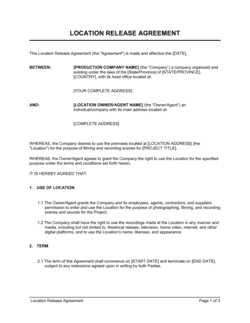
A location scouting agreement covers a preliminary visit to assess and photograph the property — it does not authorize filming. A location release is a separate, broader agreement that grants the production company the right to bring a full crew, equipment, and lights to actually film on the property, typically for a larger fee and with more detailed operational terms. The scouting agreement typically comes first; the release follows if the location is selected.

What scout fee is typical for a location scouting agreement?

Scout fees vary widely by property type and market. Residential property owners in North America are typically paid $50–$250 for a scout visit. Commercial or landmark properties may command $500–$1,500 for access. The fee creates legally recognized consideration — without it, the access grant may be characterized as a revocable license rather than a binding contractual right, which matters if the owner attempts to withdraw consent after the scout team has arrived.

Do I need insurance to conduct a location scout?

Yes, in practice. Most property owners and all major studios require a Certificate of Insurance showing active general liability coverage — typically $1M per occurrence minimum — before granting access. For independent or low-budget productions, short-term production liability policies that cover the scout period are available from specialist insurers. Providing proof of insurance before the scout protects the owner from liability if a crew member is injured on the property.

Can a location scouting agreement prevent the property owner from showing the location to other productions?

A standard scouting agreement does not include an exclusivity or hold provision. To prevent the owner from granting access to competing productions during a decision window, you need a separate location hold agreement that compensates the owner specifically for the period of exclusivity. Without a paid hold, the owner is free to show the property to other productions even while your team is evaluating it.

What happens if the scout causes damage to the property?

Under a properly drafted location scouting agreement, the production company is obligated to repair or compensate for any damage caused by its representatives within a specified number of days of written notice from the owner. The production's general liability insurance typically covers property damage claims. Pre-scout condition documentation — a timestamped walkthrough video — is critical to distinguishing scout-caused damage from pre-existing conditions.

Does a location scouting agreement need to be notarized?

Notarization is not required for a location scouting agreement to be legally binding in most jurisdictions. Both parties' signatures — ideally with a date and witness — are sufficient for enforcement. Some high-value or commercial property owners may request notarization as a precondition of access; this is unusual but can be accommodated without altering the agreement's terms.

Can I use the same location scouting template for international productions?

The core terms — access grant, fee, liability, insurance, confidentiality — are broadly applicable across jurisdictions, but the governing law clause and insurance minimums must be localized to the country and region where the property sits. UK productions should reference relevant sections of the Occupiers' Liability Act; EU productions may need to address GDPR obligations if scout footage contains identifiable persons. Consider having local counsel review the template before use in an unfamiliar jurisdiction.

How this compares to alternatives

vs Location Release Agreement

A location release agreement grants permission to bring a full production crew and equipment to film on the property — it is the contract used for actual shoot days. A location scouting template covers only the preliminary access visit to photograph and assess the property. The scouting agreement comes first; if the location is selected, a separate release is executed for the filming itself.

vs Non-Disclosure Agreement

An NDA protects confidential information exchanged between parties but does not grant any property access rights or allocate liability for physical presence on a location. A location scouting agreement includes confidentiality provisions built into a broader access and liability framework. For productions where the script or talent is highly sensitive, some teams execute both an NDA and a scouting agreement simultaneously.

vs Independent Contractor Agreement

An independent contractor agreement governs the relationship between the production company and a freelance location scout as a service provider — covering payment, deliverables, IP ownership of scout reports and images, and termination. A location scouting template governs the relationship between the production and the property owner. Productions with professional scouts on staff or under contract need both documents.

vs Event Venue Contract

An event venue contract is a full operational agreement for booking a venue to host a live event — it covers catering, capacity, cancellation, and exclusivity for the event date. A location scouting template is a narrower, preliminary document covering only the access visit. If a venue is being evaluated for an event before the full booking, the scouting template precedes and informs the event venue contract.

Industry-specific considerations

Film and television production

Multi-location scouts for episodic productions require a standardized agreement that production companies can execute quickly across dozens of properties in a single pre-production cycle.

Advertising and commercial production

Brand campaigns with tight turnarounds require scout agreements that move fast, protect the client's campaign confidentiality, and include drone and aerial photography permissions.

Architecture and real estate

Firms documenting properties for portfolio, marketing, or editorial publication need written access authorization that covers photography rights and image usage restrictions.

Event planning and experiential marketing

Venue surveys for pop-up activations, corporate events, and brand experiences require documented access rights and liability terms before any detailed planning or vendor commitments begin.

Jurisdictional notes

United States

Property access laws are primarily state-governed; trespass statutes vary in severity from civil to criminal depending on the state and context. California productions must comply with AB 1862 and local film office requirements for any exterior scouting on private property. Drone use during scouts requires FAA Part 107 certification and may require additional property owner consent for airspace above private land. Non-disclosure provisions in location agreements are generally enforceable under state trade secret law.

Canada

Each province governs trespass and property access separately; Ontario's Trespass to Property Act and British Columbia's Trespass Act set the relevant frameworks in the two largest production markets. Québec productions must address confidentiality provisions in both English and French for agreements with Québec-resident property owners under the Charter of the French Language. Provincial film commissions often require proof of a signed scouting agreement as a condition of permit assistance.

United Kingdom

The Occupiers' Liability Act 1957 and 1984 impose a duty of care on property owners toward visitors and trespassers respectively, making the insurance and indemnification clauses particularly important for scouts on UK properties. Drone use during scouts is regulated by the Civil Aviation Authority's Drone and Model Aircraft Code; commercial drone operators require Operational Authorisation. The British Film Commission recommends a written access agreement for all private location scouts as part of its standard production guidelines.

European Union

GDPR applies if scout footage or photographs capture identifiable individuals on or near the property, requiring a lawful basis for processing and potentially a data processing addendum. Property access and trespass law varies significantly by member state — France, Germany, and the Netherlands each have distinct civil law frameworks governing unauthorized access to private land. Many EU broadcasters and streaming platforms require written location scouting documentation as part of their compliance and errors-and-omissions insurance requirements.

Template vs lawyer — what fits your deal?

PathBest forCostTime
Use the templateIndependent filmmakers, photographers, and small production companies scouting residential or low-risk commercial propertiesFree15–30 minutes
Template + legal reviewProductions scouting high-value, historic, or commercially sensitive properties, or scouts involving drone operation or structural access$200–$5001–2 days
Custom draftedStudio productions, international scouts, regulated facilities (hospitals, schools, government buildings), or properties with complex ownership structures$800–$3,000+3–7 days

Glossary

Location Scout
The act of visiting and photographing a potential filming or production location to evaluate its suitability before committing to a full location agreement.
Scout Fee
A nominal payment made to the property owner in exchange for granting access to the scout, distinct from the larger location fee paid if filming proceeds.
Location Release
A separate, broader agreement signed after scouting that grants the production company the right to actually film on the property.
Location Hold
A reservation that prevents the property owner from booking other productions during a specified window while the production company decides whether to confirm the location.
Restoration Obligation
The contractual requirement to return the property to its pre-scout condition, including removing any equipment or markings left during the visit.
Certificate of Insurance (COI)
A document issued by the production's insurer confirming active coverage for general liability, typically required by property owners before granting access.
Call Sheet
A daily production document listing the schedule, crew, and locations for a filming day — referenced in location agreements to define the scope of access.
Recce
British and international film industry term for a location reconnaissance visit, equivalent to a location scout in North American usage.
Indemnification
A contractual obligation by which one party agrees to cover the other's losses, damages, or legal costs arising from specified events during or after the scout.
Permitted Use
The specific activities — photography, video recording, drone flight, crew access — that the property owner explicitly authorizes under the scouting agreement.
Force Majeure
A clause excusing either party's performance obligations when extraordinary events outside their control — such as severe weather or a government order — prevent the scout from taking place.

Part of your Business Operating System

This document is one of 3,000+ business & legal templates included in Business in a Box.

  • Fill-in-the-blanks — ready in minutes
  • 100% customizable Word document
  • Compatible with all office suites
  • Export to PDF and share electronically

Create your document in 3 simple steps.

From template to signed document — all inside one Business Operating System.
1
Download or open template

Access over 3,000+ business and legal templates for any business task, project or initiative.

2
Edit and fill in the blanks with AI

Customize your ready-made business document template and save it in the cloud.

3
Save, Share, Send, Sign

Share your files and folders with your team. Create a space of seamless collaboration.

Save time, save money, and create top-quality documents.

★★★★★

"Fantastic value! I'm not sure how I'd do without it. It's worth its weight in gold and paid back for itself many times."

Managing Director · Mall Farm
Robert Whalley
Managing Director, Mall Farm Proprietary Limited
★★★★★

"I have been using Business in a Box for years. It has been the most useful source of templates I have encountered. I recommend it to anyone."

Business Owner · 4+ years
Dr Michael John Freestone
Business Owner
★★★★★

"It has been a life saver so many times I have lost count. Business in a Box has saved me so much time and as you know, time is money."

Owner · Upstate Web
David G. Moore Jr.
Owner, Upstate Web

Run your business with a system — not scattered tools

Stop downloading documents. Start operating with clarity. Business in a Box gives you the Business Operating System used by over 250,000 companies worldwide to structure, run, and grow their business.

Free Forever Plan · No credit card required