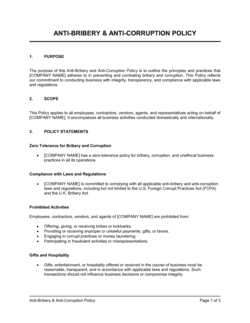
Anti-Bribery Policy Template

Free Word download β€’ Edit online β€’ Save & share with Drive β€’ Export to PDF

5 pagesβ€’20–30 min to fillβ€’Difficulty: Standard
Learn more ↓
FreeAnti-Bribery Policy Template

At a glance

What it is
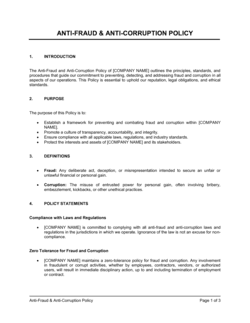
An Anti Bribery Policy is an internal governance document that defines what constitutes bribery and corruption, sets clear rules for gifts, hospitality, facilitation payments, and third-party relationships, and establishes reporting and enforcement procedures. This free Word download gives you a structured, compliance-ready starting point you can edit online and distribute to all employees and contractors as part of your compliance program.
When you need it
Use it when onboarding new employees, entering regulated or government-facing markets, responding to a client or investor due diligence request, or building out a formal compliance program for the first time.
What's inside
Policy scope and purpose, definitions of bribery and corruption, rules on gifts and hospitality, facilitation payments, political contributions, third-party due diligence requirements, employee obligations, a reporting and whistleblower procedure, and consequences for non-compliance.

What is an Anti Bribery Policy?

An Anti Bribery Policy is an internal governance document that defines bribery and corruption, sets clear rules for gifts, hospitality, facilitation payments, and political contributions, and establishes the obligations employees and third parties must follow to keep the business on the right side of anti-corruption law. It functions as both a preventive control β€” setting standards before problems arise β€” and a documented defense that demonstrates to regulators, auditors, and clients that the company has taken proportionate steps to prevent corrupt conduct. Most policies are accompanied by a gifts register, a training program, and a reporting channel.

Why You Need This Document

Without a written anti bribery policy, your business has no documented standard against which employee conduct can be measured, no defined procedure for employees who are asked for a facilitation payment, and no evidence of the compliance program that regulators treat as a mitigating factor in enforcement decisions. The UK Bribery Act 2010 creates a strict corporate offense of failing to prevent bribery by an associated person β€” and the only defense is demonstrating adequate procedures were in place. The US FCPA, Australia's Criminal Code Act, and equivalent statutes in Canada and across the EU treat documented compliance programs as significant factors in deciding whether to prosecute and at what penalty level. Beyond legal exposure, many large enterprises and government procurement programs now require suppliers to produce an anti bribery policy as a condition of contract award. This template gives you a complete, customizable starting point that covers every core element β€” scope, definitions, thresholds, due diligence, reporting, and enforcement β€” so you can publish a credible policy in hours rather than weeks.

Which variant fits your situation?

If your situation is…Use this template
Company operates internationally and must address FCPA and UK Bribery ActAnti Bribery Policy (International)
Sector-specific policy required for a public-sector contractorAnti Bribery Policy (Government Contractors)
Standalone gifts and hospitality rules needed for a sales teamGifts and Hospitality Policy
Broader ethics framework covering conflicts of interest and fraudCode of Business Conduct and Ethics
Policy covering all financial crimes including money launderingAnti Money Laundering Policy
Whistleblower channel documentation required alongside the policyWhistleblower Policy

Common mistakes to avoid

❌ Excluding contractors and agents from the policy scope

Why it matters: Third parties acting on your behalf create the same corporate liability as your own employees. The UK Bribery Act's 'associated persons' definition explicitly covers agents and contractors.

Fix: Extend the policy scope to all individuals and entities acting on the company's behalf and require third parties to contractually acknowledge compliance obligations.

❌ Setting gift thresholds without a register requirement

Why it matters: Without a log, employees can give multiple gifts to the same recipient, each below the cap, while the cumulative total signals a corrupt pattern that the threshold was designed to prevent.

Fix: Require all gifts and hospitality above a lower notification threshold to be recorded within five business days, including recipient, occasion, and estimated value.

❌ Carving out facilitation payments as locally acceptable

Why it matters: Any explicit or implicit permission for facilitation payments renders the policy non-compliant with the UK Bribery Act and materially weakens an FCPA defense.

Fix: State an unconditional prohibition, instruct employees to refuse and document requests, and provide a rapid escalation path to compliance or legal.

❌ Publishing the policy without a training and acknowledgement program

Why it matters: A policy that employees have not read provides no protection β€” regulators and courts look for evidence of active communication, not just document existence.

Fix: Require signed acknowledgements on first issue and after each annual update, and track completion centrally so you can produce a list on demand during an audit.

❌ Never revisiting the policy after initial publication

Why it matters: Laws change, business models evolve, and new high-risk markets are entered β€” a three-year-old policy may not cover current operations and signals a compliance program that exists on paper only.

Fix: Schedule an annual policy review tied to the fiscal year-end and document each review with a version number, review date, and approver name.

❌ Omitting a non-retaliation guarantee for reporters

Why it matters: Without explicit protection, employees assume β€” often correctly β€” that raising a concern will harm their career, and genuine violations go unreported until they become regulatory incidents.

Fix: Add a dedicated non-retaliation clause stating that retaliation against a good-faith reporter is itself a disciplinary offense, and that suspected retaliation should be escalated to HR or the Board.

The 9 key sections, explained

Purpose and scope

Definitions

Gifts and hospitality

Facilitation payments

Political contributions and charitable donations

Third-party due diligence

Employee obligations and training

Reporting and whistleblower protection

Consequences and enforcement

How to fill it out

  1. 1

    Insert your company name and governing law references

    Replace all [COMPANY NAME] placeholders and specify which statutes the policy is designed to comply with β€” FCPA, UK Bribery Act, or your local equivalent. This anchors the document legally and operationally.

    πŸ’‘ If you operate in multiple jurisdictions, list each applicable statute in the purpose section rather than using a generic 'applicable law' reference.

  2. 2

    Set gift and hospitality thresholds

    Choose monetary limits appropriate to your industry and the jurisdictions you operate in. Standard ranges for B2B companies are $25–$75 per gift and $100–$150 per hospitality event. Confirm these thresholds do not exceed any customer or public-sector restrictions your clients impose on their own staff.

    πŸ’‘ Set a lower threshold for interactions involving public officials β€” typically half your standard commercial limit β€” to reduce regulatory exposure.

  3. 3

    Name the compliance contact and reporting channels

    Enter the specific email address, phone number, or platform employees should use to report concerns. Anonymous hotlines are best practice for companies with more than 50 employees.

    πŸ’‘ Test the reporting channel before you publish the policy β€” a broken email address in a whistleblower section defeats the entire purpose.

  4. 4

    Define your third-party risk tiers

    Segment third parties into at least two risk tiers: standard (commercial suppliers with no government interface) and enhanced (agents, distributors, or consultants operating in high-risk countries or interacting with officials). Assign different due diligence requirements to each tier.

    πŸ’‘ Transparency International's Corruption Perceptions Index is a free, annually updated source for classifying country risk tiers.

  5. 5

    Set the training completion deadline and tracking method

    State a specific number of days for new-hire completion (30 days is standard) and an annual refresh cycle. Name the system β€” LMS, HR platform, or a signed acknowledgement form β€” used to track completion.

    πŸ’‘ Attach a one-page employee acknowledgement form to the policy. A signed record that each employee has read and understood the policy is your first line of audit defense.

  6. 6

    Get senior leadership sign-off and publish

    Have the CEO or Board formally approve the policy. The approval date, approver name, and next review date should appear on the document's cover or footer.

    πŸ’‘ A CEO cover letter or video message accompanying the policy rollout materially improves employee uptake compared to an email attachment alone.

Frequently asked questions

What is an anti bribery policy?

An anti bribery policy is an internal governance document that defines bribery and corruption, sets rules for gifts, hospitality, and facilitation payments, establishes due diligence requirements for third parties, and provides employees with reporting procedures. It forms the foundation of a company's compliance program and demonstrates to regulators, clients, and investors that the business takes corruption risk seriously.

Is an anti bribery policy legally required?

No law directly mandates a written anti bribery policy in most jurisdictions, but having one is effectively required in practice. The UK Bribery Act 2010 creates a corporate offense of failing to prevent bribery, and the primary defense is demonstrating 'adequate procedures' β€” which a written policy is central to. The US FCPA and similar statutes in Australia, Canada, and the EU treat documented compliance programs as significant mitigating factors in enforcement decisions.

Who does an anti bribery policy apply to?

The policy should apply to all employees, officers, directors, and any third party acting on the company's behalf β€” including agents, distributors, consultants, and joint-venture partners. Limiting the policy to direct employees leaves the highest-risk relationships uncovered and removes the 'associated persons' protection under the UK Bribery Act.

What is the difference between a gift and a bribe?

A gift becomes a bribe when it is given with the intent β€” explicit or implied β€” to improperly influence a business decision or official action. The key factors are intent, timing, value, transparency, and whether the gift is recorded. A proportionate, transparently logged meal before a contract decision is generally permissible; a cash payment or high-value gift given to the person making that decision is not, regardless of whether the word 'gift' is used.

Are facilitation payments ever allowed?

No. Facilitation payments β€” small unofficial payments to speed up routine government actions β€” are prohibited under the UK Bribery Act regardless of amount or local custom, and are generally prohibited under the FCPA and most equivalent statutes. Local practice or competitive pressure does not create a legal exception. Your policy should state this prohibition unconditionally and give employees clear guidance on how to refuse and document requests.

How often should the anti bribery policy be reviewed?

At minimum once per year, typically aligned to the fiscal year-end, and whenever the business enters a new high-risk market, changes its third-party model, or when relevant laws are amended. Each review should be documented with a new version number, review date, and the name of the approving authority. A policy that has not been reviewed in more than 18 months is unlikely to satisfy a regulator's standard for an active compliance program.

What training should accompany the policy?

All employees should complete anti-bribery training within 30 days of joining and annually thereafter. Training should cover the definitions in the policy, practical examples of gifts and facilitation payment scenarios, how to use the reporting channel, and the consequences of non-compliance. Completion should be tracked centrally, and a signed acknowledgement of the policy should be obtained from every employee on first issue and after material updates.

What should employees do if they suspect a bribe has been offered or received?

Employees should report the concern immediately through the designated channel β€” compliance email, hotline, or anonymous platform β€” without attempting to investigate on their own. The policy should guarantee that good-faith reports will not result in retaliation. Concerns can also be escalated to a direct manager or, if the manager is implicated, directly to legal or the Board.

Can a small business use this template without a compliance team?

Yes. A small business without a dedicated compliance function can designate the CEO, CFO, or a senior manager as the compliance contact named in the policy. The core obligations β€” no facilitation payments, a gift register, third-party due diligence, and a reporting channel β€” apply regardless of company size and can be administered with a simple spreadsheet and an acknowledged email address.

How this compares to alternatives

vs Code of Ethics

A Code of Ethics is a broad statement of values covering honesty, fairness, conflicts of interest, and professional conduct across all business activities. An anti bribery policy is a specific operational document with defined thresholds, prohibited conduct, and enforcement procedures focused exclusively on bribery and corruption risk. Companies typically need both β€” the code sets the culture; the policy sets the rules.

vs Whistleblower Policy

A Whistleblower Policy establishes the reporting infrastructure β€” channels, investigation procedures, and retaliation protections β€” that applies to all misconduct across the organization. An anti bribery policy defines the specific prohibited conduct and requires a reporting channel, but it does not replace a full whistleblower program. The two documents should be cross-referenced and operate together.

vs Anti Money Laundering Policy

An Anti Money Laundering (AML) Policy addresses the detection and prevention of financial crime involving proceeds of illegal activity, including structuring, layering, and placement of illicit funds. An anti bribery policy targets the corrupt act that may generate those proceeds. In regulated financial services and fintech firms, both policies are required and are typically reviewed together as part of a financial crime framework.

vs Conflict of Interest Policy

A Conflict of Interest Policy manages situations where an employee's personal relationships or financial interests could improperly influence their professional decisions β€” supplier selection, hiring, or contract awards. While conflicts of interest can enable bribery, they are a distinct risk category. Anti bribery policy covers external corrupt payments; conflict of interest policy covers internal governance failures. Both are needed for a complete ethics framework.

Industry-specific considerations

Construction and infrastructure

High exposure to facilitation payment requests at permitting and inspection stages; subcontractor chains create extended third-party risk that requires tiered due diligence.

Professional services

Client entertainment and referral arrangements require clear hospitality thresholds and conflict-of-interest disclosures to avoid crossing into improper inducement.

Manufacturing

Global supply chains and agent networks in high-risk jurisdictions make third-party due diligence the most operationally significant section of the policy.

Financial services

Regulatory scrutiny is acute; the policy must align with FCA, SEC, or equivalent conduct-of-business rules and integrate with AML and KYC frameworks already in place.

Healthcare and pharmaceuticals

Interactions with healthcare professionals and procurement officials carry heightened risk; the policy should address conference sponsorships, speaker fees, and sample provision explicitly.

Technology / SaaS

Reseller and channel-partner networks in emerging markets require contractual anti-bribery warranties and periodic due diligence refreshes as the partner base scales.

Template vs pro β€” what fits your needs?

PathBest forCostTime
Use the templateSmall to mid-size businesses establishing a compliance baseline or responding to a client due diligence requestFree1–2 hours to customize and publish
Template + professional reviewCompanies operating in high-risk jurisdictions, government contractors, or businesses under existing regulatory scrutiny$500–$2,000 for a compliance consultant or legal review3–5 business days
Custom draftedMultinational corporations, publicly listed companies, or businesses implementing a full adequate-procedures defense under the UK Bribery Act$3,000–$15,000+ depending on scope and jurisdictions covered2–6 weeks

Glossary

Bribery
Offering, giving, receiving, or soliciting anything of value to improperly influence the actions of a person in a position of trust or authority.
Facilitation Payment
A small unofficial payment made to a government official to speed up a routine administrative action β€” prohibited under most anti-bribery laws regardless of amount.
Hospitality
Business entertainment such as meals, events, or travel provided to clients, prospects, or officials, which is permissible only when reasonable, proportionate, and transparently recorded.
Due Diligence (Third-Party)
The process of vetting agents, distributors, joint-venture partners, and suppliers to assess their corruption risk before entering into a business relationship.
FCPA
The US Foreign Corrupt Practices Act, which prohibits US persons and companies from bribing foreign government officials to obtain or retain business.
UK Bribery Act 2010
UK legislation that criminalizes bribery of public and private parties, and creates a strict corporate liability offense for failing to prevent bribery by associated persons.
Adequate Procedures
The six-principle defense under the UK Bribery Act allowing a company to avoid corporate liability by demonstrating proportionate anti-bribery procedures were in place.
Red Flag
A warning sign in a transaction or relationship that suggests a heightened risk of bribery β€” for example, a request for cash payment to an unnamed third party.
Whistleblower
An employee or associate who reports suspected bribery or policy violations through internal or external channels, typically protected from retaliation by law.
Tone at the Top
The visible commitment of senior leadership to ethical conduct, which directly shapes whether employees take compliance policies seriously in practice.

Part of your Business Operating System

This document is one of 3,000+ business & legal templates included in Business in a Box.

  • Fill-in-the-blanks β€” ready in minutes
  • 100% customizable Word document
  • Compatible with all office suites
  • Export to PDF and share electronically

Create your document in 3 simple steps.

From template to signed document β€” all inside one Business Operating System.
1
Download or open template

Access over 3,000+ business and legal templates for any business task, project or initiative.

2
Edit and fill in the blanks with AI

Customize your ready-made business document template and save it in the cloud.

3
Save, Share, Send, Sign

Share your files and folders with your team. Create a space of seamless collaboration.

Save time, save money, and create top-quality documents.

β˜…β˜…β˜…β˜…β˜…

"Fantastic value! I'm not sure how I'd do without it. It's worth its weight in gold and paid back for itself many times."

Managing Director Β· Mall Farm
Robert Whalley
Managing Director, Mall Farm Proprietary Limited
β˜…β˜…β˜…β˜…β˜…

"I have been using Business in a Box for years. It has been the most useful source of templates I have encountered. I recommend it to anyone."

Business Owner Β· 4+ years
Dr Michael John Freestone
Business Owner
β˜…β˜…β˜…β˜…β˜…

"It has been a life saver so many times I have lost count. Business in a Box has saved me so much time and as you know, time is money."

Owner Β· Upstate Web
David G. Moore Jr.
Owner, Upstate Web

Run your business with a system β€” not scattered tools

Stop downloading documents. Start operating with clarity. Business in a Box gives you the Business Operating System used by over 250,000 companies worldwide to structure, run, and grow their business.

Free Forever PlanΒ Β·Β No credit card required