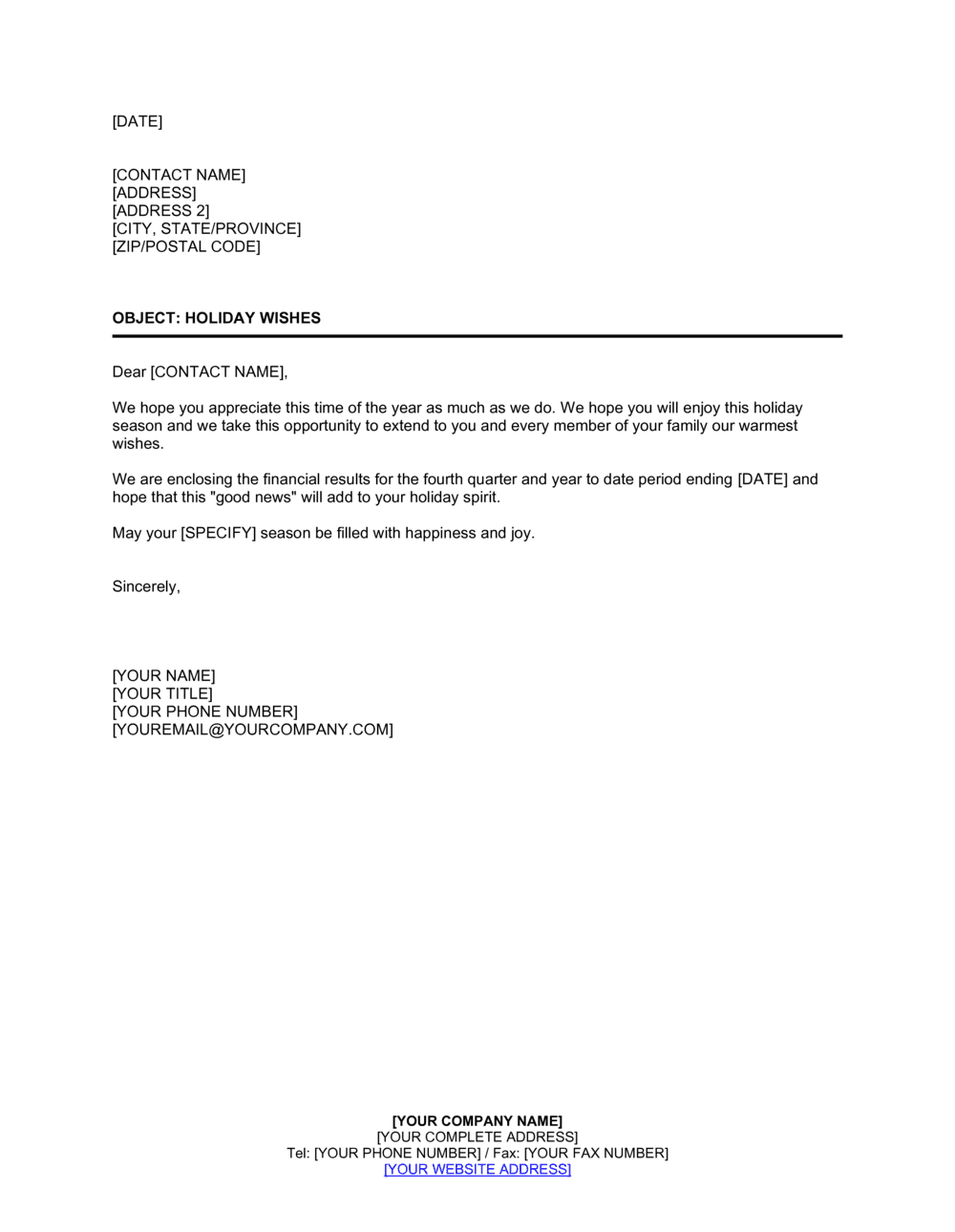
Letter to Stockholders_Holiday Template

Free Word download β€’ Edit online β€’ Save & share with Drive β€’ Export to PDF

1 pageβ€’15–20 min to fillβ€’Difficulty: Standard
Learn more ↓
FreeLetter to Stockholders_Holiday Template

At a glance

What it is
A Letter to Stockholders Holiday is a formal business letter sent by a company's executive leadership β€” typically the CEO or board chair β€” to shareholders at the close of the calendar year or a major holiday season. This free Word download gives you a professionally structured template you can edit online and export as PDF or send by email in under 15 minutes.
When you need it
Use it at the end of the fiscal or calendar year when you want to acknowledge the holiday season, reflect on the company's performance, and reinforce shareholder confidence heading into the new year. It is also appropriate around major holiday milestones when leadership wants to communicate goodwill and continuity.
What's inside
A formal salutation, a seasonal greeting, a brief recap of the year's key achievements, a forward-looking statement on the year ahead, a personal expression of appreciation for shareholder support, and a professional closing with the executive's name and title.

What is a Letter to Stockholders Holiday?

A Letter to Stockholders Holiday is a formal one-page business letter sent by a company's executive leadership β€” typically the CEO or board chair β€” to shareholders at the close of the calendar year or holiday season. It combines a seasonal greeting with a brief reflection on the year's key accomplishments, an expression of genuine gratitude for shareholder trust, and a measured forward-looking statement on the year ahead. Unlike quarterly earnings letters or annual reports, this letter carries no mandatory disclosure function β€” its purpose is to maintain a positive, personal relationship between management and the people whose capital supports the business.

Why You Need This Document

Shareholders who hear from a company only during formal reporting cycles or in times of difficulty are far more likely to lose confidence than those who receive consistent, proactive communication. A holiday letter costs less than 30 minutes to complete and delivers a meaningful touchpoint that reinforces trust, goodwill, and continuity heading into the new year. Without it, stockholders β€” particularly angel investors, silent partners, and minority shareholders in private companies β€” can feel disconnected from leadership and uncertain about the company's direction between formal updates. A well-crafted holiday letter also creates a natural opportunity to preview the year ahead, priming investors for upcoming milestones before the first quarterly update arrives. This template gives you a professionally structured, legally appropriate starting point so you can focus on the message rather than the format.

Which variant fits your situation?

If your situation is…Use this template
Formal annual report-style communication to a large shareholder baseAnnual Letter to Stockholders
Holiday message focused primarily on charitable giving or ESG initiativesCorporate Social Responsibility Holiday Letter
General company-wide holiday message to employeesHoliday Letter to Employees
Year-end financial summary letter to investorsLetter to Stockholders Annual Report
Short celebratory note for a company milestone reached during the holiday seasonBusiness Milestone Announcement Letter
Thank-you letter to investors following a successful fundraising roundInvestor Thank-You Letter

Common mistakes to avoid

❌ Using holiday-specific religious language

Why it matters: A shareholder base spanning diverse backgrounds will include recipients for whom a specific religious greeting is exclusionary, which can damage the goodwill the letter is meant to create.

Fix: Replace references to specific holidays with inclusive phrases like 'the holiday season,' 'this time of year,' or 'the year-end season' throughout the letter.
❌ Including unaudited financial figures without disclaimers

Why it matters: Preliminary numbers shared in informal letters can create investor expectations or disclosure obligations β€” especially for companies with registered securities β€” and may require correction if final figures differ.

Fix: Keep financial references general ('strong revenue growth' or 'record customer acquisition') and reserve specific figures for formal earnings releases or audited reports.

❌ Omitting the sender's title and company affiliation in the signature block

Why it matters: Stockholders who receive the letter β€” particularly those with holdings in multiple companies β€” need to immediately identify who sent it and in what official capacity.

Fix: Always include the sender's full legal name, title (e.g., Chief Executive Officer), and company name in the signature block, even if the tone of the letter is warm and personal.

❌ Making specific forward-looking commitments without cautionary language

Why it matters: Promising specific outcomes in a letter to stockholders β€” even in an informal holiday message β€” can be cited later as a representation if results fall short, creating legal or reputational risk.

Fix: Use measured, conditional language ('we are focused on,' 'we expect to pursue,' 'our goal is') and add a brief safe harbor disclaimer when any forward-looking content is included.

The 8 key clauses, explained

Letterhead and date

In plain language: The company's official name, logo, registered address, and the date the letter is issued β€” establishing the formal identity of the sender.

Sample language
[COMPANY NAME] | [ADDRESS] | [CITY, STATE, ZIP] | [DATE]

Common mistake: Using a personal email signature header instead of official company letterhead. This undermines the formal tone and can make the letter appear unofficial to shareholders accustomed to corporate communications.

Formal salutation

In plain language: The opening line addressing the recipient β€” typically all stockholders collectively or a specific shareholder group.

Sample language
Dear Fellow Stockholders,

Common mistake: Using an overly casual opener like 'Hi everyone' or 'Hello friends.' Even a warm holiday letter should open with a salutation that reflects the formal relationship between the company and its investors.

Seasonal greeting

In plain language: A brief, inclusive acknowledgment of the holiday season that sets a warm but professional tone before moving into business content.

Sample language
On behalf of the entire leadership team at [COMPANY NAME], we extend our warmest wishes to you and your families during this holiday season.

Common mistake: Using a holiday-specific greeting (e.g., 'Merry Christmas') that excludes shareholders of other traditions. Inclusive language such as 'the holiday season' or 'this time of year' is standard practice for broad distribution lists.

Year-in-review highlights

In plain language: A concise summary of the company's key accomplishments, milestones, or meaningful developments over the past year.

Sample language
This year, [COMPANY NAME] achieved [MILESTONE 1], expanded into [MARKET/REGION], and grew revenue by [X]% year-over-year β€” results made possible by the continued confidence of our stockholders.

Common mistake: Including unaudited or preliminary financial figures without a disclaimer. Sharing specific financial data in informal letters can create disclosure obligations or investor expectations β€” keep figures high-level or note they are preliminary.

Expression of gratitude

In plain language: A direct, sincere acknowledgment of stockholder support and trust, personalizing the letter beyond a standard performance update.

Sample language
Your confidence in [COMPANY NAME] remains one of our most valued assets. We are deeply grateful for your continued partnership and trust in our mission.

Common mistake: Making the gratitude section sound generic or formulaic. One specific, concrete acknowledgment β€” referencing a shared challenge overcome or a goal achieved together β€” reads more sincerely than standard boilerplate.

Forward-looking statement

In plain language: A brief, optimistic but measured outlook on the company's priorities and direction heading into the new year.

Sample language
As we enter [YEAR], we are focused on [KEY PRIORITY 1] and [KEY PRIORITY 2], and we are confident in our ability to create lasting value for our stockholders.

Common mistake: Making specific performance promises or numerical forecasts in a forward-looking section without cautionary language. Even informal letters can create expectations that become legally awkward if results disappoint.

Safe harbor or cautionary note (if applicable)

In plain language: A brief disclaimer noting that forward-looking statements are not guarantees and that actual results may differ from expectations.

Sample language
This letter contains forward-looking statements based on current expectations. Actual results may differ materially due to risks and uncertainties described in the company's filings.

Common mistake: Omitting this clause entirely when the letter includes specific projections or financial targets. Public companies and those with registered securities should always include at least a brief safe harbor note.

Closing and signature block

In plain language: A warm but formal sign-off followed by the sender's full name, title, and company affiliation.

Sample language
With warm holiday wishes and gratitude, [FULL NAME] [TITLE] [COMPANY NAME]

Common mistake: Signing with only a first name or omitting the sender's title. Stockholders β€” especially those less familiar with management β€” should be able to identify exactly who sent the letter and in what capacity.

How to fill it out

  1. 1

    Add your company letterhead and the date

    Replace the placeholder with your company's official name, address, and logo. Enter the date the letter will be sent β€” not the date you drafted it.

    πŸ’‘ Use the same letterhead format as your other formal investor communications to maintain visual consistency across the year.

  2. 2

    Confirm your recipient list before writing

    Work with your transfer agent or investor relations team to confirm the current distribution list. Address the salutation to match the audience β€” 'Dear Fellow Stockholders' for broad distribution or a more specific opener for a small group.

    πŸ’‘ If your company has both common and preferred stockholders, consider whether both groups should receive the same letter or separate versions.

  3. 3

    Write the seasonal greeting in inclusive language

    Keep the holiday opener warm but broadly inclusive. Avoid references to specific religious holidays and use phrases like 'holiday season' or 'this time of year' to ensure the letter is appropriate for all recipients.

    πŸ’‘ One sentence is sufficient for the greeting β€” its purpose is tone-setting, not content delivery.

  4. 4

    Select two or three highlights from the year

    Choose the company's most meaningful accomplishments β€” new markets entered, products launched, headcount milestones, or strategic partnerships. Keep descriptions high-level and avoid unaudited financial specifics.

    πŸ’‘ Frame achievements in terms of shareholder value created, not just internal operational metrics.

  5. 5

    Write the gratitude section with a specific reference

    Move beyond generic thanks by referencing one shared challenge or milestone that required stockholder patience or support. This makes the appreciation feel genuine rather than templated.

    πŸ’‘ Two to three sentences is ideal β€” enough to feel personal without becoming effusive.

  6. 6

    Draft a forward-looking statement and add a disclaimer

    Summarize one or two priorities for the coming year in positive but measured language. If you include any projections, add a one-sentence safe harbor disclaimer noting that results may differ.

    πŸ’‘ Avoid specific revenue, growth, or margin targets in informal letters β€” reserve those for quarterly or annual financial communications.

  7. 7

    Review, sign, and distribute

    Have the signing executive review the final draft for tone and accuracy before distribution. Export as PDF for email delivery or print on official letterhead for postal distribution.

    πŸ’‘ Send the letter within the first two weeks of December to reach stockholders before holiday closures reduce readership.

Frequently asked questions

What is a letter to stockholders holiday?

A letter to stockholders holiday is a formal business letter sent by a company's executive leadership β€” typically the CEO or board chair β€” to shareholders at the close of the calendar year or holiday season. Its primary purpose is to maintain goodwill, briefly recap the year's achievements, express gratitude for shareholder support, and offer an optimistic but measured outlook on the year ahead. It is a relationship communication, not a financial disclosure.

Is a holiday letter to stockholders legally required?

No, a holiday letter to stockholders is not legally required by securities regulations in any major jurisdiction. It is a discretionary goodwill communication. Public companies have separate mandatory disclosure obligations β€” annual reports, quarterly filings, material event notices β€” that are distinct from informal shareholder correspondence like a holiday letter.

Who should sign a holiday letter to stockholders?

The letter is most commonly signed by the CEO or board chair, as these roles carry the highest authority and are most recognizable to shareholders. For smaller companies, the founder or managing director may sign. Investor relations managers typically draft the letter but should not sign it β€” the signature should reflect senior leadership to reinforce the letter's importance.

Should a holiday letter to stockholders include financial results?

Financial references should be kept high-level and qualitative unless your company has already released audited results for the period. Avoid specific revenue figures, earnings per share, or margin percentages in an informal holiday letter. If you want to highlight financial performance, reference the already-published earnings release and direct shareholders there for details.

How long should a holiday letter to stockholders be?

One page is the standard length β€” approximately 250 to 400 words. The letter is a relationship touchpoint, not a detailed business update. Shareholders receive extensive formal communications throughout the year; the holiday letter should feel warm and concise, not like an additional reporting obligation.

What is the difference between a holiday letter to stockholders and an annual letter to stockholders?

An annual letter to stockholders is a comprehensive review of the company's strategy, financial performance, governance, and long-term outlook β€” typically 5 to 20 pages and included in the annual report. A holiday letter is a brief, warm goodwill message of one page that does not substitute for or duplicate the annual letter. They serve different purposes and are usually sent months apart.

Can I send a holiday letter to stockholders by email?

Yes, email delivery is widely accepted and often preferred for speed and cost. Format the letter as a PDF attachment on official letterhead rather than pasting it into the email body, to maintain the formal appearance appropriate for investor communications. Retain delivery records for your files and confirm that your distribution list is current before sending.

Do small private companies need to send holiday letters to stockholders?

Small private companies are not obligated to send holiday letters, but doing so is a low-cost way to maintain positive relationships with angel investors, silent partners, or minority shareholders who may not receive regular updates. For startups preparing for a future fundraising round, consistent proactive communication β€” including seasonal letters β€” builds the trust that makes subsequent raises easier.

How this compares to alternatives

vs Annual Letter to Stockholders

An annual letter to stockholders is a comprehensive, multi-page document covering strategy, governance, and financial performance β€” typically included in the annual report. A holiday letter is a brief, one-page goodwill message that does not replace the annual letter. Use the annual letter for substance and the holiday letter for relationship maintenance.

vs Shareholder Meeting Notice

A shareholder meeting notice is a formal legal document that notifies stockholders of an upcoming meeting, agenda items, and voting matters. It carries procedural and sometimes statutory requirements. A holiday letter has no legal function β€” it is a relationship communication sent at the discretion of management.

vs Press Release

A press release is a public-facing announcement intended for media distribution and broad publication. A holiday letter to stockholders is a private, direct communication addressed specifically to equity holders. Press releases are for news; holiday letters are for relationship-building.

vs Investor Update Letter

An investor update letter is a periodic operational report β€” typically quarterly β€” covering KPIs, pipeline, cash position, and strategic progress. A holiday letter is not an operational update; it is a seasonal goodwill message. Companies should send both, as they serve entirely different communication purposes.

Industry-specific considerations

Financial Services

Compliance-sensitive language is especially important given regulatory scrutiny of investor communications, making an inclusive, disclaimer-equipped template essential.

Technology / SaaS

Fast-moving companies with angel or VC investors use the holiday letter to reinforce momentum and acknowledge investor patience during long product development cycles.

Manufacturing

Year-end letters often reference supply chain improvements, capital investment milestones, and workforce achievements that are meaningful to long-term industrial investors.

Professional Services

Partnerships and closely held firms use the holiday letter to maintain personal relationships with equity-holding partners who may not be involved in day-to-day operations.

Template vs pro β€” what fits your needs?

PathBest forCostTime
Use the templateAny company sending a standard year-end holiday message to stockholdersFree15–30 minutes
Template + professional reviewPublic companies or those with registered securities that need compliance review of forward-looking language$150–$400 (legal or IR consultant review)1–2 business days
Custom draftedLarge public companies where the holiday letter is part of a coordinated IR calendar with brand, legal, and executive approval workflows$500–$2,000 (copywriter plus legal review)1–2 weeks

Glossary

Stockholder
An individual or entity that owns shares in a company and is entitled to a portion of its profits and certain voting rights.
Shareholder Communication
Any formal written or verbal contact from company leadership to individuals who hold equity, intended to inform, update, or maintain goodwill.
Investor Relations (IR)
The function within a company responsible for managing communication between the company's executives and its current and potential investors.
Board Chair
The presiding officer of a company's board of directors, who typically signs formal communications on behalf of the board.
Fiscal Year-End
The last day of a company's 12-month accounting period, which may or may not align with the calendar year ending December 31.
Forward-Looking Statement
A statement about anticipated future performance, plans, or goals β€” typically accompanied by cautionary language noting that results may differ.
Goodwill Communication
A message sent primarily to build or maintain a positive relationship rather than to convey binding information or formal business decisions.
Closing Salutation
The formal sign-off phrase at the end of a business letter β€” such as 'Sincerely,' 'Respectfully,' or 'Warm regards' β€” followed by the sender's name and title.
Distribution List
The complete roster of stockholders or other recipients to whom the letter is addressed and delivered, maintained by the company's transfer agent or IR team.

Part of your Business Operating System

This document is one of 3,000+ business & legal templates included in Business in a Box.

  • Fill-in-the-blanks β€” ready in minutes
  • 100% customizable Word document
  • Compatible with all office suites
  • Export to PDF and share electronically

Create your document in 3 simple steps.

From template to signed document β€” all inside one Business Operating System.
1
Download or open template

Access over 3,000+ business and legal templates for any business task, project or initiative.

2
Edit and fill in the blanks with AI

Customize your ready-made business document template and save it in the cloud.

3
Save, Share, Send, Sign

Share your files and folders with your team. Create a space of seamless collaboration.

Save time, save money, and create top-quality documents.

β˜…β˜…β˜…β˜…β˜…

"Fantastic value! I'm not sure how I'd do without it. It's worth its weight in gold and paid back for itself many times."

Managing Director Β· Mall Farm
Robert Whalley
Managing Director, Mall Farm Proprietary Limited
β˜…β˜…β˜…β˜…β˜…

"I have been using Business in a Box for years. It has been the most useful source of templates I have encountered. I recommend it to anyone."

Business Owner Β· 4+ years
Dr Michael John Freestone
Business Owner
β˜…β˜…β˜…β˜…β˜…

"It has been a life saver so many times I have lost count. Business in a Box has saved me so much time and as you know, time is money."

Owner Β· Upstate Web
David G. Moore Jr.
Owner, Upstate Web

Run your business with a system β€” not scattered tools

Stop downloading documents. Start operating with clarity. Business in a Box gives you the Business Operating System used by over 250,000 companies worldwide to structure, run, and grow their business.

Free Forever PlanΒ Β·Β No credit card required