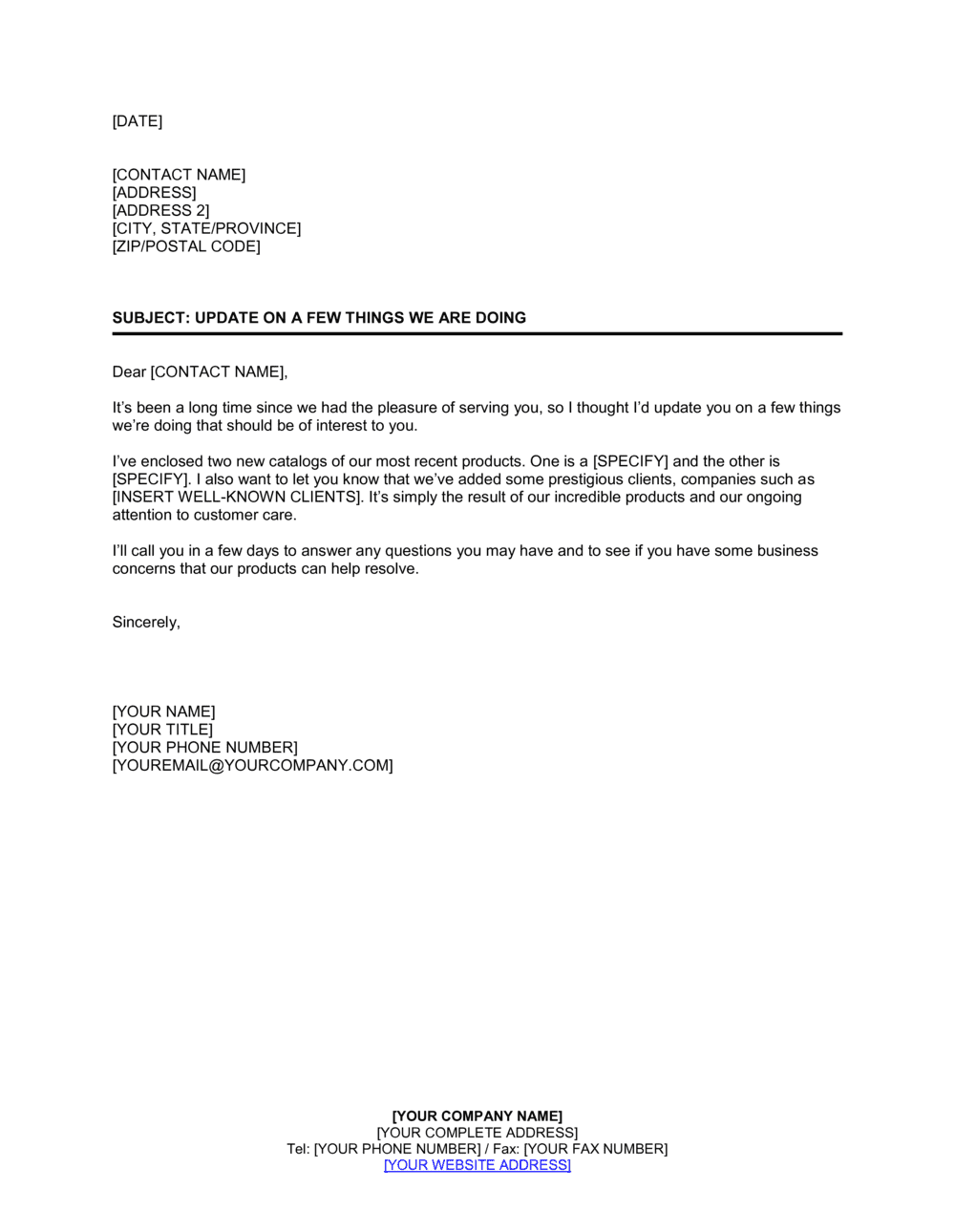
Update on a Few Things We're Doing Template

Free Word download • Edit online • Save & share with Drive • Export to PDF

1 page20–30 min to fillDifficulty: StandardSignature requiredLegal review recommended
Learn more ↓
FreeUpdate on a Few Things We're Doing Template

At a glance

What it is
A Company Update Notice is a formal written communication issued by a business to inform employees, clients, partners, or other stakeholders of significant operational, policy, structural, or legal changes affecting the organization or their relationship with it. This free Word download gives you a structured, professionally formatted starting point you can edit online and export as PDF to distribute internally or externally.
When you need it
Use it whenever the business undergoes changes that materially affect obligations, expectations, or procedures — such as a change in ownership, revised contract terms, updated privacy or data-handling policies, new operational procedures, or a restructuring of services or personnel.
What's inside
Sender and recipient identification, effective date of the changes, a plain-language description of each change being communicated, the reason or context for the change, any required action by the recipient, and an acknowledgment or signature block confirming receipt and understanding.

What is a Company Update Notice?

A Company Update Notice is a formal written communication that a business issues to employees, clients, vendors, or other stakeholders to document and deliver notice of changes to its operations, policies, contractual terms, or procedures. It identifies the issuing organization and the affected parties, specifies the effective date of each change, describes exactly what is changing and why, states any action required from the recipient, and provides a signature block that creates an auditable record of delivery and acknowledgment. When issued under an appropriate variation clause in a governing contract, a properly executed update notice can constitute a binding contractual amendment.

Why You Need This Document

Operating without a documented notice process exposes your business to disputes that are entirely avoidable. When you change a billing rate, a service term, a workplace policy, or a data-handling practice without a formal written record, recipients can later claim they were never informed — and without evidence of delivery and acknowledgment, that claim is difficult to refute. Employment changes communicated informally leave employers vulnerable to constructive dismissal claims in Canada, the UK, and the EU. Consumer-facing changes made without adequate notice risk regulatory action under consumer protection legislation in virtually every major market. A signed, timestamped update notice closes these gaps: it establishes what was communicated, when, and to whom, and it gives recipients the fair notice that courts and regulators require before holding them to new terms. This template provides the structure and legal language needed to issue compliant, defensible notices without starting from a blank page.

Which variant fits your situation?

If your situation is…Use this template
Notifying employees of a change in HR policies or employee handbook termsEmployee Policy Update Notice
Informing clients of revised service terms or contract modificationsContract Amendment Notice
Communicating a change in business ownership or key personnelChange of Ownership Letter
Updating stakeholders on a restructuring or reduction in forceOrganizational Restructuring Notice
Notifying customers of changes to a privacy policy or data practicesPrivacy Policy Update Notice
Advising partners or vendors of new operational proceduresVendor Policy Update Letter
Issuing a formal notice of a change in business address or contact detailsChange of Address Business Letter

Common mistakes to avoid

❌ Setting an effective date shorter than the contractual or statutory minimum

Why it matters: A notice that does not provide the minimum required advance notice is legally defective in most jurisdictions and can be challenged as ineffective, resetting the clock and exposing the company to claims for the period of non-compliance.

Fix: Check the governing contract and the applicable employment or consumer protection statute for the jurisdiction before setting any effective date. Build in a buffer of at least two extra business days beyond the minimum.

❌ Describing changes in vague or general terms

Why it matters: Phrases like 'updated operational procedures' or 'revised service terms' do not give recipients fair notice of what is actually changing, which courts use as a basis to void the amendment or find that no binding change occurred.

Fix: Reference the specific clause, section, or policy being changed and state the old and new position clearly. If multiple items are changing, number each one separately.

❌ Omitting opt-out or objection rights where required

Why it matters: Consumer protection law in the US, UK, EU, and Canada often requires that recipients have a meaningful opportunity to reject changes to ongoing service contracts. Omitting this right can make the entire change unenforceable and attract regulatory attention.

Fix: Review the applicable consumer or employment protection legislation for the recipient's jurisdiction before finalizing the notice. Add a clearly worded opt-out clause with a specific deadline and stated consequence.

❌ Using a trade name instead of the registered legal entity as the sender

Why it matters: If the notice is later relied upon to enforce a change or defend against a claim, the party named must match the legal entity that holds the underlying contract. A mismatch creates standing and enforceability questions.

Fix: Use the full registered legal entity name exactly as it appears on the governing contract or corporate registry filing. Add the trading name in parentheses if needed for clarity.

❌ Sending the notice to the wrong contact or delivery address

Why it matters: Many contracts specify a designated notice address and method. Sending to a general inbox or a contact who has since left the organization means deemed-receipt timelines may not run and the notice may be challenged as undelivered.

Fix: Confirm the current notice address and authorized recipient under each governing agreement before dispatch. For employment notices, verify current personal address or corporate email as specified in the employment contract.

❌ No record of dispatch or acknowledgment

Why it matters: If a recipient later disputes whether they received the notice, a company without delivery confirmation or a signed acknowledgment cannot prove the notice was effective — potentially voiding the change and creating liability.

Fix: Use a delivery method that generates a timestamp and confirmation record — email with read receipt, registered post, or an electronic signature platform — and store proof of delivery in each recipient's file.

The 10 key clauses, explained

Sender and recipient identification

In plain language: Identifies the issuing organization by full legal name and the recipient — whether an individual, a department, a client entity, or a general class of stakeholders.

Sample language
This notice is issued by [COMPANY LEGAL NAME], a [ENTITY TYPE] incorporated in [JURISDICTION] ('Company'), to [RECIPIENT NAME / ALL EMPLOYEES / ALL CLIENTS] ('Recipient').

Common mistake: Using a brand or trade name instead of the registered legal entity name. If the notice creates or modifies obligations, courts and regulators will look for the contracting entity — mismatches can render the notice ineffective.

Purpose and subject of the update

In plain language: States clearly what is changing and why the notice is being issued — the subject line of the legal record.

Sample language
The Company is writing to inform you of the following changes, which will take effect on [EFFECTIVE DATE]: [BRIEF DESCRIPTION OF CHANGES].

Common mistake: Burying the actual subject of the change in paragraph three. Recipients and courts need to identify the subject instantly — lead with what is changing, not with background context.

Effective date

In plain language: States the specific date on which the described changes take effect, distinguishing the notice date from the operative date.

Sample language
Unless otherwise stated, the changes described in this notice take effect on [EFFECTIVE DATE], which is no fewer than [X] days from the date of this communication.

Common mistake: Setting an effective date that provides less notice than the minimum required by the governing contract or applicable law. This can void the notice or expose the company to breach claims.

Description of changes

In plain language: Provides a plain-language account of each specific change, organized clearly — whether by topic, clause reference, or numbered list.

Sample language
The following changes are being made: (1) [CHANGE 1 — specific description]; (2) [CHANGE 2 — specific description]; (3) [CHANGE 3 — specific description]. All other terms remain unchanged.

Common mistake: Describing changes in vague terms like 'operational improvements' without specifying what is actually different. Vague language invites disputes about what was communicated and whether the recipient had fair notice.

Reason or context for the change

In plain language: Explains the business, legal, or regulatory reason behind the change — important for maintaining trust and demonstrating good faith.

Sample language
These changes are being implemented in response to [REASON — e.g., updated regulatory requirements / operational restructuring / revised service model], effective [DATE].

Common mistake: Omitting any reason entirely. While not always legally required, context reduces pushback, supports enforceability arguments, and demonstrates that the change is not arbitrary or retaliatory.

Impact on existing agreements or obligations

In plain language: Clarifies how the described changes interact with any existing contracts, policies, or prior communications — stating explicitly what is superseded, amended, or unaffected.

Sample language
To the extent any provision of this notice conflicts with [EXISTING AGREEMENT / POLICY NAME], this notice shall control with respect to the matters described herein. All other terms of [EXISTING AGREEMENT] remain in full force and effect.

Common mistake: Failing to reference the governing document or prior agreement. Without this, the update floats independently and recipients may argue it does not modify their existing rights.

Required recipient action

In plain language: States what, if anything, the recipient must do in response — sign and return, opt out by a deadline, update systems, attend a briefing, or simply acknowledge receipt.

Sample language
Please confirm your acknowledgment of this notice by signing below and returning a copy to [CONTACT NAME] at [EMAIL] no later than [DEADLINE DATE]. Failure to respond by this date will be deemed acceptance of the changes described herein.

Common mistake: Including a deemed-acceptance clause without providing an adequate response window. Courts in several jurisdictions have struck down deemed-acceptance provisions where the notice period was unreasonably short.

Opt-out or objection rights

In plain language: Describes the recipient's right, if any, to decline the changes — including how to exercise that right and the consequences of doing so.

Sample language
If you do not accept these changes, you may terminate the agreement by providing written notice to [CONTACT] by [OPT-OUT DEADLINE]. Continued use of the Company's services after [EFFECTIVE DATE] constitutes acceptance.

Common mistake: Omitting opt-out rights entirely when the underlying contract or consumer protection law requires them. Failure to disclose opt-out rights can make the entire amendment unenforceable and trigger regulatory penalties.

Contact information for questions

In plain language: Provides a named point of contact — person, department, or email — for recipients with questions about the changes described.

Sample language
If you have questions regarding this notice, please contact [NAME / DEPARTMENT] at [EMAIL ADDRESS] or [PHONE NUMBER]. We are available [HOURS / DAYS] to address any concerns.

Common mistake: Providing only a generic 'info@' address with no named contact or response timeframe. This creates follow-up delays and signals a lack of accountability for the communication.

Signature and acknowledgment block

In plain language: A formal execution block where an authorized representative of the company signs the notice, and — where required — the recipient countersigns to confirm receipt and acceptance.

Sample language
Issued by: [AUTHORIZED REPRESENTATIVE NAME], [TITLE], [COMPANY LEGAL NAME]. Date: [DATE]. Acknowledged and accepted by: [RECIPIENT NAME]. Date: [DATE].

Common mistake: Having a junior staff member sign a notice that triggers contractual changes without confirming they have signing authority. Notices signed by unauthorized personnel can be challenged as ineffective.

How to fill it out

  1. 1

    Identify the issuing entity and all recipient classes

    Enter the company's full registered legal name, entity type, and jurisdiction of incorporation. Identify whether the notice is addressed to employees, clients, vendors, or a combination — and whether individual names or a general class is appropriate.

    💡 If the notice is going to clients governed by individual contracts, reference each contract by name or number in the recipient block to make the connection explicit.

  2. 2

    Set the notice date and effective date

    Record today's date as the notice date. Then calculate the effective date, ensuring it satisfies any minimum notice period required by the governing contract, employment standard, or applicable regulation — typically 14 to 30 days.

    💡 Add the minimum notice period to your issue date rather than picking an effective date intuitively. A notice that falls one day short of a contractual minimum can be challenged.

  3. 3

    Describe each change specifically and separately

    List every change in plain language — one numbered item per change. Reference the specific clause, section, or policy that is being modified so recipients can locate the original provision.

    💡 Write for a recipient who is not familiar with internal jargon. If a manager can read it and explain each item in one sentence, the description is clear enough.

  4. 4

    State the reason for each change

    Include one to two sentences explaining why each change is being made — whether driven by a legal update, operational necessity, cost structure, or regulatory requirement.

    💡 For employment-related changes, the stated reason becomes part of the record if the change is later disputed as constructive dismissal. Be accurate and specific.

  5. 5

    Clarify the impact on existing agreements

    Name the specific agreement, policy, or prior communication the notice modifies. State whether it supersedes, amends, or supplements that document and confirm that all other terms remain unchanged.

    💡 If more than three prior documents are affected, attach a summary table listing each document, the relevant clause, and whether it is amended or superseded.

  6. 6

    Define the required action and deadline

    State clearly what the recipient must do — sign and return, opt out, update their records — and give a specific deadline date. Include deemed-acceptance language if it applies.

    💡 Set the response deadline at least 7–10 business days before the effective date so you have time to process responses before the changes go live.

  7. 7

    Have an authorized representative sign the notice

    Confirm that the signatory holds the authority to issue notices that modify contractual or policy terms. For externally binding notices, this is typically a director, officer, or legal counsel.

    💡 Keep a signed copy in each affected party's file and log the dispatch date, delivery method, and any confirmation of receipt.

  8. 8

    Distribute and track acknowledgments

    Send the notice by the method specified in the governing agreement — email, courier, or registered post. Log delivery confirmations and follow up on any unacknowledged copies before the effective date.

    💡 For large employee populations, use a distribution platform that timestamps delivery and records each employee's electronic acknowledgment — this creates an audit trail that is invaluable in disputes.

Frequently asked questions

What is a company update notice?

A company update notice is a formal written communication that a business issues to employees, clients, vendors, or other stakeholders to inform them of changes to its operations, policies, contracts, or procedures. It creates a documented record that the recipient was informed of the change, which is important for enforceability and compliance. When properly drafted and delivered, it can also constitute a binding amendment to an existing agreement.

When is a company update notice legally required?

A formal written notice is legally required whenever an existing contract specifies a notice provision for changes, whenever employment standards legislation requires advance notice of policy or compensation changes, or whenever consumer protection or data privacy law mandates notification of material changes to terms of service. Even where not strictly required, a written notice is strongly advisable for any change that affects financial obligations, working conditions, or contractual rights.

How much advance notice do I need to give before changes take effect?

The required notice period depends on the governing contract and the applicable jurisdiction. Most commercial contracts require 14 to 30 days. Employment standards legislation in Canada and the UK typically requires at minimum one to four weeks depending on the nature of the change and the employee's tenure. EU consumer contracts often require 30 days for unilateral changes. Always check the specific contract and the statute that governs it before setting an effective date.

Does a company update notice need to be signed?

Signature is strongly recommended when the notice modifies contractual terms, triggers an acknowledgment obligation, or is intended to serve as a formal amendment. An authorized representative of the company should always sign. Where the notice requires the recipient to accept a change, a countersignature or electronic acknowledgment creates the strongest evidentiary record. For purely informational notices with no contractual effect, a signature is still best practice.

Can a company update notice unilaterally change a contract?

A notice can amend an existing agreement only if the original contract contains a unilateral variation clause permitting one party to make changes on notice. Without such a clause, both parties must consent to any amendment. In employment contexts, unilateral changes to fundamental terms — pay, hours, location — without consent can constitute constructive dismissal regardless of what the contract says. Consumer contracts in the EU and UK impose additional restrictions on unilateral amendment rights.

What happens if an employee or client does not respond to the notice?

If the notice includes a deemed-acceptance clause and provides a reasonable response window, continued participation in the relationship after the effective date is typically treated as acceptance in most jurisdictions. However, deemed acceptance is not universally recognized — courts in some states and countries require affirmative consent for material changes. Include an explicit opt-out mechanism and consult local legal guidance for notices that make significant changes to ongoing obligations.

What is the difference between a company update notice and a contract amendment?

A contract amendment is a bilateral document that both parties sign to formally modify specific terms of an existing agreement. A company update notice is typically unilateral — issued by one party under a variation clause or as a matter of policy — and may or may not require countersignature. For significant changes to commercial contracts, a signed amendment is the more defensible approach. A notice is appropriate for informational updates, policy changes, or situations where the governing contract expressly permits unilateral variation on notice.

How should I deliver a company update notice to ensure it is legally effective?

Deliver the notice by the method specified in the governing agreement — commonly email to the designated address, registered or certified post, or courier. If no method is specified, use a method that generates a timestamped delivery record. Email with read receipt, registered post with tracking, or an electronic signature platform all create the audit trail needed to establish that deemed-receipt timelines have run. Keep a copy of the sent notice and the delivery confirmation in each recipient's file.

Do I need a lawyer to issue a company update notice?

For routine informational updates with no contractual effect, a well-drafted template is generally sufficient. Engage a lawyer when the notice modifies binding contract terms, when employment standards compliance is at issue, when the change affects a large number of recipients simultaneously, or when the notice is being issued in a jurisdiction with specific statutory notice requirements — particularly the UK, EU member states, or Canadian provinces. A one-hour legal review typically costs $200–$400 and is worthwhile for any notice that creates or modifies legal obligations.

How this compares to alternatives

vs Contract Amendment

A contract amendment is a bilateral document both parties sign to formally modify specific terms of an existing agreement — it requires mutual consent. A company update notice is typically unilateral, issued under a variation clause, and may take effect through deemed acceptance. For significant commercial changes, a signed amendment provides stronger legal protection than a notice alone.

vs Memorandum of Understanding

A memorandum of understanding records agreed intentions between parties at the beginning of a relationship or negotiation. A company update notice communicates changes to an existing relationship mid-term. An MOU creates a new framework; an update notice modifies an existing one.

vs Employee Policy Update Memo

An internal policy memo distributes procedural guidance to employees but typically does not modify the terms of employment contracts. A company update notice, when properly executed, can constitute a binding contractual modification if issued under an appropriate variation clause and the employee is given the right to object or accept.

vs Termination Notice

A termination notice ends an agreement or employment relationship. A company update notice continues the relationship while modifying specific terms within it. The two documents are structurally similar in format but fundamentally different in legal effect — using an update notice when termination is intended, or vice versa, creates significant legal risk.

Industry-specific considerations

Financial Services

Regulatory change notifications, fee structure updates, and changes to account terms all require formally documented notice under financial services legislation in most jurisdictions.

Technology / SaaS

Platform terms of service changes, API deprecations, pricing updates, and data processing policy revisions must be communicated to users and enterprise clients with documented notice periods.

Professional Services

Changes to billing rates, scope-of-service terms, or engagement conditions typically require written notice to existing clients under the governing engagement letter or master services agreement.

Healthcare

HIPAA-mandated privacy policy updates, changes to patient billing practices, and modifications to covered services require formal written notice to patients and covered entities under federal and state law.

Retail / E-commerce

Consumer-facing changes to return policies, loyalty program terms, and subscription billing structures require advance notice under consumer protection legislation in most markets.

Manufacturing

Supply chain procedure changes, updated quality standards, and revised delivery or payment terms communicated to vendors require documented notice to avoid breach claims under long-term supply agreements.

Jurisdictional notes

United States

Notice requirements vary significantly by state and by the type of relationship. Employment policy changes that affect wages or working conditions are governed by state wage and hour law — California, New York, and Illinois impose stricter advance notice requirements than the federal FLSA minimum. Consumer-facing contract changes are regulated at both the federal level (FTC Act) and by state consumer protection statutes. Deemed-acceptance clauses are scrutinized in states that apply unconscionability doctrine broadly.

Canada

Each province's Employment Standards Act sets minimum notice periods for unilateral changes to employment terms — in Ontario, a fundamental change to compensation or duties without adequate notice can constitute constructive dismissal. Consumer contract amendments are subject to provincial consumer protection legislation; several provinces require 30 days' notice for changes to ongoing service agreements. Quebec requires French-language notices for provincially regulated employers.

United Kingdom

The Employment Rights Act 1996 requires employers to notify employees in writing of any changes to their written statement of employment particulars within one month of the change. Unilateral changes to fundamental employment terms without consent can constitute constructive dismissal under UK employment law. For consumer contracts, the Consumer Rights Act 2015 limits unilateral variation rights and requires transparent notice. GDPR-derived UK data protection law requires timely notification of material changes to privacy policies.

European Union

The EU Transparent and Predictable Working Conditions Directive requires written notification of any change to employment terms within the day the change applies. The GDPR requires prompt notification of material changes to data processing practices. Consumer contracts are governed by the Unfair Contract Terms Directive, which restricts unilateral variation clauses — changes that are not foreseeable at contract formation may be unenforceable. Notice requirements and employee protections vary in stringency across member states, with France, Germany, and the Netherlands imposing the most detailed obligations.

Template vs lawyer — what fits your deal?

PathBest forCostTime
Use the templateRoutine informational updates, internal policy communications, and low-stakes operational notices with no contractual effectFree15–30 minutes
Template + legal reviewNotices that modify service terms, employment conditions, or pricing for a moderate number of recipients in a single jurisdiction$200–$500 for a one-hour legal review1–2 business days
Custom draftedMass notices to regulated consumers, cross-border employment changes, or notices that modify binding contracts in jurisdictions with strict variation requirements$800–$3,000+3–7 business days

Glossary

Effective Date
The specific calendar date on which the communicated changes take legal or operational effect.
Material Change
A change significant enough to alter the rights, obligations, or reasonable expectations of the party being notified.
Acknowledgment Clause
A section in which the recipient confirms in writing that they have received, read, and understood the notice.
Notice Period
The minimum amount of advance time a party must receive before a change becomes effective, as required by contract, policy, or law.
Governing Document
The original contract, policy, or agreement to which the update notice refers and which it amends or supplements.
Deemed Receipt
A legal presumption that a notice has been received after a specified number of days following dispatch, regardless of actual delivery confirmation.
Opt-Out Right
A recipient's contractual or statutory right to decline or terminate the relationship rather than accept the notified change.
Constructive Notice
Notice that is legally presumed to have been given when it is published or made available in a manner reasonably accessible to the recipient, even without direct delivery.
Amendment
A formal modification to an existing agreement or policy, which the update notice may introduce or reference.
Force Majeure
A clause excusing a party from obligations due to extraordinary events outside their control — sometimes referenced when explaining reasons for operational changes.
Severability
A provision stating that if one part of the notice or underlying agreement is unenforceable, the remainder continues in full force.

Part of your Business Operating System

This document is one of 3,000+ business & legal templates included in Business in a Box.

  • Fill-in-the-blanks — ready in minutes
  • 100% customizable Word document
  • Compatible with all office suites
  • Export to PDF and share electronically

Create your document in 3 simple steps.

From template to signed document — all inside one Business Operating System.
1
Download or open template

Access over 3,000+ business and legal templates for any business task, project or initiative.

2
Edit and fill in the blanks with AI

Customize your ready-made business document template and save it in the cloud.

3
Save, Share, Send, Sign

Share your files and folders with your team. Create a space of seamless collaboration.

Save time, save money, and create top-quality documents.

★★★★★

"Fantastic value! I'm not sure how I'd do without it. It's worth its weight in gold and paid back for itself many times."

Managing Director · Mall Farm
Robert Whalley
Managing Director, Mall Farm Proprietary Limited
★★★★★

"I have been using Business in a Box for years. It has been the most useful source of templates I have encountered. I recommend it to anyone."

Business Owner · 4+ years
Dr Michael John Freestone
Business Owner
★★★★★

"It has been a life saver so many times I have lost count. Business in a Box has saved me so much time and as you know, time is money."

Owner · Upstate Web
David G. Moore Jr.
Owner, Upstate Web

Run your business with a system — not scattered tools

Stop downloading documents. Start operating with clarity. Business in a Box gives you the Business Operating System used by over 250,000 companies worldwide to structure, run, and grow their business.

Start free · No credit card required