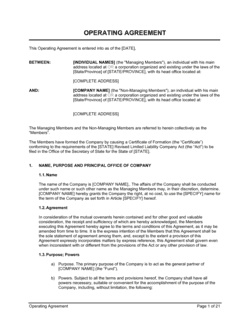
Articles of Association Long Form Template

Free Word download β€’ Edit online β€’ Save & share with Drive β€’ Export to PDF

24 pagesβ€’25–35 min to fillβ€’Difficulty: Complex
Learn more ↓
FreeArticles of Association Long Form Template

At a glance

What it is
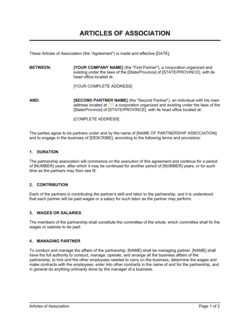
Articles of Association (long form) is a foundational governance document that sets out the internal rules by which a company is managed β€” covering share structure, director powers, shareholder rights, meeting procedures, and decision-making authority. This free Word download gives you a fully structured, editable template you can complete online and export as PDF for filing with a company registry or retaining in your corporate records.
When you need it
Use it when incorporating a new company, restructuring share classes, replacing model articles with a customized governance framework, or onboarding new shareholders who require a formal statement of company rules.
What's inside
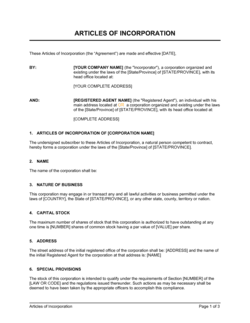
Company name and registered details, share capital and classes, director appointment and removal rules, board and shareholder meeting procedures, voting rights, dividend policy, transfer restrictions, and winding-up provisions.

What is an Articles of Association Long Form?

Articles of Association (long form) is a company's foundational governance document that sets out the detailed internal rules by which it is managed, its shares are structured, and decisions are made by directors and shareholders. Unlike a short-form or model-articles filing, the long form includes full provisions for multiple share classes, investor preference rights, pre-emption on new issuances and transfers, board and shareholder meeting procedures, reserved matters requiring shareholder consent, and dissolution rules. It is filed with the company registry at incorporation or when replacing earlier articles and is legally binding on the company and all its shareholders.

Why You Need This Document

Without clearly drafted articles, default statutory rules fill every gap β€” and those defaults rarely match the commercial arrangements agreed between founders and investors. A company that adopts standard model articles without customization has no share transfer restrictions, no pre-emption rights protecting existing shareholders from dilution, and no reserved matters preventing a director from issuing new shares or taking on debt without consent. When a shareholder dispute arises or a funding round triggers a rights question, the cost of correcting poorly drafted articles is measured in legal fees, delayed closings, and damaged relationships. This template gives you a complete, customizable starting point that covers every material governance provision a multi-shareholder company needs β€” before the moment it needs them.

Which variant fits your situation?

If your situation is…Use this template
Incorporating a simple single-class share company with one or two directorsArticles of Association Short Form
Forming a company with multiple share classes and investor preference rightsArticles of Association Long Form
Establishing a nonprofit or charitable organizationArticles of Incorporation (Nonprofit)
Setting out the rules governing an LLC rather than a corporationLLC Operating Agreement
Recording shareholder rights and obligations between co-foundersShareholders Agreement
Documenting board-level governance for an established companyCorporate Bylaws
Passing a formal resolution to amend the existing articlesSpecial Resolution Template

Common mistakes to avoid

❌ Adopting model articles without customization

Why it matters: Default model articles grant broad director powers, no pre-emption protections, and no transfer restrictions β€” leaving shareholders exposed to dilution and unwanted third-party entry.

Fix: Use the long-form template to customize share class rights, pre-emption provisions, and reserved matters to match the agreed shareholder structure before filing.
❌ Setting authorized share capital too low

Why it matters: Issuing shares beyond the authorized limit is void. Amending authorized capital requires a shareholder resolution and a registry filing, adding cost and delay at exactly the moment β€” a funding round β€” when speed matters most.

Fix: Authorize at least 10,000 shares at formation, regardless of how many you plan to issue initially.

❌ Omitting a share transfer valuation mechanism

Why it matters: When a departing shareholder and the remaining shareholders disagree on price, an undefined valuation process can result in the transfer being blocked for months while legal costs accumulate.

Fix: Add a clause requiring an independent accountant to determine fair market value within 30 days if the parties cannot agree within 15 days of a transfer notice.

❌ Not specifying reserved matters requiring shareholder approval

Why it matters: Without a reserved matters list, directors can issue new shares, take on significant debt, or sell major assets without shareholder consent β€” materially diluting or harming minority shareholders.

Fix: Include a schedule of reserved matters covering at minimum: new share issuances, borrowings above a set threshold, disposal of assets above a set value, and approval of the annual budget.

The 10 key fields, explained

Company name and registered office

Share capital and authorized shares

Rights attached to each share class

Director appointment, removal, and powers

Board meeting procedures and quorum

Shareholder meeting procedures and voting

Pre-emption rights on new share issuance

Share transfer restrictions

Dividend policy

Winding up and distribution of assets

How to fill it out

  1. 1

    Enter the company name and registered address

    Use the exact legal name as it appears on the certificate of incorporation or as proposed for registration. Enter the full registered office address including postcode or ZIP.

    πŸ’‘ Confirm the registered address is an address at which the company can legally receive statutory correspondence β€” not just a mailing address.

  2. 2

    Define the authorized share capital and classes

    Set the total authorized share capital with the number of shares per class and their nominal value. Common structures for early-stage companies are a single class of ordinary shares; investor-backed companies typically add a preference share class.

    πŸ’‘ Authorize more shares than you currently plan to issue β€” typically 10,000 or more β€” to give yourself room to issue equity to employees and future investors without needing to amend the articles.

  3. 3

    Specify the rights attached to each share class

    For each class, state the voting rights (votes per share or none), dividend entitlement (fixed percentage or discretionary), and priority on winding up.

    πŸ’‘ Attach a clear schedule of share rights rather than embedding them in the main body β€” it makes future amendments easier to locate and update.

  4. 4

    Set director appointment and removal rules

    State the minimum and maximum number of directors, who may appoint or remove them (shareholders, the board, or specific shareholder classes), and what reserved matters require shareholder consent.

    πŸ’‘ List at least three reserved matters requiring shareholder approval β€” issuing shares, disposing of major assets, and incurring debt above a threshold are the most common.

  5. 5

    Configure meeting procedures and quorum

    Enter the notice periods for board and shareholder meetings, quorum numbers, and voting thresholds for ordinary and special resolutions. Confirm these meet or exceed the statutory minimums in your jurisdiction.

    πŸ’‘ Consider allowing written resolutions in lieu of meetings β€” they are faster for routine decisions and save cost when shareholders are dispersed.

  6. 6

    Complete pre-emption and transfer restriction provisions

    State whether pre-emption rights apply on new issuances and transfers, the notice period for exercise, and the mechanism for setting the price when right of first refusal is triggered.

    πŸ’‘ Include a deadlock valuation mechanism β€” such as independent expert determination β€” so the transfer price cannot be disputed indefinitely.

  7. 7

    Review and file with the company registry

    Review the completed articles against the applicable company law in your jurisdiction. File with the relevant company registry alongside the certificate of incorporation or as an amended filing.

    πŸ’‘ Keep a fully executed signed copy in the company's registered records even when the registry does not require an original β€” you will need it for due diligence in any future funding round or sale.

Frequently asked questions

What are Articles of Association?

Articles of Association are the internal constitutional rules of a company that govern how it is managed, how directors and shareholders make decisions, and how shares are issued and transferred. They are a legally required document in most jurisdictions and must be filed with the company registry at or shortly after incorporation. The long-form version provides detailed provisions tailored to the company's specific share structure and governance needs.

What is the difference between the long form and short form Articles of Association?

Short-form articles adopt the jurisdiction's default model articles with minimal customization β€” suitable for a simple single-class, single-director company. The long-form version adds detailed provisions for multiple share classes, investor preference rights, pre-emption on transfers, board committees, reserved matters, and deadlock resolution. Companies with external investors, multiple founders, or complex share structures need the long form.

Are Articles of Association the same as a Shareholders Agreement?

No. Articles of Association are a public document filed with the company registry that governs the company's internal management and is binding on all shareholders by virtue of company law. A Shareholders Agreement is a private contract between specific shareholders that can include confidential commercial terms. The two documents work together β€” the articles provide the constitutional framework; the shareholders agreement handles commercial matters not appropriate for public disclosure.

Who needs to sign the Articles of Association?

Requirements vary by jurisdiction. In the UK, articles do not need to be signed to be valid β€” they are filed electronically with Companies House. In many other jurisdictions, founding shareholders or directors must sign before filing. Check the company registry requirements for your specific country before submitting.

Can Articles of Association be amended after incorporation?

Yes. Articles can be amended by passing a special resolution β€” typically requiring 75% of shareholder votes β€” and filing the updated articles with the company registry. Some provisions, such as class rights attached to preference shares, may require consent of the affected class in addition to a general shareholder vote.

What is the difference between Articles of Association and a Memorandum of Association?

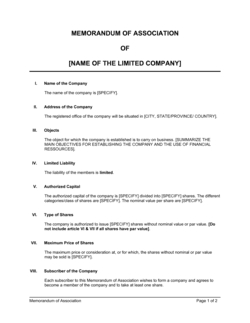
A Memorandum of Association is a brief formation document confirming that the subscribers wish to form a company and agree to take at least one share each. In most modern jurisdictions it is a one-page formality. The Articles of Association is the substantive governance document setting out all internal rules. In older company law frameworks the two were separate documents; in the UK since the Companies Act 2006, the memorandum has been reduced to a standard prescribed form.

Do I need a lawyer to prepare Articles of Association?

For a simple company with a single share class and straightforward governance, a well-structured template is typically sufficient. Engage a corporate lawyer when the company has multiple share classes with complex economic rights, when external investors require negotiated protections, when the company operates in a regulated industry, or when cross-border shareholders are involved. A template review typically costs $300–$800 and is worthwhile for any company planning to raise external capital.

What happens if a company acts in breach of its Articles of Association?

Actions taken in breach of the articles β€” such as issuing shares without following pre-emption procedures or holding a meeting without proper notice β€” can be challenged by shareholders and declared invalid by a court. Directors who cause the company to breach its articles may also face personal liability for resulting losses. Keeping the articles up to date and following their procedures for every material decision is essential.

How this compares to alternatives

vs Shareholders Agreement

Articles of Association are a public constitutional document filed with the company registry and binding on all shareholders as a matter of law. A Shareholders Agreement is a private contract between specific shareholders covering commercial terms not suitable for public disclosure β€” such as dividend expectations, funding obligations, and founder vesting. Most companies with external investors use both.

vs LLC Operating Agreement

An LLC Operating Agreement governs the internal rules of a limited liability company, the US entity type that has members rather than shareholders. Articles of Association apply to corporations or limited companies under company law frameworks common in the UK, Commonwealth countries, and many civil law jurisdictions. The documents serve the same governance function but apply to different entity types.

vs Corporate Bylaws

Corporate Bylaws are the US equivalent of Articles of Association β€” they set out the internal governance rules of a corporation including director and shareholder meeting procedures, officer roles, and voting rights. In US practice, Bylaws are adopted alongside the Certificate of Incorporation; in UK and Commonwealth practice, Articles of Association serve the combined function.

vs Articles of Association Short Form

The short-form articles adopt the jurisdiction's model articles with minimal additions β€” suitable for a simple single-class company with one or two directors. The long form adds detailed share class rights, pre-emption provisions, reserved matters, transfer restrictions, and dispute resolution mechanisms needed by any company with multiple shareholders or external investment.

Industry-specific considerations

Technology / SaaS

Multiple share classes for founder, employee option pool, and investor tranches; anti-dilution provisions for preference shareholders in successive funding rounds.

Professional Services

Restrictive transfer provisions ensuring shares stay within the partnership or professional group; drag-along and tag-along rights for orderly exits.

Financial Services

Regulatory fit-and-proper requirements for director appointments; provisions restricting share ownership to approved persons under financial services licensing rules.

Manufacturing

Family business succession provisions including pre-emption rights in favour of family members; valuation mechanisms designed for asset-heavy balance sheets.

Template vs pro β€” what fits your needs?

PathBest forCostTime
Use the templateFounders incorporating a simple company with one or two share classes and no external investorsFree30–60 minutes
Template + professional reviewCompanies with multiple founders, an employee share option pool, or a first angel or seed investment round$300–$800 for a corporate lawyer review2–5 days
Custom draftedSeries A or later funding rounds, regulated industries, cross-border shareholding structures, or complex preference share waterfalls$1,500–$5,000+1–3 weeks

Glossary

Articles of Association
The internal rulebook of a company that governs how it is managed, how decisions are made, and how shares are issued and transferred.
Share Capital
The total value of shares a company is authorized to issue, divided into classes with defined rights attached to each.
Ordinary Shares
The standard class of shares conferring voting rights and entitlement to dividends and residual assets after debts are paid on winding up.
Preference Shares
Shares that carry a priority right to dividends or return of capital over ordinary shares, often used by investors in funding rounds.
Quorum
The minimum number of directors or shareholders who must be present at a meeting for its decisions to be legally valid.
Special Resolution
A shareholder vote requiring a supermajority β€” typically 75% of votes cast β€” used to approve changes to the articles or major structural decisions.
Pre-emption Rights
The right of existing shareholders to be offered new shares in proportion to their current holdings before those shares are offered to outside parties.
Transfer Restrictions
Provisions that limit how shares may be sold or transferred, often requiring board approval or giving existing shareholders first refusal.
Indemnity
A provision protecting directors from personal liability for actions taken in good faith on behalf of the company, within the scope of their authority.
Winding Up
The formal process of dissolving a company, liquidating its assets, paying its debts, and distributing any remaining funds to shareholders.

Part of your Business Operating System

This document is one of 3,000+ business & legal templates included in Business in a Box.

  • Fill-in-the-blanks β€” ready in minutes
  • 100% customizable Word document
  • Compatible with all office suites
  • Export to PDF and share electronically

Create your document in 3 simple steps.

From template to signed document β€” all inside one Business Operating System.
1
Download or open template

Access over 3,000+ business and legal templates for any business task, project or initiative.

2
Edit and fill in the blanks with AI

Customize your ready-made business document template and save it in the cloud.

3
Save, Share, Send, Sign

Share your files and folders with your team. Create a space of seamless collaboration.

Save time, save money, and create top-quality documents.

β˜…β˜…β˜…β˜…β˜…

"Fantastic value! I'm not sure how I'd do without it. It's worth its weight in gold and paid back for itself many times."

Managing Director Β· Mall Farm
Robert Whalley
Managing Director, Mall Farm Proprietary Limited
β˜…β˜…β˜…β˜…β˜…

"I have been using Business in a Box for years. It has been the most useful source of templates I have encountered. I recommend it to anyone."

Business Owner Β· 4+ years
Dr Michael John Freestone
Business Owner
β˜…β˜…β˜…β˜…β˜…

"It has been a life saver so many times I have lost count. Business in a Box has saved me so much time and as you know, time is money."

Owner Β· Upstate Web
David G. Moore Jr.
Owner, Upstate Web

Run your business with a system β€” not scattered tools

Stop downloading documents. Start operating with clarity. Business in a Box gives you the Business Operating System used by over 250,000 companies worldwide to structure, run, and grow their business.

Start freeΒ Β·Β No credit card required