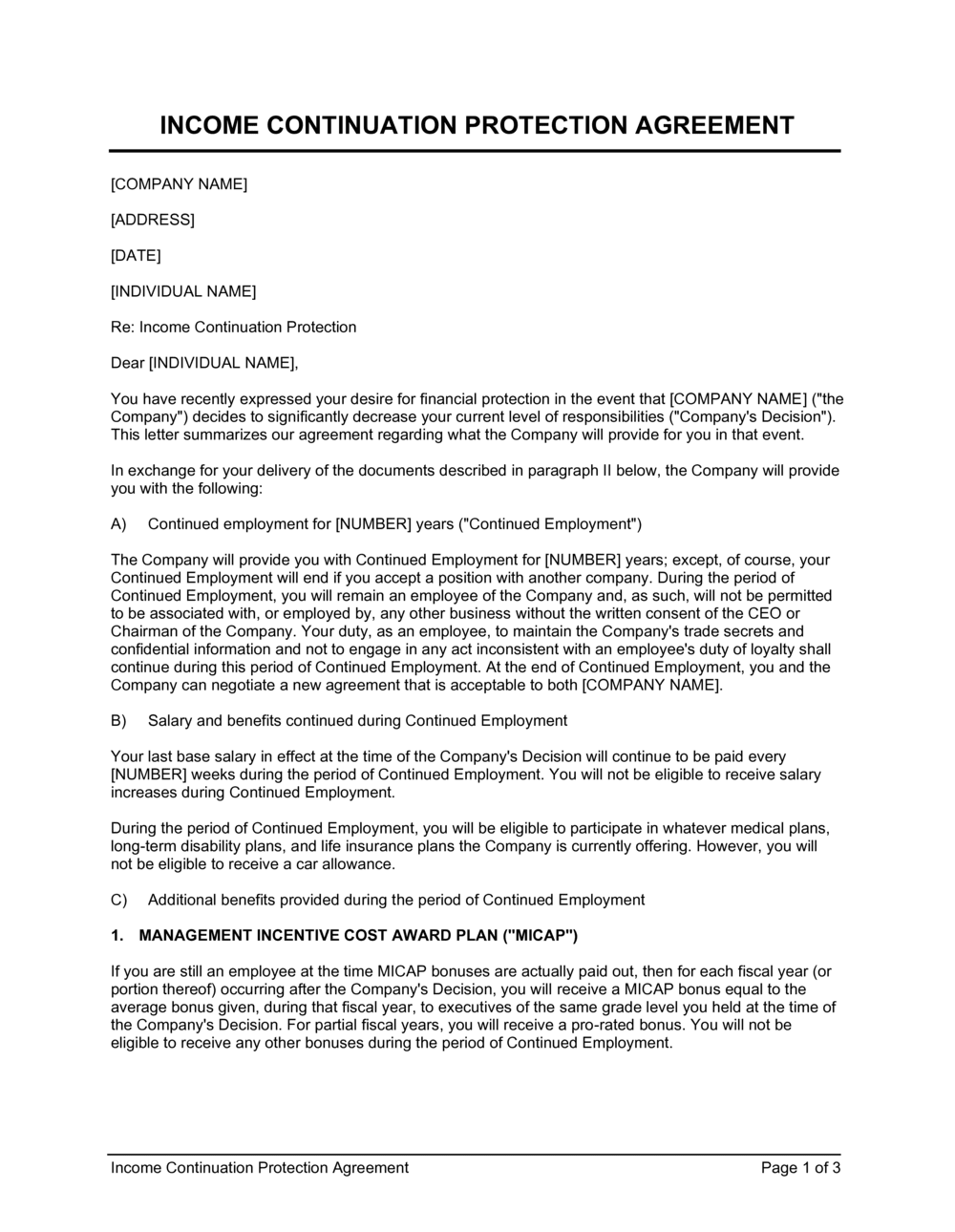
- Income Continuation
- The contractual obligation of an employer to continue paying an employee's salary or a defined portion of it during a qualifying period of disability or incapacity.
- Elimination Period
- The waiting period between the onset of a qualifying disability and the date on which income continuation payments begin — typically 30, 60, or 90 days.
- Own-Occupation Definition
- A disability standard that triggers benefits when the employee is unable to perform the specific duties of their current role, regardless of ability to work in another capacity.
- Any-Occupation Definition
- A stricter disability standard that triggers benefits only when the employee is unable to perform any gainful occupation for which they are reasonably suited by training, education, or experience.
- Benefit Period
- The maximum length of time income continuation payments will be made — commonly 12 months, 24 months, or until the employee reaches age 65.
- Coordination of Benefits
- A clause that offsets the employer's salary continuation obligation by amounts the employee receives from group disability insurance, workers' compensation, or Social Security disability benefits.
- Total Disability
- A medical condition that prevents the employee from performing all or substantially all of the material duties of their position, as certified by a licensed physician.
- Partial Disability
- A condition that reduces but does not eliminate the employee's ability to perform their duties, typically triggering a proportionally reduced benefit payment.
- Reinstatement
- The process by which an employee recovering from disability resumes active employment, with the agreement specifying any conditions, timelines, and benefit termination triggers.
- Salary Base
- The compensation figure used to calculate income continuation payments — typically the employee's gross base salary at the time disability begins, excluding variable bonuses or commissions unless specified.
- ERISA
- The Employee Retirement Income Security Act — a US federal law that governs employer-sponsored benefit plans and may apply to formalized income continuation arrangements depending on how they are structured.