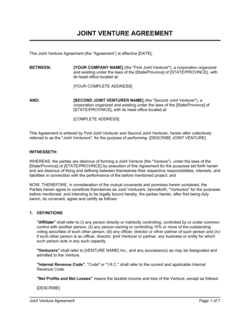
Innovation Ideas For Your Product and Technology Template

Free Word download • Edit online • Save & share with Drive • Export to PDF

4 pages25–30 min to fillDifficulty: StandardSignature requiredLegal review recommended
Learn more ↓
FreeInnovation Ideas For Your Product and Technology Template

At a glance

What it is
An Innovation Ideas for Your Product and Technology agreement is a legally binding document that governs the submission, evaluation, and ownership of new product or technology ideas exchanged between a company and an individual contributor — such as an employee, contractor, or external innovator. This free Word download covers confidentiality, IP assignment, evaluation rights, compensation terms, and non-circumvention in a single structured document you can edit online and export as PDF.
When you need it
Use it whenever your company invites or receives innovation submissions — from internal ideation programs, hackathons, open innovation initiatives, or unsolicited external proposals — and needs to establish who owns the resulting IP before evaluation begins. It is also appropriate when a founder or inventor shares a new product concept with a potential partner or licensee and requires formal protection of the idea.
What's inside
Definitions of the idea and scope of submission, confidentiality obligations, IP ownership and assignment, evaluation rights and timelines, compensation or royalty terms, non-circumvention restrictions, warranties from the submitter, limitation of liability, and governing law with dispute resolution procedures.

What is an Innovation Ideas for Your Product and Technology Agreement?

An Innovation Ideas for Your Product and Technology agreement is a legally binding document that governs the formal submission, evaluation, and ownership of new product concepts or technical innovations exchanged between a company and an individual contributor — whether an employee, independent inventor, external startup, or innovation consultant. It establishes the precise scope of the idea being shared, assigns or preserves intellectual property rights, imposes confidentiality obligations on the receiving company, sets a defined evaluation window, and specifies what compensation the submitter receives if the idea is commercialized. Unlike a standard NDA, this agreement addresses the full lifecycle of an innovation submission — from first disclosure through commercialization or reversion — in a single enforceable instrument.

Why You Need This Document

Without a signed innovation ideas agreement in place before any disclosure, both parties face serious and largely avoidable legal exposure. A company that evaluates an unsolicited idea without a formal submission agreement may later face claims that it misappropriated the concept — even if it independently developed a similar product. An inventor who discloses a novel technology concept without this agreement in place has no contractual right to compensation, no guaranteed reversion of rights if the company declines, and no confidentiality obligations protecting the idea from being shared internally or acted upon without a deal. The consequences range from protracted IP litigation to the permanent loss of patent rights if the unprotected disclosure triggers a statutory public disclosure bar. This template gives both parties a clear, proportionate framework — evaluation rights for the company, IP protection and compensation rights for the submitter — closing the gaps that turn promising innovation partnerships into expensive disputes.

Which variant fits your situation?

If your situation is…Use this template
Employee submitting an innovation idea through an internal company programInnovation Ideas for Your Product and Technology
External inventor or startup sharing a concept with a corporate partnerNon-Disclosure Agreement (NDA)
Company licensing a patented technology from an external partyTechnology License Agreement
Engaging a contractor to develop a new product or software featureIndependent Contractor Agreement
Joint development of a product between two companiesJoint Venture Agreement
Assigning all IP from a completed innovation project to the companyIntellectual Property Assignment Agreement
Compensating an inventor with royalties on commercialized innovationsRoyalty Agreement

Common mistakes to avoid

❌ Disclosing the idea before signing

Why it matters: Once an idea is disclosed without a signed agreement, confidentiality obligations are difficult to establish retroactively and any IP assignment may be challenged as lacking proper consideration.

Fix: Execute the agreement and obtain both signatures before sharing any written materials, diagrams, or verbal descriptions of the innovation.

❌ Omitting an Exhibit A written description

Why it matters: Without a specific written description of the submitted idea attached to the agreement, the scope of what was assigned or protected is entirely disputed — courts cannot enforce obligations over an undefined subject matter.

Fix: Always attach a dated written description of the innovation, signed by both parties, as an exhibit incorporated by reference into the agreement.

❌ Leaving compensation as 'to be agreed'

Why it matters: An agreement to agree on material terms is generally unenforceable in common-law jurisdictions, leaving the submitter with no right to payment even if the company commercializes the idea successfully.

Fix: Include at minimum a royalty formula with a floor payment, a fixed lump sum, or a binding term that triggers negotiation within a specified deadline with a default mechanism if no deal is reached.

❌ Using a perpetual confidentiality obligation

Why it matters: Courts in the US, UK, and EU frequently refuse to enforce perpetual confidentiality clauses as unreasonably restrictive, sometimes voiding the confidentiality section entirely rather than substituting a reasonable term.

Fix: Set a defined confidentiality period — typically 3 to 5 years — that is commercially reasonable and proportionate to the sensitivity of the information.

❌ No reversion clause for unevaluated ideas

Why it matters: Without a reversion clause, an idea submitted to a company that never responds sits in legal limbo — the submitter cannot take it to a competitor and the company has no obligation to act.

Fix: Include an automatic reversion provision: if the company does not provide written notice of intent within the evaluation period, all rights revert to the submitter by operation of the agreement.

❌ Ignoring the submitter's employment or prior assignment obligations

Why it matters: If the submitter is employed elsewhere or previously assigned IP rights to a university or prior employer, the company may acquire an idea it cannot legally use — triggering third-party infringement claims.

Fix: Require the submitter to warrant in writing that the idea is free of prior assignments and have them list any prior employers or institutions that may have claims before execution.

The 9 key clauses, explained

Definitions and scope of submission

In plain language: Precisely identifies the innovation being submitted, distinguishes it from background IP the submitter already owns, and sets the boundaries of what the agreement covers.

Sample language
'Innovation' means the concept, design, or technology described in Exhibit A, submitted by [SUBMITTER NAME] to [COMPANY NAME] on [DATE], and excludes any prior inventions listed in Exhibit B.

Common mistake: Leaving the definition of the submitted idea vague or oral — without an attached written description, both parties dispute what was actually disclosed, making ownership and evaluation disputes nearly impossible to resolve.

Confidentiality obligations

In plain language: Requires the receiving company to keep the submitted idea confidential for a defined period and to use it only for the purpose of evaluation, not to exploit it independently.

Sample language
[COMPANY NAME] agrees to hold the Innovation in strict confidence for [X] years and to use the Innovation solely to evaluate its commercial potential, disclosing it only to employees with a need to know who are bound by equivalent obligations.

Common mistake: Setting no expiration on confidentiality obligations. Perpetual confidentiality clauses are unenforceable in several jurisdictions and courts may void the entire provision rather than impose a reasonable limit.

Ownership and IP assignment

In plain language: Determines who owns the submitted idea and any derivatives — either confirming the submitter retains ownership pending a commercialization deal, or assigning ownership to the company upon signing or payment.

Sample language
All right, title, and interest in the Innovation, including all patent, copyright, trade secret, and other intellectual property rights, are hereby assigned by [SUBMITTER NAME] to [COMPANY NAME] effective upon payment of [CONSIDERATION] as set out in Section [X].

Common mistake: Using ambiguous language like 'the company may use the idea' without specifying whether ownership transfers or a license is granted — creating a dispute about the scope of rights every time the company tries to commercialize.

Evaluation rights and timeline

In plain language: Grants the company a defined window to assess the idea's commercial viability and specifies what happens if no decision is made within that window — typically the idea reverts to the submitter.

Sample language
[COMPANY NAME] shall have [60] days from the date of submission ('Evaluation Period') to assess the Innovation. If [COMPANY NAME] does not provide written notice of intent to license or acquire within the Evaluation Period, all rights revert to [SUBMITTER NAME] and the confidentiality obligations of Section [X] continue for [Y] years.

Common mistake: No reversion clause if the company fails to act. Without one, the submitter has no legal mechanism to reclaim rights or take the idea to another party after the evaluation stalls indefinitely.

Compensation, licensing, and royalties

In plain language: Sets out what the submitter receives in exchange for the idea — a lump-sum payment, royalty on commercialized revenue, equity, or a combination — and the conditions under which payment is triggered.

Sample language
In consideration of the assignment, [COMPANY NAME] shall pay [SUBMITTER NAME] a royalty of [X]% of net revenue derived from products incorporating the Innovation, payable quarterly within [30] days of each quarter-end, for a period of [Y] years.

Common mistake: Leaving compensation terms entirely to a future negotiation without any formula or floor. Courts generally will not imply a reasonable compensation term, leaving the submitter with no enforceable right to payment.

Submitter's warranties and representations

In plain language: Requires the submitter to confirm that the idea is original, that they have the right to disclose and assign it, and that it does not infringe third-party IP rights.

Sample language
[SUBMITTER NAME] represents and warrants that: (a) the Innovation is original and does not infringe any third-party patent, copyright, or trade secret; (b) [SUBMITTER NAME] is the sole inventor and has full authority to assign the Innovation; and (c) the Innovation is not subject to any prior assignment, license, or encumbrance.

Common mistake: Omitting a warranty on prior encumbrances. An idea already assigned to a previous employer or subject to a university IP policy creates immediate ownership conflicts that the receiving company cannot unwind without litigation.

Non-circumvention and exclusivity

In plain language: Prevents the receiving company from using information gained during the evaluation to bypass the submitter and independently develop, license, or exploit the idea or the submitter's contacts.

Sample language
[COMPANY NAME] agrees not to circumvent [SUBMITTER NAME] by directly contacting, negotiating with, or entering into agreements with any third party identified in the submission documents for the purpose of developing or commercializing the Innovation, for a period of [X] years.

Common mistake: Using a non-circumvention clause so broad it effectively prevents the company from operating in its own industry. Courts routinely strike down overbroad non-circumvention terms, voiding the protection entirely.

Limitation of liability

In plain language: Caps the maximum liability of each party for breach of the agreement, typically excluding indirect damages such as lost profits and capping direct damages at amounts paid or a fixed ceiling.

Sample language
In no event shall either party be liable for indirect, incidental, consequential, or punitive damages. Each party's total liability under this Agreement shall not exceed [the greater of $[X] or the amounts paid by [COMPANY NAME] in the [12] months preceding the claim].

Common mistake: No limitation of liability at all — exposing the receiving company to speculative lost-profits claims from a submitter who argues the innovation would have generated millions in unrealized revenue.

Governing law and dispute resolution

In plain language: Specifies which jurisdiction's law governs the agreement and the process for resolving disputes — typically negotiation, then mediation, then binding arbitration or litigation.

Sample language
This Agreement is governed by the laws of [STATE / PROVINCE / COUNTRY]. Any dispute not resolved by good-faith negotiation within [30] days shall be submitted to binding arbitration administered by [AAA / JAMS / ICDR] in [CITY], except that either party may seek injunctive relief in a court of competent jurisdiction.

Common mistake: Choosing a governing law with no connection to either party's location or operations. Several jurisdictions — particularly California for IP matters — apply local law regardless of what the contract specifies.

How to fill it out

  1. 1

    Identify the parties and their roles

    Enter the full legal name of the submitter (individual or entity) and the receiving company, including their registered addresses and, where applicable, entity type and jurisdiction of incorporation.

    💡 If the submitter is an employee, confirm their employment agreement doesn't already assign all innovations to the employer — this agreement may be redundant or contradictory.

  2. 2

    Attach a written description of the innovation as Exhibit A

    Draft a clear, specific written description of the idea — including diagrams, specifications, or prototypes if available — and attach it as Exhibit A. The agreement's scope is limited to what is described in this exhibit.

    💡 Date and sign the exhibit separately to create an independent record of what was disclosed and when, which matters if a patent dispute arises later.

  3. 3

    List prior inventions and excluded IP in Exhibit B

    Have the submitter list any pre-existing inventions, patents, or IP they are specifically excluding from the assignment so there is no ambiguity about what is transferred.

    💡 An empty Exhibit B is a red flag — most experienced inventors have at least some prior work. Confirm the submitter has genuinely considered what to exclude.

  4. 4

    Set the evaluation period and reversion terms

    Enter a specific number of days (typically 30–90) for the evaluation window and confirm what happens if no decision is made — rights revert to the submitter, confidentiality continues, or the parties negotiate an extension.

    💡 60 days is the most common evaluation window for product ideas; 90 days is standard for complex technology with patent implications.

  5. 5

    Define ownership and compensation terms

    Choose between full assignment with a lump sum, a royalty-based license, an equity arrangement, or a deferred payment tied to commercialization milestones. State the formula and payment timeline explicitly.

    💡 If you cannot agree on a fixed price, use a royalty formula with a minimum floor payment — it aligns incentives and avoids the 'future negotiation' trap.

  6. 6

    Calibrate the non-circumvention scope

    Limit the non-circumvention clause to the specific contacts and industry segment identified in the submission. An overbroad clause covering the company's entire industry will likely be struck down by a court.

    💡 Name the specific third parties, if any, that the non-circumvention covers rather than using a general prohibition — this makes the clause easier to enforce.

  7. 7

    Review jurisdiction-specific IP requirements

    Confirm that the IP assignment and work-made-for-hire language complies with the law of the submitter's and company's jurisdiction — particularly for moral rights in Canada, the UK, and the EU.

    💡 In Canada and the EU, moral rights cannot be assigned — add a waiver clause instead, which is permitted in most provinces and member states.

  8. 8

    Sign before any oral or written disclosure of the idea

    Both parties must execute the agreement before any substantive information about the innovation is shared. Post-disclosure signatures significantly weaken confidentiality and IP protections.

    💡 Use a timestamped e-signature platform to create a clear record that execution preceded disclosure — this is critical evidence in any subsequent IP dispute.

Frequently asked questions

What is an innovation ideas agreement for product and technology?

An innovation ideas agreement for product and technology is a legally binding document that governs the terms under which a person submits a new product concept or technical idea to a company for evaluation. It establishes who owns the idea, how it will be kept confidential, what the submitter will receive if the company commercializes it, and how disputes will be resolved. Without this agreement in place before disclosure, both ownership and compensation become contested after the fact.

Who should sign this agreement?

Both the submitter — whether an employee, independent inventor, contractor, or external startup — and an authorized representative of the receiving company must sign. For employee submissions, confirm whether the employment contract already covers innovation assignment; if it does, this agreement supplements or supersedes those terms depending on how it is drafted. Both signatures should be obtained before any substantive disclosure.

Does this agreement give the company ownership of the idea?

It depends on how the ownership clause is drafted. The agreement can be structured to assign full ownership to the company upon signing or payment, to grant a limited license for evaluation purposes only with ownership retained by the submitter, or to defer ownership transfer until a separate commercialization agreement is executed. Choose the structure that reflects the actual commercial arrangement before signing.

Is this agreement the same as a non-disclosure agreement (NDA)?

No, though it includes confidentiality obligations similar to an NDA. A standard NDA protects information from disclosure but does not address IP ownership, evaluation rights, compensation, or non-circumvention. An innovation ideas agreement covers all of these dimensions and is specifically designed for the submission and evaluation context. In many situations, both documents are used together.

What happens to the idea if the company decides not to proceed?

A well-drafted agreement includes a reversion clause specifying that if the company does not provide written notice of intent within the evaluation period, all rights revert to the submitter automatically. Confidentiality obligations typically continue for a defined period after reversion — commonly 3 to 5 years — so the submitter can pursue other partners while the idea remains protected.

Can an employee use this agreement for ideas developed outside work hours?

Possibly, but with significant complexity. Most employment contracts assign IP created by employees in connection with the employer's business, regardless of when or where it was developed. Several US states — including California, Delaware, and Illinois — have statutes limiting employer IP claims to work performed within the scope of employment. Employees should review their employment agreement and, if necessary, obtain a written carve-out before submitting the idea under this agreement.

What should the written description of the innovation include?

The written description attached as Exhibit A should identify the problem the innovation solves, describe the solution in enough technical detail for a qualified reader to understand it, note the stage of development (concept, prototype, or market-ready), list any related patents or prior art the submitter is aware of, and state any specific claims of novelty. A vague description weakens both the IP assignment and the confidentiality scope — be as specific as the parties are comfortable disclosing at this stage.

Do I need a patent before submitting an innovation idea?

No, a patent is not required before submission, but having a patent application on file strengthens the submitter's position considerably. A patent application creates a priority date that establishes when the invention was first claimed, which is critical in a later ownership dispute. If the idea has genuine commercial value, consider filing a provisional patent application — which costs relatively little — before disclosing to any company under this agreement.

Does this agreement need to be notarized?

Notarization is not required for this type of agreement to be enforceable in most jurisdictions. Both parties' signatures, obtained before disclosure, are generally sufficient. However, a notarized or witnessed copy may be useful if the idea has significant commercial value and a patent dispute is anticipated — the additional formality creates a stronger evidentiary record.

How this compares to alternatives

vs Non-Disclosure Agreement (NDA)

An NDA protects confidential information from unauthorized disclosure but does not address who owns the idea, what the submitter will be paid, how long the company has to evaluate, or what happens if no deal is reached. An innovation ideas agreement covers all of these dimensions. Use an NDA for general information sharing; use this agreement specifically when an idea is being formally submitted for commercial evaluation.

vs Intellectual Property Assignment Agreement

An IP assignment agreement transfers ownership of already-developed IP from one party to another — typically after a project is complete. An innovation ideas agreement governs the submission and evaluation process before any ownership decision is made. The innovation agreement often triggers an IP assignment as a later step once the company decides to proceed.

vs Independent Contractor Agreement

An independent contractor agreement governs the ongoing delivery of services and typically includes IP assignment for work product created during the engagement. An innovation ideas agreement covers a discrete one-time submission of a pre-existing idea, not work being performed under contract. If you are commissioning the development of a new idea rather than receiving a pre-existing one, a contractor agreement is the right starting point.

vs Joint Venture Agreement

A joint venture agreement structures a shared business enterprise where both parties contribute resources and share risk and reward on an ongoing basis. An innovation ideas agreement is a narrower, transactional document covering a single submission and its evaluation. If the evaluation leads to a co-development arrangement, a joint venture or co-development agreement would typically follow as a separate instrument.

Industry-specific considerations

Technology / SaaS

Algorithm, software feature, and platform innovation submissions require precise scope definitions and IP assignment language covering both code and underlying technical methods.

Manufacturing and Hardware

Product design improvements, materials innovations, and process efficiencies often have immediate patentability implications, making the evaluation timeline and prior-art warranty particularly critical.

Consumer Products / Retail

External inventors frequently pitch product concepts to consumer brands; a formal submission agreement protects the brand from unsolicited-idea liability and the inventor from having the concept commercialized without compensation.

Healthcare and MedTech

Medical device and drug delivery innovations involve regulatory IP considerations, potential FDA filings, and clinical data ownership that require jurisdiction-specific provisions beyond standard assignment language.

Financial Services / Fintech

Algorithmic trading methods, payment processing innovations, and data analytics concepts often intersect with existing patent thickets and require careful prior-art representation from the submitter.

Energy and Clean Technology

Renewable energy and efficiency technology submissions frequently involve government grant conditions or university spin-out obligations that the submitter must warrant are disclosed and resolved before assignment.

Jurisdictional notes

United States

IP assignment is generally enforceable for employment-scope inventions under federal patent law. California, Delaware, Illinois, Minnesota, North Carolina, and Washington have statutes limiting employer IP claims to work performed within the employment scope, and requiring employees to be told about these limits. Work-made-for-hire doctrine under the Copyright Act applies to certain commissioned works but not to patents — patent assignment must be express and in writing.

Canada

Moral rights in Canada cannot be assigned under the Copyright Act but can be waived — include a moral rights waiver clause for any innovation with creative or software components. Provincial employment standards vary on IP assignment; Quebec's civil law framework differs from common-law provinces in how IP obligations are implied. University and government-funded research may be subject to institutional IP policies that the submitter must warrant are satisfied.

United Kingdom

The Patents Act 1977 (sections 39–42) gives employees certain rights to compensation for inventions of outstanding benefit to the employer, even after assignment — these statutory rights cannot be contracted out. Moral rights under the Copyright, Designs and Patents Act 1988 persist post-assignment and must be explicitly waived in writing. Post-Brexit, the UK follows its own IP regime independently of the EU, though substantive rules remain broadly similar.

European Union

EU member states each have national patent and copyright laws that implement minimum harmonized standards; specific rules on employee invention compensation vary — Germany and France, for example, require employers to pay separate statutory compensation to employee inventors even where an assignment clause exists. Moral rights are recognized across all member states and are generally inalienable, though contractual waivers are permitted in some jurisdictions. GDPR applies to any personal data of the submitter processed during evaluation.

Template vs lawyer — what fits your deal?

PathBest forCostTime
Use the templateInternal employee innovation programs, low-stakes idea submissions, and early-stage ideation where the idea has not yet been prototyped or patentedFree30–45 minutes
Template + legal reviewExternal inventor submissions, ideas with patent potential, or submissions involving equity or royalty compensation above $10,000$400–$900 for a 1–2 hour IP attorney review2–5 days
Custom draftedHigh-value technology submissions, cross-border arrangements involving multiple jurisdictions, or situations where the submitter already has a patent application on file$2,000–$6,000+1–3 weeks

Glossary

Innovation Submission
A formal disclosure of a new product concept, technical solution, or improvement provided by a submitter to a receiving company for evaluation.
IP Assignment
A contractual transfer of full ownership rights in an invention, design, or other intellectual property from the creator to another party — typically the employer or company.
Prior Art
Existing publicly available knowledge, patents, or products that predate and may limit the novelty of a submitted idea, affecting patentability and ownership claims.
Work Made for Hire
A US copyright doctrine under which work created by an employee within the scope of employment is automatically owned by the employer, not the creator.
Non-Circumvention Clause
A provision prohibiting the receiving party from bypassing the submitter to deal directly with the submitter's contacts, partners, or sources identified in the submission.
Evaluation Period
The defined timeframe — typically 30 to 90 days — during which the receiving company may assess the submitted idea before the agreement's confidentiality and exclusivity obligations either renew or expire.
Royalty
A recurring payment made to the idea originator based on a percentage of revenue, units sold, or profits generated from the commercialization of the submitted innovation.
Novelty
The quality of an idea being new and not publicly known or previously patented — a prerequisite for patent protection in most jurisdictions.
Confidential Information
Non-public data, concepts, technical details, or business information disclosed under the agreement that the receiving party is obligated not to share or exploit outside the agreed purpose.
Moral Rights
Inalienable rights recognized in many jurisdictions — particularly in Canada, the UK, and the EU — that allow creators to claim authorship and object to derogatory treatment of their work, even after assignment.
Limitation of Liability
A clause capping the maximum financial exposure of one or both parties in the event of a breach, typically expressed as a dollar ceiling or tied to amounts paid under the agreement.

Part of your Business Operating System

This document is one of 3,000+ business & legal templates included in Business in a Box.

  • Fill-in-the-blanks — ready in minutes
  • 100% customizable Word document
  • Compatible with all office suites
  • Export to PDF and share electronically

Create your document in 3 simple steps.

From template to signed document — all inside one Business Operating System.
1
Download or open template

Access over 3,000+ business and legal templates for any business task, project or initiative.

2
Edit and fill in the blanks with AI

Customize your ready-made business document template and save it in the cloud.

3
Save, Share, Send, Sign

Share your files and folders with your team. Create a space of seamless collaboration.

Save time, save money, and create top-quality documents.

★★★★★

"Fantastic value! I'm not sure how I'd do without it. It's worth its weight in gold and paid back for itself many times."

Managing Director · Mall Farm
Robert Whalley
Managing Director, Mall Farm Proprietary Limited
★★★★★

"I have been using Business in a Box for years. It has been the most useful source of templates I have encountered. I recommend it to anyone."

Business Owner · 4+ years
Dr Michael John Freestone
Business Owner
★★★★★

"It has been a life saver so many times I have lost count. Business in a Box has saved me so much time and as you know, time is money."

Owner · Upstate Web
David G. Moore Jr.
Owner, Upstate Web

Run your business with a system — not scattered tools

Stop downloading documents. Start operating with clarity. Business in a Box gives you the Business Operating System used by over 250,000 companies worldwide to structure, run, and grow their business.

Start free · No credit card required