Executive Summary - For Investors Template

Free Word download β€’ Edit online β€’ Save & share with Drive β€’ Export to PDF

2 pagesβ€’20–30 min to fillβ€’Difficulty: Standardβ€’Signature requiredβ€’Legal review recommended
Learn more ↓
FreeExecutive Summary - For Investors Template

At a glance

What it is
An Executive Summary for Investors is a formal 2–4 page binding overview document presented to prospective investors that outlines your company's business model, market opportunity, competitive advantage, management team, financial highlights, and funding ask. This free Word download gives you a professionally structured, investor-ready template you can edit online and export as PDF to accompany a full business plan or stand alone during early capital conversations.
When you need it
Use it when approaching angel investors, venture capitalists, or private equity firms for the first time β€” before sending a full business plan or pitch deck β€” or when a lender or strategic partner requests a concise written overview of your company and capital requirements.
What's inside
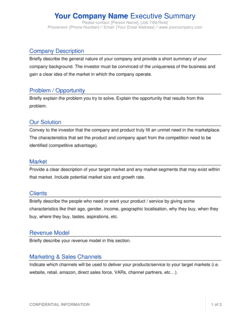
Company overview and mission, problem statement and proposed solution, market size and target customer, competitive landscape and differentiation, business model and revenue streams, management team credentials, financial highlights and projections, and the specific funding ask with intended use of proceeds.

What is an Executive Summary for Investors?

An Executive Summary for Investors is a formal 2–4 page document that presents a concise, structured overview of a company to prospective investors β€” covering the problem being solved, the proposed solution, market size, competitive positioning, business model, management team credentials, financial highlights, and the specific capital being raised with intended use of proceeds. Unlike a casual company overview, an investor-facing executive summary is a disclosure document: it contains forward-looking projections and material business information that may carry legal weight under securities regulations in the jurisdictions where it is distributed. It is typically the first written document an investor reads before deciding whether to request a full business plan or schedule a meeting, which means it must persuade a reader without verbal context or visual presentation aids.

Why You Need This Document

Without a professionally structured executive summary, investor conversations stall at the first written follow-up request. Venture capital firms, angel groups, and institutional lenders routinely ask for a written overview before a meeting is scheduled β€” sending a pitch deck in response signals that you have not prepared for the written stage of the process, and sending a 30-page business plan sends too much too early. A weak or incomplete summary also creates material risk: forward-looking financial projections distributed to investors without legal review can give rise to liability under US securities law, FSMA in the UK, and provincial securities acts in Canada if the figures are misleading or if the distribution constitutes an unlicensed investment promotion. This template gives you a legally structured, investor-ready starting point with the section architecture, sample language, and disclosure framework that sophisticated investors expect β€” cutting your preparation time from days to hours and reducing the legal risk of distributing a document that was never designed for investor scrutiny.

Which variant fits your situation?

If your situation is…Use this template
Raising pre-seed or seed capital from angel investorsExecutive Summary for Investors (Seed Stage)
Submitting a full investor-ready business plan alongside the summaryBusiness Plan
Presenting visually to investors in a meeting settingPitch Deck / Elevator Pitch
Applying for a bank loan or SBA financingBank Loan Business Plan
Providing a one-page snapshot for early-stage ideation or networkingOne-Page Business Plan
Protecting confidential disclosures before sharing financials with investorsNon-Disclosure Agreement (NDA)
Formalizing terms after investor interest is confirmedTerm Sheet

Common mistakes to avoid

❌ Writing the summary before the full business plan

Why it matters: A summary written before the underlying plan is complete will contradict financial figures, market assumptions, or milestone dates once the plan is finalized β€” creating a credibility problem in due diligence.

Fix: Complete the financial model and full business plan first, then distill the executive summary from verified figures and confirmed milestones.

❌ Using a top-down market size with no bottom-up validation

Why it matters: Claiming 1% of a $20B market sounds credible until the investor models the required customer count and finds it exceeds your entire target segment β€” at which point the summary loses credibility entirely.

Fix: Build a bottom-up calculation β€” reachable customers multiplied by average contract value β€” and include both figures in the market section with the variance explained.

❌ Omitting burn rate and runway from the financial highlights

Why it matters: Every investor's first calculation is how long the company survives at current burn. Omitting it signals either that the runway is dangerously short or that the founder does not track it β€” both are disqualifying signals.

Fix: State monthly burn and resulting runway at close explicitly in the financial highlights section, even if the figure is uncomfortable.

❌ Presenting a vague funding ask without use-of-proceeds detail

Why it matters: Asking for $2M with no breakdown tells investors you have not planned capital deployment β€” or that you are concealing an unfavorable allocation such as heavy founder salaries.

Fix: Break the ask into at least four categories with percentage and dollar amounts tied to specific, dated milestones the capital will fund.

❌ Describing the team by title and education rather than achievement

Why it matters: A list of degrees and previous employers without quantified outcomes fails to answer the investor's core question β€” has this team built and exited a business, grown a revenue line, or shipped a product at scale?

Fix: Lead each team member's bio with one quantified achievement directly relevant to the current venture, then add context on prior roles.

❌ Sending the executive summary without a signed NDA in place

Why it matters: An executive summary typically contains financial projections, proprietary market analysis, and product roadmap details. Distributing it without a confidentiality agreement gives recipients no contractual obligation to protect that information.

Fix: Execute a mutual NDA before sending the executive summary to any investor who is not bound by an existing confidentiality obligation, and track every recipient.

The 10 key clauses, explained

Company overview and mission

In plain language: Identifies the legal entity, founding date, headquarters, and a one-to-two sentence mission statement that defines what the company does, for whom, and to what end.

Sample language
[COMPANY NAME], incorporated in [STATE/COUNTRY] in [YEAR] as a [ENTITY TYPE], is a [STAGE] company headquartered in [CITY]. Our mission is to [MISSION STATEMENT] for [TARGET CUSTOMER].

Common mistake: Writing a marketing tagline instead of a mission statement. Investors need a factual description of the business model, not a brand slogan β€” a tagline fails to convey what the company actually does or how it makes money.

Problem statement

In plain language: Articulates the specific, documented pain point or market gap the company addresses, with evidence that the problem is real and significant enough to justify a commercial solution.

Sample language
[TARGET CUSTOMER] currently face [SPECIFIC PROBLEM], resulting in [QUANTIFIED COST OR CONSEQUENCE]. Existing solutions β€” [ALTERNATIVE A] and [ALTERNATIVE B] β€” fail because [SPECIFIC REASON].

Common mistake: Describing a symptom rather than a root problem. Investors who cannot identify the core pain point cannot evaluate whether the proposed solution is defensible or whether the market will pay for it.

Solution and value proposition

In plain language: Describes the product or service, how it solves the stated problem, and what specific outcome it delivers to the customer β€” framed around results rather than features.

Sample language
[PRODUCT/SERVICE NAME] is a [DESCRIPTION] that enables [TARGET CUSTOMER] to [OUTCOME] in [TIMEFRAME], reducing [COST/TIME/RISK] by [X]%.

Common mistake: Listing product features instead of customer outcomes. Investors evaluate whether customers will pay for a result, not whether a feature list is impressive β€” feature-heavy summaries signal a product-first rather than market-first mindset.

Market size and opportunity

In plain language: Quantifies the total addressable market, serviceable addressable market, and the realistic near-term share the company targets, with cited data sources supporting each figure.

Sample language
The global [MARKET] market was valued at $[X]B in [YEAR] (Source: [CITATION]) and is projected to grow at [X]% CAGR through [YEAR]. Our serviceable market β€” [SEGMENT DESCRIPTION] β€” represents approximately $[X]M of near-term opportunity.

Common mistake: Citing a large TAM figure without a bottom-up SAM calculation. Claiming 1% of a $50B market without showing a credible path to that 1% tells investors the founder has not tested the assumption against actual sales capacity.

Competitive landscape and differentiation

In plain language: Identifies direct and indirect competitors, maps their key strengths and limitations, and explains the company's specific, durable advantage that competitors cannot easily replicate.

Sample language
Primary competitors include [COMPETITOR A] (strong in [SEGMENT], weak on [LIMITATION]) and [COMPETITOR B] (priced at $[X]/mo, lacks [FEATURE]). [COMPANY NAME] differentiates through [SPECIFIC ADVANTAGE β€” e.g., proprietary dataset, patent, distribution channel].

Common mistake: Claiming no real competition exists. Every problem has a current solution β€” spreadsheets, manual processes, or an incumbent vendor. Omitting competitors signals poor market awareness and immediately reduces credibility with experienced investors.

Business model and revenue streams

In plain language: Explains how the company generates revenue, including pricing model, average contract value or transaction size, payment terms, and any recurring versus one-time revenue breakdown.

Sample language
[COMPANY NAME] generates revenue through [MODEL β€” e.g., SaaS subscription / transactional / licensing]. Pricing: $[X]/month per seat or $[X] per transaction. Average contract value: $[X]. Recurring revenue as a percentage of total: [X]%.

Common mistake: Omitting average contract value and revenue mix. Without these figures, investors cannot model returns or assess whether the unit economics support the funding ask and projected growth rate.

Traction and milestones

In plain language: Presents the most compelling quantified evidence of market validation β€” revenue, customer count, growth rate, signed LOIs, pilots, or partnerships β€” along with the next key milestones the funding will enable.

Sample language
As of [DATE]: $[X] ARR ([X]% MoM growth), [X] paying customers, [X] signed LOIs totaling $[X]. Key milestones funded by this round: [MILESTONE 1] by [DATE], [MILESTONE 2] by [DATE].

Common mistake: Presenting vanity metrics β€” registered users, app downloads, or social followers β€” instead of revenue or paying-customer counts. Investors discount engagement metrics that do not have a demonstrated path to monetization.

Management team

In plain language: Profiles the founding team and key executives with the single most relevant, quantified achievement for each person, and identifies any material gaps being filled with the current round.

Sample language
[NAME], CEO β€” [X] years in [INDUSTRY]; previously [ROLE] at [COMPANY] where [QUANTIFIED ACHIEVEMENT]. Hiring with this round: VP Sales (Q[X] [YEAR]), Head of Engineering (Q[X] [YEAR]).

Common mistake: Listing titles and alma maters without quantified achievements. An Ivy League degree without a relevant operational track record does not address the investor's core question: has this team built and sold something before?

Financial highlights and projections

In plain language: Summarizes current revenue run rate, gross margin, burn rate, and a three-year revenue projection β€” with Year 1 broken into monthly milestones and Years 2–3 shown annually.

Sample language
Current ARR: $[X]. Gross margin: [X]%. Monthly burn: $[X]. Year 1 projected revenue: $[X]. Year 3 projected revenue: $[X]. EBITDA breakeven: [MONTH/YEAR].

Common mistake: Presenting only upside projections with no burn or runway figures. Investors always calculate how long the company survives at current burn β€” omitting these numbers signals either poor financial literacy or an attempt to obscure a short runway.

Funding ask and use of proceeds

In plain language: States the total capital being raised, the instrument (equity, convertible note, SAFE), the valuation or cap, and how proceeds will be allocated across spending categories with percentage and dollar figures.

Sample language
We are raising $[AMOUNT] via [INSTRUMENT] at a $[X]M [pre-money valuation / valuation cap]. Allocation: [X]% product development ($[X]), [X]% sales and marketing ($[X]), [X]% operations ($[X]), [X]% G&A ($[X]). This capital funds [MILESTONE] by [DATE] and extends runway to [X] months.

Common mistake: Stating a funding amount without breaking it into spending categories tied to outcomes. Investors fund milestones, not burn rates β€” a vague ask signals the founder has not planned the deployment of capital.

How to fill it out

  1. 1

    Complete the company overview and mission

    Enter your legal entity name, incorporation jurisdiction, founding date, headquarters city, and a one-to-two sentence mission statement. The mission should identify what you do, for whom, and to what end β€” not a brand tagline.

    πŸ’‘ Write the company overview section first β€” it anchors the tone and scope of every subsequent section and prevents the summary from drifting in different directions.

  2. 2

    Articulate the problem with quantified evidence

    Describe the specific pain point your target customer faces and support it with a data point β€” a dollar cost, time lost, error rate, or frequency statistic. Cite the source.

    πŸ’‘ One well-sourced statistic on problem severity is worth more than three paragraphs of qualitative description β€” investors evaluate whether the pain is large enough to justify a commercial solution.

  3. 3

    Frame your solution around customer outcomes

    Describe your product or service in terms of the result it delivers to customers β€” time saved, cost reduced, revenue generated β€” not the features it includes. Include a quantified outcome where possible.

    πŸ’‘ Test your solution statement by asking: would a customer pay for this outcome if the product were delivered any way at all? If yes, the framing is market-first.

  4. 4

    Build market size from the bottom up

    Calculate your SAM by counting the number of reachable customers in your target segment and multiplying by average contract value. Then compare to a top-down TAM from a cited market research source. The two figures should land within 30% of each other.

    πŸ’‘ Never rely solely on a top-down percentage-of-market figure. Sophisticated investors immediately build the bottom-up check themselves β€” if your numbers don't hold up, the conversation ends.

  5. 5

    Populate traction metrics with the most recent data

    Enter current ARR or MRR, paying customer count, month-over-month growth rate, and any signed LOIs or pilot agreements. Update these figures immediately before each investor conversation.

    πŸ’‘ Stale traction numbers β€” metrics from three months ago presented as current β€” are noticed immediately in due diligence and raise questions about what changed.

  6. 6

    Summarize the management team with one achievement each

    For each founder or key executive, write one sentence leading with their most relevant, quantified career achievement β€” then their title and company. Identify open roles being filled with the current round.

    πŸ’‘ Cut any credential that doesn't directly support the thesis that this team can execute this specific plan in this specific market.

  7. 7

    Enter financial highlights and the three-year projection

    Include current ARR, gross margin percentage, monthly burn rate, and projected revenue for Years 1–3. Ensure these figures match the financial model exactly β€” any inconsistency between the summary and the model is caught in due diligence.

    πŸ’‘ Include a single-line runway figure β€” 'current burn of $[X]/month; [X] months of runway at close' β€” investors calculate this immediately and appreciate having it stated.

  8. 8

    State the funding ask with milestone-linked use of proceeds

    Enter the raise amount, instrument type, and valuation or cap. Break the use of proceeds into at least four spending categories with dollar amounts and percentage allocations. Tie each category to a specific milestone and date.

    πŸ’‘ End the document with the ask β€” not bury it mid-document. Investors who read to the end are already interested; make the ask easy to find and act on.

Frequently asked questions

What is an executive summary for investors?

An executive summary for investors is a formal 2–4 page document that gives prospective investors a concise, structured overview of your business β€” covering the problem, solution, market opportunity, business model, traction, management team, financial highlights, and funding ask. It is typically the first written document an investor reviews before deciding whether to request a full business plan or schedule a meeting.

How long should an investor executive summary be?

Two to four pages is the accepted standard. Investors who receive longer summaries routinely skip to the financials and funding ask, meaning the detail in pages 5 and beyond is not read. A tight two-page summary with clear section headings and quantified data points communicates more effectively than a six-page narrative.

What is the difference between an executive summary and a pitch deck?

A pitch deck is a visual, slide-based tool designed for a live 20-minute presentation. An executive summary is a written document sent before a meeting or in response to a request for written information. The deck generates the meeting; the executive summary is read at the investor's desk, often without you present, and must stand alone without verbal explanation.

Should an executive summary be signed?

Yes β€” when used as a formal investor disclosure document accompanying a funding round, the executive summary should be signed by authorized representatives of the company to confirm the accuracy of the information presented and to create an accountable record. This is particularly important when the document contains financial projections or material business information that could give rise to securities law obligations.

Do I need an NDA before sending an executive summary to investors?

It is generally advisable to execute a mutual NDA before sending an executive summary that contains non-public financial data, proprietary market analysis, or product roadmap details. Many venture capital firms decline to sign NDAs at the initial outreach stage, so founders must balance protection with the friction cost of requiring one. At minimum, track every recipient and consider what information you include based on whether the investor has signed a confidentiality agreement.

What financial information should appear in an investor executive summary?

Include current ARR or MRR, gross margin percentage, monthly burn rate, runway at close, and a three-year revenue projection with Year 1 broken into quarterly milestones. Do not include full three-statement financials in the summary β€” those belong in the business plan or data room. The summary should give investors enough to evaluate whether the financial profile warrants a deeper look.

What is the best order to write an executive summary?

Write the executive summary last β€” after the full business plan and financial model are complete. The summary must accurately reflect figures and milestones in the underlying documents. Founders who write the summary first frequently produce documents that contradict their own financial model, a discrepancy investors catch immediately during due diligence.

Is an executive summary the same as a business plan?

No. A business plan is a full 20–35 page document covering every material aspect of the business with detailed financial statements, market research, and operational plans. An executive summary is a 2–4 page distillation designed to capture investor interest and prompt a request for the full plan. The summary should be compelling enough to stand alone but structured to make investors want to read more.

What are the most common reasons investors reject an executive summary?

The four most common rejection triggers are: a market size claim with no bottom-up validation, traction metrics that are vanity figures with no revenue path, a management team section listing degrees without operational achievements, and a vague funding ask with no use-of-proceeds breakdown. Any one of these signals a founder who has not stress-tested the core assumptions of the business.

How this compares to alternatives

vs Business Plan

A business plan is a full 20–35 page document with detailed financial statements, market research, and operational plans. An executive summary is a 2–4 page distillation of that plan designed to generate investor interest before the full document is shared. The executive summary should be written after the business plan is complete so the figures align precisely.

vs Pitch Deck

A pitch deck is a visual, slide-based presentation tool built for a live 20-minute investor meeting. An executive summary is a written document read independently, often before any meeting is scheduled. The deck drives engagement in the room; the executive summary must persuade a reader who has no visual or verbal cues to anchor the message.

vs One-Page Business Plan

A one-page plan is an internal alignment or early-ideation tool that captures the key hypotheses of a business model. It lacks the financial detail, traction data, and formal funding ask that investors require. An executive summary for investors is a formal disclosure document β€” two to four times longer and structured for external capital-raising, not internal planning.

vs Term Sheet

A term sheet is the document that comes after investor interest is confirmed β€” it sets out the proposed economic and governance terms of the investment. An executive summary is the document that creates that interest in the first place. The executive summary opens the conversation; the term sheet structures the deal once both parties agree to proceed.

Industry-specific considerations

SaaS / Technology

MRR, ARR, churn rate, CAC payback, and net revenue retention metrics are expected by default; infrastructure cost and gross margin visibility are closely scrutinized.

Healthcare / MedTech

Regulatory pathway status β€” FDA clearance stage, CE mark, or IRB approval β€” and reimbursement code strategy must be addressed alongside the standard financial summary.

Consumer Goods / E-commerce

Average order value, repeat purchase rate, customer acquisition cost by channel, and contribution margin per unit replace SaaS-style metrics in the financial highlights section.

Professional Services

Billable utilization rate, revenue per employee, client concentration risk, and pipeline visibility are the metrics investors use to evaluate scalability and defensibility.

Manufacturing

Gross margin by product line, inventory turnover, capex requirements, and supply chain concentration risk must be addressed in both the business model and financial highlights sections.

Fintech / Financial Services

Regulatory licensing status, compliance cost structure, AUM or transaction volume, and any banking-partner dependencies are material disclosures investors require before advancing to due diligence.

Jurisdictional notes

United States

An executive summary distributed to prospective investors may constitute a general solicitation under SEC Regulation D. Founders raising under Rule 506(b) must avoid general solicitation and distribute only to pre-existing relationships. Under Rule 506(c), general solicitation is permitted but all investors must be verified accredited investors. Material misstatements or omissions in a document presented to investors can give rise to liability under Section 10(b) of the Securities Exchange Act β€” have legal counsel review any forward-looking projections before distribution.

Canada

Securities regulation in Canada is provincial. Distribution of an executive summary to prospective investors may trigger prospectus requirements under provincial securities acts unless an exemption applies β€” most commonly the accredited investor exemption or the friends, family, and business associates exemption. Ontario, British Columbia, and Alberta each have specific filing and disclosure obligations under these exemptions. Engage securities counsel familiar with the applicable province before distributing.

United Kingdom

Under the Financial Services and Markets Act 2000 (FSMA), communicating an investment promotion to UK investors must be approved by an FCA-authorized person unless an exemption applies β€” typically the high-net-worth individual or sophisticated investor exemption. An executive summary containing financial projections and a funding ask is likely to constitute a financial promotion. Distributing without proper authorization or a valid exemption carries criminal penalties. Post-Brexit, UK rules are independent of EU prospectus regulations.

European Union

Under the EU Prospectus Regulation, public offers of securities above €8M require a full FCA or national regulator-approved prospectus. Offers below this threshold may qualify for national exemptions, but the threshold and conditions vary by member state. France, Germany, and the Netherlands each maintain distinct exemption frameworks. GDPR obligations apply when personal data of investors or team members appears in the document β€” ensure any personal information in the management team section complies with applicable data protection law.

Template vs lawyer β€” what fits your deal?

PathBest forCostTime
Use the templateFounders raising pre-seed or seed capital from angel investors or early-stage fundsFree4–8 hours
Template + legal reviewRaises above $250K, documents containing forward-looking financial projections, or distribution to multiple unrelated investors$300–$800 for a securities attorney review2–5 business days
Custom draftedRegulated industries, cross-border capital raises, or Series A and above where securities disclosure obligations are material$1,500–$5,000+1–3 weeks

Glossary

Executive Summary
A 2–4 page written overview of a business intended to give investors or lenders enough information to decide whether to request the full business plan.
Funding Ask
The specific dollar amount of capital being sought from investors, including the instrument β€” equity, convertible note, or SAFE β€” and intended use of proceeds.
Use of Proceeds
A breakdown of how raised capital will be allocated across categories such as product development, sales and marketing, operations, and general and administrative costs.
SAFE (Simple Agreement for Future Equity)
A financing instrument that allows investors to provide capital now in exchange for the right to receive equity at a future priced round, without setting a current valuation.
Convertible Note
A short-term debt instrument that converts to equity at a future financing round, typically at a discount to the round price or subject to a valuation cap.
Valuation Cap
The maximum company valuation at which a convertible note or SAFE converts into equity, protecting early investors from excessive dilution in a high-valuation round.
TAM (Total Addressable Market)
The total global or national revenue opportunity for a product or service if it achieved 100% market share β€” used to size the opportunity for investors.
Unit Economics
Revenue and cost metrics at the level of a single customer transaction, including customer acquisition cost (CAC), lifetime value (LTV), and gross margin.
Due Diligence
The investigative process investors undertake after expressing interest β€” reviewing financials, legal structure, IP, contracts, and team β€” before committing capital.
Pre-Money Valuation
The agreed value of a company immediately before a new investment round is closed, used to calculate how much equity investors receive for their capital.
Traction
Measurable evidence of market demand β€” revenue, user growth, signed contracts, partnerships, or pilot results β€” that validates the business model to investors.

Part of your Business Operating System

This document is one of 3,000+ business & legal templates included in Business in a Box.

  • Fill-in-the-blanks β€” ready in minutes
  • 100% customizable Word document
  • Compatible with all office suites
  • Export to PDF and share electronically

Create your document in 3 simple steps.

From template to signed document β€” all inside one Business Operating System.
1
Download or open template

Access over 3,000+ business and legal templates for any business task, project or initiative.

2
Edit and fill in the blanks with AI

Customize your ready-made business document template and save it in the cloud.

3
Save, Share, Send, Sign

Share your files and folders with your team. Create a space of seamless collaboration.

Save time, save money, and create top-quality documents.

β˜…β˜…β˜…β˜…β˜…

"Fantastic value! I'm not sure how I'd do without it. It's worth its weight in gold and paid back for itself many times."

Managing Director Β· Mall Farm
Robert Whalley
Managing Director, Mall Farm Proprietary Limited
β˜…β˜…β˜…β˜…β˜…

"I have been using Business in a Box for years. It has been the most useful source of templates I have encountered. I recommend it to anyone."

Business Owner Β· 4+ years
Dr Michael John Freestone
Business Owner
β˜…β˜…β˜…β˜…β˜…

"It has been a life saver so many times I have lost count. Business in a Box has saved me so much time and as you know, time is money."

Owner Β· Upstate Web
David G. Moore Jr.
Owner, Upstate Web

Run your business with a system β€” not scattered tools

Stop downloading documents. Start operating with clarity. Business in a Box gives you the Business Operating System used by over 250,000 companies worldwide to structure, run, and grow their business.

Free Forever PlanΒ Β·Β No credit card required