How To Write A Compelling Sales Page That Converts

Free Word download β€’ Edit online β€’ Save & share with Drive β€’ Export to PDF

7 pagesβ€’20–30 min to fillβ€’Difficulty: Standard
Learn more ↓
FreeHow To Write A Compelling Sales Page That Converts Template

At a glance

What it is
A sales page is a structured written document designed to persuade a specific reader to take one defined action β€” buy a product, book a call, or sign up for a service. This free Word download gives you a proven section-by-section framework you can edit online and export as a PDF or paste directly into your website builder, covering everything from the headline to the closing call to action.
When you need it
Use it when launching a new product or service, setting up a standalone offer page, or replacing a weak landing page that generates traffic but fails to convert visitors into buyers or leads.
What's inside
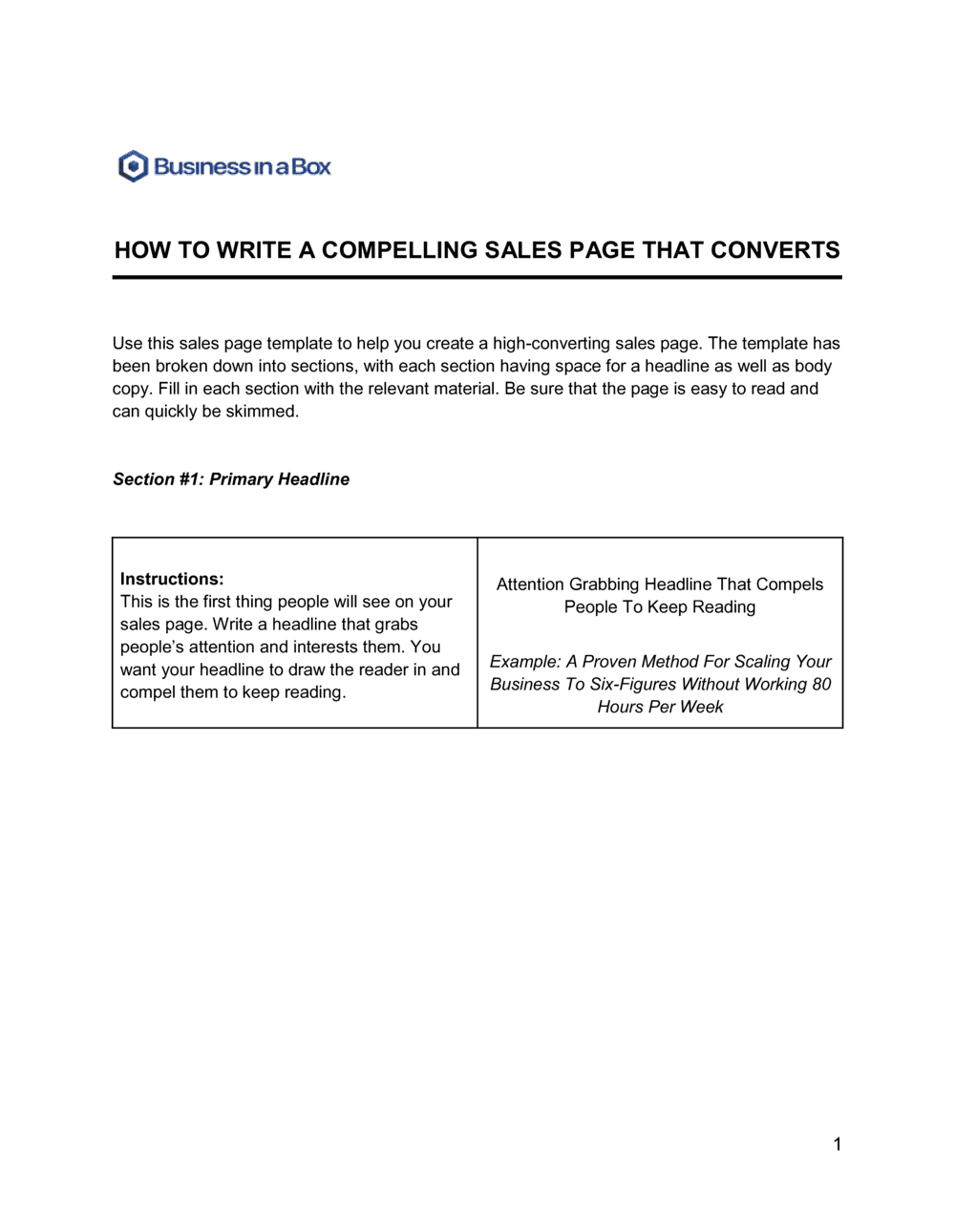
Attention-grabbing headline, problem and empathy statement, offer description with benefits and features, social proof section, objection handling, pricing and guarantee, and a clear call-to-action block β€” all arranged in a sequence tested against buyer psychology.

What is a Sales Page?

A sales page is a structured, conversion-focused document designed to move a specific reader from awareness of their problem to a confident purchase decision β€” without a salesperson involved. Unlike a general website page, every section of a sales page is arranged in a deliberate sequence: establish relevance with a strong headline, build trust through empathy and proof, present the offer with clarity, eliminate hesitation through objection handling, and close with a single unambiguous call to action. This free Word template gives you a battle-tested section-by-section framework you can complete in an afternoon and deploy on any website builder, email funnel, or PDF proposal.

Why You Need This Document

A weak or missing sales page is the most common reason a business generates traffic but not revenue. When a visitor lands on a page that opens with a company name, lists features without outcomes, buries the price, and ends with a vague "Contact us," they leave β€” and they rarely come back. The cost is concrete: paid ad spend that produces clicks but no sales, a warm email list that opens but doesn't buy, and a product that the market wants but the page fails to sell. A properly structured sales page addresses every objection a motivated buyer carries before they ever ask it, presents pricing with enough context to feel like a fair exchange, and removes the friction between interest and action. This template gives you the exact structure that converts, so you can stop guessing at what your page is missing and start filling in the sections that close sales.

Which variant fits your situation?

If your situation is…Use this template
Selling a high-ticket coaching or consulting packageLong-Form Sales Page (Application Funnel)
Launching a digital product or online courseCourse Launch Sales Page
Running a limited-time promotional offerSales Page with Countdown Timer Block
Collecting leads before a product launchOpt-In Landing Page Template
Selling a SaaS free trial or paid plan upgradeSaaS Pricing Page Template
Promoting a live webinar or virtual eventWebinar Registration Page Template
Presenting a service-based business offer to cold trafficService Sales Page Template

Common mistakes to avoid

❌ Leading with the product name instead of the outcome

Why it matters: Cold visitors have no attachment to your brand name. A headline that leads with your product name forces the reader to do the work of figuring out whether it's relevant to them β€” most won't.

Fix: Rewrite the headline to state the specific result the buyer gets and who it is for. Save the product name for the second or third line.

❌ Using testimonials without specifics or attribution

Why it matters: Vague quotes like 'Highly recommend!' or 'Game changer!' are treated as filler by skeptical readers and can actually reduce credibility by looking fabricated.

Fix: Use only testimonials that include a measurable result, a full name, and a role or location. If you don't have strong testimonials yet, gather them before launching the page.

❌ Burying or omitting the price

Why it matters: Readers who have to hunt for the price assume it's too high and leave. Price transparency signals confidence in the value of the offer.

Fix: State the price clearly at least twice β€” once in the offer stack section and again in the closing CTA block. Pair each price mention with the strongest benefit statement.

❌ Writing a generic guarantee with no conditions

Why it matters: A vague 'satisfaction guaranteed' reads as a legal disclaimer, not a real commitment. It provides no psychological safety for the buyer and adds nothing to conversion.

Fix: Replace vague language with specific terms: refund window in days, what the buyer must do to claim it, and how they contact you. Specificity signals genuine confidence in the offer.

❌ Placing a single CTA only at the bottom of the page

Why it matters: Visitors who are ready to buy mid-page will not always scroll to the bottom. Every missed CTA placement is a lost conversion.

Fix: Add a CTA after the hero block, after the benefits section, and again in the closing block. For pages taller than five screens, add a sticky header or floating button.

❌ Skipping the objection handling section entirely

Why it matters: Every reader who closes the page without buying has at least one unanswered objection. Leaving objections unaddressed guarantees that a predictable percentage of interested readers will not convert.

Fix: Interview three to five recent buyers and ask what almost stopped them from purchasing. Use their exact language to write four to eight FAQ entries that address those hesitations directly.

The 9 key sections, explained

Headline and hero block

Problem and empathy statement

Solution introduction and credibility hook

Benefits and features breakdown

Social proof and testimonials

Offer stack and pricing

Guarantee and risk reversal

Objection handling (FAQ block)

Call to action and closing

How to fill it out

  1. 1

    Define the single desired action

    Before writing a word, decide what one action you want the reader to take β€” buy, book, or sign up. Every section of the page should point toward that single action. A page that offers two choices converts at half the rate of one that offers one.

    πŸ’‘ Write the CTA button text first. If you can't describe the action in three words, your offer isn't clear enough yet.

  2. 2

    Write the problem section using the reader's own words

    Pull exact phrases from customer reviews, support tickets, forum posts, or sales call notes. The problem section should read like the reader wrote it themselves β€” because the language came from people exactly like them.

    πŸ’‘ Read your problem copy out loud. If it sounds like marketing, rewrite it until it sounds like a frustrated person venting to a friend.

  3. 3

    Craft a headline that names the outcome and the audience

    Test at least three headline formulas: outcome + audience, problem + solution, and before/after contrast. Choose the one that a cold visitor β€” someone who has never heard of you β€” would immediately understand without any context.

    πŸ’‘ The [OUTCOME] for [AUDIENCE] without [PAIN POINT] formula works for most offers and can be drafted in under five minutes once you know your value proposition.

  4. 4

    Build the benefits list from customer outcomes, not features

    Take each feature of your offer and complete the sentence: 'Which means you'll be able to...' That completion is your benefit bullet. Pair each benefit with the feature that delivers it in parentheses or as a sub-bullet.

    πŸ’‘ Aim for six to ten benefit bullets. Fewer than six feels thin; more than twelve creates decision fatigue.

  5. 5

    Select three to six testimonials that handle specific objections

    Map your best testimonials to your three biggest objections β€” price, effort, and fit. Choose one testimonial per objection that directly addresses it with a named, specific result. Place them near the section most relevant to the objection they address.

    πŸ’‘ A testimonial with a full name, photo, and company or city converts at significantly higher rates than an anonymous quote or initials.

  6. 6

    State the price with an anchor and a payment option

    Show the total value of all included components before revealing the price. If you offer a payment plan, present it as '[X] payments of $[Y]' β€” monthly installment framing consistently outperforms a lump-sum price for offers above $300.

    πŸ’‘ Never make the reader scroll back up to find the price again. Include the price and CTA at least twice on any page taller than three screens.

  7. 7

    Write the guarantee with exact terms and conditions

    State the refund window in days, what the buyer needs to do to qualify, and what they get back. Specific guarantees outperform vague ones because they signal that the seller has confidence in the outcome.

    πŸ’‘ A 30-day money-back guarantee with a simple email process converts better than a 60-day guarantee with a complicated request form.

  8. 8

    Review and cut every sentence that serves the seller, not the reader

    Read the full page and flag every sentence that starts with 'I,' 'We,' or the company name. Rewrite each one to center the reader's outcome. Sales copy that talks about the seller rather than the buyer consistently underperforms.

    πŸ’‘ The ratio of 'you/your' to 'I/we' on a high-converting page is typically 3:1 or higher. Count yours before publishing.

Frequently asked questions

What is a sales page?

A sales page is a standalone web page or document written with a single goal: to persuade a specific reader to take one defined action, such as purchasing a product, booking a discovery call, or enrolling in a course. Unlike a general website page, every section of a sales page is sequenced to move the reader through awareness of their problem, recognition of the solution, and confidence in the seller β€” ending with a clear call to action.

How is a sales page different from a landing page?

A landing page is any page a visitor lands on from an ad, email, or search result β€” it could be a lead capture page, a thank-you page, or a sales page. A sales page is specifically designed to convert a visitor into a buyer or qualified applicant. All sales pages are landing pages, but not all landing pages are sales pages. The distinction matters for copywriting: lead capture pages are short and low-commitment; sales pages are longer and designed to handle objections fully before asking for a purchase decision.

How long should a sales page be?

Length should match the price and complexity of the offer, not a word-count target. Low-priced impulse purchases ($20–$50) convert well on short pages of 500–800 words. Mid-tier offers ($200–$1,000) typically need 1,200–2,500 words to build sufficient trust. High-ticket offers ($2,000+) often require 3,000–5,000 words or more because the reader's risk threshold is higher and more objections need to be addressed. A page should be exactly as long as it takes to answer every question a motivated buyer would ask.

What is the most important section of a sales page?

The headline is the single most important element β€” it determines whether the visitor reads anything else. If the headline does not immediately communicate a relevant outcome for the right audience, the rest of the page is never seen. After the headline, the problem section and social proof carry the most weight in moving an undecided reader toward purchase.

Do I need to include a price on my sales page?

Yes, in almost every case. Hiding or omitting the price on a sales page increases visitor drop-off because readers assume the price is too high to state openly. Price transparency signals confidence. The only exception is a high-ticket application funnel where the price is discussed on a sales call β€” in that case, the page's goal is to generate a qualified application, not a direct purchase.

What makes a sales page convert well?

The highest-converting sales pages share five characteristics: a headline that names the outcome and audience, a problem section written in the reader's own language, specific testimonials with named results, a clear and anchored price with a risk-reversal guarantee, and a closing CTA that restates the core transformation. Conversion rates also improve when the page is written for one specific audience segment rather than trying to appeal to everyone.

Can I use this template for a physical product or only for digital offers?

The template works for any offer type β€” physical products, digital downloads, services, software subscriptions, courses, coaching programs, and events. The sections remain the same; what changes is the language in the benefits block (shipping and handling for physical products, access and format for digital), the guarantee terms, and the specifics of the social proof. The underlying persuasion sequence is the same regardless of product type.

How do I know if my sales page is performing well?

The primary metric is conversion rate: unique visitors divided by completed purchases or form submissions. Industry benchmarks vary widely β€” cold traffic (paid ads) typically converts at 1–3%, while warm traffic (email list) converts at 3–10% for mid-priced offers. If your page is generating traffic but converting below 1%, test the headline and price presentation first β€” these two elements account for the majority of conversion variance.

Should I hire a copywriter or use a template?

For most small businesses, service providers, and first-time course launches, a structured template produces a working sales page faster and at lower cost than hiring a copywriter. Hire a professional copywriter when the offer price justifies the investment (typically $5,000+ in expected revenue), when you are running significant paid traffic to a page that needs to be optimized from day one, or when previous pages have failed and you need a diagnosed fix.

How this compares to alternatives

vs Marketing Plan

A marketing plan defines the strategy, channels, budget, and timeline for promoting a product or service over a period of time. A sales page is a single execution artifact β€” one conversion-focused document within that broader strategy. The marketing plan tells you where and how to drive traffic; the sales page converts that traffic into buyers.

vs Product Launch Plan

A product launch plan coordinates the full sequence of pre-launch, launch, and post-launch activities β€” emails, social posts, ads, and PR. The sales page is the destination that all of those activities point toward. You need both: the launch plan drives traffic; the sales page converts it.

vs Business Proposal

A business proposal is a customized document sent to a specific prospect to outline a solution, scope, and price for their particular situation. A sales page is a one-to-many document written for a defined audience segment and published publicly. Proposals close individual deals; sales pages scale conversions without one-on-one selling effort.

vs Email Marketing Campaign Template

An email marketing campaign drives a warm audience to take action through a sequence of messages. A sales page is the destination those emails link to β€” the place where the final conversion decision is made. High-performing campaigns combine both: emails build urgency and context; the sales page handles objections and closes the sale.

Industry-specific considerations

E-learning and online education

Course enrollment pages require a curriculum breakdown as the offer stack, outcome-focused testimonials from graduates, and a clear module-by-module benefits structure.

Professional services

Service sales pages replace or supplement the discovery call by addressing scope, process, pricing, and typical client outcomes before the prospect picks up the phone.

SaaS and software

Pricing and upgrade pages function as sales pages with a features-versus-benefits table, a free-trial guarantee, and plan-comparison anchoring to drive upsells.

Retail and e-commerce

Standalone product sales pages for hero SKUs outperform standard product listings by adding problem framing, use-case scenarios, and customer photo testimonials.

Template vs pro β€” what fits your needs?

PathBest forCostTime
Use the templateCoaches, course creators, freelancers, and small business owners launching an offer without a dedicated marketing teamFree3–6 hours for a first draft
Template + professional reviewBusiness owners spending $500+ per month on paid traffic to the page, or anyone whose previous page converted below 1%$300–$1,500 for a copywriter review and rewrite of key sections3–5 business days
Custom draftedHigh-ticket offers above $3,000, large product launches with significant ad spend, or brands that need full A/B testing and funnel optimization$2,000–$10,000+ for a full sales page from a professional direct-response copywriter2–4 weeks

Glossary

Above the Fold
The portion of a web page visible without scrolling β€” the first 600–800 pixels that determine whether a visitor keeps reading or leaves.
Call to Action (CTA)
A specific instruction that tells the reader exactly what to do next, such as 'Buy Now,' 'Book a Free Call,' or 'Start Your Free Trial.'
Value Proposition
A single, clear statement explaining what the offer delivers, for whom, and why it is better than the alternatives.
Social Proof
Evidence from third parties β€” testimonials, case studies, star ratings, or logos β€” that validates the seller's claims.
Objection Handling
Copy that anticipates and addresses the most common reasons a reader would hesitate to buy, before they have a chance to close the tab.
Conversion Rate
The percentage of page visitors who complete the desired action, calculated as conversions divided by total unique visitors.
Guarantee
A risk-reversal statement β€” typically a money-back period β€” that shifts the perceived risk from buyer to seller and lowers the barrier to purchase.
Hero Section
The top block of a sales page containing the headline, subheadline, and primary CTA β€” the first thing every visitor sees.
Benefit vs. Feature
A feature describes what a product does; a benefit describes the outcome it produces for the buyer. High-converting pages lead with benefits.
Urgency and Scarcity
Truthful triggers β€” a closing deadline, limited seats, or a price increase β€” that give a reader a concrete reason to act now rather than later.

Part of your Business Operating System

This document is one of 3,000+ business & legal templates included in Business in a Box.

  • Fill-in-the-blanks β€” ready in minutes
  • 100% customizable Word document
  • Compatible with all office suites
  • Export to PDF and share electronically

Create your document in 3 simple steps.

From template to signed document β€” all inside one Business Operating System.
1
Download or open template

Access over 3,000+ business and legal templates for any business task, project or initiative.

2
Edit and fill in the blanks with AI

Customize your ready-made business document template and save it in the cloud.

3
Save, Share, Send, Sign

Share your files and folders with your team. Create a space of seamless collaboration.

Save time, save money, and create top-quality documents.

β˜…β˜…β˜…β˜…β˜…

"Fantastic value! I'm not sure how I'd do without it. It's worth its weight in gold and paid back for itself many times."

Managing Director Β· Mall Farm
Robert Whalley
Managing Director, Mall Farm Proprietary Limited
β˜…β˜…β˜…β˜…β˜…

"I have been using Business in a Box for years. It has been the most useful source of templates I have encountered. I recommend it to anyone."

Business Owner Β· 4+ years
Dr Michael John Freestone
Business Owner
β˜…β˜…β˜…β˜…β˜…

"It has been a life saver so many times I have lost count. Business in a Box has saved me so much time and as you know, time is money."

Owner Β· Upstate Web
David G. Moore Jr.
Owner, Upstate Web

Run your business with a system β€” not scattered tools

Stop downloading documents. Start operating with clarity. Business in a Box gives you the Business Operating System used by over 250,000 companies worldwide to structure, run, and grow their business.

Start freeΒ Β·Β No credit card required