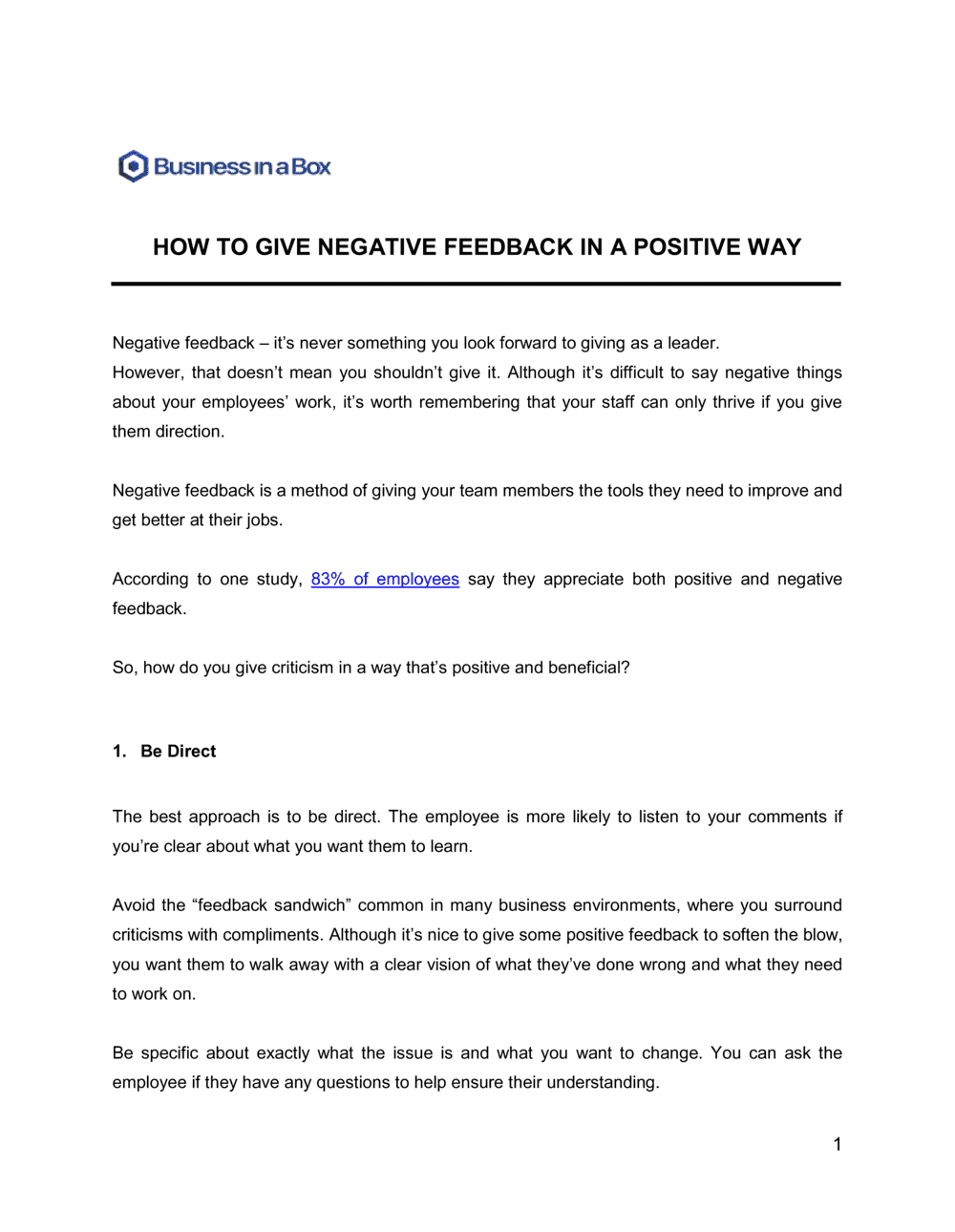
How To Give Negative Feedback In A Positive Way

Free to read β€’ Save or share with one click

FreeHow To Give Negative Feedback In A Positive Way Template

At a glance

What it is
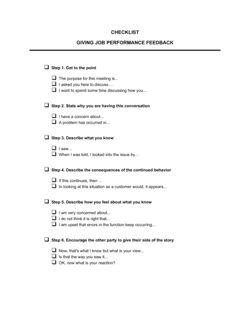
How To Give Negative Feedback In A Positive Way is a structured guide and fillable Word template that helps managers, team leads, and HR professionals deliver critical performance feedback in a way that motivates improvement rather than triggering defensiveness. This free Word download gives you a step-by-step framework β€” observation, impact, expectation, and support β€” that you can edit online and export as PDF for use in one-on-one meetings, performance reviews, or coaching sessions.
When you need it
Use it whenever you need to address a recurring performance gap, behavioral issue, or missed expectation with a team member β€” especially when the conversation carries emotional risk or has already been deferred too long. It is equally useful as preparation for formal performance reviews and for informal check-in conversations before problems escalate.
What's inside
The template includes sections for documenting specific observations, articulating business impact, stating the desired behavior change, agreeing on a support plan, and setting a follow-up timeline. It also includes framing language to open and close the conversation constructively, and a manager preparation checklist to reduce the risk of common delivery errors.

What is a How To Give Negative Feedback In A Positive Way Template?

A How To Give Negative Feedback In A Positive Way template is a structured operational guide that helps managers, team leads, and HR professionals plan and deliver corrective feedback conversations using a proven behavioral framework. Rather than leaving the conversation to improvisation β€” where discomfort tends to produce either excessive softening or unintended harshness β€” the template walks the feedback giver through preparation, observation framing, impact articulation, employee response, expectation setting, support planning, and follow-up scheduling. The result is a repeatable, documentable process that gives employees the clarity they need to change specific behaviors and gives managers a defensible record of the conversation if escalation becomes necessary.

Why You Need This Document

Avoided or poorly delivered corrective feedback is one of the most expensive operational failures a manager can make. Employees who never receive specific, actionable feedback on underperformance do not self-correct β€” they repeat the behavior, normalize it, and often become frustrated when consequences arrive without warning. Meanwhile, managers who deliver feedback without a framework frequently damage trust through vague criticism, unintentional character attacks, or sandwiched messages that obscure the real concern. The downstream costs are concrete: missed performance targets, team friction, avoidable turnover, and formal disciplinary processes that could have been prevented with a single well-structured 20-minute conversation. This template eliminates the preparation gap that causes most feedback conversations to go wrong β€” giving you a script, a checklist, and a follow-up structure so that difficult conversations produce the outcomes they are supposed to.

Which variant fits your situation?

If your situation is…Use this template
Addressing a one-time mistake or lapse in judgmentHow To Give Negative Feedback In A Positive Way
Documenting a pattern of underperformance over timePerformance Improvement Plan (PIP)
Conducting a structured annual or mid-year reviewEmployee Performance Review Template
Setting goals and expectations at the start of a new role or periodEmployee Goals and Objectives Template
Documenting a verbal warning before escalating to written disciplineEmployee Warning Letter
Giving positive reinforcement and recognition to high performersEmployee Recognition Letter
Gathering 360-degree input before a feedback conversation360-Degree Feedback Template

Common mistakes to avoid

❌ Using the feedback sandwich

Why it matters: Wrapping critical feedback between two positives trains employees to tune out praise as filler and muddies the core message. Research consistently shows recipients retain the positives and discount or forget the criticism.

Fix: Lead with a neutral, direct opening that names the purpose of the conversation. Save genuine recognition for a separate conversation where it can land with full weight.

❌ Waiting too long to deliver the feedback

Why it matters: Feedback delivered weeks after the behavior loses specificity, allows the problem to compound, and signals to the employee that performance standards are negotiable.

Fix: Aim to deliver constructive feedback within 48 to 72 hours of the triggering event, once you have moved past any initial emotional reaction.

❌ Describing personality instead of behavior

Why it matters: Telling an employee they are 'unprofessional' or 'difficult' provokes defensiveness and gives them nothing actionable to change. It also creates legal exposure if it ever becomes part of a dismissal record.

Fix: Replace every trait label with a specific observable behavior: 'In the last two team meetings, you interrupted colleagues three times before they finished their sentences' is addressable; 'you're dismissive' is not.

❌ Skipping the employee response prompt

Why it matters: Delivering feedback without inviting a response positions the manager as judge rather than coach β€” reducing trust, limiting information, and making the employee less likely to commit to change.

Fix: After presenting your observation and impact, pause and ask a specific open question: 'What was your experience of that situation?' Then listen without interrupting.

❌ No follow-up checkpoint scheduled

Why it matters: Without a defined accountability structure, most behavior-change commitments fade within two to three weeks and the manager must restart the entire conversation from scratch.

Fix: End every corrective feedback conversation by scheduling a specific follow-up date before the employee leaves the room. Add it to the calendar immediately.

❌ Delivering feedback in a group setting or over email

Why it matters: Public criticism humiliates the employee in front of peers, destroying psychological safety for the entire team. Written-only feedback removes tone, invites misreading, and bypasses the two-way dialogue that makes behavior change stick.

Fix: Always deliver corrective feedback in private, in real time (or video call for remote teams), and follow it with a written summary sent to the employee after the conversation β€” not instead of it.

The 9 key sections, explained

Manager preparation checklist

Opening statement

Observation statement (Situation and Behavior)

Impact statement

Employee response space

Expectation statement

Support and resources plan

Agreed action summary

Follow-up checkpoint

How to fill it out

  1. 1

    Complete the preparation checklist before the meeting

    Work through every item on the manager preparation checklist β€” confirm you have specific dated examples, that you've chosen a private setting, and that you're approaching the conversation from a calm, factual position rather than from frustration.

    πŸ’‘ If you identified the issue in the last 24 hours and are still emotionally activated, delay the conversation by one business day rather than delivering feedback you'll later need to walk back.

  2. 2

    Draft your observation statement with specific dates and behaviors

    Fill in the observation section using the SBI framework: the specific situation (when, where), the observable behavior (what the person did or did not do), and nothing else β€” no interpretation, no motive attribution.

    πŸ’‘ Aim for two to three concrete examples rather than one. A pattern is harder to dispute than a single incident and signals that the conversation is about a real trend.

  3. 3

    Write out the business impact in concrete terms

    Describe the specific consequence to the team, project, client, or business outcome. Use numbers where available β€” missed by two days, cost the team three hours of rework, generated one client complaint.

    πŸ’‘ If you cannot articulate a real impact, reconsider whether the issue is significant enough to address formally or whether it warrants an informal comment instead.

  4. 4

    Prepare your opening and the employee response prompt

    Write out your opening statement so it is neutral and inviting rather than accusatory. Prepare the specific question you will ask to invite the employee's perspective after you present the observation and impact.

    πŸ’‘ Practicing the opening aloud for 60 seconds before the meeting dramatically reduces the chance of an unintentional tone that puts the employee immediately on the defensive.

  5. 5

    State the expectation in measurable behavioral terms

    Complete the expectation statement using a specific, observable behavior and a timeframe where possible. Avoid adjectives β€” 'submit all client deliverables by the agreed deadline or flag risks 24 hours in advance' is better than 'be more reliable.'

    πŸ’‘ Ask yourself: if the employee followed this instruction perfectly, would I be able to observe it? If not, make the expectation more specific.

  6. 6

    Identify and document your support commitment

    Fill in at least one concrete action you will take to help the employee succeed β€” a weekly check-in, access to training, a reduced workload for a defined period, or a peer mentor pairing.

    πŸ’‘ Tie the support plan directly to the identified root cause. If the issue stems from unclear instructions, the support is clearer briefing β€” not generic coaching.

  7. 7

    Schedule the follow-up checkpoint before ending the meeting

    Before closing, agree on a specific follow-up date and format β€” a 15-minute calendar invite is more credible than a vague 'we'll check in soon.' Enter the date in the template and confirm it with the employee in the room.

    πŸ’‘ A two-week follow-up is the optimal default for most corrective feedback conversations β€” long enough to show meaningful change, short enough to catch a problem before it compounds.

Frequently asked questions

What is the best way to give negative feedback to an employee?

The most effective method is to focus on specific observable behaviors and their concrete impact rather than personality or character. Use a structured framework β€” such as Situation, Behavior, Impact β€” to keep the conversation factual and forward-looking. Invite the employee's perspective before stating what you expect going forward, and always end with a defined support plan and a scheduled follow-up date.

Why is giving negative feedback important for managers?

Avoiding difficult feedback does not make performance problems disappear β€” it allows them to compound until they require formal disciplinary action. Timely, specific constructive feedback is one of the most direct tools a manager has to improve team performance, reduce turnover from unresolved frustration, and build a culture where honest communication is normal. Employees who never receive corrective feedback also rarely improve, and often leave when they finally do receive it because the gap feels insurmountable.

How do you give negative feedback without hurting someone's feelings?

The goal is not to avoid discomfort entirely β€” some discomfort signals that the message has landed. The goal is to ensure the discomfort is productive rather than demoralizing. Address the behavior, not the person. Use specific examples rather than generalizations. Acknowledge the employee's effort and context before stating the expectation. And make clear that the conversation is motivated by your investment in their success, not frustration or judgment.

What is the SBI feedback model?

SBI stands for Situation, Behavior, Impact. It is a three-part feedback structure developed by the Center for Creative Leadership. You describe the specific situation in which the behavior occurred, the observable behavior itself, and the impact that behavior had on the team or outcome. The model keeps feedback grounded in facts rather than interpretations, which reduces defensiveness and makes the message more actionable.

How often should managers give constructive feedback?

Constructive feedback should be given as close as possible to the triggering behavior β€” typically within 48 to 72 hours. Waiting for the annual performance review to surface corrective feedback is one of the most common management failures. For ongoing performance concerns, monthly one-on-ones provide a regular cadence where smaller corrections can be addressed before they become formal issues. Most employees in surveys report wanting more feedback, not less.

Should negative feedback always be given in private?

Yes. Corrective feedback delivered in front of colleagues is humiliating regardless of how carefully it is worded. Public criticism damages psychological safety across the entire team, not just for the individual. The only exception is a coaching moment directly observed in a live client or team setting β€” and even then, the substantive feedback should always be followed up privately.

What is the difference between constructive feedback and a performance improvement plan?

Constructive feedback is a conversation β€” typically informal or semi-structured β€” addressing a specific behavior or instance before it reaches a formal threshold. A performance improvement plan (PIP) is a documented, time-bound formal process typically initiated when informal feedback has not produced the required change, or when the severity of the performance gap warrants immediate formal action. Constructive feedback conversations, if documented, provide the evidence base for a PIP if escalation becomes necessary.

How do you follow up after giving negative feedback?

Schedule a specific follow-up meeting at the end of the feedback conversation β€” a two-week checkpoint is a reasonable default for most situations. At the follow-up, acknowledge any visible improvement explicitly before discussing anything that still needs work. If the behavior has not changed, treat the follow-up as an opportunity to recalibrate the support plan or determine whether formal corrective action is appropriate.

Can this template be used for peer-to-peer feedback, not just manager-to-employee?

Yes. The observation, impact, and expectation framework applies equally to peer feedback in cross-functional teams, project retrospectives, or 360-degree review processes. The main adjustment for peer feedback is tone β€” peers typically do not have authority to set formal expectations, so the expectation section becomes a request or suggested change rather than a directive. The support section may also shift from resources the peer can provide to a mutual agreement on how to work together differently.

How this compares to alternatives

vs Employee Performance Review

A performance review is a formal, scheduled assessment covering an employee's full body of work over a defined period β€” typically quarterly or annually. Constructive feedback in a positive way is an in-the-moment or near-the-moment tool for addressing a specific behavior before it becomes a pattern. Reviews look backward across a period; this template is triggered by a specific incident or trend.

vs Employee Warning Letter

A warning letter is a formal disciplinary document issued when informal feedback has failed to produce change, or when the severity of a behavior breach warrants immediate documentation. This template is designed for the earlier, less formal stage β€” the conversation intended to correct course before formal action becomes necessary. The feedback conversation this template supports should be documented and can form the basis for a warning letter if escalation is required.

vs Performance Improvement Plan (PIP)

A PIP is a formal, time-bound written plan triggered by a sustained pattern of underperformance that informal feedback has not resolved. It typically involves HR, carries formal documentation obligations, and sets explicit consequences. This template operates upstream of a PIP β€” it is the tool for the earlier conversations that should precede any formal performance management process.

vs 360-Degree Feedback Template

A 360-degree feedback process gathers structured input from peers, direct reports, and managers to build a comprehensive performance picture for an individual. This template is for a single manager-led feedback conversation targeting a specific behavior. The 360 informs the content of feedback conversations; this template structures how that feedback is actually delivered.

Industry-specific considerations

Professional Services

Client-facing roles require feedback to address both technical delivery gaps and communication behaviors that affect client retention and billing relationships.

Technology / SaaS

Fast-paced sprint cycles and remote-first teams mean feedback must be timely, specific, and deliverable over video β€” where tone is harder to convey without a structured script.

Retail / Hospitality

High employee turnover makes constructive feedback efficiency critical β€” managers often have 10-minute windows between shifts to address behavioral issues before they affect customer experience.

Healthcare

Patient safety standards mean behavioral feedback must be documented carefully and delivered without undermining team confidence in high-pressure clinical environments.

Manufacturing

Safety-critical behaviors require immediate corrective feedback tied to specific procedures, with follow-up checkpoints that align to shift schedules and compliance requirements.

Financial Services

Regulatory accountability standards mean behavioral feedback must be documented consistently to support compliance audits and demonstrate a culture of professional conduct.

Template vs pro β€” what fits your needs?

PathBest forCostTime
Use the templateManagers at any level delivering constructive feedback conversations for non-disciplinary performance issuesFree15–30 minutes to prepare per conversation
Template + professional reviewHR teams standardizing a feedback framework across a department or organization, or managers dealing with sensitive or legally adjacent performance issues$200–$500 for an HR consultant or organizational psychologist review1–3 days
Custom draftedOrganizations building a full performance management system with integrated feedback cadences, escalation protocols, and manager training$2,000–$10,000 for a custom HR program design engagement4–8 weeks

Glossary

Constructive Feedback
Feedback focused on specific behaviors and their impact, delivered with the intent of improving future performance rather than criticizing the person.
SBI Model
A feedback framework standing for Situation, Behavior, and Impact β€” structuring feedback around what happened, what the person did, and what effect it had.
Psychological Safety
A team environment where employees feel safe to speak up, admit mistakes, and receive criticism without fear of punishment or humiliation.
Sandwich Feedback
A delivery method that places critical feedback between two positive statements β€” widely criticized for diluting the message and creating confusion about the real concern.
Performance Gap
The measurable difference between an employee's current performance level and the expected or required standard.
Behavior vs. Trait
The distinction between addressing what a person did (observable behavior) versus characterizing who they are (personality trait) β€” effective feedback targets behavior only.
Active Listening
A communication technique in which the listener fully concentrates, acknowledges, and responds to the speaker β€” essential for allowing the employee to respond without feeling dismissed.
Follow-Up Checkpoint
A scheduled meeting set at the end of a feedback conversation to review whether the agreed behavior change or improvement has been achieved.
Corrective Action
A formal or informal plan documenting the steps an employee must take to correct a performance or behavioral issue within a defined timeframe.
Emotional Neutrality
Delivering feedback from a factual, calm position rather than from frustration or anger β€” critical for keeping the conversation productive rather than defensive.

Part of your Business Operating System

This document is one of 3,000+ business & legal templates included in Business in a Box.

  • Fill-in-the-blanks β€” ready in minutes
  • Compatible with all office suites
  • Export to PDF and share electronically

Create your document in 3 simple steps.

From template to signed document β€” all inside one Business Operating System.
1
Download or open template

Access over 3,000+ business and legal templates for any business task, project or initiative.

2
Edit and fill in the blanks with AI

Customize your ready-made business document template and save it in the cloud.

3
Save, Share, Send, Sign

Share your files and folders with your team. Create a space of seamless collaboration.

Save time, save money, and create top-quality documents.

β˜…β˜…β˜…β˜…β˜…

"Fantastic value! I'm not sure how I'd do without it. It's worth its weight in gold and paid back for itself many times."

Managing Director Β· Mall Farm
Robert Whalley
Managing Director, Mall Farm Proprietary Limited
β˜…β˜…β˜…β˜…β˜…

"I have been using Business in a Box for years. It has been the most useful source of templates I have encountered. I recommend it to anyone."

Business Owner Β· 4+ years
Dr Michael John Freestone
Business Owner
β˜…β˜…β˜…β˜…β˜…

"It has been a life saver so many times I have lost count. Business in a Box has saved me so much time and as you know, time is money."

Owner Β· Upstate Web
David G. Moore Jr.
Owner, Upstate Web

Run your business with a system β€” not scattered tools

Stop downloading documents. Start operating with clarity. Business in a Box gives you the Business Operating System used by over 250,000 companies worldwide to structure, run, and grow their business.

Free Forever PlanΒ Β·Β No credit card required