A Tactful Way to Decline to Write a Letter of Recommendation Template

Free Word download β€’ Edit online β€’ Save & share with Drive β€’ Export to PDF

1 pageβ€’15–20 min to fillβ€’Difficulty: Standard
Learn more ↓
FreeA Tactful Way to Decline to Write a Letter of Recommendation Template

At a glance

What it is
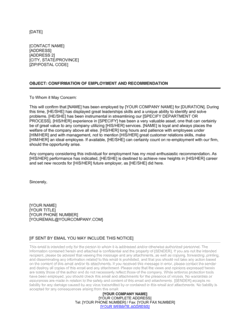
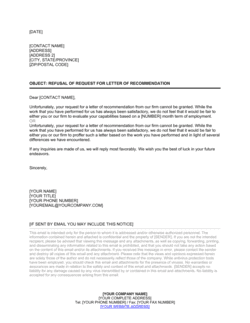
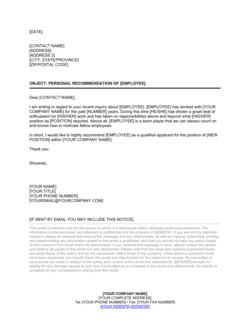
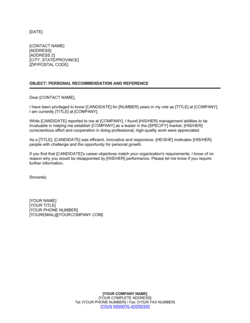
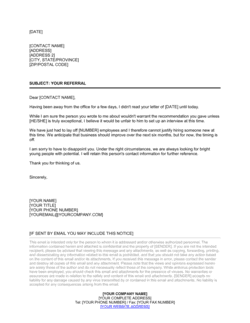
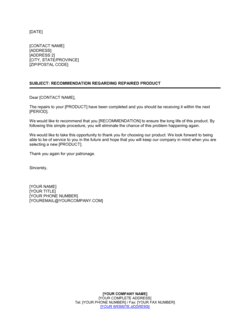
A Tactful Way to Decline to Write a Letter of Recommendation is a professionally worded letter template that allows a manager, professor, or colleague to refuse a recommendation request without damaging the relationship. This free Word download gives you a ready-to-edit structure you can personalize in minutes and export as PDF or send directly by email.
When you need it
Use it when you receive a recommendation request but cannot write a strong, honest endorsement β€” whether because you know the person too briefly, have performance concerns, or simply lack the bandwidth to do it justice.
What's inside
A courteous acknowledgment of the request, a clear but non-damaging explanation for declining, an optional alternative suggestion, and a warm closing that keeps the professional relationship intact.

What is a Tactful Way to Decline to Write a Letter of Recommendation?

A Tactful Way to Decline to Write a Letter of Recommendation is a professionally structured letter that allows a manager, professor, or colleague to refuse a recommendation request clearly and respectfully β€” without disclosing negative assessments or damaging the professional relationship. It frames the refusal around the writer's own constraints (limited shared history, time, or company policy) rather than the requester's qualifications, giving the person time and direction to find a more suitable endorser before their application deadline. This free Word download gives you a ready-to-edit template you can personalize in minutes and send by email or post.

Why You Need This Document

Declining a recommendation request is one of the most professionally sensitive communications you will write, and handling it poorly has real consequences. A vague or delayed response leaves the requester scrambling at the last minute, while a weak letter written out of obligation can actively harm their application β€” reviewers are experienced at reading faint praise. Without a clear, courteous structure, even a well-intentioned refusal can read as cold, evasive, or judgmental, causing lasting damage to a relationship that may matter professionally for years. This template gives you a tested framework that closes the request decisively, preserves goodwill, and β€” where appropriate β€” redirects the requester toward a stronger alternative, protecting both parties with minimal effort on your part.

Which variant fits your situation?

If your situation is…Use this template
Declining because of limited interaction or short working relationshipDecline to Write a Recommendation β€” Insufficient Knowledge
Declining due to performance concerns without specifying themTactful Decline Without Stated Reason
Declining but redirecting the requester to a better-suited referenceDecline with Alternative Reference Suggestion
Declining due to company policy prohibiting personal referencesDecline Based on Company Policy
Accepting the request but setting scope limitationsConditional Letter of Recommendation Acceptance
Writing a standard positive letter of recommendationLetter of Recommendation
Declining a character reference for a personal (non-employment) contextDecline to Write a Character Reference Letter

Common mistakes to avoid

❌ Providing a vague or evasive reason

Why it matters: Responses like 'it's not a good time' or 'I'm very busy' invite follow-up requests and leave the requester confused about whether to ask again later.

Fix: State one clear, plausible reason β€” limited shared history, company policy, or insufficient recent interaction β€” and leave it at that. One honest sentence closes the door respectfully.

❌ Delaying the response beyond one week

Why it matters: Applications have deadlines. A slow decline forces the requester to scramble for another reference at the last minute, which reflects poorly on you regardless of how polite the letter eventually is.

Fix: Respond within 48–72 hours of receiving the request. If you need time to decide, send a brief acknowledgment immediately and follow with the formal decline within a few days.

❌ Offering excessive praise to soften the decline

Why it matters: Loading the goodwill section with superlatives like 'exceptional talent' or 'remarkable professional' can be read as an implicit positive reference β€” creating expectations the requester will carry into their next ask.

Fix: Keep positive statements specific, measured, and tied to observable behaviors you actually witnessed. One genuine sentence outperforms three inflated ones.

❌ Naming an alternative reference without checking first

Why it matters: Suggesting a specific colleague without their knowledge puts both them and the requester in an awkward position β€” the colleague may also decline or be caught off guard by a reference request.

Fix: Contact the suggested person before sending your decline letter and confirm they are willing and able to write a strong endorsement. Only then include their name.

The 8 key sections, explained

Salutation and warm opening

Acknowledgment of the request and its importance

Clear but non-damaging reason for declining

Expression of genuine goodwill

Alternative suggestion (optional)

Offer of limited assistance

Forward-looking closing statement

Professional sign-off and sender information

How to fill it out

  1. 1

    Enter the requester's name and today's date

    Replace the [REQUESTER NAME] placeholder with the person's preferred name and add the date at the top of the letter. Use first name only for colleagues you know informally; use full name or title for more formal relationships.

    πŸ’‘ Sending within 48–72 hours of the request signals respect for the requester's timeline β€” applications often have tight deadlines.

  2. 2

    Personalize the acknowledgment line

    Add a specific reference to the program, position, or opportunity the person mentioned in their request. This shows you read their ask carefully and are not sending a form letter.

    πŸ’‘ One specific detail β€” 'your MBA application at [SCHOOL]' rather than 'your application' β€” meaningfully raises the warmth of the letter.

  3. 3

    Choose and fill in your reason for declining

    Select the reason that best fits your situation from the template's bracketed options: limited time working together, current time constraints, company policy, or insufficient knowledge of recent work. Delete the unused options.

    πŸ’‘ Keep the reason brief β€” one to two sentences. The longer the explanation, the more it reads as an excuse or, worse, a veiled critique.

  4. 4

    Add a genuine goodwill statement

    Write one sentence that decouples the refusal from any negative assessment of the person. Make it specific to them β€” reference a skill or quality you have genuinely observed.

    πŸ’‘ Avoid superlatives like 'outstanding' or 'exceptional' in the goodwill section β€” they can imply you are softening a more critical view.

  5. 5

    Decide whether to include an alternative suggestion

    If you can think of a colleague better placed to write the recommendation, add their name and title in the optional section. If you cannot, delete this section entirely rather than leaving a blank placeholder.

    πŸ’‘ Contact the suggested person before sending the letter to confirm they are willing β€” never suggest someone without their prior agreement.

  6. 6

    Choose your limited-assistance offer

    Pick one concrete alternative from the template's options β€” employment verification, LinkedIn endorsement, or a brief professional introduction β€” and commit only to what you will actually do.

    πŸ’‘ If you genuinely cannot offer any alternative assistance, remove this section. A hollow offer is worse than none.

  7. 7

    Finalize the closing and add your contact details

    Personalize the closing with a specific reference to the requester's field or goals, then complete the sign-off block with your full name, current title, organization, email, and phone number.

    πŸ’‘ Re-read the full letter once from the recipient's perspective before sending β€” if the decline reads as cold or clinical anywhere, add one warm sentence to that section.

Frequently asked questions

Is it acceptable to decline a request to write a letter of recommendation?

Yes β€” declining is entirely acceptable, and in many cases it is the more professional choice. Writing a weak, lukewarm, or reluctant endorsement can harm the requester more than a polite refusal. If you cannot write a genuinely strong letter, declining tactfully and promptly gives the person time to find a better-suited reference before their deadline.

Do I need to explain why I am declining a recommendation request?

You are not obligated to give a detailed reason, but providing a brief, plausible explanation β€” such as limited shared history or company policy β€” is more professional than a bare refusal. A one-sentence reason closes the door clearly and reduces the likelihood of follow-up requests or confusion about whether the decline is permanent.

How do I decline a recommendation request without damaging the relationship?

The key is separating the refusal from any negative assessment of the person. Frame the decline around your own constraints β€” time, knowledge, or policy β€” rather than the requester's qualifications. Acknowledge the request promptly, offer a genuine goodwill statement, and where possible suggest an alternative reference or limited form of support. Speed and warmth matter as much as the words you choose.

What if the requester keeps asking after I have declined?

Repeat your decline briefly and without expanding the explanation. A second ask is often the result of unclear language in the first response. Restate that you are not in a position to write the letter and reiterate your suggestion of an alternative reference if you made one. You do not owe a longer or more detailed justification.

Can I offer to verify employment instead of writing a recommendation?

Yes, and this is a common and professionally appropriate alternative. An employment verification confirms the person's title, dates of service, and reporting structure without requiring you to make any evaluative judgment. Many employers and academic programs accept verified employment data as a supplement to a stronger reference from someone else.

Should I decline in writing or by phone?

A written decline β€” email or formal letter β€” is generally preferred for professional contexts. It gives the requester a record of your response, avoids an uncomfortable real-time conversation, and allows you to word the refusal carefully. For a close colleague or personal contact, a brief phone or in-person conversation followed by a written note is also appropriate.

What is the biggest risk of writing a weak recommendation instead of declining?

A lukewarm or generic letter of recommendation often does more damage to the requester than no letter at all. Reviewers and hiring managers are skilled at reading between the lines of faint praise. An unenthusiastic endorsement signals that the reference writer could not find strong things to say β€” and that signal travels regardless of how politely the letter is worded.

Does declining a recommendation request expose me to any legal risk?

Declining a recommendation request carries no meaningful legal risk in virtually all professional contexts. You are not legally required to provide a reference. The greater legal exposure typically lies in writing a reference β€” particularly one that contains inaccurate or defamatory statements. When in doubt about whether a written endorsement could cause harm, declining is the safer course.

How long should a decline letter be?

Three to five short paragraphs is the appropriate length β€” enough to be courteous and clear without belaboring the point. A decline letter that runs more than one page draws unnecessary attention to the refusal. Brevity signals confidence in the decision and respects the requester's time.

How this compares to alternatives

vs Letter of Recommendation

A letter of recommendation is a full, positive endorsement of a candidate's skills, character, and suitability for a role or program. A decline letter is used when you cannot write that endorsement honestly or fully. Choose the decline letter whenever a genuine, strong recommendation is beyond what you can credibly provide β€” the requester is better served by finding a more enthusiastic reference.

vs Employment Verification Letter

An employment verification letter confirms factual details β€” job title, dates, and reporting structure β€” without any evaluative content. It is a useful alternative to offer inside a decline letter when you want to provide some support without making a qualitative judgment about the person's abilities or suitability.

vs Reference Check Response Letter

A reference check response letter addresses an inbound inquiry from an employer or institution checking a candidate's background, whereas a decline letter responds to a direct request from the candidate themselves. The audience and tone differ significantly β€” the decline is a private communication to the requester, while a reference check response goes to a third party conducting due diligence.

vs Professional Introduction Letter

A professional introduction letter connects two people by vouching for one to the other β€” it is a positive, forward-looking document. A decline letter is appropriate when you cannot write any form of endorsement at all. If you can genuinely speak to the requester's character or networking value, a brief introduction letter may be a meaningful alternative to offer in place of a formal recommendation.

Industry-specific considerations

Higher Education

Professors frequently receive recommendation requests from students they supervised only briefly; a tactful decline protects both the student's application and the faculty member's professional credibility.

Financial Services

Strict compliance and HR policies at many financial institutions prohibit personalized references, making a policy-based decline letter the standard and defensible response.

Healthcare

Credentialing and licensing boards require detailed endorsements; declining to write one when you lack sufficient clinical observation protects both the applicant and the certifying body.

Technology / SaaS

High employee turnover means managers regularly receive requests from brief direct reports; a professional decline with an offer of a LinkedIn endorsement is widely accepted in the industry.

Template vs pro β€” what fits your needs?

PathBest forCostTime
Use the templateManagers, professors, HR professionals, and colleagues handling a standard recommendation decline in any professional settingFree10–15 minutes
Template + professional reviewHR teams implementing a company-wide reference policy or executives declining a high-profile or sensitive request$50–$150 (HR advisor or employment counsel review)1–2 hours
Custom draftedOrganizations in regulated industries with strict reference disclosure policies or situations involving potential legal sensitivity$200–$600 (employment lawyer drafting)1–2 days

Glossary

Letter of Recommendation
A formal written endorsement from a known professional contact attesting to a candidate's skills, character, or suitability for a position or program.
Reference Request
A formal or informal ask from a job seeker or applicant for someone to vouch for their qualifications in writing or by phone.
Tactful Decline
A refusal delivered in a manner that acknowledges the request respectfully, avoids causing offense, and preserves the professional relationship.
Damaging Reference
An endorsement that inadvertently or intentionally harms the subject's prospects by including negative information β€” even if technically accurate.
Neutral Reference
A limited statement confirming only verifiable facts β€” job title, dates of employment, reporting structure β€” without opinion or assessment.
Company Reference Policy
An organizational guideline dictating what information employees may disclose when responding to reference requests, often restricting content to title and dates.
Conflict of Interest
A situation where a personal, financial, or professional relationship could impair the objectivity or credibility of a written endorsement.
Endorser Liability
The potential legal or reputational exposure a reference writer faces if an endorsement contains inaccurate, misleading, or defamatory statements.
Soft Decline
A refusal framed around external constraints β€” time, company policy, or limited knowledge β€” rather than an explicit assessment of the requester's qualifications.
Counteroffer (Reference Context)
An alternative provided in a decline letter, such as suggesting a different reference writer or offering a limited employment verification instead.

Part of your Business Operating System

This document is one of 3,000+ business & legal templates included in Business in a Box.

  • Fill-in-the-blanks β€” ready in minutes
  • 100% customizable Word document
  • Compatible with all office suites
  • Export to PDF and share electronically

Create your document in 3 simple steps.

From template to signed document β€” all inside one Business Operating System.
1
Download or open template

Access over 3,000+ business and legal templates for any business task, project or initiative.

2
Edit and fill in the blanks with AI

Customize your ready-made business document template and save it in the cloud.

3
Save, Share, Send, Sign

Share your files and folders with your team. Create a space of seamless collaboration.

Save time, save money, and create top-quality documents.

β˜…β˜…β˜…β˜…β˜…

"Fantastic value! I'm not sure how I'd do without it. It's worth its weight in gold and paid back for itself many times."

Managing Director Β· Mall Farm
Robert Whalley
Managing Director, Mall Farm Proprietary Limited
β˜…β˜…β˜…β˜…β˜…

"I have been using Business in a Box for years. It has been the most useful source of templates I have encountered. I recommend it to anyone."

Business Owner Β· 4+ years
Dr Michael John Freestone
Business Owner
β˜…β˜…β˜…β˜…β˜…

"It has been a life saver so many times I have lost count. Business in a Box has saved me so much time and as you know, time is money."

Owner Β· Upstate Web
David G. Moore Jr.
Owner, Upstate Web

Run your business with a system β€” not scattered tools

Stop downloading documents. Start operating with clarity. Business in a Box gives you the Business Operating System used by over 250,000 companies worldwide to structure, run, and grow their business.

Free Forever PlanΒ Β·Β No credit card required