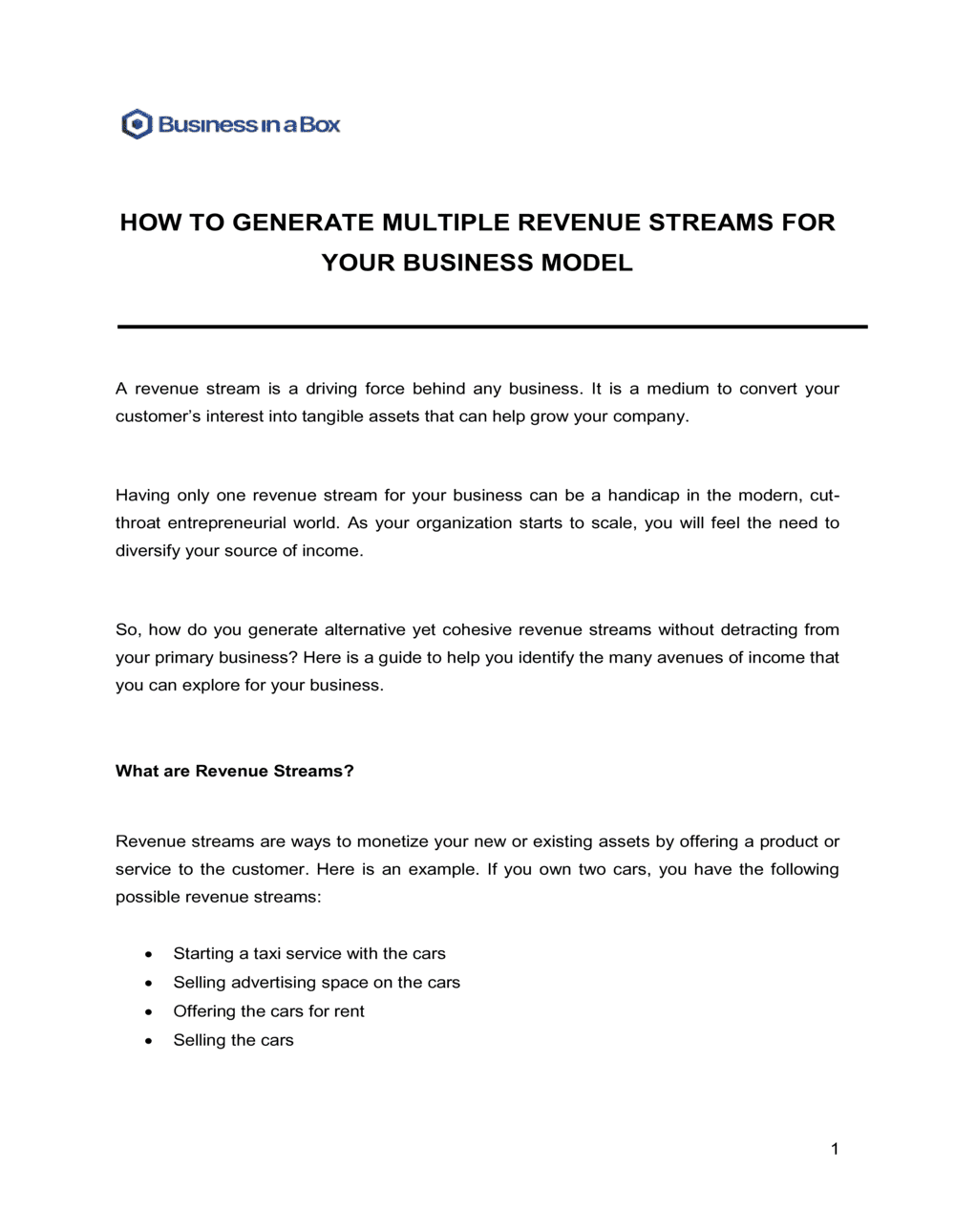
How To Generate Multiple Revenue Streams For Your Business Model

Free Word download β€’ Edit online β€’ Save & share with Drive β€’ Export to PDF

5 pagesβ€’20–30 min to fillβ€’Difficulty: Standard
Learn more ↓
FreeHow To Generate Multiple Revenue Streams For Your Business Model Template

At a glance

What it is
This guide and planning template walks business owners and strategists through a structured process for identifying, evaluating, and implementing multiple revenue streams within an existing or new business model. It is a free Word download you can edit online and export as PDF, covering revenue type mapping, feasibility assessment, prioritization, and a 90-day activation roadmap.
When you need it
Use it when your business relies on a single revenue source and you want to reduce concentration risk, when growth has plateaued and you need adjacent income channels, or when preparing a business plan for investors who expect a diversified revenue model.
What's inside
Revenue stream identification worksheets, a feasibility and effort-impact scoring matrix, channel prioritization framework, financial projection templates for each stream, and a phased implementation roadmap with milestones and resource requirements.

What is a Multiple Revenue Streams Business Model Guide?

A Multiple Revenue Streams Business Model Guide is a structured planning document that helps business owners and strategists identify, evaluate, and activate additional channels of income beyond their current primary source. It maps all existing revenue, scores candidate new streams on feasibility and impact, and produces a prioritized 90-day activation plan with stream-level financial projections. Unlike a general business plan, this document focuses entirely on the revenue dimension of the business model β€” making it the right tool when the specific problem is income concentration, growth plateau, or the need to demonstrate revenue diversification to investors or lenders.

Why You Need This Document

A business that earns 80% of its revenue from a single client, product, or channel is one contract cancellation, market shift, or competitor away from a cash flow crisis. The cost of that concentration is invisible until it isn't β€” and by then, the runway to build alternatives has collapsed. This guide forces the decision before the crisis: which streams are worth pursuing, in what order, with what resources, and measured against what outcome at 90 days. Without this structure, most businesses generate a list of revenue ideas that never leave a whiteboard because no one assigned an owner, a budget, or a decision date. The template converts that conversation into an executable plan with defined milestones, stream-level financial models, and an explicit go/no-go checkpoint β€” giving leadership the clarity to act rather than deliberate.

Which variant fits your situation?

If your situation is…Use this template
Mapping all current and potential revenue streams at the business model levelHow To Generate Multiple Revenue Streams For Your Business Model
Presenting a diversified revenue model to investors or a boardBusiness Plan
Planning the launch of a specific new product or service revenue streamNew Product Launch Plan
Formalizing a subscription or recurring billing revenue modelRecurring Revenue Model Template
Documenting passive income or licensing revenue strategyLicensing Agreement
Building a detailed 12-month financial projection for each new streamFinancial Projections β€” 12 Months
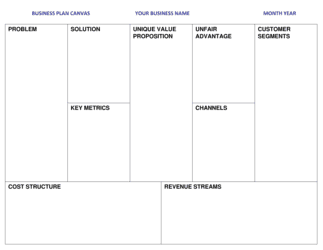
Mapping revenue streams in the context of a full one-page business modelBusiness Plan Canvas (One Page)

Common mistakes to avoid

❌ Activating too many streams at once

Why it matters: Spreading a leadership team and budget across four or more simultaneous new revenue initiatives reliably ensures that none of them receive enough focus to reach escape velocity.

Fix: Cap new stream activation at two or three per 90-day cycle. Sequence the remainder on a prioritized roadmap and revisit after the first cohort has either scaled or been paused.

❌ Skipping the current revenue audit

Why it matters: Without a documented baseline, you cannot measure whether new streams are actually adding diversification or simply shifting revenue between channels, and you may miss that an existing stream is in decline.

Fix: Complete the full revenue audit β€” actual dollars, margin, and trend β€” before generating any new stream ideas. The audit typically reveals opportunities in existing revenue that require less effort than launching something new.

❌ Ignoring gross margin when scoring candidates

Why it matters: A high-revenue stream with 8% gross margin can consume more working capital and management bandwidth than a lower-revenue stream with 65% margin, while delivering less operating profit.

Fix: Include gross margin as an explicit scoring dimension in the effort-impact matrix. Eliminate from consideration any stream with a projected margin below your business's current blended gross margin, unless there is a clear path to improving it within 12 months.

❌ No defined decision gate at 90 days

Why it matters: Without an explicit go/no-go threshold, teams continue investing time and money in underperforming streams for months, rationalizing slow progress rather than making a clear-eyed pivot or exit decision.

Fix: Before launch, write down the specific metric and threshold that will trigger a scale decision versus a pause decision at Day 90. Commit to it in writing with the team so it cannot be quietly revised when results disappoint.

❌ Treating passive income streams as low-effort by default

Why it matters: Licensing, digital products, and affiliate models require significant upfront investment in content, legal agreements, or platform setup β€” and ongoing marketing to generate meaningful revenue.

Fix: Score passive streams on the same effort-impact matrix as active streams. Assign a realistic time-to-first-revenue estimate and budget before committing to them.

❌ Building streams that require capabilities the team does not have

Why it matters: Launching a stream that depends on skills, relationships, or technology your team lacks adds 3–6 months to the timeline and often doubles the budget, frequently resulting in an abandoned initiative.

Fix: Complete the capability gap analysis before committing to any stream. If closing the gaps requires more than 60 days and more than 15% of your current operating budget, evaluate whether a simpler adjacent stream is a better first move.

The 9 key sections, explained

Current Revenue Audit

Revenue Stream Identification Workshop

Feasibility and Effort-Impact Scoring Matrix

Revenue Stream Prioritization and Selection

Financial Projections by Stream

Resource Requirements and Capability Gap Analysis

Go-to-Market Plan per Stream

Revenue Diversification Dashboard

90-Day Implementation Roadmap

How to fill it out

  1. 1

    Complete the current revenue audit

    List every active revenue source, its annual contribution in dollars and as a percentage of total revenue, its gross margin, and its 12-month trend. Flag any single stream that represents more than 40% of total revenue as a concentration risk.

    πŸ’‘ Pull actuals from your accounting software β€” do not estimate. The audit loses its diagnostic value if the baseline numbers are approximations.

  2. 2

    Run the revenue stream identification workshop

    Work through each of the six categories β€” product extensions, service productization, licensing, subscriptions, partnerships, and content or data monetization β€” and generate at least two candidate streams per category. Aim for 8–12 candidates before filtering.

    πŸ’‘ Involve at least one person outside your immediate team in this session. External perspectives surface adjacencies that insiders overlook because they are too close to the core business.

  3. 3

    Score each candidate on the effort-impact matrix

    Rate every candidate stream on revenue potential, gross margin, time to first revenue, and operational complexity, each on a 1–5 scale. Calculate the total score and rank candidates from highest to lowest.

    πŸ’‘ Weight time to first revenue at 1.5Γ— if your business has less than 6 months of cash runway. Speed of revenue matters more than long-term potential when capital is constrained.

  4. 4

    Select two or three streams to activate

    Choose the top two or three streams from your ranked list, confirming that your team has β€” or can quickly acquire β€” the capabilities to execute them. Document the streams you are deferring and the conditions that would trigger revisiting them.

    πŸ’‘ Never activate more than three new streams in a single 90-day cycle. Focus is the primary predictor of whether any individual stream reaches meaningful revenue.

  5. 5

    Build a separate financial projection for each selected stream

    Model monthly revenue, direct costs, and gross profit for each stream from Month 1 through Month 12, then add Year 2 and Year 3 annual summaries. Define the breakeven month for each.

    πŸ’‘ Start each projection from the number of customers or units you need to sell, not from a revenue target. Working from volume assumptions to revenue is harder to game than working backward from a number.

  6. 6

    Complete the resource and capability gap analysis

    For each selected stream, list the people, technology, and capital required. Compare against what you currently have and document each gap with a closure plan β€” hire, partner, or build β€” and an estimated cost and timeline.

    πŸ’‘ If closing a gap for a given stream requires more than 60 days or $20K before you see first revenue, reconsider whether a simpler stream with fewer requirements should take priority.

  7. 7

    Write the go-to-market plan and define the 90-day decision metric

    For each stream, state the target customer, price point, primary acquisition channel, launch offer, and the single metric you will use to decide whether to scale or pause at the 90-day mark.

    πŸ’‘ The decision metric must be an output β€” paying customers, signed contracts, or revenue β€” not an activity. 'Send 500 emails' is not a decision metric; '10 paying customers' is.

  8. 8

    Build the implementation roadmap and set up the tracking dashboard

    Map week-by-week actions across the 90-day period for each stream, then set up the revenue diversification dashboard to track actual vs. projected performance by stream from Day 1.

    πŸ’‘ Review the dashboard weekly for the first 90 days. Monthly reviews are too infrequent to catch underperforming streams before they consume significant resources.

Frequently asked questions

What are multiple revenue streams in a business model?

Multiple revenue streams means a business earns income from more than one distinct channel, product, or customer segment. Examples include a consulting firm that adds online courses and a licensing program alongside its core client work, or a software company that combines subscription fees with professional services and an affiliate referral program. Diversification across streams reduces the financial risk of losing any single source of income.

How many revenue streams should a business have?

Most small and mid-sized businesses operate most effectively with two to four active revenue streams. Fewer than two creates dangerous concentration risk; more than four typically dilutes focus to the point where no individual stream is managed well. The right number depends on team size, capital, and the operational complexity of each stream β€” not on an abstract target.

What are the most common types of revenue streams for small businesses?

The six most common categories are product sales (physical or digital), service fees (project-based or retainer), subscription or membership revenue, licensing or royalty income, affiliate or referral commissions, and advertising or sponsorship revenue. Most businesses will find their best adjacent streams in the same category as their primary revenue, since the customer relationships and distribution channels already exist.

How do I know which new revenue stream to pursue first?

Use an effort-impact matrix that scores each candidate on four dimensions: revenue potential, gross margin, time to first revenue, and operational complexity. The stream with the highest combined score that your team can activate within 90 days without closing major capability gaps is the right first choice. Avoid choosing a stream based on revenue potential alone.

Can a small business with one product add meaningful passive income?

Yes, but passive income requires active upfront investment. Licensing the product IP, creating a digital training course, or building an affiliate program around the product are all viable paths. Expect 3–6 months of build time and a marketing investment before the stream generates self-sustaining revenue. Score each option on the effort-impact matrix before committing.

What is revenue concentration risk and when does it become dangerous?

Revenue concentration risk is the financial exposure created when a single client, product, or channel represents an outsized share of total revenue. Most financial advisors flag a risk threshold at 30–40% β€” when one source exceeds this, its loss would be immediately material to operations. Lenders and investors often require concentration analysis as part of due diligence.

How long does it take to generate meaningful revenue from a new stream?

For a well-planned stream with existing customer relationships and no major capability gaps, 60–90 days to first revenue and 6–12 months to meaningful contribution (defined as 10%+ of total revenue) is a realistic range. Streams that require new customer acquisition from scratch, new technology, or regulatory approval typically take 12–18 months to become meaningful contributors.

How is this guide different from a business plan?

A business plan covers the full operating model β€” market analysis, team, operations, and financials β€” for an entire business. This guide focuses specifically on identifying, scoring, and activating additional revenue streams within an existing or new business model. It is narrower in scope and more tactical, with worksheets and a 90-day implementation roadmap rather than a comprehensive strategic document.

What financial model should I use alongside this guide?

Pair this guide with a 12-month financial projection template that allows you to model each revenue stream separately before consolidating into a total revenue view. Avoid using a single-line revenue model β€” you need stream-level visibility to evaluate performance and make go/no-go decisions at the 90-day checkpoint.

How this compares to alternatives

vs Business Plan

A business plan is a comprehensive strategic and financial document covering the full operating model of a business for an investor or lender audience. This guide is narrower β€” it focuses specifically on identifying and activating additional revenue streams within an existing model. Use the business plan when you need to present the whole company; use this guide when the specific problem is revenue diversification.

vs Business Plan Canvas (One Page)

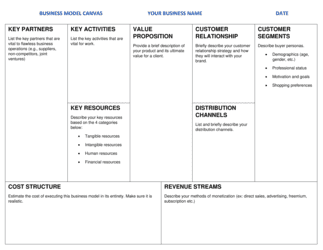
The one-page canvas maps all nine building blocks of a business model at a high level, including the revenue streams block. This guide goes significantly deeper on the revenue dimension β€” with scoring, feasibility analysis, financial projections per stream, and a 90-day roadmap. Use the canvas for rapid alignment; use this guide when you are ready to plan and execute specific new streams.

vs Financial Projections β€” 12 Months

A 12-month financial projection models expected revenue, expenses, and cash flow but does not guide the strategic decision of which streams to pursue or how to prioritize them. This guide produces the strategic choices; the financial projection template then models the numbers for each selected stream. They work best as a pair.

vs Marketing Plan

A marketing plan defines how to acquire customers for existing products or services through channel and campaign strategy. This guide operates one level upstream β€” it determines what revenue streams to add before a marketing plan is written for each one. Once a new stream is selected, a dedicated marketing plan is the natural next document.

Industry-specific considerations

Professional Services

Consultants and agencies use this guide to move from pure hourly billing into productized services, digital courses, licensing arrangements, and retainer-based models that smooth revenue variability.

SaaS / Technology

Software companies apply this framework to layer professional services, marketplace transaction fees, API licensing, and data products onto a core subscription revenue base.

Retail / E-commerce

Retailers use the guide to identify subscription box programs, wholesale or B2B channels, affiliate partnerships, and private-label licensing as streams adjacent to direct-to-consumer sales.

Food & Beverage

Restaurants and food brands use this framework to evaluate catering, branded product lines, cooking classes, licensing to manufacturers, and corporate meal programs as supplements to core dining revenue.

Creative and Marketing Agencies

Agencies apply the scoring matrix to evaluate white-label services, software tools, training programs, and media properties as revenue streams beyond client project fees.

Nonprofit Organizations

Nonprofits use this guide to identify earned revenue streams β€” membership programs, fee-for-service contracts, social enterprise products β€” that reduce grant dependency and improve financial resilience.

Template vs pro β€” what fits your needs?

PathBest forCostTime
Use the templateSmall business owners and founders who understand their market and can model basic financialsFree1–2 weeks to complete the full guide including financial projections
Template + professional reviewGrowth-stage businesses adding streams that require pricing strategy, channel partner agreements, or investor-ready financial models$500–$2,000 for a strategy consultant or fractional CFO review session2–3 weeks
Custom draftedBusinesses raising capital where the revenue diversification strategy is a central part of the investor pitch, or entering regulated markets$3,000–$8,000 for a business strategy or financial advisory engagement4–6 weeks

Glossary

Revenue Stream
A distinct channel or mechanism through which a business earns income from a specific customer segment or activity.
Revenue Concentration Risk
The financial exposure a business faces when a disproportionate share of total revenue comes from a single client, product, or channel.
Recurring Revenue
Income that repeats at predictable intervals β€” subscriptions, retainers, or maintenance contracts β€” providing stable, forecastable cash flow.
Passive Income Stream
Revenue generated with minimal ongoing effort after initial setup, such as licensing fees, royalties, or digital product sales.
Adjacency
A new product, service, or customer segment that is related to the core business and can be reached without building entirely new capabilities.
Effort-Impact Matrix
A prioritization tool that scores potential revenue streams on the effort required to activate them against the revenue impact expected.
Monetization Model
The specific mechanism a business uses to capture value from a product or service β€” such as subscription, transaction fee, licensing, or advertising.
Customer Lifetime Value (LTV)
The total gross profit a business expects to earn from a single customer relationship across all revenue streams over the full duration of that relationship.
Productized Service
A consulting or professional service packaged into a fixed scope, fixed price offering that can be sold repeatedly without custom scoping.
Freemium
A monetization model in which a base version of a product is offered free of charge while advanced features or higher usage tiers are paid.
Licensing Revenue
Income earned by granting another party the right to use intellectual property β€” software, content, patents, or brand β€” in exchange for a fee or royalty.

Part of your Business Operating System

This document is one of 3,000+ business & legal templates included in Business in a Box.

  • Fill-in-the-blanks β€” ready in minutes
  • 100% customizable Word document
  • Compatible with all office suites
  • Export to PDF and share electronically

Create your document in 3 simple steps.

From template to signed document β€” all inside one Business Operating System.
1
Download or open template

Access over 3,000+ business and legal templates for any business task, project or initiative.

2
Edit and fill in the blanks with AI

Customize your ready-made business document template and save it in the cloud.

3
Save, Share, Send, Sign

Share your files and folders with your team. Create a space of seamless collaboration.

Save time, save money, and create top-quality documents.

β˜…β˜…β˜…β˜…β˜…

"Fantastic value! I'm not sure how I'd do without it. It's worth its weight in gold and paid back for itself many times."

Managing Director Β· Mall Farm
Robert Whalley
Managing Director, Mall Farm Proprietary Limited
β˜…β˜…β˜…β˜…β˜…

"I have been using Business in a Box for years. It has been the most useful source of templates I have encountered. I recommend it to anyone."

Business Owner Β· 4+ years
Dr Michael John Freestone
Business Owner
β˜…β˜…β˜…β˜…β˜…

"It has been a life saver so many times I have lost count. Business in a Box has saved me so much time and as you know, time is money."

Owner Β· Upstate Web
David G. Moore Jr.
Owner, Upstate Web

Run your business with a system β€” not scattered tools

Stop downloading documents. Start operating with clarity. Business in a Box gives you the Business Operating System used by over 250,000 companies worldwide to structure, run, and grow their business.

Start freeΒ Β·Β No credit card required