How to Implement Customer Service Training

Free to read β€’ Save or share with one click

FreeHow to Implement Customer Service Training Template

At a glance

What it is
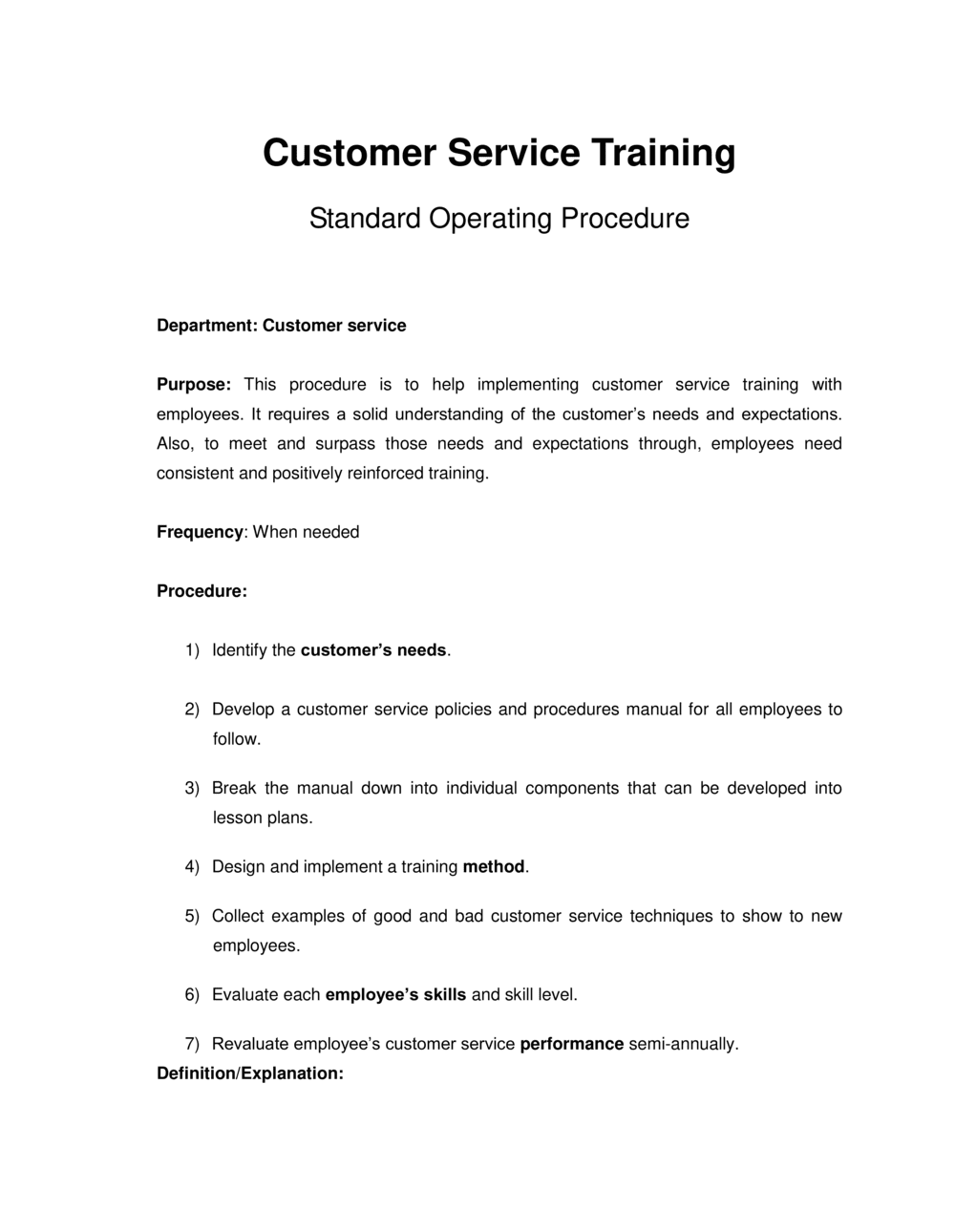
A How To Implement Customer Service Training document is a structured operational guide that walks managers and HR teams through every phase of designing and deploying a customer service training program β€” from needs assessment through post-training evaluation. This free Word download gives you a ready-to-edit framework you can tailor to your team size, industry, and service channels, then export as PDF for distribution to trainers and department heads.
When you need it
Use it when onboarding a new customer-facing team, standardizing service quality across locations or departments, launching a new product or service channel that requires updated support skills, or responding to a measurable drop in customer satisfaction scores.
What's inside
The guide covers training objectives and KPIs, audience and skills-gap analysis, curriculum and module design, delivery method selection, trainer preparation, scheduling and rollout logistics, participant assessments, and a post-training evaluation framework tied to business outcomes.

What is a How To Implement Customer Service Training Document?

A How To Implement Customer Service Training document is a structured operational guide that takes managers, HR teams, and L&D specialists through every phase of designing and deploying a customer service training program β€” from running a skills gap analysis and building a curriculum to scheduling cohorts and measuring post-training business impact. Unlike a general training outline, this document ties every design decision to a measurable service quality outcome, ensuring the program produces observable change in how staff interact with customers rather than simply filling seats for a session.

Why You Need This Document

Without a documented implementation plan, customer service training tends to be delivered inconsistently β€” different managers run different versions, new hires receive a different experience than the team they join, and no one collects the baseline data needed to show whether the program made any difference. The result is training budget that cannot be justified and service quality problems that resurface within weeks of the last session. A structured implementation plan eliminates those failure modes by anchoring every delivery decision to defined objectives, a repeatable rollout schedule, and a 90-day evaluation cycle that connects training activity to CSAT scores, first contact resolution rates, and complaint volumes. This template gives you that structure in a format you can customize, share with department heads, and reuse every time your service standards, team, or product offering changes.

Which variant fits your situation?

If your situation is…Use this template
Onboarding brand-new customer support hiresNew Employee Onboarding Plan
Documenting ongoing service standards for referenceCustomer Service Policy
Training staff on a specific new product or featureProduct Training Plan
Measuring service team performance after trainingEmployee Performance Review
Running a recurring training calendar across departmentsTraining Schedule Template
Certifying staff competency after completing trainingTraining Completion Certificate
Capturing team feedback on the training programTraining Evaluation Form

Common mistakes to avoid

❌ No baseline metrics before training begins

Why it matters: Without a pre-training baseline for CSAT, FCR, or complaint volume, you cannot demonstrate whether the training produced any improvement β€” making it impossible to justify budget for future programs.

Fix: Pull at least 60 days of relevant service metrics before the training launch date and document them in the program overview section.

❌ One-size-fits-all curriculum for mixed-experience audiences

Why it matters: Veteran staff disengage when they sit through content they learned in their first month, and new hires get lost when advanced scenarios appear before foundational skills are established.

Fix: Segment participants by tenure or skill level and create at least two curriculum tracks β€” a foundational track for new or developing staff and an advanced track for experienced agents.

❌ Skipping the post-training behavior and results evaluation

Why it matters: Collecting only post-session happiness surveys tells you participants enjoyed the training, not whether they changed their behavior with customers or improved any business metric.

Fix: Schedule supervisor observation check-ins at 30 and 60 days, and pull CSAT and FCR data at 90 days against the documented baseline.

❌ Scheduling all cohorts during peak business periods

Why it matters: When customer volume spikes, managers pull staff from training sessions, creating patchwork attendance and inconsistent competency levels across the team.

Fix: Map training dates against historical volume data and schedule cohorts during lower-demand windows; for contact centers, use the previous year's call volume data by week.

The 8 key sections, explained

Program Overview and Objectives

Target Audience and Skills Gap Analysis

Curriculum Design and Module Breakdown

Delivery Method and Format

Trainer Preparation and Facilitation Guide

Schedule and Rollout Plan

Participant Assessment and Knowledge Checks

Post-Training Evaluation and Business Impact Measurement

How to fill it out

  1. 1

    Define the business problem and measurable objectives

    Identify the specific service quality issue β€” rising complaint volume, low CSAT scores, inconsistent handling of escalations β€” and set two to four measurable objectives with baseline and target values.

    πŸ’‘ Pull three months of CSAT data and FCR rates before you write a single objective. Numbers from real performance data make objectives defensible to leadership.

  2. 2

    Profile your training audience and run a skills gap analysis

    List the roles and headcount entering the program. Survey managers, review call recordings, or run a short skills assessment to identify which competencies are missing or inconsistent.

    πŸ’‘ Segment your audience by tenure β€” new hires, staff under two years, and veterans need different module depths and different examples.

  3. 3

    Design the curriculum module by module

    Break the program into discrete modules, each with one primary learning objective, a format, a duration under 60 minutes, and the materials required. Sequence modules from foundational skills to complex scenarios.

    πŸ’‘ Limit each module to one core skill or concept β€” modules that try to cover three topics at once produce weak retention across all three.

  4. 4

    Select delivery methods matched to your workforce

    Choose in-person, virtual, self-paced, or blended delivery based on where and when your team works. Document the rationale so stakeholders understand why certain formats were chosen over others.

    πŸ’‘ For shift-based or remote teams, self-paced e-learning with a deadline outperforms live sessions β€” it removes the scheduling variable that most often causes missed training.

  5. 5

    Prepare trainers with a facilitation guide

    Write a session-by-session facilitation guide with timing, key talking points, and instructions for activities and role-plays. Conduct a train-the-trainer session at least one week before the first cohort.

    πŸ’‘ Record the train-the-trainer session so it can onboard future facilitators without scheduling a repeat.

  6. 6

    Build the rollout schedule with buffer time

    Map all cohort dates, locations or platforms, and participant groups. Build at least one week of buffer between cohorts to allow for feedback-driven adjustments after the first session.

    πŸ’‘ Run a pilot cohort of 8–12 volunteers before the full rollout β€” a pilot catches facilitation problems and unclear instructions before they reach 100% of your team.

  7. 7

    Set up assessments and passing thresholds

    Create a post-module quiz, a role-play rubric, or a scenario evaluation for each module. Define the minimum passing score and the remediation path for participants who do not meet it.

    πŸ’‘ Use scenario-based quiz questions built from real customer interactions your team handles β€” they test applied judgment, not just memorization.

  8. 8

    Schedule and execute the post-training evaluation

    Deploy a reaction survey immediately after each session. Compare pre- and post-training quiz scores. Schedule manager observations at 30 and 60 days and pull CSAT or FCR data at 90 days to measure business impact.

    πŸ’‘ Set a calendar reminder for the 90-day business impact review at the time of training launch β€” it is the measurement most commonly skipped because it falls outside the visible rollout window.

Frequently asked questions

What is a customer service training implementation plan?

A customer service training implementation plan is a structured operational document that guides managers and L&D teams through every phase of delivering a service training program β€” from identifying skills gaps and designing curriculum through scheduling rollout and measuring post-training business impact. It ensures training is consistent, measurable, and tied to specific service quality outcomes rather than treated as a one-time event.

How long should a customer service training program take?

Program length depends on the complexity of the service role and the size of the skills gap. A foundational program for new hires typically runs 16–24 hours spread over two to three weeks. A targeted refresher for experienced staff on a specific skill β€” handling escalations, for example β€” can be delivered in two to four hours. Programs delivered in sessions longer than 60 minutes without activities or breaks consistently produce lower retention scores.

How do you measure customer service training effectiveness?

The Kirkpatrick four-level model is the standard framework. Level 1 measures participant reaction via post-session surveys. Level 2 measures learning gain through pre- and post-training knowledge checks. Level 3 measures on-the-job behavior change through supervisor observations at 30 and 60 days. Level 4 measures business results β€” CSAT, FCR, average handle time β€” at 90 days against the pre-training baseline. Collecting only Level 1 data is the most common evaluation mistake.

What topics should customer service training cover?

Core modules typically cover active listening and empathy, product and service knowledge, handling complaints and de-escalation, communicating policies clearly and respectfully, multi-channel etiquette (phone, email, chat, in-person), and internal escalation procedures. Advanced programs add modules on upselling or cross-selling, CRM tool proficiency, and handling high-volume or high-stress periods.

What is the difference between customer service training and a customer service policy?

A customer service policy documents the standards and rules employees must follow β€” response time targets, refund procedures, escalation thresholds. A training implementation plan is the operational guide for teaching staff how to meet those standards. The policy is the what; the training plan is the how. Both documents are needed β€” a policy without training produces inconsistent execution, and training without a policy produces inconsistent standards.

Should customer service training be delivered in-person or online?

The best delivery format depends on your workforce. In-person or live virtual sessions work well for role-play-heavy modules requiring real-time feedback. Self-paced e-learning is more practical for shift-based, remote, or multi-location teams where scheduling a live session for all staff simultaneously is not feasible. Blended programs β€” combining self-paced modules with live practice sessions β€” consistently outperform either format used exclusively.

How often should customer service training be repeated?

New hires need a full foundational program before or within their first 30 days. Existing staff benefit from annual refresher training and targeted modules whenever service standards, products, or customer channels change significantly. CSAT scores that drop more than 5 points over a 60-day period are a reliable signal that an unscheduled refresher is needed.

Can a small business implement customer service training without an HR team?

Yes. A structured template removes most of the design work. A small business owner or team lead can identify the two or three most common service failures, build a two- to three-module program around them, and deliver it as a guided discussion with role-play exercises in under four hours. The key is documenting the program so it can be replicated consistently for every new hire rather than delivered informally each time.

What should a customer service training evaluation form include?

A post-session evaluation form should capture: overall session rating (1–5 scale), ratings for content relevance and trainer effectiveness, two to three open-ended questions on what participants will do differently, and a net promoter-style question asking whether they would recommend the training to a colleague. Combine survey responses with quiz scores and manager observations for a complete picture of training effectiveness.

How this compares to alternatives

vs Customer Service Policy

A customer service policy defines the rules and standards employees must follow β€” response time SLAs, refund thresholds, escalation protocols. A training implementation plan is the operational guide for teaching staff how to meet those standards. The policy is the destination; the training plan maps the route. Most businesses need both working together.

vs Employee Onboarding Plan

An onboarding plan covers the full new-hire experience β€” paperwork, system access, company culture, role expectations, and initial training across all job functions. A customer service training implementation plan is a focused deep-dive into service skills only. For customer-facing roles, onboarding includes service training as one component; the training plan provides the detail that onboarding documents typically summarize.

vs Employee Performance Review

A performance review documents how an employee is currently performing against role expectations and identifies development needs. A training implementation plan is the intervention designed to close those gaps. Reviews diagnose; training plans treat. Post-training performance reviews are also the primary mechanism for measuring Level 3 behavior change in the Kirkpatrick evaluation model.

vs Training Evaluation Form

A training evaluation form is a single participant-facing survey collected at the end of a session β€” it captures Level 1 reaction data only. A customer service training implementation plan is the governing document for the entire program, of which the evaluation form is one component. You need the implementation plan to design, deliver, and measure the program; you need the evaluation form to collect one of several required data points.

Industry-specific considerations

Retail

Training focuses on in-store complaint handling, returns and refunds policy communication, and upselling techniques β€” often delivered as short shift-start modules to minimize floor coverage gaps.

Contact Centers and BPO

High-volume, script-driven programs with strong emphasis on FCR, average handle time, and de-escalation β€” typically blended with live call monitoring and coached feedback sessions.

Hospitality and Food Service

Training covers service recovery for guest complaints, upselling menu items or upgrades, and maintaining brand tone during high-stress peak service periods.

Healthcare

Patient-facing communication training includes empathy and active listening for sensitive conversations, HIPAA-compliant information handling, and managing distressed or anxious patients.

Template vs pro β€” what fits your needs?

PathBest forCostTime
Use the templateSmall business owners, team leads, and HR generalists designing foundational service training for teams up to 50 staffFree4–8 hours to complete and customize
Template + professional reviewMid-sized businesses rolling out training across multiple locations or departments with measurable KPI targets$500–$2,000 for an L&D consultant review and curriculum refinement1–2 weeks
Custom draftedEnterprise contact centers, regulated industries, or organizations requiring accredited training programs tied to certification or compliance$5,000–$25,000+ for instructional design and custom content development6–16 weeks

Glossary

Skills Gap Analysis
A structured comparison between the service competencies employees currently have and the competencies the role requires, used to focus training content.
Learning Objective
A specific, measurable statement describing what a trainee will be able to do after completing a training module.
Kirkpatrick Model
A four-level training evaluation framework that measures participant reaction, learning, behavior change, and business results.
Blended Learning
A training delivery approach that combines in-person instruction with self-paced online modules, video, or practice simulations.
Knowledge Check
A brief quiz or scenario exercise embedded within or after a training module to confirm participants understood the content before moving on.
CSAT (Customer Satisfaction Score)
A post-interaction survey metric β€” typically a 1–5 scale β€” that captures how satisfied a customer was with a single service experience.
First Contact Resolution (FCR)
The percentage of customer issues resolved in a single interaction, without requiring a callback or follow-up β€” a key indicator of service training effectiveness.
Role-Play Exercise
A structured simulation in which trainees practice handling real-world customer scenarios with a colleague or trainer acting as the customer.
Training Needs Assessment (TNA)
A systematic process for identifying the specific skills, knowledge, and behaviors a team needs to develop before a training program is designed.
Spaced Repetition
A learning technique that re-exposes trainees to key concepts at increasing intervals over time to improve long-term retention.

Part of your Business Operating System

This document is one of 3,000+ business & legal templates included in Business in a Box.

  • Fill-in-the-blanks β€” ready in minutes
  • Compatible with all office suites
  • Export to PDF and share electronically

Create your document in 3 simple steps.

From template to signed document β€” all inside one Business Operating System.
1
Download or open template

Access over 3,000+ business and legal templates for any business task, project or initiative.

2
Edit and fill in the blanks with AI

Customize your ready-made business document template and save it in the cloud.

3
Save, Share, Send, Sign

Share your files and folders with your team. Create a space of seamless collaboration.

Save time, save money, and create top-quality documents.

β˜…β˜…β˜…β˜…β˜…

"Fantastic value! I'm not sure how I'd do without it. It's worth its weight in gold and paid back for itself many times."

Managing Director Β· Mall Farm
Robert Whalley
Managing Director, Mall Farm Proprietary Limited
β˜…β˜…β˜…β˜…β˜…

"I have been using Business in a Box for years. It has been the most useful source of templates I have encountered. I recommend it to anyone."

Business Owner Β· 4+ years
Dr Michael John Freestone
Business Owner
β˜…β˜…β˜…β˜…β˜…

"It has been a life saver so many times I have lost count. Business in a Box has saved me so much time and as you know, time is money."

Owner Β· Upstate Web
David G. Moore Jr.
Owner, Upstate Web

Run your business with a system β€” not scattered tools

Stop downloading documents. Start operating with clarity. Business in a Box gives you the Business Operating System used by over 250,000 companies worldwide to structure, run, and grow their business.

Start freeΒ Β·Β No credit card required