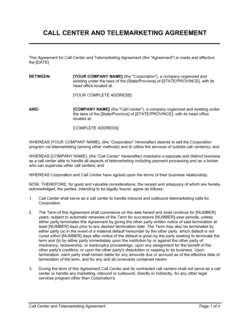
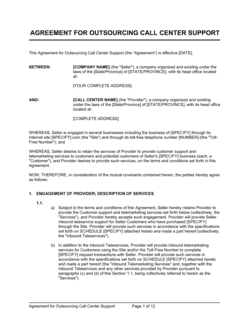
Call Center Script Template

Free to read • Save or share with one click

FreeCall Center Script Template

At a glance

What it is
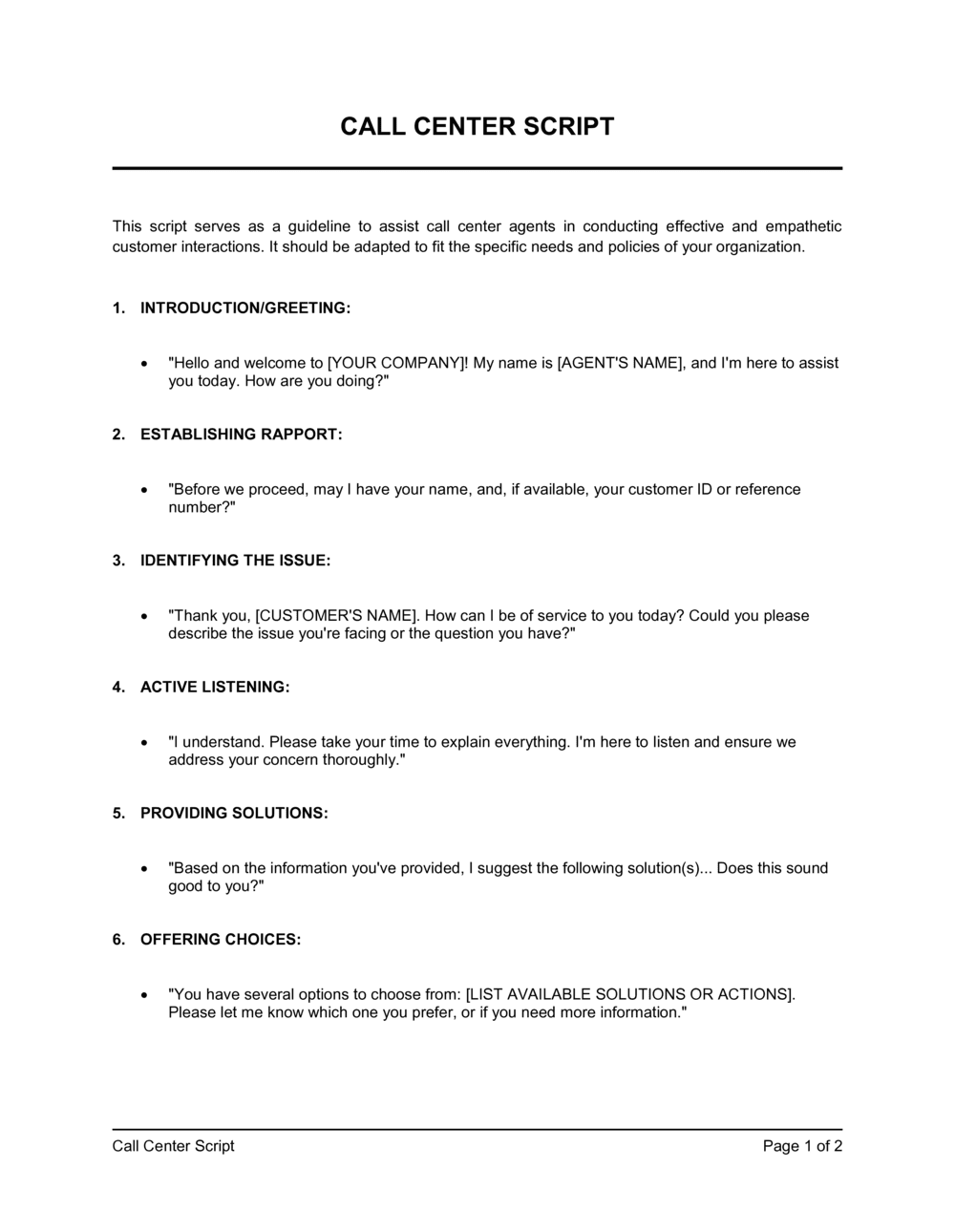
A Call Center Script is a structured, compliance-aware document that standardizes what agents say during inbound and outbound calls — covering greetings, product or service pitches, objection handling, regulatory disclosures, and call-close language. This free Word download gives you an editable, legally conscious framework you can customize for your product, industry, and jurisdiction, then export as PDF for agent training and operations use.
When you need it
Use it when launching or standardizing a call center operation, onboarding new agents, rolling out a new product or promotion over the phone, or when regulators or compliance auditors require documented call procedures. It is also essential any time agents are making sales calls subject to telemarketing or consumer protection regulations.
What's inside
Opening greeting and caller identification, purpose statement and pitch flow, key benefit talking points, objection-handling branches, required regulatory disclosures (Do Not Call, GDPR, TCPA, recording consent), offer summary and pricing, call-close and confirmation language, and escalation procedures for complaints or refusals.

What is a Call Center Script?

A Call Center Script is a structured, compliance-aware document that specifies the exact language call center agents use during inbound and outbound phone interactions — from the opening greeting and company identification through product pitch, mandatory regulatory disclosures, objection handling, verbal authorization capture, and call close. Unlike a loose talking-points document, a properly drafted call center script functions as an operational compliance record: it ensures every agent delivers required disclosures in the correct sequence, handles refusals lawfully, and creates a documented consent trail that supports the company in regulatory audits, chargeback disputes, and litigation. This free Word download gives you an editable, jurisdiction-aware framework you can customize for your call type, industry, and target markets, then export as PDF for agent training and ongoing operations use.

Why You Need This Document

Operating a call center — outbound or inbound — without a documented, legally reviewed script exposes your business to regulatory penalties, consumer litigation, and operational inconsistency that compounds with every call your agents make. The FTC's Telemarketing Sales Rule imposes civil penalties of up to $51,744 per violation for agents who fail to identify the seller, omit material terms, or continue pitching after a clear refusal. The TCPA has generated class-action settlements exceeding $100 million against companies whose agents made calls without documented consent. In the EU, a single undocumented recording or inadequate consent disclosure can trigger GDPR enforcement by national data protection authorities. Beyond regulatory exposure, an unscripted call center produces inconsistent customer experiences, higher complaint rates, and training costs that scale linearly with headcount. A documented, versioned call center script solves all three problems simultaneously: it delivers the disclosures regulators require, gives agents a proven conversation path that reduces handle time, and provides the audit trail that protects the company when a call is disputed. This template gives you that foundation in a format you can deploy immediately and update as regulations change.

Which variant fits your situation?

If your situation is…Use this template
Making outbound cold calls to new prospectsOutbound Sales Call Script
Handling inbound customer service and support callsInbound Customer Service Script
Following up on a quote, proposal, or trial sign-upFollow-Up Call Script
Collecting payment or discussing overdue accounts by phoneDebt Collection Call Script
Conducting customer satisfaction or NPS survey callsCustomer Survey Call Script
Onboarding a new customer after a saleWelcome and Onboarding Call Script
Handling escalated complaints or retention callsCustomer Retention and Escalation Script

Common mistakes to avoid

❌ Skipping the call recording disclosure

Why it matters: Recording a call without prior notice violates all-party consent laws in at least 12 US states and under GDPR. A single violation in California can cost $5,000; class actions have resulted in multi-million dollar settlements.

Fix: Place the recording disclosure as the second line of every script — immediately after the greeting — before any customer information is collected or the pitch begins.

❌ Continuing to pitch after an unambiguous refusal

Why it matters: The FTC's TSR defines continuing to pitch after a customer clearly says no as an abusive telemarketing practice, with civil penalties up to $51,744 per violation.

Fix: Write a hard stop into every objection-handling branch: if the objection repeats after one reframe, the script directs the agent to thank the caller, offer DNC opt-out, and end the call.

❌ Omitting material terms before obtaining verbal authorization

Why it matters: Under the TSR, all material terms — price, billing schedule, cancellation policy, and refund terms — must be disclosed before a consumer agrees. Omitting any one of them voids the authorization and triggers regulatory liability.

Fix: Build a pre-authorization checklist into the script: price confirmed, billing frequency confirmed, cancellation method confirmed. Agents check each box before advancing to the authorization read-back.

❌ Using vague data-sharing language in the consent clause

Why it matters: GDPR, CCPA, and CASL all require specific identification of how personal data will be used. Phrases like 'may be shared with third parties' are treated as no valid consent in regulatory enforcement and private litigation.

Fix: Name the specific purposes and recipient categories in the data privacy clause — for example, 'used to process your order and shared with our payment processor, [NAME]' — and have legal review the language before deployment.

❌ Using a single script across multiple jurisdictions

Why it matters: Disclosure requirements differ materially by country and US state. A script compliant in Texas may violate California's all-party consent law, Canada's CASL cooling-off requirements, or the UK's ICO guidance on consent language.

Fix: Create a jurisdiction-specific version of each script, or build a modular disclosure library — clearly labeled sections agents insert based on the caller's location.

❌ No version control or review date on deployed scripts

Why it matters: Regulations change. An un-dated script deployed for 18 months may have been compliant at launch but violates rules that changed after deployment — with no audit trail showing when it was last reviewed.

Fix: Print a version number, effective date, and reviewer name in the header of every script. Establish a calendar review cycle — at minimum annually, or whenever a relevant regulation changes.

The 10 key clauses, explained

Opening greeting and agent identification

In plain language: The exact words an agent uses at the start of the call to introduce themselves, identify the company, and establish purpose — legally required in many jurisdictions for outbound calls.

Sample language
Hello, may I speak with [CUSTOMER NAME]? This is [AGENT NAME] calling from [COMPANY NAME]. I'm calling today about [PURPOSE OF CALL].

Common mistake: Omitting the company name in the opening line. Under the TSR and most provincial telemarketing rules, failure to identify the seller's name promptly is a violation that can result in fines.

Call recording disclosure

In plain language: A statement at the start of the call notifying the party that the conversation may be recorded, satisfying one-party or all-party consent requirements depending on the jurisdiction.

Sample language
Please be aware that this call may be recorded or monitored for quality assurance and training purposes. By continuing this conversation, you consent to the recording.

Common mistake: Delivering the recording disclosure after gathering the caller's personal information. Recording without prior notice violates all-party consent laws in states like California, Illinois, and Florida, and under GDPR.

Purpose and value proposition statement

In plain language: A concise, accurate description of why the agent is calling and what benefit the product or service provides to the customer — must not contain false or misleading claims.

Sample language
The reason for my call today is to let you know about [PRODUCT/SERVICE], which helps [TARGET CUSTOMER] [ACHIEVE OUTCOME] for [PRICE/TERMS].

Common mistake: Using superlatives or unverifiable claims like 'best in the industry' without a substantiated basis. The FTC's TSR and UK ASA rules both prohibit misleading sales language in telemarketing calls.

Regulatory and mandatory disclosures

In plain language: Required disclosures that must be delivered during the call — including Do Not Call rights, debt collection mini-Miranda warnings, or GDPR data processing notices — depending on the call type and jurisdiction.

Sample language
If you do not wish to receive future calls from [COMPANY NAME], please let me know and we will add you to our internal Do Not Call list. You may also register with the National Do Not Call Registry at donotcall.gov.

Common mistake: Burying the DNC opt-out offer at the end of a long pitch. Both the FTC and FCC require that agents honor DNC requests promptly — failing to offer the option clearly triggers regulatory exposure.

Product or service offer and pricing

In plain language: A clear, accurate description of what is being offered, the price, payment terms, and any trial or promotional conditions — all material terms must be stated before the caller commits.

Sample language
Today we're offering [PRODUCT/SERVICE] at [PRICE] per [PERIOD/UNIT]. This includes [KEY FEATURES]. There [is / is no] contract, and you may cancel at any time by [CANCELLATION METHOD].

Common mistake: Omitting cancellation terms or burying them after verbal authorization is obtained. The TSR requires all material terms — including refund and cancellation policies — to be disclosed before a customer consents to a sale.

Objection handling branches

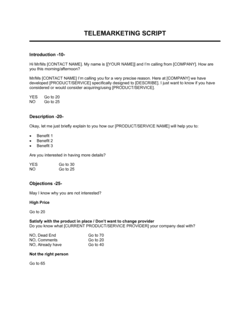
In plain language: Scripted responses to the most common caller objections — price, timing, competitor preference, or lack of interest — structured as a decision tree to guide agents through conversation paths.

Sample language
I understand this may not feel like the right time. Many of our customers felt the same way before they tried [PRODUCT/SERVICE] and found that [SPECIFIC BENEFIT]. Would it make sense to [ALTERNATIVE OFFER / CALLBACK]?

Common mistake: Writing objection responses that pressure callers who have clearly refused. Under the TSR, continuing to pitch after an unambiguous refusal is an abusive telemarketing practice subject to $51,744-per-violation penalties.

Verbal authorization and consent capture

In plain language: The script language used to obtain and record the caller's verbal agreement to a transaction, enrollment, or data use — the oral consent record that substitutes for a written signature.

Sample language
Before I proceed, I need to confirm a few things for our records. Can you confirm your full name is [CUSTOMER NAME] and your address is [ADDRESS]? And do you authorize [COMPANY NAME] to [ACTION] for [PRICE/TERMS]?

Common mistake: Reading authorization language too quickly or confirming on the customer's behalf rather than having them state agreement clearly. An ambiguous verbal record is not a valid consent and will not hold up in a chargeback dispute or regulatory audit.

Call-close and next-steps confirmation

In plain language: The closing exchange that summarizes what was agreed, sets expectations for delivery or follow-up, and thanks the caller — creating a clear record of the call's outcome.

Sample language
To confirm, you've agreed to [SUMMARY OF AGREEMENT]. You'll receive a [CONFIRMATION EMAIL / LETTER] at [EMAIL/ADDRESS] within [TIMEFRAME]. Is there anything else I can help you with today?

Common mistake: Ending the call before confirming the customer's contact information or next-step timing. Missing confirmation details leads to fulfillment failures, disputes, and repeat contacts that frustrate customers and inflate call volume.

Escalation and complaint handling procedure

In plain language: The scripted path for transferring a caller to a supervisor, handling a formal complaint, or documenting a refusal — required for regulated industries and essential for consistent service recovery.

Sample language
I understand your concern and I want to make sure this is resolved for you. Let me connect you with [SUPERVISOR / SPECIALIST] who can assist further. Please hold for just a moment while I transfer you.

Common mistake: Having no documented escalation path at all. Agents left to improvise on angry or complex calls produce inconsistent outcomes, generate more complaints, and expose the company to liability when conversations go off-script.

Data privacy and opt-out confirmation

In plain language: Language confirming how the caller's personal data collected during the call will be stored and used, and providing a clear opt-out or withdrawal-of-consent mechanism.

Sample language
The information you've shared today will be used by [COMPANY NAME] to [PURPOSE] and will be stored in accordance with our Privacy Policy. If you'd like to opt out of future contact or request deletion of your data, you can do so by [METHOD].

Common mistake: Using vague language like 'your data may be shared with partners.' GDPR, CASL, and CCPA all require specific, plain-language descriptions of data use — vague consent language is treated as no consent.

How to fill it out

  1. 1

    Identify the call type and regulatory environment

    Determine whether the script is for inbound or outbound calls, sales or service, and which jurisdictions your agents will be calling into. This governs which mandatory disclosures are required and in what order.

    💡 If you are calling US mobile numbers with an autodialer or prerecorded message, TCPA express written consent is required before the campaign begins — no script language can substitute for pre-obtained consent.

  2. 2

    Write the opening and company identification language

    Draft the first three lines an agent will speak — greeting, agent name, company name, and purpose. Keep it to two sentences. The company name and purpose must appear in the opening under TSR rules.

    💡 Test the opening by timing it — it should be deliverable in under 10 seconds. Callers who feel ambushed by a long preamble hang up before the agent finishes.

  3. 3

    Insert all required disclosures in sequence

    Place the call recording disclosure immediately after the greeting, before any personal information is collected. Add the DNC opt-out offer before the pitch. For debt collection calls, include the mini-Miranda warning before discussing the account.

    💡 Create a disclosure checklist for each jurisdiction your agents call into and highlight each disclosure in a different color in the script so agents cannot skip it.

  4. 4

    Draft the offer and pricing language with all material terms

    Write the product or service description with exact price, billing frequency, trial terms, and cancellation method. Every material term must appear before the verbal authorization step.

    💡 Read the draft offer language aloud and time it — if it takes more than 45 seconds, you are including too many features. Lead with the single most relevant benefit for the target audience.

  5. 5

    Build the objection-handling decision tree

    Identify the four to six most common objections for this call type (price, timing, competition, no interest, need to consult spouse/manager). Write two to three sentences for each — acknowledge, reframe, and offer an alternative or callback.

    💡 Stop each objection branch with a clear exit instruction: if the caller repeats the objection after one reframe, the script should direct the agent to accept the refusal and offer the DNC opt-out.

  6. 6

    Write the verbal authorization and consent capture script

    Draft the exact read-back language for confirming the customer's identity, agreed terms, and authorization. Ensure the customer is asked to say 'yes' or 'I agree' explicitly — not led to it with a leading question.

    💡 Record a sample authorization exchange during agent training and compare it against the script verbatim. Even small deviations — like paraphrasing price — can invalidate the consent record.

  7. 7

    Add the close, confirmation, and opt-out language

    Write the closing summary of what was agreed, the expected follow-up (confirmation email or letter within a stated timeframe), and the data opt-out mechanism. Include the escalation path for agents who encounter a complaint at close.

    💡 End the script with a single, clear disposition instruction: what code the agent enters into the CRM for each call outcome. Inconsistent dispositions corrupt your compliance reporting.

  8. 8

    Have legal or compliance review the final script

    Submit the completed script to a legal or compliance reviewer familiar with TSR, TCPA, CASL, GDPR, or applicable national telemarketing regulations before any agents use it. Document the review date and reviewer name on the script itself.

    💡 Treat the reviewed script as a versioned document — include a version number and effective date in the header. Any material change to the script restarts the review process.

Frequently asked questions

What is a call center script?

A call center script is a structured document that specifies the exact language agents use during phone calls — covering the opening greeting, product or service pitch, mandatory regulatory disclosures, objection handling, verbal authorization language, and call close. It serves two purposes simultaneously: ensuring a consistent, professional caller experience and documenting compliance with telemarketing and consumer protection regulations.

Are call center scripts legally required?

No law explicitly requires a written call center script, but the regulatory disclosures that scripts deliver are required by law in most jurisdictions. The US FTC's Telemarketing Sales Rule, the TCPA, Canada's CASL, the UK's Privacy and Electronic Communications Regulations, and the EU's GDPR all mandate specific statements or consent captures during telemarketing and outbound calls. A documented script is the practical way to prove agents made those disclosures consistently.

What disclosures must a call center script include for US outbound calls?

For outbound telemarketing calls in the US, the script must include: the seller's identity and the purpose of the call at the outset; all material terms of any offer before requesting payment or authorization; the customer's right to be placed on a Do Not Call list; and — for debt collection calls — the mini-Miranda warning. For calls made with an autodialer or prerecorded message, prior express written consent is required before the call is even placed.

What is the TCPA and how does it affect call scripts?

The Telephone Consumer Protection Act restricts calls made with autodialers or prerecorded messages to mobile numbers, requiring prior express written consent from the recipient. For calls made by a live agent to landlines or mobile numbers without an autodialer, the TCPA primarily enforces DNC list compliance. Scripts for autodialed or prerecorded campaigns must reference the consent mechanism and never substitute scripted language for the required pre-call consent.

What is the difference between an inbound and outbound call center script?

An inbound script is designed for calls the customer initiates — support inquiries, order status checks, or complaints — where the agent's goal is service and resolution. An outbound script is for calls the company initiates — sales, collections, or surveys — where regulatory disclosure requirements are significantly stricter. Outbound scripts must include TSR-required disclosures, DNC opt-out offers, and pre-authorization material term summaries that inbound scripts typically do not require.

Do call center scripts need to be reviewed by a lawyer?

For scripts used in outbound sales or debt collection, legal review is strongly recommended before deployment. Violations of the TSR or TCPA carry civil penalties of up to $51,744 per call, and class-action exposure under the TCPA has resulted in settlements exceeding $100 million. Scripts for inbound customer service present lower regulatory risk but should still be reviewed if they include upsell language, credit card capture, or data processing consent.

How often should call center scripts be updated?

Scripts should be reviewed at minimum once per year and immediately after any change to applicable telemarketing or data privacy regulations. Major triggers for unscheduled review include: a new product or pricing change, a regulatory enforcement action against a competitor using similar language, a TCPA or GDPR rule update, or a material increase in call complaints or chargebacks suggesting the script is generating confusion.

Can a call center script be used as evidence in a compliance dispute?

Yes. A versioned, dated script combined with call recordings is the primary evidence base for demonstrating regulatory compliance in FTC investigations, CFPB audits, ICO inquiries, or chargeback disputes. Conversely, a script that documents non-compliant language — or the absence of a required disclosure — can be used against the company. This is why legal review and version control are not optional for outbound sales operations.

What happens if an agent goes off-script?

Off-script statements that create a false impression, omit required disclosures, or pressure a caller after refusal can trigger personal and company liability regardless of what the written script says. Companies are liable for agent conduct under respondeat superior principles. Mitigating factors include a documented script with the required disclosures, recorded training confirming agents were trained on the script, and call monitoring that flags deviations promptly.

How this compares to alternatives

vs Customer Service Policy

A customer service policy sets the company's standards, commitments, and response-time targets at an organizational level — it is an internal governance document. A call center script operationalizes those standards into the exact language agents speak on live calls. Both are needed: the policy defines the rules, the script enforces them in real time.

vs Sales Script

A general sales script focuses on persuasion flow — pitch, benefit statements, and closing language — without necessarily incorporating regulatory compliance elements. A call center script adds mandatory disclosures, DNC opt-out language, verbal authorization capture, and escalation procedures required by telemarketing law. For outbound calling programs, a sales script alone is legally insufficient.

vs Telemarketing Agreement

A telemarketing agreement is a contract between two parties — typically a business and an outsourced call center — governing service levels, compliance obligations, and liability allocation. A call center script is the operational document agents follow during calls. The agreement governs the relationship; the script governs the conversation.

vs Customer Complaint Form

A customer complaint form captures grievances after an interaction — it is a passive intake document. A call center script's escalation section handles complaints in real time during a live call, routing the caller to a resolution path before they disengage. Both are part of a complete customer service framework, but they serve opposite points in the complaint lifecycle.

Industry-specific considerations

Financial Services

Scripts must include CFPB-aligned fair lending disclosures, mini-Miranda warnings for collections calls, and clear APR and fee language before verbal authorization on any credit product.

Healthcare

HIPAA prohibits discussing patient information on recorded lines without express authorization; scripts must include HIPAA consent capture and handle PHI references through secure verification steps rather than open recitation.

Retail and E-commerce

Order confirmation and upsell scripts must disclose all billing terms, recurring charges, and cancellation methods before authorization to comply with FTC negative option rules and state auto-renewal laws.

Telecommunications

Subject to FCC slamming and cramming rules, requiring explicit verbal confirmation of service changes and prohibiting enrollment in new services without clear, unambiguous customer authorization documented on the call recording.

Jurisdictional notes

United States

The FTC's Telemarketing Sales Rule and the TCPA are the primary federal frameworks. The TSR requires prompt seller identification, material term disclosure before authorization, and honoring DNC requests immediately. The TCPA requires prior express written consent for autodialed or prerecorded calls to mobile numbers. At least 12 states — including California, Florida, and Illinois — require all-party consent for call recording, stricter than the federal one-party standard. State-level telemarketing registration requirements apply in many jurisdictions.

Canada

Canada's Anti-Spam Legislation (CASL) and the Unsolicited Telecommunications Rules (UTR) govern outbound calls. CASL requires express or implied consent before commercial electronic messages, including automated calls. The UTR mandates that callers identify themselves within the first 60 seconds, state the purpose of the call, and provide contact information. Canada's National Do Not Call List must be scrubbed before any outbound campaign. Quebec's Act Respecting the Protection of Personal Information in the Private Sector adds additional consent and transparency obligations for data collected during calls.

United Kingdom

The Privacy and Electronic Communications Regulations (PECR) and the ICO's direct marketing guidance govern outbound calls. Calls to individuals who have registered with the Telephone Preference Service (TPS) are prohibited without prior consent. Live calls to businesses may proceed without TPS screening, but must still comply with GDPR for any personal data processing. Call recording requires compliance with GDPR's lawful basis requirements — consent or legitimate interest — with appropriate notice. The ICO has issued fines exceeding £500,000 for unlawful direct marketing calls.

European Union

GDPR governs all personal data processing during calls, including recordings. Consent for marketing calls must be freely given, specific, informed, and unambiguous — pre-ticked boxes or bundled consent do not qualify. The ePrivacy Directive restricts unsolicited direct marketing calls to individuals without prior consent in most member states. Germany and France maintain particularly strict opt-in requirements, while some member states permit soft opt-in for existing customers. Call recordings that capture personal data must comply with GDPR's data minimization, retention limitation, and data subject rights obligations.

Template vs lawyer — what fits your deal?

PathBest forCostTime
Use the templateInbound customer service scripts and low-volume outbound calls for established businesses with existing compliance programsFree2–4 hours to customize and deploy
Template + legal reviewOutbound sales scripts for any volume, or any script used in a regulated industry such as financial services, healthcare, or telecommunications$300–$800 for a compliance attorney or telemarketing law specialist review3–5 business days
Custom draftedHigh-volume outbound campaigns, multi-jurisdiction programs, debt collection scripts, or any operation subject to CFPB, FCC, or ICO oversight$1,500–$5,000+ depending on call type and jurisdictions covered1–3 weeks

Glossary

TCPA (Telephone Consumer Protection Act)
A US federal law restricting unsolicited telephone calls, text messages, and fax communications, requiring prior express consent for autodialed or prerecorded calls.
TSR (Telemarketing Sales Rule)
An FTC rule governing outbound telemarketing calls in the US, covering required disclosures, prohibited practices, and Do Not Call list compliance.
Do Not Call (DNC) Registry
A government-maintained list of telephone numbers whose owners have opted out of receiving unsolicited telemarketing calls.
Call Recording Consent
A disclosure — typically delivered at the start of a call — informing the caller or called party that the conversation may be recorded, as required by applicable wiretapping and privacy laws.
Mini-Miranda Warning
A required disclosure in US debt collection calls identifying the call as an attempt to collect a debt and that any information obtained will be used for that purpose.
Objection Handling
Scripted responses agents use to address a caller's stated reason for declining or hesitating, guiding the conversation toward a positive resolution.
Call Disposition
A coded outcome label applied to each call after it ends — such as Sale, No Answer, Callback Requested, or DNC — used for reporting and compliance tracking.
GDPR (General Data Protection Regulation)
EU regulation requiring that personal data collected during a call — including recordings — be processed lawfully, with adequate notice and a valid legal basis such as consent or legitimate interest.
Verbal Authorization
An oral confirmation from the caller agreeing to a transaction, service enrollment, or data processing — used as the consent record when a written signature is not obtained.
Branching Script
A call script structured as a decision tree, where the agent's next line depends on the caller's response at each step, covering multiple conversation paths from a single document.
Express Written Consent
Under the TCPA, a signed or electronically documented agreement from a consumer authorizing a company to contact them via autodialer or prerecorded message for marketing purposes.

Part of your Business Operating System

This document is one of 3,000+ business & legal templates included in Business in a Box.

  • Fill-in-the-blanks — ready in minutes
  • Compatible with all office suites
  • Export to PDF and share electronically

Create your document in 3 simple steps.

From template to signed document — all inside one Business Operating System.
1
Download or open template

Access over 3,000+ business and legal templates for any business task, project or initiative.

2
Edit and fill in the blanks with AI

Customize your ready-made business document template and save it in the cloud.

3
Save, Share, Send, Sign

Share your files and folders with your team. Create a space of seamless collaboration.

Save time, save money, and create top-quality documents.

★★★★★

"Fantastic value! I'm not sure how I'd do without it. It's worth its weight in gold and paid back for itself many times."

Managing Director · Mall Farm
Robert Whalley
Managing Director, Mall Farm Proprietary Limited
★★★★★

"I have been using Business in a Box for years. It has been the most useful source of templates I have encountered. I recommend it to anyone."

Business Owner · 4+ years
Dr Michael John Freestone
Business Owner
★★★★★

"It has been a life saver so many times I have lost count. Business in a Box has saved me so much time and as you know, time is money."

Owner · Upstate Web
David G. Moore Jr.
Owner, Upstate Web

Run your business with a system — not scattered tools

Stop downloading documents. Start operating with clarity. Business in a Box gives you the Business Operating System used by over 250,000 companies worldwide to structure, run, and grow their business.

Free Forever Plan · No credit card required