How To Attract Clients and Maximize Your Freelance Business

Free to read β€’ Save or share with one click

FreeHow To Attract Clients and Maximize Your Freelance Business Template

At a glance

What it is
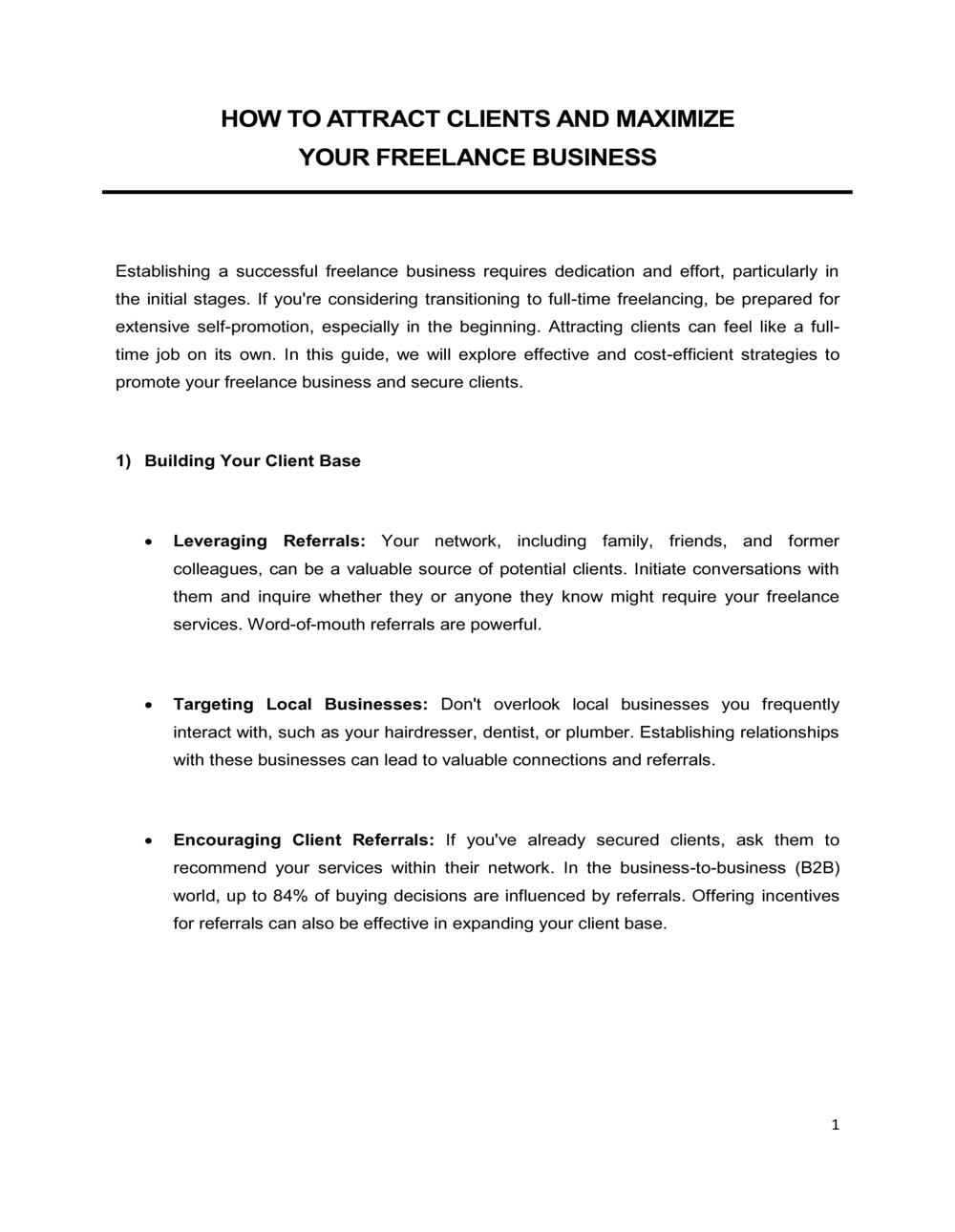
How To Attract Clients And Maximize Your Freelance Business is a structured operational guide that walks independent professionals through every stage of building a sustainable client pipeline β€” from defining a niche and positioning a personal brand to setting rates, closing engagements, and generating referrals. This free Word download gives you a ready-to-customize framework you can edit online and export as PDF to use as a personal growth roadmap or share with a business mentor or coach.
When you need it
Use it when launching a freelance practice, transitioning from a full-time role to self-employment, or when an existing freelance business has plateaued and needs a structured approach to consistent client acquisition and revenue growth.
What's inside
Niche definition and target client profile, personal brand and positioning statement, outreach and networking strategy, portfolio and social proof, rate setting and pricing models, proposal and pitch process, client retention and referral systems, and a 90-day action plan with measurable milestones.

What is How To Attract Clients And Maximize Your Freelance Business?

How To Attract Clients And Maximize Your Freelance Business is a structured operational guide that walks independent professionals through the complete process of building a sustainable, growing freelance practice β€” from defining a focused niche and crafting a positioning statement to setting profitable rates, running an outreach cadence, converting proposals, and generating referrals from satisfied clients. Unlike a general business plan, it is purpose-built for the specific challenge freelancers face: creating a reliable client pipeline without a sales team, marketing budget, or established brand. The guide combines strategic frameworks with a concrete 90-day action plan so that every section translates directly into weekly activities you can track and adjust.

Why You Need This Document

Most freelancers stall not because of a skills gap, but because they have no system β€” outreach is sporadic, positioning is too broad to stand out, and referrals are left to chance. The result is a feast-or-famine income cycle that makes freelancing feel unsustainable. Without a written strategy, it is impossible to identify which activity produced a lead, which channel converts best, or why a proposal was lost. This guide gives you the structure to diagnose and fix each of those gaps in sequence, turning client acquisition from an unpredictable event into a repeatable process. The free Word download means you can customize every section to your niche, rates, and market β€” and start executing within a single working day.

Which variant fits your situation?

If your situation is…Use this template
Starting a freelance practice with no existing client baseHow To Attract Clients And Maximize Your Freelance Business
Formalizing the business side of freelancing with a full operational planFreelance Business Plan
Presenting services to a prospective clientFreelance Proposal Template
Protecting intellectual property and setting deliverable termsFreelance Contract
Building a structured marketing strategy alongside client outreachMarketing Plan
Setting and tracking 90-day goals for freelance growthAction Plan Template
Defining rates and packaging service tiersConsulting Proposal

Common mistakes to avoid

❌ Positioning as a generalist to appeal to more clients

Why it matters: Generalist positioning makes every pitch feel average and forces the freelancer to compete on price. Clients hiring for specialized problems pay premium rates for specialists.

Fix: Pick one niche and commit to it for at least 90 days. Measure inbound quality and rate achieved before deciding to broaden scope.

❌ Sending proposals without a discovery call

Why it matters: Proposals written without understanding the client's actual situation miss the real decision criteria and typically require multiple revisions, signaling inexperience.

Fix: Gate every proposal behind a 20–30 minute discovery call. If the prospect refuses a call before seeing a proposal, that is a strong signal of low buying intent.

❌ Setting rates by copying competitor pricing

Why it matters: Competitor rates reflect their cost structure, client relationships, and positioning β€” none of which match yours. Anchoring to them produces rates that may be unsustainable or leave significant money on the table.

Fix: Start from your income target and work backward to a rate. Then validate against market data as a sanity check, not as the primary input.

❌ Waiting for referrals to arrive organically

Why it matters: Satisfied clients rarely refer proactively β€” not because they are unwilling, but because it simply does not occur to them at the right moment. Passive referral strategies produce sporadic, unreliable leads.

Fix: Schedule a referral ask 2–4 weeks after every successful project close. A single specific question β€” 'Do you know one person who would benefit from [result]?' β€” converts far better than a general 'feel free to refer me.'

❌ Treating the 90-day plan as a wish list with no tracking

Why it matters: Without weekly activity metrics, it is impossible to know whether a slow pipeline is caused by insufficient outreach, poor messaging, or a wrong channel β€” meaning no corrective action is possible.

Fix: Track three leading-indicator metrics weekly: outreach contacts sent, discovery calls booked, and proposals submitted. Review against targets every Friday.

❌ Building a portfolio of samples rather than case studies

Why it matters: Work samples show capability; case studies demonstrate impact. Clients evaluating freelancers want evidence that hiring you will produce a measurable result, not just competent output.

Fix: Reframe every portfolio piece as a before-and-after story with a specific, quantified outcome. Replace 'website redesign for Company X' with 'redesign that increased conversion rate from 1.8% to 3.4% in 60 days.'

The 9 key sections, explained

Defining your niche and service offering

Ideal client profile

Personal brand and positioning statement

Outreach and networking strategy

Portfolio and social proof

Rate setting and pricing model

Proposal and pitch process

Client retention and referral system

90-day action plan and milestones

How to fill it out

  1. 1

    Define your niche before filling any other section

    Write down the specific industry you serve, the type of client within that industry, and the single most pressing problem you solve for them. Test whether a stranger could immediately understand who you help and how.

    πŸ’‘ If your niche statement includes the word 'anyone,' narrow it. A freelance copywriter for SaaS onboarding teams earns more than a general copywriter because the positioning is specific enough to justify premium pricing.

  2. 2

    Build your ideal client profile from real examples

    Think of the two or three best clients you have worked with β€” or would most like to work with β€” and list their company size, industry, budget, decision-maker title, and the trigger that made them ready to hire. Composite those into a single ICP.

    πŸ’‘ Note what those clients said when they first reached out. That language belongs in your outreach copy and proposal headlines.

  3. 3

    Draft a positioning statement and test it on a peer

    Write one sentence covering who you serve, what outcome you deliver, and what makes your approach distinct. Read it to someone outside your field and ask what they think you do.

    πŸ’‘ If the response is vague or confused, the positioning is not specific enough. Replace adjectives with numbers or named methodologies.

  4. 4

    Map two primary outreach channels and set a weekly cadence

    Choose the two channels where your ideal clients spend time and define a specific, repeatable weekly activity β€” e.g., 10 LinkedIn connection requests on Monday, 5 follow-up messages on Wednesday.

    πŸ’‘ Track outreach in a simple spreadsheet: contact name, date sent, response, and next step. After 4 weeks you will have enough data to see which channel converts better.

  5. 5

    Assemble three portfolio case studies with measurable results

    For each case study, write the client's situation before hiring you, what you did, and the measurable outcome β€” revenue generated, time saved, ranking improved, or cost reduced. Use numbers wherever possible.

    πŸ’‘ If you are just starting out and have no paid clients, complete one or two pro-bono or discounted projects specifically to generate a case study with a real result.

  6. 6

    Set your rates against your income target, not the market average

    Calculate your target monthly income, add 30% for taxes and business expenses, then divide by the number of billable hours or projects you can realistically deliver. That is your floor rate β€” not your final rate.

    πŸ’‘ Price your retainer offers at a level that requires two to three retainer clients to cover your baseline expenses. This anchors your outreach priority on retainer-ready prospects.

  7. 7

    Document your proposal process and follow-up timing

    Write down every step from first inquiry to signed contract, including how many days you wait before following up. Build a simple email template for each stage so you are not drafting from scratch under time pressure.

    πŸ’‘ Send proposals within 24–48 hours of a discovery call. Conversion rates drop sharply after 72 hours as the client's urgency cools.

  8. 8

    Schedule your 90-day review dates now

    Before you close the document, add three calendar reminders β€” Day 30, Day 60, and Day 90 β€” to review your activity metrics against the milestones you set. Treat these like client deadlines.

    πŸ’‘ At each review, answer: what activity produced the most qualified leads? Double down on that and cut the lowest-performing channel.

Frequently asked questions

How do I attract my first freelance clients with no track record?

Start by completing one or two pro-bono or heavily discounted projects for organizations whose results you can document and publish as case studies. Simultaneously, leverage your existing professional network β€” former colleagues, managers, and classmates are the highest-converting source of first clients because they already know your work ethic. A specific, targeted LinkedIn outreach message to 10 warm contacts per week consistently outperforms cold outreach to strangers at this stage.

What is the most effective way to stand out as a freelancer?

Specialization is the single highest-leverage differentiator. A freelancer who positions as a conversion copywriter specifically for B2B SaaS onboarding sequences will win pitches and command higher rates than a generalist copywriter, even with identical skills. Pair a focused niche with 2–3 published case studies showing measurable client results, and most of your credibility work is done.

How should I set my freelance rates?

Start with your target annual income, add 30–35% to cover taxes and business expenses, then divide by realistic billable hours or project volume to find your floor rate. Use value-based pricing where possible β€” anchor rates to the business outcome you deliver rather than hours worked. If a project saves a client $50,000 in annual costs, a $5,000 project fee is easy to justify regardless of the hours involved.

How many clients should a freelancer have at once?

Most full-time freelancers work sustainably with 3–6 active clients at any one time, depending on project size and scope. A mix of one or two anchor retainer clients providing predictable monthly income plus two to four project-based clients creates stability without overcommitment. More than six simultaneous clients typically degrades delivery quality and increases client churn.

What is the difference between an hourly rate and a project rate?

An hourly rate bills for time spent and creates uncertainty for the client on total cost. A project rate sets a fixed price for a defined deliverable, shifting the risk of efficiency to the freelancer. Most experienced freelancers migrate toward project and retainer pricing because it rewards expertise β€” a task that takes 30 minutes due to deep experience should not be billed at the same rate as a junior spending 3 hours on the same task.

How do I turn one-off projects into retainer clients?

At the end of every project, identify the ongoing problem your work addressed and propose a monthly retainer structured around maintaining or expanding that result. Frame it in terms of what the client loses without continued engagement, not what they gain. Offer a 3-month trial retainer at a slight discount to lower the commitment threshold. Retainer conversations are most effective within 1–2 weeks of a successful project delivery.

Which platforms are best for finding freelance clients?

Platform effectiveness depends on your niche and price point. LinkedIn dominates for B2B consulting and professional services above $5,000 per project. Upwork and Fiverr work well for creative and technical services at lower to mid price points, though rate ceilings are lower. Industry associations, Slack communities, and in-person events produce the highest-quality leads for specialist freelancers because the trust baseline is already established.

How long does it take to build a stable freelance client pipeline?

Most freelancers reach a stable, fully-booked pipeline within 3–6 months of consistent, targeted outreach β€” provided they have clear positioning, a credible portfolio, and a defined weekly outreach cadence of at least 10–15 contacts per week. Sporadic outreach extends that timeline significantly. The 90-day action plan framework in this guide is specifically designed to compress that ramp by sequencing the highest-leverage activities first.

Do I need a website to attract freelance clients?

A website helps but is not required to win your first clients. A complete, well-written LinkedIn profile with a clear positioning headline, a featured section showing portfolio work, and active posting in your niche can generate qualified inbound leads without a website. Build the website once you have validated your niche and have two or three strong case studies to anchor it β€” doing it in the reverse order often means rebuilding the site after your positioning evolves.

How this compares to alternatives

vs Freelance Business Plan

A freelance business plan covers entity structure, financial projections, operational model, and legal setup for running a freelance business as a formal entity. This guide focuses specifically on client acquisition tactics, positioning, outreach, and revenue growth. Use both together when launching a full-time practice; start with this guide if client pipeline is the immediate priority.

vs Marketing Plan

A marketing plan documents brand strategy, campaign calendars, channel budgets, and audience targeting for a business. This guide is a personal operational framework for individual freelancers β€” it is lighter on campaign infrastructure and heavier on direct outreach, portfolio building, and one-to-one relationship development. A freelancer with a growing practice may eventually need both.

vs Freelance Proposal

A freelance proposal is a client-facing document sent to a specific prospect outlining deliverables, timeline, and pricing. This guide is an internal strategy and action plan for building the pipeline that generates proposal opportunities. The guide produces the leads; the proposal closes them.

vs Action Plan Template

An action plan template is a generic goal-execution framework applicable across business contexts. This guide is purpose-built for freelance client acquisition β€” it provides freelance-specific frameworks for positioning, rate setting, and referral systems that a generic action plan does not include. Use the action plan template to track execution of the strategy defined here.

Industry-specific considerations

Creative and Design

Portfolio presentation, per-project pricing for design deliverables, and platform selection between Behance-driven inbound and direct LinkedIn outreach.

Technology and Development

Technical niche positioning (e.g., React front-end, Salesforce integration), GitHub portfolio as social proof, and retainer structuring around ongoing maintenance contracts.

Professional Services and Consulting

Thought leadership content as inbound driver, value-based pricing anchored to measurable business outcomes, and long-term retainer relationships with mid-size firms.

Content and Copywriting

Niche by industry and content type (e.g., SaaS email sequences), clips-based portfolio with conversion metrics, and recurring content retainer packages by word count or deliverable.

Template vs pro β€” what fits your needs?

PathBest forCostTime
Use the templateNew and established freelancers who want a structured, self-directed client acquisition strategyFree2–4 hours to complete; 90 days to execute
Template + professional reviewFreelancers investing in accelerated growth who want feedback from a business coach or experienced mentor$200–$800 for a coaching session or freelance business advisor review1–2 weeks
Custom draftedFreelancers building an agency or scaling to a multi-person consultancy requiring a full go-to-market strategy$1,500–$5,000 for a marketing strategist or business consultant engagement3–6 weeks

Glossary

Niche
A focused segment of a market defined by industry, audience type, or problem type β€” the more specific, the easier it is to stand out and charge premium rates.
Ideal Client Profile (ICP)
A detailed description of the type of client most likely to hire you, pay on time, refer others, and benefit most from your specific expertise.
Positioning Statement
A one- to two-sentence declaration of who you serve, what problem you solve, and what makes your approach distinct from other freelancers.
Retainer
An ongoing engagement where a client pays a fixed monthly fee for a defined scope of work or availability, providing predictable recurring income.
Value-Based Pricing
Setting rates based on the measurable outcome or business value delivered to the client, rather than on hours worked or market averages.
Social Proof
Evidence β€” testimonials, case studies, published results, or client logos β€” that demonstrates your track record and reduces the perceived risk for new clients.
Inbound Lead
A prospective client who contacts you after finding your content, portfolio, or profile β€” attracted rather than cold-approached.
Outbound Outreach
Proactively contacting prospective clients by email, LinkedIn message, or phone to introduce your services and open a conversation.
Proposal
A written document sent to a prospective client that outlines the problem, your proposed solution, deliverables, timeline, and pricing.
Referral System
A structured process for asking satisfied clients and professional contacts to recommend your services to others, typically with clear timing and a simple ask.

Part of your Business Operating System

This document is one of 3,000+ business & legal templates included in Business in a Box.

  • Fill-in-the-blanks β€” ready in minutes
  • Compatible with all office suites
  • Export to PDF and share electronically

Create your document in 3 simple steps.

From template to signed document β€” all inside one Business Operating System.
1
Download or open template

Access over 3,000+ business and legal templates for any business task, project or initiative.

2
Edit and fill in the blanks with AI

Customize your ready-made business document template and save it in the cloud.

3
Save, Share, Send, Sign

Share your files and folders with your team. Create a space of seamless collaboration.

Save time, save money, and create top-quality documents.

β˜…β˜…β˜…β˜…β˜…

"Fantastic value! I'm not sure how I'd do without it. It's worth its weight in gold and paid back for itself many times."

Managing Director Β· Mall Farm
Robert Whalley
Managing Director, Mall Farm Proprietary Limited
β˜…β˜…β˜…β˜…β˜…

"I have been using Business in a Box for years. It has been the most useful source of templates I have encountered. I recommend it to anyone."

Business Owner Β· 4+ years
Dr Michael John Freestone
Business Owner
β˜…β˜…β˜…β˜…β˜…

"It has been a life saver so many times I have lost count. Business in a Box has saved me so much time and as you know, time is money."

Owner Β· Upstate Web
David G. Moore Jr.
Owner, Upstate Web

Run your business with a system β€” not scattered tools

Stop downloading documents. Start operating with clarity. Business in a Box gives you the Business Operating System used by over 250,000 companies worldwide to structure, run, and grow their business.

Start freeΒ Β·Β No credit card required