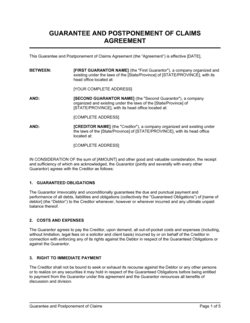
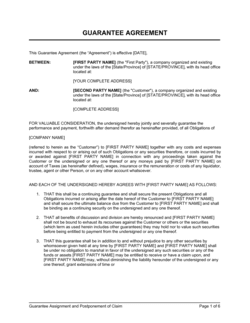
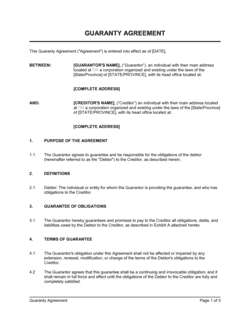
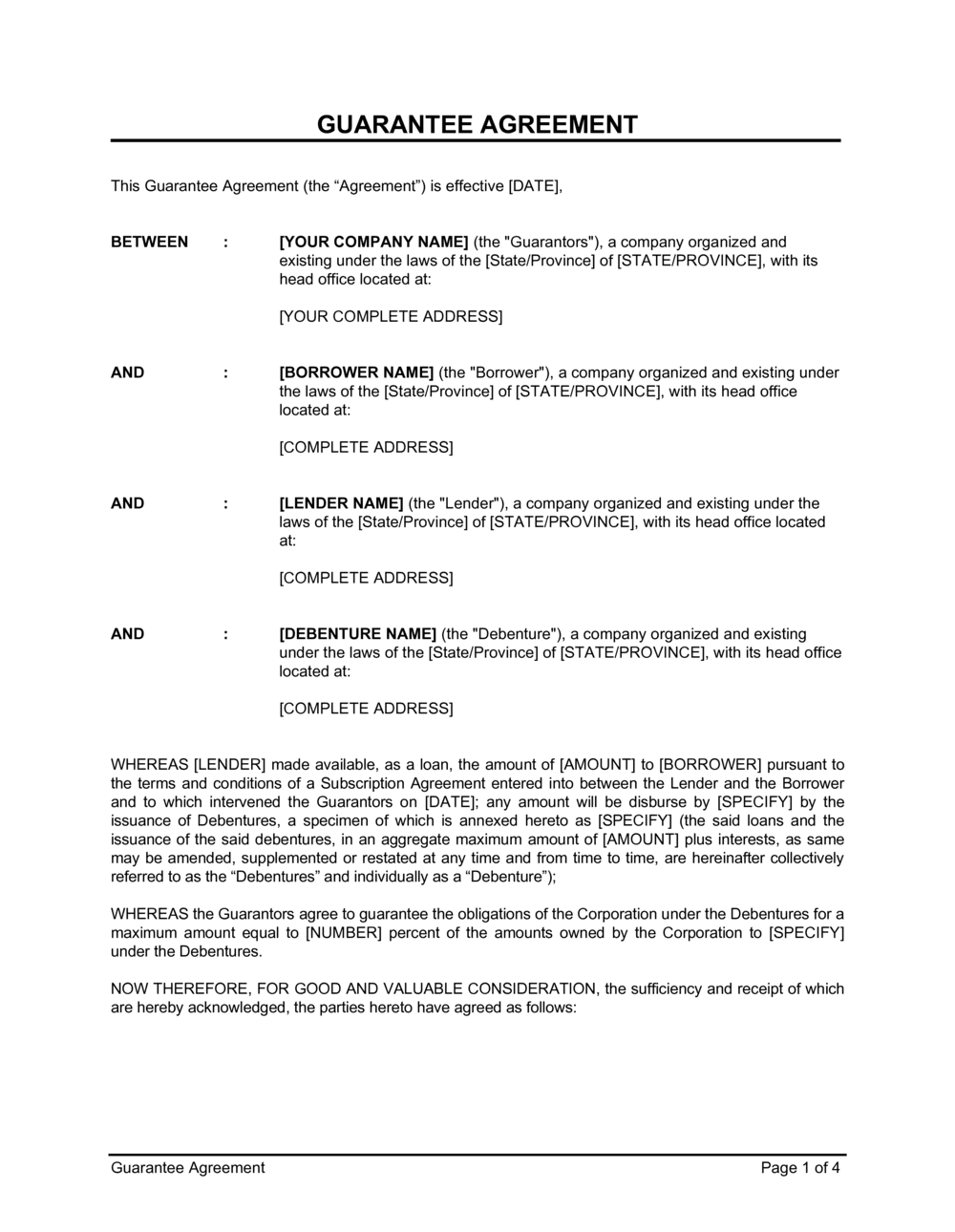
Guarantee Agreement Template

Free Word download • Edit online • Save & share with Drive • Export to PDF

4 pages25–30 min to fillDifficulty: ComplexSignature requiredLegal review recommended
Learn more ↓
FreeGuarantee Agreement Template

At a glance

What it is
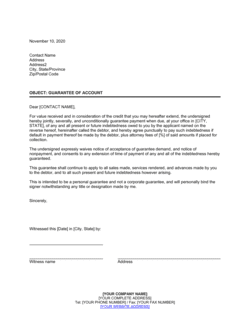
A Guarantee Agreement is a legally binding undertaking in which a guarantor agrees to be personally or corporately liable for the obligations of a primary debtor if that debtor defaults. This free Word download covers scope of liability, duration, demand mechanics, waiver of defenses, and the guarantor's rights — giving banks, landlords, and major suppliers an enforceable secondary source of repayment in a single document.
When you need it
Use it whenever a creditor requires a third-party backstop before extending credit, entering a lease, or committing to a supply arrangement — most commonly when the primary debtor is a newly formed entity, has insufficient credit history, or lacks the assets to satisfy the obligation alone.
What's inside
Parties and recitals, guaranteed obligations and cap on liability, demand and payment mechanics, guarantor's representations, waiver of defenses (including presentment and notice of default), subrogation rights, continuing vs. limited guarantee election, termination and release conditions, and governing law with jurisdiction-specific enforcement notes.

What is a Guarantee Agreement?

A Guarantee Agreement is a legally binding contract in which a guarantor — an individual or corporate entity — unconditionally undertakes to be liable for the obligations of a principal debtor if that debtor fails to pay or perform. It is a secondary obligation: the guarantor's duty is triggered by the debtor's default, not by the underlying transaction itself. Banks require one before approving a small-business loan to a newly incorporated LLC; commercial landlords demand one before signing a multi-year lease with a startup tenant; suppliers insist on one before extending open-account trade credit to a customer with limited credit history. The agreement defines what is guaranteed, up to what amount, for how long, and exactly what procedural steps the creditor must — or, after a waiver, need not — take before calling on the guarantee.

Why You Need This Document

Without a written guarantee agreement, a creditor has no enforceable secondary source of recovery when a debtor defaults — leaving them dependent entirely on the debtor's own assets, which are often the first to disappear in a financial crisis. For the guarantor, an undocumented or loosely worded guarantee creates the opposite problem: open-ended personal exposure to obligations that were never clearly defined or capped. A properly drafted guarantee agreement eliminates both risks. It gives the creditor a clear, unconditional enforcement path — including waiver of the procedural defenses that otherwise require exhausting remedies against the debtor first. It gives the guarantor a defined scope of liability, a release mechanism when the debt is repaid, and subrogation rights to recover from the debtor afterward. This template provides the clause-level structure that banks, lawyers, and courts expect to see, so you are not drafting from scratch for one of the most consequential documents a business owner or lender will ever sign.

Which variant fits your situation?

If your situation is…Use this template
Guaranteeing all present and future obligations of the debtor with no fixed end dateContinuing Guarantee Agreement
Guaranteeing a single, defined transaction up to a specified dollar amountLimited Guarantee Agreement
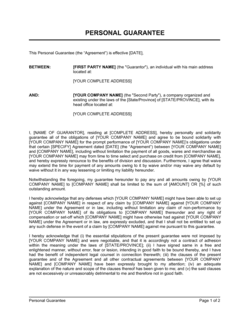
Individual owner personally guaranteeing a corporate loan or leasePersonal Guarantee Agreement
Parent entity backstopping a subsidiary's obligations to a counterpartyCorporate Guarantee Agreement
Multiple guarantors each liable for the full amount independentlyJoint and Several Guarantee Agreement
Guaranteeing performance of contractual duties rather than payment of moneyPerformance Guarantee Agreement
Bank requiring a guarantee as part of a commercial real estate loan packageGuarantee Agreement (Real Estate Loan)

Common mistakes to avoid

❌ Signing after the underlying obligation is already extended

Why it matters: In many common-law jurisdictions a guarantee signed after credit is already in place may be void for lack of consideration — the creditor gave nothing new in exchange for the guarantor's promise.

Fix: Execute the guarantee simultaneously with or before the closing of the loan, lease, or supply agreement. If timing requires a post-closing guarantee, provide documented fresh consideration such as a fee reduction or additional credit.

❌ No dollar cap on a personal guarantee

Why it matters: An uncapped continuing personal guarantee exposes the guarantor to every future amendment, drawdown, and fee accrual on the underlying facility — often far beyond what the guarantor understood at signing.

Fix: Negotiate a cap equal to the initial principal or a defined multiple of it. Document the agreed cap clearly in the scope clause and confirm it is not overridden by later amendments.

❌ Omitting the material alteration defense waiver

Why it matters: Under the common-law rule, a guarantor is automatically discharged if the underlying obligation is materially varied without their consent. Without an express waiver, any loan amendment — including an interest rate change or extension — can extinguish the guarantee.

Fix: Include an express waiver of the material alteration defense. If the guarantor negotiates to retain this protection, require their written consent to any amendment of the underlying agreement.

❌ Using the guarantor's trade name instead of their legal name

Why it matters: A guarantee signed under a trade name rather than the guarantor's registered legal name creates an enforcement gap — courts may find the named party has no legal existence or that the individual behind the trade name was not personally bound.

Fix: Always use the guarantor's full legal name: the individual's full given and family name for personal guarantors, or the entity's exact registered corporate name for corporate guarantors.

❌ No written release mechanism

Why it matters: Without a clause obligating the creditor to issue a formal written release upon full payment, guarantors remain technically exposed to claims long after the debt is repaid — and disputes about whether the guarantee has terminated can require litigation to resolve.

Fix: Include a termination and release clause requiring the creditor to deliver a signed release within a fixed number of business days after the guaranteed obligations are fully discharged.

❌ Selecting an impractical governing jurisdiction

Why it matters: A guarantee governed by the law of a jurisdiction where the guarantor holds no assets or has no presence may be theoretically enforceable but practically uncollectable — requiring the creditor to re-litigate in a second jurisdiction to reach actual assets.

Fix: Choose a governing law that corresponds to the guarantor's domicile or the location of their primary assets. For cross-border guarantees, obtain local counsel advice on recognition and enforcement before finalizing the governing law clause.

The 9 key clauses, explained

Parties and recitals

In plain language: Identifies the guarantor, the principal debtor, and the beneficiary (creditor) as legal entities, and recites the commercial context — the underlying loan, lease, or supply agreement — that the guarantee supports.

Sample language
This Guarantee Agreement is entered into as of [DATE] by [GUARANTOR FULL LEGAL NAME] ('Guarantor') in favor of [CREDITOR FULL LEGAL NAME] ('Creditor'). The Guarantor executes this Guarantee to induce Creditor to extend [DESCRIBE CREDIT FACILITY / LEASE / SUPPLY TERMS] to [PRINCIPAL DEBTOR FULL LEGAL NAME] ('Principal Debtor').

Common mistake: Identifying the guarantor by trade name instead of their registered legal name or full personal name. A mismatch between the guarantee and other loan documents can create an enforcement gap when the creditor tries to collect.

Scope of guaranteed obligations

In plain language: Defines precisely which obligations of the principal debtor are covered — whether a specific debt, all obligations under a named agreement, or all present and future obligations — and the maximum dollar cap if the guarantee is limited.

Sample language
Guarantor unconditionally guarantees the full and punctual payment and performance of all obligations of Principal Debtor under the [AGREEMENT NAME] dated [DATE], including principal, interest, fees, and costs, up to a maximum aggregate amount of $[CAP AMOUNT] ('Guaranteed Obligations').

Common mistake: Using 'all obligations' language for what the parties intended to be a limited guarantee. Without a clear dollar cap or transaction reference, the guarantor may be exposed to obligations far beyond what was negotiated.

Unconditional and continuing nature

In plain language: States that the guarantee is absolute and not conditioned on the creditor first pursuing the debtor or any collateral, and that it continues until all guaranteed obligations are fully discharged.

Sample language
This Guarantee is an unconditional, absolute, and continuing obligation of Guarantor. Guarantor's liability shall not be affected by any discharge, release, or limitation of Principal Debtor's obligations, any change in the terms of the Guaranteed Obligations, or any failure by Creditor to enforce its rights against Principal Debtor or any collateral.

Common mistake: Omitting 'continuing' language when the parties intend the guarantee to cover revolving or future obligations. A guarantee drafted only as to existing obligations may not attach to new drawdowns or renewals of the same credit facility.

Waiver of defenses and notices

In plain language: Lists the legal defenses and procedural rights the guarantor waives — including presentment, demand, notice of default, protest, and the right to require exhaustion of remedies against the debtor — to ensure the creditor can call on the guarantee without procedural delay.

Sample language
Guarantor waives: (a) presentment, demand for payment, and notice of dishonor; (b) notice of acceptance of this Guarantee; (c) notice of any default by Principal Debtor; (d) any right to require Creditor to proceed against Principal Debtor or any collateral before proceeding against Guarantor; and (e) any defense based on any alteration, extension, or modification of the Guaranteed Obligations.

Common mistake: Failing to include a waiver of the anti-deficiency defense. In states with anti-deficiency statutes, a guarantor may argue they cannot be pursued for more than the value of the collateral — without a waiver, this can significantly reduce recovery.

Demand and payment mechanics

In plain language: Sets out how the creditor triggers the guarantee — the form of demand, the notice address, and the time the guarantor has to pay — so there is no procedural ambiguity when enforcement becomes necessary.

Sample language
Creditor may demand payment under this Guarantee by written notice to Guarantor at the address set out below. Guarantor shall pay the demanded amount within [NUMBER] business days of receipt of such notice, without set-off, deduction, or counterclaim.

Common mistake: Setting the payment cure period too long — 30 or 60 days is common but gives a distressed guarantor time to dissipate assets. For payment guarantees, 5–10 business days is a commercially standard and enforceable period.

Guarantor representations and warranties

In plain language: The guarantor confirms they have the legal capacity and authority to give the guarantee, that doing so does not breach any other agreement, and that they have independently reviewed the underlying obligation.

Sample language
Guarantor represents and warrants that: (a) Guarantor has full legal capacity and authority to execute this Guarantee; (b) execution does not violate any law, judgment, or agreement binding on Guarantor; and (c) Guarantor has independently reviewed the Guaranteed Obligations and has not relied on any representation by Creditor in executing this Guarantee.

Common mistake: Skipping representations for individual (personal) guarantors on the assumption that capacity is obvious. Courts have voided personal guarantees where the guarantor successfully argued duress or lack of independent advice — a representations clause creates contemporaneous evidence of informed consent.

Subrogation and contribution rights

In plain language: Preserves the guarantor's right to seek reimbursement from the principal debtor and, where there are co-guarantors, to seek contribution from them after satisfying the creditor's claim — but subordinates those rights to the creditor's full recovery.

Sample language
Upon full payment of all Guaranteed Obligations, Guarantor shall be subrogated to the rights of Creditor against Principal Debtor to the extent of amounts paid. Guarantor shall not exercise any subrogation or contribution rights until Creditor has received payment in full of all amounts owed under the Guaranteed Obligations.

Common mistake: Allowing the guarantor to exercise subrogation rights before the creditor is fully paid. If a guarantor pursues the debtor for reimbursement while the debt is still outstanding, it can trigger a debtor insolvency that reduces the creditor's ultimate recovery.

Termination and release

In plain language: States the conditions under which the guarantee expires — typically full repayment of the guaranteed obligations — and the mechanism by which the creditor must issue a formal written release.

Sample language
This Guarantee shall terminate upon full and irrevocable payment and discharge of all Guaranteed Obligations. Upon such termination, Creditor shall, within [NUMBER] business days of Guarantor's written request, execute and deliver a written release confirming discharge of all obligations under this Guarantee.

Common mistake: No release mechanism at all — leaving the guarantor exposed indefinitely even after the underlying debt is paid. Without a written release obligation, disputes over whether the guarantee has terminated are common and expensive.

Governing law and jurisdiction

In plain language: Specifies which jurisdiction's law governs the agreement, where disputes must be brought, and whether enforcement includes a consent to jurisdiction and waiver of jury trial.

Sample language
This Guarantee shall be governed by and construed in accordance with the laws of [STATE / PROVINCE / COUNTRY]. Guarantor irrevocably submits to the exclusive jurisdiction of the courts of [JURISDICTION] for any dispute arising under this Guarantee and, to the extent permitted by law, waives any right to a jury trial.

Common mistake: Choosing a governing law with no connection to where the guarantor is domiciled or the assets are located. A New York-law guarantee against a guarantor with all assets in Texas may be enforceable on paper but practically difficult to collect on without re-litigating jurisdiction.

How to fill it out

  1. 1

    Identify all parties with their full legal names

    Enter the guarantor's full legal name (or registered corporate name), the principal debtor's exact legal entity name, and the creditor's full legal name. Cross-reference corporate registry filings to confirm each name.

    💡 For personal guarantors, also include their home address — this is the address courts use for service of process if enforcement becomes necessary.

  2. 2

    Describe the underlying obligation in the recitals

    Briefly state the commercial transaction being supported — the loan facility amount and facility agreement date, the lease term and premises, or the supply agreement reference number. This context anchors the scope of the guarantee.

    💡 Attach or reference the underlying agreement by name and date so it is unambiguously incorporated. Vague recitals create scope disputes later.

  3. 3

    Define the scope and cap of liability

    Decide whether the guarantee is continuing (covering all obligations) or limited (capped at a dollar amount or tied to a single transaction). Enter the cap amount if limited, or confirm the continuing nature explicitly in the scope clause.

    💡 For personal guarantors on commercial loans, negotiate a hard dollar cap equal to the initial principal rather than 'all obligations' — this limits exposure to the known risk at signing.

  4. 4

    Confirm the waiver-of-defenses clause matches your jurisdiction

    Review the list of waived defenses and remove any that are prohibited or unenforceable in the governing jurisdiction. In particular, check whether your state or province restricts waiver of anti-deficiency protections or the right to notice of default.

    💡 In California, certain anti-deficiency waivers by individual guarantors on residential real estate loans are void by statute — a lawyer review is essential before finalizing this clause.

  5. 5

    Set the demand mechanics and cure period

    Specify the notice address for the guarantor, the required form of demand (written, delivered by a named method), and the number of business days the guarantor has to pay after receiving demand.

    💡 Use the same notice provisions as the underlying credit agreement for consistency — mismatched notice addresses between two related documents are a common source of technical defenses.

  6. 6

    Include subrogation subordination language

    Confirm that the guarantor's subrogation and contribution rights are expressly subordinated to the creditor's full recovery. This one clause prevents a co-guarantor or paying guarantor from inadvertently triggering the debtor's insolvency.

    💡 If there are multiple guarantors, add a cross-contribution clause specifying how liability is shared among them after the creditor is satisfied.

  7. 7

    Execute before the underlying obligation is extended

    Both the guarantor and creditor must sign the guarantee before or simultaneously with the closing of the underlying loan, lease, or supply agreement. A guarantee signed after credit is already extended may lack consideration in some jurisdictions.

    💡 Use dated signature blocks and, for high-value guarantees, have execution witnessed or notarized — it significantly simplifies enforcement if the guarantor later disputes their signature.

Frequently asked questions

What is a guarantee agreement?

A guarantee agreement is a legally binding contract in which a guarantor promises to be liable for the obligations of a principal debtor if that debtor fails to perform. It is a secondary obligation — the guarantor's duty to pay or perform is triggered by the debtor's default, not by the transaction itself. Banks, landlords, and suppliers commonly require one before extending credit or signing agreements with newly formed or under-capitalized entities.

What is the difference between a guarantee and an indemnity?

A guarantee is a secondary obligation: the guarantor is only liable if the primary debtor defaults, and defenses available to the debtor are generally available to the guarantor. An indemnity is a primary, independent obligation — the indemnifier pays regardless of whether the debtor's underlying obligation is valid or enforceable. Most commercial guarantee agreements include both guarantee and indemnity language to eliminate the gap between the two.

What is the difference between a limited and a continuing guarantee?

A limited guarantee caps the guarantor's exposure at a fixed dollar amount or ties it to a single defined transaction. A continuing guarantee covers all obligations of the debtor arising from time to time — including future drawdowns, renewals, and amendments — until it is formally revoked or the debtor's obligations are fully discharged. Creditors typically prefer continuing guarantees; guarantors should negotiate for a limited guarantee whenever possible.

Can a personal guarantee be enforced against a guarantor's personal assets?

Yes — in most jurisdictions a valid personal guarantee allows the creditor to pursue the guarantor's personal assets, including bank accounts, real property, and investments, to satisfy the guaranteed debt. This is precisely why lenders require them: the guarantee pierces the limited-liability protection of the debtor's corporate structure. Guarantors should understand this exposure fully before signing and consider negotiating a dollar cap or sunset clause.

What defenses does a guarantor typically have?

Common defenses include: the underlying obligation is unenforceable or void; the creditor materially varied the obligation without the guarantor's consent (the material alteration rule); the creditor released the primary debtor without the guarantor's consent; the guarantee was signed without consideration; or the guarantee was procured by misrepresentation or duress. Most commercial guarantees include broad waiver clauses that eliminate many of these defenses — which is why reviewing the waiver language carefully before signing is essential.

Does a guarantee agreement need to be in writing?

Yes. In virtually every major jurisdiction — including all US states, Canada, the UK, and EU member states — a guarantee must be in writing and signed by the guarantor to be enforceable. This requirement derives from the Statute of Frauds in common-law jurisdictions. Oral guarantees are generally not enforceable for the payment of another's debt.

What happens to the guarantee if the underlying loan is amended?

Under the common-law material alteration rule, a guarantor is typically discharged if the underlying obligation is materially varied — for example by increasing the interest rate, extending the term, or adding new conditions — without the guarantor's consent. Most commercial guarantees include an express waiver of this rule, meaning the guarantee survives amendments automatically. Guarantors who want protection from future amendments should negotiate to retain this defense or require consent rights to any material changes.

Can a guarantee be terminated before the debt is repaid?

A continuing guarantee can generally be revoked by the guarantor on written notice to the creditor, but revocation only cuts off liability for obligations arising after the notice date — it does not release the guarantor from obligations already accrued. A limited guarantee typically terminates automatically when the cap is reached or the specific transaction is discharged. In either case, the guarantor should obtain a formal written release from the creditor confirming termination.

Do I need a lawyer to sign a guarantee agreement?

For standard commercial guarantees supporting a straightforward bank loan or commercial lease, a well-drafted template reviewed by a solicitor or attorney is typically sufficient. Legal review is strongly recommended when the guarantee is uncapped, covers a high-value or long-term obligation, involves multiple guarantors with joint and several liability, or where the governing jurisdiction has specific statutory rules — such as California's anti-deficiency protections or the UK's Consumer Credit Act requirements. A 1–2 hour lawyer review typically costs $300–$800 and can prevent six-figure personal exposure.

How this compares to alternatives

vs Indemnity Agreement

An indemnity is a primary, independent obligation to pay — it does not depend on the debtor's default and is unaffected by defenses available to the debtor. A guarantee is a secondary obligation triggered only by the debtor's failure to perform. Commercial guarantee agreements typically include both to eliminate enforcement gaps, but where maximum creditor protection is needed, a standalone indemnity provides stronger coverage.

vs Surety Bond

A surety bond is a three-party instrument issued by a licensed surety company that guarantees the performance or payment obligations of a principal. Unlike a personal or corporate guarantee, a surety bond involves a regulated third-party insurer and typically covers construction or government contract performance. A guarantee agreement is a direct contract between the guarantor and creditor with no insurer involvement.

vs Letter of Credit

A letter of credit is a bank's independent undertaking to pay a specified amount on presentation of complying documents — it is a payment mechanism, not a secondary obligation. A guarantee requires a default by the primary debtor before the creditor can call on it; a letter of credit pays on document presentation regardless of whether a default has occurred. Letters of credit are used primarily in trade finance; guarantees are used across lending, leasing, and supply arrangements.

vs Promissory Note

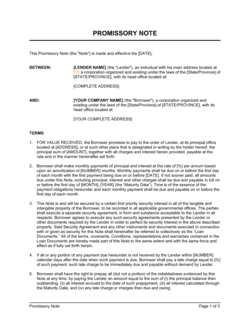
A promissory note is a primary debt instrument in which the signor unconditionally promises to pay a specified sum. A guarantee is a contingent secondary obligation that only arises if the principal debtor defaults. Where a lender wants both a direct payment obligation and a guarantee, the guarantor signs the note as a co-maker and executes a separate guarantee — creating two independent enforcement paths.

Industry-specific considerations

Banking and Commercial Lending

Banks require a continuing personal or corporate guarantee on virtually all SME loans, lines of credit, and equipment financing — typically uncapped and covering all present and future obligations under the facility.

Commercial Real Estate

Landlords require personal guarantees from principals of startup or thinly capitalized tenants; guarantee terms often mirror the lease term or are capped at 12–24 months of base rent.

Manufacturing and Supply Chain

Trade creditors extending open-account terms to new customers require director or parent-company guarantees capped at the credit limit before shipping goods — reducing exposure to customer insolvency.

Professional Services

Law firms, accountants, and consultancies engaged on large retainers may require a personal guarantee from a controlling principal when the client entity lacks a trading history or sufficient balance-sheet strength.

Jurisdictional notes

United States

Guarantees must satisfy the Statute of Frauds — they must be in writing and signed by the guarantor. Several states impose additional protections: California's anti-deficiency statutes (Code of Civil Procedure §580a–§580d) limit recovery against guarantors on certain real-estate-secured loans, and waivers of these protections by individual guarantors may be void. The FTC's Credit Practices Rule restricts confession-of-judgment clauses in consumer guarantees. State-specific considerations make legal review important for any personal guarantee above $100,000.

Canada

Each province has its own Statute of Frauds or equivalent requiring guarantees to be written and signed. Ontario's Guarantees (Creditors' Relief) Act and similar provincial statutes affect priority among creditors. Quebec is a civil-law jurisdiction: guarantees (called 'suretyship' under the Civil Code of Quebec) carry mandatory rules on the extent of the surety's liability and the creditor's obligation to inform the surety of the debtor's default. Personal guarantees from directors of closely held corporations are common and generally enforceable without additional consideration.

United Kingdom

Under the Statute of Frauds 1677 (still in force), a guarantee must be in writing and signed by the guarantor or their authorized agent. The Consumer Credit Act 1974 imposes additional requirements — including prescribed form notices — for guarantees supporting regulated consumer credit agreements. UK courts apply the material alteration rule strictly: any variation to the underlying obligation without the guarantor's consent risks discharging the guarantee unless a clear variation waiver is included. Independent legal advice for guarantors, while not legally required, is strongly recommended by the FCA and reduces undue influence challenges.

European Union

There is no harmonized EU guarantee law — requirements are governed by each member state's civil or commercial code. France, Germany, Spain, and Italy each impose distinct formalities: French law requires handwritten amounts in personal guarantees (Article 2297 of the Civil Code) to confirm the guarantor's awareness of their exposure. German law distinguishes between bürgschaft (guarantee) and schuldbeitritt (assumption of debt) with different enforcement consequences. GDPR considerations arise where the guarantee involves processing personal financial data of individual guarantors. Cross-border guarantees within the EU should always involve local counsel in the guarantor's home jurisdiction.

Template vs lawyer — what fits your deal?

PathBest forCostTime
Use the templateStandard commercial guarantees for bank loans, commercial leases, or trade credit with a clear dollar cap and defined termFree30 minutes
Template + legal reviewUncapped personal guarantees, multi-guarantor arrangements, or any guarantee governed by a jurisdiction with specific statutory protections$300–$8002–5 business days
Custom draftedHigh-value syndicated facilities, cross-border guarantees, regulated industries, or guarantees tied to complex equity and shareholder arrangements$1,500–$5,000+1–3 weeks

Glossary

Guarantor
The party who agrees to be liable for the primary debtor's obligations if the debtor fails to perform.
Principal Debtor
The primary obligor — the borrower, tenant, or counterparty whose obligations are being guaranteed.
Creditor / Beneficiary
The party in whose favor the guarantee is given — typically a lender, landlord, or supplier.
Continuing Guarantee
A guarantee that covers all obligations of the debtor arising from time to time, with no fixed expiry, until formally revoked or the debtor's obligations are discharged.
Limited Guarantee
A guarantee capped at a specific dollar amount or limited to a defined transaction, after which the guarantor has no further exposure.
Joint and Several Liability
Where multiple guarantors are each individually liable for the full guaranteed amount, allowing the creditor to pursue any one of them for the entire debt.
Subrogation
The guarantor's right, after paying the creditor, to step into the creditor's shoes and pursue the primary debtor for reimbursement.
Indemnity vs. Guarantee
A guarantee is a secondary obligation that arises only if the debtor defaults; an indemnity is a primary, independent obligation to pay regardless of whether the debtor's obligation is enforceable.
Waiver of Presentment
A clause by which the guarantor gives up the right to require the creditor to first demand payment from the primary debtor before calling on the guarantee.
Deficiency
The shortfall remaining after a creditor has applied collateral or other security against the guaranteed debt — often the amount the guarantor is ultimately called to pay.
Release of Guarantor
A formal discharge of the guarantor's obligations, typically issued when the underlying debt is repaid in full or the creditor agrees to release the guarantee.
Material Alteration Rule
A common-law principle that discharges a guarantor if the underlying obligation is materially varied without the guarantor's consent — a key defense preserved or waived in the guarantee agreement.

Part of your Business Operating System

This document is one of 3,000+ business & legal templates included in Business in a Box.

  • Fill-in-the-blanks — ready in minutes
  • 100% customizable Word document
  • Compatible with all office suites
  • Export to PDF and share electronically

Create your document in 3 simple steps.

From template to signed document — all inside one Business Operating System.
1
Download or open template

Access over 3,000+ business and legal templates for any business task, project or initiative.

2
Edit and fill in the blanks with AI

Customize your ready-made business document template and save it in the cloud.

3
Save, Share, Send, Sign

Share your files and folders with your team. Create a space of seamless collaboration.

Save time, save money, and create top-quality documents.

★★★★★

"Fantastic value! I'm not sure how I'd do without it. It's worth its weight in gold and paid back for itself many times."

Managing Director · Mall Farm
Robert Whalley
Managing Director, Mall Farm Proprietary Limited
★★★★★

"I have been using Business in a Box for years. It has been the most useful source of templates I have encountered. I recommend it to anyone."

Business Owner · 4+ years
Dr Michael John Freestone
Business Owner
★★★★★

"It has been a life saver so many times I have lost count. Business in a Box has saved me so much time and as you know, time is money."

Owner · Upstate Web
David G. Moore Jr.
Owner, Upstate Web

Run your business with a system — not scattered tools

Stop downloading documents. Start operating with clarity. Business in a Box gives you the Business Operating System used by over 250,000 companies worldwide to structure, run, and grow their business.

Start free · No credit card required