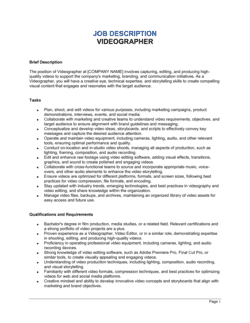
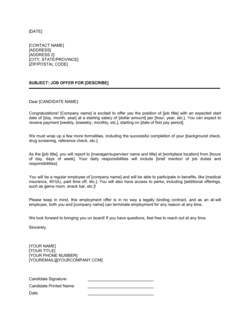
Graphic Designer Job Description Template

Free Word download β€’ Edit online β€’ Save & share with Drive β€’ Export to PDF

2 pagesβ€’20–30 min to fillβ€’Difficulty: Standardβ€’Signature requiredβ€’Legal review recommended
Learn more ↓
FreeGraphic Designer Job Description Template

At a glance

What it is
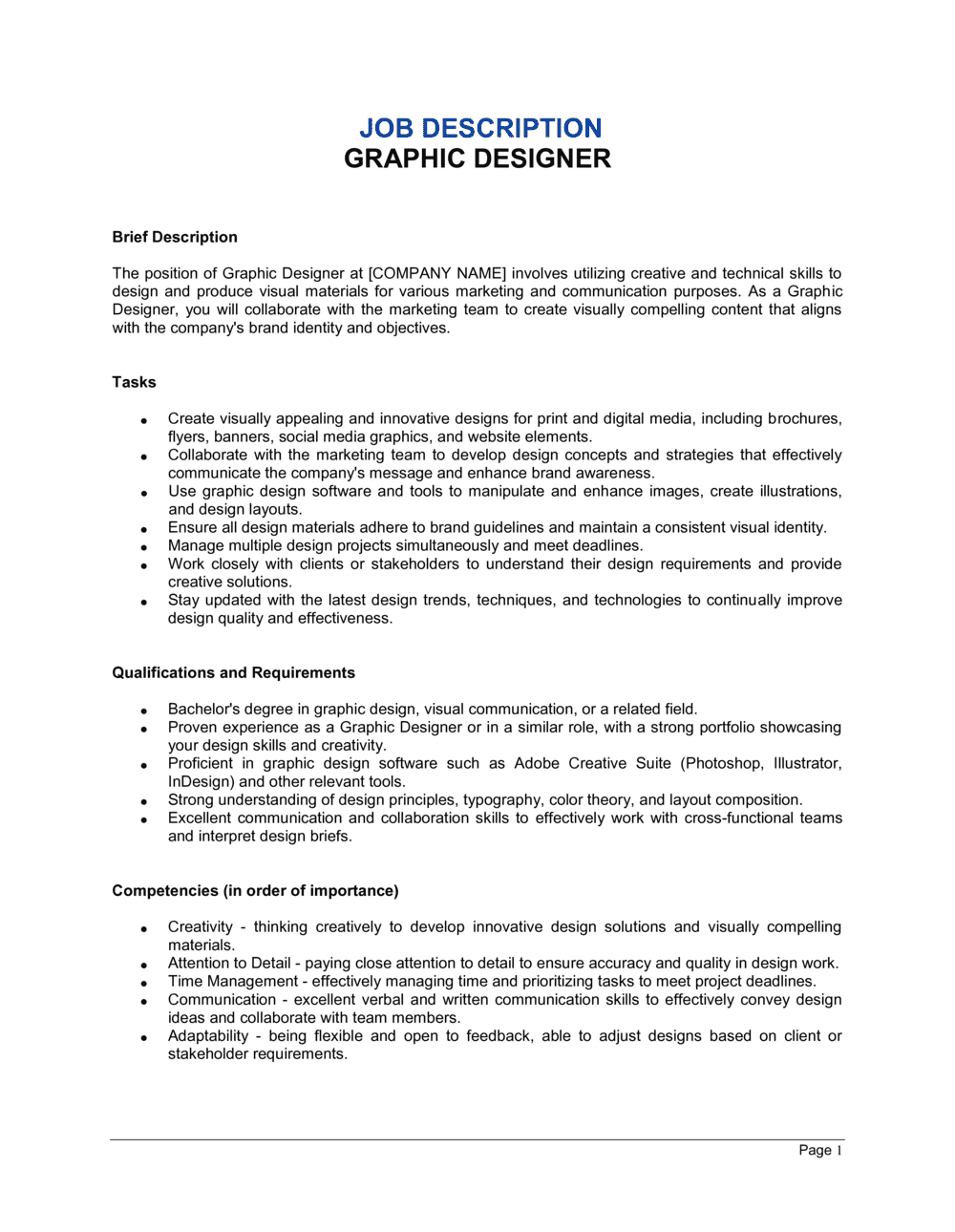
A Graphic Designer Job Description is a binding document that defines the scope of a graphic designer's role, responsibilities, qualifications, reporting structure, compensation, and IP ownership expectations. This free Word download gives you a professionally structured template you can edit online and attach to an employment contract or offer letter, then export as PDF for signature.
When you need it
Use it when hiring a full-time, part-time, or contract graphic designer and you need a written record of exactly what the role entails, what tools and skills are required, and who owns the creative output produced.
What's inside
Role summary and reporting structure, core duties and deliverables, required and preferred qualifications, software and tools proficiency, compensation and benefits overview, IP and portfolio rights, and performance expectations.

What is a Graphic Designer Job Description?

A Graphic Designer Job Description is a structured legal document that defines the scope, duties, qualifications, reporting structure, compensation, and intellectual property terms of a graphic designer's role within an organization. Unlike a casual job posting, a properly drafted job description functions as a binding schedule to the employment contract β€” establishing what the designer has formally agreed to deliver, who owns the creative output they produce, and what conditions govern their portfolio rights. It covers everything from required software proficiency and deliverable expectations to IP assignment clauses that protect the company's brand assets and creative investment.

Why You Need This Document

Hiring a graphic designer without a formal, signed job description leaves four significant gaps that surface quickly and cost real money to resolve. First, without an explicit IP assignment clause, the designer may retain copyright or moral rights over original work they create β€” particularly in Canada and the UK β€” which can prevent you from modifying, licensing, or selling creative assets central to your brand. Second, without clearly written duties and output expectations, you have no documented baseline for performance reviews or disciplinary action, making termination for poor performance legally precarious. Third, a missing portfolio rights clause means a designer can legally display unreleased campaigns or client-facing work in their public portfolio, potentially breaching your own client NDAs. Fourth, failing to state the work location arrangement in writing β€” remote, hybrid, or on-site β€” exposes the employer to constructive dismissal claims in Canada and the UK if the arrangement later changes. This template gives you a professionally structured starting point that closes all four gaps, with jurisdiction-aware clauses ready to adapt to your specific hiring context.

Which variant fits your situation?

If your situation is…Use this template
Hiring a full-time salaried in-house graphic designerGraphic Designer Job Description (Full-Time)
Engaging a freelance or contract designer for a defined projectIndependent Contractor Agreement
Hiring a senior designer or creative director with leadership dutiesCreative Director Job Description
Posting a junior or entry-level design roleJunior Graphic Designer Job Description
Hiring a UX/UI designer with a focus on digital product workUX Designer Job Description
Bringing on a motion graphics or video-focused designerMotion Graphics Designer Job Description
Onboarding a brand designer responsible for identity systemsBrand Designer Job Description

Common mistakes to avoid

❌ Omitting the IP assignment clause entirely

Why it matters: Without an explicit written assignment, a graphic designer may retain copyright or moral rights over original creative work, particularly in Canada and the UK. This can prevent the company from modifying, licensing, or selling work the designer produced.

Fix: Include a clear IP assignment clause in the job description and mirror it in the employment contract. Have the employee sign both documents before their first day.

❌ Listing only vague duties with no output expectations

Why it matters: Job descriptions with duties like 'support the marketing team creatively' give managers no baseline for performance reviews and make it nearly impossible to terminate for poor performance without creating a wrongful dismissal risk.

Fix: Write at least six specific duties tied to measurable deliverables β€” asset types, frequency, or quality standards β€” so expectations are unambiguous from day one.

❌ Granting unconditional portfolio rights

Why it matters: A blanket portfolio clause that permits the designer to display any company work in their portfolio can expose unreleased campaigns, client identities, and proprietary brand work before public launch.

Fix: Limit portfolio rights to publicly released work only, require attribution, and explicitly exclude any work covered by a client NDA or marked confidential.

❌ Failing to specify the work location arrangement

Why it matters: A job description that is silent on remote or hybrid expectations creates a contractual dispute if the employer later requires on-site attendance. In Canada and the UK, a unilateral change to work location can constitute constructive dismissal.

Fix: State the work arrangement explicitly β€” fully on-site, hybrid (specify the number of required in-office days per week), or fully remote β€” and include it in the signed employment contract.

❌ Setting qualification requirements that exclude protected groups without justification

Why it matters: Requiring a four-year design degree as a hard prerequisite when a strong portfolio is the actual hiring signal can constitute indirect discrimination under equal employment laws in the US, Canada, UK, and EU.

Fix: Replace mandatory degree requirements with a portfolio requirement and list the degree as preferred. If a degree is genuinely required (e.g., for a government contract), document the business justification.

❌ Signing the job description after the employee's start date

Why it matters: Restrictive clauses β€” IP assignment, portfolio restrictions, confidentiality β€” signed after employment begins may be unenforceable in common-law jurisdictions without fresh consideration, because the employee has already given up nothing new.

Fix: Execute the job description as a schedule to the employment contract before or on the employee's first day. If post-start signing is unavoidable, provide documented additional compensation as fresh consideration.

The 9 key clauses, explained

Role summary and job title

In plain language: States the exact job title, the department the designer sits within, and a two-to-three sentence summary of the role's purpose and primary contribution.

Sample language
[COMPANY NAME] is seeking a [JUNIOR / MID-LEVEL / SENIOR] Graphic Designer to join the [DEPARTMENT] team. Reporting to the [TITLE], the Designer will be responsible for creating visual assets that support [COMPANY NAME]'s brand, marketing campaigns, and product communications.

Common mistake: Using a generic title like 'Designer' without a seniority indicator β€” this generates applications from candidates at every level, wasting screening time and signaling a poorly scoped role.

Core duties and responsibilities

In plain language: An itemized list of the specific tasks the designer is expected to perform day-to-day, from concepting to final file delivery.

Sample language
Design and produce visual assets including [SOCIAL MEDIA GRAPHICS / PRINT COLLATERAL / PACKAGING / EMAIL TEMPLATES / PRESENTATIONS] aligned with [COMPANY NAME]'s brand standards. Manage multiple projects simultaneously and deliver print-ready or web-optimized files by agreed deadlines.

Common mistake: Listing vague duties like 'support creative needs' with no specifics β€” candidates cannot assess fit, and the employer has no basis for performance management if expectations were never written down.

Required qualifications and experience

In plain language: Specifies the minimum education, years of experience, and portfolio requirements a candidate must meet to be considered.

Sample language
[X]+ years of professional graphic design experience. Bachelor's degree in Graphic Design, Visual Communication, or a related field, or equivalent portfolio demonstrating [SKILL AREAS]. A link to an online portfolio is required with all applications.

Common mistake: Requiring a degree when a strong portfolio is the actual signal of competence β€” this disqualifies strong self-taught candidates and may expose the employer to claims of indirect discrimination in jurisdictions with protected characteristics laws.

Software and tools proficiency

In plain language: Lists the specific design applications the role requires, distinguishing between must-have and nice-to-have proficiency.

Sample language
Required: Adobe Creative Suite (Illustrator, Photoshop, InDesign). Preferred: Figma, Adobe After Effects, Canva Pro. Familiarity with [DAM / PROJECT MANAGEMENT TOOL β€” e.g., Bynder, Asana, Monday.com] is an asset.

Common mistake: Omitting specific version or platform requirements for roles where legacy software (print production tools) or platform-specific skills (Figma vs. Sketch) are non-negotiable β€” creating a skills mismatch discovered only after hiring.

Reporting structure and collaboration expectations

In plain language: Identifies who the designer reports to, which teams they collaborate with, and whether they manage or mentor other creatives.

Sample language
The Graphic Designer reports directly to the [CREATIVE DIRECTOR / MARKETING MANAGER / TITLE] and works closely with the [MARKETING / PRODUCT / COMMUNICATIONS] team. [This role does / does not] include management responsibility for [JUNIOR DESIGNERS / INTERNS].

Common mistake: Omitting whether the role includes people management β€” a designer hired expecting an individual-contributor role who is later assigned direct reports has grounds to renegotiate terms or resign constructively in several jurisdictions.

Intellectual property and work-made-for-hire

In plain language: Establishes that all creative output produced within the scope of employment belongs to the employer and assigns any rights not automatically transferred under applicable law.

Sample language
All work product, designs, illustrations, and creative assets produced by the Employee in connection with their employment β€” including work created outside business hours on company-related projects β€” are the sole and exclusive property of [COMPANY NAME] and are hereby irrevocably assigned to [COMPANY NAME].

Common mistake: Relying on 'work made for hire' doctrine alone without an explicit assignment clause. In Canada and the UK, the doctrine applies differently; without a written assignment, the employee may retain moral rights or co-authorship claims over original creative works.

Portfolio and confidentiality rights

In plain language: Specifies what company work, if any, the designer may include in their personal portfolio, and under what conditions β€” with or without attribution, post-employment, and subject to client confidentiality.

Sample language
Employee may include work produced for [COMPANY NAME] in a personal portfolio for the purpose of demonstrating professional skills, provided that (a) such work has been publicly released by [COMPANY NAME], (b) no confidential client information is disclosed, and (c) [COMPANY NAME] is credited as the client.

Common mistake: Granting blanket portfolio rights without restricting unreleased, confidential, or client-specific work β€” a designer displaying an unreleased campaign or a client's branding before launch can cause material business damage and breach client NDAs.

Compensation, benefits, and working hours

In plain language: States the base salary or hourly rate, payment frequency, bonus eligibility, benefits package, standard working hours, and remote or hybrid work arrangement.

Sample language
Compensation: [$X] per year / [$X] per hour, paid [bi-weekly / semi-monthly]. Standard hours: [X] per week. Work arrangement: [on-site / hybrid β€” [X] days in-office / fully remote]. Benefits: [BENEFITS SUMMARY or reference to company handbook].

Common mistake: Omitting the work location arrangement entirely β€” post-pandemic hires who discover a hybrid or return-to-office requirement after signing have grounds to treat the change as constructive dismissal in Canada and the UK if it was not disclosed at the time of hire.

Termination and probationary period

In plain language: Defines the probationary period duration, the notice required for voluntary resignation or employer-initiated termination, and the conditions for immediate termination for cause.

Sample language
The first [30 / 60 / 90] days of employment constitute a probationary period. Either party may terminate this agreement with [X weeks'] written notice. [COMPANY NAME] may terminate immediately for cause, including but not limited to breach of confidentiality, IP theft, or gross misconduct.

Common mistake: Using a probationary clause that implies reduced rights during the period without specifying what those reduced rights actually are β€” courts in Canada and the UK have held that employees on probation still accrue minimum statutory entitlements from day one.

How to fill it out

  1. 1

    Define the seniority level and team context

    Start by confirming the exact job title β€” junior, mid-level, senior, or lead β€” and the department the role sits within. This anchors every other section and ensures the duties and compensation align internally.

    πŸ’‘ Check your existing org chart before writing the title. Inconsistent seniority labels across departments create pay equity problems and complicate future compensation benchmarking.

  2. 2

    Write specific, measurable core duties

    List 6–10 specific responsibilities the designer will own day-to-day. Distinguish between primary duties (weekly) and secondary duties (occasional). Tie each to a deliverable or output, not just a behavior.

    πŸ’‘ Use output language β€” 'produce X assets per week' or 'own the brand style guide' β€” not activity language like 'assist with design needs.'

  3. 3

    Set minimum and preferred qualifications separately

    Divide qualifications into two lists: hard minimums (e.g., 3+ years experience, proficiency in Adobe Creative Suite) and preferred-but-not-required items (e.g., motion graphics experience, Figma). This prevents disqualifying strong candidates who lack a nice-to-have.

    πŸ’‘ Replace degree requirements with portfolio requirements where the work product is the real signal. Many jurisdictions' equal employment guidance treats degree requirements as a potential indirect barrier.

  4. 4

    List specific software tools with required vs. preferred distinction

    Name every platform the designer will use, not just 'Adobe Creative Suite.' Specify whether proficiency in each is required from day one or can be learned on the job.

    πŸ’‘ Include project management and collaboration tools (Asana, Notion, Slack) in the preferred list β€” designers who have used them previously ramp up 2–3 weeks faster.

  5. 5

    Complete the IP assignment and portfolio rights clauses

    Fill in the company's legal name in the IP assignment section. Then decide whether to grant portfolio rights and under what conditions β€” publicly released work only, with attribution, subject to NDA.

    πŸ’‘ If your designers regularly work on client accounts, have legal review the portfolio rights clause before posting. A clause that inadvertently permits disclosure of client identities may breach your client services agreements.

  6. 6

    State the compensation, work arrangement, and hours

    Enter the salary range or hourly rate, payment frequency, standard working hours, and the specific work arrangement β€” fully on-site, hybrid with the number of required office days, or fully remote.

    πŸ’‘ Publishing a salary range in the job description reduces time-to-hire by 20–30% and is legally required in Colorado, New York, California, and several other US states.

  7. 7

    Define the probationary period and notice terms

    Set the probationary period (30, 60, or 90 days is standard), the notice period for both parties, and the conditions for immediate termination for cause. Confirm these terms meet statutory minimums in the applicable jurisdiction.

    πŸ’‘ In Ontario, Canada, employees terminated without cause during a probationary period are still entitled to statutory minimum notice or pay in lieu β€” zero-notice probationary clauses are frequently struck down.

  8. 8

    Attach as a schedule to the employment contract

    Attach the completed job description as Schedule A to the employment contract. Have both parties initial the schedule at signing to confirm it was reviewed as part of the agreement.

    πŸ’‘ Keeping the job description in a separate schedule means you can update duties without amending the main contract β€” reducing legal cost over the employment relationship.

Frequently asked questions

What is a graphic designer job description?

A graphic designer job description is a written document that defines the role's title, seniority level, core duties, required qualifications, software proficiency, reporting structure, compensation, and IP ownership terms. It functions as both a recruiting tool and a legally enforceable schedule to the employment contract, establishing what the employer expects and what the designer has agreed to deliver.

What should a graphic designer job description include?

At minimum: job title and seniority level, role summary and reporting structure, 6–10 specific duties with output expectations, required and preferred qualifications, software tools (required vs. preferred), compensation and work arrangement, IP assignment language, portfolio rights conditions, and probationary and notice terms. Missing the IP and portfolio sections is the most common legal gap in creative-role descriptions.

Who owns the work a graphic designer creates for their employer?

In the United States, work produced by an employee within the scope of their job is generally considered work made for hire and belongs to the employer automatically under the Copyright Act. In Canada and the UK, the doctrine applies but moral rights may still vest in the creator unless explicitly waived. In the EU, member states vary on author's rights treatment. For full protection across jurisdictions, include an explicit written IP assignment and moral-rights waiver in the job description and employment contract.

Can a graphic designer use their employer's work in their portfolio?

Only if the employment contract or job description explicitly permits it. Without a written portfolio rights clause, the employer's IP ownership means the designer technically needs permission for every piece. Most employers grant limited portfolio rights for publicly released work, with attribution required and client-confidential or unreleased work excluded. Define these boundaries in writing before signing to avoid disputes after the employment relationship ends.

What is the difference between a graphic designer job description and an employment contract?

A job description defines the role's scope β€” duties, qualifications, tools, and output expectations. An employment contract governs the legal relationship β€” compensation, benefits, termination, severance, IP assignment, and confidentiality in full legal detail. The job description is typically attached as a schedule to the employment contract so that duties can be updated without re-executing the main agreement. Both documents should be signed before the designer's first day.

Do I need a lawyer to create a graphic designer job description?

For a standard in-house full-time hire, a well-structured template is sufficient for most small and mid-sized employers. Legal review is recommended when the role involves sensitive client work covered by third-party NDAs, when the designer will work across multiple jurisdictions, or when the IP created is central to the company's product or valuation. A 1-hour template review typically costs $150–$400 and is worthwhile for any senior design hire.

Can a graphic designer job description be updated after hiring?

Minor duty updates are generally permissible as part of the employer's right to direct how work is performed. However, material changes β€” to compensation, work location, reporting structure, or IP terms β€” require the employee's written consent to be enforceable. This is why attaching the job description as a separate schedule, rather than embedding it in the contract body, makes updates easier and legally cleaner.

What software should I list in a graphic designer job description?

At minimum, list Adobe Creative Suite applications relevant to the role β€” typically Illustrator, Photoshop, and InDesign for brand and print work, or Figma for digital and UI-focused roles. Distinguish between required proficiency (must have on day one) and preferred proficiency (can learn on the job). Including project management tools like Asana or Monday.com and file management platforms like Bynder or Google Drive as preferred skills sets realistic expectations without disqualifying strong designers.

What is a reasonable probationary period for a graphic designer?

Sixty to ninety days is standard for most full-time design roles. Thirty days is common for junior positions or roles with very defined, fast-to-evaluate outputs. Be aware that in Canada and the UK, statutory employment minimums accrue from day one regardless of the probationary period β€” a probationary clause does not eliminate the obligation to pay minimum notice or statutory severance on termination.

How this compares to alternatives

vs Employment Contract

An employment contract governs the full legal relationship β€” compensation, IP assignment, confidentiality, termination, and severance β€” in binding detail. A job description defines the role's scope and duties. The two documents work together: the job description is typically attached as a schedule to the employment contract. Neither is sufficient alone; the job description without a contract lacks enforceability on key terms, and the contract without a job description leaves duty expectations undefined.

vs Independent Contractor Agreement

An independent contractor agreement engages a freelance designer for a defined project or period, with no employment entitlements β€” no benefits, no payroll tax withholding, and no ongoing duty relationship. A job description applies to employees. Misclassifying a designer who works exclusively for one company as a contractor triggers back taxes, penalties, and benefit liability. The key distinction is the degree of control the employer exercises over how and when work is performed.

vs Job Offer Letter

A job offer letter confirms the role, compensation, and start date to secure acceptance. It is not a comprehensive legal document and typically lacks IP assignment, portfolio rights, and detailed duty expectations. A job description fills that gap by documenting exactly what the role entails and what the designer agrees to deliver. The two documents are complementary: the offer letter triggers acceptance, and the job description β€” attached to the employment contract β€” governs ongoing performance.

vs Non-Disclosure Agreement

An NDA focuses exclusively on confidentiality obligations β€” preventing disclosure of proprietary information, client identities, and unreleased creative assets. A job description covers a much broader scope, including duties, qualifications, and IP ownership, but its confidentiality clause is typically narrower. For roles involving sensitive client work or proprietary design systems, a standalone NDA signed at or before hire provides stronger and more enforceable confidentiality protection than the brief clause in a job description alone.

Industry-specific considerations

Marketing and advertising agencies

Client-work confidentiality clauses and portfolio restrictions are critical; multi-client exposure means IP ownership must be airtight and NDA obligations explicitly referenced in the description.

Technology / SaaS

Figma and design-system proficiency replace or supplement Adobe Suite requirements; the IP clause should explicitly cover UI components, icon libraries, and design tokens as company property.

Retail and e-commerce

High-volume asset production β€” product imagery, email banners, social ads β€” means deliverable volume expectations and turnaround-time standards belong in the duties clause.

Publishing and media

Print production expertise (prepress, color profiles, bleed specifications) should be listed as required rather than preferred; union or guild membership considerations may apply in larger organizations.

Healthcare and pharmaceuticals

Regulatory compliance requirements for promotional materials (FDA, PAAB in Canada) mean the duties clause should reference adherence to medical communications standards and approval workflows.

Professional services

Proposal and pitch deck design are primary outputs; the description should specify proficiency in PowerPoint and Google Slides alongside standard design tools, and confidentiality obligations tied to client pitch data.

Jurisdictional notes

United States

Work-made-for-hire doctrine under the US Copyright Act automatically vests ownership of employee-created work in the employer, but an explicit IP assignment clause is still recommended to cover edge cases such as work produced on personal devices or outside business hours. Salary range disclosure in job postings is legally required in Colorado, New York, California, Washington, and several other states. Non-compete clauses referenced in job descriptions are banned or heavily restricted in California, Minnesota, and other states.

Canada

Canadian copyright law vests first ownership of employee-created work in the employer under the Copyright Act, but moral rights remain with the creator and must be explicitly waived in writing. Provincial employment standards set minimum notice periods from day one of employment β€” probationary clauses that attempt to eliminate notice obligations are frequently voided by courts. Quebec employers must provide employment documents in French for provincially regulated roles.

United Kingdom

The Copyright, Designs and Patents Act 1988 assigns ownership of works created by employees in the course of their employment to the employer, but moral rights are not automatically waived and should be addressed in writing. Employers must provide a written statement of employment particulars β€” including job title and duties β€” on or before the first day of work. Post-employment non-compete and non-solicitation clauses must be reasonable in scope and duration to be enforceable.

European Union

EU member states vary on author's rights treatment for employee-created works. In Germany, France, and several other member states, certain author's rights cannot be fully transferred and moral rights protections are stronger than in common-law jurisdictions β€” a written assignment clause is essential but may not fully extinguish all creator rights. The EU Transparent and Predictable Working Conditions Directive requires written employment terms, including job duties, within seven calendar days of the employment start date.

Template vs lawyer β€” what fits your deal?

PathBest forCostTime
Use the templateStandard full-time or part-time in-house design hires at small to mid-sized companies in a single jurisdictionFree30–60 minutes
Template + legal reviewRoles involving client-confidential work, cross-border employment, or where IP created is central to the company's product$150–$400 for a 1-hour employment lawyer review1–3 days
Custom draftedSenior creative directors with equity, agency roles spanning multiple client NDAs, or regulated industries requiring compliance-specific duties language$800–$2,500+1–2 weeks

Glossary

Job Description
A written document that defines the duties, qualifications, reporting structure, and expectations of a specific role within an organization.
IP Assignment
A clause that transfers ownership of creative work produced by the employee during their tenure to the employer.
Portfolio Rights Clause
A provision specifying whether a designer may display employer-owned work in their personal portfolio, and under what conditions.
At-Will Employment
Employment that either party may end at any time for any lawful reason, without advance notice β€” recognized in most US states but not in Canada, the UK, or the EU.
Non-Disclosure Agreement (NDA)
A confidentiality agreement preventing the employee from sharing proprietary business information, client data, or unreleased creative assets.
Probationary Period
A defined initial employment period β€” typically 30 to 90 days β€” during which performance is evaluated under reduced termination formalities.
Deliverables
Specific, measurable outputs a designer is expected to produce β€” such as brand guidelines, social media assets, or print-ready files β€” within a defined timeframe.
Creative Brief
A short document provided to a designer summarizing the project goals, target audience, tone, and constraints before work begins.
Style Guide
A reference document that establishes an organization's visual standards β€” typography, color palette, logo usage, and imagery β€” that the designer is expected to maintain.
Scope of Work
A detailed description of the specific tasks, outputs, and boundaries of a designer's engagement, used to prevent scope creep in both employment and contract contexts.
Work Made for Hire
A US copyright doctrine under which creative work produced by an employee within the scope of employment automatically belongs to the employer, not the creator.

Part of your Business Operating System

This document is one of 3,000+ business & legal templates included in Business in a Box.

  • Fill-in-the-blanks β€” ready in minutes
  • 100% customizable Word document
  • Compatible with all office suites
  • Export to PDF and share electronically

Create your document in 3 simple steps.

From template to signed document β€” all inside one Business Operating System.
1
Download or open template

Access over 3,000+ business and legal templates for any business task, project or initiative.

2
Edit and fill in the blanks with AI

Customize your ready-made business document template and save it in the cloud.

3
Save, Share, Send, Sign

Share your files and folders with your team. Create a space of seamless collaboration.

Save time, save money, and create top-quality documents.

β˜…β˜…β˜…β˜…β˜…

"Fantastic value! I'm not sure how I'd do without it. It's worth its weight in gold and paid back for itself many times."

Managing Director Β· Mall Farm
Robert Whalley
Managing Director, Mall Farm Proprietary Limited
β˜…β˜…β˜…β˜…β˜…

"I have been using Business in a Box for years. It has been the most useful source of templates I have encountered. I recommend it to anyone."

Business Owner Β· 4+ years
Dr Michael John Freestone
Business Owner
β˜…β˜…β˜…β˜…β˜…

"It has been a life saver so many times I have lost count. Business in a Box has saved me so much time and as you know, time is money."

Owner Β· Upstate Web
David G. Moore Jr.
Owner, Upstate Web

Run your business with a system β€” not scattered tools

Stop downloading documents. Start operating with clarity. Business in a Box gives you the Business Operating System used by over 250,000 companies worldwide to structure, run, and grow their business.

Free Forever PlanΒ Β·Β No credit card required